
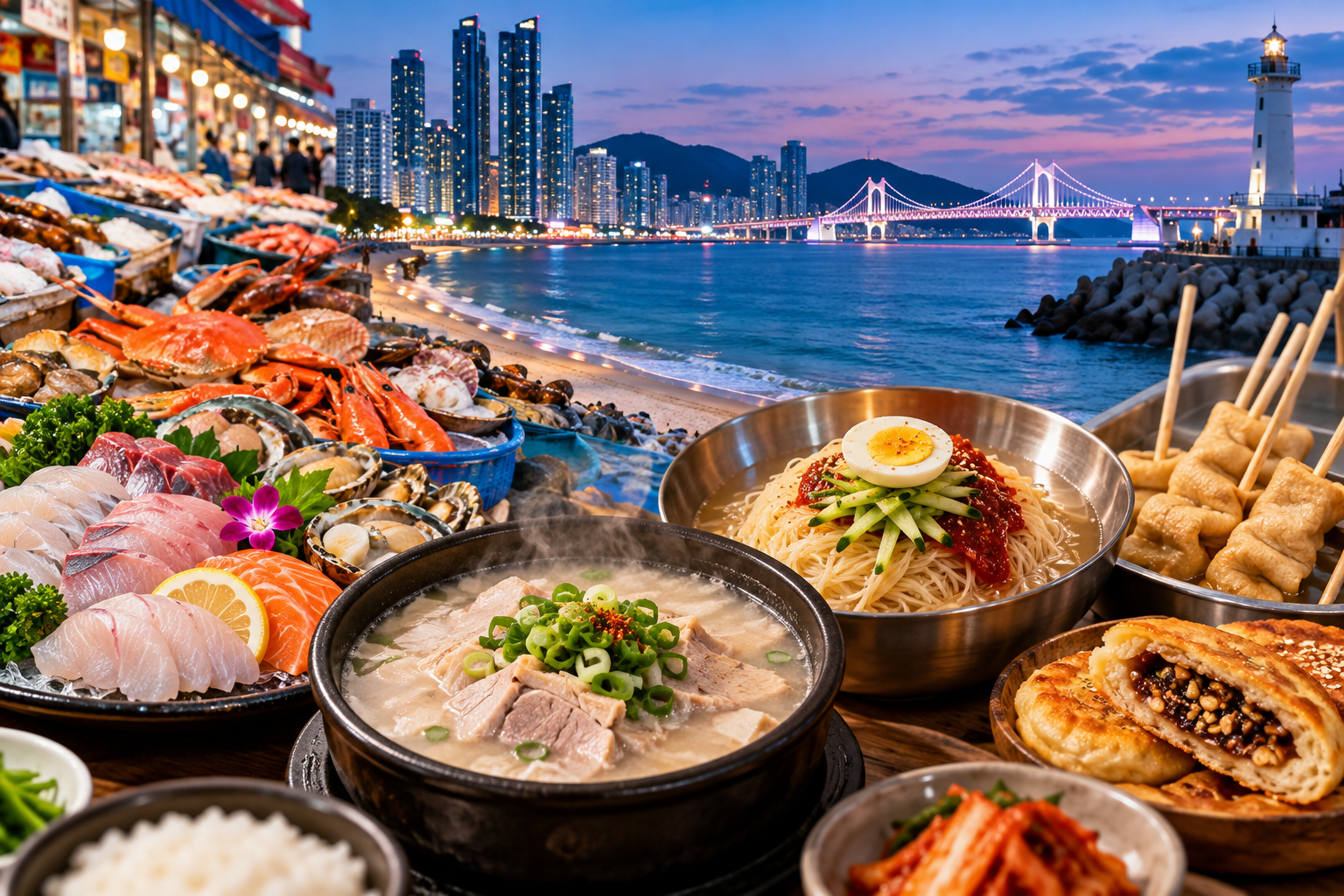
Busan is one of the best cities in South Korea for travelers who love food.
As Korea’s largest coastal city, Busan is famous for fresh seafood, but the local food scene goes far beyond fish markets. Pork soup with rice, wheat noodles, Korean-style raw fish, traditional market food, and neighborhood restaurants are all part of the experience.
For first-time visitors, deciding what and where to eat can be difficult because Busan is a large city and many famous restaurants are spread across different neighborhoods.
This guide introduces some of the foods and restaurants worth experiencing in Busan, with practical information including addresses, phone numbers, locations, and what to order.
1. Songjeong Samdae Gukbap – Classic Dwaeji Gukbap in Seomyeon
One of the first foods visitors should try in Busan is dwaeji gukbap, a comforting bowl of pork broth served with pork and rice.
Songjeong Samdae Gukbap is located in Seomyeon’s famous Dwaeji Gukbap Alley and has a long history in the neighborhood.
Address:
33 Seomyeon-ro 68beon-gil, Busanjin-gu, Busan, South Korea
Phone:
+82-51-806-5722
What to try:
Dwaeji gukbap, sundae gukbap, suyuk, and chapssal sundae.
The broth is known for being milky yet relatively clean in flavor, making this a good introduction to Busan-style pork soup.
Seomyeon is also one of the most convenient dining areas for travelers because it combines restaurants, shopping, cafés, nightlife, and excellent public transportation.
Best for
First-time visitors, solo travelers, budget-conscious travelers, and anyone who wants to try one of Busan’s signature dishes.
2. Eom Yongbaek Dwaejigukbap – A Modern Take on a Busan Classic
For travelers who want to compare different styles of pork soup, Eom Yongbaek Dwaejigukbap is another interesting choice.
The restaurant serves both Busan-style and Miryang-style versions of dwaeji gukbap, giving visitors a chance to experience how this familiar Korean dish can vary.
Address:
1F, 39 Suyeong-ro 680beon-gil, Suyeong-gu, Busan, South Korea
Phone:
+82-51-757-8092
What to try:
Busan-style dwaeji gukbap, Miryang-style dwaeji gukbap, and steamed pork.
The restaurant is also known for its steamed pork served with accompaniments such as tofu, chives, and garlic.
Best for
Food-focused travelers and visitors who want to explore different interpretations of Busan’s famous pork soup.
3. Hapcheon Gukbapjip – Clear-Broth Pork Soup Loved in Busan
Not every bowl of Busan pork soup looks the same.
Hapcheon Gukbapjip in Nam-gu is known for a clearer, lighter-looking broth and generous portions of pork.
Address:
235 Yongho-ro, Nam-gu, Busan, South Korea
Phone:
+82-51-628-4898
What to try:
Dwaeji gukbap and steamed pork.
This is a useful restaurant for travelers who want to go beyond the most tourist-oriented neighborhoods and experience a well-known local version of the dish.
Hapcheon Gukbapjip is also included in the MICHELIN Guide’s Busan selection, demonstrating how seriously this seemingly simple local dish is taken in the city.
Best for
Local-food enthusiasts, repeat visitors, and travelers interested in traditional Busan dishes.
4. Yeongjin Dwaeji Gukbap – Famous for Suyuk Baekban
Yeongjin Dwaeji Gukbap is another popular name in Busan’s pork-soup culture.
Located in Saha-gu, it is particularly well known for suyuk baekban, a set meal featuring steamed pork.
Address:
39 Hasinbeonyeong-ro 157beon-gil, Saha-gu, Busan, South Korea
Phone:
+82-507-1374-3820
What to try:
Suyuk baekban and dwaeji gukbap.
For visitors who enjoy exploring restaurants outside Busan’s main tourist districts, this can be an interesting addition to a food-focused itinerary.
Best for
Travelers who want a more local dining experience and anyone who enjoys boiled or steamed pork dishes.
5. Jagalchi Market – The Classic Busan Seafood Experience
No Busan food guide would be complete without seafood.
Jagalchi Market is one of the city’s best-known food destinations and remains an essential stop for many first-time visitors.
Rather than thinking of Jagalchi as a single restaurant, think of it as an entire seafood district.
Visitors can see tanks filled with live seafood, explore the market, and choose from numerous seafood restaurants and vendors in the surrounding area.
Popular choices may include Korean-style raw fish known as hoe, shellfish, grilled fish, seafood soups, and seasonal catches.
Best for
Seafood lovers, first-time visitors, market explorers, and travelers who want one of Busan’s most recognizable food experiences.
Travel tip
Prices and available seafood can vary according to season and vendor. Ask about the price before ordering, particularly when choosing seafood sold by weight.
6. Gwangalli – Seafood With a View
Gwangalli is another excellent area for food lovers.
The neighborhood surrounding Gwangalli Beach is filled with seafood restaurants, Korean restaurants, bars, cafés, and modern dining spots.
What makes the area special is the view.
In the evening, restaurants around the waterfront can offer beautiful views toward Gwangan Bridge, making dinner part of the sightseeing experience.
For travelers who want seafood without the traditional market atmosphere of Jagalchi, Gwangalli can be an appealing alternative.
Best for
Couples, evening dining, seafood lovers, and travelers who enjoy restaurants with coastal views.
7. Try Milmyeon – Busan’s Famous Wheat Noodles
Another food closely associated with Busan is milmyeon.
The dish features wheat noodles and is commonly served either in a chilled broth or mixed with a spicy sauce.
It can be especially refreshing during Busan’s hot and humid summer.
You may see two common versions:
Mul milmyeon – noodles served in cold broth.
Bibim milmyeon – noodles mixed with a spicy sauce.
Rather than visiting Busan and eating only Korean barbecue or seafood, trying milmyeon gives travelers another taste of the city’s distinctive food history.
Best for
Summer travelers, noodle lovers, budget travelers, and anyone interested in regional Korean dishes.
8. Nampo-dong and BIFF Square – Street Food and Casual Eating
For casual eating, head toward Nampo-dong and BIFF Square.
This part of Busan is ideal for travelers who prefer tasting several small foods rather than sitting down for one large meal.
One of the best-known Busan snacks is ssiat hotteok, a sweet Korean pancake filled with seeds.
You may also encounter tteokbokki, fish cakes, dumplings, fried foods, and other Korean street-food favorites.
The nearby Gukje Market and Jagalchi area make it easy to combine sightseeing and food exploration.
Best for
Street-food lovers, families, budget travelers, and first-time visitors.
9. Busan Eomuk – More Than Ordinary Fish Cake
Busan is famous throughout Korea for eomuk, or fish cake.
Although fish cake can be found everywhere in Korea, Busan has a particularly strong association with it because of the city’s history as a major port.
Modern Busan fish-cake shops sell much more than the traditional skewers served in broth.
Travelers may encounter fish cakes filled with cheese, vegetables, seafood, or other ingredients, as well as gift boxes designed for travelers.
Trying warm eomuk while exploring a market is one of the simplest ways to experience everyday Busan food culture.
10. Traditional Markets – Where Busan’s Food Culture Comes Alive
Some of the most memorable food experiences in Busan happen in markets rather than famous restaurants.
Gukje Market, Bupyeong Kkangtong Market, and the neighborhoods around Jagalchi provide opportunities to try numerous Korean dishes in a relatively small area.
Bupyeong Kkangtong Market is particularly interesting in the evening, when visitors can explore a lively collection of snacks and street foods.
Markets are also useful for travelers who are unfamiliar with Korean cuisine because you can see many foods before deciding what to order.
What Food Is Busan Most Famous For?
If you have only a short time in the city, start with a few dishes that strongly represent Busan.
Dwaeji gukbap is one of the most important.
Then try milmyeon, fresh or grilled seafood, Busan eomuk, and ssiat hotteok.
Together, these foods provide a much broader introduction to Busan than eating only at internationally familiar restaurants.
Which Area Is Best for Food in Busan?
Different neighborhoods offer different experiences.
Choose Seomyeon for pork soup, casual restaurants, nightlife, and easy transportation.
Choose Jagalchi and Nampo-dong for seafood, markets, traditional food, and street snacks.
Choose Gwangalli for seafood, cafés, restaurants, and evening views of Gwangan Bridge.
Choose Haeundae for the widest combination of tourist-friendly restaurants, cafés, bars, hotels, and beachside dining.
Exploring more than one neighborhood is the best way to understand Busan’s food culture.
Tips for Eating at Local Restaurants in Busan
Many traditional Korean restaurants specialize in only a few dishes. A short menu is therefore not necessarily a disadvantage.
At popular restaurants, expect queues during lunch and dinner.
Some smaller restaurants may have limited English information, so having the Korean name of the dish available on your phone can be useful.
Restaurant hours, prices, menus, and closing days can change, so check current information before making a special trip.
And when visiting seafood markets, confirm prices before ordering.
Busan Beyond Local Food
Busan is no longer only a destination for markets and traditional Korean dishes.
The city also has a growing contemporary and fine-dining scene. The MICHELIN Guide now publishes a Seoul & Busan edition, with restaurants across Busan ranging from local specialties to contemporary cuisine.
That side of the city deserves its own guide, so we will explore Busan’s MICHELIN restaurants separately.
Final Thoughts
Busan is a city that rewards travelers who arrive hungry.
A bowl of dwaeji gukbap in a neighborhood restaurant, cold milmyeon on a summer afternoon, seafood near the harbor, and street food in Nampo-dong can reveal as much about the city as its beaches and famous landmarks.
For first-time visitors, do not worry about finding only the most expensive or fashionable restaurant.
Start with the foods Busan is known for, explore different neighborhoods, and allow some room in your itinerary for unexpected local discoveries.
That is often where the best Busan food memories begin.