Tag: Busan Transportation

  • K-Tour Pass Busan 2026: Is the 15,000 Won Pass Worth It for Foreign Tourists?

    K-Tour Pass Busan 2026: Is the 15,000 Won Pass Worth It for Foreign Tourists?

    Busan has a new travel pass for international visitors in 2026.

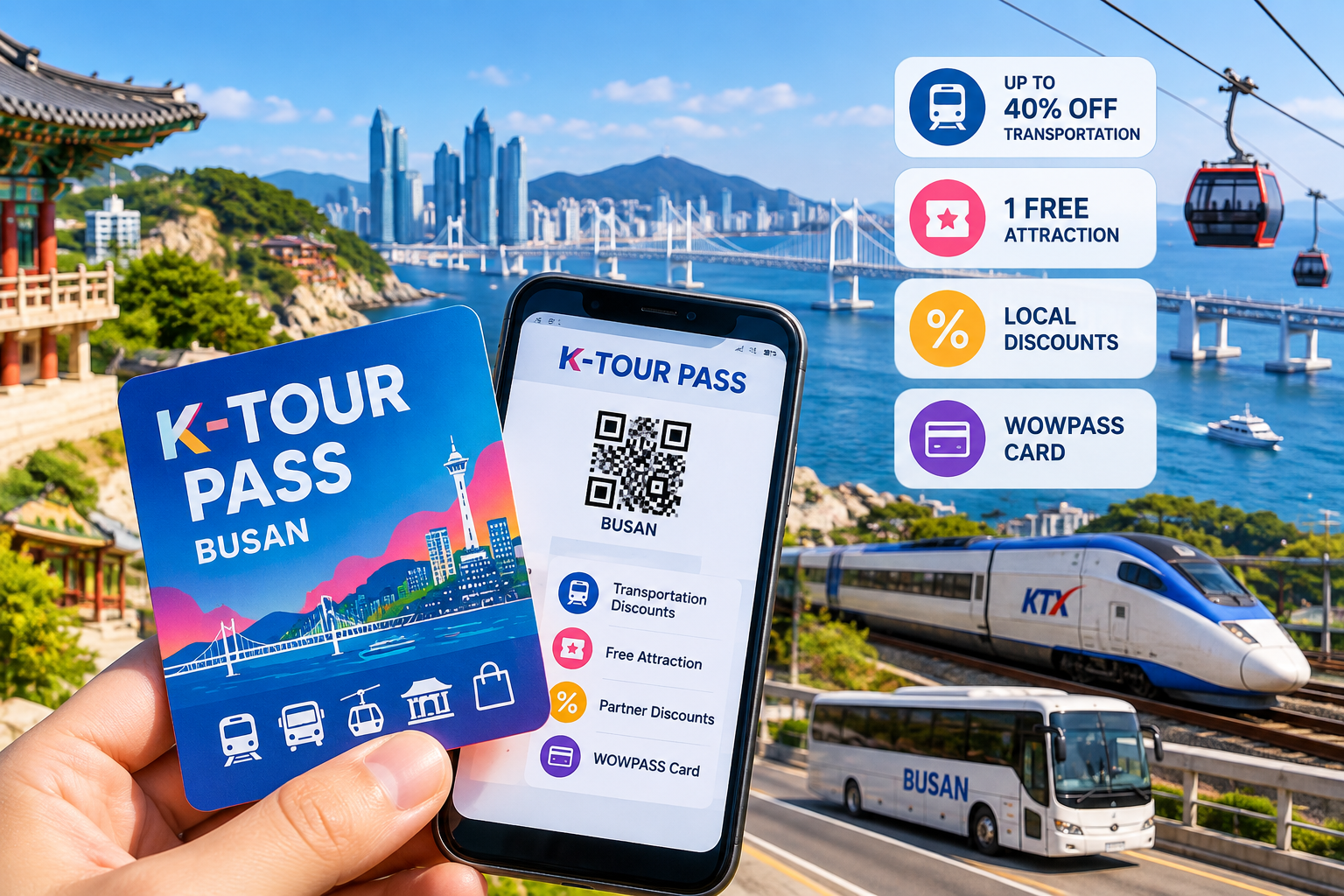
    The K-Tour Pass, launched as a pilot program on October 1, combines discounts on transportation to Busan with attraction benefits, local discounts, and a WOWPASS card.

    Both versions cost KRW 15,000, which makes the obvious question:

    Is the K-Tour Pass actually worth buying, or are you better off paying for transportation and attractions separately?

    The answer depends less on how long you stay in Busan and more on how you are getting there and what you plan to do after you arrive.

    Here is how to decide.

    What Is the K-Tour Pass?

    The K-Tour Pass is a travel pass designed specifically for international tourists visiting Korea.

    The pilot program began in Busan on October 1, 2026. There are two versions:

    • K-Tour Pass 1: designed mainly for travelers making a trip to Busan
    • K-Tour Pass 2: designed for travelers using a multi-day KORAIL Pass

    Both cost KRW 15,000.

    Whichever version you choose, the pass also includes an AREX discount, free admission to one participating Busan attraction, discounts at participating businesses, and a WOWPASS card.

    The transportation discount coupons and K-Tour Pass mobile ticket are currently valid through December 31, 2026.

    K-Tour Pass 1 vs Pass 2: Which One Should You Choose?

    This is the most important decision.

    K-Tour Pass 1

    Pass 1 includes a 40% discount on eligible transportation to Busan, up to KRW 24,000.

    Depending on the seller and transportation option, the discount can apply to eligible train or bus travel to Busan.

    This makes Pass 1 particularly interesting if your itinerary looks something like:

    Seoul → Busan

    or another eligible city-to-Busan journey.

    Because the pass itself costs KRW 15,000, the transportation discount can potentially recover much or all of the purchase price before you use any of the Busan attraction benefits.

    K-Tour Pass 2

    Pass 2 works differently.

    Instead of the 40% Busan-bound transportation discount, it provides a KRW 24,000 discount coupon for a KORAIL Pass.

    This is more relevant if Busan is only one part of a longer rail itinerary around Korea.

    For example:

    Seoul → Busan → another Korean city

    may make Pass 2 worth considering if you were already planning to purchase a multi-day KORAIL Pass.

    If you are simply traveling from Seoul to Busan once, however, do not automatically assume that Pass 2 is better just because it is connected to rail travel.

    Compare the actual ticket plan first.

    What Do Both Passes Include?

    The two versions share several benefits.

    1. AREX Discount

    K-Tour Pass includes a 50% discount coupon for an AREX one-way ticket, with a maximum discount of KRW 6,000.

    This is useful for travelers arriving through Incheon Airport and traveling toward Seoul before continuing to Busan.

    But if your itinerary does not involve the AREX, this benefit has little value to you.

    That is an important principle when evaluating the pass:

    Do not add up benefits that you were never going to use.

    2. One Free Busan Attraction

    You can choose one participating attraction from a list of about 35 options and use it once for free.

    The current list includes attractions such as:

    • Lotte World Adventure Busan
    • Songdo Marine Cable Car
    • Skyline Luge Busan

    This can significantly change the value calculation.

    If the attraction you already planned to visit costs more than a large portion of the KRW 15,000 pass price, the pass becomes easier to justify.

    But choosing an attraction simply because it is free does not really save money if it was never part of your itinerary.

    3. Discounts at Around 50 Partner Locations

    The pass also provides discounts at around 50 participating locations, including attractions, experience facilities, cafés, souvenir shops and other businesses.

    Unlike the free-attraction benefit, participating discount merchants can generally be used multiple times.

    Again, think of these as extra savings rather than the main reason to buy the pass.

    The WOWPASS Benefit Is Useful, but Understand What You Are Getting

    A physical WOWPASS card is also included.

    It can function as a prepaid payment card and includes a T-money transportation function for buses and subways.

    However, an important detail is easy to miss:

    The card does not come with transportation money already loaded onto it.

    You need to top it up separately.

    The prepaid WOWPASS balance and the T-money transportation balance are also not simply the same balance. Travelers should follow the appropriate top-up method for each function.

    K-Tour Pass holders can currently collect their WOWPASS card at dedicated kiosks at locations including:

    • Incheon Airport
    • Gimpo Airport
    • Gimhae Airport
    • Seoul Station
    • Busan Station

    So do not interpret “WOWPASS included” as “free public transportation in Busan.”

    It is the card that is included, not unlimited bus or subway fares.

    For local transportation after you arrive, see our guide to paying for buses in Busan, including T-Money, fares, and the payment options foreign travelers should know.

    When Is the K-Tour Pass Worth It?

    The pass makes the most sense when several benefits match things you were already going to pay for.

    Scenario 1: You Are Traveling from Seoul to Busan

    This is probably one of the strongest cases for considering Pass 1.

    If your eligible transportation receives a meaningful 40% discount and you also plan to visit one of the included Busan attractions, the combined value can exceed the KRW 15,000 purchase price.

    The key is to check your actual transportation option before buying.

    If you plan to take the train, check our guide to booking KTX tickets in Korea, including the new two-month advance booking window for 2026.

    If you are planning to travel by train, you may also want to read our guide:

    [Internal link: How to Book KTX Tickets in Korea in 2026: New 2-Month Advance Booking Rule for Foreign Travelers]

    Scenario 2: You Are Traveling Around Korea by Rail

    If you already intend to purchase a multi-day KORAIL Pass, compare Pass 2.

    Its KRW 24,000 KORAIL Pass discount is larger than the KRW 15,000 purchase price of the K-Tour Pass itself.

    But that does not mean everyone should buy a KORAIL Pass just to use this discount.

    First decide whether a KORAIL Pass makes financial sense for your itinerary. Then evaluate the K-Tour Pass.

    Scenario 3: You Plan to Visit an Included Paid Attraction

    Suppose Lotte World Busan, Songdo Marine Cable Car, Skyline Luge Busan, or another participating attraction is already on your itinerary.

    The free admission benefit then has real value.

    Combine that with transportation savings and the pass can become considerably more attractive.

    Scenario 4: You Are Already in Busan

    This is where the decision changes.

    If you have already arrived in Busan and cannot make meaningful use of the Busan-bound transportation benefit, do not buy the pass simply because it sounds convenient.

    Calculate the value of:

    one free attraction + discounts you will actually use + WOWPASS card

    against the KRW 15,000 purchase price.

    For some travelers that may still work.

    For others, paying separately will be simpler.

    When Would I Probably Skip the K-Tour Pass?

    Consider skipping it if:

    • you are already in Busan and will not benefit from the main transportation discount;
    • none of the free attractions are places you planned to visit;
    • you already have the payment and transportation cards you need;
    • you will use few or none of the partner discounts;
    • your actual savings are likely to stay below KRW 15,000.

    The mistake would be treating every listed benefit as money saved.

    A discount only has value if it applies to something you were going to buy anyway.

    What If You Are Taking an Express or Intercity Bus to Busan?

    Do not assume every bus ticket automatically qualifies.

    The transportation benefit depends on the K-Tour Pass option, booking channel, and eligible transportation product.

    Check the current conditions before paying for the pass or booking your bus.

    If you are still deciding how to reserve long-distance buses in Korea, see:

    [Internal link: How to Book Express and Intercity Buses in Korea in 2026: A First-Time Traveler’s Guide]

    That guide explains the difference between express and intercity buses, booking platforms, terminals, tickets and what foreign travelers should expect.

    If you are considering a bus instead of the train, our guide to booking express and intercity buses in Korea explains the booking platforms, terminals, tickets, and common mistakes for first-time travelers.

    How Do You Buy the K-Tour Pass?

    The K-Tour Pass is currently available through participating online travel platforms including Klook and HopnHop.

    After purchasing, you receive a mobile ticket.

    One detail is especially important:

    Do not rely on a screenshot of the ticket.

    Participating locations scan the barcode displayed in the mobile ticket, and screenshots or printed copies may not be accepted.

    Open the live mobile ticket when using a benefit.

    Can You Get a Refund?

    Yes, but only while the benefits remain unused.

    According to the current rules, you can receive a full refund if you have not used the transportation coupons or mobile-ticket benefits.

    Once certain benefits have been registered or used—including transportation coupons, the WOWPASS issuance code, or participating attraction/merchant benefits—the purchase may no longer be refundable.

    If your plans are uncertain, avoid activating benefits before you are sure you will use the pass.

    A Simple Way to Decide Before Buying

    Before purchasing, write down four things:

    1. How are you getting to Busan?

    If Pass 1 applies to your transportation, calculate the actual discount.

    2. Are you buying a KORAIL Pass anyway?

    If yes, compare Pass 2.

    3. Which free attraction would you choose?

    Check its normal admission price.

    4. Which other benefits would you genuinely use?

    Count only those benefits—not every discount advertised with the pass.

    Then compare the realistic total savings with KRW 15,000.

    That is a much better way to decide than buying the pass simply because it bundles many benefits.

    Final Verdict: Who Should Consider the K-Tour Pass?

    The K-Tour Pass is most compelling for an international visitor who is traveling to Busan and can combine a transportation discount with an attraction they already planned to visit.

    Pass 1 is particularly worth checking for a straightforward trip to Busan.

    Pass 2 deserves attention if you already plan to use a multi-day KORAIL Pass.

    The value is less obvious for travelers who are already in Busan or who will not use the included attractions and transportation discounts.

    So the real question is not:

    “Does the K-Tour Pass include a lot of benefits?”

    It does.

    The better question is:

    “Will this pass reduce the cost of the Busan trip I have already planned?”

    If the answer is yes and your realistic savings exceed KRW 15,000, the K-Tour Pass can be a useful addition to a 2026 Busan itinerary.


  • How to Pay for Buses in Busan in 2026: QR Payments, T-Money and Fares for Foreign Tourists

    How to Pay for Buses in Busan in 2026: QR Payments, T-Money and Fares for Foreign Tourists

    Getting around Busan by bus has become easier for international travelers in 2026.

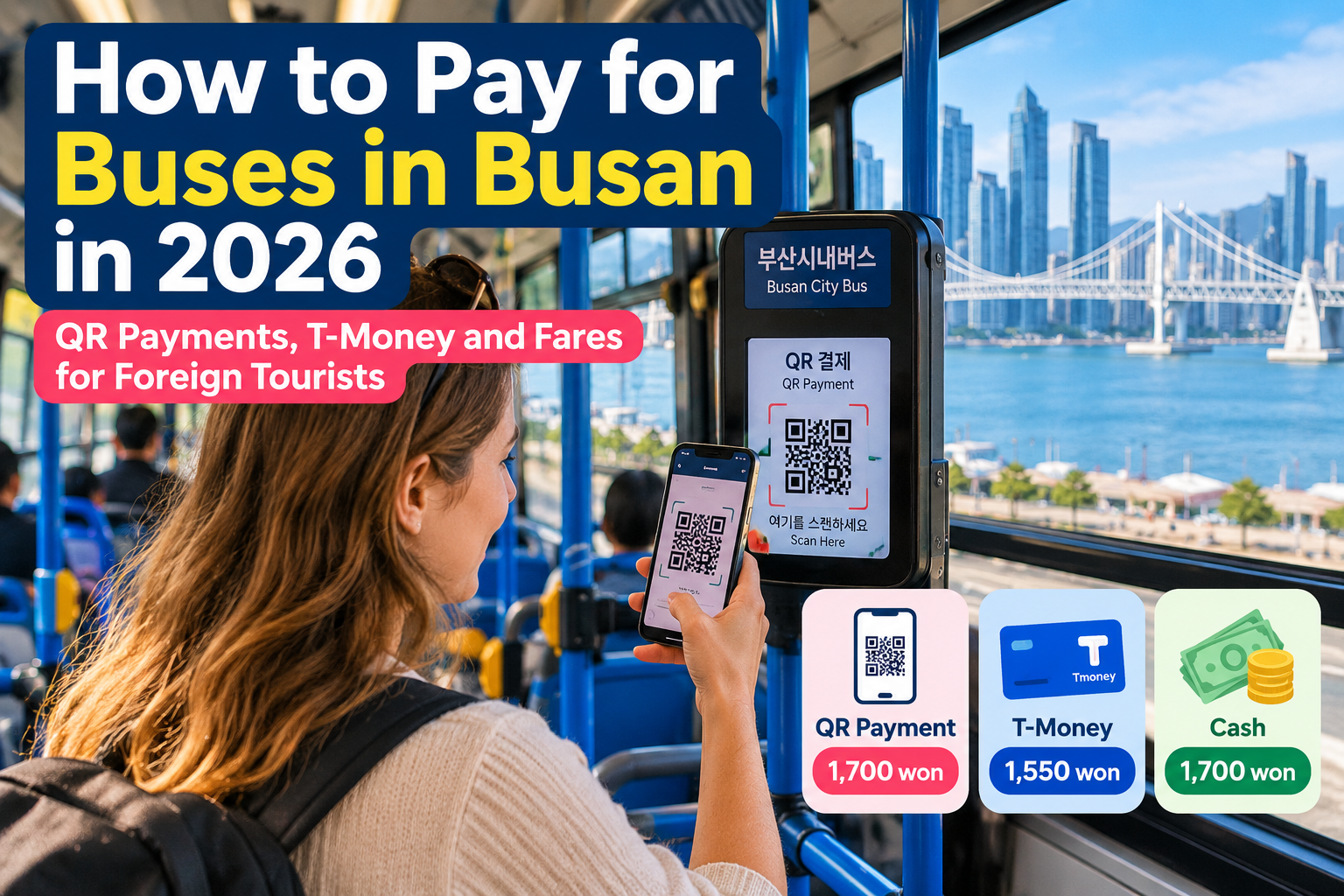
    Starting September 21, foreign visitors can pay for Busan city buses by scanning a QR code with supported overseas payment apps. This means some travelers can now ride a bus without buying a Korean transportation card or preparing Korean cash first.

    However, QR payment is not always the cheapest or most convenient option. If you plan to use buses and the subway frequently, a transportation card such as T-Money can still be the better choice.

    Here is what foreign travelers need to know about paying for buses in Busan in 2026.

    Three Ways to Pay for a Bus in Busan

    For most international visitors, there are three practical ways to pay for a city bus in Busan:

    • a transportation card such as T-Money
    • cash in Korean won
    • the new QR payment system using a supported overseas payment app

    The best option depends on how often you plan to use public transportation and whether your mobile payment app supports the new QR service.

    1. Paying with T-Money or Another Transportation Card

    For travelers who will use public transportation several times during their trip, a transportation card remains one of the easiest options.

    T-Money and other compatible Korean transportation cards can be used on buses and the subway in Busan.

    For a regular city bus, the adult transportation-card fare is 1,550 won, compared with 1,700 won when paying cash.

    Using a transportation card also gives you access to eligible transfer discounts between public transportation services.

    This makes a transportation card particularly useful if you plan to:

    • take several buses in one day
    • transfer between buses
    • combine buses and the subway
    • travel around Busan for several days

    Transportation cards can also be recharged at locations such as subway stations and convenience stores.

    Is T-Money Only for Seoul?

    No.

    This is a common point of confusion for first-time visitors. Although T-Money is strongly associated with Seoul, it can also be used on public transportation in Busan.

    So if you already bought and loaded a T-Money card in Seoul, you generally do not need to buy another transportation card just because you arrived in Busan.

    2. New QR Bus Payment for Foreign Tourists

    Busan introduced a new QR payment option for foreign tourists on September 21, 2026.

    The system uses Zeropay’s global payment network and allows travelers with supported overseas payment apps to scan a QR code posted inside the bus.

    Supported services include major mobile payment platforms such as Alipay and WeChat Pay, along with other participating overseas payment services.

    You do not need to install a separate Korean transportation app simply to use this QR payment method if you already have a supported payment app.

    How to Pay by QR Code

    The process is straightforward.

    After boarding the bus:

    1. Open your supported mobile payment app.
    2. Scan the Zeropay QR code inside the bus.
    3. Confirm the payment.
    4. Show the completed payment screen to the bus driver.

    Currency conversion is handled through the payment system.

    Multilingual instructions and QR codes are being provided on Busan city buses, with additional information available around major tourist areas and transportation gateways.

    How Much Does QR Bus Payment Cost?

    The QR fare is 1,700 won per person.

    That is the same as the standard adult cash fare for a regular city bus.

    There are two important differences compared with using a transportation card.

    First, transfer discounts do not apply to QR payments.

    Second, the QR system charges the same 1,700-won fare for adults, teenagers and children.

    If several people are traveling together, each passenger requires a separate payment.

    For families or travelers making multiple transfers, this can make a transportation card more economical.

    3. Paying Cash on Busan Buses

    Cash remains another option on Busan city buses.

    For a regular city bus, the adult cash fare is 1,700 won.

    However, cash has two disadvantages for most tourists.

    The fare is higher than the standard transportation-card fare, and cash passengers cannot receive the same transfer discount available when using a transportation card.

    For that reason, cash is most useful as a backup rather than the main payment method for a multi-day trip.

    Busan Bus Fares in 2026

    For a regular Busan city bus, the basic fares are:

    Payment MethodAdult FareTransfer Discount
    Transportation card1,550 wonAvailable when eligible
    Cash1,700 wonNo
    Foreign tourist QR payment1,700 wonNo

    These figures apply to regular city buses. Express and late-night buses can have different fares.

    QR Payment vs T-Money: Which Is Better?

    For most tourists, the answer depends on the trip.

    Choose QR payment if:

    You only need an occasional bus ride, already use a supported overseas payment app, and do not want to buy or recharge a Korean transportation card.

    Choose T-Money or another compatible transportation card if:

    You plan to use buses and the subway frequently, expect to make transfers, or will travel around Korea for several days.

    The new QR system is mainly about convenience. A transportation card can still be better for frequent public transportation use because of the lower regular bus fare and transfer benefits.

    Can You Use the Same T-Money Card in Seoul and Busan?

    Yes.

    For many international travelers, this is the simplest solution.

    If your itinerary includes both Seoul and Busan, you can generally continue using the same T-Money card instead of purchasing a separate card for each city.

    That makes T-Money especially practical for travelers arriving in Seoul and later traveling to Busan.

    What About the Busan Subway?

    Do not confuse the new onboard bus QR payment system with QR tickets used for the Busan Metro.

    They are different payment systems.

    For tourists who plan to use both buses and the subway regularly, using a compatible transportation card is usually simpler because the same card can be used across the public transportation network.

    How to Ride a Bus in Busan

    If you have never used a Korean city bus before, the basic process is simple.

    Check your bus number and direction before boarding. Enter through the front door and pay your fare when you board.

    If using a transportation card, tap it on the card reader.

    If using the new foreign-tourist QR payment system, scan the QR code inside the bus, complete payment and show the confirmation screen to the driver.

    Before your stop, press one of the stop buttons inside the bus.

    Passengers normally exit through the rear door.

    When using a transportation card, remember to tap your card when getting off as well, especially if you may transfer to another bus or the subway.

    Which Payment Method Should First-Time Visitors Use?

    If you are spending several days in Busan, a transportation card is still the most flexible choice.

    You can use it for buses and the subway, and it is more convenient when making transfers.

    But the new QR payment system solves a real problem for short-term visitors.

    If you arrive in Busan without a transportation card and simply need to take a bus, you may now be able to pay using a familiar overseas mobile payment app instead of finding a place to purchase and recharge a card.

    That makes spontaneous bus trips considerably easier for international travelers.

    Final Tips for Using Buses in Busan

    Busan’s subway is convenient, but many beaches, hillside neighborhoods, temples and scenic areas are easier to reach by bus.

    For frequent public transportation use, keep a transportation card loaded with enough balance.

    For occasional trips, check whether your existing mobile payment app supports Busan’s new Zeropay QR bus payment system.

    And remember one important difference: QR payment offers convenience, while a transportation card generally offers better value for travelers making multiple trips and transfers.

    With both options now available, exploring Busan by bus has become easier for foreign visitors in 2026.


  • Gimhae Airport to Busan in 2026: Best Ways to Get to Haeundae, Seomyeon and Busan Station

    Gimhae Airport to Busan in 2026: Best Ways to Get to Haeundae, Seomyeon and Busan Station

    Getting from Gimhae Airport to Busan

    Gimhae International Airport (PUS) is the main airport serving Busan and one of the most common entry points for international travelers visiting South Korea’s second-largest city.

    But after landing, many first-time visitors face the same question: What is the best way to get from Gimhae Airport to Haeundae, Seomyeon, Busan Station, or other parts of Busan?

    The answer depends on where you are staying, how much luggage you have, what time you arrive, and whether you prefer the cheapest, easiest, or fastest option.

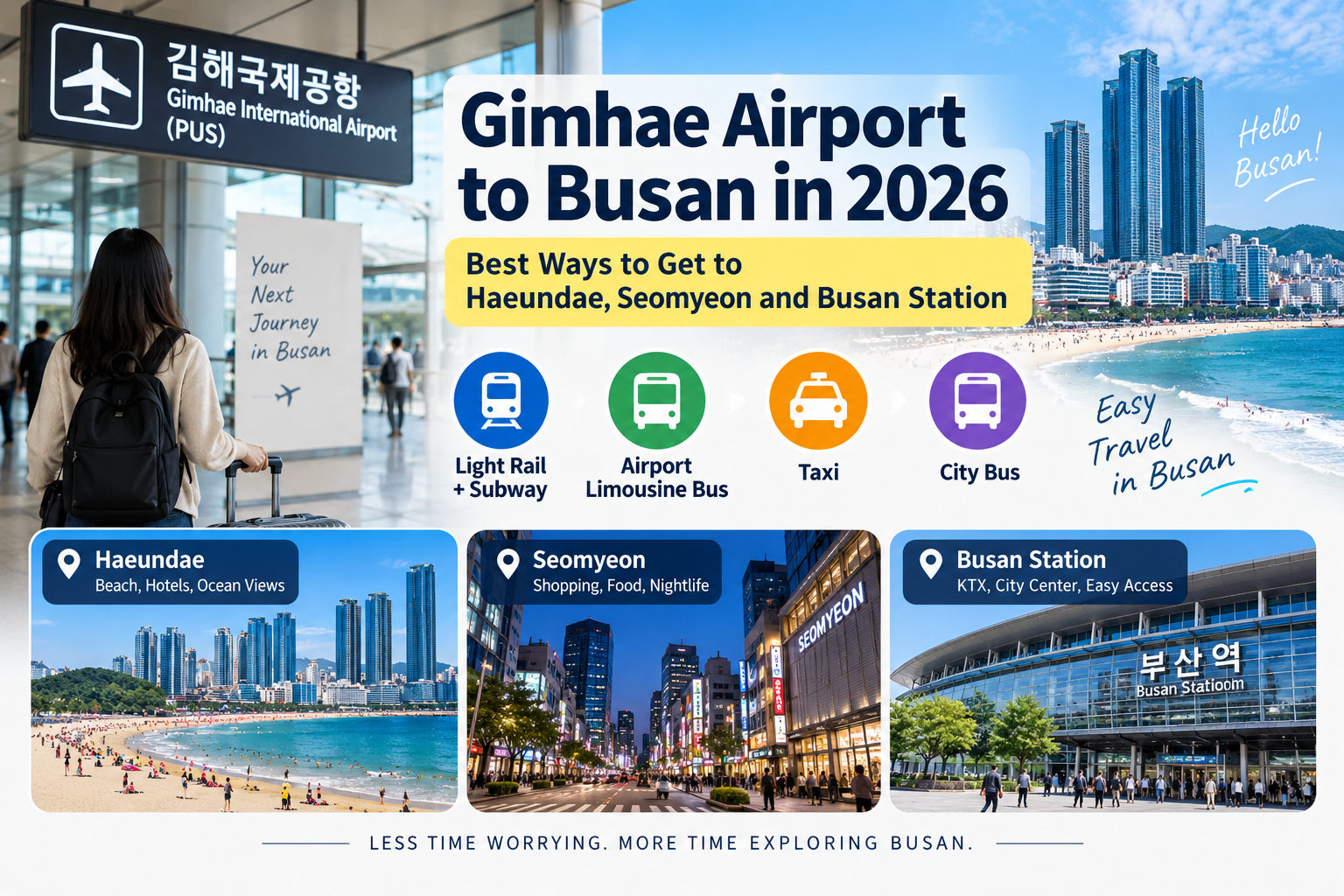
    In 2026, travelers can choose from several transportation options, including the Busan-Gimhae Light Rail Transit (BGL), subway connections, airport limousine buses, regular city buses, and taxis. Busan has also been expanding payment and transportation services for international visitors, making it easier to travel around the city without a car.

    This guide compares the main ways to travel from Gimhae Airport to central Busan and explains which option makes the most sense for popular destinations such as Haeundae, Seomyeon, and Busan Station.

    Quick Comparison: Gimhae Airport to Busan

    Here is the simplest way to think about your options:

    TransportationBest ForMain Advantage
    Light Rail + SubwayBudget travelersAffordable and reliable
    Airport Limousine BusTravelers with luggageFewer transfers
    City BusBudget-conscious travelers on suitable routesLow cost
    TaxiFamilies, groups, late arrivalsDoor-to-door convenience

    For many travelers with light luggage, the light rail and subway are the most economical choices. If you have large suitcases, however, avoiding multiple transfers can be worth paying more for a limousine bus or taxi.

    The best option also changes depending on your destination. Seomyeon is relatively convenient by rail, while Haeundae is farther from the airport and may be more comfortable to reach by a direct or low-transfer option.

    Option 1: Light Rail and Subway — Best for Budget Travelers

    For many visitors, the Busan-Gimhae Light Rail Transit (BGL) is the most practical low-cost way to leave Gimhae International Airport.

    The airport station is connected to the passenger terminals, and the light rail takes you to Sasang Station, where you can transfer to Busan Metro Line 2. From there, you can continue toward major areas including Seomyeon, Gwangan, and Haeundae.

    How It Works

    The basic route is:

    Gimhae International Airport → Sasang Station → Busan Metro

    At Sasang, your next route depends on your destination.

    For Seomyeon, continue on Metro Line 2 toward the city center.

    For Haeundae, stay on Line 2 after transferring at Sasang and continue east toward Haeundae Station.

    For Busan Station, you will need another subway transfer because Busan Station is on Metro Line 1.

    Why Choose the Light Rail and Subway?

    The biggest advantages are predictable travel times and relatively low transportation costs. You also avoid road traffic, which can make bus or taxi travel slower during busy periods.

    This option works particularly well if:

    • you are traveling alone or as a couple;
    • you have a small suitcase or backpack;
    • you arrive while the rail system is operating;
    • saving money is more important than door-to-door convenience.

    The main disadvantage is luggage. Carrying a large suitcase through stations, platforms, elevators, and transfers can become tiring after a long flight.

    Practical Tip for First-Time Visitors

    Before leaving the airport, check your hotel’s nearest subway station, not just the neighborhood name.

    Busan is spread across a large area, and two hotels described as being in the same general district can require very different final transfers or walks.

    A few minutes spent checking the exact station can make the trip from the airport much easier.

    Option 2: Airport Limousine Bus — Best for Travelers with Luggage

    If you are carrying a large suitcase, an airport limousine bus can be more comfortable than transferring between the light rail and subway.

    Busan reorganized its Gimhae Airport limousine services in 2026, with routes connecting the airport to important visitor areas including Seomyeon and Haeundae.

    The biggest advantage is simple: fewer transfers with your luggage.

    Gimhae Airport to Haeundae

    Haeundae is one of Busan’s most popular areas for international visitors, but it is relatively far from Gimhae Airport.

    Using the light rail and subway is possible, but the journey can feel long after an international flight. A limousine bus can therefore be an attractive option for travelers staying around Haeundae, especially when traveling with suitcases.

    Depending on the route and stop, services may also be useful for travelers staying around Centum City, eastern Busan, or nearby coastal areas.

    Gimhae Airport to Seomyeon

    Seomyeon is much more central and is one of the most convenient bases for first-time visitors to Busan.

    Travelers can reach it by light rail and subway, but the airport limousine service provides another option for visitors who would rather reduce transfers.

    This can be particularly useful if your accommodation is reasonably close to a limousine bus stop.

    Check the Current Schedule Before You Travel

    Airport bus routes, stops, fares, and operating schedules can change.

    Before your flight, check the latest information from Gimhae International Airport or the relevant Busan transportation service, especially if you plan to arrive early in the morning or late at night.

    Do not choose a hotel solely because an airport bus currently stops nearby. Transportation services can be adjusted, while the subway network is generally a more permanent part of the city’s infrastructure.

    Option 3: Taxi — Best for Convenience, Families and Late Arrivals

    A taxi is usually the easiest option if you want to travel directly from Gimhae Airport to your hotel without transfers.

    This can make sense for families, small groups, travelers with several suitcases, or passengers arriving after a long flight.

    The main benefit is door-to-door convenience. Instead of navigating stations with luggage, you can leave the airport and travel directly to your accommodation.

    When Is a Taxi Worth It?

    A taxi becomes more attractive when the fare is shared between several people.

    For a solo traveler, public transportation will usually be much cheaper. For three or four travelers, however, the difference per person may be easier to justify, especially when luggage and convenience are considered.

    Travel time and fare will depend on your destination and traffic conditions. Haeundae is considerably farther from the airport than areas such as Seomyeon, so avoid relying on one fixed taxi price when planning your budget.

    It is useful to have your hotel name and address available in Korean as well as English. Showing the exact location on a map can also help avoid confusion.

    Option 4: City Bus — Useful, but Not Always the Easiest First Choice

    Regular city buses can provide inexpensive connections between Gimhae Airport and parts of Busan.

    They may work well when a route happens to stop near your accommodation, but they are not automatically the best choice for every international traveler.

    Compared with the subway, bus routes can be more difficult for a first-time visitor to understand, and traveling with a large suitcase may be inconvenient.

    For most first-time visitors, the decision is therefore simple:

    Use the rail system when you want an inexpensive and predictable trip, choose an airport limousine when its route works well for your hotel, and consider a taxi when convenience matters most.

    City buses become more useful once you know exactly which route serves your destination.

    Best Transportation by Destination

    The easiest airport transfer depends heavily on where you are staying. Here is how to think about three of the most common destinations for international visitors.

    Gimhae Airport to Haeundae

    Haeundae is one of the farthest major tourist areas from Gimhae Airport.

    If you are traveling light and want to save money, take the light rail to Sasang and transfer to Metro Line 2 toward Haeundae.

    If you have large luggage, check whether the current airport limousine route has a convenient stop near your hotel. A taxi is another comfortable choice, particularly for families or groups who can share the fare.

    Best for budget travelers: Light rail + Metro Line 2
    Best for heavy luggage: Airport limousine, when the route suits your hotel
    Best for maximum convenience: Taxi

    Gimhae Airport to Seomyeon

    Seomyeon is one of the easiest areas to reach from the airport and an excellent transportation hub for exploring Busan.

    A practical public-transport route is Gimhae Airport → Sasang → Metro Line 2 → Seomyeon.

    Because Seomyeon is closer to the airport than Haeundae, it is also a more reasonable taxi destination for travelers who prioritize convenience.

    If an airport limousine stop is close to your accommodation, compare that option with the rail route before traveling.

    Best for most budget-conscious visitors: Light rail + Metro Line 2
    Best with several suitcases: Limousine bus or taxi

    Gimhae Airport to Busan Station

    Busan Station is particularly useful for travelers connecting to KTX trains or staying in the older central part of Busan.

    Unlike Seomyeon and Haeundae, Busan Station is on Metro Line 1, so a rail journey from the airport requires an additional subway transfer after entering Busan’s metro network.

    If you have large luggage or need to catch a train, a taxi may be worth considering because it reduces the risk and inconvenience of moving between multiple stations.

    Always leave extra time when connecting to a KTX train. Flight delays, immigration, baggage collection, traffic, and unfamiliar public transportation can all make a tightly planned connection stressful.

    Best for low cost: Light rail + subway
    Best for luggage or a time-sensitive train connection: Taxi

    Paying for Transportation from Gimhae Airport

    Having a payment plan before leaving the airport can make your first journey in Busan much easier.

    For public transportation, travelers commonly use a reloadable transportation card such as T-money or Cashbee. These cards can be useful not only in Busan but also on public transportation in other parts of South Korea.

    If you already purchased a transportation card earlier in your Korea trip, you generally do not need a separate card simply because you have arrived in Busan.

    However, do not assume that every ticket machine, bus, taxi, or transportation service accepts exactly the same foreign card or mobile payment method. Korea continues to expand cashless payment options, but keeping a small amount of Korean won available can still be useful.

    What If You Arrive Late at Night?

    Late arrival changes the decision.

    Rail and bus services do not operate 24 hours a day, so travelers landing late should check the last available public transportation connection for their specific arrival date.

    Remember that your flight’s scheduled landing time is not the time you will leave the terminal. Immigration, baggage claim, customs, and finding your way through an unfamiliar airport all take additional time.

    If your arrival is close to the final public transportation services, a taxi may be the safer and simpler option.

    Traveling with Large Luggage

    Do not choose transportation based only on the cheapest fare.

    A route that looks easy on a map can become much less convenient when you are carrying a large suitcase through transfers, elevators, station exits, and crowded trains.

    Before choosing your airport transfer, consider:

    • how many times you need to transfer;
    • how far your hotel is from the final station or stop;
    • whether you are traveling with children;
    • how many suitcases your group has;
    • and whether you will be traveling during a busy commuting period.

    For travelers with significant luggage, paying more for a lower-transfer option can be one of the most worthwhile transportation decisions of the trip.

    Which Option Should You Choose?

    There is no single best airport transfer for every traveler. Your destination, luggage, arrival time, and group size matter more than choosing the cheapest option.

    Your SituationRecommended Option
    Solo traveler with light luggageLight rail + subway
    Staying in SeomyeonLight rail + Metro Line 2
    Staying in Haeundae with light luggageLight rail + Metro Line 2
    Staying in Haeundae with large luggageAirport limousine or taxi
    Family or small groupTaxi can be worth comparing
    Connecting to KTX at Busan StationRail if you have enough time; taxi for convenience
    Arriving late at nightCheck final transit times; taxi may be necessary
    Hotel near a limousine stopCompare limousine service with the rail route

    Frequently Asked Questions

    What is the cheapest way from Gimhae Airport to Busan?

    For many destinations, combining the Busan-Gimhae Light Rail Transit with the Busan Metro is one of the most economical and predictable options.

    Is there a subway directly from Gimhae Airport to Haeundae?

    Not directly. You can take the light rail from the airport to Sasang Station, transfer to Busan Metro Line 2, and continue toward Haeundae.

    Is Seomyeon easy to reach from Gimhae Airport?

    Yes. Seomyeon is relatively convenient because you can transfer from the airport light rail to Metro Line 2 at Sasang and continue toward Seomyeon.

    Should I take a taxi from Gimhae Airport?

    A taxi is worth considering if you have heavy luggage, are traveling with children or several people, arrive late, or simply want door-to-door transportation. Solo travelers with light luggage will usually save money by using public transportation.

    Can I use T-money in Busan?

    T-money is widely used on public transportation in Busan. If you already have a transportation card from another part of your Korea trip, check its balance before traveling rather than automatically buying another card.

    How early should I leave Gimhae Airport if I need to catch a KTX train?

    Allow a generous buffer. Immigration, baggage collection, transportation transfers, traffic, and finding the correct platform can all take longer than expected. Avoid planning a tight airport-to-KTX connection.

    Final Thoughts

    Getting from Gimhae International Airport to Busan is not difficult once you choose transportation based on your actual destination.

    For travelers with light luggage, the light rail and subway provide an affordable and dependable way into the city. Travelers carrying large suitcases may prefer an airport limousine bus when its route matches their accommodation, while families, groups, and late-night arrivals may find a taxi worth the additional cost.

    Most importantly, check the exact location of your hotel before choosing your transfer. Busan is a large city, and the best route to Haeundae can be very different from the best route to Seomyeon or Busan Station.

    Transportation routes, schedules, and fares can change, so confirm current operating information shortly before your trip.

    With your airport transfer planned in advance, you can spend less time figuring out transportation after landing and more time enjoying Busan.

  • First Time in Busan: A Beginner’s Guide to Beaches, Neighborhoods and Getting Around

    First Time in Busan: A Beginner’s Guide to Beaches, Neighborhoods and Getting Around

    Busan Is Not Just Seoul by the Sea

    For many first-time visitors to South Korea, Seoul is the beginning of the journey.

    Then comes Busan.

    At first glance, the country’s major southern city may seem easier to understand. There are famous beaches, seafood markets, colorful hillside neighborhoods, temples, cafés, and coastal views.

    But Busan can surprise travelers with its scale.

    The city stretches across a landscape shaped by mountains, bays, rivers, ports, and the sea. Neighborhoods that appear relatively close on a map can require more travel time than expected.

    That means a successful Busan trip begins with one important idea:

    Do not treat the entire city as one neighborhood.

    Instead, understand Busan as a collection of different areas, each offering a different travel experience.

    Haeundae feels different from Nampo.

    Gwangalli offers a different evening from Jagalchi.

    The atmosphere around Busan Station is different from the coastal neighborhoods farther east.

    Once you understand these differences, planning Busan becomes much easier.

    Why Busan Deserves More Than a Quick Stop

    Some travelers try to fit Busan into a single rushed day.

    It is possible to see a few famous places that way, but it is difficult to understand the city.

    Busan is not simply a checklist of attractions.

    Its identity is closely connected to the sea.

    You notice it in the beaches, ports, seafood markets, bridges, coastal roads, hillside communities, and walking routes overlooking the water.

    The pace can also feel different from Seoul.

    Busan is still a large modern city, but its geography creates moments when the urban landscape suddenly opens toward the ocean.

    That contrast is one of its greatest attractions.

    If your Korea itinerary allows it, giving Busan more than one day makes it much easier to experience both the famous sights and the atmosphere between them.

    Getting to Busan

    Many international travelers reach Busan after spending time in Seoul.

    High-speed rail is one of the most practical ways to travel between the two cities, with trains arriving at Busan Station.

    Other rail and intercity transportation options are also available depending on your starting point, schedule, and budget.

    Busan also has Gimhae International Airport, which serves domestic and international routes.

    The best arrival method depends on the rest of your Korea itinerary.

    If you are already traveling in Seoul, rail may fit naturally into your trip.

    If Busan is your first destination or you are arriving from another city or country, air travel may be more convenient.

    Do not choose transportation based only on the time spent on the train or airplane.

    Consider the entire journey:

    Where are you starting? Where is your accommodation? How much luggage do you have? And how will you travel from the station or airport to your final destination?

    Door-to-door travel time matters more than one impressive number on a booking screen.

    Arriving at Busan Station

    Busan Station is an important gateway for travelers arriving by rail.

    But arriving at the station does not mean you have arrived at every part of “central Busan.”

    Your next step depends on where you are staying.

    Travelers based around Nampo or the older downtown areas have a different onward journey from visitors staying near Haeundae or Gwangalli.

    This is why accommodation choice matters so much in Busan.

    A hotel that looks inexpensive may be less convenient if most of the places you want to visit are on the opposite side of the city.

    Before booking, look at your planned attractions on a map.

    A few minutes of planning can save hours of unnecessary transportation over several days.

    Arriving Through Gimhae International Airport

    Travelers flying into Busan generally arrive through Gimhae International Airport.

    From there, public transportation and other ground-transport options connect travelers with different parts of the city.

    As with Busan Station, the most useful question is not simply:

    “How do I get from the airport to Busan?”

    You are already entering the Busan metropolitan area.

    The better question is:

    “How do I get from the airport to my specific neighborhood?”

    A traveler staying near Haeundae may need a different plan from someone staying near Nampo.

    Check your accommodation location before arrival and consider luggage, transfers, arrival time, and the operating hours of the transportation you plan to use.

    Understand Busan Through Its Major Areas

    For a first visit, you do not need to memorize every district.

    Start with a few names that frequently appear in travel itineraries:

    Haeundae

    Gwangalli

    Nampo and Jagalchi

    Seomyeon

    Busan Station area

    Each can play a different role in your trip.

    Understanding those roles is more useful than memorizing a long list of attractions.

    Haeundae: The Famous Beach Side of Busan

    For many international visitors, Haeundae Beach is the image that first comes to mind when they think of Busan.

    The area combines the beach with hotels, restaurants, cafés, modern development, and access to other attractions in eastern Busan.

    This makes Haeundae an appealing base for travelers who want the coastal side of the city to be central to their trip.

    Walking beside the beach early in the morning can feel very different from visiting later when the area becomes busier.

    In the evening, lights from the surrounding city change the atmosphere again.

    But Haeundae is not the only place to experience the sea.

    Choosing it simply because it is the most famous beach can cause travelers to overlook neighborhoods that may fit their preferences better.

    Gwangalli: A Beach with a City View

    Gwangalli Beach offers another version of coastal Busan.

    One of its defining visual features is the view toward Gwangan Bridge.

    The relationship between the beach, water, bridge, cafés, restaurants, and surrounding city gives Gwangalli a distinctive atmosphere.

    It can be particularly appealing later in the day as the city lights become more visible.

    Travelers who enjoy an urban beach environment may find Gwangalli especially attractive.

    Haeundae and Gwangalli should not necessarily be treated as competitors.

    They provide different experiences.

    If you have enough time, experiencing both can help you understand the variety of Busan’s coastline.

    Nampo and Jagalchi: Markets, Port History and Older Downtown Busan

    The Nampo and Jagalchi area offers a very different introduction to the city.

    Here, the experience is less about resort-style beach scenery and more about markets, food, shopping streets, port culture, and the older commercial heart of Busan.

    Jagalchi Market is closely associated with seafood and Busan’s maritime identity.

    Nearby streets and markets make the wider area worth exploring rather than visiting only one building and leaving.

    For travelers interested in food, traditional commercial areas, and a more densely urban experience, this part of Busan can be especially rewarding.

    It also combines naturally with several attractions in the western and central parts of the city.

    Seomyeon: A Practical Urban Base

    Seomyeon does not provide the classic beach view many travelers imagine when planning Busan.

    Its advantage is different.

    It is a busy urban area with shopping, restaurants, nightlife, and useful transportation connections.

    For travelers who want to explore different sides of Busan rather than staying primarily near the coast, Seomyeon can be a practical base.

    This illustrates an important rule when choosing accommodation:

    The most scenic location is not always the most convenient location.

    A beach hotel may be perfect for one traveler.

    A well-connected urban neighborhood may be better for another.

    Which Area Should You Stay In?

    There is no single best place to stay in Busan.

    Choose according to your priorities.

    If waking up near a famous beach matters most, Haeundae may be appealing.

    If you enjoy beach evenings, bridge views, cafés, and a lively coastal atmosphere, consider Gwangalli.

    If markets, seafood, older downtown streets, and port culture are high on your list, the Nampo and Jagalchi area may suit you.

    If transportation convenience and access to different parts of the city are more important than being directly beside the sea, Seomyeon deserves consideration.

    Your accommodation is not simply a bed.

    It determines where your day begins and where it ends.

    In a geographically spread-out city, that matters.

    Busan’s Geography Changes How You Travel

    Seoul teaches visitors to think in neighborhoods.

    Busan requires that same habit, but geography makes it even more important.

    Mountains and water influence the way roads and rail lines move through the city.

    A route that looks straightforward on a flat map may involve transfers or longer travel times.

    Do not assume that two coastal attractions are close simply because both face the sea.

    And do not schedule several famous places on opposite sides of Busan without checking the actual travel time between them.

    A better strategy is to group your itinerary geographically.

    Spend part of a day exploring one area deeply.

    Then move to another area when the transition makes sense.

    This reduces transportation fatigue and gives you more time to experience the places you came to see.

    Public Transportation in Busan

    Busan has an extensive public transportation network that includes subway and bus services.

    For many visitors, these will be the foundation of getting around the city.

    The subway can be particularly useful for connecting major urban areas, while buses expand access to places not located directly beside subway stations.

    However, some coastal or hillside attractions may require more planning than simply riding one subway line.

    Always check the complete route.

    Look at transfers.

    Consider the walk from the station or bus stop to the attraction.

    And remember that a route that seems easy without luggage can feel very different when you are carrying a suitcase.

    Taxis Can Be Useful Strategically

    Public transportation is often practical, but taxis can sometimes save time or reduce unnecessary physical effort.

    This can be particularly useful when several people are traveling together, when you have luggage, when weather conditions are uncomfortable, or when the final part of a journey is inconvenient by public transportation.

    The goal is not to choose between “only public transportation” and “only taxis.”

    Use each where it makes sense.

    Good travel planning is about the whole journey, not loyalty to one method of transportation.

    Do Not Underestimate Walking

    Busan is a wonderful city for walking, but not every walk is flat.

    Hills and slopes are part of the city’s character.

    Some famous neighborhoods and viewpoints involve stairs or inclines.

    Coastal walks can also cover substantial distances.

    Comfortable shoes matter.

    So does realistic scheduling.

    If you plan a long coastal walk in the morning, several hillside attractions in the afternoon, and a large market in the evening, your legs may remember Busan more clearly than your camera does.

    Balance active days with easier experiences.

    Your First Evening in Busan

    After arriving, resist the temptation to immediately cross the entire city for a famous attraction.

    If possible, spend your first evening near your accommodation.

    Staying in Haeundae?

    Walk toward the beach.

    Staying near Gwangalli?

    See the bridge and waterfront after dark.

    Staying around Nampo?

    Explore nearby streets and begin discovering the older downtown atmosphere.

    Staying in Seomyeon?

    Find dinner, walk through the neighborhood, and learn where your nearest transportation connections are.

    A simple first evening helps you understand your surroundings and recover from the journey.

    Busan will still be there tomorrow.

    The Sea Changes the Experience of the City

    What makes Busan special is not simply that it has beaches.

    It is how frequently the sea becomes part of the urban experience.

    You may see it from a beach, a bridge, a coastal path, a hillside neighborhood, a market area, or a temple overlooking the water.

    Sometimes the sea is the destination.

    Sometimes it is the background.

    That relationship between city and coastline gives Busan an identity very different from Seoul.

    And once you understand how the neighborhoods fit together, you can begin exploring that identity more deeply.

    In the next part, we will look at Haeundae, Gwangalli, coastal scenery, hillside neighborhoods, markets, and how to build a realistic first Busan itinerary without spending your entire trip in transit.


    Experience Busan by Following the Coast

    Once you understand Busan’s major neighborhoods, the city becomes easier to explore.

    But there is another useful way to understand it:

    Follow the relationship between the city and the sea.

    Busan’s coastline is not one continuous tourist zone. Different sections offer beaches, ports, cliffs, bridges, markets, residential neighborhoods, cafés, and walking routes.

    This variety means that two places described as “coastal Busan” can feel completely different.

    For a first visit, choose a few experiences that show those differences rather than trying to cover the entire coastline.

    Start with Haeundae

    If you are staying in eastern Busan, Haeundae is an obvious place to begin.

    The beach is famous, but the surrounding area is part of the experience as well.

    Walk along the waterfront.

    Explore nearby streets.

    Stop for coffee or a meal.

    Look toward the high-rise skyline and then back toward the sea.

    This combination of beach and modern city is one of the defining images of contemporary Busan.

    During warmer periods, the area can become particularly busy. At other times of year, the same beach may feel much calmer.

    That seasonal difference is important.

    A beach does not need swimming weather to be worth visiting.

    Cooler months can be excellent for walking, photography, and simply enjoying the coast without planning a traditional beach day.

    Do Not Rush Through the Beach

    Travelers sometimes approach famous beaches the same way they approach monuments.

    Arrive.

    Take a photograph.

    Leave.

    That misses the point.

    The appeal of a beach is partly the time you spend there.

    Walk without a destination for a while.

    Sit and watch the water.

    Visit a nearby café.

    Return after sunset if it fits your schedule.

    A slower visit can tell you much more about Busan than a five-minute photograph with the beach in the background.

    Explore Beyond Haeundae Beach

    Eastern Busan contains more than one famous stretch of sand.

    Depending on your interests and current access conditions, the wider Haeundae area can be combined with coastal walks, viewpoints, cafés, and other seaside attractions.

    The important planning principle is to keep nearby experiences together.

    If you have already traveled to eastern Busan, explore that part of the city properly rather than immediately crossing to the opposite side for one additional attraction.

    This is one of the easiest ways to make a Busan itinerary feel less rushed.

    Gwangalli Is Especially Memorable in the Evening

    Gwangalli Beach provides a different coastal experience.

    The view toward Gwangan Bridge gives the waterfront a strong urban identity.

    During the day, the beach can be a pleasant place to walk and look across the water.

    As evening arrives, the atmosphere changes.

    Lights appear along the surrounding buildings and bridge, restaurants and cafés become part of the experience, and the waterfront can feel like an outdoor living room for the city.

    For this reason, many travelers may prefer to place Gwangalli later in the day.

    You do not need a complicated activity.

    Dinner, a walk, and time beside the water can be enough.

    Haeundae or Gwangalli?

    First-time visitors often ask which beach is better.

    That question has no universal answer.

    Choose Haeundae if you want one of Korea’s best-known beaches, a large modern coastal district, and convenient access to several eastern Busan attractions.

    Choose Gwangalli if the bridge view, cafés, restaurants, and an urban evening atmosphere are more important to you.

    Or visit both if your schedule allows.

    The useful question is not which beach wins.

    It is when each beach fits naturally into your trip.

    Busan Is Also a City of Hills

    The sea is only half of Busan’s geography.

    Mountains and hills shape many neighborhoods and create some of the city’s most recognizable views.

    This is especially noticeable when you move away from the flat waterfront and into hillside communities.

    Stairs, narrow streets, steep roads, and layered houses remind visitors that Busan developed around difficult terrain as well as the coast.

    That geography creates beautiful views.

    It can also make walking more demanding than expected.

    Gamcheon Culture Village: More Than a Photograph

    Gamcheon Culture Village is one of Busan’s most recognizable hillside destinations.

    Its colorful buildings spread across the slopes, creating views that have become widely shared in travel photography.

    But the village should not be reduced to a photo background.

    It has a history and remains connected to the lives of local residents.

    Walk respectfully.

    Keep noise under control.

    Follow signs regarding restricted areas.

    Do not enter private spaces for photographs.

    And remember that people may live behind the doors and windows that appear in your pictures.

    Responsible tourism is especially important in residential destinations that receive large numbers of visitors.

    Take Your Time in Gamcheon

    Because of the slopes and stairs, exploring Gamcheon can require more energy than a map suggests.

    Do not schedule it as if you were walking through a flat shopping center.

    Wear comfortable shoes.

    Allow time to stop.

    And pay attention to weather conditions.

    On a hot summer day, steep streets can feel very different from the same route during mild weather.

    The goal is not to photograph every colorful corner.

    It is to experience the landscape and understand how the neighborhood fits into Busan’s hillside geography.

    Nampo and Jagalchi Reveal Busan’s Maritime Character

    After hillside views, the Nampo and Jagalchi area can introduce another side of the city.

    Busan has long been shaped by maritime trade, fishing, and port activity.

    That history remains visible in the atmosphere of its markets and older commercial areas.

    For travelers, this part of the city can feel very different from the polished beachfront districts farther east.

    That contrast is valuable.

    A trip focused only on modern beaches would show only one version of Busan.

    Jagalchi Market and Seafood Culture

    Jagalchi Market is strongly associated with seafood and is one of the best-known market names in Busan.

    Even travelers who do not plan to buy seafood may find the surrounding area interesting because it reflects the city’s relationship with the ocean.

    If you choose to eat seafood, take time to understand what you are ordering and how pricing works.

    Ask questions when necessary.

    Check displayed information where available.

    Do not feel pressured to order something simply because it is famous.

    Food experiences are most enjoyable when they match your preferences and budget.

    Explore the Wider Market Area

    Do not think of Jagalchi as an isolated attraction.

    Nearby commercial streets and markets can be incorporated into the same walking experience.

    This is another example of why neighborhood-based travel works well in Busan.

    Instead of traveling across the city for several individual “must-see” places, spend time understanding one area.

    Walk.

    Eat.

    Browse.

    Watch the movement of the streets.

    Then continue when you are ready.

    Markets Are Working Places

    Markets can be fascinating for travelers because they feel visually and culturally different from familiar retail environments.

    But remember that vendors are working.

    Avoid blocking narrow passages.

    Ask before taking close photographs of people.

    Keep your belongings secure in crowded spaces.

    Be patient when communication takes time.

    And approach unfamiliar foods with curiosity rather than treating them as spectacles.

    Respect improves the experience for everyone.

    Food Is One of the Best Ways to Understand Busan

    Busan’s food culture deserves more than a quick mention.

    Seafood is important, but it is not the entire story.

    The city has dishes and food traditions connected to its regional identity and modern history.

    Markets, neighborhood restaurants, street food, and local specialties can all become part of the trip.

    Rather than trying to eat every famous Busan dish in one day, spread food experiences across your itinerary.

    A market lunch, a casual neighborhood dinner, and a meal near the coast can each show a different side of the city.

    We will explore Busan’s food and market culture more deeply in a later guide.

    Build Your Day Geographically

    A first-time visitor can save significant time by grouping destinations.

    For example, a day focused on the Nampo, Jagalchi, and nearby western or central attractions is generally more logical than repeatedly moving between Nampo and Haeundae.

    Similarly, an eastern Busan day can focus on Haeundae and nearby coastal experiences.

    Gwangalli can work well as an evening destination when it fits your route.

    The exact itinerary depends on your accommodation, but the principle remains the same:

    Do not zigzag across Busan without a reason.

    A Sample Eastern Busan Day

    A relaxed eastern Busan day might begin around Haeundae.

    Spend the morning walking near the beach and exploring the surrounding area.

    Add another nearby coastal experience according to your interests and current conditions.

    Take a proper lunch break.

    Do not fill every hour.

    Later, depending on your route and energy, transition toward another neighborhood.

    If Gwangalli fits naturally into the journey, arriving toward the evening can provide a different beach atmosphere and views of the illuminated bridge.

    This is a full day without requiring a long checklist.

    A Sample Older Downtown Day

    Another day might focus on Busan’s older downtown and market areas.

    Begin around Gamcheon Culture Village if it is part of your itinerary.

    Allow enough time for the slopes and walking.

    Then move toward the Nampo and Jagalchi area.

    Explore the market environment, have a meal, browse nearby streets, and experience the commercial energy of this part of the city.

    Because these experiences are geographically more compatible than a random collection of famous attractions, the day can feel much more coherent.

    Leave Space for Weather

    Coastal travel is affected by weather.

    Rain can change a beach day.

    Strong wind can make exposed coastal areas uncomfortable.

    Summer heat can make hillside walking exhausting.

    Cold winter conditions can turn a relaxed waterfront walk into a very short one.

    Always keep an alternative plan.

    A rainy morning does not have to ruin the day.

    Move an indoor activity forward and save a coastal walk for better conditions if your schedule allows.

    Flexibility is particularly valuable in a city where so many memorable experiences happen outdoors.

    The Best Busan Itinerary Is Not the Longest One

    It is easy to create a Busan itinerary that looks impressive on paper.

    Five neighborhoods.

    Three beaches.

    Two markets.

    A temple.

    A cable car.

    A mountain.

    A famous café.

    All in one day.

    The result is often more transportation than travel.

    A better itinerary may contain only a few major experiences.

    But you will remember them.

    You will have time to walk beside the sea rather than simply photograph it.

    You will have time to eat without checking the clock.

    You will notice how neighborhoods change.

    And you will begin to understand why Busan feels different from Seoul.

    From the City to the Coast

    So far, we have focused on the parts of Busan that help first-time visitors understand the city: its major neighborhoods, beaches, markets, and basic travel patterns.

    But Busan’s coastline offers another level of exploration.

    There are places where walking becomes the main attraction.

    There are coastal paths, viewpoints, temples, cliffs, and routes where the city gives way to wider ocean scenery.

    Those experiences require different planning from a simple beach visit.

    In PART 3, we will bring the first Busan trip together with practical itineraries, accommodation choices, transportation strategy, trip length, and the experiences worth saving for the next Busan guide.


    How Many Days Do You Need in Busan?

    There is no perfect number of days for Busan.

    A traveler interested mainly in one beach and a market will need less time than someone who wants to explore coastal walks, temples, neighborhoods, food, and several parts of the city.

    For a first visit, the most important thing is to be realistic about distance.

    Busan rewards travelers who slow down.

    With only one day, choose one side of the city and focus on a few experiences.

    With two days, you can begin comparing the coastal side of Busan with its older downtown and market areas.

    With three days, there is much more room for a coastal walk, a temple, a slower neighborhood experience, or simply time beside the sea.

    More days do not automatically create a better trip.

    But enough time allows Busan to become more than a collection of photographs.

    If You Have Only One Full Day

    A one-day Busan visit requires difficult choices.

    Do not try to see everything.

    If beaches and modern coastal scenery are your priorities, concentrate on the eastern side of the city.

    Build the day around Haeundae, add another nearby experience, and consider Gwangalli later if the route remains reasonable.

    If markets, food, hillside scenery, and older downtown Busan interest you more, build the day around Gamcheon, Nampo, and Jagalchi instead.

    Trying to combine every famous location from both sides can turn your only Busan day into a transportation exercise.

    Choose the version of Busan you most want to experience.

    Then experience it properly.

    A Practical Two-Day First Visit

    Two full days provide a much better introduction.

    One possible structure is:

    Day 1: Eastern and Coastal Busan

    Begin around Haeundae.

    Spend time at the beach and explore the surrounding area.

    Add another nearby coastal attraction or walking experience if your energy and the weather allow.

    Later, move toward Gwangalli if it fits your route.

    Finish the evening with dinner and the waterfront atmosphere.

    Day 2: Hillside and Older Downtown Busan

    Explore Gamcheon Culture Village earlier in the day.

    Then move toward Nampo and Jagalchi.

    Walk through market and commercial areas, eat something local, and allow time to experience the streets rather than rushing through them.

    This simple division prevents much of the unnecessary back-and-forth that makes short Busan trips tiring.

    What a Third Day Adds

    A third day creates something valuable:

    choice.

    You no longer need to squeeze every important experience into two packed days.

    You can dedicate more time to the coastline.

    You can explore a temple.

    You can choose a longer walking route.

    You can spend several hours in a neighborhood that interested you unexpectedly.

    Or you can simply enjoy a slower morning.

    Travel itineraries often treat free time as wasted time.

    It is not.

    Free time is what allows a trip to respond to weather, fatigue, curiosity, and discovery.

    Build Your Schedule Around Your Accommodation

    Where you sleep should influence how you organize each day.

    If you stay in Haeundae, it makes sense to use your location.

    An early beach walk requires almost no transportation.

    You can explore eastern Busan before travelers staying farther away arrive.

    If you stay around Nampo, use that access to markets and older downtown areas.

    If you stay near Gwangalli, enjoy the waterfront when you do not have to worry about crossing the city afterward.

    If you stay in Seomyeon, take advantage of its transportation connections to divide your days geographically.

    Do not create an itinerary as if every traveler starts from the same point.

    Your hotel is part of your transportation plan.

    First-Time Visitors Should Prioritize Variety

    Busan contains enough attractions to fill a long trip, but a first visit benefits from contrast.

    Try to experience more than one side of the city.

    A beach shows you one Busan.

    A traditional market shows another.

    A hillside neighborhood reveals the terrain.

    A coastal viewpoint changes your perspective again.

    Food adds another layer.

    The goal is not to visit the greatest possible number of places.

    It is to leave with a sense of what makes Busan distinctive.

    For Beach Lovers

    If the sea is your main reason for visiting Busan, give it time.

    Do not treat Haeundae and Gwangalli as quick photography stops.

    Walk along the waterfront.

    Visit at different times of day.

    Explore nearby streets.

    Have a meal overlooking or close to the coast.

    Consider adding a coastal walking experience during a longer stay.

    And remember that Busan’s beaches can still be enjoyable outside the traditional swimming season.

    The ocean does not close when summer ends.

    For Food Travelers

    Travelers who organize trips around food will find plenty to explore in Busan.

    Markets are an obvious starting point, but do not limit yourself to famous market stalls.

    Neighborhood restaurants can be just as memorable.

    Seafood is closely associated with the city, yet Busan’s food identity extends beyond seafood alone.

    Instead of attempting a huge food checklist, leave room for several types of meals.

    Try something in a market.

    Eat in a neighborhood restaurant.

    Have a casual meal after a coastal walk.

    Ask yourself what people around you are eating.

    Food can become a way of understanding the city rather than simply another category of attractions.

    For Families

    Families should be especially cautious about overplanning.

    A route that seems simple to an adult looking at a map may involve long transfers, hills, stairs, waiting, and considerable walking.

    Choose one main area for part of the day.

    Allow time for meals and rest.

    Be prepared to shorten an activity if children become tired.

    Beaches and open waterfront areas can provide useful flexibility, but families should always pay attention to water safety, weather, and local restrictions.

    A successful family day is not the one with the most completed attractions.

    It is the one everyone still enjoys at the end.

    For Older Travelers

    Busan can be physically demanding because of its hills, stairs, long stations, and spread-out geography.

    That does not mean older travelers cannot enjoy the city comfortably.

    It means route selection matters.

    Use public transportation strategically.

    Consider taxis when they significantly reduce difficult transfers or steep approaches.

    Do not combine several physically demanding locations simply because they appear close on a map.

    Take breaks.

    Choose viewpoints and coastal experiences appropriate to your mobility.

    Busan offers many ways to enjoy its scenery without turning every day into a hiking day.

    For Solo Travelers

    Busan can be rewarding for solo travelers because many of its best experiences work naturally alone.

    Walking beside the beach, exploring a market, sitting in a café, photographing the coast, or wandering through a neighborhood does not require a group.

    Solo travel also provides flexibility.

    You can stay longer somewhere you enjoy and leave quickly when a place does not interest you.

    Normal travel awareness still matters.

    Keep track of your belongings.

    Know how you will return to your accommodation.

    Pay attention to the last practical transportation options for late evenings.

    And take extra care when walking alone in more isolated coastal or mountain environments.

    For Travelers Coming from Seoul

    If Busan follows Seoul in your itinerary, do not expect the same travel rhythm.

    The public transportation experience may feel familiar in some ways, but the geography is different.

    Busan is more stretched out, and mountains and coastline strongly influence movement.

    This is why the basic principles you learned about public transportation in Korea remain useful while the actual itinerary needs to change.

    Do not try to recreate your Seoul schedule in Busan.

    Let the city determine the pace.

    Check the Weather Before Building an Outdoor Day

    Weather matters everywhere, but it becomes particularly important when beaches and coastal scenery are central to your plans.

    Rain, strong wind, summer heat, cold temperatures, or poor visibility can change the experience considerably.

    Check conditions before committing to a long outdoor route.

    If the weather becomes unsuitable, move a market, café, shopping area, museum, or other indoor activity into that part of the day.

    Then return to the coast when conditions improve if your itinerary allows.

    A flexible itinerary is usually stronger than a perfect-looking schedule that cannot adapt.

    Seasonal Travel Changes Busan

    Busan is often associated with summer because of its beaches, but the city is not only a summer destination.

    Spring can provide comfortable conditions for walking and outdoor exploration, although temperatures and weather vary.

    Summer brings the classic beach atmosphere but also heat, humidity, rain, and larger crowds.

    Autumn can be excellent for walking and outdoor travel as conditions become cooler.

    Winter creates a quieter coastal experience, although wind and cold can make waterfront activities feel much more demanding.

    If you are deciding when to travel, think about what you want to do rather than searching for one universally “best” season.

    Our broader guide to the best time to visit Korea can help you understand how the seasons affect a Korea itinerary.

    Keep Everyday Travel Simple

    A little preparation makes Busan much easier.

    Understand how you will use public transportation.

    Know how you plan to pay for everyday purchases.

    Keep your phone charged.

    Have access to navigation information.

    Wear shoes appropriate for the amount of walking you expect.

    Check operating information for places that matter to your itinerary.

    And avoid scheduling every minute.

    Travel problems become more stressful when there is no room in the schedule to solve them.

    Learn the Basics Before Your Korea Trip

    If Busan is part of a larger journey around South Korea, several practical topics are worth understanding before you arrive.

    Knowing the basics of cash, cards, and payments in Korea can make markets, restaurants, cafés, and everyday purchases easier.

    Understanding Korean culture and etiquette can also help you navigate daily interactions more comfortably.

    And if this is your first trip to the country, our first-time traveler’s guide to Korea provides a broader introduction to planning your journey.

    Busan becomes easier when you have already solved the basic questions of traveling in Korea.

    Do Not Plan Every Meal Before You Arrive

    Research is useful, but leave some room for discovery.

    A restaurant you saved months ago may be closed, crowded, inconvenient, or simply far from where you happen to be when you are hungry.

    Instead of crossing the city for every famous meal, combine planned food experiences with spontaneous ones.

    Look at the neighborhood around you.

    Check what is open.

    See where people are eating.

    Sometimes the unplanned meal becomes the one you remember.

    Give Yourself Time to Do Nothing

    This may be the most underrated Busan travel advice.

    Sit beside the sea.

    Watch the bridge lights.

    Have coffee without checking the next destination.

    Walk along the beach without counting attractions.

    Spend longer at a market because you find it interesting.

    Busan’s geography encourages these pauses.

    The ocean creates open space in a large city.

    Use it.

    A trip does not become more valuable because every hour contains an attraction.

    What Should You Save for the Next Busan Guide?

    This first guide is designed to help you understand Busan and organize your first visit.

    But several experiences deserve much more detail than we can give them here.

    The next Busan guide will move beyond the basic city introduction and focus on coastal walks, scenic viewpoints, temples, trekking, and outdoor experiences.

    That means exploring Busan not simply as a city with beaches, but as a destination where mountains and ocean meet.

    We will look more closely at how to choose walks for different fitness levels, how to combine coastal attractions geographically, and how weather and terrain should influence your plans.

    From Seoul to Busan: Two Very Different Cities

    Travelers sometimes compare Seoul and Busan as if one must be better.

    That misses what makes a Korea trip interesting.

    Seoul offers the intensity of the capital: royal history, dense neighborhoods, shopping districts, major cultural institutions, mountains, and the Han River.

    Busan offers another perspective: ports, beaches, seafood markets, hillside communities, coastal scenery, and a city shaped by the ocean.

    Experiencing both makes the differences more meaningful.

    If Seoul introduces you to the scale and energy of modern Korea, Busan shows how differently Korean urban life can develop when the sea becomes part of the landscape.

    Final Thoughts: Let Busan Be Busan

    The easiest mistake a first-time visitor can make is arriving in Busan with a list instead of a sense of the city.

    Haeundae.

    Gwangalli.

    Gamcheon.

    Jagalchi.

    A photograph at each place.

    Then back to the train.

    You will have seen Busan.

    But you may not have experienced it.

    Slow down enough to notice the differences.

    Watch the city wake up beside the beach.

    Walk through a market where people are actually working.

    Look down from a hillside and understand why the streets developed the way they did.

    Eat without rushing.

    Sit beside the ocean after dark.

    Choose neighborhoods instead of chasing attractions.

    Use transportation to connect experiences rather than allowing transportation to become the experience.

    Most importantly, leave some room for the city to surprise you.

    Busan is not simply Korea’s second stop after Seoul.

    It is a destination with its own geography, rhythm, history, food, neighborhoods, and relationship with the sea.

    Once you stop trying to see all of it at once, you can finally begin to experience it.