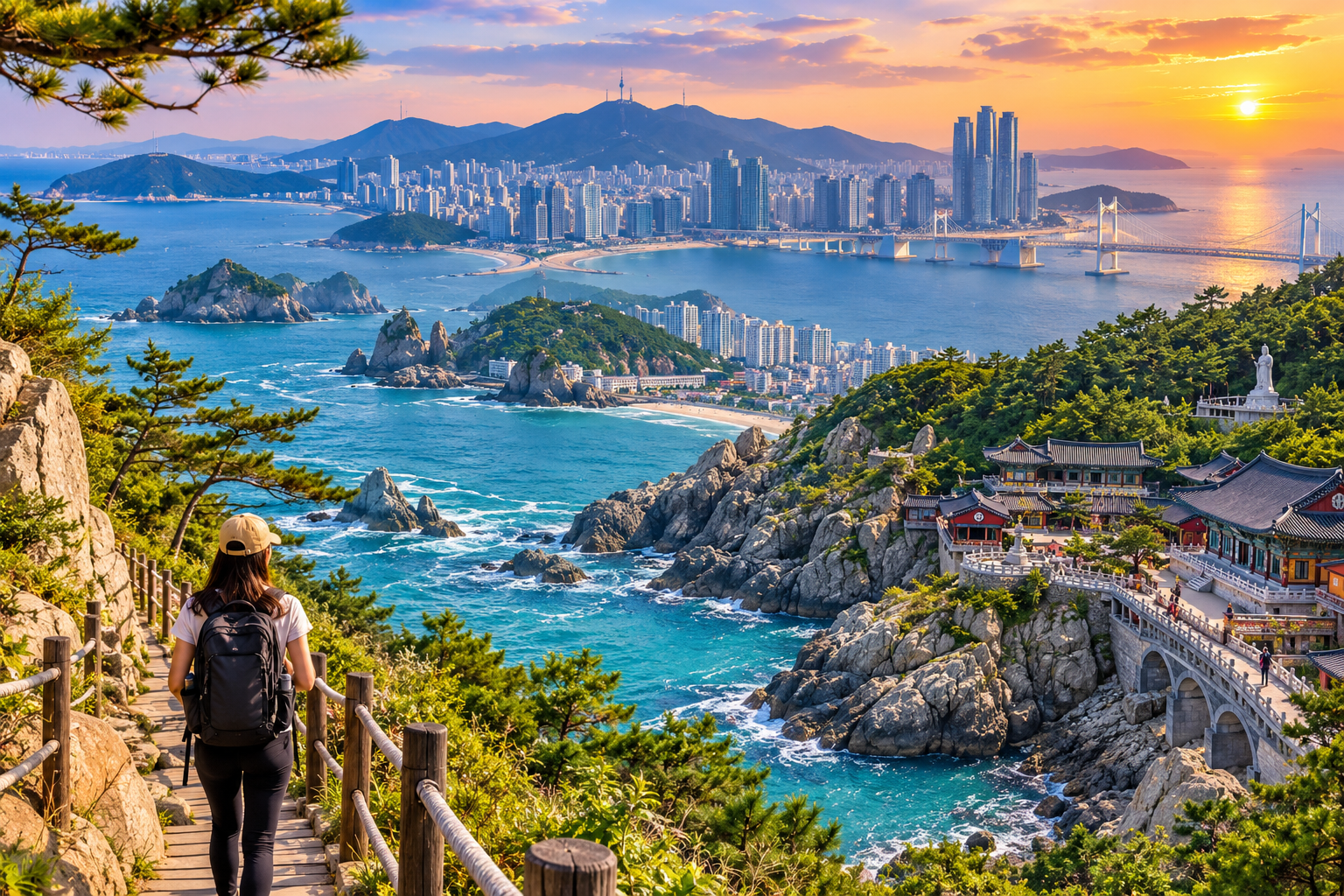
Busan Is a City Made for Outdoor Exploration
Many travelers arrive in Busan thinking first about beaches.
Haeundae and Gwangalli deserve their popularity, but the coastline of Busan offers much more than places to sit beside the water.
Here, mountains meet the sea.
Cliffs rise above the coastline. Walking paths follow rocky shores. Temples overlook the ocean. Hills create viewpoints across islands, bridges, ports, and neighborhoods.
For travelers who enjoy being outdoors, this geography changes the entire experience of the city.
You do not have to be an experienced hiker to enjoy it.
Some of Busan’s best outdoor experiences are relatively relaxed walks. Others involve hills, stairs, longer distances, or exposed coastal terrain.
The key is choosing a route that matches your fitness level, available time, weather, and interests.
This guide will help you do exactly that.
Beaches Are Only the Beginning
A first visit to Busan often starts with the famous beaches.
That makes sense.
The beaches are accessible, visually impressive, and closely connected to the city’s identity.
But if you only visit the sand, you see the coastline from one perspective.
Walking along a coastal trail changes that perspective.
You begin noticing cliffs, fishing areas, small bays, islands, forests, bridges, and the shape of the city itself.
The sea stops being a background for photographs.
It becomes part of the journey.
Choose the Experience Before Choosing the Place
One of the easiest mistakes when planning outdoor travel is collecting famous destination names without thinking about what each experience actually involves.
Instead, begin with a question:
What kind of outdoor day do you want?
Do you want an easy scenic walk?
A longer coastal route?
A temple beside the ocean?
A forested park?
A mountain hike?
A dramatic viewpoint?
A route that combines several of these?
Your answer should determine where you go.
A traveler who wants a peaceful morning beside the sea should not automatically choose the same route as someone looking for several hours of hiking.
Haedong Yonggungsa: A Temple Beside the Sea
Among Busan’s best-known cultural attractions is Haedong Yonggungsa Temple.
What makes the setting memorable is its relationship with the coast.
Many Korean temples are associated with mountains, but Haedong Yonggungsa is famous for its seaside location.
The combination of temple architecture, rocky coastline, and open ocean gives the area a very different atmosphere from an urban beach.
For first-time visitors, it can provide an opportunity to experience both Korean Buddhist culture and Busan’s coastal landscape in the same trip.
Visit the Temple as More Than a Photo Stop
The dramatic setting naturally attracts photographers.
But remember that this is a religious site, not simply a scenic attraction.
Dress and behave respectfully.
Keep your voice at an appropriate level.
Do not interfere with people who are praying or participating in religious activities.
Pay attention to signs and restricted areas.
Photography may be part of your visit, but it should not become more important than the place itself.
A slower visit often creates a much stronger memory than rushing between the most popular photo locations.
Expect Stairs and Uneven Terrain
A visit to Haedong Yonggungsa can involve stairs and walking over varied surfaces.
That matters for travelers with limited mobility, families with small children, and anyone carrying heavy bags.
Comfortable shoes are useful even when you are not planning a formal hike.
Weather can also change the experience.
Hot conditions can make stairs more tiring.
Rain may make surfaces slippery.
Strong coastal wind can make exposed areas feel colder than expected.
Check conditions before you go and give yourself enough time.
Combine Nearby Experiences Carefully
Haedong Yonggungsa is located in eastern Busan, so it makes sense to consider it as part of an eastern Busan day.
This is where geographic planning becomes important again.
Do not visit the temple in the morning, cross the entire city for lunch, and then return east for another coastal attraction unless you have a specific reason.
Group nearby experiences whenever possible.
Busan is large enough that inefficient routing can consume a surprising amount of your day.
Taejongdae: Forest, Cliffs and the Open Sea
On a very different side of Busan, Taejongdae offers another type of outdoor experience.
Located on Yeongdo, it is known for forested scenery, coastal cliffs, and views toward the sea.
The atmosphere is different from both Haeundae and Haedong Yonggungsa.
Instead of a modern beach district or a temple complex, Taejongdae gives travelers the feeling of moving through a natural coastal landscape.
For visitors who want scenery without committing to a major mountain hike, it can be an appealing option.
Why Taejongdae Feels Different
Busan is a major port city, but places such as Taejongdae remind visitors that dramatic natural landscapes exist within the urban area.
Trees can temporarily hide the city.
Then the landscape opens toward cliffs and ocean views.
This contrast is one of the reasons outdoor travel in Busan is so rewarding.
You can spend the morning surrounded by buildings and markets and later find yourself looking across open water from a forested coastline.
Plan Taejongdae According to Your Energy
Do not assume every visitor will experience Taejongdae in exactly the same way.
The amount of walking you do can vary according to your chosen route, transportation options available within the area, current access conditions, and the viewpoints you decide to visit.
Before setting out, check current visitor information.
Then decide whether you want a more active walking experience or a more relaxed sightseeing visit.
This is particularly important if Taejongdae is only one part of a larger day.
Saving energy is sometimes better than proving that you can walk every possible section.
Weather Matters at Coastal Viewpoints
A coastal viewpoint can look completely different depending on conditions.
Clear weather may provide wide ocean views.
Cloud, fog, or rain can reduce visibility.
Strong wind may make exposed areas uncomfortable or potentially unsafe.
Do not judge a coastal destination only by perfect photographs taken under perfect conditions.
Instead, check the weather and decide whether the experience makes sense that day.
If visibility is poor, moving an indoor activity forward and returning later may be the better choice.
Igidae Coastal Walk: See Busan from the Edge of the City
For travelers who want walking to become a central part of the experience, the Igidae coastal area offers a different perspective on Busan.
The landscape combines sea views, rocky shoreline, urban scenery, and sections where the route feels removed from the busy streets nearby.
Depending on the section you choose, this can become a more active experience than simply walking along a beach promenade.
This is where travelers should begin thinking seriously about distance, terrain, and fitness level.
Do Not Judge a Trail Only by Distance
A five-kilometer coastal route is not necessarily equivalent to a five-kilometer walk through a flat city center.
Outdoor routes may include:
- slopes
- stairs
- uneven surfaces
- exposed sections
- limited shade
- fewer convenient rest stops
Weather also changes difficulty.
A route that feels pleasant in mild conditions may become exhausting during summer heat.
The same path can feel significantly more difficult in rain or strong wind.
When planning, consider terrain and conditions, not just kilometers.
Oryukdo: Where the Coast Opens Up
The Oryukdo area is another well-known part of Busan’s southern coastline.
The scenery here emphasizes the meeting of land and open sea.
For travelers interested in coastal walking and viewpoints, Oryukdo can become an important part of a larger route or a destination in its own right.
As with other exposed coastal locations, conditions matter.
Wind, rain, visibility, and trail access can all affect the experience.
Check current information before beginning a long walk.
Igidae and Oryukdo Can Be Part of a Bigger Walking Story
Rather than thinking of Igidae and Oryukdo only as separate attractions, experienced walkers may consider how sections of Busan’s coastal routes connect into longer journeys.
However, a first-time visitor does not need to complete the longest possible route.
There is no prize for exhaustion.
Choose the section that gives you the scenery you want while leaving enough energy to enjoy the rest of the day.
A shorter walk completed comfortably is often a better travel experience than a longer route finished only because an itinerary said you should do it.
Coastal Walking Requires Basic Preparation
Even an accessible coastal route deserves preparation.
Carry water.
Wear shoes with appropriate grip.
Protect yourself from strong sun when necessary.
Check the forecast.
Keep your phone charged.
Know where your route begins and where you plan to finish.
And avoid assuming that food, water, toilets, or transportation will appear exactly when you want them.
Basic preparation allows you to concentrate on the scenery rather than solving preventable problems.
Summer Requires Extra Caution
Busan summers can be hot and humid.
Outdoor walking during the hottest part of the day may be much more demanding than international visitors expect.
If you travel during hot weather, consider starting earlier.
Take breaks.
Drink water regularly.
Use sun protection.
And be willing to shorten your route.
Completing an itinerary is never more important than responding sensibly to the conditions around you.
Winter Has Its Own Challenges
Winter can provide beautiful, quieter coastal experiences.
But the wind can make temperatures near the water feel significantly colder.
Dress for the conditions rather than relying only on the temperature displayed on your phone.
Layers can be useful because conditions may change as you move between sheltered streets, public transportation, and exposed coastal areas.
Shorter daylight hours should also be considered when planning longer outdoor routes.
Rain Changes More Than the View
Rain does not automatically mean that every outdoor plan must be canceled.
But it changes the calculation.
Wet stairs and rocks can become slippery.
Visibility may decline.
Some paths may become unpleasant or unsuitable.
Transportation can take longer.
If conditions do not look appropriate, choose another activity.
Busan has markets, cafés, museums, shopping areas, restaurants, and other experiences that can fill a day while you wait for better weather.
Flexibility is part of good outdoor planning.
Respect Barriers and Trail Closures
If a path is closed, do not treat the closure as a suggestion.
Coastal routes can be affected by weather, maintenance, erosion, construction, or other safety issues.
Never cross barriers simply to reach a viewpoint or photograph.
Online photographs may show routes that are no longer accessible in the same way.
Always prioritize current local information over an old travel post or social media video.
The Best View Is Not Worth an Unsafe Decision
Outdoor destinations encourage people to search for dramatic photographs.
Cliffs and coastal viewpoints can make that temptation stronger.
Stay behind barriers.
Avoid unstable surfaces.
Do not move toward dangerous edges for a better photograph.
Do not climb structures or rocks where access is restricted.
And pay attention to waves around rocky coastal areas.
The goal is to return with good memories, not simply impressive images.
A Good Outdoor Day Has a Rhythm
Do not fill an outdoor day with several demanding walks simply because they fit on a map.
A better rhythm might be:
a scenic morning walk,
a proper lunch,
a cultural or neighborhood experience,
and a relaxed waterfront evening.
This creates variety while allowing your body to recover.
Outdoor travel should add energy to your trip, not remove all of it.
Busan Rewards Travelers Who Walk Slowly
One of the greatest pleasures of coastal walking is that the destination does not have to be the only important part.
Stop when the view changes.
Watch fishing boats.
Notice how neighborhoods meet the coastline.
Listen to the water.
Look back toward the skyline.
Allow yourself to sit.
Busan’s outdoor landscapes are not simply routes between famous points.
They are places where slowing down becomes part of the experience.
What Comes Next
Haedong Yonggungsa, Taejongdae, Igidae, and Oryukdo show several different ways to experience Busan outdoors.
But they are only part of the story.
Busan also has mountain trails and elevated viewpoints that reveal just how unusual the city’s geography really is.
From above, the relationship between mountains, neighborhoods, bridges, ports, and ocean becomes much easier to understand.
In PART 2, we will move upward into Busan’s mountain landscapes, hiking experiences and panoramic viewpoints, while helping first-time visitors choose routes that match their ability rather than simply following the most famous names.
Busan Is a Mountain City Too
The ocean dominates many images of Busan, but look behind the beaches and high-rise buildings and another landscape appears.
Mountains.
They rise between neighborhoods, shape roads and transportation routes, and create natural boundaries throughout the city.
For travelers, this means Busan offers something unusual: you can spend part of the day beside the sea and another part looking down on the city from a mountain.
You do not need to climb the highest peak to appreciate this geography.
Even a moderate hike or elevated viewpoint can completely change the way you understand Busan.
Hiking Shows You the Shape of Busan
At street level, Busan can feel fragmented.
One neighborhood may seem disconnected from another.
The coastline bends.
Mountains interrupt direct routes.
Bridges connect areas separated by water.
From higher ground, these pieces begin to make sense.
You can see how urban districts fit between mountains and coastline.
You may see the port, bridges, apartment towers, islands, and sea within the same panorama.
That is why hiking in Busan is not only about exercise.
It is also a way to understand the city.
Geumjeongsan: One of Busan’s Major Mountain Experiences
For travelers interested in a more substantial hike, Geumjeongsan is one of the important mountain areas to know.
The mountain landscape provides a dramatic contrast to Busan’s beaches and dense urban neighborhoods.
Depending on the route you choose, a visit can include forest trails, elevated views, historic sites, and sections connected with Geumjeongsanseong Fortress.
This makes the area attractive to travelers who want both nature and history.
But Geumjeongsan should not be treated as one simple trail.
Different routes can create very different experiences.
Geumjeongsanseong Adds History to the Landscape
The Geumjeongsanseong Fortress area gives hikers another reason to slow down.
Rather than thinking only about reaching a summit, you can experience sections where historical remains and mountain scenery exist together.
This changes the purpose of the walk.
The goal does not have to be:
“How quickly can I reach the top?”
It can instead be:
“What can I understand about this landscape while I move through it?”
For many travelers, that creates a more memorable day.
Beomeosa: Culture at the Foot of the Mountain
A mountain day in this part of Busan may also involve Beomeosa Temple.
Located on the slopes of Geumjeongsan, Beomeosa offers a very different temple experience from Haedong Yonggungsa.
Haedong Yonggungsa is strongly associated with the sea.
Beomeosa is surrounded by a mountain environment.
Experiencing both can show how Korean Buddhist temples relate differently to the landscapes around them.
For travelers interested in culture as well as hiking, Beomeosa can become an important part of a Geumjeongsan day.
A Temple Is Not Simply the Beginning of a Trail
If your route brings you through a temple area, remember that the temple deserves respect independently of the hike.
Do not rush through religious spaces as if they are only trail access points.
Observe signs.
Keep noise reasonable.
Respect worshippers.
Avoid interfering with ceremonies or private religious activities.
A hiking trip can also be a cultural experience if you give both parts appropriate attention.
Choose Your Geumjeongsan Route Carefully
Before hiking, decide what kind of day you actually want.
Do you want a relatively short mountain experience?
Do you want to combine a temple visit with walking?
Are you interested in fortress sections?
Do you want a longer hike?
Where will you begin?
Where will you finish?
How will you return to your accommodation?
These questions matter because mountain routes are not interchangeable.
Do not simply search for “Geumjeongsan hike” and assume the first route you find is appropriate for you.
Hiking Difficulty Is Personal
Words such as “easy,” “moderate,” and “difficult” are useful, but they are subjective.
A route described as easy by an experienced local hiker may feel demanding to a visitor who has spent the previous week walking all day through Seoul and Busan.
Fitness is only one factor.
Heat matters.
Humidity matters.
Sleep matters.
Footwear matters.
The weight of your backpack matters.
Your knees may have opinions about stairs that your travel itinerary did not consider.
Plan according to the person actually taking the trip—you.
Hwangnyeongsan: A Different Kind of View
Not every elevated Busan experience needs to become a long mountain hike.
Hwangnyeongsan is well known for panoramic views over the city.
From elevated areas, travelers can appreciate the scale of Busan and see how urban districts, mountains, bridges, and coastline relate to one another.
The experience can be particularly striking as daylight fades and city lights begin to appear.
For travelers who want a dramatic view without dedicating an entire day to a long trail, Hwangnyeongsan may fit more naturally into the itinerary.
Daytime and Nighttime Views Tell Different Stories
A viewpoint changes with the time of day.
During daylight, geography is easier to read.
You can identify mountains, neighborhoods, coastline, bridges, and the shape of the city.
Around sunset, the colors and atmosphere begin to change.
After dark, roads, buildings, and bridges form a different landscape made of light.
If you are planning a sunset or nighttime viewpoint visit, think about transportation back afterward.
The beautiful view is only part of the plan.
Getting safely and conveniently back to your accommodation matters too.
Do Not Build a Trip Around a Perfect Sunset
Travel photographs can create unrealistic expectations.
You may imagine arriving at exactly the right moment, under a clear sky, with dramatic colors spreading over Busan.
Nature may have another plan.
Clouds can arrive.
Visibility can change.
Rain can begin.
The horizon may look completely different from the photograph that inspired your visit.
Enjoy the experience you actually receive.
A cloudy view over Busan can still be memorable.
Travel becomes frustrating when reality is required to reproduce social media.
Mountain Weather Can Differ from Street-Level Weather
Do not assume conditions at your hotel will be identical to conditions on an exposed ridge or viewpoint.
Wind can be stronger.
Temperatures may feel cooler.
Fog can reduce visibility.
Surfaces can remain wet.
Weather can change while you are walking.
For a longer hike, check the forecast before leaving and continue paying attention to conditions during the day.
If the situation becomes uncomfortable or unsafe, turning around is a successful decision.
Start Earlier for Longer Hikes
If you are planning a substantial mountain route, beginning earlier usually provides more flexibility.
You have more daylight.
You can take breaks without worrying as much about finishing late.
You have time to adjust the route if conditions change.
And during warmer seasons, an earlier start may help you avoid some of the hottest part of the day.
Do not begin a long unfamiliar trail late simply because your morning schedule became crowded.
Move the hike to another day if necessary.
Carry What You Actually Need
For a normal day hike, preparation does not need to become complicated.
But a few basics matter.
Carry enough water for your planned route.
Bring appropriate sun protection.
Keep your phone charged.
Consider a portable battery for a longer day.
Wear footwear suitable for the terrain.
Carry an extra layer when conditions may become cooler or windy.
And bring any personal necessities you cannot easily replace on the trail.
The longer and more isolated the route, the more carefully you should prepare.
Navigation Deserves Attention
Do not assume every trail will have signs in the language you prefer.
Before starting, understand your general route.
Know your starting point and intended finishing point.
Pay attention at intersections.
Use reliable navigation information where appropriate.
If you realize you have moved away from your planned route, stop and reassess rather than continuing in the hope that everything will somehow reconnect.
Confidence is useful.
Guessing is not navigation.
Do Not Depend on Mobile Service for Everything
Phones are extremely useful for transportation, navigation, translation, weather, and communication.
But outdoor travel is a good reason to avoid making your entire plan dependent on one device.
Keep the battery charged.
Save essential information when practical.
Know the name of your destination.
Understand roughly where you are going before you begin.
Technology should support your awareness, not replace it.
Solo Hiking Requires Additional Judgment
Solo travelers can enjoy Busan’s mountain and coastal routes, but should make conservative decisions.
Choose established routes appropriate to your experience.
Avoid unnecessary risk for photographs.
Pay attention to daylight.
Let someone know your general plan when undertaking a longer hike.
And if weather, trail conditions, or your own energy level begins to concern you, change the plan.
There is always another trail.
Families Should Choose Routes for the Whole Family
A route suitable for an active adult is not automatically suitable for young children.
Families should consider stairs, drop-offs, distance, toilets, rest opportunities, weather, and how easily the route can be shortened.
A child who happily walks two kilometers through a park may react very differently to two kilometers of steep trail.
Choose the experience around the least experienced member of the group.
That usually creates a better day for everyone.
Travelers with Limited Mobility Should Research Access in Advance
Busan’s mountains, cliffs, stairs, and hillside attractions can create accessibility challenges.
Some viewpoints or facilities may be easier to reach than others, but access conditions can change and not every scenic location is suitable for every traveler.
Research current accessibility information for the specific destination you plan to visit.
When necessary, choose an alternative viewpoint rather than forcing a route that creates unnecessary difficulty.
The value of a view does not depend on how hard it was to reach.
Hiking Etiquette Matters
Popular Korean hiking areas can become busy, particularly during favorable weather and weekends.
Share the trail.
Allow faster hikers to pass where practical.
Do not block narrow sections for photographs.
Keep music and other noise at a considerate level.
Take your rubbish with you.
Respect restricted areas and natural surroundings.
A mountain may be part of your vacation, but it is shared space.
Combine Hiking with Food and Rest
After several hours outdoors, Busan’s food culture becomes even more appealing.
Instead of scheduling another demanding attraction immediately after a hike, consider giving yourself a proper meal and recovery time.
This is particularly useful if your evening plans involve more walking.
A mountain morning followed by lunch, rest, and a relaxed coastal evening can be much more enjoyable than trying to complete three physically demanding experiences in one day.
Coastal Walk or Mountain Hike?
If your itinerary has room for only one major outdoor experience, decide what you want to see.
Choose a coastal walk if you want the sea to remain central to the journey.
Choose a mountain hike if you want elevation, forest, broader panoramas, and a clearer sense of Busan’s geography.
Choose a temple-and-nature combination if culture is equally important.
There is no correct choice.
The best route is the one that matches your interests and physical comfort.
What If You Do Not Like Hiking?
You can still enjoy Busan outdoors.
Walk beside a beach.
Choose a shorter coastal section.
Visit a scenic temple.
Spend time in a waterfront park.
Find an accessible viewpoint.
Enjoy a slow evening near Gwangalli.
Outdoor travel does not have to mean climbing a mountain.
Busan offers many ways to experience its landscape without turning your vacation into an endurance challenge.
Do Not Turn Nature into Another Checklist
Travelers sometimes make the same mistake outdoors that they make in cities.
They collect locations.
One trail.
One viewpoint.
One temple.
One beach.
Then the next.
But natural places reward attention.
A single long coastal walk may become more memorable than five short viewpoint stops.
One mountain morning may teach you more about Busan than a day spent moving between famous photographs.
Give the landscape enough time to become an experience.
From Mountain Peaks Back to the Sea
Busan’s mountains and coastline are not separate travel themes.
They explain each other.
From the mountains, you understand the shape of the coast.
From the coast, you see the mountains rising behind the city.
Temples occupy both landscapes.
Neighborhoods fit between them.
Roads and bridges respond to them.
This relationship is what makes Busan’s geography so distinctive.
In PART 3, we will bring everything together into practical outdoor itineraries for different travelers—easy scenic days, moderate walking days, more active hiking days, seasonal planning, safety, and how to combine outdoor Busan with the rest of your Korea trip.
Build an Outdoor Busan Day Around Your Energy
The best outdoor itinerary in Busan is not necessarily the one with the most famous places.
It is the one that matches your energy.
A traveler who wants a peaceful coastal morning should plan differently from someone who wants several hours on a mountain trail.
Before choosing destinations, ask yourself three questions:
How much walking do I actually want to do?
How much time do I have?
What will the weather be like?
Those answers can prevent an enjoyable outdoor day from becoming an exhausting one.
An Easy Scenic Day
You do not need to complete a long trail to experience Busan outdoors.
An easier day can focus on scenery with manageable amounts of walking.
You might begin with a seaside temple or another coastal attraction, take time for lunch, and spend the later part of the day beside the water.
A beach walk or accessible viewpoint can complete the day without requiring a major hike.
This type of itinerary works particularly well for travelers who have already spent several days walking around Korea.
Rest is part of travel too.
A Moderate Coastal Walking Day
If you enjoy walking but do not want a full mountain hike, make the coastline the main event.
Choose a suitable section around Igidae or Oryukdo based on current trail conditions and your ability.
Start with enough daylight.
Carry water.
Take breaks when the scenery gives you a reason to stop.
Afterward, have a proper meal rather than immediately beginning another demanding activity.
If your energy remains good, a relaxed evening near the waterfront can provide a satisfying end to the day.
A More Active Mountain Day
Travelers looking for a stronger hiking experience can dedicate much of a day to Geumjeongsan.
The exact route should depend on your fitness, available time, weather, and interest in places such as Beomeosa Temple or Geumjeongsanseong Fortress.
Begin earlier rather than later.
Do not underestimate the time required for breaks, photographs, navigation, and transportation at both ends of the hike.
After finishing, keep the evening flexible.
You may discover that dinner and rest are all the itinerary you need.
A Temple and Nature Day
For some travelers, outdoor Busan is most interesting when nature and culture appear together.
Busan provides two particularly different temple settings.
Haedong Yonggungsa connects religious architecture with the rocky coastline and open sea.
Beomeosa places the temple within a mountain environment.
They do not need to be visited on the same day.
In fact, separating them may help you appreciate how different their landscapes feel.
A temple should not become another item to collect.
Give yourself time to observe the architecture, surroundings, and atmosphere respectfully.
A Viewpoint Evening
If a full hike does not fit your schedule, an elevated viewpoint can still reveal Busan’s geography.
A visit around Hwangnyeongsan can work well later in the day when conditions are suitable.
Watching daylight fade over the city can help connect many of the places you have already visited.
Beaches, bridges, neighborhoods, mountains, and coastline begin to form one landscape.
Before going, however, think about how you will return.
Night views are more enjoyable when transportation afterward is already part of the plan.
Do Not Combine Everything in One Day
It may be tempting to create a schedule containing a coastal walk, mountain hike, temple, beach, and night viewpoint.
On paper, it looks efficient.
In reality, it may involve too much transportation and physical effort.
Outdoor attractions also depend more heavily on weather and daylight than many indoor attractions.
Leave room for delays.
Leave room for rest.
And leave room to stay longer when somewhere turns out to be better than expected.
Use Geography to Reduce Travel Time
Busan’s size makes geographic planning especially important.
When possible, combine experiences in the same general part of the city.
An eastern Busan day can focus on attractions that naturally fit that side of the city.
A mountain day can be organized around one hiking area instead of adding distant coastal destinations.
A southern coastal walk should not automatically be followed by an attraction on the opposite side of Busan.
Every hour you save in transit is an hour you can spend actually experiencing the city.
Your Accommodation Changes the Plan
Where you stay affects how early you can begin and how easily you can return after an outdoor day.
Travelers based near Haeundae have different starting points from those staying around Nampo, Gwangalli, or Seomyeon.
Before committing to a route, check the journey from your accommodation to the trail or attraction.
Then check the journey back.
The return route is easy to ignore when planning in the comfort of a hotel room.
It becomes much more important after several hours of walking.
Public Transportation Is Part of Outdoor Planning
Busan’s public transportation system makes many outdoor areas accessible, but reaching a trail or viewpoint may involve more than one step.
A subway ride may be followed by a bus.
A bus stop may still be some distance from the beginning of your walk.
A route that looks simple on a map may require a transfer and an uphill approach.
Check the entire journey rather than only the nearest station.
Our broader guide to public transportation in Korea can help first-time visitors understand the basic transportation system before traveling around Busan.
Know When a Taxi Makes Sense
There are situations when a taxi can be a practical part of an outdoor itinerary.
After a long hike, reducing an inconvenient transfer may be worth the cost.
A taxi may also help when several travelers are sharing the fare or when weather conditions make a difficult connection less appealing.
This does not mean taxis are always the best choice.
It means transportation should support the experience.
Use the option that makes sense for that particular journey.
Spring in Outdoor Busan
Spring can be an attractive season for walking and hiking as conditions become milder.
Vegetation changes, outdoor spaces become more inviting, and longer walks may feel more comfortable than during extreme heat or cold.
However, spring weather is not perfectly predictable.
Temperatures can vary, rain can affect plans, and some days may still feel cool near the coast.
Check the forecast rather than relying only on the season name.
Summer Requires a Different Strategy
Summer gives Busan its famous beach energy.
It can also bring heat, humidity, intense sun, and periods of heavy rain.
For outdoor walking, timing becomes especially important.
Starting early can make a substantial difference.
Carry water.
Use sun protection.
Take breaks.
Avoid assuming that a route will feel easy simply because the distance appears short.
And during severe weather, change the plan rather than forcing an exposed coastal or mountain route.
Autumn Is Excellent for Walking
For many travelers, autumn conditions can make outdoor exploration particularly enjoyable.
Cooler temperatures may make longer walks and mountain routes more comfortable.
The atmosphere in forested areas also changes as the season progresses.
But popular hiking areas may become busy during favorable weekends.
If possible, consider starting earlier and allowing extra time.
Good weather attracts local hikers too.
Winter Can Be Beautiful and Quiet
Winter gives Busan’s coastline another personality.
Beaches and walking areas can feel quieter, and clear days may provide beautiful views.
But wind is a major consideration.
Conditions beside the ocean or at elevated viewpoints can feel much colder than sheltered city streets.
Dress in layers.
Watch daylight hours.
And choose routes conservatively when surfaces are wet, icy, or otherwise unsuitable.
There Is No Single Best Season
The best season depends on what you want to do.
A beach-focused traveler may have different priorities from a mountain hiker.
Someone who dislikes heat may prefer spring or autumn.
A traveler seeking quieter coastal scenery may enjoy winter.
Our guide to the best time to visit Korea provides a broader overview of seasonal travel considerations throughout the country.
Use seasonal information to make decisions—not to search for a mythical week when every destination has perfect weather.
Always Check Current Conditions
Outdoor information can change.
Trails may close.
Construction can affect access.
Transportation routes and schedules can change.
Weather can make a normally accessible route unsuitable.
Facilities may operate differently depending on the season or day.
For anything important to your itinerary, check current information close to your visit.
A travel guide should help you understand what to plan.
Current official information should help you confirm whether that plan works today.
Leave No Trace of Your Visit
Busan’s coastline and mountains are shared environments.
Take rubbish with you when appropriate disposal is not available.
Do not damage plants.
Do not remove natural objects simply as souvenirs.
Stay on established routes.
Respect wildlife.
Follow local rules regarding food, fires, camping, or restricted areas.
The best way to appreciate a beautiful place is to avoid making it less beautiful for the next visitor.
Respect Residential Areas
Some scenic routes and viewpoints pass near places where people live.
Travelers should remember that a photogenic neighborhood is still a neighborhood.
Keep noise reasonable.
Do not enter private property.
Do not photograph residents intrusively.
Avoid blocking doors, roads, and narrow passages.
Responsible travel is not complicated.
It begins with recognizing that your destination may be someone else’s home.
Outdoor Safety Is More Important Than the Itinerary
If conditions become unsafe, stop.
If you are exhausted, shorten the route.
If visibility disappears, reconsider an exposed viewpoint.
If a trail is closed, choose another trail.
If you are unsure whether continuing is sensible, turning around is always an option.
A changed itinerary is not a failed trip.
Outdoor travel requires judgment, and good judgment sometimes means deciding not to continue.
Connect Outdoor Busan with the Rest of Your Trip
Busan is often one part of a longer journey through Korea.
If you arrive after several intense days in Seoul, consider your existing fatigue before scheduling a major hike on your first morning.
If you plan to continue to another destination afterward, leave enough recovery time.
Your body does not reset simply because you changed cities.
The best Korea itinerary balances busy urban days, cultural experiences, food, transportation, and time outdoors.
If you have not yet decided where to stay or how to organize the city, start with our first-time guide to Busan.
Understanding Haeundae, Gwangalli, Nampo, Jagalchi, Seomyeon, transportation, and the basic geography of the city will make this outdoor guide much easier to use.
Once you know where the major areas are, you can choose outdoor experiences that fit naturally into the rest of your itinerary.
From Seoul Outdoors to Busan Outdoors
Travelers who enjoyed walking through Seoul will notice an interesting contrast in Busan.
Seoul combines royal palaces, urban parks, the Han River, historic neighborhoods, and mountains.
Busan combines mountains with beaches, cliffs, islands, ports, temples, and the open sea.
Both cities reward travelers who explore on foot.
But the landscapes feel completely different.
Our guide to Seoul outdoors can help travelers compare the two cities and build a Korea itinerary with varied walking experiences.
Do Not Measure a Hike Only by the Summit
It is easy to think of hiking as a mission to reach the highest point.
But some of the best moments happen before the summit.
A view through the trees.
A temple bell.
A section of fortress wall.
A glimpse of the ocean.
A quiet place to rest.
A conversation with another traveler.
A change in weather.
A mountain becomes memorable through these smaller experiences.
Reaching the summit can be satisfying.
It does not have to be the only definition of success.
The Same Is True of Coastal Walking
A coastal walk does not need to be completed from the first possible point to the last.
Choose a section.
Walk at your own pace.
Stop when you want.
Turn back when appropriate.
Sit beside the water.
The coastline is not a racecourse.
Travelers sometimes become so focused on completing a famous route that they forget to look at the place they came to see.
Let the Landscape Set the Pace
Busan is a large city, but its outdoor spaces encourage a different rhythm.
The mountains slow you down.
The coastline invites you to stop.
The weather forces you to adapt.
The sea changes with the light.
These are not inconveniences.
They are part of the experience.
Outdoor travel becomes more rewarding when you stop trying to control every minute.
Final Thoughts: Discover the Busan Beyond the Beaches
Busan’s beaches may introduce you to the city.
Its outdoor landscapes can help you understand it.
Walk along the coastline and you see how neighborhoods meet the sea.
Climb higher and you understand why the city spreads the way it does.
Visit a seaside temple and then a mountain temple, and you experience two very different relationships between culture and landscape.
Follow a forested path.
Look across a cliff.
Watch a bridge appear in the distance.
Stand above the city and find the coastline you walked the previous day.
These experiences connect Busan together.
You do not need to complete every trail.
You do not need to climb every mountain.
And you do not need perfect weather or a perfect photograph.
Choose an experience that matches your ability.
Prepare for the conditions.
Respect the landscape.
Give yourself enough time.
Then walk.
Busan looks impressive from the beach, but some of its best stories begin when you follow the coast or start climbing above it.