Introduction
Seoul may be the starting point for many BTS fans visiting South Korea, but the BTS journey does not end in the capital.
Across Korea, ARMY can discover beaches, forests, lakes, art spaces, and other locations connected to BTS album photos, music videos, performances, and memorable content. Some have become famous destinations in their own right, attracting fans from around the world.
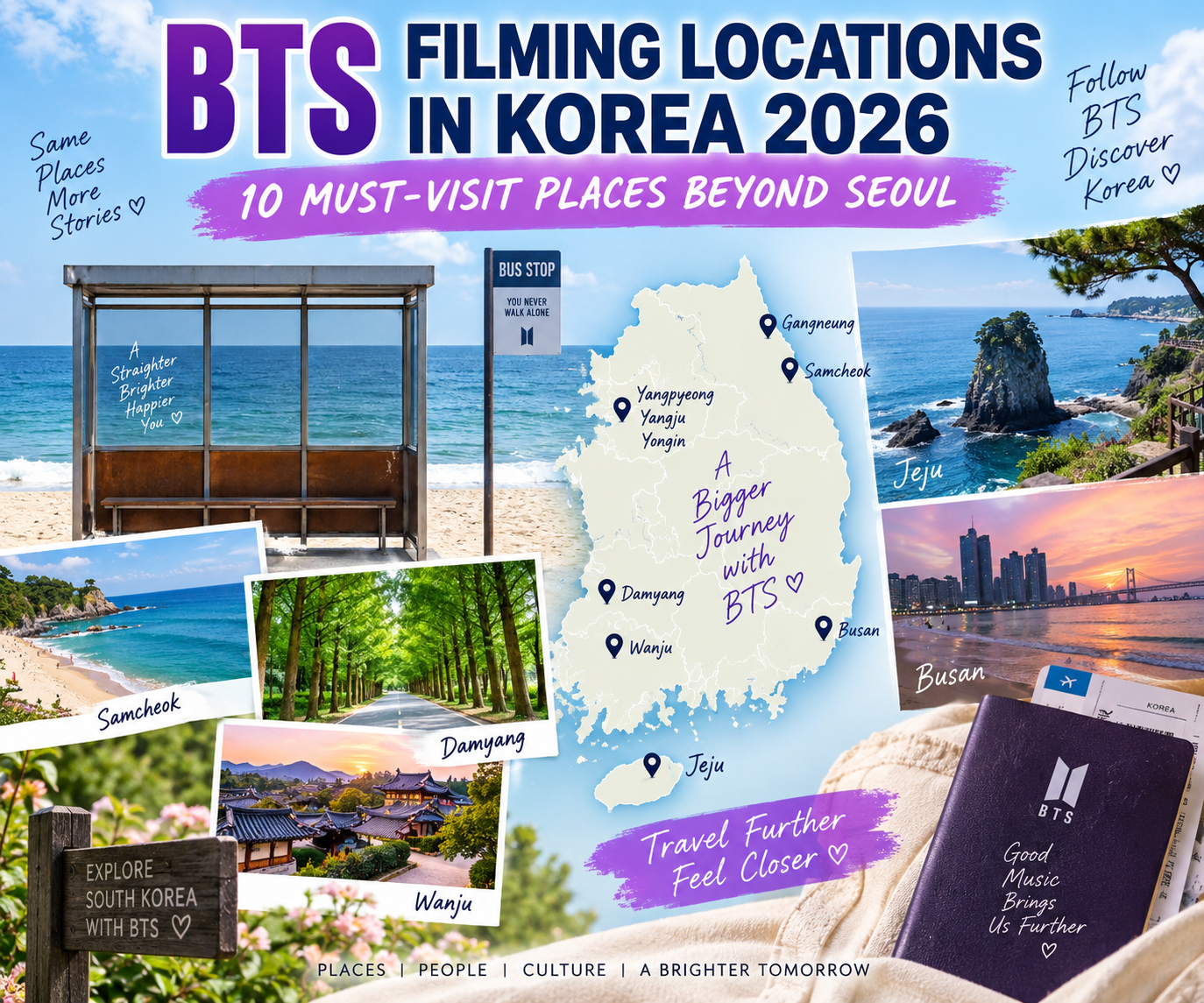
One of the best known is the BTS Bus Stop at Jumunjin Beach in Gangneung, recreated at the location associated with BTS’s You Never Walk Alone album imagery. But Gangneung is only one part of a much larger BTS travel map.
In this guide, we’ll explore 10 BTS-related locations beyond Seoul that ARMY can visit in 2026, along with practical ideas for turning these stops into real Korea travel itineraries.
If you have already explored BTS places in Seoul, consider this your next journey — following the BTS story beyond the capital and discovering more of South Korea along the way.
1. BTS Bus Stop at Jumunjin Beach, Gangneung
The BTS Bus Stop in Jumunjin, Gangneung is one of the most recognizable BTS pilgrimage destinations outside Seoul.
The original bus stop appeared in imagery associated with BTS’s 2017 album You Never Walk Alone. Although the original structure was created for the photo shoot and later removed, a replica was installed at the location for fans and visitors.
Standing beside the blue sea with the beach stretching behind it, the bus stop has become a favorite photo spot for ARMY traveling in Korea. Fans often recreate the album-inspired scene while enjoying the quieter coastal atmosphere of Gangneung.
The location is also an excellent reason to explore more of Korea’s east coast. Jumunjin, Gangneung’s beaches, cafés, seafood restaurants, and other coastal attractions can easily turn a BTS stop into a full-day or overnight trip.
Travel tip: Gangneung is accessible from Seoul by KTX, making the BTS Bus Stop possible as a day trip. However, staying overnight gives you more time to explore the coast without rushing.
2. Maengbang Beach, Samcheok — The “Butter” Album Location
On Korea’s east coast, Maengbang Beach (맹방해변) in Samcheok became internationally known among ARMY after appearing in the concept photography for BTS’s 2021 single album Butter.
The colorful beach setting — including parasols, beach chairs, and the lifeguard-style backdrop — created some of the most recognizable images from the Butter era. The location later became a destination for fans hoping to recreate those photographs.
Maengbang Beach also shows why BTS-themed travel can be a great way to explore Korea beyond the major cities. Samcheok offers beautiful coastline, beaches, and scenic attractions that international travelers might otherwise miss.
For travelers already visiting the BTS Bus Stop in Gangneung, Maengbang Beach can become part of a longer Gangwon east-coast BTS itinerary rather than a separate trip from Seoul.
Travel tip: Gangneung and Samcheok are in the same general east-coast region, but they are not next to each other. Allow sufficient transportation time if you plan to visit both during the same trip.
3. Awon Gotaek, Wanju — A Beautiful BTS “Summer Package” Location
Awon Gotaek (아원고택) in Wanju, Jeollabuk-do, offers a completely different atmosphere from the coastal BTS locations in Gangwon.
The traditional Korean house and surrounding scenery became familiar to ARMY through BTS’s 2019 Summer Package in Korea. Its combination of hanok architecture, mountains, and peaceful countryside made it one of the most visually memorable locations connected to the group’s travel content.
For international visitors, Awon Gotaek is especially interesting because the trip offers more than a BTS photo location. It is also an opportunity to experience traditional Korean architecture and the quieter landscape of rural Korea.
Wanju can be combined with nearby Jeonju, famous for its Hanok Village and Korean food, making this a strong option for travelers who want to turn their BTS pilgrimage into a broader cultural trip.
Travel tip: Check current visitor access and operating information before making the journey, as Awon Gotaek is not simply an always-open public park.
4. Seohuri Forest, Yangpyeong — A Peaceful BTS Photo Location
Seohuri Forest (서후리숲) in Yangpyeong, Gyeonggi-do, is a beautiful woodland destination that became well known among ARMY after BTS visited the area for album photography.
The forest’s tall trees and quiet walking paths create a very different experience from Seoul’s busy BTS landmarks. Fans can enjoy the natural scenery while exploring a place connected to BTS’s earlier years.
Yangpyeong is relatively close to Seoul, making Seohuri Forest an attractive option for travelers who want a countryside escape without traveling across the country.
The area is also known for mountains, rivers, cafés, and scenic drives, so visitors can easily build a relaxing day trip around the BTS-related stop.
Travel tip: Check Seohuri Forest’s current opening days and admission information before traveling, particularly if visiting during winter or periods of bad weather.
5. Iryeong Station, Yangju — A “Spring Day” Filming Location
Iryeong Station (일영역) in Yangju, Gyeonggi-do, is closely associated with BTS’s beloved song “Spring Day.” The station appeared in the music video, making it one of the recognizable BTS filming locations near Seoul.
The quiet railway setting has a nostalgic atmosphere that matches the emotional tone of the song. For many ARMY, visiting the area offers a chance to connect a familiar music-video scene with a real place in Korea.
Yangju is outside central Seoul but close enough to consider as part of a day trip. The surrounding area also gives travelers a glimpse of a quieter side of Gyeonggi Province.
Travel tip: Railway facilities can have access restrictions and operational changes. Check current visitor information before traveling, stay only in permitted areas, and never enter active railway tracks.
6. Yongin Dae Jang Geum Park — Step Into the World of “Daechwita”
Yongin Dae Jang Geum Park (용인 대장금파크) in Gyeonggi-do is a large historical drama filming complex, but BTS fans may recognize its scenery from Agust D’s “Daechwita” music video, featuring SUGA.
Traditional-style streets, palace settings, and historical architecture helped create the dramatic visual world of the music video. For fans of SUGA and BTS, visiting the park offers a chance to experience scenery associated with one of his most memorable solo releases.
The destination is also worthwhile for travelers interested in Korean historical dramas and traditional architecture, making it more than a single-purpose BTS photo stop.
Travel tip: Yongin is accessible from Seoul, but the park is outside the city center. Check current opening hours, admission information, and transportation options before leaving Seoul.
7. Mosan Airfield, Jecheon — A Location from BTS’s Youth Era
Mosan Airfield (모산비행장) in Jecheon, Chungcheongbuk-do, is associated with imagery from BTS’s celebrated The Most Beautiful Moment in Life (HYYH) era.
The wide open landscape and runway-like setting created a distinctive backdrop during an important period in BTS’s artistic development. For longtime ARMY, locations connected to the HYYH era can feel particularly meaningful because of the themes of youth, friendship, uncertainty, and growing up that defined this chapter of BTS history.
Jecheon itself is surrounded by mountains and lakes, making it possible to combine a BTS-related stop with a scenic trip through central Korea.
Travel tip: Access conditions around airfield areas can change. Check current local information before visiting and remain only in areas legally open to the public.
8. Metasequoia-Lined Road, Damyang — A Scenic BTS Travel Stop
Damyang’s Metasequoia-Lined Road (담양 메타세쿼이아길) in Jeollanam-do is known for its long rows of towering trees and picturesque scenery. The Damyang area has also become familiar to BTS fans through content connected to the group.
For international travelers, Damyang is especially appealing because a BTS-inspired trip can easily become a broader journey through southern Korea. The region is famous for bamboo forests, peaceful walking paths, local food, and beautiful natural scenery.
A visit here offers a slower travel experience than Seoul or Busan and can be combined with Juknokwon Bamboo Garden and other Damyang attractions.
Travel tip: Damyang is best treated as part of a regional itinerary rather than a quick trip from Seoul. Consider combining it with Gwangju or other destinations in Jeollanam-do.
9. Dadaepo Beach, Busan — Follow Jimin’s Footsteps by the Sea
Dadaepo Beach (다대포해수욕장) in Busan is especially meaningful for fans of Jimin, who was born in Busan. The beach became familiar to ARMY after Jimin shared photographs from the area, turning it into a popular stop for fans following places connected to the BTS members.
Dadaepo is famous for its wide sandy beach, beautiful sunsets, and relaxed atmosphere. It offers a very different experience from Busan’s busier destinations such as Haeundae and Gwangalli.
For international ARMY, the stop can be combined with a wider BTS-inspired Busan itinerary, while also exploring one of Korea’s most popular coastal cities.
Travel tip: Try to visit in the late afternoon. Dadaepo is particularly beautiful around sunset, and you can combine the trip with other western Busan attractions.
10. Oedolgae Sea Stack, Jeju — A BTS Album Photo Location
Oedolgae Sea Stack (외돌개) in Seogwipo, Jeju Island, is one of the most scenic BTS-related destinations outside Seoul. The dramatic volcanic rock and surrounding coastline appeared in photography connected to BTS’s The Most Beautiful Moment in Life, Part 2 era.
For ARMY, the location offers something especially valuable: it combines BTS history with one of Korea’s most popular travel destinations. Instead of visiting only for a photo, travelers can explore the surrounding Jeju coastline and nearby walking trails while enjoying the island’s volcanic landscape.
Jeju also has several other places connected to BTS members and BTS content, making it possible to build an entire BTS-inspired day into a longer Jeju itinerary.
Travel tip: Oedolgae is in Seogwipo on the southern side of Jeju Island. Plan it together with other southern Jeju attractions rather than traveling there as a single stop.
How to Plan Your BTS Trip Beyond Seoul
These BTS locations are spread across South Korea, so trying to visit them all in one trip would require significant travel time. A better strategy is to group them by region.
For an east-coast trip, combine Gangneung’s BTS Bus Stop with Samcheok’s Maengbang Beach and spend one or two nights exploring Gangwon-do.
For locations closer to Seoul, Yangpyeong, Yangju, and Yongin can be planned as separate day trips depending on transportation and opening conditions.
In the southwest, combine Wanju with Jeonju, while Damyang works well as part of a trip through Gwangju and Jeollanam-do.
Busan and Jeju deserve longer stays. Rather than visiting only for a BTS-related photo, use these locations as starting points for exploring Korea’s beaches, food, neighborhoods, and natural scenery.
This approach turns a BTS pilgrimage into something even better: a journey through different regions of South Korea.
Frequently Asked Questions About BTS Filming Locations in Korea
What is the most famous BTS location outside Seoul?
The BTS Bus Stop near Jumunjin in Gangneung is one of the best-known BTS pilgrimage spots in Korea, especially because of its connection to the You Never Walk Alone album imagery.
Can I visit the BTS Bus Stop from Seoul?
Yes. Gangneung can be reached from Seoul by KTX, and travelers can continue to the Jumunjin area using local transportation. An overnight stay is worth considering if you want to explore more of Gangneung.
Where was BTS’s “Butter” concept photography taken?
Maengbang Beach in Samcheok became famous among ARMY through BTS’s Butter concept photography.
Are there BTS filming locations near Seoul?
Yes. Locations in Gyeonggi-do, including Yangpyeong, Yangju, and Yongin, can be incorporated into trips from Seoul, although travel times and public transportation options vary.
Are there BTS-related places in Jeju?
Yes. Jeju has locations connected to BTS content, including Oedolgae in Seogwipo, which is associated with BTS album photography.
Should I rent a car for a BTS pilgrimage outside Seoul?
It depends on the destination. Major cities such as Gangneung and Busan are accessible by public transportation, but some rural filming locations can be considerably easier to reach by car. International visitors should compare train, bus, taxi, tour, and rental-car options before planning each regional itinerary.
Final Thoughts
Following BTS filming locations beyond Seoul is also a wonderful way to discover how diverse South Korea really is.
From the blue coastline of Gangneung and Samcheok to the forests of Yangpyeong, traditional scenery around Wanju, beaches in Busan, and the volcanic landscape of Jeju, each destination offers something beyond its BTS connection.
For ARMY, these places can bring familiar albums, videos, and BTS memories into the real world. For travelers, they can also become gateways to Korean food, nature, regional culture, and destinations that many first-time visitors never experience.
So don’t rush simply to recreate a photograph. Stay a little longer, explore the surrounding area, and let your BTS pilgrimage become part of a bigger journey through Korea.