
Tag: Gimhae Airport

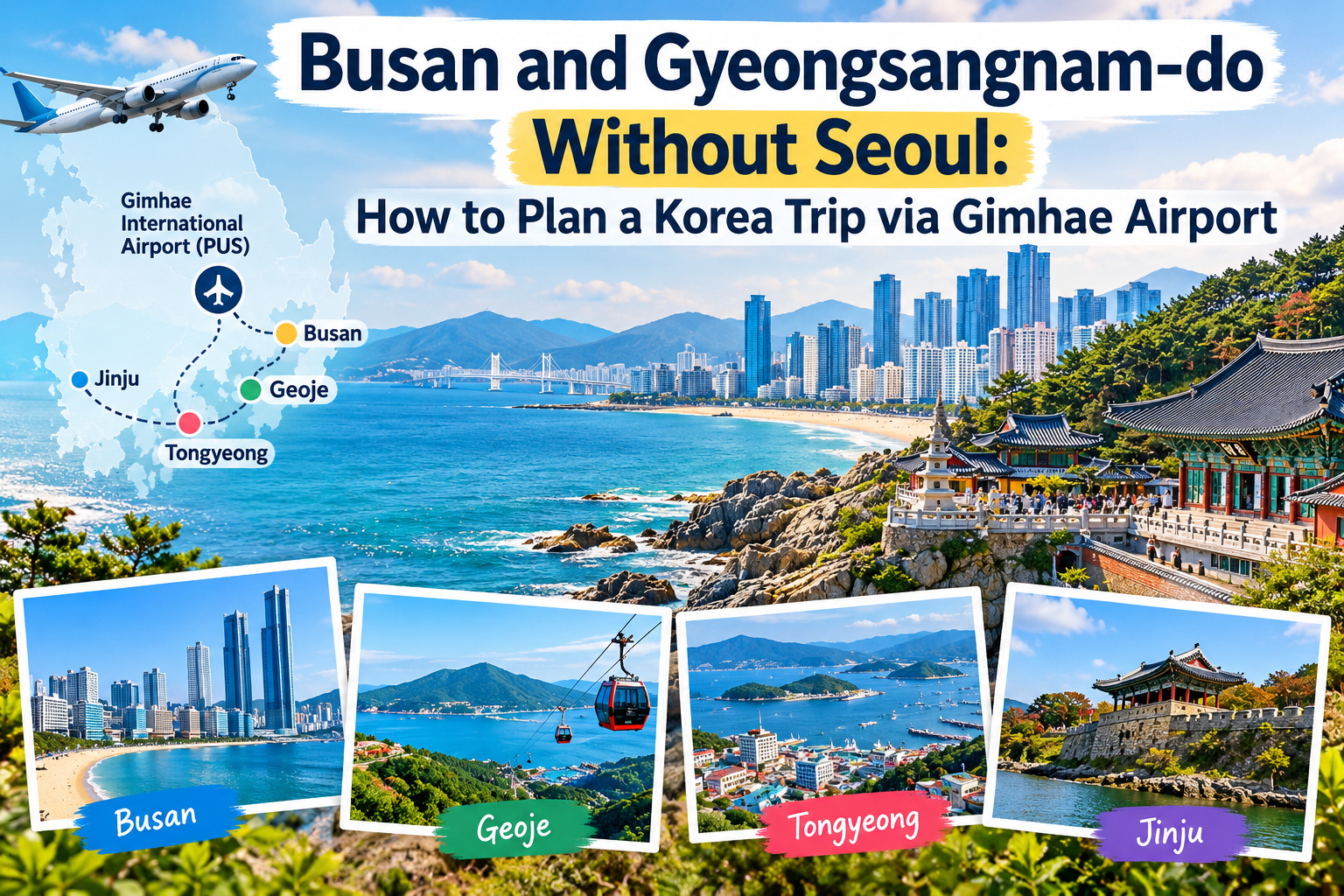
  • Busan and Gyeongsangnam-do Without Seoul: How to Plan a Korea Trip via Gimhae Airport

    Busan and Gyeongsangnam-do Without Seoul: How to Plan a Korea Trip via Gimhae Airport

    Most first-time visitors to South Korea automatically think of flying into Seoul. But if your trip is focused on Busan and southern Korea, starting at Gimhae International Airport can save you a surprising amount of time.

    Gimhae Airport gives international travelers direct access to Busan and Gyeongsangnam-do, making it possible to build an entire Korea itinerary without traveling through Seoul first.

    You could spend a few days exploring Busan, continue to coastal cities such as Geoje and Tongyeong, visit historic Jinju, or travel farther into the southern part of Korea before returning to Gimhae Airport.

    Here is how to plan a Busan and Gyeongsangnam-do trip via Gimhae International Airport in 2026.

    Why Start Your Korea Trip at Gimhae Airport?

    Gimhae International Airport (PUS) is the main international gateway for Busan and southeastern Korea.

    For travelers whose main destinations are Busan and Gyeongsangnam-do, arriving here can be much more convenient than flying into Seoul and then traveling several hours south.

    This route makes particular sense if you want to focus on:

    • Busan
    • Geoje
    • Tongyeong
    • Jinju
    • other destinations in Gyeongsangnam-do

    It can also work well for travelers returning home through Gimhae Airport, allowing you to create a southern Korea itinerary without backtracking to Seoul.

    First Stop: Spend 2–4 Days in Busan

    For most international travelers, Busan is the easiest place to begin.

    After arriving at Gimhae Airport, head into the city and use Busan as your first base.

    Popular areas to stay include:

    Haeundae

    Choose Haeundae if beaches, ocean views, cafes and coastal attractions are your priorities.

    It works especially well for travelers who want to visit Haeundae Beach, Dongbaekseom, Cheongsapo and the eastern coastline.

    Seomyeon

    Seomyeon is a convenient choice if transportation and nightlife matter more than staying next to the beach.

    Its central location makes it relatively easy to travel to different parts of Busan.

    Busan Station

    Staying near Busan Station can be useful if you plan to continue your trip by train.

    It also gives you convenient access to areas such as Nampo, Jagalchi Market and the older downtown districts.

    If you need detailed transportation instructions after landing, see our Gimhae Airport to Busan guide for ways to reach Haeundae, Seomyeon and Busan Station.

    How Many Days Do You Need in Busan?

    For a southern Korea itinerary, I would generally allow at least two full days in Busan, with three or four days being more comfortable.

    A simple first visit could look like this:

    Day 1: Haeundae and the eastern coastline
    Day 2: Nampo, Jagalchi and Gamcheon
    Day 3: Additional coastal attractions, temples, markets or neighborhoods

    Instead of trying to see every famous attraction, group places geographically. Busan is a large city, and crossing from one side to the other can take longer than first-time visitors expect.

    Where Should You Go After Busan?

    This is where starting at Gimhae Airport becomes especially interesting.

    Rather than returning north toward Seoul, you can continue into Gyeongsangnam-do, the province surrounding much of Busan.

    Several destinations work particularly well.

    Option 1: Geoje

    Geoje is a good choice for travelers interested in dramatic coastal scenery and islands.

    The area is known for its coastline, viewpoints and access to nearby islands.

    Compared with Busan, Geoje feels less urban and gives your trip a more relaxed coastal character.

    It can work well as a one- or two-night stop after Busan.

    Who should choose Geoje?

    Geoje is especially suitable if you prefer:

    • coastal scenery
    • island landscapes
    • slower travel
    • scenic drives
    • nature rather than big-city attractions

    Travelers who want a Busan trip with a quieter second half may find Geoje particularly appealing.

    Option 2: Tongyeong

    Tongyeong is another strong addition to a southern Korea itinerary.

    It is a compact coastal city surrounded by islands and is known for harbor views, seafood and scenic landscapes.

    For travelers who enjoy smaller cities, Tongyeong provides a very different atmosphere from Busan.

    A typical itinerary might be:

    Busan → Geoje → Tongyeong

    or simply:

    Busan → Tongyeong

    if you have limited time.

    Tongyeong is worth considering for at least one night rather than treating it only as a rushed day trip.

    Option 3: Jinju

    If you want to add history rather than another coastal destination, consider Jinju.

    The city’s best-known historic landmark is Jinjuseong Fortress, which played an important role during the Japanese invasions of Korea in the late 16th century.

    Jinju provides a useful contrast to Busan, Geoje and Tongyeong because the focus shifts from beaches and coastal scenery toward history and local culture.

    It can therefore fit nicely into a longer southern itinerary.

    Busan + Gyeongsangnam-do: Sample 5-Day Itinerary

    If you only have five days, keep the route simple.

    Day 1 — Arrive at Gimhae Airport

    Travel into Busan, check into your hotel and explore the neighborhood around your accommodation.

    Avoid planning too much for arrival day, especially after a long international flight.

    Day 2 — Explore Busan

    Choose one side of the city rather than trying to cross Busan repeatedly.

    For example, spend the day around Haeundae and the eastern coastline.

    Day 3 — Explore More of Busan

    Visit the Nampo and Jagalchi area or another part of the city you missed on Day 2.

    Day 4 — Gyeongsangnam-do

    Travel to either Geoje, Tongyeong or Jinju.

    With only five days, choose one rather than trying to visit all three.

    Stay overnight if possible.

    Day 5 — Return Toward Gimhae Airport

    Travel back toward Busan or Gimhae Airport depending on your flight time.

    If you have an early international departure, returning to Busan the night before may make the final day less stressful.

    A Better 7-Day Southern Korea Itinerary

    Seven days gives you much more flexibility.

    One possible route is:

    Day 1: Arrive at Gimhae Airport → Busan
    Day 2: Busan
    Day 3: Busan
    Day 4: Busan → Geoje
    Day 5: Geoje → Tongyeong
    Day 6: Tongyeong → Busan
    Day 7: Busan → Gimhae Airport

    Another option is:

    Gimhae Airport → Busan → Tongyeong → Jinju → Busan → Gimhae Airport

    The better route depends on whether you prefer coastal scenery or history and city exploration.

    Do You Need a Rental Car?

    Not necessarily.

    Busan itself has an extensive public transportation network, so renting a car solely for sightseeing in Busan is usually unnecessary.

    Intercity buses also connect Busan with many cities in Gyeongsangnam-do.

    However, a rental car can become more useful once you leave Busan, particularly if you want to visit smaller coastal attractions or move between places that are inconvenient by public transportation.

    Public transportation is better if:

    • you mainly visit cities
    • you do not want to drive in Korea
    • your itinerary is Busan plus one or two major destinations
    • you are comfortable using intercity buses

    A rental car may be better if:

    • you want to explore rural or coastal areas
    • you have several countryside stops
    • you are traveling with family or significant luggage
    • flexibility matters more than minimizing costs

    International visitors planning to drive should check Korea’s current license and International Driving Permit requirements before their trip.

    Train or Bus for Gyeongsangnam-do?

    One important planning mistake is assuming that trains are always the easiest way to travel around Korea.

    South Korea has an excellent rail system, but intercity buses can be more practical for some destinations in Gyeongsangnam-do.

    The best option depends on the exact city.

    For destinations such as Tongyeong and Geoje, buses are often particularly useful because rail access is limited compared with major railway cities.

    Always compare the complete journey rather than simply choosing the fastest-looking train.

    Should You Visit Seoul on the Same Trip?

    You certainly can, but you do not have to.

    If this is your first trip to Korea and you have ten days or more, combining Seoul and Busan may still make sense.

    But travelers with only five to seven days sometimes spend too much of their vacation moving between cities.

    If beaches, seafood, coastal scenery and southern Korea are your priorities, a trip focused entirely on Busan and Gyeongsangnam-do can be a worthwhile alternative.

    This is particularly true if you can fly directly to Gimhae Airport.

    Who Is This Route Best For?

    A Gimhae-based itinerary works particularly well for:

    • travelers who have already visited Seoul
    • repeat visitors looking for a different side of Korea
    • travelers interested in Busan and the southern coast
    • visitors with direct flights to Gimhae Airport
    • people who prefer slower regional travel
    • travelers who want to combine a major city with smaller coastal destinations

    It may be less suitable if most of the attractions on your wish list are in Seoul, northern Korea or the Seoul metropolitan area.

    Practical Tips Before You Go

    Check your international flight options first

    Direct international routes to Gimhae Airport vary depending on your departure city and travel date.

    Check the actual flight schedule before building the rest of your itinerary.

    Do not underestimate Busan travel times

    Busan is geographically spread out.

    Two attractions that both appear to be “in Busan” can still require a substantial journey between them.

    Keep your final night flexible

    If you have an early flight from Gimhae Airport, consider spending your final night in Busan rather than traveling from a distant city on departure morning.

    Check bus schedules before changing cities

    Intercity transportation frequencies can vary by destination and day.

    Check current schedules close to your travel date rather than relying solely on an old itinerary online.

    Travel lighter if possible

    A regional trip involving buses and multiple hotels is much easier with manageable luggage.

    FAQ

    Can I travel to Korea without visiting Seoul?

    Absolutely. Seoul is not required for every Korea itinerary. Travelers focused on southern Korea can arrive through Gimhae International Airport and build a trip around Busan and Gyeongsangnam-do.

    Is Gimhae Airport actually in Busan?

    Gimhae International Airport serves Busan and the surrounding region and is located on the western side of Busan, despite the “Gimhae” name.

    How many days should I spend in Busan?

    For a first visit, around three days is a useful starting point. Two days can work for a short trip, while four or more allows for a slower itinerary.

    Can I visit Tongyeong from Busan?

    Yes. Busan and Tongyeong are connected by intercity transportation, making Tongyeong a practical addition to a southern Korea itinerary.

    Should I choose Geoje or Tongyeong?

    Choose Geoje if island scenery and exploring the coastline are your priority. Tongyeong may suit travelers who prefer a compact coastal city with harbor views, food and easy access to scenic attractions.

    Do I need a car to explore Gyeongsangnam-do?

    No. Major cities can be reached by public transportation. A car becomes more useful if you want to explore rural areas, remote viewpoints or multiple smaller attractions.

    Final Thoughts

    For international visitors, Korea does not have to mean Seoul first, everywhere else second.

    If your interests are concentrated in the south, Gimhae International Airport can become the starting point for an entirely different Korea itinerary.

    Begin with a few days in Busan, then continue into Gyeongsangnam-do for coastal scenery, smaller cities and regional experiences before returning to Gimhae Airport.

    For a short trip, keep it simple with Busan plus one additional destination.

    With a full week, a route such as Busan → Geoje → Tongyeong → Busan gives you a mix of big-city energy and Korea’s southern coastline without spending a large part of your vacation traveling to and from Seoul.

  • Gimhae Airport to Busan in 2026: Best Ways to Get to Haeundae, Seomyeon and Busan Station

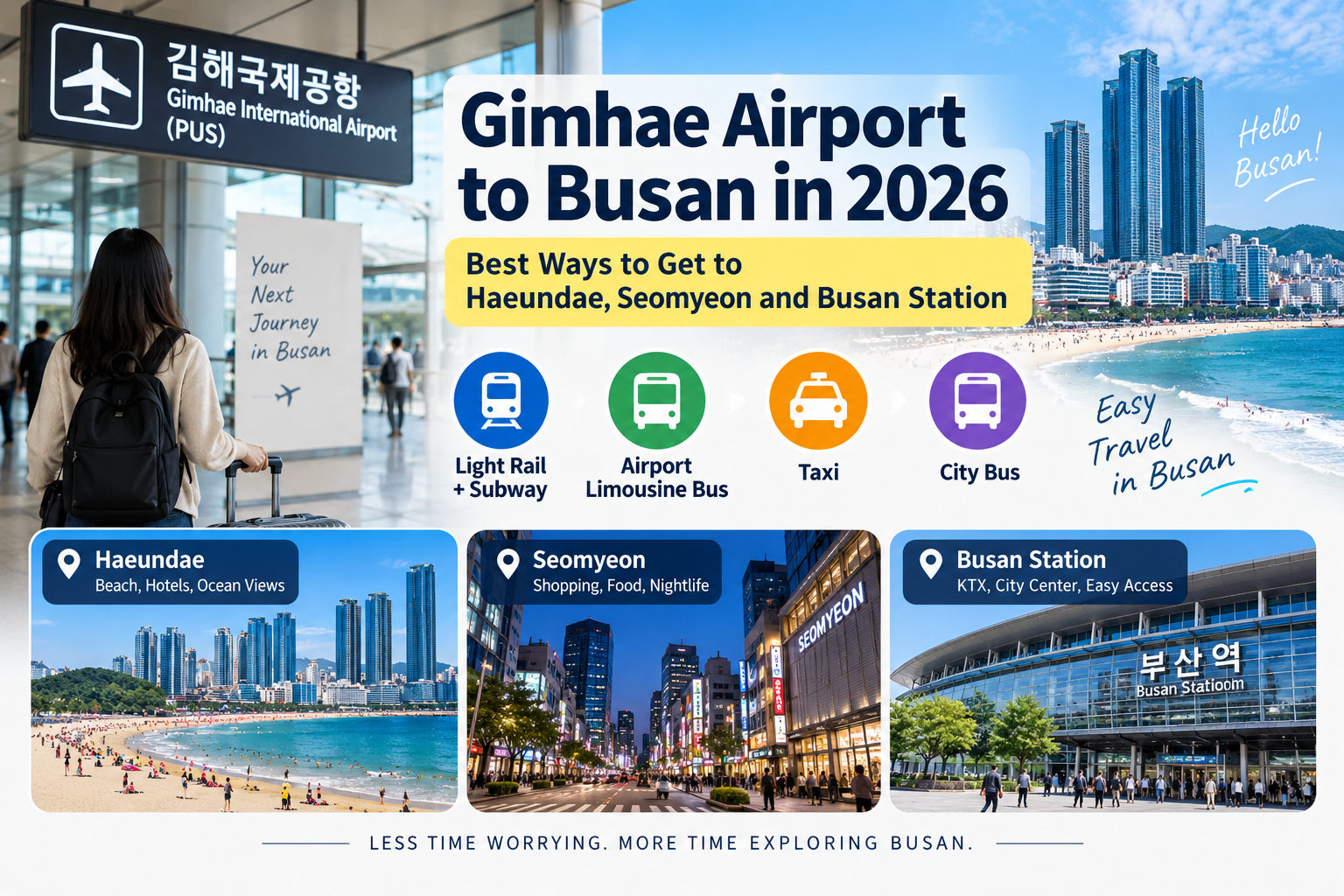
    Gimhae Airport to Busan in 2026: Best Ways to Get to Haeundae, Seomyeon and Busan Station

    Getting from Gimhae Airport to Busan

    Gimhae International Airport (PUS) is the main airport serving Busan and one of the most common entry points for international travelers visiting South Korea’s second-largest city.

    But after landing, many first-time visitors face the same question: What is the best way to get from Gimhae Airport to Haeundae, Seomyeon, Busan Station, or other parts of Busan?

    The answer depends on where you are staying, how much luggage you have, what time you arrive, and whether you prefer the cheapest, easiest, or fastest option.

    In 2026, travelers can choose from several transportation options, including the Busan-Gimhae Light Rail Transit (BGL), subway connections, airport limousine buses, regular city buses, and taxis. Busan has also been expanding payment and transportation services for international visitors, making it easier to travel around the city without a car.

    This guide compares the main ways to travel from Gimhae Airport to central Busan and explains which option makes the most sense for popular destinations such as Haeundae, Seomyeon, and Busan Station.

    Quick Comparison: Gimhae Airport to Busan

    Here is the simplest way to think about your options:

    TransportationBest ForMain Advantage
    Light Rail + SubwayBudget travelersAffordable and reliable
    Airport Limousine BusTravelers with luggageFewer transfers
    City BusBudget-conscious travelers on suitable routesLow cost
    TaxiFamilies, groups, late arrivalsDoor-to-door convenience

    For many travelers with light luggage, the light rail and subway are the most economical choices. If you have large suitcases, however, avoiding multiple transfers can be worth paying more for a limousine bus or taxi.

    The best option also changes depending on your destination. Seomyeon is relatively convenient by rail, while Haeundae is farther from the airport and may be more comfortable to reach by a direct or low-transfer option.

    Option 1: Light Rail and Subway — Best for Budget Travelers

    For many visitors, the Busan-Gimhae Light Rail Transit (BGL) is the most practical low-cost way to leave Gimhae International Airport.

    The airport station is connected to the passenger terminals, and the light rail takes you to Sasang Station, where you can transfer to Busan Metro Line 2. From there, you can continue toward major areas including Seomyeon, Gwangan, and Haeundae.

    How It Works

    The basic route is:

    Gimhae International Airport → Sasang Station → Busan Metro

    At Sasang, your next route depends on your destination.

    For Seomyeon, continue on Metro Line 2 toward the city center.

    For Haeundae, stay on Line 2 after transferring at Sasang and continue east toward Haeundae Station.

    For Busan Station, you will need another subway transfer because Busan Station is on Metro Line 1.

    Why Choose the Light Rail and Subway?

    The biggest advantages are predictable travel times and relatively low transportation costs. You also avoid road traffic, which can make bus or taxi travel slower during busy periods.

    This option works particularly well if:

    • you are traveling alone or as a couple;
    • you have a small suitcase or backpack;
    • you arrive while the rail system is operating;
    • saving money is more important than door-to-door convenience.

    The main disadvantage is luggage. Carrying a large suitcase through stations, platforms, elevators, and transfers can become tiring after a long flight.

    Practical Tip for First-Time Visitors

    Before leaving the airport, check your hotel’s nearest subway station, not just the neighborhood name.

    Busan is spread across a large area, and two hotels described as being in the same general district can require very different final transfers or walks.

    A few minutes spent checking the exact station can make the trip from the airport much easier.

    Option 2: Airport Limousine Bus — Best for Travelers with Luggage

    If you are carrying a large suitcase, an airport limousine bus can be more comfortable than transferring between the light rail and subway.

    Busan reorganized its Gimhae Airport limousine services in 2026, with routes connecting the airport to important visitor areas including Seomyeon and Haeundae.

    The biggest advantage is simple: fewer transfers with your luggage.

    Gimhae Airport to Haeundae

    Haeundae is one of Busan’s most popular areas for international visitors, but it is relatively far from Gimhae Airport.

    Using the light rail and subway is possible, but the journey can feel long after an international flight. A limousine bus can therefore be an attractive option for travelers staying around Haeundae, especially when traveling with suitcases.

    Depending on the route and stop, services may also be useful for travelers staying around Centum City, eastern Busan, or nearby coastal areas.

    Gimhae Airport to Seomyeon

    Seomyeon is much more central and is one of the most convenient bases for first-time visitors to Busan.

    Travelers can reach it by light rail and subway, but the airport limousine service provides another option for visitors who would rather reduce transfers.

    This can be particularly useful if your accommodation is reasonably close to a limousine bus stop.

    Check the Current Schedule Before You Travel

    Airport bus routes, stops, fares, and operating schedules can change.

    Before your flight, check the latest information from Gimhae International Airport or the relevant Busan transportation service, especially if you plan to arrive early in the morning or late at night.

    Do not choose a hotel solely because an airport bus currently stops nearby. Transportation services can be adjusted, while the subway network is generally a more permanent part of the city’s infrastructure.

    Option 3: Taxi — Best for Convenience, Families and Late Arrivals

    A taxi is usually the easiest option if you want to travel directly from Gimhae Airport to your hotel without transfers.

    This can make sense for families, small groups, travelers with several suitcases, or passengers arriving after a long flight.

    The main benefit is door-to-door convenience. Instead of navigating stations with luggage, you can leave the airport and travel directly to your accommodation.

    When Is a Taxi Worth It?

    A taxi becomes more attractive when the fare is shared between several people.

    For a solo traveler, public transportation will usually be much cheaper. For three or four travelers, however, the difference per person may be easier to justify, especially when luggage and convenience are considered.

    Travel time and fare will depend on your destination and traffic conditions. Haeundae is considerably farther from the airport than areas such as Seomyeon, so avoid relying on one fixed taxi price when planning your budget.

    It is useful to have your hotel name and address available in Korean as well as English. Showing the exact location on a map can also help avoid confusion.

    Option 4: City Bus — Useful, but Not Always the Easiest First Choice

    Regular city buses can provide inexpensive connections between Gimhae Airport and parts of Busan.

    They may work well when a route happens to stop near your accommodation, but they are not automatically the best choice for every international traveler.

    Compared with the subway, bus routes can be more difficult for a first-time visitor to understand, and traveling with a large suitcase may be inconvenient.

    For most first-time visitors, the decision is therefore simple:

    Use the rail system when you want an inexpensive and predictable trip, choose an airport limousine when its route works well for your hotel, and consider a taxi when convenience matters most.

    City buses become more useful once you know exactly which route serves your destination.

    Best Transportation by Destination

    The easiest airport transfer depends heavily on where you are staying. Here is how to think about three of the most common destinations for international visitors.

    Gimhae Airport to Haeundae

    Haeundae is one of the farthest major tourist areas from Gimhae Airport.

    If you are traveling light and want to save money, take the light rail to Sasang and transfer to Metro Line 2 toward Haeundae.

    If you have large luggage, check whether the current airport limousine route has a convenient stop near your hotel. A taxi is another comfortable choice, particularly for families or groups who can share the fare.

    Best for budget travelers: Light rail + Metro Line 2
    Best for heavy luggage: Airport limousine, when the route suits your hotel
    Best for maximum convenience: Taxi

    Gimhae Airport to Seomyeon

    Seomyeon is one of the easiest areas to reach from the airport and an excellent transportation hub for exploring Busan.

    A practical public-transport route is Gimhae Airport → Sasang → Metro Line 2 → Seomyeon.

    Because Seomyeon is closer to the airport than Haeundae, it is also a more reasonable taxi destination for travelers who prioritize convenience.

    If an airport limousine stop is close to your accommodation, compare that option with the rail route before traveling.

    Best for most budget-conscious visitors: Light rail + Metro Line 2
    Best with several suitcases: Limousine bus or taxi

    Gimhae Airport to Busan Station

    Busan Station is particularly useful for travelers connecting to KTX trains or staying in the older central part of Busan.

    Unlike Seomyeon and Haeundae, Busan Station is on Metro Line 1, so a rail journey from the airport requires an additional subway transfer after entering Busan’s metro network.

    If you have large luggage or need to catch a train, a taxi may be worth considering because it reduces the risk and inconvenience of moving between multiple stations.

    Always leave extra time when connecting to a KTX train. Flight delays, immigration, baggage collection, traffic, and unfamiliar public transportation can all make a tightly planned connection stressful.

    Best for low cost: Light rail + subway
    Best for luggage or a time-sensitive train connection: Taxi

    Paying for Transportation from Gimhae Airport

    Having a payment plan before leaving the airport can make your first journey in Busan much easier.

    For public transportation, travelers commonly use a reloadable transportation card such as T-money or Cashbee. These cards can be useful not only in Busan but also on public transportation in other parts of South Korea.

    If you already purchased a transportation card earlier in your Korea trip, you generally do not need a separate card simply because you have arrived in Busan.

    However, do not assume that every ticket machine, bus, taxi, or transportation service accepts exactly the same foreign card or mobile payment method. Korea continues to expand cashless payment options, but keeping a small amount of Korean won available can still be useful.

    What If You Arrive Late at Night?

    Late arrival changes the decision.

    Rail and bus services do not operate 24 hours a day, so travelers landing late should check the last available public transportation connection for their specific arrival date.

    Remember that your flight’s scheduled landing time is not the time you will leave the terminal. Immigration, baggage claim, customs, and finding your way through an unfamiliar airport all take additional time.

    If your arrival is close to the final public transportation services, a taxi may be the safer and simpler option.

    Traveling with Large Luggage

    Do not choose transportation based only on the cheapest fare.

    A route that looks easy on a map can become much less convenient when you are carrying a large suitcase through transfers, elevators, station exits, and crowded trains.

    Before choosing your airport transfer, consider:

    • how many times you need to transfer;
    • how far your hotel is from the final station or stop;
    • whether you are traveling with children;
    • how many suitcases your group has;
    • and whether you will be traveling during a busy commuting period.

    For travelers with significant luggage, paying more for a lower-transfer option can be one of the most worthwhile transportation decisions of the trip.

    Which Option Should You Choose?

    There is no single best airport transfer for every traveler. Your destination, luggage, arrival time, and group size matter more than choosing the cheapest option.

    Your SituationRecommended Option
    Solo traveler with light luggageLight rail + subway
    Staying in SeomyeonLight rail + Metro Line 2
    Staying in Haeundae with light luggageLight rail + Metro Line 2
    Staying in Haeundae with large luggageAirport limousine or taxi
    Family or small groupTaxi can be worth comparing
    Connecting to KTX at Busan StationRail if you have enough time; taxi for convenience
    Arriving late at nightCheck final transit times; taxi may be necessary
    Hotel near a limousine stopCompare limousine service with the rail route

    Frequently Asked Questions

    What is the cheapest way from Gimhae Airport to Busan?

    For many destinations, combining the Busan-Gimhae Light Rail Transit with the Busan Metro is one of the most economical and predictable options.

    Is there a subway directly from Gimhae Airport to Haeundae?

    Not directly. You can take the light rail from the airport to Sasang Station, transfer to Busan Metro Line 2, and continue toward Haeundae.

    Is Seomyeon easy to reach from Gimhae Airport?

    Yes. Seomyeon is relatively convenient because you can transfer from the airport light rail to Metro Line 2 at Sasang and continue toward Seomyeon.

    Should I take a taxi from Gimhae Airport?

    A taxi is worth considering if you have heavy luggage, are traveling with children or several people, arrive late, or simply want door-to-door transportation. Solo travelers with light luggage will usually save money by using public transportation.

    Can I use T-money in Busan?

    T-money is widely used on public transportation in Busan. If you already have a transportation card from another part of your Korea trip, check its balance before traveling rather than automatically buying another card.

    How early should I leave Gimhae Airport if I need to catch a KTX train?

    Allow a generous buffer. Immigration, baggage collection, transportation transfers, traffic, and finding the correct platform can all take longer than expected. Avoid planning a tight airport-to-KTX connection.

    Final Thoughts

    Getting from Gimhae International Airport to Busan is not difficult once you choose transportation based on your actual destination.

    For travelers with light luggage, the light rail and subway provide an affordable and dependable way into the city. Travelers carrying large suitcases may prefer an airport limousine bus when its route matches their accommodation, while families, groups, and late-night arrivals may find a taxi worth the additional cost.

    Most importantly, check the exact location of your hotel before choosing your transfer. Busan is a large city, and the best route to Haeundae can be very different from the best route to Seomyeon or Busan Station.

    Transportation routes, schedules, and fares can change, so confirm current operating information shortly before your trip.

    With your airport transfer planned in advance, you can spend less time figuring out transportation after landing and more time enjoying Busan.