Seoul Is a City Best Experienced on Foot
Seoul is often introduced through its skyscrapers, subway system, shopping districts, and fast-moving urban culture. Yet one of the best ways to understand the Korean capital is surprisingly simple:
Walk through it.
Within a single day, you can pass through the gates of a centuries-old royal palace, follow streets lined with traditional architecture, climb toward a viewpoint above the city, and finish the evening beside the Han River.
Few major cities combine history, mountains, parks, and dense urban life in quite the same way.
For first-time visitors, this is important because Seoul should not be experienced only by traveling from one famous attraction to another.
Some of the city’s most memorable moments happen between the attractions.
A palace becomes more meaningful when you explore the neighborhood around it. A mountain trail becomes more interesting when you look down and recognize the city you have been walking through. A riverside park feels different after spending several hours among crowded streets.
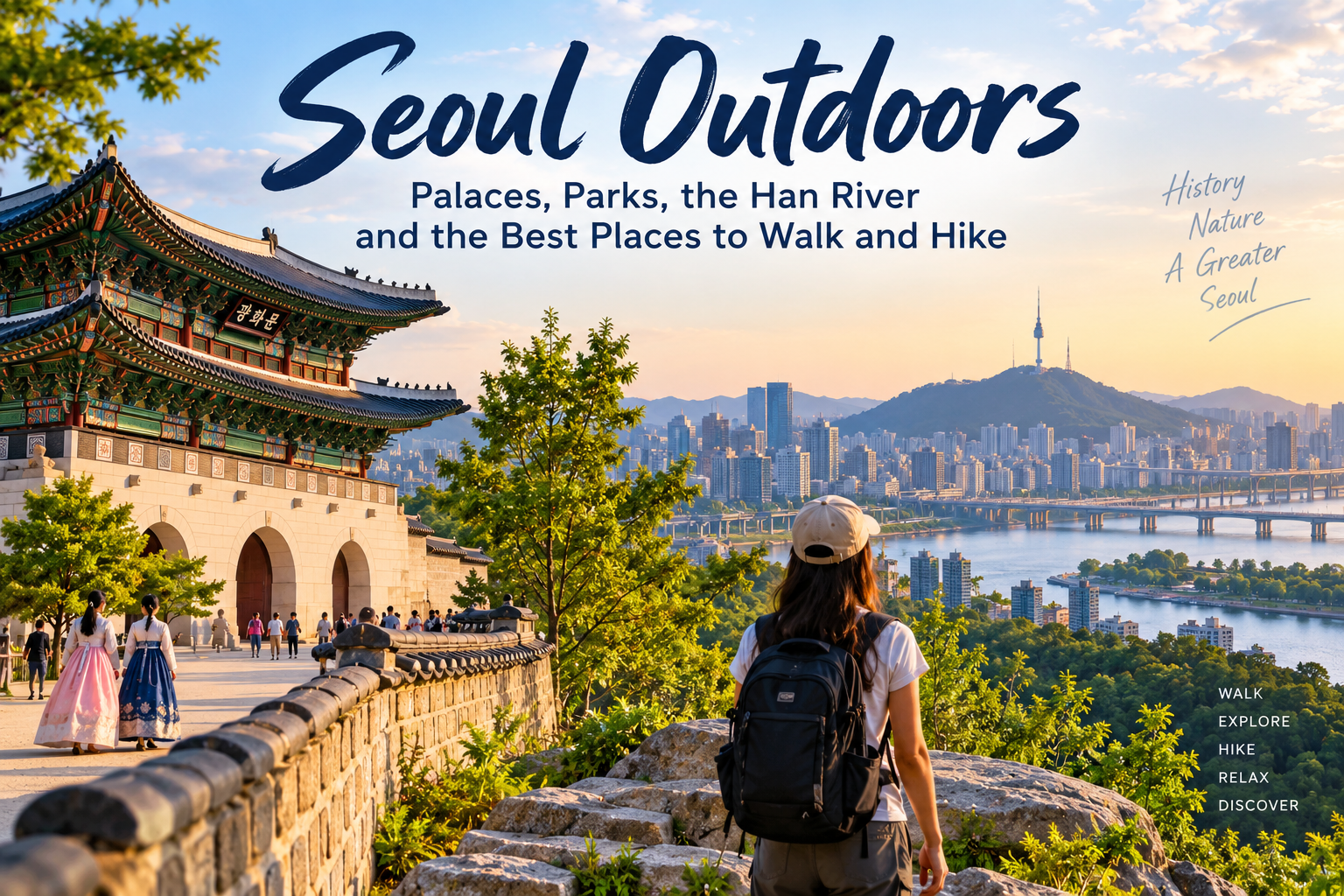
This guide explores the outdoor side of Seoul—from royal palaces and historic walking areas to parks, the Han River, and hiking trails.
The goal is not to create another checklist of “must-see” attractions.
It is to help you choose the kind of Seoul experience that fits your interests, schedule, and physical ability.
Begin with the Royal Palaces of Seoul
For travelers interested in Korean history, Seoul’s royal palaces are among the most important places to visit.
They are not simply beautiful buildings.
They provide a physical connection to the Joseon Dynasty, which ruled Korea for more than five centuries and left a profound influence on the country’s history, culture, architecture, and urban development.
Seoul contains several major royal palaces, and each offers a somewhat different experience.
Gyeongbokgung: The Classic First Palace
For many international visitors, Gyeongbokgung Palace is the natural starting point.
Originally established during the early Joseon period, it served as the dynasty’s principal royal palace.
Today, its large courtyards, gates, halls, mountain backdrop, and ceremonial spaces make it one of Seoul’s most recognizable historical sites.
But there is a better way to visit Gyeongbokgung than simply entering, taking a few photographs, and leaving.
Slow down.
Look beyond the individual buildings and notice how the palace relates to the surrounding landscape.
Mountains rise behind the complex while modern Seoul continues beyond its walls. That contrast between royal architecture, natural scenery, and contemporary city life is part of what makes the palace so memorable.
Travelers interested in traditional Korean clothing will also notice many visitors wearing hanbok around the palace district. Rental shops are common in nearby areas, making the palace visit part of a broader cultural experience for some travelers.
Allow enough time to walk rather than rushing directly between the most photographed locations.
Changdeokgung: Architecture and Landscape Together
If Gyeongbokgung provides the grand introduction, Changdeokgung Palace offers another perspective on royal Seoul.
One of its defining qualities is the relationship between architecture and the natural landscape.
The palace is particularly associated with its historic garden, often known in English as the Secret Garden.
Here, the experience is less about monumental scale and more about the interaction of buildings, trees, paths, water, and changing seasons.
For travelers interested in gardens, architecture, photography, or slower historical exploration, Changdeokgung can be especially rewarding.
Because access arrangements and tour conditions for some palace areas can change, visitors should check current official information before their visit rather than relying on an old itinerary or travel post.
This is a useful rule throughout Korea:
When an attraction has scheduled admissions, guided sections, seasonal restrictions, or limited entry, confirm the latest information before traveling.
Do You Need to Visit Every Palace?
Probably not.
This is where many first-time itineraries become unnecessarily crowded.
Visiting several royal palaces can be rewarding for travelers with a strong interest in Korean history or architecture. But for a short trip, trying to see every palace may reduce each visit to a race.
Instead, consider what you want from the experience.
If this is your first trip and you want a broad introduction to royal Seoul, Gyeongbokgung is an obvious choice.
If gardens, landscape design, and a quieter historical atmosphere interest you, Changdeokgung may deserve more of your time.
Other palaces can then be added according to your schedule and interests.
The goal is not to collect palace names.
The goal is to understand something about the city through them.
From the Palace to the Streets of Historic Seoul
One of the advantages of visiting Seoul’s central palace district is that your historical experience does not have to end at the palace gate.
Nearby areas can be explored on foot, allowing the day to develop naturally.
Bukchon, Insadong, and the streets around the palace districts reveal different layers of Seoul.
Bukchon is widely known for its traditional hanok architecture, but it is important to remember that parts of the area are also residential.
Visitors should therefore treat the neighborhood as a living community rather than an outdoor theme park.
Keep noise down, respect signs and access restrictions, and avoid treating private homes as tourist attractions.
Responsible tourism matters especially in places where residents and visitors share the same narrow streets.
Insadong: Culture, Crafts and an Easy Walking Area
Insadong offers a different atmosphere.
The area has long been associated with traditional crafts, galleries, tea, souvenirs, and cultural experiences.
It can work well as part of the same day as a palace visit because travelers can move from formal royal architecture into a more commercial and pedestrian-oriented cultural district.
Rather than rushing through only the main street, explore carefully.
Small lanes can contain shops, cafés, galleries, and restaurants that are easy to miss when following only the largest crowds.
This is one of the advantages of walking in Seoul:
the route itself becomes part of the attraction.
Cheonggyecheon: A Different Kind of Urban Walk
Not every good walk in Seoul requires a mountain or historic neighborhood.
Cheonggyecheon Stream offers an example of how walking can be incorporated into the center of a dense modern city.
The stream corridor provides a pedestrian route through parts of central Seoul, creating a striking contrast with the traffic and buildings above.
It can be incorporated into a longer day rather than necessarily treated as a destination requiring several hours.
For example, travelers exploring central Seoul can use sections of the stream as a transition between other neighborhoods and attractions.
This approach is often more satisfying than repeatedly entering the subway for very short journeys.
Walking Reveals the Scale of Seoul
There is another reason to explore central Seoul on foot.
Walking teaches you how the city fits together.
When you travel exclusively underground, attractions can feel like isolated points connected by subway stations.
Walking reveals the spaces between them.
You begin to understand where the palace district sits in relation to commercial streets, where older neighborhoods meet modern office areas, and how mountains remain visible even from the center of a huge metropolis.
This geographic understanding becomes useful throughout the rest of your trip.
But Know When Not to Walk
Walking is valuable, but more walking is not automatically better.
Seoul can be hot and humid in summer, cold in winter, and physically demanding when an itinerary includes hills, palace grounds, shopping districts, and long station transfers on the same day.
Pay attention to your energy level.
Comfortable footwear is essential.
Carry appropriate water during warm conditions, prepare suitable clothing for the season, and do not underestimate how much distance you may cover inside large attractions before you even begin walking between them.
A successful walking itinerary should leave you curious about the next place—not exhausted by the previous one.
From Historic Streets to Higher Ground
After exploring Seoul at street level, there is another way to understand the city:
see it from above.
Seoul’s mountains and hills are not distant scenery.
They are part of the city itself.
Some routes provide relatively accessible walks and viewpoints, while others lead into genuine mountain terrain requiring much more preparation.
This makes Seoul unusual for travelers who enjoy both culture and outdoor activities.
You can spend the morning exploring a royal palace and later stand on a trail looking across one of Asia’s largest metropolitan areas.
But choosing the right trail matters.
A relaxed traveler looking for a scenic walk should not automatically choose the same route as an experienced hiker seeking a challenging mountain day.
In the next part, we will compare Seoul’s outdoor options—from Namsan and Inwangsan to Bukhansan, city parks, and the Han River—and look at which experiences are best for different travelers.
Choosing the Right Outdoor Experience in Seoul
One of Seoul’s greatest surprises is how quickly the landscape can change.
You can leave a subway station surrounded by traffic, cafés, offices, and apartment buildings, and before long find yourself walking beneath trees with the city spread out below.
But Seoul’s outdoor experiences are not all the same.
Some are comfortable urban walks suitable for almost anyone. Others involve steep slopes, rocky terrain, long distances, and changing mountain conditions.
Before choosing a route, ask yourself three questions:
How much time do I have? How physically demanding do I want the experience to be? And what kind of view or atmosphere am I looking for?
Those questions are more useful than simply searching for “the best hike in Seoul.”
Namsan: An Accessible Introduction to Walking Above the City
For first-time visitors who want a scenic walk without committing to a serious mountain hike, Namsan is a practical place to consider.
Located near the center of Seoul, Namsan combines greenery, walking routes, city views, and one of the capital’s most recognizable landmarks, N Seoul Tower.
Its central location makes it relatively easy to combine with other sightseeing.
The experience can also be adapted to different travelers. Some may choose a longer uphill walk, while others may prefer an easier approach and spend more time enjoying the views.
That flexibility makes Namsan useful for families, couples, solo travelers, and visitors with limited time.
The best reason to visit, however, is not simply to reach the tower.
As you move higher, Seoul begins to look different.
Dense neighborhoods, roads, distant mountains, and the Han River become parts of one enormous landscape.
After exploring the city from street level, seeing it from above helps put its scale into perspective.
Inwangsan: History, Rock and City Views
Travelers looking for something more adventurous may be interested in Inwangsan.
The mountain rises close to Seoul’s historic center and is known for rocky scenery and impressive views across the city.
Its location creates an unusual combination: a mountain experience that remains closely connected to historic Seoul.
From elevated sections, travelers can appreciate the relationship between palace districts, modern buildings, surrounding mountains, and the wider urban landscape.
Inwangsan can be particularly appealing to visitors who enjoy photography or want a hike that feels more substantial than a city-park walk without necessarily devoting an entire day to a major mountain excursion.
However, “inside Seoul” does not mean “effortless.”
Routes can include slopes, stairs, uneven surfaces, and exposed sections. Weather can also change the difficulty of a walk.
Wear appropriate footwear and choose a route that matches your condition.
Bukhansan: When You Want a Real Mountain Day
For travelers who genuinely enjoy hiking, Bukhansan National Park offers a very different experience.
This is not simply a scenic urban stroll.
Depending on the route, a Bukhansan hike can require significant time, physical effort, appropriate footwear, water, weather awareness, and route planning.
The reward is the opportunity to experience substantial mountain scenery while remaining remarkably close to one of the world’s largest metropolitan areas.
This contrast is one of the reasons hiking in Seoul can be so memorable.
The city does not disappear completely from the experience. Instead, mountain and metropolis exist beside each other.
But visitors should resist choosing a route simply because a photograph looks impressive.
Different trails vary considerably.
A route suitable for an experienced hiker may not be appropriate for a traveler who rarely hikes or who has already spent several exhausting days sightseeing.
Before heading into the mountains, check current trail information, weather conditions, daylight hours, and any temporary restrictions.
Hiking Is Part of Korean Everyday Culture
Visitors may notice something else on Seoul’s mountains: hiking does not feel like a niche activity.
For many Koreans, spending time in the mountains is a familiar form of recreation.
On popular routes, you may see experienced hikers equipped with technical clothing and trekking poles, groups of friends spending the day outdoors, older hikers moving confidently along trails, and families enjoying easier sections.
For an international visitor, hiking can therefore offer more than scenery.
It can provide a glimpse into an important part of everyday leisure culture in Korea.
Respect the trail, give other hikers space, carry your waste out, and avoid assuming that a popular mountain is automatically an easy one.
Trekking or Hiking? Choose the Experience, Not the Label
Travel websites often use words such as “walking,” “trekking,” and “hiking” loosely.
For planning purposes, it is more useful to think in terms of effort.
A riverside walk along the Han River is very different from climbing a steep mountain trail.
A park path is different from a rocky ridge.
A short viewpoint walk is different from a route that takes several hours.
Instead of focusing on the label, consider:
distance, elevation, terrain, weather, time, and your own fitness.
If you are uncertain, choose the easier option first.
Seoul offers enough variety that you do not need to take unnecessary risks to enjoy excellent views.
Seoul’s Parks Offer a Slower Side of the City
Not every outdoor day needs to involve climbing.
Seoul has many parks that provide space to walk, rest, picnic, exercise, or simply take a break from dense commercial districts.
For travelers, parks can be particularly valuable in the middle of a busy itinerary.
After several days of palaces, museums, shopping streets, cafés, and subway transfers, an afternoon in a park can change the rhythm of the trip.
Different parks offer different experiences.
Some are closely connected to the Han River.
Others provide gardens, forests, open lawns, cultural spaces, or views of the city.
Rather than treating parks as empty spaces between “real attractions,” consider them part of Seoul’s everyday identity.
Seoul Forest: Nature Meets a Contemporary Neighborhood
Seoul Forest is a good example of how a park can fit naturally into a wider day of exploration.
The large green space provides walking areas and a break from surrounding urban density.
Its location also makes it possible to combine an outdoor visit with nearby contemporary neighborhoods.
This is particularly useful for travelers who want variety without crossing the entire city several times in one day.
A morning or afternoon in a park can be followed by cafés, shops, restaurants, or other neighborhood experiences.
That combination—nature and contemporary urban culture—is very characteristic of Seoul.
Olympic Park: Space, Walking and Modern Seoul
Olympic Park offers another kind of outdoor experience.
Its large grounds provide room for walking and exploring while also reflecting an important chapter in Seoul’s modern history.
For visitors who enjoy spacious environments, photography, or a slower day away from tightly packed tourist streets, a large urban park can be refreshing.
Again, the value is not necessarily in checking off every landmark inside the park.
Give yourself permission simply to walk.
Travel does not always need to be productive.
The Han River Is Not Just Something to Cross
Many visitors first encounter the Han River through a train or taxi window.
They cross it while traveling between neighborhoods and think of it primarily as geography.
That misses much of its significance.
The river and its surrounding parks form one of Seoul’s most important recreational landscapes.
Residents come to riverside areas to walk, cycle, exercise, meet friends, eat, relax, and watch the city change as daylight fades.
For travelers, spending time beside the river can provide a valuable contrast to palace visits and commercial districts.
It is also an experience that does not necessarily require a complicated itinerary.
Sometimes the point is simply to stop moving.
Choosing a Han River Experience
Because the Han River stretches across a large part of Seoul, there is no single “Han River experience.”
Different riverside parks and neighborhoods offer different views and atmospheres.
Your choice should depend on what else you plan to do that day, how you are traveling, and whether you want to walk, cycle, picnic, photograph the skyline, or simply relax.
This is another reason neighborhood-based planning works better than building an itinerary from disconnected lists.
If your evening plans are already near the river, choose a convenient riverside area rather than traveling across Seoul merely because another park appears on a “Top 10” list.
Daytime and Evening Feel Completely Different
Time of day can transform an outdoor location.
During daylight, parks and riverside paths make it easier to appreciate Seoul’s geography.
Around sunset, the mood begins to change.
As buildings and bridges illuminate, the river becomes part of the city’s nighttime landscape.
Travelers interested in photography may particularly enjoy this transition.
But remember that the best view is not always the most famous viewpoint.
A quieter place where you can sit comfortably may create a better memory than a crowded location visited only because it appeared on social media.
Seasonal Seoul Changes the Outdoor Experience
Outdoor travel in Seoul is highly seasonal.
Spring can bring mild walking conditions and seasonal blossoms, although weather varies.
Summer can be hot, humid, and rainy, making long exposed walks more demanding.
Autumn is popular for hiking and outdoor activities as temperatures cool and foliage changes.
Winter can produce beautiful clear views, but cold temperatures, wind, snow, or icy surfaces can make some routes significantly more difficult.
Do not plan an outdoor itinerary solely from photographs taken during another season.
Check the actual conditions for your visit.
Safety Matters More Than the Perfect Photograph
Seoul is an exciting city for outdoor exploration, but basic preparation still matters.
Wear shoes appropriate for the route.
Carry water when necessary.
Protect yourself from strong sun or cold conditions.
Check the weather before mountain activities.
Pay attention to daylight when planning longer hikes.
Do not leave established routes simply to reach a better photography position.
And if conditions are worse than expected, changing your plan is not a failed travel day.
There will always be another park, neighborhood, museum, café, market, or walking route to explore.
Build an Outdoor Day That Fits You
There is no single ideal outdoor itinerary for Seoul.
A traveler who enjoys serious hiking may happily spend much of a day at Bukhansan.
Someone interested in history and moderate walking might prefer a palace followed by Inwangsan.
A family may enjoy a park and an easy riverside evening.
A traveler recovering from jet lag may prefer Namsan and a relaxed dinner nearby.
All of these can be good Seoul experiences.
The important question is not:
“What does everyone else visit?”
It is:
“What kind of day do I want to have?”
In the final part, we will bring these experiences together into practical Seoul itineraries—combining palaces, walking routes, parks, mountains, and the Han River without spending half the day traveling back and forth across the city.
Turn Seoul’s Outdoor Attractions into a Realistic Itinerary
Knowing where to go is only half of travel planning.
The harder question is how to combine those places into a day that feels enjoyable rather than exhausting.
Seoul makes this especially important because distances can be deceptive. Two attractions may both be described as being “in central Seoul” while still requiring significant walking or transportation between them.
The best outdoor itineraries usually have a simple structure:
Choose one main experience, add one or two nearby activities, and leave enough time to enjoy them.
If a mountain hike is the main event, do not surround it with several demanding attractions.
If a palace is your priority, explore the surrounding historic area rather than immediately crossing the city.
If the Han River is where you want to spend the evening, organize the afternoon so that you gradually move toward it.
Good itinerary design is less about fitting more into the day and more about reducing unnecessary movement.
Itinerary Idea 1: A Historic Seoul Walking Day
For travelers visiting Seoul for the first time, a historic walking day can be one of the most rewarding introductions to the city.
Begin with a royal palace in the morning.
Starting earlier can give you more time to explore the grounds before moving into nearby neighborhoods.
After the palace, continue toward a traditional or cultural district such as Bukchon or Insadong, depending on your interests and current visitor conditions.
Stop for lunch rather than treating food as something to squeeze between attractions.
Then spend part of the afternoon walking through central Seoul.
A section of Cheonggyecheon can provide a pleasant change of pace before you continue toward another neighborhood, café, market, or cultural attraction.
This kind of day works because the experiences share a geographic and historical relationship.
You are not simply visiting several places.
You are following a story through the city.
Itinerary Idea 2: Palace and Inwangsan for History with a View
Travelers who enjoy both history and moderate physical activity can build a day around central Seoul and Inwangsan.
Begin with a palace or historic neighborhood while your energy is high.
Afterward, allow time for food and a break before beginning the more physical part of the day.
The mountain experience then changes your perspective.
Places you encountered at street level become part of a wider landscape.
Historic Seoul, modern buildings, roads, mountains, and dense neighborhoods can all become visible within the same view.
This is one of the most rewarding ways to understand Seoul geographically.
However, do not treat the mountain as an automatic extension of sightseeing.
Check the weather and current route conditions first, and be prepared to change plans if the trail is unsuitable.
Itinerary Idea 3: A Full Hiking Day at Bukhansan
If hiking is one of the main reasons you are excited about Seoul, give Bukhansan the time it deserves.
Do not plan a demanding mountain route as a short activity between shopping and dinner reservations.
Prepare for it as a genuine outdoor day.
Choose a route appropriate for your experience.
Check transportation to and from the trail area.
Carry what you need for the expected conditions.
Start with enough daylight.
And leave flexibility in your evening schedule.
After a substantial hike, you may not want to cross Seoul for several additional attractions.
A relaxed meal and an early evening can be a better ending.
For experienced hikers, the mountain itself may become one of the highlights of a Seoul trip—not because it is another famous destination, but because it reveals how closely nature and urban life coexist in Korea’s capital.
Itinerary Idea 4: Seoul Forest and Contemporary Seoul
Not every outdoor itinerary needs to focus on history or mountains.
A slower day can begin at Seoul Forest.
Spend time walking through the park before exploring the surrounding urban area.
This combination is useful for travelers who enjoy contemporary neighborhoods, cafés, design, fashion, and relaxed walking more than traditional sightseeing.
It also demonstrates something important about Seoul.
The city’s outdoor spaces are not separate from its modern culture.
A park, café district, shopping area, and residential neighborhood can all form part of the same experience.
This type of itinerary works particularly well after a demanding sightseeing day.
Itinerary Idea 5: Save the Han River for the Evening
For many travelers, the Han River works beautifully as the final experience of the day.
Spend the morning and afternoon exploring another part of Seoul, then move toward a convenient riverside park later.
Walk.
Sit.
Watch cyclists and runners pass.
Look across the water as the city begins to illuminate.
The experience does not need an elaborate schedule.
In fact, overplanning can defeat the purpose.
After days of trying to understand subway lines, opening hours, attractions, and neighborhoods, the river can be a place where you simply enjoy being in Seoul.
That slower moment may become one of the most memorable parts of the trip.
For Families: Choose Flexibility Over Distance
Families traveling with children may benefit from shorter outdoor experiences and easy alternatives.
A park, palace, accessible walking route, or Han River visit can provide flexibility that a demanding mountain itinerary cannot.
Children may become tired earlier than expected, weather may change, and meal or rest breaks may take longer.
Build the day around one important experience and allow the rest to remain flexible.
The goal is not to complete an itinerary designed for adults traveling alone.
It is to create a day the whole family can enjoy.
For Older Travelers: Pay Attention to Terrain, Not Just Distance
Distance alone does not tell you how difficult a route will feel.
Stairs, steep slopes, uneven surfaces, summer heat, winter ice, and long periods of standing can all make a relatively short itinerary demanding.
Travelers who prefer gentler experiences can still enjoy Seoul outdoors without climbing a mountain.
Palace grounds, selected park routes, riverside areas, and easier urban walks can provide rich experiences.
Choose comfort over pressure.
There is no prize for completing the most difficult route.
For Solo Travelers: Outdoor Seoul Can Be Especially Rewarding
Solo travel works well in Seoul because many outdoor experiences do not require a group.
Walking through a palace district, exploring a park, spending time beside the Han River, or taking an appropriate hiking route can all be enjoyable independently.
However, mountain safety becomes particularly important when hiking alone.
Tell someone your plan when appropriate, stay on established routes, keep your phone charged, monitor weather and daylight, and avoid taking unnecessary risks in isolated or difficult terrain.
Independence should make a trip more flexible, not less careful.
For Photographers: Give Yourself Time
Seoul provides extraordinary visual contrasts.
Palace roofs can appear against mountain ridges and modern buildings.
Traditional streets change with the light.
Mountain viewpoints reveal enormous urban landscapes.
The Han River reflects bridges and city lights after sunset.
But photography takes time.
If images are an important part of your trip, reduce the number of destinations you schedule.
Waiting for light, changing position, or simply observing a scene can be more valuable than racing toward another attraction.
And always respect residents, restricted areas, religious or cultural spaces, and other visitors while taking photographs.
Avoid the “Instagram Itinerary”
Social media can introduce travelers to beautiful places, but it can also create unrealistic expectations.
A photograph rarely shows the transportation time, queue, weather, crowd, steep climb, seasonal difference, or physical effort behind it.
Do not build an entire Seoul itinerary around reproducing images you have seen online.
Use photographs as inspiration, then research the actual experience.
Ask whether the location suits your interests.
Check how difficult it is to reach.
Consider whether another nearby place might fit your day better.
Travel becomes more satisfying when the experience matters more than proving you were there.
Respect Seoul’s Shared Spaces
Many of the places discussed in this guide are not created solely for tourists.
Bukchon includes residential areas.
Mountains are shared by hikers.
Parks are used by local families and residents.
The Han River is part of everyday recreational life.
Historic sites carry cultural significance beyond their value as photo locations.
Travel responsibly.
Follow local signs and restrictions.
Keep noise appropriate in residential areas.
Do not leave rubbish behind.
Stay on permitted trails.
Avoid damaging plants, historic structures, or natural areas for photographs.
A good visitor leaves a place as enjoyable for the next person as it was on arrival.
Check Current Information Before You Go
Travel information changes.
Opening hours can be revised.
Palace programs may vary.
Trail sections can close temporarily.
Weather can make a route unsuitable.
Construction can alter access.
Seasonal events can affect crowds and transportation.
For attractions and hiking areas where timing, reservations, or conditions matter, check current official information close to your visit.
A travel guide should help you understand how to plan.
Current official sources should confirm the details that may change.
Connect This Guide with Your First Seoul Trip
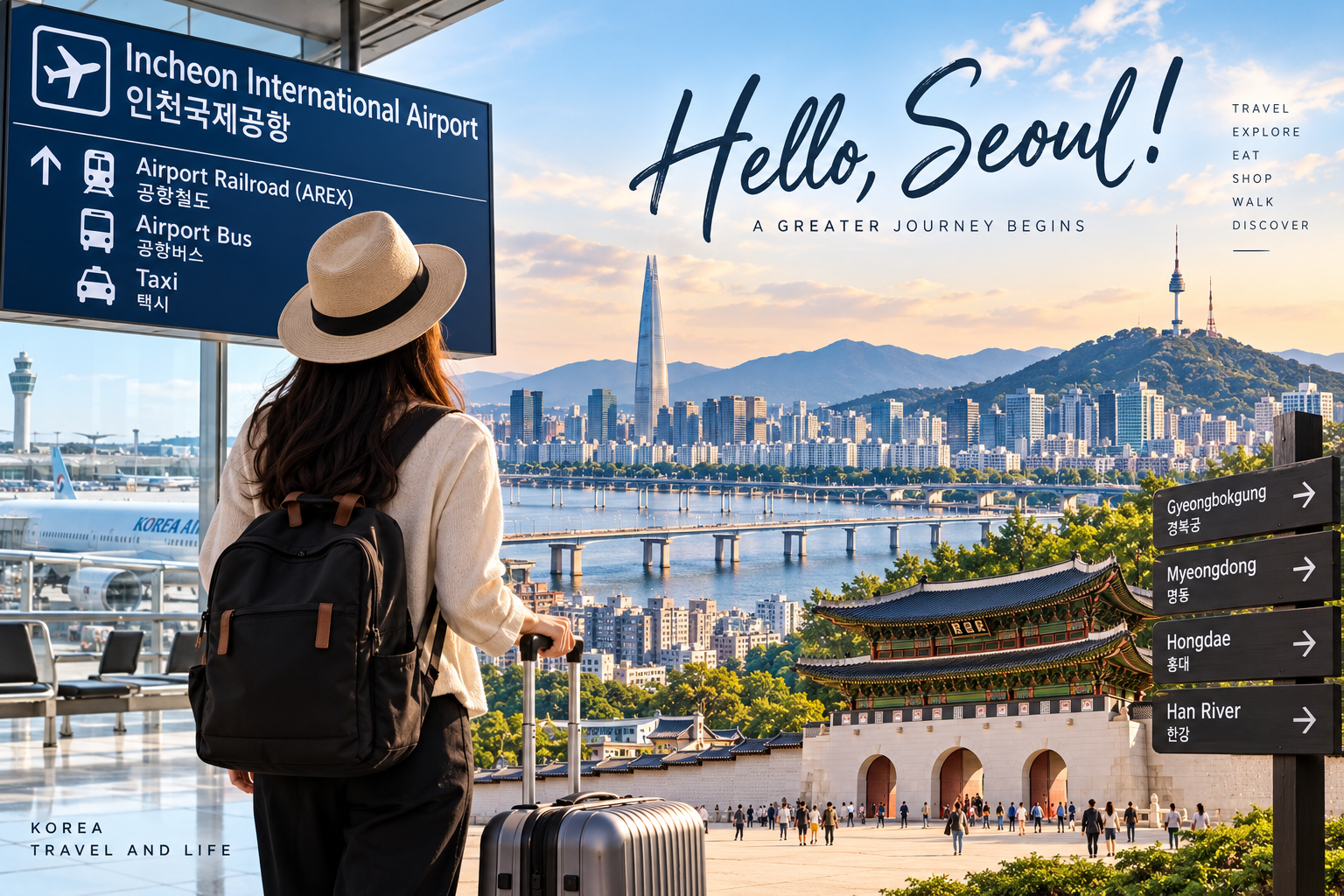
If this is your first visit to the Korean capital, begin with our guide:
First Time in Seoul: From Incheon Airport to Exploring the City
That guide explains the first stage of the journey—from arriving at Incheon International Airport to understanding transportation and organizing your first days in Seoul.
This outdoor guide takes the next step.
Once you know how to move through the city, you can begin deciding how you want to experience it.
History?
Walking?
Mountains?
Parks?
The Han River?
Or a combination of all of them?
There is no single correct answer.
What Comes Next: Shopping and Neighborhoods
The next guide in this Seoul series will turn from palaces, mountains, and parks toward another side of the capital:
shopping, markets, fashion, beauty, cafés, and contemporary neighborhoods.
Seoul’s shopping areas are not interchangeable.
Myeongdong, Hongdae, Seongsu, Gangnam, Dongdaemun, traditional markets, and other districts offer very different experiences.
Instead of simply ranking them, the next guide will help travelers answer a more useful question:
Which part of Seoul is right for what I actually want to do and buy?
That will complete the first three-part introduction to Seoul and create a foundation for more detailed neighborhood guides in the future.
Final Thoughts: Seoul Is More Than a Megacity
Seoul is one of the world’s great urban centers, but its identity cannot be understood through buildings, shopping streets, and subway stations alone.
Walk through a royal palace in the morning and you encounter the city’s history.
Follow an old neighborhood street and you see how the past survives within the present.
Climb a mountain and the enormous metropolis appears below you.
Enter a park and the pace changes.
Sit beside the Han River in the evening and Seoul becomes quieter again.
These experiences seem different, but together they reveal something essential about the city.
Seoul does not separate history, nature, and modern urban life as neatly as visitors might expect.
They exist beside one another.
That is why walking and outdoor exploration can be such powerful ways to experience the capital.
You are not simply moving between attractions.
You are seeing how Seoul fits together.
And sometimes, the best way to understand one of the world’s largest cities is simply to step outside and start walking.