
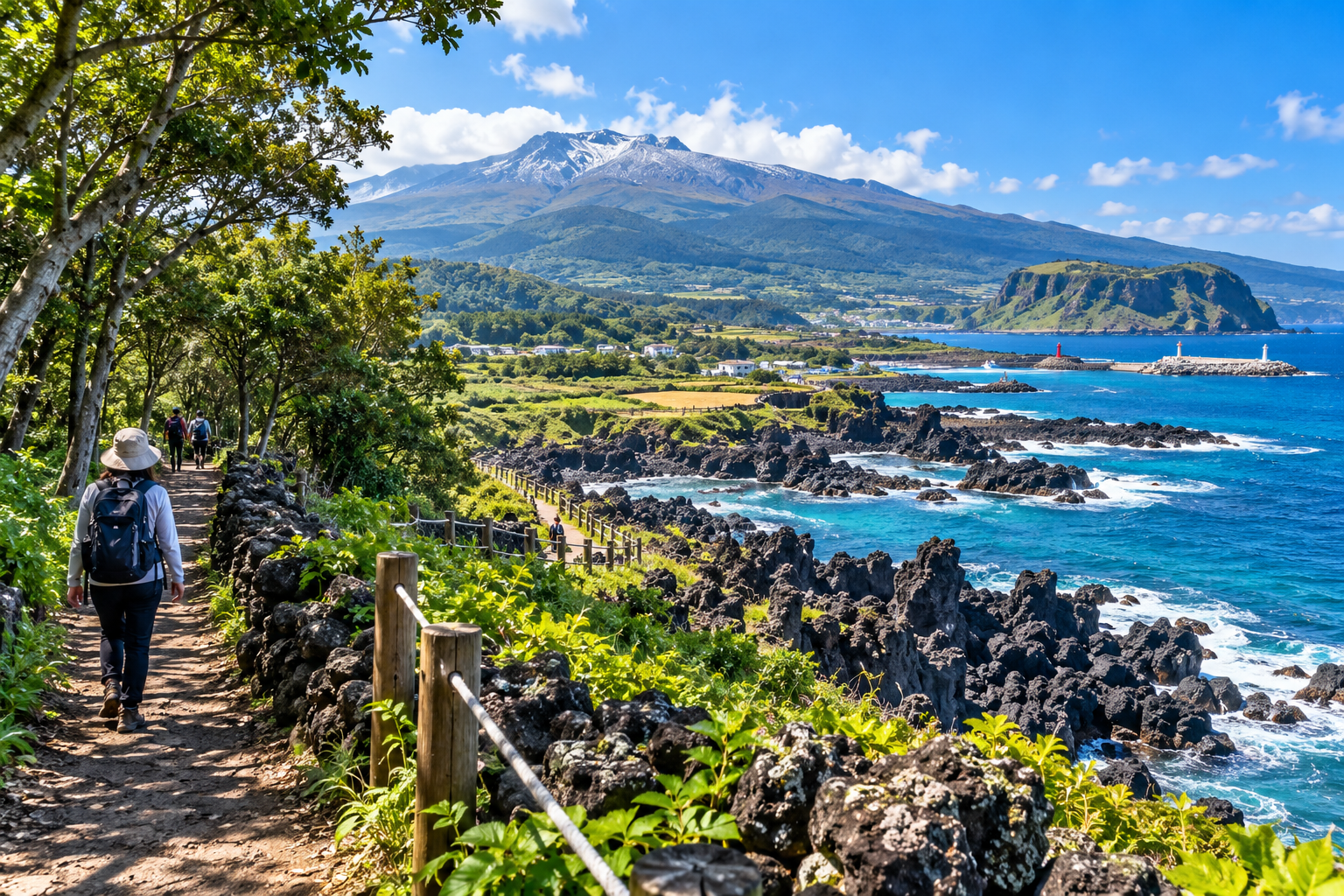
Jeju Is an Island Built for Outdoor Travel
Many travelers first imagine Jeju through a few familiar images: blue water, beaches, cafés, and Hallasan rising above the island.
But Jeju becomes much more interesting when you experience it on foot.
The island is shaped by volcanic activity, wind, water, forests, cliffs, fields, and mountains. Walking through these landscapes reveals details that are easy to miss when traveling only from one parking lot to another.
You begin to notice dark volcanic stone beneath your feet.
You see how villages meet the coastline.
You hear waves before the ocean becomes visible.
You watch the weather change around Hallasan.
And you begin to understand that Jeju’s natural attractions are not separate destinations. They are parts of the same volcanic island.
For travelers who enjoy nature, walking, or hiking, Jeju can become one of the most rewarding parts of a trip to Korea.
Start with the Landscape, Not the Checklist
A common mistake is to create a list of famous outdoor destinations and then try to visit all of them.
Hallasan.
Seongsan Ilchulbong.
Olle trails.
Waterfalls.
Beaches.
Forests.
Volcanic cones.
Coastal cliffs.
Each may deserve a place in your itinerary.
But outdoor travel works differently from ordinary sightseeing.
Weather matters.
Your fitness level matters.
Daylight matters.
Trail conditions matter.
Transportation matters.
And sometimes the most memorable experience is not the most famous location.
Before choosing a trail, decide what kind of outdoor day you actually want.
What Kind of Outdoor Experience Do You Want?
Jeju offers outdoor experiences for very different travelers.
You may want:
a serious mountain hike
a long coastal walk
a short scenic trail
a forest walk
a volcanic landscape
a waterfall and easy nature day
a sunrise experience
or simply
a peaceful place to walk beside the sea
These are not interchangeable.
Someone who wants a relaxing coastal afternoon should not accidentally choose an itinerary designed for an all-day mountain hike.
Likewise, an experienced hiker may want more than a short viewpoint walk.
Choose the experience first.
Then choose the place.
Hallasan Is the Center of Jeju
At the heart of the island rises Hallasan, the highest mountain in South Korea.
Its presence defines Jeju physically and visually.
Even when you are far from the mountain, Hallasan influences the island’s geography, climate, vegetation, roads, and views.
On clear days, it can dominate the horizon.
On other days, clouds may hide it almost completely.
For many outdoor travelers, hiking Hallasan becomes one of the major goals of a Jeju trip.
But it should never be treated as an ordinary sightseeing stop.
Hallasan Requires Real Planning
A serious Hallasan hike can take a substantial part of the day.
The experience depends on the route, your pace, weather, season, trail conditions, and current access rules.
Some routes are much more demanding than casual visitors expect.
This is not the place to arrive in unsuitable shoes with little water because a photograph looked easy online.
Before hiking, check current official information about:
- trail access
- operating or entry times
- reservation requirements where applicable
- weather
- closures
- route conditions
- safety notices
These details can change.
An old travel blog should never be your final source for current mountain access information.
Reaching the Summit Is Not the Only Goal
Travelers sometimes treat Hallasan as a pass-or-fail challenge.
Summit reached: success.
Summit not reached: failure.
That is not a useful way to experience a mountain.
Weather may change.
Your body may feel different from expected.
Trail conditions may slow you down.
You may simply decide that turning around is the safer choice.
A good mountain day is one you return from safely.
The landscape, forest, changing elevation, and experience of walking on Jeju are valuable even when your original plan changes.
Know Your Fitness Level
Do not choose a Hallasan route according to someone else’s social media post.
Consider your own experience.
How often do you hike?
Are you comfortable walking uphill for several hours?
How are your knees on long descents?
Can you carry enough water and food?
Are you accustomed to changing mountain weather?
Have you allowed enough daylight?
Being generally healthy does not automatically mean a long mountain hike will feel easy.
And there is nothing wrong with choosing a less demanding outdoor experience.
Descending Can Be Harder Than Expected
Many first-time hikers focus almost entirely on climbing.
But descending can be demanding too.
After hours of uphill walking, your legs are already tired.
Long descents can place additional stress on knees and ankles.
Wet surfaces, rocks, snow, or ice can make the return journey slower.
Save energy for the way down.
Do not use all of your strength trying to reach a particular point.
The hike is not finished until you are safely off the trail.
Mountain Weather Is Different
Jeju may look sunny near the coast while Hallasan is covered in cloud.
Temperature can change with elevation.
Wind can become stronger.
Rain, snow, fog, or rapidly changing conditions may affect visibility and trail safety.
This is why looking out of your hotel window is not enough.
Check mountain-specific conditions when planning a hike.
If official guidance indicates that conditions are unsuitable, change your plan.
Jeju offers many other outdoor experiences.
Start Early
For major hikes, an early start can provide several advantages.
You have more daylight.
You have more time to adjust your pace.
You reduce the pressure to rush.
And if something unexpected slows you down, you have a larger safety margin.
Starting early does not mean ignoring official entry times or trail regulations.
Always follow current local rules.
What Should You Carry?
The exact equipment depends on the route and season, but basic preparation matters.
For a substantial hike, think about:
- appropriate walking or hiking shoes
- enough water
- food or snacks
- weather-appropriate layers
- sun protection
- a charged phone
- a portable battery
- any personal essentials you may need
In colder conditions, mountain equipment requirements can become much more serious.
Research the actual conditions before you go.
Hallasan Is Not Your Only Volcanic Experience
One of the advantages of Jeju is that you can experience its volcanic identity without completing a major mountain hike.
The island contains numerous smaller volcanic landforms known as oreum.
These volcanic cones are scattered across Jeju and create some of its most distinctive scenery.
Some offer relatively approachable walks and panoramic views.
Others require more effort.
As always, access, terrain, and conditions vary.
What Is an Oreum?
For a first-time international visitor, the word oreum may be unfamiliar.
In Jeju, it refers to the island’s smaller parasitic volcanic cones formed through volcanic activity.
They are an important part of the landscape and local identity.
Once you begin noticing them, the island looks different.
What first appeared to be a series of ordinary hills becomes evidence of Jeju’s volcanic history.
Exploring an oreum can be a useful alternative for travelers who want elevation and scenery without committing to a full Hallasan hike.
Choose an Oreum Carefully
Do not assume every oreum is an easy hill.
Trail length, slope, surfaces, facilities, and accessibility differ.
Some may be popular and well developed.
Others may feel much more natural.
Weather can also change the difficulty.
Before visiting, check current access information and choose according to your ability.
Respect any closures or restrictions designed to protect the landscape.
Seongsan Ilchulbong Shows Jeju’s Volcanic Story
Seongsan Ilchulbong is one of the clearest places for first-time visitors to connect Jeju’s famous scenery with its volcanic origins.
Its dramatic form beside the sea makes it visually different from Hallasan.
The experience is also much shorter than a major mountain hike, making it accessible to a wider range of travelers.
But even here, stairs, slopes, crowds, heat, and wind can affect how demanding the visit feels.
Take your time.
Sunrise Is Optional
The name Sunrise Peak creates an obvious expectation.
Many travelers feel they must visit at sunrise.
You do not.
Sunrise can be beautiful when the weather cooperates, especially if you are staying nearby.
But waking extremely early, traveling a long distance, and arriving under heavy cloud may not be the best use of your energy.
Visit at the time that works for your itinerary.
A volcanic landscape does not stop being interesting after sunrise.
Volcanic Stone Is Everywhere
Jeju’s geology is not confined to famous attractions.
Dark volcanic stone appears throughout the island.
You see it in fields.
Walls.
Coastlines.
Villages.
Paths.
Traditional structures.
The stone becomes part of Jeju’s visual language.
This is one reason walking can be so rewarding.
A car quickly carries you past these details.
On foot, you begin to notice them.
The Coast Reveals Another Side of the Volcano
Jeju’s volcanic identity continues where the land meets the sea.
Dark rocks contrast with blue water.
Cliffs expose dramatic formations.
Waves shape the coastline.
Some areas feel open and gentle.
Others feel rugged and powerful.
The coast is not simply a collection of beaches.
It is part of the geological story of the island.
Do Not Walk Everywhere You See a View
Beautiful coastal scenery can tempt travelers to leave established paths.
That can be dangerous and damaging.
Rock surfaces may be slippery.
Cliff edges may be unstable.
Waves can be unpredictable.
Protected vegetation can be harmed by repeated foot traffic.
Private land may look like an open viewpoint.
Stay on permitted routes and follow barriers and local instructions.
The best photograph is never worth an unsafe step.
Wind Changes Coastal Walking
Wind is a major part of Jeju’s outdoor environment.
A pleasant coastal walk can feel very different when strong wind arrives.
It can make cool weather feel colder.
It can make walking more tiring.
And near exposed cliffs or rocky coastlines, it can affect safety.
Check conditions rather than assuming that clear skies mean easy walking.
Waterfalls Add Variety to an Outdoor Itinerary
Not every nature day needs to involve a mountain or a long trail.
Jeju’s waterfalls can provide shorter outdoor experiences that combine well with other nearby attractions.
Around Seogwipo, well-known waterfalls can fit naturally into a southern Jeju day.
These experiences are particularly useful when you want nature without committing to several hours of hiking.
But even short waterfall visits may involve stairs, wet surfaces, or uneven terrain.
Suitable footwear still matters.
Forests Show a Quieter Jeju
The island’s outdoor identity is not limited to open coastlines and mountain views.
Forested areas can offer a completely different atmosphere.
Trees reduce the sense of exposure.
Sounds change.
Light changes.
The pace naturally becomes slower.
A forest walk can also provide variety during a trip dominated by beaches and coastal roads.
For travelers who do not want strenuous hiking, a well-chosen forest experience may be one of the most relaxing ways to enjoy Jeju outdoors.
Nature Is Not a Backup Attraction
Travel itineraries sometimes treat outdoor experiences as empty space between famous landmarks.
In Jeju, nature is often the main attraction.
A walk does not need a dramatic monument at the end.
A forest does not need a viral café beside it.
A coastline does not need to be famous to be beautiful.
Allow some experiences to exist simply because walking through them feels good.
Build the Day Around One Major Outdoor Activity
If you are planning a demanding hike, make that the center of the day.
Do not surround it with six other major attractions.
If you are planning a long coastal walk, allow time for transportation, meals, rest, and unexpected stops.
If you are exploring volcanic landscapes, group locations geographically.
Outdoor days need margins.
Without them, every delay creates stress.
Always Have a Plan B
Jeju’s weather makes flexibility especially important.
If Hallasan is unsuitable, perhaps a lower-elevation walk works.
If the coast is experiencing severe wind, an inland or sheltered experience may be better.
If heavy rain makes your original trail inappropriate, use the day for a market, museum, café, or another safe activity.
Changing your itinerary is not failure.
It is part of traveling responsibly on an island shaped by weather.
The Next Step: Walk Jeju Slowly
Hallasan and volcanic landscapes explain how Jeju was formed.
But there is another outdoor experience that shows how people move through this landscape today.
The Jeju Olle Trail network connects coastlines, villages, fields, forests, and communities across the island.
You do not need to be a serious hiker to experience it.
In PART 2, we will explore Jeju Olle trails and coastal walks, including how to choose a route, how much to walk, what to carry, and why some of Jeju’s best experiences happen between the famous attractions rather than at them.
Jeju Olle Trails: Seeing the Island at Walking Speed
Jeju can be crossed by car, explored by bus, and photographed from famous viewpoints.
But walking changes your relationship with the island.
The Jeju Olle Trail network gives travelers a way to move through coastlines, villages, fields, forests, and rural landscapes at a human pace.
Instead of asking only, “What attraction is next?” you begin noticing what exists between attractions.
A stone wall.
A small harbor.
A quiet field.
A village road.
The sound of waves beyond a hill.
These details are easy to miss from a vehicle.
For travelers who want to experience Jeju rather than simply collect destinations, an Olle walk can become one of the highlights of the trip.
You Do Not Need to Walk an Entire Route
First-time visitors sometimes assume that choosing an Olle route means committing to the whole course.
It does not have to.
Your goal may be to walk for an hour.
Perhaps you want half a day.
Maybe you want a longer walking day.
The right distance depends on your fitness, schedule, weather, transportation, and interest.
Completing a route can be satisfying, but completion is not the only measure of a successful walk.
A shorter section enjoyed slowly may fit your trip much better.
Choose the Route by Experience
Do not select a walking route only because it appears on a “best trails” list.
Ask what you want to experience.
Do you want dramatic ocean views?
A quiet village?
Fields and countryside?
A forest?
A harbor?
Volcanic scenery?
A route close to your accommodation?
Different sections of Jeju offer different combinations.
The best route is the one that matches the day you want to have.
Transportation Matters Before You Start Walking
Every walking plan has two transportation questions:
How will you reach the starting point?
and
How will you leave when you finish?
The second question is easy to forget.
A beautiful route can become stressful if you reach the end tired and discover that returning to your accommodation is complicated.
Before starting, check transportation at both ends.
If you plan to walk only part of a route, identify realistic exit points in advance.
Do Not Measure Difficulty by Distance Alone
A 10-kilometer walk is not always easier than another 10-kilometer walk.
Terrain matters.
Elevation matters.
Road surfaces matter.
Weather matters.
Wind matters.
And your own condition matters.
A flat urban walk and an exposed coastal trail of the same distance can feel completely different.
Research the specific section rather than judging it only by the number of kilometers.
Coastal Walking Is One of Jeju’s Great Experiences
Jeju’s coastline constantly changes.
One section may pass dark volcanic rock.
Another may open toward a wide beach.
You may walk beside fields before suddenly seeing the ocean again.
Small harbors introduce working coastal communities.
Villages create moments of everyday life between natural landscapes.
This variety is what makes coastal walking so rewarding.
The destination is only part of the experience.
The Eastern Coast
Eastern Jeju can be especially memorable for travelers interested in volcanic landscapes and open coastal scenery.
The area around Seongsan Ilchulbong provides one of the island’s most recognizable backgrounds.
But do not focus only on the famous peak.
Walking allows you to experience the surrounding coastline at a different scale.
From a distance, the landscape becomes part of a larger scene rather than a single attraction.
Walking Near Seongsan
If you already plan to visit Seongsan Ilchulbong, consider allowing additional time for the surrounding area.
Instead of immediately returning to your vehicle or bus after the main attraction, explore an appropriate nearby walking section.
This can transform Seongsan from a single sightseeing stop into a fuller eastern Jeju experience.
As always, check current route conditions and permitted paths.
Southern Jeju Offers Dramatic Variety
The southern side of Jeju combines coastal scenery with cliffs, waterfalls, urban areas, and access to Seogwipo.
This makes it particularly useful for travelers who want to mix walking with food, markets, and other sightseeing.
A morning outdoor experience can be followed by lunch in Seogwipo.
A shorter afternoon walk can lead naturally into an evening market visit.
This kind of combination creates a balanced day without requiring constant long-distance travel.
Western Jeju Encourages a Slower Pace
Western Jeju is often associated with beaches, coastal roads, cafés, and relaxed scenery.
For walkers, this can create an appealing rhythm.
You do not necessarily need a dramatic summit or famous endpoint.
A comfortable section of coastline followed by a meal or café can be enough.
This is particularly useful for travelers who want outdoor time without making the entire day physically demanding.
The North Can Be Practical Too
Travelers staying in Jeju City sometimes assume that the best walking experiences require crossing the island first.
Not necessarily.
Depending on your schedule, exploring a convenient northern or northwestern section may be more enjoyable than spending hours traveling to a famous trail on the opposite side.
Location matters.
The most famous route is not automatically the best route for your day.
Walking and Public Transportation Can Work Together
Travelers without rental cars can still build strong walking itineraries.
In fact, walking and public transportation can complement each other well when the route is planned carefully.
Take a bus toward the area you want to explore.
Walk an appropriate section.
Then use another bus or taxi to continue or return.
The important part is checking the entire journey in advance.
Do not look only at how to reach the starting point.
A Taxi Can Be a Useful Tool
A short taxi ride can sometimes solve an awkward connection.
This does not mean you need to use taxis for the entire trip.
Think of them strategically.
A bus may take you most of the way.
A taxi may solve the final section.
Or after a long walk, a taxi may save you from an inconvenient transfer.
Time and energy are part of your travel budget too.
What Should You Carry on a Coastal Walk?
For a moderate walking day, basic preparation can make a large difference.
Consider carrying:
- water
- a small snack
- sun protection
- a light weather layer
- a charged phone
- a portable battery
- basic personal essentials
Wear shoes suitable for the actual route.
Even a scenic coastal path may include uneven surfaces, slopes, steps, or sections that become slippery when wet.
Sun Exposure Can Be Strong
Cool wind can make you forget how much sun exposure you are receiving.
This is particularly easy near the coast.
Use appropriate sun protection and carry water even when the temperature feels comfortable.
In warmer months, avoid underestimating heat simply because the ocean breeze feels pleasant.
Wind Can Change the Entire Walk
Jeju is known for wind, and exposed coastal routes can make that especially noticeable.
Strong wind can increase fatigue.
It can affect balance.
It can make temperatures feel much colder.
And in certain exposed locations, it may affect safety.
If conditions are poor, choose another route or another activity.
There will always be another part of Jeju to explore.
Rain Requires More Than an Umbrella
Light rain may create a beautiful atmosphere.
Heavy rain can create slippery surfaces, poor visibility, and uncomfortable or unsafe walking conditions.
An umbrella alone does not make every trail appropriate.
Check the route.
Check conditions.
Use suitable clothing.
And be willing to stop or change plans.
Outdoor travel requires judgment, not stubbornness.
Do Not Walk Too Late
A route that feels simple in daylight can become confusing after dark.
Allow enough time to finish comfortably.
Sunset photographs can be beautiful, but they should not leave you navigating an unfamiliar trail without adequate light.
If you deliberately plan an evening viewpoint, understand the return route before sunset.
Respect Villages Along the Way
Some walking routes pass directly through communities.
Remember that these are not outdoor theme parks.
People live and work there.
Keep noise reasonable.
Do not enter private homes, gardens, farms, or fields.
Do not photograph people intrusively.
Keep pathways clear.
And follow local signs.
Responsible walking helps protect the relationship between tourism and the communities that make these routes possible.
Leave the Landscape as You Found It
Carry your waste until you find an appropriate place to dispose of it.
Do not pick flowers or plants.
Do not build rock piles.
Do not remove volcanic stones as souvenirs.
Do not leave food behind.
The best evidence that you walked through a natural place is your memory, not a physical mark on the landscape.
Slow Walking Creates Better Travel Memories
Walking creates something that fast sightseeing often cannot:
continuity.
You remember how one village became a field.
How the field became a stone wall.
How the stone wall followed the road.
How the road eventually opened toward the sea.
These transitions create a sense of place.
Jeju stops feeling like a collection of pins on a map.
It begins to feel like an island.
Take Breaks Before You Need Them
Do not wait until you are exhausted to rest.
Stop for water.
Sit somewhere appropriate.
Eat a snack.
Look at the scenery without photographing it immediately.
A walking day should have pauses.
They are part of the experience, not wasted time.
Cafés Can Become Natural Rest Stops
Jeju’s café culture can work particularly well with walking.
A café near the end of a coastal section can provide rest, shelter, food, and time to review the next part of the day.
The key is to choose cafés that fit your route.
Do not turn a walking itinerary into hours of extra transportation just to visit a famous café on the opposite side of the island.
Let the route lead to the café, not the other way around.
Combine Walking with Local Food
Outdoor travel changes your appetite.
A simple local meal after several hours of walking can become more memorable than an elaborate restaurant planned weeks in advance.
Markets, small restaurants, seafood areas, and local specialties can fit naturally around walking routes.
Check opening times where necessary, but leave some room for discovery.
Not every meal needs to be a famous destination.
Families Should Choose Shorter Sections
Walking with children requires a different pace.
Choose routes with realistic distances, easy exit options, food and restroom access where possible, and attractions that keep the day varied.
A child may enjoy collecting visual memories of waves, rocks, boats, and villages more than completing a long trail.
Success is not measured in kilometers.
Older Travelers Should Prioritize Terrain
Distance alone does not reveal accessibility.
Steps, slopes, rocks, wet surfaces, and uneven paths may matter more.
Research the particular section you are considering.
Short scenic walks can provide excellent Jeju experiences without requiring a full trail.
Using a taxi to connect easier sections is also a perfectly reasonable strategy.
Solo Walkers Should Be Conservative
Solo walking offers wonderful freedom.
But it also requires more personal responsibility.
Tell someone your general plan when appropriate.
Keep your phone charged.
Know your transportation options.
Watch the weather.
Pay attention to daylight.
And avoid leaving established routes for photographs or shortcuts.
There is no prize for turning a peaceful walk into an unnecessary risk.
Photographers Need More Time
If photography is important to you, reduce your planned distance.
You will stop frequently.
Light changes.
Clouds move.
A fishing boat enters the frame.
A stone wall catches your attention.
A ten-kilometer walk can take much longer when every few minutes offers another reason to pause.
Plan for the way you actually travel.
Do Not Turn Every View into Content
Jeju is highly photogenic.
It is easy to spend an entire walk looking through a screen.
Take photographs.
Then put the phone away occasionally.
Listen to the wind.
Watch the waves.
Notice the smell of the sea.
Look behind you.
Some of the best travel memories will never become photographs.
A Half-Day Walking Plan
A simple half-day can work like this:
Travel to one carefully chosen coastal area.
Walk an appropriate section for two or three hours.
Take breaks.
Finish near a place where you can eat or rest.
Then use the remainder of the day for a nearby market, café, beach, or town.
This gives you a meaningful outdoor experience without exhausting the entire day.
A Full-Day Walking Plan
For a longer walking day, simplify everything else.
Eat a good breakfast.
Start with enough daylight.
Carry what you need.
Walk at a sustainable pace.
Take a proper meal or rest break.
Know where you can finish early if necessary.
Afterward, keep the evening easy.
A long walking day does not need a second sightseeing marathon.
Walking Can Replace Sightseeing
This idea is important.
You do not always need to walk to an attraction.
The walk itself can be the attraction.
For travelers accustomed to planning around landmarks, this can feel unusual.
But it is one of the best ways to understand Jeju.
A few hours along the coast may tell you more about the island than several hurried photo stops.
Check Current Trail Information
Trail routes, temporary closures, construction, weather damage, and access conditions can change.
Before beginning a significant walk, check current information from reliable local or official sources.
If signs on the ground differ from an old online map, follow current local guidance.
A saved screenshot from years ago should not override present conditions.
Do Not Force a Route Because You Planned It
You may have spent weeks choosing the perfect walk.
Then the weather changes.
Or you wake up tired.
Or transportation takes longer than expected.
Change the plan.
Shorten the route.
Choose a different section.
Go to a forest instead.
Visit a waterfall.
A flexible traveler will usually have a better Jeju experience than a traveler determined to complete an outdated plan.
The Best Coastal Walk Is the One That Fits Your Day
There is no single Jeju walking route that every visitor must complete.
The best choice depends on:
your location,
your fitness,
your available time,
the season,
the weather,
your transportation,
and what kind of scenery you enjoy.
That is why Jeju rewards travelers who understand the island before choosing the trail.
What Comes Next
Hallasan shows Jeju from above.
The Olle trails reveal the island at walking speed.
But forests, waterfalls, seasonal conditions, and different fitness levels create even more ways to experience Jeju outdoors.
In PART 3, we will bring everything together with practical outdoor itineraries for easy, moderate, and active travelers, seasonal planning, safety, and a simple method for choosing the right Jeju nature experience without overloading your trip.
Build Your Jeju Outdoor Day Around Your Energy Level
The best outdoor itinerary is not necessarily the most difficult one.
Jeju offers nature experiences for travelers with very different levels of fitness, mobility, experience, and available time.
Some visitors want to spend an entire day hiking.
Others would rather walk beside the sea for an hour, visit a waterfall, and enjoy a long lunch.
Both can experience Jeju outdoors successfully.
The key is choosing a day that matches your body rather than someone else’s travel itinerary.
An Easy Jeju Nature Day
An easy outdoor day can still include some of Jeju’s most memorable scenery.
Start with a short coastal walk or accessible natural viewpoint.
Take your time.
Continue to a waterfall, beach, garden, forest, or other nearby attraction that does not require strenuous hiking.
Have lunch in the same general region.
Spend the afternoon exploring slowly.
This type of itinerary works particularly well for families, older travelers, and anyone who wants nature without making physical activity the main challenge of the day.
A Moderate Outdoor Day
A moderate day might include several hours of walking on a suitable Olle section or another established trail.
Begin early enough that you do not feel rushed.
Carry water and basic supplies.
Take breaks.
After the walk, choose one nearby attraction rather than crossing the island for another major activity.
Finish with a good meal and a relaxed evening.
This balance allows you to feel physically active without turning the entire day into an endurance test.
An Active Hiking Day
For experienced and properly prepared travelers, a major Hallasan hike can become the central experience of the day.
Treat it that way.
Do not schedule a demanding mountain route in the morning and then expect to complete a full sightseeing itinerary afterward.
Prepare in advance.
Check current trail information.
Start according to the applicable access rules and conditions.
Carry appropriate supplies.
Monitor your pace and the weather.
After the hike, prioritize recovery.
Dinner and rest may be the only plans you need.
A Coastal Walking Day
If the sea is your priority, build the day around one section of coastline.
Choose a route that matches your ability.
Travel to the starting area.
Walk slowly enough to notice the landscape.
Stop for photographs and breaks.
Eat nearby.
If you still have energy, add a short beach, harbor, market, or café visit.
Avoid the temptation to finish the walk and immediately drive across Jeju to another famous destination.
Let the coast be enough.
A Forest and Waterfall Day
Not every Jeju nature day needs a summit or a long trail.
A forest walk paired with a waterfall or another southern attraction can create a quieter outdoor itinerary.
Forests are especially valuable when you want to experience a different side of the island.
The soundscape changes.
The light becomes softer.
The sense of wind and exposure may decrease.
And the experience can feel far removed from the open coastline.
Choose locations that fit geographically rather than combining distant places simply because they share the word “nature.”
Jeju’s Forests Deserve Time
Visitors often prioritize beaches and volcanic landmarks, leaving forests for whatever time remains.
That can be a mistake.
Jeju’s forest environments reveal another layer of the island’s ecology.
Depending on the location and season, you may encounter dense vegetation, volcanic terrain, shaded paths, and a completely different atmosphere from the coast.
A forest walk can also provide a useful change of pace between more exposed outdoor days.
Bijarim Forest
Bijarim Forest is one of Jeju’s well-known forest destinations.
For travelers who enjoy trees, quiet walking, and a slower natural experience, it can provide a strong contrast to beaches and cliffs.
As with any natural attraction, check current access information and conditions before visiting.
Do not judge the experience by how dramatic it looks in a photograph.
Forests often reward attention rather than spectacle.
Saryeoni Forest Path
Saryeoni Forest Path is another name outdoor travelers may encounter while researching Jeju.
Its forest environment can appeal to visitors who prefer walking without the commitment of a major mountain ascent.
However, route access, transportation, weather, and the section you choose all matter.
Research the current situation before setting out.
The phrase “forest trail” does not automatically mean that every section will suit every traveler.
Waterfalls Work Well with Shorter Outdoor Days
Jeju’s waterfalls can fit naturally into an itinerary when you want outdoor scenery without spending most of the day hiking.
Around Seogwipo, waterfalls can be combined with meals, markets, coastal scenery, or shorter walks.
This makes them especially useful on days when you want variety.
Remember that stairs and wet surfaces may still require care.
Easy sightseeing does not mean ignoring footwear or weather.
Do Not Build a Nature Checklist
It is easy to replace one type of overplanning with another.
A traveler decides to avoid famous tourist attractions and then creates a new list:
one mountain,
two forests,
three waterfalls,
four beaches,
and an Olle trail.
The problem is the same.
Outdoor travel needs time.
Choose experiences that feel different from one another.
A mountain day, a coastal walk, and a forest experience can provide more variety than visiting five similar viewpoints.
Spring: A Season for Walking
Spring can be a rewarding time for Jeju outdoor travel.
Changing vegetation and seasonal flowers can add color to the landscape, while temperatures may be comfortable for walking.
But spring weather is not guaranteed to be calm.
Rain and wind remain possible.
Mountain conditions may differ from coastal conditions.
Check the forecast and prepare layers rather than packing only for the photographs you hope to take.
Summer: Respect Heat and Humidity
Summer can make Jeju’s coast particularly appealing.
It can also make long walks and hikes much harder.
Heat, humidity, sun exposure, and changing weather can increase fatigue quickly.
Carry enough water.
Use sun protection.
Consider starting demanding activities earlier.
Take breaks before you feel exhausted.
And do not underestimate the physical effect of walking for hours in humid conditions.
Autumn: Excellent for Active Travel
For many outdoor travelers, autumn can offer attractive conditions for hiking and walking.
Cooler temperatures may make longer activities more comfortable, and seasonal changes can transform mountain and forest scenery.
Popular locations may also attract more visitors during desirable periods.
Start early when appropriate and keep your schedule flexible.
Good weather does not eliminate the need for preparation.
Winter: A Different Kind of Jeju
Winter can create beautiful coastal scenery and quieter walking experiences.
But exposed areas may feel significantly colder because of wind.
Hallasan requires particular caution.
Snow, ice, changing mountain weather, closures, and equipment requirements can affect hiking plans.
Never assume that conditions near your accommodation represent conditions on the mountain.
Check current information before heading to higher elevations.
There Is No Perfect Outdoor Season
Every season offers advantages and disadvantages.
Spring may provide comfortable walking and flowers.
Summer may suit travelers focused on beaches.
Autumn can be attractive for hiking.
Winter may offer quieter landscapes and a completely different atmosphere.
The best time to visit Korea depends partly on your priorities, and Jeju adds its own island and mountain conditions to that decision.
Choose according to the experiences you value most.
Check Conditions the Morning of Your Activity
Outdoor planning does not end when you create the itinerary.
Check conditions again on the day itself.
Weather changes.
Trails close.
Access rules change.
Transportation may be disrupted.
A route that looked perfect when you planned your trip months earlier may not be the right choice today.
Good travelers update their plans when reality changes.
Use Official Information for Safety-Critical Details
Travel blogs are useful for inspiration and general planning.
But information involving trail closures, access restrictions, reservations, severe weather, or safety should be verified through current official sources.
This is especially important for Hallasan and other significant outdoor activities.
A beautiful article cannot see today’s mountain conditions.
Current local information can.
Know When to Turn Around
Turning around is one of the most important outdoor skills.
You may be tired.
Weather may deteriorate.
The trail may take longer than expected.
Someone in your group may be struggling.
Daylight may be disappearing.
Changing the plan is not embarrassing.
The objective is to enjoy Jeju and return safely.
No viewpoint is worth ignoring clear warning signs.
Do Not Depend Entirely on Your Phone
Phones are extremely useful for maps, translation, transportation, weather, and communication.
But batteries fail.
Signals may weaken.
Rain can make devices difficult to use.
Carry a portable battery on longer outings.
Know the basic route before starting.
Pay attention to signs.
And avoid beginning a trail with a nearly empty battery.
Shoes Matter More Than Travel Fashion
Jeju offers countless beautiful photo opportunities.
That does not mean every location is suitable for fashion footwear.
Uneven volcanic rock, wet surfaces, forest paths, stairs, and mountain trails require appropriate shoes.
Choose footwear according to the activity.
You can always change for dinner later.
Carry Water Before You Need It
Do not assume that every trail will have convenient shops or cafés.
Carry enough water for the activity you are planning.
In warm or humid weather, this becomes even more important.
For longer hikes, food and other supplies also require more careful preparation.
A little extra planning at the beginning can prevent a difficult situation later.
Protect Jeju’s Natural Landscape
Jeju’s popularity creates pressure on the places visitors come to enjoy.
Stay on established routes.
Respect closures.
Carry out your waste.
Do not remove stones or plants.
Do not enter protected areas for photographs.
Avoid disturbing wildlife.
And follow local instructions even when another visitor appears to ignore them.
Responsible tourism protects the experience for everyone who comes after you.
Respect Private Land
A beautiful field is not automatically a tourist attraction.
A stone wall does not mean the property behind it is public.
A quiet village road may lead directly past someone’s home.
Do not climb fences, enter farms, block entrances, or create noise for photographs.
Jeju’s scenery exists alongside everyday life.
Respecting that relationship is part of traveling well.
Outdoor Travel Without a Rental Car
You do not need to abandon nature travel because you are not driving.
But you should choose experiences carefully.
Prioritize routes with practical transportation.
Use buses where they work well.
Use taxis strategically when they solve difficult connections.
Consider tours for activities where transportation would otherwise consume too much of the day.
And remember to plan how you will leave the destination, not just how you will arrive.
Rental Cars Offer Freedom, Not Unlimited Time
Driving makes many outdoor destinations easier to reach.
It does not make Jeju smaller.
You still need time to walk.
You still need time to eat.
You still need time to park.
You still need to account for traffic and weather.
Do not use a rental car as an excuse to double the number of attractions in your itinerary.
Use the flexibility to travel better, not faster.
Connect Your Outdoor Plans to Where You Stay
Accommodation location can dramatically affect an outdoor itinerary.
If your priority is eastern Jeju, staying nearby for part of the trip may reduce early-morning travel.
If southern landscapes and Seogwipo are central to your plans, a southern base may be more practical.
If you have an early flight, the final night may require a different calculation.
Our first-time guide to Jeju Island explains these accommodation and transportation decisions in more detail.
Outdoor planning becomes much easier when your hotel and daily route support each other.
Jeju Outdoors and Busan Outdoors Are Different
Travelers who enjoyed hiking and coastal walking in Busan will find familiar elements in Jeju.
Both destinations combine mountains and sea.
But the experience is different.
Busan outdoors exists alongside a major city, dense neighborhoods, bridges, beaches, temples, and urban transportation.
Jeju outdoors feels more strongly shaped by volcanic geology, rural landscapes, long coastlines, forests, oreum, and Hallasan.
The two destinations complement each other rather than compete.
Seoul Adds Another Outdoor Experience
Seoul offers yet another version of outdoor Korea.
Palaces connect with historic streets.
Urban parks meet the Han River.
Mountains rise directly beside dense neighborhoods.
A traveler can move from a subway station to a hiking trail remarkably quickly.
Comparing Seoul outdoors, Busan’s coastline, and Jeju’s volcanic landscapes shows how geographically diverse a trip to Korea can be.
A Simple Three-Day Outdoor Jeju Plan
For travelers who want nature to dominate their visit, a three-day structure might look like this:
Day 1 — Volcanic Jeju
Choose Seongsan Ilchulbong and nearby eastern landscapes.
Add a manageable coastal walk rather than filling the day with distant attractions.
Day 2 — Walking Jeju
Choose an Olle section that matches your ability and transportation.
Let the walk become the main experience.
Finish with food, a market, or a nearby café.
Day 3 — Mountain or Forest Jeju
Experienced and properly prepared hikers may choose Hallasan when conditions allow.
Other travelers can choose an oreum, forest, waterfall, or combination of shorter natural experiences.
The itinerary should change according to weather.
A Relaxed Outdoor Jeju Plan
You do not need three demanding days.
A relaxed itinerary might include:
a short coastal walk,
a waterfall,
a forest,
a scenic beach,
a market,
and plenty of time for meals and rest.
This can still provide a deep connection with Jeju’s landscape.
Physical exhaustion is not proof that you traveled well.
The Best Jeju Outdoor Itinerary Has Empty Space
Leave room between plans.
A walk may take longer because the scenery is beautiful.
A trail may be slower than expected.
You may discover a quiet café.
Weather may delay your morning.
You may simply want to sit beside the sea.
Empty space gives these experiences somewhere to happen.
Final Thoughts: Experience Jeju One Step at a Time
Jeju’s outdoor appeal is difficult to understand from a checklist.
Hallasan may be the island’s highest point, but the summit is only one part of the story.
The Olle trails reveal villages and coastlines.
Oreum reveal the volcanic landscape on a smaller scale.
Forests offer quiet.
Waterfalls bring movement.
Stone walls connect the land to everyday life.
And the sea constantly reminds you that Jeju is an island.
You do not need to hike everything.
You do not need to complete every trail.
You do not need perfect weather.
Choose experiences that match your body, your schedule, and the conditions.
Walk when walking feels right.
Rest when you need to rest.
Change direction when the weather demands it.
And give yourself enough time to notice what exists between the famous places.
The best way to experience Jeju outdoors is not to conquer the island, but to move through it slowly enough to understand why its landscape is so memorable.