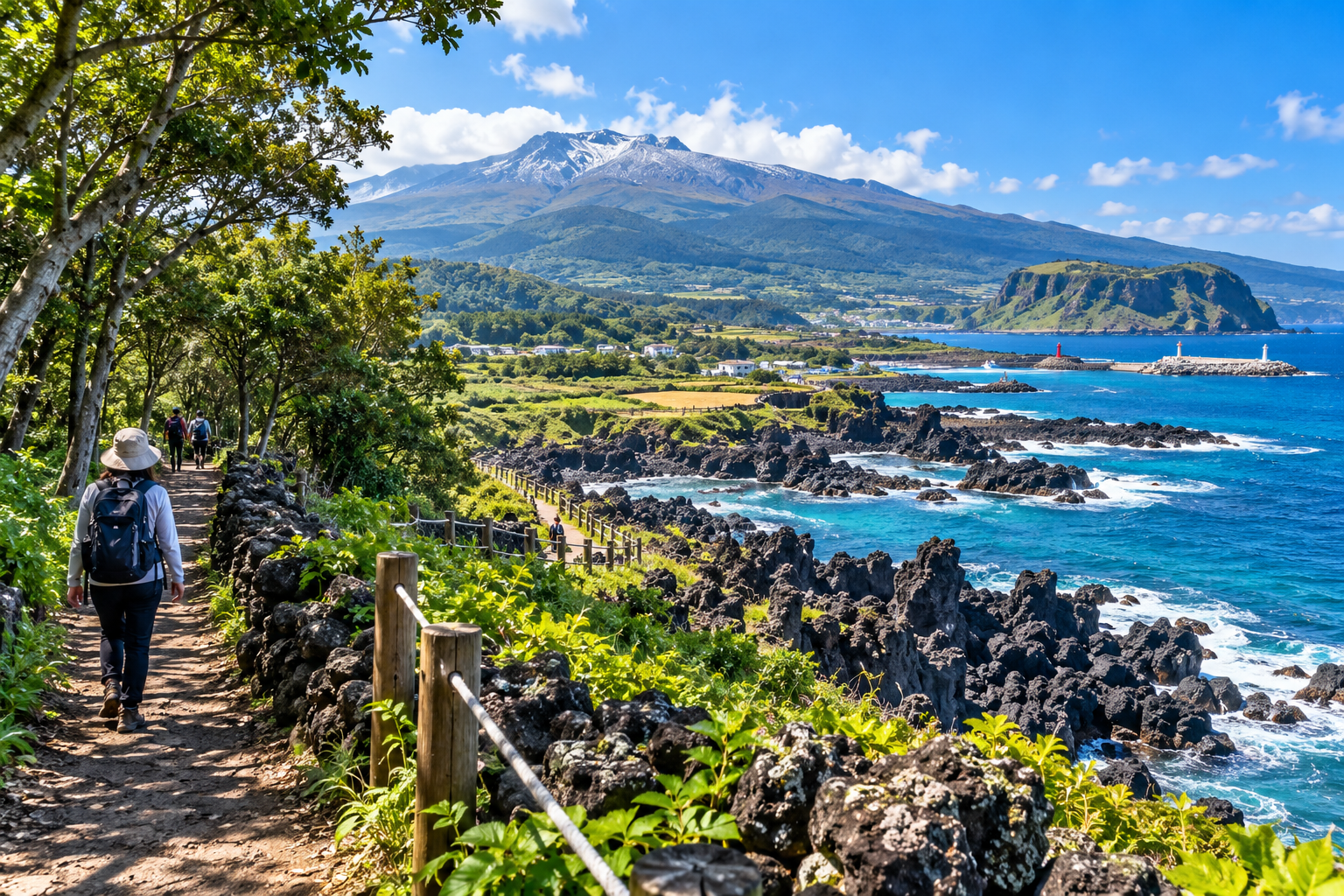
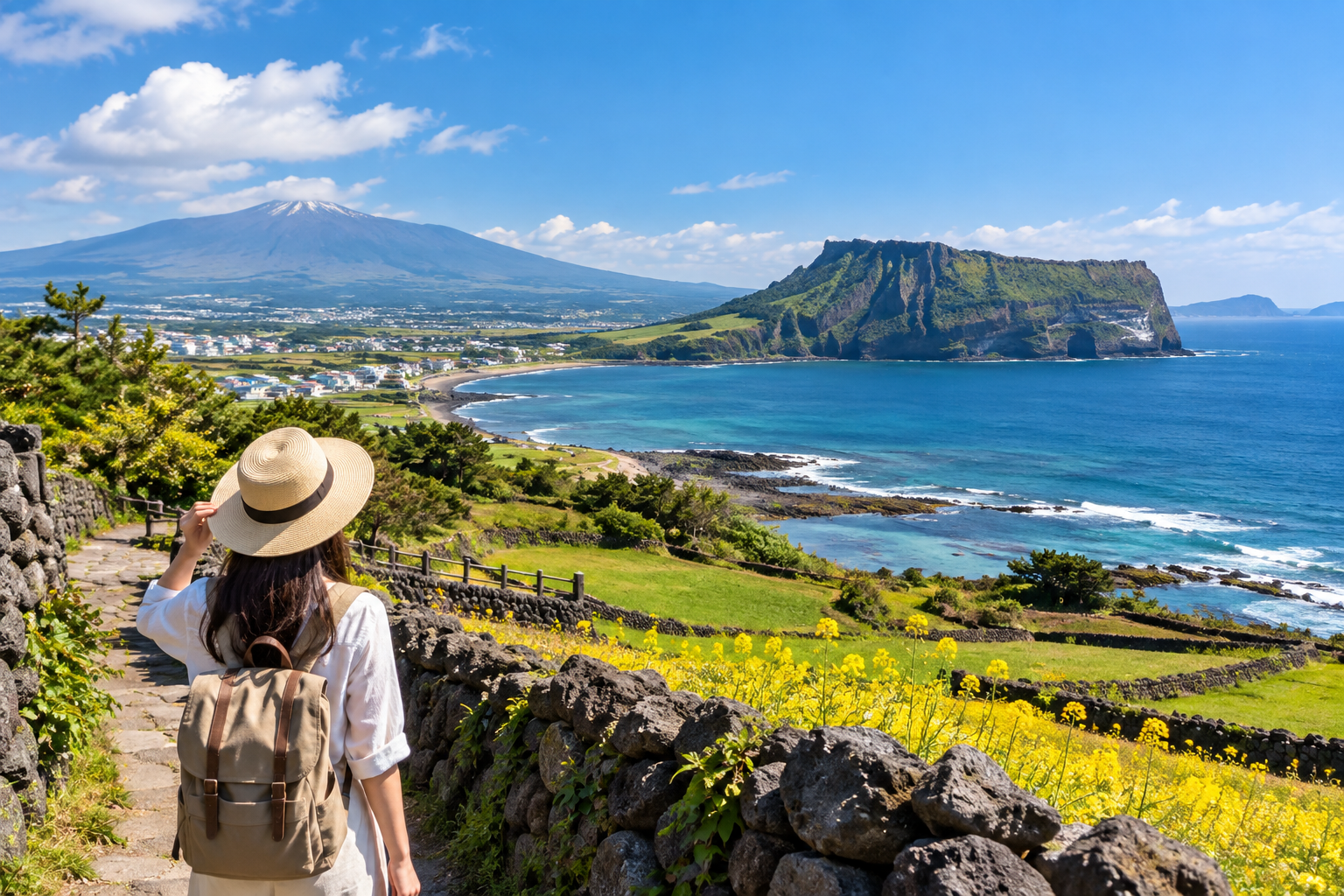
Jeju Island Is Bigger Than Many First-Time Visitors Expect
Jeju Island looks simple on a map.
It is an island, there is one major airport, and many of its famous attractions appear to follow the coastline.
That can make first-time visitors think they can stay anywhere and easily travel everywhere.
In reality, Jeju requires more planning.
The island is large enough that accommodation location, transportation, weather, and the direction of your daily route can significantly affect your trip.
A beautiful café on the western coast, a waterfall near Seogwipo, and a sunrise destination in eastern Jeju may all look like reasonable additions to the same itinerary.
They may not be.
The first rule of planning a Jeju trip is therefore simple:
Do not think of Jeju as one small tourist area.
Think of it as several different regions connected by roads, coastline, villages, mountains, and natural landscapes.
Once you understand that, Jeju becomes much easier to explore.
Why Jeju Feels Different from Seoul and Busan
Traveling in Seoul often means moving between dense neighborhoods by subway.
Busan introduces beaches, mountains, markets, and a much more stretched-out urban geography.
Jeju changes the travel rhythm again.
Here, nature plays a much larger role in determining your day.
Volcanic landscapes, coastal roads, beaches, forests, waterfalls, fields, villages, and Hallasan shape the island.
Attractions can be separated by substantial driving or bus travel.
Weather may also be very different on opposite sides of the island or at different elevations.
This means Jeju rewards travelers who plan geographically rather than collecting famous attractions from social media.
Jeju Is More Than a Checklist
First-time visitors often arrive with a long list:
Hallasan.
Seongsan Ilchulbong.
Waterfalls.
Beaches.
Cafés.
Museums.
Markets.
Coastal roads.
Olle trails.
Each may be worth experiencing.
The problem begins when they are treated as if they all exist beside one another.
Jeju is best enjoyed when you leave enough time for the landscape between destinations.
A coastal drive can become part of the experience.
A small village may make you stop unexpectedly.
Weather may encourage you to change direction.
A café overlooking the sea may deserve more than twenty minutes.
Jeju becomes much more enjoyable when the itinerary has room to breathe.
Arriving at Jeju International Airport
Most visitors arrive through Jeju International Airport, located near Jeju City on the northern side of the island.
The airport is relatively close to the city, but your final destination may be much farther away.
This distinction matters.
Landing in Jeju does not mean you are close to every major attraction.
If your accommodation is in Seogwipo or another part of the island, you still have another journey after leaving the airport.
Before your flight, know where you are staying and how you plan to get there.
Do not wait until you are standing outside the terminal with luggage to begin thinking about island transportation.
Your First Decision: How Will You Get Around?
Transportation is one of the most important decisions in a Jeju itinerary.
Unlike Seoul, where many first-time visitors can rely heavily on the subway, Jeju requires a different strategy.
Depending on your circumstances, you may use:
a rental car, buses, taxis, organized tours, or a combination of several options.
There is no single correct method.
The best choice depends on your driving eligibility, confidence, budget, accommodation, destinations, group size, and preferred travel style.
Renting a Car in Jeju
For many travelers, a rental car provides the greatest flexibility.
It can make it easier to reach natural attractions, move between coastal areas, carry luggage, and change plans when weather affects the day.
But renting a car should not be treated as an automatic recommendation.
International visitors need to confirm the current legal and rental-company requirements that apply to their driving credentials before the trip.
Requirements can depend on factors such as your license and the documents accepted for driving in Korea.
Do not rely on an old blog post or a social media comment for something this important.
Check current official information and your rental company’s requirements before making a reservation.
Driving Is Convenient, but It Changes the Trip
A car provides freedom, but it also creates responsibilities.
You need to navigate unfamiliar roads.
You need to understand parking.
You need to consider traffic.
You cannot simply stop anywhere because the scenery looks beautiful.
And the driver should remain focused rather than trying to admire every coastal view.
If you are uncomfortable driving abroad, choosing a rental car only because other travelers say it is “necessary” may make the trip more stressful.
Convenience should improve your vacation, not dominate it.
Can You Visit Jeju Without a Car?
Yes.
A car is useful, but travelers without one can still experience Jeju.
The key is planning differently.
Public buses connect many parts of the island, but journeys may require more time, transfers, or walking than a car journey.
Taxis can fill some gaps.
Organized day tours can also be useful for travelers who want to visit several attractions without managing every transportation connection themselves.
The important thing is to build an itinerary designed for your transportation method.
A car-based itinerary copied by a bus traveler may be unrealistic.
Jeju by Bus Requires Patience
Bus travel can be a practical option for budget-conscious travelers or visitors who do not drive.
But do not compare it directly with Seoul’s subway experience.
Waiting times, transfers, walking distances, and the location of attractions all matter.
A bus may take you near a destination without taking you directly to the entrance.
Another destination that looks close on the map may require an indirect route.
For this reason, travelers using buses should generally schedule fewer major destinations per day.
That is not necessarily a disadvantage.
Slower travel can create a more relaxed Jeju experience.
Taxis Can Solve Specific Problems
Taxis can be useful for shorter journeys, inconvenient connections, luggage, bad weather, or situations where waiting for public transportation would consume too much time.
For two or more travelers, the cost may sometimes feel more reasonable when compared with the time saved.
But using taxis for every long journey across the island can become expensive.
A mixed strategy may work better:
bus for a straightforward route,
taxi for a difficult final connection,
and perhaps a tour for a day containing several widely separated attractions.
Organized Tours Can Be Practical
Some independent travelers avoid tours because they want freedom.
But a well-chosen day tour can solve a real transportation problem.
This can be particularly helpful if you do not drive and want to see several natural attractions in one part of Jeju.
The trade-off is flexibility.
You follow a schedule.
You may have limited time at each stop.
And the itinerary may include places you would not have chosen independently.
Before booking, look at the route rather than simply counting how many attractions are included.
A tour with fewer geographically logical stops may be better than one with a long list and constant driving.
Understand Jeju Through Regions
For a first trip, you do not need to memorize every town and village.
Start by thinking broadly about:
Jeju City and the north
Seogwipo and the south
Eastern Jeju
Western Jeju
Hallasan and the central mountain area
Each region offers a different travel experience.
This simple framework will make accommodation and itinerary decisions much easier.
Jeju City: Convenient for Arrival and Departure
Jeju City is the island’s largest urban center and is close to the airport.
That makes it convenient for travelers arriving late, departing early, or using transportation connections from the northern side of the island.
The city also provides restaurants, markets, shopping, and practical services.
For some visitors, staying in Jeju City for the entire trip is convenient.
For others, it may feel too far from the natural areas they most want to experience.
Convenience and atmosphere are not always the same thing.
Seogwipo: A Strong Base for Southern Jeju
Seogwipo on the southern side of the island is another major base for travelers.
The surrounding region provides access to waterfalls, coastal scenery, natural attractions, restaurants, and different sections of southern Jeju.
For visitors whose itinerary emphasizes the south, staying in or around Seogwipo can reduce unnecessary daily travel.
But remember that traveling between the airport and Seogwipo takes time.
If you have an early flight home, plan the final night and airport journey carefully.
Eastern Jeju: Sunrise, Volcanic Landscapes and Coast
Eastern Jeju contains some of the island’s most recognizable landscapes.
The Seongsan Ilchulbong area is particularly famous and often appears on first-time itineraries.
The east also offers coastal scenery, villages, beaches, and other natural attractions.
Travelers who want to explore this side slowly may benefit from spending a night in the region rather than repeatedly traveling from the opposite side of the island.
This is especially true if sunrise is part of your plan.
A sunrise itinerary feels very different when your accommodation is nearby.
Western Jeju: Beaches, Coastal Roads and a Slower Rhythm
Western Jeju offers another combination of beaches, cafés, coastal scenery, villages, and countryside.
It can work particularly well for travelers who enjoy driving or moving slowly along the coast.
As elsewhere on the island, avoid assuming that every famous western destination belongs in one day.
Choose a reasonable section and explore it properly.
The pleasure of western Jeju often comes from the journey between destinations as much as the destinations themselves.
Hallasan Changes the Geography of the Island
At the center of Jeju rises Hallasan, the island’s dominant mountain.
Even travelers who never hike it should understand its importance.
The mountain influences roads, weather, scenery, and the way different sides of the island connect.
A route that looks direct across the center of Jeju may not work the way you expect from a simple map.
Hallasan also creates one of the island’s major outdoor experiences, but hiking it requires much more planning than a casual sightseeing stop.
We will explore Hallasan and Jeju’s walking experiences in greater detail in a later guide.
Where Should a First-Time Visitor Stay?
There is no universally best area.
Choose according to your itinerary.
If airport convenience, urban services, and northern transportation connections matter most, Jeju City may be practical.
If southern attractions are central to your trip, consider Seogwipo.
If you want sunrise and eastern landscapes to shape your experience, staying in eastern Jeju for at least part of the trip may make sense.
If beaches, cafés, and western coastal exploration are priorities, consider a base in the west.
The correct question is not:
“What is the best hotel area in Jeju?”
It is:
“Where should I sleep so that tomorrow’s journey makes sense?”
One Hotel or Multiple Hotels?
Changing accommodation takes time.
You pack.
Check out.
Move luggage.
Travel.
Check in again.
For a short trip, staying in one location may be simpler.
But on a longer trip, dividing your stay between two regions can reduce repeated travel across the island.
For example, a traveler might spend part of the trip in the north or east and another part around Seogwipo.
That does not mean everyone should change hotels.
Calculate whether the transportation time saved is worth the inconvenience of moving.
Do Not Choose Accommodation by Price Alone
A cheaper room can become expensive in another way if it adds hours of transportation to your trip.
Before booking, map the places you most want to visit.
Then compare accommodation areas.
Look at the first destination of the morning.
Look at where you expect to finish in the evening.
Think about restaurants and transportation around the property.
And consider what happens if the weather changes your plan.
Location is part of the cost of accommodation.
Your First Night in Jeju
If you arrive late, keep the first night simple.
Check in.
Eat nearby.
Learn the area around your accommodation.
Prepare for the next morning.
There is rarely a good reason to land, collect luggage, travel to your hotel, and then immediately begin crossing the island to complete a sightseeing checklist.
Jeju rewards daylight.
Save your energy for it.
Your First Morning Should Match Your Location
Wake up and use the region where you are staying.
If you are in Jeju City, begin with something that fits the northern side before moving farther away.
If you are in Seogwipo, explore the south.
If you deliberately stayed in eastern Jeju, take advantage of being there.
This sounds obvious, but many inefficient itineraries ignore accommodation location completely.
They begin each morning by traveling long distances to the opposite side of the island.
Weather Has More Power Over a Jeju Itinerary
Jeju is an outdoor destination.
That means weather can influence your trip more strongly than it might during several days of museums, shopping, and indoor attractions in a large city.
Rain can affect hiking.
Wind can change coastal experiences.
Cloud can hide mountain views.
Heat can make long walks more demanding.
Conditions at Hallasan may differ significantly from conditions near the coast.
Do not create an itinerary that collapses if Tuesday’s weather is different from what you imagined.
Build Flexible Days
Instead of deciding that one attraction must happen at exactly 10:00 a.m. three months from now, create groups of geographically compatible experiences.
Then adjust the order according to weather and conditions.
Have an outdoor priority.
Have an indoor or lower-risk alternative.
Know which experiences can move to another day.
Flexibility is not poor planning.
In Jeju, flexibility is often the result of good planning.
The Island Should Determine Your Pace
Jeju becomes frustrating when travelers try to force a Seoul-style schedule onto it.
Ten attractions may fit neatly into an online list.
They do not necessarily fit into one enjoyable day.
Driving takes time.
Parking takes time.
Bus travel takes time.
Walking takes time.
Weather changes.
And sometimes the best part of Jeju is the place you did not expect to stop.
Plan fewer major destinations.
Give them more time.
Let the landscape become part of the trip.
What Comes Next
Now that you understand Jeju’s basic geography, accommodation choices, and transportation options, the island becomes much easier to plan.
The next question is:
What should a first-time visitor actually see?
In PART 2, we will move through the experiences that define a first Jeju trip—from Seongsan Ilchulbong and the eastern coast to Seogwipo’s waterfalls, beaches, markets, volcanic landscapes, and the places worth choosing when you cannot see everything.
What Should You See on Your First Trip to Jeju?
Once you understand Jeju’s geography, the next challenge is choosing what to see.
This is where many first-time itineraries become overloaded.
Jeju has mountains, volcanic landscapes, beaches, waterfalls, forests, coastal trails, villages, markets, museums, cafés, and countless viewpoints.
You cannot experience all of them properly in a short trip.
And you do not need to.
A better first trip includes a few experiences that reveal why Jeju is different from mainland Korea.
For many travelers, that means combining volcanic scenery, coastline, local food, and at least one opportunity to slow down and experience the island on foot.
Start with Jeju’s Volcanic Identity
Jeju is a volcanic island, and that geological history is visible throughout the landscape.
It shaped Hallasan, volcanic cones, caves, cliffs, rock formations, and much of the terrain visitors see today.
Understanding this changes the way you look at Jeju.
A hill is no longer simply a viewpoint.
Dark rocks beside the ocean are not simply decoration.
The landscape tells the story of how the island formed.
You do not need to study geology before your vacation, but recognizing Jeju as a volcanic landscape makes many attractions more meaningful.
Seongsan Ilchulbong: An Icon of Eastern Jeju
Seongsan Ilchulbong is one of Jeju’s most recognizable natural landmarks.
Rising dramatically near the eastern coastline, it is famous for its distinctive volcanic form and broad views of the surrounding landscape.
It is often called Sunrise Peak, and sunrise is one reason travelers choose to visit.
But you do not need to arrive at sunrise for the experience to be worthwhile.
The landscape remains impressive throughout the day when conditions are suitable.
For first-time visitors, Seongsan Ilchulbong can provide an excellent introduction to Jeju’s volcanic identity.
Should You Visit at Sunrise?
Sunrise sounds romantic.
The practical reality depends on where you are staying, the season, weather, and how willing you are to wake up early.
If your accommodation is nearby, a sunrise plan may be relatively easy.
If you are staying far away, the journey can require a very early start.
Clouds can also hide the sunrise completely.
Do not build your entire impression of Seongsan around one perfect photograph.
If sunrise fits naturally into your trip, enjoy it.
If it does not, visit at another time.
The volcanic landscape is still there after breakfast.
Give Yourself Time Around Seongsan
Do not arrive, climb, take one photograph, and immediately leave eastern Jeju.
The surrounding region deserves consideration.
Coastal scenery, villages, cafés, and other attractions can make Seongsan part of a larger eastern Jeju day.
This is exactly the type of geographic grouping that makes island travel more efficient.
Once you have traveled east, stay east long enough to experience it.
Udo: A Smaller Island Experience
Near eastern Jeju lies Udo, a smaller island that is a popular excursion for visitors.
The appeal is easy to understand.
Coastal scenery, beaches, rural landscapes, and a slower atmosphere can make Udo feel like a trip within your Jeju trip.
But visiting Udo requires additional transportation and time.
You need to consider ferry operations, weather, your schedule, and how you plan to move around after arriving.
Do not add Udo simply because it appears on every popular itinerary.
Give it enough time to be worth the journey.
Ferry Plans Need Flexibility
Any island excursion involving a ferry is more sensitive to conditions than an ordinary road journey.
Schedules and operations can be affected by weather and other factors.
Check current information close to your visit.
Do not create a tightly connected schedule where a delayed or changed ferry ruins the rest of your day.
If Udo is important to you, allow flexibility around it.
Jeju’s Beaches Are Not All the Same
Jeju’s coastline contains beaches with different scenery, atmosphere, facilities, and surrounding neighborhoods.
Some visitors want swimming.
Others want photography.
Some want a café overlooking the water.
Others simply want a quiet coastal walk.
Choose a beach according to the experience you want and the region you are already exploring.
Crossing the island only because one beach is currently famous on social media may not be the best use of your time.
The Coast Is Worth Visiting Outside Summer
Jeju’s beaches are not only summer destinations.
In cooler seasons, the coastline can still be one of the most beautiful parts of the island.
You may not be swimming, but you can walk, photograph the scenery, visit nearby cafés, and experience a quieter atmosphere.
Weather and wind become more important, especially in colder months.
Dress for the actual conditions rather than for the beach image in your imagination.
Eastern Jeju Works Best as a Region
A good eastern Jeju day might include one major natural landmark, coastal scenery, a meal, and one or two nearby experiences.
That may sound less ambitious than a list of seven attractions.
It is also more realistic.
The purpose of geographic planning is not simply to reduce driving.
It allows you to understand how places relate to one another.
You begin experiencing eastern Jeju rather than collecting eastern Jeju attractions.
Seogwipo Introduces Another Side of the Island
Move south and the character of the trip changes again.
Seogwipo and the surrounding southern region offer waterfalls, coastline, markets, restaurants, parks, and access to a wide range of natural attractions.
For many first-time visitors, southern Jeju becomes one of the most rewarding parts of the island.
If you are staying in Seogwipo, take advantage of your location instead of beginning every morning with a long drive elsewhere.
Jeongbang Waterfall: Where Water Meets the Coast
Jeongbang Waterfall is one of the best-known waterfalls around Seogwipo.
Its coastal setting helps distinguish it from a typical inland waterfall experience.
The combination of falling water, rock, and sea makes the location memorable.
But as with many natural attractions, access conditions and the experience can vary with weather.
Wet surfaces can be slippery.
Wear appropriate shoes and follow local safety instructions.
A photograph is not worth ignoring the terrain beneath your feet.
Cheonjiyeon Waterfall: An Accessible Seogwipo Experience
Cheonjiyeon Waterfall offers another well-known waterfall experience near Seogwipo.
The surrounding walking environment can make it a convenient addition to a southern Jeju itinerary.
Rather than asking which waterfall is universally “better,” consider how each fits your route.
If one requires substantial backtracking while another is naturally near your accommodation or other plans, convenience may be the deciding factor.
Not every comparison needs a winner.
Do You Need to See Every Famous Waterfall?
No.
This principle applies throughout Jeju.
If waterfalls are one of your main interests, seeing several may make sense.
If they are only one part of your trip, choose one or two that fit naturally into your itinerary.
The same rule applies to beaches, museums, cafés, and volcanic sites.
More is not automatically better.
Variety usually creates a stronger first trip than repetition.
Seogwipo Maeil Olle Market
Natural landscapes are only one part of Jeju.
To experience a more everyday side of the island, spend time around Seogwipo Maeil Olle Market.
Markets provide opportunities to encounter local food, snacks, ingredients, and the rhythm of daily commercial life.
They also work well later in the day when you have finished a major outdoor activity.
Instead of treating the market as a ten-minute stop, walk slowly.
Look before buying.
Try something that genuinely interests you.
And remember that vendors are working, not performing for tourists.
Food Should Be Part of the Jeju Experience
Jeju has a regional food identity shaped by island life, local agriculture, and the sea.
Visitors may encounter dishes featuring seafood, pork, noodles, local produce, and other specialties associated with the island.
You do not need to eat every famous dish.
Choose meals that fit your preferences and budget.
If you do not eat seafood, Jeju still has plenty to offer.
If a famous restaurant requires a long detour and a long wait, decide whether the meal is genuinely important to you.
Food should improve the journey, not control it.
Markets Are Good Places to Explore, Not Just Eat
A market can also help you understand what people buy, what ingredients are common, and how regional products are presented.
Walk through before deciding what to eat.
Observe.
Compare.
Ask questions politely when necessary.
Keep narrow passages clear.
And avoid taking intrusive photographs of vendors or customers.
A little awareness makes market travel much more respectful.
Jeju’s Cafés Can Be Destinations—but Be Selective
Jeju is famous for cafés with ocean views, distinctive architecture, gardens, and carefully designed interiors.
They can be enjoyable places to rest between outdoor activities.
But café hopping can also consume an entire trip without you realizing it.
Choose cafés that fit the route you are already traveling.
Do not drive across the island solely because a drink appeared in a viral video unless that experience is genuinely important to you.
A café should support your Jeju day, not force you to reorganize the island around it.
The Journey Between Places Matters
One of the biggest differences between Jeju and a dense urban destination is that travel between attractions can itself become memorable.
Fields.
Stone walls.
Small villages.
Ocean glimpses.
Wind turbines.
Mountain views.
Quiet roads.
Unexpected weather.
These details create the island experience.
If you rush from parking lot to parking lot, you may see many attractions while missing Jeju.
Jeju’s Stone Walls Tell a Story
Across the island, dark volcanic stone appears in walls, fields, buildings, and landscapes.
These walls are not simply decorative.
They reflect the materials, environment, and agricultural history of the island.
The more you travel through Jeju, the more you begin to recognize how volcanic stone shapes its visual identity.
Small details like this can become as memorable as famous landmarks.
Respect Rural Communities
Some of Jeju’s most beautiful landscapes are also working agricultural areas and residential communities.
Do not enter private fields for photographs.
Do not block narrow roads.
Park only where permitted.
Keep noise reasonable.
And do not assume every picturesque stone wall or flower field is a public tourist attraction.
Responsible travel matters especially in places where tourism and everyday life exist side by side.
Olle Trails Offer a Different Way to See Jeju
For travelers who enjoy walking, Jeju Olle trails offer another way to experience the island.
Rather than moving from attraction to attraction by vehicle, walking allows you to notice coastlines, villages, fields, forests, and smaller details at a slower pace.
You do not need to walk every route.
You do not even need to complete an entire route.
A carefully chosen section can become one of the most memorable experiences of the trip.
Choose Walking Routes According to Ability
As with Busan’s coastal walks, distance alone does not determine difficulty.
Terrain, weather, elevation, surfaces, and your own condition all matter.
Research the specific route or section you plan to walk.
Carry water.
Wear suitable shoes.
Keep your phone charged.
Pay attention to daylight.
And check current trail conditions before beginning.
A walking holiday should not become a competition.
Hallasan Deserves Its Own Plan
It may be tempting to add Hallasan to a general sightseeing day.
Do not.
A serious Hallasan hike should be treated as the central activity of the day.
Routes, access rules, weather, seasonal conditions, reservation requirements where applicable, and turnaround or entry times can change.
Check current official information before attempting a hike.
Do not rely on an old itinerary.
Mountain conditions deserve more respect than a fixed vacation schedule.
You Do Not Have to Climb Hallasan
Hallasan is central to Jeju’s identity, but reaching a summit is not required to experience the island properly.
Some travelers love long hikes.
Others do not.
There are many shorter walks, forests, coastal routes, volcanic landscapes, and viewpoints available.
Choose outdoor experiences that match your ability and interests.
A vacation is not an athletic examination.
Build an Outdoor Day with an Alternative
Suppose you plan a major outdoor experience.
Also know what you will do if conditions become unsuitable.
A market.
A museum.
A café.
A shorter coastal route.
A different region with better weather.
This prevents disappointment from becoming panic.
Jeju rewards travelers who can change direction.
Do Not Chase the Weather Across the Island Recklessly
Flexibility is useful, but constantly driving long distances in search of perfect weather can waste the day.
If conditions are poor, check whether they are expected to improve.
Consider nearby alternatives first.
Sometimes accepting a cloudy coast is better than spending hours driving toward a blue patch on a weather map.
The island does not need perfect sunshine to be beautiful.
A Good First Jeju Day Is Not a Race
Imagine two travelers.
One visits eight famous locations and spends most of the day checking the clock.
The other visits three, has a good meal, walks beside the sea, stops unexpectedly at a viewpoint, and watches the evening arrive slowly.
Which traveler saw more?
The answer depends on what “seeing” means.
Jeju is one of those destinations where fewer stops can produce a richer experience.
Connect the East and South Carefully
Eastern Jeju and Seogwipo can both belong in a first-time itinerary.
But that does not mean every eastern and southern attraction belongs on the same day.
If you have several days, divide the island.
Give the east its own time.
Give the south its own time.
Then use another day for the west, Hallasan, or a walking experience according to your interests.
This structure is much easier to adjust when weather changes.
What Comes Next
By now, you know how Jeju’s regions differ and which experiences can define a first visit.
The final challenge is turning those ideas into an itinerary that actually works.
How many days should you stay?
Should you change hotels?
What can you realistically see in two, three, or four days?
How should a traveler without a rental car plan differently?
And how do the seasons change the experience?
In PART 3, we will bring everything together into practical first-time Jeju itineraries, transportation strategies, seasonal planning, and the mistakes worth avoiding.
How Many Days Do You Need in Jeju?
Jeju can be visited quickly, but it becomes much easier to appreciate when you have enough time to slow down.
For most first-time visitors, the question should not be:
“How many attractions can I fit into Jeju?”
A better question is:
“How much of the island can I experience without spending the entire trip in transit?”
Two full days can provide an introduction.
Three days allow you to experience different regions more comfortably.
Four days create much more flexibility for weather, walking, Hallasan, or a slower coastal day.
If Jeju is one of the main reasons for your trip to Korea, staying longer can be worthwhile.
If You Have Only Two Full Days
With two days, be selective.
Do not attempt to circle the entire island while stopping at every famous attraction.
One practical approach is to dedicate each day to a different region.
Day 1: Eastern Jeju
Build the day around Seongsan Ilchulbong and nearby eastern experiences.
Choose coastal scenery, a beach, a village, or another attraction that fits naturally into the route.
If Udo is your priority, it may take a substantial part of the day, so reduce the number of other stops.
Day 2: Southern Jeju
Explore the Seogwipo area.
Choose one or two natural attractions, spend time around the city or market, and allow yourself a proper meal.
Two days will not show you all of Jeju.
That is fine.
A Practical Three-Day First Visit
Three full days provide a stronger introduction.
One possible structure is:
Day 1: Eastern Jeju
Explore Seongsan Ilchulbong and the surrounding eastern coast.
Day 2: Seogwipo and Southern Jeju
Visit selected waterfalls or coastal attractions and spend time around Seogwipo.
Day 3: Choose Your Priority
Use the third day for western Jeju, a Jeju Olle walking experience, Hallasan if properly planned, or another region that matches your interests.
This structure gives each part of the island enough space to feel different.
What a Fourth Day Changes
A fourth day adds something extremely valuable in Jeju:
flexibility.
If rain disrupts one outdoor day, you have another opportunity.
If you discover that you love the eastern coast, you can stay longer.
If you want to walk rather than drive, you have time.
If Hallasan is important, you can dedicate a day to the mountain without sacrificing most of the rest of your itinerary.
Extra time does not need to mean extra attractions.
Sometimes it simply means a better pace.
Should You Change Hotels?
For a two-night trip, changing accommodation may create more inconvenience than benefit.
For a longer trip, two bases can sometimes make sense.
For example, you might spend part of the journey closer to Jeju City or eastern Jeju and another part near Seogwipo.
This can reduce repeated travel across the island.
But moving hotels also costs time.
Do not change accommodation simply because a sample itinerary tells you to.
Compare the travel time you may save with the time and effort required to pack, check out, move, and check in again.
Plan the Final Night Carefully
Your departure time should influence your final night.
If you have an early flight, staying far from Jeju International Airport may create unnecessary stress.
Think backward from your flight.
How will you reach the airport?
How much time should you allow?
When will you return a rental car if you have one?
What happens if traffic or weather slows the journey?
A peaceful final evening is usually better than beginning departure day with a race across the island.
A Jeju Trip Without a Rental Car
Travelers without a car should not think of their trip as an inferior version of a driving itinerary.
It should be a different itinerary.
Choose accommodation with transportation convenience in mind.
Group destinations carefully.
Use buses for routes that work well.
Use taxis strategically for difficult connections.
Consider a day tour when it solves a genuine transportation problem.
Most importantly, schedule fewer destinations.
Time saved by not parking or driving can be spent walking, eating, observing, or simply resting.
Do Not Copy a Driving Itinerary if You Use Buses
This is one of the most important rules for car-free Jeju travel.
A driving itinerary may include several places that are easy to connect by road but inconvenient by public transportation.
The same sequence can require transfers, waiting, and long walks when using buses.
Build your plan around the transportation you will actually use.
Check the full journey between stops.
And always look at how you will return to your accommodation at the end of the day.
When a Day Tour Makes Sense
A tour can be particularly useful for a traveler with limited time who does not drive.
It may provide transportation between several attractions in the same general region without requiring you to manage every connection.
Before booking, examine the itinerary carefully.
Ask whether the stops genuinely interest you.
Look at how much time is spent at each location.
Consider whether the route is geographically sensible.
The longest attraction list is not necessarily the best tour.
Families Should Reduce the Daily Schedule
Jeju can be wonderful for families because of its open landscapes, beaches, nature, and variety.
But family travel requires realistic pacing.
Children may not enjoy long drives followed by long walks followed by another long drive.
Choose one major experience and several flexible smaller ones.
Plan meals.
Allow rest.
Keep weather alternatives.
And remember that a destination adults find breathtaking may be less exciting to a tired child who wants dinner.
Older Travelers Can Enjoy Jeju at a Slower Pace
Jeju does not require difficult hiking.
Travelers who prefer less strenuous days can focus on coastal scenery, markets, cafés, accessible viewpoints, gardens, museums, and shorter walks.
Use taxis or other transportation strategically when they reduce unnecessary physical effort.
Research accessibility for specific attractions in advance.
Stairs, slopes, rocky surfaces, and long walking approaches can vary considerably.
Choose the version of Jeju that suits your mobility rather than chasing someone else’s itinerary.
Solo Travelers Have More Flexibility
Solo travel can work particularly well in Jeju because the island rewards spontaneous decisions.
You can stay longer at a beach.
Change a café.
Skip an attraction.
Walk farther when the weather is good.
Or return early when you are tired.
But solo travelers should also make conservative decisions during hikes and remote walks.
Know your route.
Watch daylight.
Keep your phone charged.
Pay attention to weather.
And avoid unnecessary risk for photographs.
Spring in Jeju
Spring can be an attractive period for outdoor travel.
Temperatures may become more comfortable for walking, flowers and vegetation change the landscape, and the island begins moving away from winter conditions.
However, weather can still vary.
Wind and rain can affect coastal plans.
Mountain conditions may differ from the coast.
Pack for the actual forecast rather than assuming every spring day will be mild and sunny.
Summer in Jeju
Summer creates the classic island atmosphere many travelers imagine.
Beaches become more central to the trip, and long daylight hours can provide more time outdoors.
But summer also brings challenges.
Heat and humidity can make hiking and long walks exhausting.
Rain and severe weather can disrupt transportation and outdoor plans.
Popular destinations may become crowded.
Start demanding outdoor activities earlier when appropriate, stay hydrated, and remain flexible.
Autumn in Jeju
Autumn can be excellent for walking, hiking, and coastal exploration as temperatures become more comfortable.
For travelers interested in Hallasan or longer outdoor days, cooler conditions may be particularly appealing.
As always, weather still matters.
Do not assume a season guarantees perfect conditions.
Check the forecast and current information for the specific activities you plan to do.
Winter in Jeju
Winter shows a quieter side of the island.
Some travelers enjoy the atmosphere of windswept beaches, fewer crowds, and clear coastal scenery.
But Jeju can feel colder than expected because of strong wind.
Mountain conditions require particular attention.
Snow, ice, closures, or restrictions may affect higher areas.
Dress appropriately and check current conditions before outdoor activities.
When Is the Best Time to Visit?
There is no single best month for every traveler.
The ideal season depends on whether your priorities are beaches, hiking, flowers, quieter travel, or comfortable walking temperatures.
Our broader guide to the best time to visit Korea can help you compare seasonal conditions as you plan the rest of your trip.
Jeju should then be considered more specifically because island and mountain weather can create additional variation.
Keep One Flexible Block in Your Itinerary
One of the best things you can add to a Jeju itinerary is something that looks like nothing.
An open half-day.
Do not assign it months in advance.
Use it when you arrive.
Maybe the weather is perfect for a walk.
Maybe you discover a coastal road you want to explore.
Maybe you need rest.
Maybe a local recommendation changes your plan.
A flexible block gives the island permission to influence your itinerary.
Common Mistake: Trying to Circle the Entire Island Too Quickly
Driving around the coastline may sound like the perfect Jeju road trip.
But if your schedule is short and you constantly stop, the journey can become a race.
You may spend more time inside the vehicle than experiencing the places outside it.
Instead of measuring success by how much of the island you physically covered, ask how much you actually experienced.
One region explored slowly can be more memorable than an entire island seen through a windshield.
Common Mistake: Choosing Too Many Famous Cafés
Jeju’s café culture is part of its modern travel appeal.
But a list of famous cafés can quietly take over the itinerary.
Each one requires travel, parking or transportation, ordering, waiting, and time inside.
Choose selectively.
A beautiful café near your existing route can be an excellent break.
Driving an hour each way for a drink may not be.
Common Mistake: Ignoring Travel Time
Two attractions may look close when viewing the entire island on a small map.
Zoom in.
Check the actual route.
Then consider parking, bus transfers, walking, meals, and delays.
Travel time is not empty space between attractions.
It is part of your day.
Planning honestly around it creates a much more enjoyable itinerary.
Common Mistake: Treating Weather as a Minor Detail
In Jeju, weather is part of the itinerary.
A cloudy day may simply change the view.
Heavy rain or strong wind can change whether an activity is appropriate at all.
Mountain conditions can be different from coastal conditions.
Check the weather each day and be willing to rearrange your plan.
The island will not reorganize itself around your spreadsheet.
Common Mistake: Planning Hallasan Casually
Hallasan should not be added to the itinerary as an afterthought.
If you want a serious hike, research the appropriate route and current rules.
Check weather and trail conditions.
Understand timing requirements.
Prepare suitable clothing, water, food, and footwear.
Confirm any current reservation or access requirements through official information.
And be prepared to change the plan if conditions make the hike unsuitable.
The mountain deserves its own day and its own preparation.
Common Mistake: Forgetting That People Live Here
Jeju is a major tourist destination.
It is also home.
People live in the villages you photograph.
Farmers work in the fields beside scenic roads.
Businesses serve local customers as well as visitors.
Private property remains private even when it looks beautiful.
Drive carefully.
Park responsibly.
Keep noise reasonable.
Do not enter fields or residential spaces for photographs.
Good tourism begins with remembering that your vacation takes place inside someone else’s everyday environment.
Learn the Basics Before Arriving in Jeju
If Jeju is part of your first trip to South Korea, understanding a few national travel basics will make the island easier.
Our guide to cash, cards, and payments in Korea explains everyday payment habits.
Our guide to Korean culture and etiquette can help with common social situations.
And our first-time traveler’s guide to Korea provides a broader introduction to planning a trip around the country.
Solving these questions before reaching Jeju leaves more time to focus on the island itself.
Jeju works particularly well as part of a trip that also includes Seoul and Busan.
The three destinations reveal very different sides of Korea.
Seoul introduces the capital’s palaces, neighborhoods, shopping, mountains, parks, and the Han River.
Busan brings beaches, ports, markets, coastal walks, and a city shaped by mountains and the sea.
Jeju shifts the focus toward volcanic landscapes, rural scenery, island culture, hiking, coastlines, and slower travel.
Visiting all three is not about deciding which is best.
Their differences are what make the journey interesting.
What Should Come After This Guide?
This first Jeju guide is about orientation.
It helps you decide where to stay, how to move around, which regions to prioritize, and how many experiences belong in one day.
The next Jeju guide can go deeper into the island’s outdoor identity:
Hallasan, Jeju Olle trails, volcanic landscapes, coastal walks, waterfalls, forests, and the best outdoor experiences for different fitness levels.
That is where Jeju becomes more than a destination.
It becomes a landscape you experience on foot.
Final Thoughts: Do Less and Experience More
Jeju is easy to overplan.
The island has too many beautiful places, too many saved photographs, and too many recommendations.
The solution is not a longer checklist.
It is better selection.
Choose regions carefully.
Stay somewhere that supports your itinerary.
Use transportation that matches your travel style.
Respect the weather.
Leave room for walking.
Leave room for food.
Leave room for unexpected stops.
And leave room to do nothing for a while.
Stand beside the sea.
Watch the wind move across the landscape.
Notice the volcanic stone beneath your feet.
Look toward Hallasan when the clouds allow it.
Walk through a market without rushing.
Take the slower road when your schedule permits.
Jeju does not need to be completed.
It needs to be experienced.
Your first trip to Jeju will be better when you stop trying to see the entire island and start giving each part of it enough time to become memorable.