
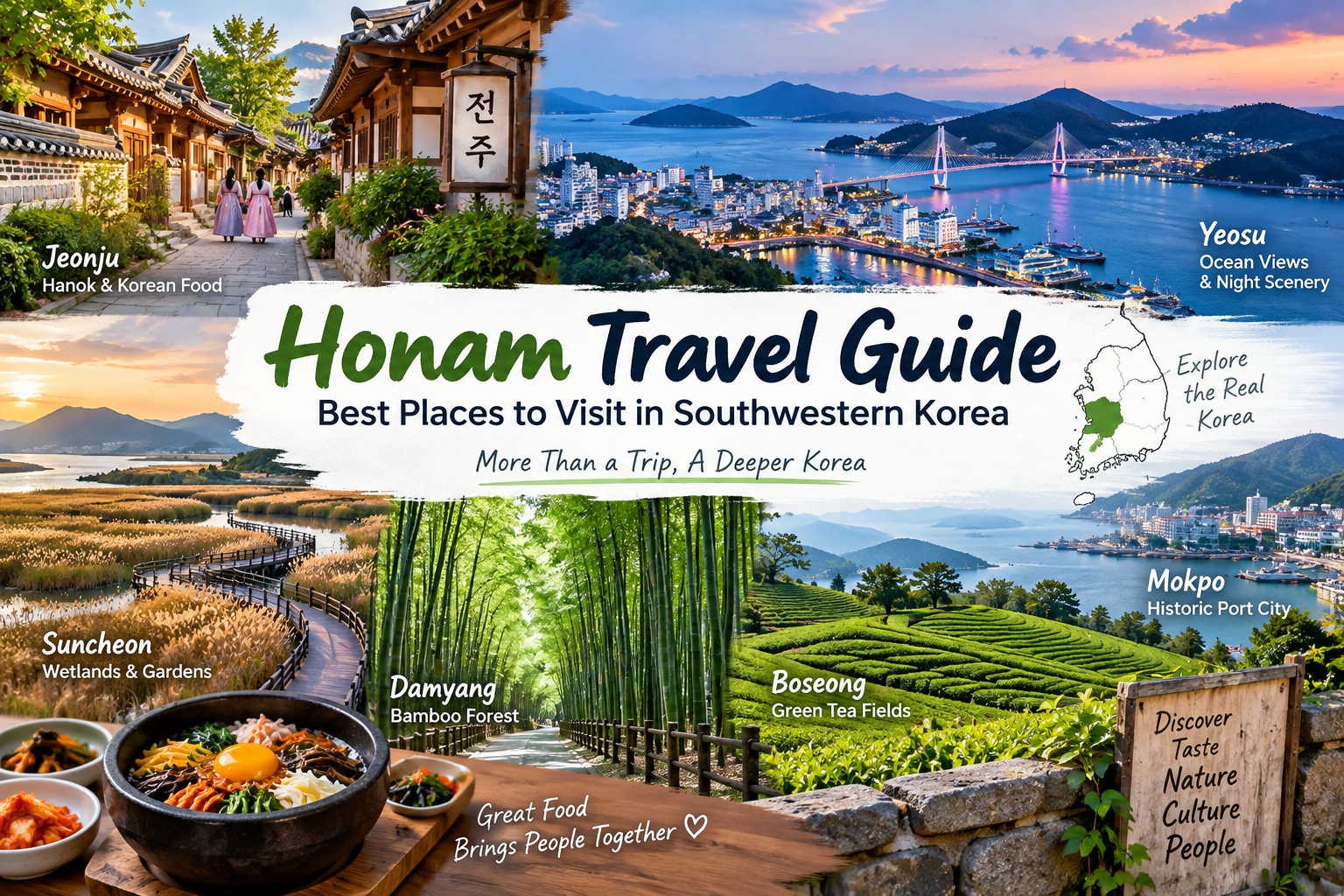
Discover the Honam Region of Korea
Honam is the traditional name for the southwestern region of Korea centered on Jeolla, today broadly associated with Jeonbuk State, Jeollanam-do (South Jeolla), and Gwangju. It is a regional and historical term rather than a single modern administrative area.
For travelers, Honam offers a different side of Korea from Seoul and the better-known southeastern routes. The region is especially famous for its food, but it also includes historic cities, traditional hanok neighborhoods, coastlines, wetlands, islands, mountains, bamboo forests, and distinctive local markets.
From eating bibimbap in Jeonju to watching the sea in Yeosu, walking through the wetlands of Suncheon, and exploring the historic port city of Mokpo, Honam rewards travelers who venture beyond Korea’s most familiar routes.
Is Honam the Same as Jeolla?
Honam and Jeolla refer to closely related parts of southwestern Korea, but the terms are not used in exactly the same way. Jeolla is the historical provincial name that survives today in Jeonbuk State and Jeollanam-do (South Jeolla), while Honam is a broader traditional regional term.
In modern usage, Honam commonly refers to Jeonbuk, Jeollanam-do, and the metropolitan city of Gwangju. Travelers are therefore more likely to see Jeolla in province names and on maps, while Honam often appears when southwestern Korea is discussed as a broader historical, cultural, or regional area
1. Jeonju – Hanok, History and Korean Food
Jeonju is one of the best places to begin a journey through the Honam region.
The city is famous for Jeonju Hanok Village, an area filled with hundreds of traditional Korean hanok buildings.
Visitors can walk through narrow streets, see traditional architecture, visit cultural attractions, try Korean snacks, and experience a different atmosphere from modern Korean cities.
Jeonju is also one of Korea’s most famous food destinations.
The city is strongly associated with Jeonju bibimbap, but travelers will find many other dishes, traditional sweets, market foods, and local specialties.
For international visitors interested in both Korean culture and food, Jeonju is an excellent introduction to southwestern Korea.
2. Gwangju – Culture, Markets and Local Life
Gwangju is the largest city in the Honam region and an important center of culture and history.
The city offers museums, cultural spaces, traditional markets, shopping areas, restaurants, and easy access to surrounding destinations.
Gwangju is also an excellent place to experience Jeolla-do’s reputation for generous and flavorful food.
Rather than treating the city only as a transportation hub, spend time exploring its neighborhoods and markets.
Gwangju can provide a more everyday view of urban life in Korea away from the country’s most heavily visited cities.
3. Yeosu – Ocean Views and Night Scenery
Yeosu is one of the most attractive coastal cities in southern Korea.
Surrounded by sea and islands, the city is known for waterfront scenery, seafood, bridges, and beautiful night views.
Travelers can spend time walking beside the coast, visiting viewpoints, exploring local markets, and enjoying fresh seafood.
Yeosu becomes especially atmospheric in the evening when lights reflect across the water.
For travelers who enjoy coastal cities, Yeosu offers a very different experience from Seoul or inland destinations.
4. Suncheon – Wetlands and Gardens
Suncheon is one of the best destinations in Korea for travelers interested in nature.
The area is famous for Suncheon Bay Wetland, an important coastal wetland with reed fields, walking paths, and expansive natural scenery.
Suncheon also offers gardens and other outdoor attractions that make it a good destination for slower travel.
The landscape changes with the seasons, creating different experiences throughout the year.
Suncheon and Yeosu are often easy to combine in the same regional itinerary because they are relatively close to each other.
5. Mokpo – A Historic Port City
Located in southwestern Korea, Mokpo has long been connected to the sea.
The city offers harbor views, local seafood, markets, historic neighborhoods, and access to islands off Korea’s southwest coast.
Mokpo’s atmosphere feels different from Korea’s largest cities.
Travelers can explore the waterfront, visit local markets, discover regional dishes, and use the city as a gateway to nearby islands and coastal areas.
It is a particularly interesting destination for travelers who enjoy port cities and regional food culture.
6. Damyang – Walk Through a Bamboo Forest
Damyang is famous for bamboo and is one of the most distinctive nature destinations in the Honam region.
One of its best-known attractions is Juknokwon Bamboo Garden, where walking paths wind through tall bamboo.
The cool shade and sound of bamboo moving in the wind create a peaceful atmosphere.
Damyang is also known for local food and traditional landscapes, making it a good day trip or overnight destination from Gwangju.
For travelers who want a break from busy cities, Damyang offers a quieter side of Korea.
7. Boseong – Korea’s Green Tea Country
Boseong is strongly associated with green tea.
Its rolling tea fields create one of the most recognizable landscapes in southwestern Korea.
The scenery is particularly beautiful when the tea plants are green and the hills are covered with carefully arranged rows of leaves.
Visitors can walk through tea plantation areas and try green tea drinks, desserts, and other local products.
Boseong is an excellent destination for photography, nature, and travelers interested in Korean tea culture.
8. Explore the Islands of Southwestern Korea
The southwest coast of Korea is surrounded by numerous islands.
Some are connected by bridges, while others require ferry travel.
Island trips can offer quiet fishing villages, beaches, walking trails, seafood, and landscapes far removed from Korea’s major cities.
However, island transportation requires more planning.
Ferry schedules can vary according to destination, season, and weather, so travelers should always check current transportation information before departure.
For visitors with enough time, exploring an island can become one of the most memorable experiences in Honam.
9. Experience Jeolla-do’s Famous Food Culture
Food is one of the strongest reasons to visit Honam.
Jeolla-do has long been celebrated in Korea for its rich culinary traditions and generous meals.
A Korean meal in the region may arrive with numerous banchan, or side dishes, surrounding the main dish.
Jeonju is famous for bibimbap, coastal cities such as Yeosu and Mokpo offer seafood, and smaller towns have their own local specialties.
The best food experiences are not limited to expensive or famous restaurants.
Traditional markets, neighborhood restaurants, and family-run establishments can be equally memorable.
For food-focused travelers, Honam deserves several days of exploration.
10. Visit Traditional Markets
Traditional markets provide an excellent introduction to regional food and everyday life.
Instead of seeing only polished tourist districts, visitors can explore stalls selling vegetables, seafood, meat, snacks, prepared dishes, and local specialties.
Markets in Jeonju, Gwangju, Yeosu, Mokpo, and other cities offer different experiences depending on the region.
They are also useful places to discover foods you may never encounter in restaurants aimed primarily at international visitors.
Bring curiosity and an appetite.
11. Discover Korea at a Slower Pace
One of the pleasures of traveling through Honam is that many destinations encourage slower travel.
Instead of rushing between major landmarks, you can spend an afternoon walking through a bamboo forest, sit beside the sea, explore a traditional market, or enjoy a long Korean meal with many side dishes.
This slower rhythm can be especially refreshing after several busy days in Seoul.
Honam gives travelers room to experience regional Korea rather than simply checking attractions off a list.
How Many Days Do You Need in Honam?
Honam covers a large area, so it is better to choose several destinations rather than attempting to see everything at once.
For a short trip, three or four days can provide a good introduction.
For example:
Day 1: Seoul → Jeonju → Jeonju Hanok Village → local food
Day 2: Jeonju → Gwangju → traditional market → local restaurants
Day 3: Gwangju → Suncheon → Suncheon Bay → Yeosu
Day 4: Yeosu → coastal sightseeing → seafood → return or continue traveling
With five to seven days, travelers can add Damyang, Boseong, Mokpo, or an island destination.
Food lovers may want even more time.
How to Get to Honam from Seoul
The best transportation option depends on which part of Honam you plan to visit.
Seoul to Jeonju
Jeonju is accessible from the Seoul area by train and express or intercity bus.
Rail travel is a convenient option for many visitors, while buses can also be useful depending on your departure point and accommodation.
Once you arrive in Jeonju, local buses and taxis can be used to reach the main sightseeing areas.
Seoul to Gwangju
High-speed rail makes Gwangju relatively easy to reach from the Seoul area.
Travelers can use KTX services to Gwangju-Songjeong Station and continue by subway, bus, or taxi.
Gwangju can also work as a transportation base for exploring nearby destinations such as Damyang.
Seoul to Yeosu
Yeosu can be reached from the Seoul area by rail, including KTX services.
Because the journey is longer than a trip to Jeonju, staying overnight is generally more practical than treating Yeosu as a day trip from Seoul.
Seoul to Mokpo
Mokpo is connected to the Seoul area by high-speed rail.
From Mokpo, travelers can explore the city or continue toward islands and other parts of the southwest coast.
Always check current train and bus schedules before traveling because departure times and services can change.
Getting Around the Honam Region
Major cities are connected by trains and intercity buses, but transportation becomes less frequent in rural and coastal areas.
Within cities such as Gwangju, Jeonju, Yeosu, and Mokpo, local buses and taxis can cover many tourist destinations.
For places such as Boseong, smaller towns, remote coastal areas, and multi-stop regional trips, renting a car can provide more flexibility.
If you plan to visit islands, check ferry schedules carefully and allow extra time for weather-related changes.
When Is the Best Time to Visit Honam?
Honam can be visited throughout the year.
Spring is pleasant for outdoor sightseeing and seasonal flowers.
Summer brings green landscapes and coastal travel, although the weather can be hot, humid, and rainy.
Autumn offers comfortable temperatures and is an excellent season for markets, cities, gardens, and countryside trips.
Winter is quieter and can be a good time for food-focused travel, although some outdoor destinations may feel less active.
For a balanced combination of food, cities, and nature, spring and autumn are particularly attractive.
Honam for First-Time Visitors
If this is your first trip to southwestern Korea, Jeonju is one of the easiest places to start.
It combines traditional architecture, Korean food, cultural experiences, and relatively convenient transportation from the Seoul area.
Travelers with more time can continue to Gwangju and then choose between several directions.
Go south toward Suncheon and Yeosu for wetlands and coastal scenery.
Travel toward Damyang for bamboo forests.
Continue southwest toward Mokpo for port-city culture and island connections.
The best itinerary depends on whether you are most interested in food, nature, history, or the coast.
Where Korean Food Becomes Part of the Journey
Travelers often arrive in Honam because they have heard about Jeolla-do’s food.
But food here is more than a list of famous dishes.
Traditional markets, regional ingredients, seafood, banchan, family-run restaurants, and local specialties all reveal something about the communities that created them.
A meal can become part of the sightseeing itself.
That is why Honam will also be an important region for travelers who want to explore Korea through its restaurants and local food.
Why Honam Belongs on Your Korea Itinerary
Honam offers something that can be difficult to experience on a short trip limited to Korea’s largest cities.
It combines traditional culture, regional cuisine, wetlands, bamboo forests, tea fields, port cities, islands, and coastal landscapes.
You can begin with a bowl of bibimbap in Jeonju, walk beneath bamboo in Damyang, explore wetlands in Suncheon, eat seafood beside the sea in Yeosu or Mokpo, and discover places that many first-time international visitors never reach.
For travelers willing to go beyond the familiar route, southwestern Korea offers a deeper and more flavorful journey.
Come for the food, but leave time for everything else.