Some places in South Korea are worth visiting for a famous landmark. Others are worth visiting simply for the feeling of being there.
Damyang Metasequoia Road belongs to the second category.
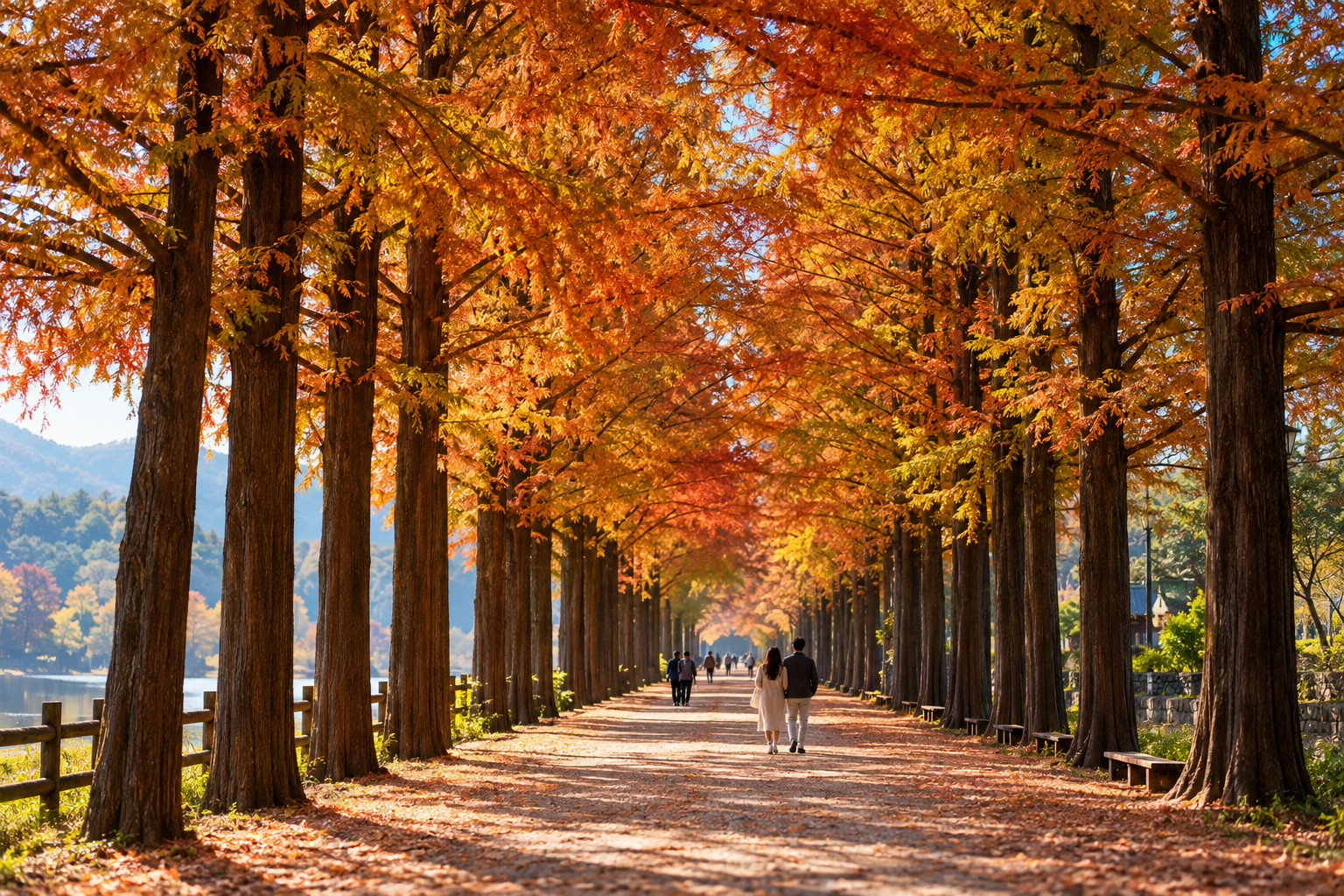
Imagine walking between two long rows of towering trees, their branches forming a tunnel overhead. In autumn, the soft green foliage gradually gives way to copper, amber and reddish-brown.
It’s a completely different atmosphere from the golden ginkgo avenues of Seoul or the mountain foliage of Seoraksan.
But there’s one question that travel photographs rarely answer.
Is Damyang worth the journey if you’re visiting Korea without a car?
After all, Damyang doesn’t have a KTX station, and getting there from Seoul or Busan involves more planning than visiting Nami Island or a city park.
This guide takes a practical approach. We’ll look at when to visit, how to reach the famous road, how much to budget, and whether a self-guided day trip or organized tour makes more sense.
We’ll also explore how to combine the road with Juknokwon Bamboo Garden and Gwanbangjerim Forest without turning a relaxing autumn outing into a transportation marathon.
Travel information reviewed: October 17, 2026. Operating hours, fares, bus schedules and autumn colors may change.
1. What Makes Damyang Metasequoia Road Special?
Damyang is a county near Gwangju in southwestern South Korea, best known for its bamboo forests and green landscapes.
Its Metasequoia-lined Road, known in Korean as 담양 메타세쿼이아길, is one of the country’s distinctive tree-lined attractions.
According to the Korea Tourism Organization, the wider metasequoia boulevard stretches approximately 8.5 kilometers and was recognized by the Korea Forest Service as one of Korea’s most beautiful roads.
But don’t let that 8.5-kilometer figure confuse you.
You do not need to walk the entire boulevard to enjoy the attraction.
Most visitors concentrate on the dedicated scenic walking area, where rows of tall trees create the famous tunnel-like view.
And while the trees are beautiful in summer, autumn gives the road a different character.
The warm-colored leaves, long shadows and striking symmetry of the tree trunks create the kind of scenery that makes you want to slow down rather than rush to your next stop.
There’s no complicated hiking route to complete.
You can simply walk, take photographs, sit for a while and enjoy the changing season.
Official attraction information: VISITKOREA — Damyang Metasequoia-lined Road
2. When Is the Best Time to Visit in Autumn 2026?
Here’s the part many visitors get wrong.
They plan to visit Damyang at the same time as Seoul’s autumn foliage.
But autumn colors don’t arrive everywhere in Korea at once.
Damyang lies farther south, and the trees along the metasequoia road can change color later than mountain forests in northern Korea.
For travelers planning an autumn visit, late October through November is a useful period to monitor, with early to mid-November often discussed as a promising window for deeper autumn colors.
However, this is a planning window, not a confirmed 2026 peak date.
Temperature, rainfall and weather conditions can shift the timing, and not every part of the road changes color simultaneously.
| Visiting period | What you may find | How to plan |
|---|---|---|
| Mid-to-late October | Mostly green foliage with possible early changes | Visit for the tree tunnel itself, not guaranteed peak colors |
| Early November | A greater possibility of mixed green, yellow and copper tones | Check recent photographs before traveling |
| Mid-November | Potential for richer autumn colors | Promising period, but not a guaranteed peak |
| Late November | Remaining color or substantial leaf fall | Go for the atmosphere rather than expecting full foliage |
If your travel dates are fixed, don’t cancel a visit simply because the trees aren’t at their deepest autumn color.
Even without peak foliage, the architecture-like lines of the trees are impressive.
But if you’re traveling several hours specifically for photographs, check recent local images and weather before committing.
For a broader look at autumn timing across the country, read our Korea Fall Foliage 2026: Best Places and When to See Autumn Colors.
What time of day is best for photographs?
Many travel photographs make the road look completely empty.
In reality, popular autumn weekends can attract plenty of visitors.
Earlier in the morning is generally a better choice if you want fewer people in your photographs.
Soft morning light may also create a gentler atmosphere between the trees.
Later afternoon light can make the trunks and foliage look especially warm, although the effect depends on weather and the position of the sun.
One important warning: the official opening hours for the paid attraction must take priority over a photograph you’ve seen online.
Don’t assume you can enter the ticketed walking area before opening just because another traveler photographed nearby scenery at sunrise.
3. Damyang Metasequoia Road: Entrance Fee and Opening Hours
This is one of the easiest parts of the trip to budget for.
According to the Korea Tourism Organization’s published visitor information:
| Item | Published information |
|---|---|
| Location | 12 Metasequoia-ro, Damyang-gun |
| Korean address | 담양군 담양읍 메타세쿼이아로 12 |
| Adult admission | KRW 2,000 |
| Teenager admission | KRW 1,000 |
| Child admission | KRW 700 |
| September–April hours | 9:00 AM–6:00 PM |
| May–August hours | 9:00 AM–7:00 PM |
| Parking | Available |
The official listing also provides reduced group admission rates and certain age-based exemptions.
Some local travel guides report a Damyang local-voucher return scheme linked to admission payments introduced in 2026. Because its conditions and availability can vary, don’t count a voucher as cash savings until you confirm the current arrangement at the ticket office.
For an international traveler, the practical approach is simple.
Budget the published admission price first, then treat any locally usable voucher as an additional benefit.
You should also distinguish the paid scenic walking area from the broader metasequoia-lined road network.
A statement that the road is accessible at any time does not necessarily mean the ticketed attraction is open around the clock.
Official reference: VISITKOREA attraction listing
4. How to Get to Damyang from Seoul
Let’s deal with the biggest obstacle.
Damyang has no KTX station of its own.
So if you’re traveling independently from Seoul, there are two main approaches worth comparing.
Option A: Travel through Gwangju
Take a train from Seoul to Gwangju-Songjeong Station, then continue toward Damyang by local transportation.
This can work particularly well if you’re already using Gwangju as a regional base.
However, Gwangju-Songjeong Station is not in Damyang, and reaching the famous road still requires additional travel.
You’ll need to account for the transfer across Gwangju, the regional bus or taxi connection, and the final journey to the attraction.
Don’t compare only the KTX time with a direct bus journey.
Compare the entire trip from your accommodation to the entrance.
For the train reservation process, see our How to Book KTX Tickets in Korea in 2026.
Option B: Check a direct intercity bus
Depending on the travel date and current timetable, direct long-distance bus services may provide a simpler connection between Seoul and Damyang.
This can be more convenient than arriving by train and making multiple transfers.
But the exact departure terminal, timetable and return service are critical.
Before booking, confirm that the service actually runs on your chosen date and that the return journey leaves enough time for sightseeing.
You can check the appropriate reservation platforms using our Guide to Booking Express and Intercity Buses in Korea.
Is a same-day round trip from Seoul worth it?
It is possible to plan a same-day visit, but it is a long travel day.
Consider what happens if you spend several hours reaching Damyang, then another stretch of time connecting to the road, and still need to make the last convenient trip back.
You could end up watching the clock instead of enjoying the trees.
That’s why I would approach a Seoul-origin day trip cautiously.
If Damyang is your main reason for traveling, consider staying one night in Gwangju.
It gives you a more flexible visit, especially if you want to combine the metasequoia road with Juknokwon Bamboo Garden.
5. How to Get to Damyang from Gwangju
For many independent travelers, Gwangju is the most practical gateway to Damyang.
Regional buses connect Gwangju and Damyang, including services commonly identified with route 311.
However, the exact boarding point, journey time and stopping pattern can vary.
Don’t assume that every bus marked for Damyang will stop directly outside the metasequoia walking area.
Before leaving, use an up-to-date Korean map app such as Naver Map or KakaoMap to confirm your specific departure point and destination.
Search these Korean names:
- 담양 메타세쿼이아길 — Damyang Metasequoia Road
- 담양공용버스터미널 — Damyang Bus Terminal
- 죽녹원 — Juknokwon Bamboo Garden
- 광주종합버스터미널 — Gwangju U-Square Bus Terminal
You may find that a bus connection is convenient for reaching central Damyang, while a short local taxi ride makes the final attraction-to-attraction journey easier.
That’s perfectly reasonable.
Trying to save every taxi fare can sometimes mean losing too much of your afternoon waiting for a less convenient bus.
Should you use a taxi?
A taxi is worth considering if you’re traveling as a couple, in a family or with friends who can share the fare.
It can also be useful for the short transfer between Juknokwon and the metasequoia attraction.
For a solo budget traveler, public transportation may make more sense, provided there is a convenient service.
The right choice depends on the total route and the number of passengers — not just the price of one ride.
6. What If You’re Coming from Busan?
Busan is another possible starting point, particularly for travelers already exploring southern Korea.
However, Damyang is not a straightforward urban excursion from Busan.
Traveling independently generally involves a long-distance connection toward the Gwangju or Damyang area and then local transportation.
You may also encounter organized autumn tours that combine Damyang’s bamboo forest and metasequoia road.
These are worth comparing carefully.
Some tours take care of the most difficult part — regional transportation — but give you less freedom to decide how long to stay at each attraction.
Before reserving a tour, check whether the advertised package includes actual admission, how much time is allocated to Damyang Metasequoia Road, and whether the departure and return points work with your hotel.
The word Damyang in a tour title doesn’t necessarily mean the famous road is the main stop.
7. DIY Trip vs Guided Tour: Which Is Better?
This decision can make a bigger difference to your experience than the season you choose.
A self-guided visit gives you freedom.
Want to spend an extra 40 minutes photographing the trees? You can.
Want to stop for bamboo rice or traditional grilled tteokgalbi before visiting the garden? No problem, provided your return transport allows it.
A guided tour, on the other hand, can remove much of the uncertainty around buses and transfers.
| Factor | Self-guided visit | Organized tour |
|---|---|---|
| Transport planning | You arrange trains, buses and taxis | Usually handled by the operator |
| Flexibility | High | Limited by scheduled stops |
| Photography time | You control your schedule | Depends on the itinerary |
| Cost | Often attractive for travelers already near Gwangju | May be worth the premium for simpler transport |
| Language support | You navigate independently | Varies by operator |
| Best for | Independent travelers, slower itineraries | First-time visitors, short trips, groups |
When a DIY trip makes sense
Choose a self-guided trip if you’re already staying in Gwangju or have a flexible overnight itinerary.
The travel planning becomes much simpler when you don’t need to return all the way to Seoul on the same day.
When a tour may be worth it
Consider a tour if you’re visiting from Busan, traveling with people who prefer not to navigate regional transfers, or trying to visit several attractions within a limited time.
But don’t buy a tour based only on the number of locations listed.
A four-stop tour with short visits may be less satisfying than a relaxed afternoon in Damyang.
Ask how much usable time you will actually spend walking among the trees.
8. The Best Damyang Autumn Itinerary: Three Places, One Relaxed Day
One reason Damyang makes a rewarding day trip is that Metasequoia Road isn’t the only attraction worth seeing.
Three places work particularly well together.
Stop 1: Juknokwon Bamboo Garden
Start with the bamboo forest.
Juknokwon is one of Damyang’s best-known attractions, featuring paths through dense bamboo groves.
Walking here feels different from walking along the metasequoia road.
The bamboo creates a green, sheltered environment, while the tall metasequoia trees form a grand, open avenue.
You don’t need to cover every trail inside Juknokwon to enjoy it.
Set aside approximately 60–90 minutes for a relaxed visit, depending on how much walking you want to do.
The Korea Tourism Organization lists the adult entrance fee at KRW 3,000.
Note that the published operating hours change seasonally: March–October is 9:00 AM–7:00 PM, while November–February is 9:00 AM–6:00 PM, with last admission earlier than closing.
Official guide: VISITKOREA — Juknokwon Bamboo Garden
Stop 2: Gwanbangjerim Forest
Next, slow down along the riverside.
Gwanbangjerim is a historic forest planted along Damyangcheon Stream, with mature trees that create a different autumn atmosphere from both bamboo groves and the metasequoia road.
The Korea Tourism Organization describes a forest corridor extending approximately two kilometers.
It’s especially appealing if you want a quieter walk and a different kind of autumn photograph.
You can also use this part of the day for a meal or rest around central Damyang.
Official guide: VISITKOREA — Gwanbangjerim Forest
Stop 3: Damyang Metasequoia Road
Finish with the main attraction.
Allow approximately 45–90 minutes depending on how much you enjoy photography.
You don’t need to hurry from one end of the road to the other.
The experience is about the trees, their symmetry and the changing light.
If the timing works, you may also stop by nearby Meta Provence, a shopping and leisure complex beside the metasequoia attraction.
It’s a convenient option for a coffee or break, rather than an essential stop for every traveler.
A sample itinerary
| Time | Activity | Planning note |
|---|---|---|
| 10:00 AM | Arrive at Juknokwon | Adjust for your actual transport arrival |
| 10:00–11:30 AM | Explore the bamboo garden | Choose comfortable paths |
| 11:30 AM–1:00 PM | Lunch and Gwanbangjerim | Allow time to rest |
| 1:00–1:30 PM | Transfer toward Metasequoia Road | Walk or take a taxi depending on conditions |
| 1:30–3:00 PM | Explore the tree-lined road | Photography and a relaxed walk |
| After 3:00 PM | Return toward Gwangju or enjoy a café | Confirm your return connection first |
This is an illustrative schedule, not a published transport timetable. Distances, walking speed and waiting times vary, so leave enough flexibility for your actual journey.
9. How Much Does a Damyang Day Trip Cost?
The attraction fees are relatively modest.
For a traveler visiting both the metasequoia road and Juknokwon, the standard adult admission costs currently listed by the Korea Tourism Organization are:
| Expense | Published or planning amount |
|---|---|
| Damyang Metasequoia Road admission | KRW 2,000 |
| Juknokwon adult admission | KRW 3,000 |
| Combined adult admission | KRW 5,000 |
| Meals and drinks | Depends on your choices |
| Gwangju–Damyang transportation | Check your route and fare |
| Local taxis | Optional |
| Train or long-distance bus from Seoul/Busan | Depends on date, class and route |
| Organized tour | Compare the final price and inclusions |
The entrance fees are not the expensive part of this journey.
Transportation is what determines whether Damyang becomes an affordable outing or an expensive detour.
If you’re already staying in Gwangju, the total cost can be relatively manageable.
If you’re traveling from Seoul solely for one afternoon, intercity transportation may account for the majority of your spending.
That’s why adding Damyang to an existing Gwangju or Jeolla itinerary may offer better value than making a special long-distance round trip.
10. Where Should You Stay: Damyang or Gwangju?
Not every traveler needs to stay overnight.
But if you’re coming from Seoul or Busan and want a relaxed visit, spending a night in the region is worth considering.
Stay in Gwangju if transport convenience matters
Gwangju is a practical base for travelers using KTX, intercity buses or other regional connections.
It can be easier to organize your onward journey from a major city than from a smaller destination.
This is the option I would consider first for an international visitor without a car.
Stay in Damyang if atmosphere matters more
Damyang may appeal to travelers who want a slower countryside visit or accommodation near the area’s natural attractions.
But check the exact location of your accommodation carefully.
Not every stay described as being in Damyang will be within walking distance of the metasequoia road or Juknokwon.
And if you’re dependent on public transportation, arriving late at night may complicate your plans.
For most first-time visitors without a car, Gwangju is the more flexible base.
11. Five Mistakes That Can Ruin a Damyang Day Trip
Mistake 1: Assuming the trees peak on the same date every year
Autumn colors respond to weather, not a calendar.
Check recent photographs and conditions instead of treating a predicted peak date as guaranteed.
Mistake 2: Assuming the entire 8.5-kilometer road is one ticketed walking trail
The broader metasequoia boulevard and the main scenic attraction are not exactly the same thing.
Use the attraction’s published address when planning your visit.
Mistake 3: Planning around the fastest train without calculating transfers
A fast KTX connection to Gwangju doesn’t mean you’ll be standing under Damyang’s trees immediately after leaving the station.
Add the time required for regional buses or taxis.
Mistake 4: Trying to squeeze too many attractions into one day
Juknokwon, Gwanbangjerim and Metasequoia Road already make a satisfying outing.
You don’t have to add distant gardens and mountain destinations just because they appear in the same regional guide.
Mistake 5: Forgetting the return journey
This is especially important for independent travelers.
Before exploring the attractions, confirm how you’ll return to Gwangju, whether your long-distance connection still works, and how much extra time to allow.
Don’t leave that decision until the ticketed attraction closes.
12. Is Damyang Better Than Nami Island for Autumn Foliage?
This is an interesting comparison, especially if you have only one free day in Korea.
Both destinations offer beautiful tree-lined scenery.
But they suit different kinds of trips.
| What matters to you | Damyang Metasequoia Road | Nami Island |
|---|---|---|
| Main attraction | Tall metasequoia avenue and nearby bamboo forest | Island walks, multiple tree-lined paths |
| Travel from Seoul | Longer and more complicated | Generally more convenient |
| Regional character | Southwestern countryside and local food | Established day-trip destination near Seoul |
| Ideal travel style | Gwangju-based trip or slower regional journey | Seoul-based day trip |
| Best reason to choose | Distinctive metasequoia scenery and Damyang attractions | Easier access and a broad range of activities |
If you’re visiting Korea for the first time and have just one spare day in Seoul, Nami Island may be easier to fit into your itinerary.
If you’ve already visited the major Seoul attractions, are exploring southern Korea or specifically want the towering metasequoia tunnel, Damyang becomes more compelling.
For a detailed breakdown of the easier Seoul-area alternative, see our Nami Island from Seoul in Autumn 2026: DIY Train Trip vs Guided Tour.
13. Frequently Asked Questions
Is Damyang Metasequoia Road worth visiting?
Yes, especially if you enjoy photography, peaceful walking routes and distinctive seasonal scenery. However, whether it’s worth a special trip from Seoul depends on how much time and money you’re willing to spend reaching it.
Can you visit Damyang without renting a car?
Yes. Public transport connects the area with Gwangju, although reaching specific attractions may require local buses, walking or taxis.
Is Damyang a good day trip from Seoul?
It’s possible, but the round-trip journey can be demanding. A Gwangju-based day trip or an overnight itinerary may be more comfortable.
Is the Metasequoia Road free?
The Korea Tourism Organization lists admission fees for the paid scenic attraction, including KRW 2,000 for adults. Check current admission arrangements before visiting.
When will the trees be at their best in autumn 2026?
Early to mid-November may be promising for richer colors, but there is no guaranteed peak date. Check recent local conditions close to your travel date.
How long should you spend at the road?
For many visitors, around 45–90 minutes is a reasonable planning estimate. Those who enjoy photography may want longer.
Can you combine Damyang Metasequoia Road with Juknokwon?
Absolutely. The two attractions complement each other well, particularly with a stop at Gwanbangjerim Forest in between.
Final Verdict: Who Should Visit Damyang Metasequoia Road?
Damyang isn’t the most convenient autumn destination in Korea.
And that is exactly why it’s worth thinking carefully before adding it to your itinerary.
If you’re looking for an easy day trip from Seoul with minimal transfers, you may prefer Nami Island or a closer autumn destination.
But if you’re already traveling through Gwangju, have an extra night in southern Korea or want to see one of the country’s most memorable avenues of tall trees, Damyang is an excellent place to consider.
The best version of the trip isn’t the one with the most stops.
It’s the one that gives you enough time to appreciate the bamboo forest, walk beneath the metasequoias and enjoy the quieter rhythm of the region.
My recommended approach: Travel through Gwangju, give yourself a relaxed day in Damyang, and combine Metasequoia Road with Juknokwon and Gwanbangjerim.
Most importantly, check the autumn colors, current operating information and return transport before leaving.
Because the most rewarding part of Damyang isn’t simply taking a photograph beneath the trees.
It’s having enough time to enjoy being there.