Tag: Korea transportation

  • How to Book Express and Intercity Buses in Korea in 2026: A First-Time Traveler’s Guide

    How to Book Express and Intercity Buses in Korea in 2026: A First-Time Traveler’s Guide

    Traveling around Korea by bus can be one of the easiest ways to reach places that are not conveniently connected by train. But for first-time visitors, booking a long-distance bus can feel more confusing than booking a KTX ticket.

    The first thing to know is that you do not need to use a bus for every trip.

    If you are traveling between major cities such as Seoul and Busan, a KTX train may be the simpler choice, especially on your first trip to Korea. But if your destination does not have a convenient train station, or a bus takes you directly to the city you want to visit without a transfer, an express or intercity bus can be the better option.

    This is especially useful when traveling to smaller cities and regional destinations across Korea.

    The confusing part is that Korea has two main types of long-distance buses—express buses and intercity buses—and they do not always use the same booking system. You may come across KOBUS, Bustago, or T-money when searching for tickets.

    The good news is that international travelers now have more booking options than before, including services that support foreign-issued credit cards.

    This guide explains how to choose the right bus, where to book it, how to pay, and what to do at the terminal. It also focuses on the questions that matter most if this is your first trip to Korea.

    First: Should You Take a Bus or a Train in Korea?

    Before opening a bus booking website, check whether taking a bus actually makes sense for your route.

    A simple rule for first-time travelers is:

    Choose the train when it gives you a simple, fast connection between major cities. Choose a bus when it gets you closer to your actual destination or avoids an unnecessary transfer.

    For example, Korea’s rail network makes travel between many major cities straightforward. However, buses reach many smaller cities and towns that are not directly served by trains.

    An intercity bus can therefore be particularly useful if you are heading to a regional destination in Gangwon, Chungcheong, Jeolla, or Gyeongsang.

    Do not assume that KTX is automatically the best option simply because it is faster.

    Compare three things:

    • Where the train station is located
    • Where the bus terminal is located
    • How many transfers you will need after arriving

    A slightly longer bus ride that takes you directly to the center of your destination can sometimes be easier than a faster train followed by another bus or taxi.

    For a first trip to Korea, prioritize the simplest complete journey—not just the fastest vehicle.

    Express Bus vs Intercity Bus: What Is the Difference?

    This distinction confuses many first-time visitors.

    Express buses generally connect major cities over longer distances and commonly use major express bus terminals.

    Intercity buses cover a much wider variety of regional routes, including many smaller cities and towns.

    You do not need to memorize the Korean bus system before your trip.

    Instead, start with your destination.

    If your route appears on KOBUS, you can book it as an express bus. If it does not, check the intercity bus systems such as Bustago or T-money.

    This is much easier than trying to decide which type of bus you need before searching for the route.

    Where Should Foreign Travelers Book a Bus in Korea?

    Once you know that a bus is the right choice for your trip, the next question is where to book it.

    This is where many first-time visitors get confused. Korea does not have one booking website that covers every long-distance bus route.

    Depending on the route, you may need to use KOBUS, Bustago, or another intercity bus booking service.

    Here is the easiest way to approach it.

    1. KOBUS: Start Here for Express Buses

    KOBUS is the main booking system for express buses in Korea.

    If you are traveling between major cities on an express bus route, this is a good place to check first.

    You select your departure terminal, destination, travel date, and preferred departure time. Available buses are then displayed with information such as departure time, seat type, and fare.

    For a first-time traveler, however, there is one important rule:

    Check the exact terminal name before paying.

    Large cities can have more than one bus terminal. In Seoul, for example, simply knowing that your bus leaves from “Seoul” is not enough. Going to the wrong terminal can mean missing your bus even if you have a valid ticket.

    Save the terminal name and location on your phone as soon as you make the reservation.

    2. Bustago: Check Here for Intercity Routes

    If you cannot find your destination through the express bus system, check Bustago.

    Bustago covers many intercity bus routes connecting cities and regional destinations around Korea.

    This can be especially useful when your destination is outside the main high-speed rail network.

    Do not assume that a route does not exist just because you cannot find it on KOBUS. It may simply be classified as an intercity bus route and sold through a different system.

    Bustago also provides options for foreign travelers, including payment with supported foreign-issued cards.

    3. T-money Intercity Bus Booking

    You may also encounter the T-money intercity bus reservation system when searching for routes.

    Again, you do not need to understand which company operates every bus.

    For a traveler, the practical approach is simply:

    Search KOBUS for an express route first. If you cannot find the route, check the intercity booking systems.

    That one habit removes much of the confusion.

    If you are also deciding which transportation card to use for local buses and subways during your trip, see our guide to choosing between T-Money and the Seoul Climate Card for tourists.

    What If the Korean Booking Sites Feel Difficult?

    Do not assume you have done something wrong if a booking site feels less straightforward than the airline or hotel websites you normally use.

    International visitors may encounter differences in language support, payment procedures, terminal names, or ticket collection methods.

    If you are uncomfortable completing the reservation through a Korean booking system, you can also check travel platforms that sell Korean bus tickets to international travelers.

    These services can sometimes provide a simpler English-language booking process and international payment options.

    However, convenience can come with different prices, availability, or booking conditions.

    Before paying through any third-party service, compare the route, departure terminal, arrival terminal, cancellation policy, and final price with the official booking option whenever possible.

    For your first trip to Korea, the easiest booking method can be more valuable than saving a very small amount of money.

    The goal is not to use the most “local” method. It is to arrive at the correct terminal with a valid ticket and understand exactly where you are going.

    Can You Pay with a Foreign Credit Card?

    Foreign travelers have more options for booking Korean buses than they did in the past, but payment support can still vary depending on the booking system and card.

    When a booking service offers foreign-card payment, use a supported international card and complete any verification requested by your card issuer.

    If your card is declined, do not repeatedly try the same transaction without checking the reason. Instead, try another supported card or consider another booking method.

    And if online booking does not work, do not assume that you cannot take the bus.

    For many routes, tickets can also be purchased at the bus terminal, subject to seat availability.

    However, buying at the terminal is less attractive during weekends, public holidays, and busy travel periods because the departure you want may sell out.

    If you already know your travel date and route, booking ahead is the safer choice.

    Choosing a Seat

    When seat selection is available, you can usually choose from the remaining seats during booking.

    You may also see different bus classes depending on the route.

    Standard buses are generally the cheapest option. Higher-grade buses provide more space and more comfortable seating, which can be worthwhile on a longer journey.

    For a first-time visitor, there is usually no need to overthink the seat choice.

    If the journey is several hours long and the price difference is reasonable for your budget, paying for additional space can make the trip more comfortable.

    The more important decision is choosing the correct departure time and terminal.

    Do You Need to Print Your Bus Ticket?

    Do not automatically assume that every online reservation works like an airline mobile boarding pass.

    Ticketing procedures can differ by operator, route, and booking method.

    After making a reservation, read the confirmation carefully and check whether you can board using a mobile ticket or QR code or whether you need to collect or print a ticket at the terminal.

    If ticket collection is required, arrive early enough to find the ticket counter or machine.

    Keep your reservation details available on your phone, and taking a screenshot of the confirmation can also be useful in case you have difficulty accessing the booking page later.

    What to Do at the Bus Terminal

    For your first long-distance bus trip in Korea, try to arrive at the terminal about 20 to 30 minutes before departure.

    This gives you time to:

    • Confirm that you are at the correct terminal
    • Find the departure gate
    • Collect a ticket if necessary
    • Use the restroom
    • Buy water or a snack
    • Check your bus number and departure time

    Do not rely only on the destination name displayed on a bus.

    Check the departure information shown on your ticket and the terminal display as well.

    Korean long-distance buses generally operate on scheduled departure times, so being at the correct gate before departure matters.

    Luggage: Where Does Your Suitcase Go?

    If you are traveling with a large suitcase, you will normally place it in the luggage compartment underneath the bus.

    Keep important items with you rather than in your checked luggage.

    Your passport, wallet, phone, medication, valuables, and anything you may need during the journey should stay in your carry-on bag.

    When you arrive, remember to retrieve your suitcase before leaving the terminal area.

    This sounds obvious, but after a long journey it is easy to follow other passengers away from the bus without thinking about your luggage.

    Are There Toilets on Korean Long-Distance Buses?

    Generally, you should not expect a toilet on the bus.

    Longer journeys commonly include a stop at a highway rest area, where passengers can use the restroom and buy food or drinks.

    If the bus stops at a rest area, pay attention to how long the break will last.

    Take a photo of the bus or remember its identifying information before walking away, especially at a busy rest area where several similar buses may be parked.

    Most importantly, return to the bus before the stated departure time.

    For a first-time traveler, using the restroom before leaving the terminal is still the easiest option.

    Bus or KTX? What Should a First-Time Visitor Choose?

    If both a train and a bus are available for your route, you may wonder which one is better.

    There is no single answer for every trip.

    For first-time visitors, the best choice is usually the one that makes the entire journey easier—not simply the option with the shortest travel time.

    Choose KTX When…

    KTX is often the easier choice when you are traveling between major cities that are well connected by high-speed rail.

    Consider KTX when:

    • Both your departure and destination are conveniently served by KTX
    • Saving travel time is important
    • You prefer a straightforward station-to-station journey
    • Your accommodation is convenient to the train station
    • You want to avoid navigating an unfamiliar bus terminal

    For a first trip between Seoul and Busan, for example, KTX is often the simplest option despite buses also being available.

    Choose an Express or Intercity Bus When…

    A bus becomes particularly useful when it gets you closer to where you actually want to go.

    Consider a bus when:

    • Your destination does not have a convenient train station
    • Taking the train would require an additional bus or taxi transfer
    • There is a direct bus to your destination
    • The bus terminal is more convenient for your accommodation
    • You are visiting a smaller city or regional destination
    • The bus schedule works better for your itinerary

    This is why buses become more useful as you travel beyond Korea’s major rail corridors.

    Compare the Whole Trip, Not Just the Travel Time

    Suppose a train takes two hours while a bus takes three.

    The train may initially look like the obvious choice.

    But if reaching the train station takes 40 minutes and you need another transfer after arriving, while the bus leaves near your hotel and arrives close to your destination, the three-hour bus may actually produce the easier journey.

    Before booking, compare:

    hotel → departure station or terminal → journey → arrival station or terminal → final destination

    This simple comparison is much more useful than comparing KTX and bus travel times alone.

    Common Mistakes First-Time Travelers Should Avoid

    Mistake 1: Going to the Wrong Bus Terminal

    This is one of the most important mistakes to avoid.

    Major Korean cities can have multiple terminals, and the terminal you need may not be the one you expect.

    Do not search only for “Seoul Bus Terminal” or “Busan Bus Terminal” on the day of travel.

    Check the exact terminal written on your reservation, then save that location in your map app before leaving your hotel.

    Mistake 2: Assuming KOBUS Shows Every Bus

    If you cannot find your destination on KOBUS, that does not necessarily mean there is no bus.

    The route may be operated as an intercity service and listed through another booking system.

    Check the intercity booking options before giving up on the route.

    Mistake 3: Booking the Right City but the Wrong Terminal

    Look carefully at both the departure and arrival terminals.

    Two terminals in the same metropolitan area can be far enough apart to significantly change your itinerary.

    This matters even more if you have a hotel reservation, attraction ticket, or another connection after arriving.

    Mistake 4: Arriving Just Before Departure

    Even with a reservation, arriving at an unfamiliar Korean terminal one or two minutes before departure creates unnecessary risk.

    You may need time to locate the correct platform or collect a physical ticket.

    For your first bus journey in Korea, arriving 20 to 30 minutes early gives you a useful buffer.

    Mistake 5: Planning a Tight Connection After the Bus

    Road travel can be affected by traffic.

    Avoid scheduling an important flight, train, tour, or reservation immediately after the expected arrival time of a long-distance bus.

    Give yourself extra time, particularly around weekends and Korean public holidays.

    A Simple Booking Strategy for Your First Korea Trip

    If all of this still sounds complicated, use this sequence:

    1. Check whether KTX or another train provides an easy direct journey.

    If it does, compare the total journey with the bus.

    2. If a bus looks better, check KOBUS for an express bus.

    3. If the route is not there, check an intercity bus booking service such as Bustago or the T-money system.

    4. Confirm the exact departure and arrival terminals before paying.

    5. Check how your ticket must be used or collected.

    6. Save the reservation and terminal location on your phone.

    7. On your first trip, arrive at the terminal 20 to 30 minutes early.

    You do not need to master Korea’s entire bus system.

    You only need to know which option works for your particular journey.

    Which Booking Method Should You Use?

    Here is the simplest way to decide.

    Your situationWhat to check first
    Traveling between major cities with an express bus connectionKOBUS
    Traveling to a smaller city or regional destinationBustago or an intercity bus booking system
    KOBUS does not show your destinationCheck intercity bus services
    Korean booking systems are difficult to useConsider an international travel booking platform
    Both KTX and bus are availableCompare the entire door-to-door journey
    You cannot book onlineCheck ticket availability at the terminal

    For a first-time visitor, simplicity matters.

    If one option saves only a small amount of money but creates several extra transfers, an unfamiliar terminal, or a difficult booking process, the cheaper option may not be the better choice.

    Choose the journey you can understand and manage confidently.

    Frequently Asked Questions

    Can foreigners book Korean express buses online?

    Yes. Foreign travelers can book many Korean long-distance bus routes online. Available booking and payment options depend on the route and platform, so check the requirements before completing payment.

    Can I use a foreign credit card?

    Foreign-issued cards are supported through some Korean bus reservation services and international booking platforms. Card support can vary, so having an alternative payment method is useful.

    Should I book Korean buses in advance?

    For ordinary travel days, tickets may still be available at the terminal. However, advance booking is recommended when your itinerary depends on a particular departure.

    Booking ahead becomes especially important on weekends, public holidays, and other busy travel periods.

    Can I buy a bus ticket at the terminal?

    Yes, tickets for many routes can be purchased at terminal ticket counters or machines if seats remain available.

    If this is your first trip and you have a fixed itinerary, however, reserving ahead can reduce uncertainty.

    Do Korean long-distance buses have toilets?

    Generally, you should not expect an onboard toilet.

    Longer routes commonly stop at highway rest areas. Use the restroom before departure and pay attention to the return time during rest stops.

    Can I take a large suitcase on the bus?

    Long-distance buses generally have luggage compartments underneath the vehicle for larger bags.

    Keep your passport, wallet, phone, medication, and valuables with you.

    Is KTX better than taking a bus?

    Not always.

    KTX is often faster and very convenient between major cities, while buses can be more practical for destinations without convenient rail connections.

    Compare the entire journey from your accommodation to your final destination rather than travel time alone.

    How early should I arrive at the bus terminal?

    For your first long-distance bus trip in Korea, arriving around 20 to 30 minutes before departure is a practical target.

    It gives you time to confirm the terminal, locate the departure gate, and handle any ticket collection requirements.

    Final Advice for First-Time Visitors

    Korea’s long-distance bus network can look complicated when you first encounter several terminals and booking systems.

    But you do not need to understand all of it.

    Start with one question:

    What is the simplest way to get from where I am staying to where I actually want to go?

    If KTX provides a simple direct journey, take the train.

    If a bus takes you closer to your destination or avoids inconvenient transfers, check the express or intercity bus options.

    Then confirm the exact terminals, understand how your ticket works, save your reservation details, and arrive a little early.

    For a first trip to Korea, the best transportation choice is not necessarily the fastest or cheapest one.

    It is the one that makes the whole journey easier.
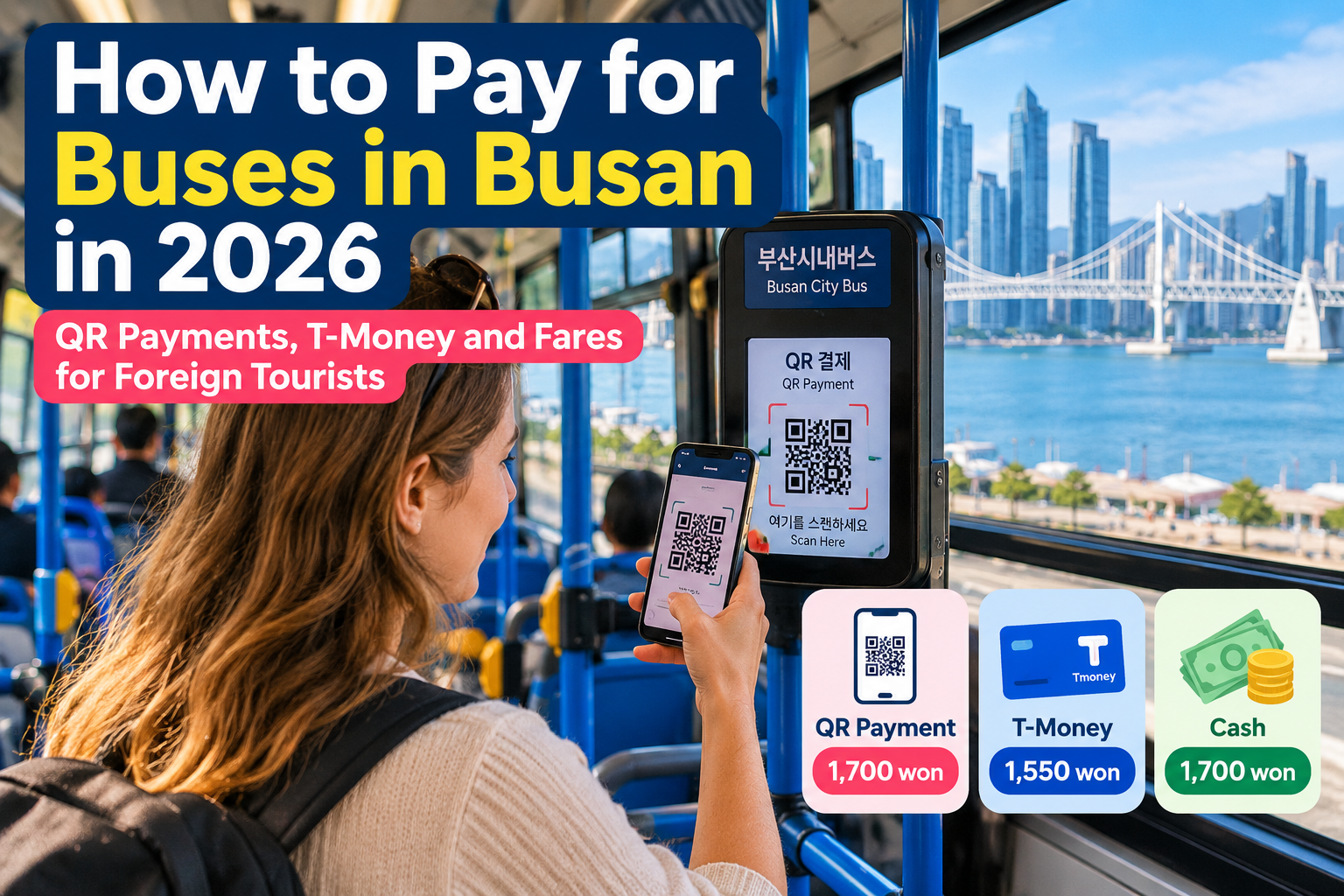
  • How to Pay for Buses in Busan in 2026: QR Payments, T-Money and Fares for Foreign Tourists

    How to Pay for Buses in Busan in 2026: QR Payments, T-Money and Fares for Foreign Tourists

    Getting around Busan by bus has become easier for international travelers in 2026.

    Starting September 21, foreign visitors can pay for Busan city buses by scanning a QR code with supported overseas payment apps. This means some travelers can now ride a bus without buying a Korean transportation card or preparing Korean cash first.

    However, QR payment is not always the cheapest or most convenient option. If you plan to use buses and the subway frequently, a transportation card such as T-Money can still be the better choice.

    Here is what foreign travelers need to know about paying for buses in Busan in 2026.

    Three Ways to Pay for a Bus in Busan

    For most international visitors, there are three practical ways to pay for a city bus in Busan:

    • a transportation card such as T-Money
    • cash in Korean won
    • the new QR payment system using a supported overseas payment app

    The best option depends on how often you plan to use public transportation and whether your mobile payment app supports the new QR service.

    1. Paying with T-Money or Another Transportation Card

    For travelers who will use public transportation several times during their trip, a transportation card remains one of the easiest options.

    T-Money and other compatible Korean transportation cards can be used on buses and the subway in Busan.

    For a regular city bus, the adult transportation-card fare is 1,550 won, compared with 1,700 won when paying cash.

    Using a transportation card also gives you access to eligible transfer discounts between public transportation services.

    This makes a transportation card particularly useful if you plan to:

    • take several buses in one day
    • transfer between buses
    • combine buses and the subway
    • travel around Busan for several days

    Transportation cards can also be recharged at locations such as subway stations and convenience stores.

    Is T-Money Only for Seoul?

    No.

    This is a common point of confusion for first-time visitors. Although T-Money is strongly associated with Seoul, it can also be used on public transportation in Busan.

    So if you already bought and loaded a T-Money card in Seoul, you generally do not need to buy another transportation card just because you arrived in Busan.

    2. New QR Bus Payment for Foreign Tourists

    Busan introduced a new QR payment option for foreign tourists on September 21, 2026.

    The system uses Zeropay’s global payment network and allows travelers with supported overseas payment apps to scan a QR code posted inside the bus.

    Supported services include major mobile payment platforms such as Alipay and WeChat Pay, along with other participating overseas payment services.

    You do not need to install a separate Korean transportation app simply to use this QR payment method if you already have a supported payment app.

    How to Pay by QR Code

    The process is straightforward.

    After boarding the bus:

    1. Open your supported mobile payment app.
    2. Scan the Zeropay QR code inside the bus.
    3. Confirm the payment.
    4. Show the completed payment screen to the bus driver.

    Currency conversion is handled through the payment system.

    Multilingual instructions and QR codes are being provided on Busan city buses, with additional information available around major tourist areas and transportation gateways.

    How Much Does QR Bus Payment Cost?

    The QR fare is 1,700 won per person.

    That is the same as the standard adult cash fare for a regular city bus.

    There are two important differences compared with using a transportation card.

    First, transfer discounts do not apply to QR payments.

    Second, the QR system charges the same 1,700-won fare for adults, teenagers and children.

    If several people are traveling together, each passenger requires a separate payment.

    For families or travelers making multiple transfers, this can make a transportation card more economical.

    3. Paying Cash on Busan Buses

    Cash remains another option on Busan city buses.

    For a regular city bus, the adult cash fare is 1,700 won.

    However, cash has two disadvantages for most tourists.

    The fare is higher than the standard transportation-card fare, and cash passengers cannot receive the same transfer discount available when using a transportation card.

    For that reason, cash is most useful as a backup rather than the main payment method for a multi-day trip.

    Busan Bus Fares in 2026

    For a regular Busan city bus, the basic fares are:

    Payment MethodAdult FareTransfer Discount
    Transportation card1,550 wonAvailable when eligible
    Cash1,700 wonNo
    Foreign tourist QR payment1,700 wonNo

    These figures apply to regular city buses. Express and late-night buses can have different fares.

    QR Payment vs T-Money: Which Is Better?

    For most tourists, the answer depends on the trip.

    Choose QR payment if:

    You only need an occasional bus ride, already use a supported overseas payment app, and do not want to buy or recharge a Korean transportation card.

    Choose T-Money or another compatible transportation card if:

    You plan to use buses and the subway frequently, expect to make transfers, or will travel around Korea for several days.

    The new QR system is mainly about convenience. A transportation card can still be better for frequent public transportation use because of the lower regular bus fare and transfer benefits.

    Can You Use the Same T-Money Card in Seoul and Busan?

    Yes.

    For many international travelers, this is the simplest solution.

    If your itinerary includes both Seoul and Busan, you can generally continue using the same T-Money card instead of purchasing a separate card for each city.

    That makes T-Money especially practical for travelers arriving in Seoul and later traveling to Busan.

    What About the Busan Subway?

    Do not confuse the new onboard bus QR payment system with QR tickets used for the Busan Metro.

    They are different payment systems.

    For tourists who plan to use both buses and the subway regularly, using a compatible transportation card is usually simpler because the same card can be used across the public transportation network.

    How to Ride a Bus in Busan

    If you have never used a Korean city bus before, the basic process is simple.

    Check your bus number and direction before boarding. Enter through the front door and pay your fare when you board.

    If using a transportation card, tap it on the card reader.

    If using the new foreign-tourist QR payment system, scan the QR code inside the bus, complete payment and show the confirmation screen to the driver.

    Before your stop, press one of the stop buttons inside the bus.

    Passengers normally exit through the rear door.

    When using a transportation card, remember to tap your card when getting off as well, especially if you may transfer to another bus or the subway.

    Which Payment Method Should First-Time Visitors Use?

    If you are spending several days in Busan, a transportation card is still the most flexible choice.

    You can use it for buses and the subway, and it is more convenient when making transfers.

    But the new QR payment system solves a real problem for short-term visitors.

    If you arrive in Busan without a transportation card and simply need to take a bus, you may now be able to pay using a familiar overseas mobile payment app instead of finding a place to purchase and recharge a card.

    That makes spontaneous bus trips considerably easier for international travelers.

    Final Tips for Using Buses in Busan

    Busan’s subway is convenient, but many beaches, hillside neighborhoods, temples and scenic areas are easier to reach by bus.

    For frequent public transportation use, keep a transportation card loaded with enough balance.

    For occasional trips, check whether your existing mobile payment app supports Busan’s new Zeropay QR bus payment system.

    And remember one important difference: QR payment offers convenience, while a transportation card generally offers better value for travelers making multiple trips and transfers.

    With both options now available, exploring Busan by bus has become easier for foreign visitors in 2026.


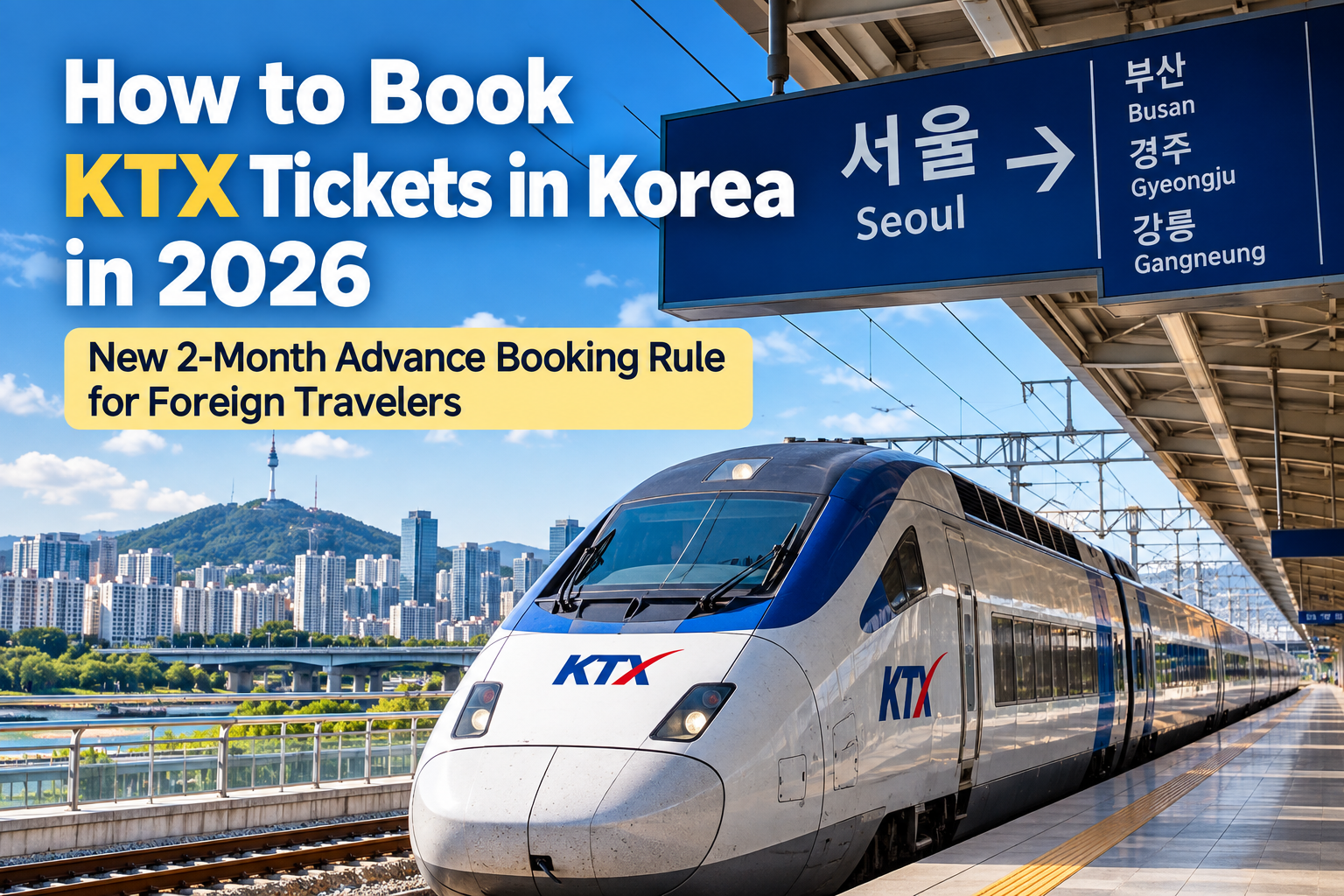
  • How to Book KTX Tickets in Korea in 2026: New 2-Month Advance Booking Rule for Foreign Travelers

    How to Book KTX Tickets in Korea in 2026: New 2-Month Advance Booking Rule for Foreign Travelers

    If you are planning a trip to South Korea in late 2026, booking your KTX train tickets is about to become easier.

    Starting October 1, 2026, travelers will be able to book KTX and other eligible train tickets up to two months before departure. Previously, most regular train tickets could only be booked about one month in advance.

    For international travelers planning popular routes such as Seoul to Busan, Seoul to Gyeongju, or Seoul to Gangneung, the change means you can secure your train tickets much earlier — especially useful when arranging hotels, flights, and a multi-city Korea itinerary.

    Here is what foreign travelers need to know about booking KTX tickets in Korea in 2026.

    What Is Changing for KTX Booking in October 2026?

    The biggest change is simple:

    From October 1, 2026, regular train tickets can be booked up to two months before departure.

    The previous advance booking window was generally one month.

    This applies to KTX and other eligible Korail train services, making it possible to organize long-distance travel much earlier.

    For example, if you are visiting Korea in November or December, you will no longer have to wait until roughly one month before your journey to start checking many regular train tickets.

    This is particularly helpful for international visitors who often book their flights and hotels several months ahead.

    Why the New 2-Month Booking Window Matters for Foreign Travelers

    KTX is one of the easiest ways to travel between major Korean cities.

    A traveler visiting Seoul and Busan, for example, can travel between the two cities by high-speed train rather than taking another domestic flight.

    The same rail network can also be useful for destinations such as Gyeongju, Daegu, Daejeon, Gangneung, Jeonju, and other parts of Korea.

    Until now, the shorter booking window sometimes created an awkward gap.

    You might have booked your international flight and hotels months in advance but still had to wait before buying your KTX ticket.

    The new system makes it easier to organize the transportation part of your itinerary at the same time.

    How to Book KTX Tickets in Korea

    For most foreign travelers, the safest starting point is Korail’s official booking service.

    Korail provides an English-language booking interface, along with other language options.

    The basic booking process is straightforward:

    1. Select your departure station.
    2. Select your destination.
    3. Choose your travel date.
    4. Search for available trains.
    5. Select your preferred departure time and seat.
    6. Enter the required passenger information.
    7. Complete payment.
    8. Keep your ticket or booking information available for your journey.

    When searching for trains, always check the station name carefully.

    Seoul has several major railway stations, and different trains may depart from different locations.

    Seoul to Busan: The Most Popular KTX Route for Tourists

    The Seoul–Busan route is one of the most useful KTX journeys for international travelers.

    It connects South Korea’s capital with its largest coastal city and makes a Seoul-and-Busan itinerary relatively easy to organize.

    Direct KTX services typically make the journey in roughly 2.5 to 3 hours, depending on the train.

    That means you can have breakfast in Seoul and arrive in Busan around lunchtime without going through an airport.

    Because this is such a popular route, booking earlier can be useful when your travel dates are fixed.

    What About Seoul to Gyeongju?

    Travelers visiting Gyeongju should pay particular attention to the station name.

    High-speed KTX trains serving the area use Gyeongju Station, which is outside the historic center.

    After arriving, you will still need local transportation to reach central Gyeongju and major attractions.

    Even with that extra transfer, KTX is often one of the most convenient ways to reach Gyeongju from Seoul.

    If Gyeongju is one of the main stops on your Korea itinerary, booking your train and accommodation together can make the trip much easier to organize.

    KTX to Gangneung and Korea’s East Coast

    KTX is also useful if you want to travel from Seoul toward Gangneung and the east coast.

    Gangneung is popular for beaches, cafes, seafood, and access to destinations around Gangwon Province.

    For travelers who do not want to rent a car, the train can be one of the simplest ways to leave Seoul and reach the east coast.

    Weekend services can attract significant demand, so travelers with a fixed itinerary should avoid assuming that their preferred train will always have seats available at the last minute.

    Should You Book KTX Tickets as Soon as They Become Available?

    Not necessarily.

    If your schedule is flexible and you are traveling on an ordinary weekday, you may have several train options.

    However, booking earlier makes more sense when:

    • you are traveling on a Friday evening or weekend,
    • your itinerary depends on a specific departure time,
    • you are traveling with several people,
    • you are visiting during a major Korean holiday,
    • or you are traveling during a particularly busy tourism period.

    For a carefully planned multi-city itinerary, there is little advantage in waiting unnecessarily once your dates are confirmed.

    Be Careful During Korean Public Holidays

    The new two-month booking window does not mean every train ticket will always follow exactly the same booking process.

    Major Korean holidays, especially Seollal (Lunar New Year) and Chuseok, can have special reservation periods and procedures.

    Demand during these periods is extremely high, and Korail may announce a separate holiday booking schedule.

    If your trip overlaps with a major Korean holiday, check the latest Korail announcement rather than relying only on the normal advance booking rule.

    This is one of the most important differences between ordinary KTX travel and holiday-period travel.

    Can Foreign Travelers Use the KTX Booking System?

    Yes.

    Korail provides foreign-language services, including English, and the Korean government has announced further improvements aimed at making rail booking more convenient for international visitors.

    These plans include expanded multilingual services and global payment options.

    Still, payment compatibility can vary depending on the card, issuing country, and booking platform.

    If an overseas card does not work, do not immediately assume that the train is sold out. Check the payment method and make sure you are using an official Korail booking channel.

    KTX or SRT: What Is the Difference?

    Foreign visitors may also encounter SRT when searching for high-speed trains.

    Both KTX and SRT operate high-speed rail services, but they traditionally used different booking systems and key departure stations.

    KTX commonly serves Seoul Station and Yongsan Station, while many SRT services use Suseo Station in southern Seoul.

    Korea has also been moving toward greater integration of KTX and SRT booking services, which can make comparing train options easier.

    For tourists, the most important consideration is usually not the brand of train but:

    Which station is easiest to reach, what time the train departs, where it stops, and whether seats are available.

    Do You Need a Korail Pass?

    Not every traveler needs a rail pass.

    If you are only taking one or two long-distance train journeys, buying individual tickets may be simpler.

    A rail pass becomes more relevant when you plan several eligible train journeys within a relatively short period.

    Before purchasing any pass, compare the current pass price with the actual cost of the individual trains you intend to take.

    Do not buy a rail pass simply because you plan to ride the KTX once.

    Tips for Booking KTX as a Foreign Visitor

    A few simple habits can prevent common problems.

    First, use official railway booking channels whenever possible.

    Second, double-check both your departure and arrival stations before paying.

    Third, keep a copy of your booking information available on your phone.

    Fourth, arrive at the station with enough time to find the correct platform.

    Korean railway stations are generally well organized, but major stations such as Seoul Station and Busan Station can be busy.

    Finally, remember that a confirmed seat is especially valuable when your hotel check-in, tour, or onward transportation depends on arriving at a particular time.

    Frequently Asked Questions

    How early can I book KTX tickets in Korea in 2026?

    Starting October 1, 2026, the normal advance reservation period for KTX and other eligible rail tickets expands from one month to two months before departure.

    Can foreigners book KTX tickets online?

    Yes. Korail provides foreign-language booking services, including English.

    Should I book Seoul to Busan KTX tickets in advance?

    It is a good idea if you need a particular departure time, especially on weekends, busy travel dates, or when traveling with a group.

    How long does the KTX take from Seoul to Busan?

    Many direct KTX services take roughly 2.5 to 3 hours, although journey times vary by service and stopping pattern.

    Can KTX tickets sell out?

    Yes. Popular trains and departure times can sell out, particularly during weekends and major travel periods.

    Is the two-month rule the same during Chuseok and Seollal?

    Do not assume so. Major Korean holidays can use special reservation schedules announced separately by Korail.

    Is KTX better than flying from Seoul to Busan?

    For many travelers, KTX is more convenient because it connects city centers and avoids the additional airport travel and procedures required for a domestic flight. The better choice still depends on your itinerary and fare.

    Final Thoughts

    The new two-month KTX booking window is a small change that can make planning a Korea trip much easier.

    From October 1, 2026, international travelers will be able to organize many train journeys earlier instead of waiting until about one month before departure.

    That is especially useful if you are building a multi-city itinerary connecting Seoul with Busan, Gyeongju, Gangneung, or other destinations around Korea.

    Once your itinerary is fixed, check your train options early, confirm the correct stations, and pay extra attention to special booking rules if your trip overlaps with a major Korean holiday.

    For travelers who want to explore beyond Seoul, Korea’s high-speed rail network remains one of the easiest ways to see more of the country.

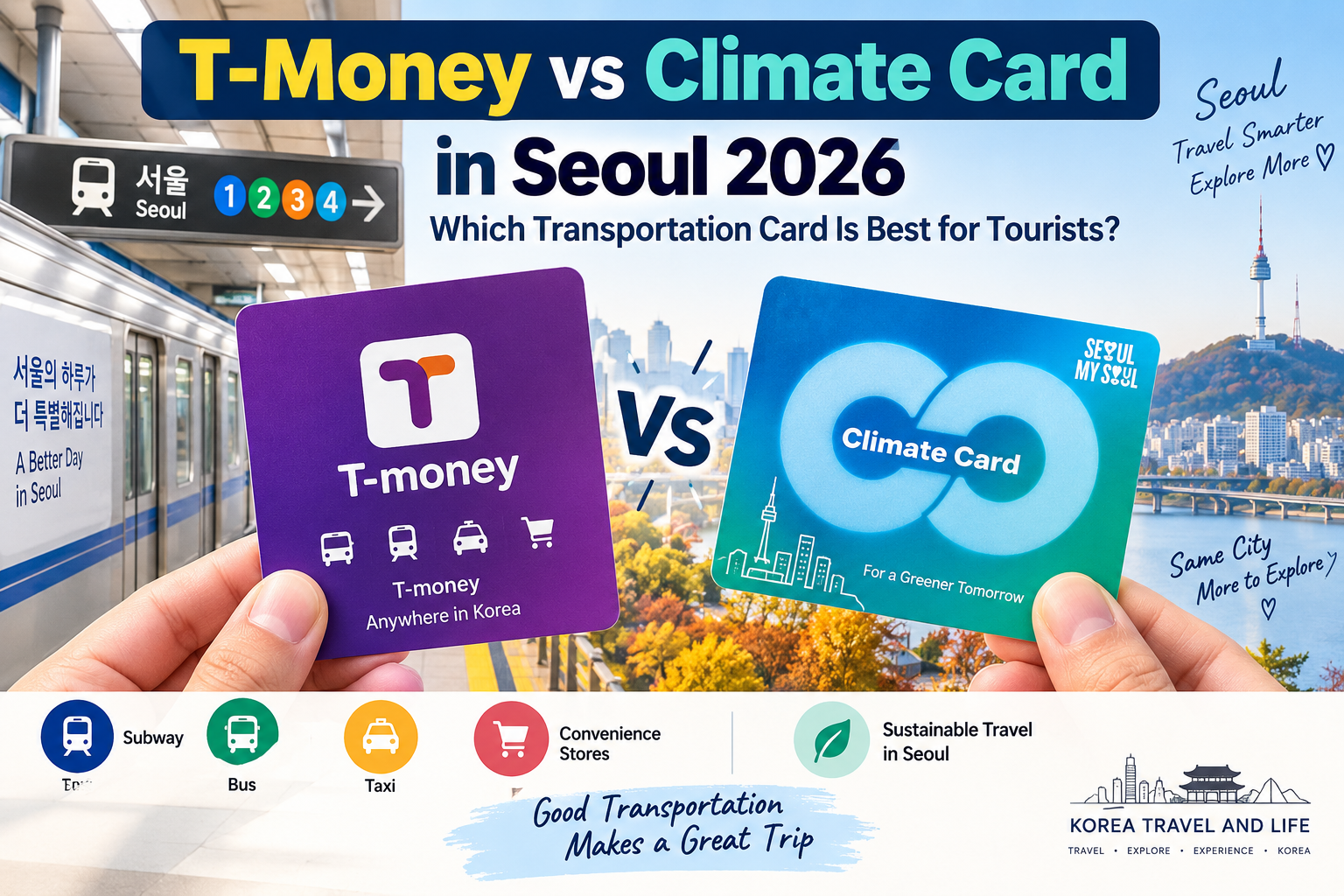
  • T-Money vs Climate Card in Seoul 2026: Which Transportation Card Is Best for Tourists?

    T-Money vs Climate Card in Seoul 2026: Which Transportation Card Is Best for Tourists?

    Getting around Seoul is easy once you understand the city’s transportation system. But for first-time visitors, choosing the right transportation card can be surprisingly confusing.

    Two of the most useful options are T-Money and the Climate Card.

    Both can make traveling around Seoul much easier, but they work very differently. T-Money is a rechargeable transportation card that can be used across Korea, while the Climate Card offers unlimited rides within its designated Seoul transportation network for a fixed period.

    So which one should you buy?

    This 2026 guide explains the differences between T-Money and the Climate Card, how much they cost, where you can use them, and which option may make more sense for your Korea itinerary.

    Quick Answer: T-Money or Climate Card?

    For most travelers, the choice depends on where you are traveling.

    Choose T-Money if you:

    • Plan to travel outside Seoul
    • Will visit places such as Busan, Gyeongju, Jeju, or other Korean cities
    • Prefer paying for transportation based on actual usage
    • Want one transportation card that works across much of Korea
    • Expect to use taxis or other transportation outside the Climate Card service area

    Choose the Climate Card if you:

    • Will spend most of your trip inside Seoul
    • Expect to use buses and subways frequently
    • Want unlimited eligible public transportation during your pass period
    • Prefer knowing your transportation cost in advance
    • Are staying in Seoul for between one and seven days

    For many first-time visitors traveling around Korea, T-Money offers greater flexibility.

    For travelers spending several busy sightseeing days almost entirely in Seoul, however, a short-term Climate Card can be very convenient.

    What Is a T-Money Card?

    T-Money is one of Korea’s most widely used prepaid transportation cards.

    Instead of buying an individual ticket every time you ride a subway or bus, you load money onto the card and tap it when entering and leaving the transportation system.

    T-Money can be purchased at many convenience stores, including chains such as CU, GS25, and 7-Eleven, as well as at transportation facilities.

    The standard card generally costs around KRW 3,000–5,000, before adding transportation credit.

    One of T-Money’s biggest advantages for international travelers is its wide coverage.

    It can be used on public transportation across many parts of Korea, making it particularly useful for travelers visiting several cities during one trip.

    Where Can You Use T-Money?

    T-Money can be used on many:

    • Subways
    • City buses
    • Express and intercity buses
    • Taxis
    • Other participating transportation services

    It can also be used at some convenience stores, vending machines, and other participating merchants displaying the T-Money logo.

    This makes T-Money particularly useful for itineraries such as:

    Seoul → Busan → Gyeongju → Seoul

    Instead of buying a new local transportation card in every destination, travelers can continue using the same T-Money card for many local transportation needs.

    What Is the Seoul Climate Card?

    The Climate Card was introduced by the Seoul Metropolitan Government as an unlimited public transportation pass.

    For tourists, the most important products are the short-term Climate Card passes.

    As of 2026, short-term passes are available for:

    • 1 day — KRW 5,000
    • 2 days — KRW 8,000
    • 3 days — KRW 10,000
    • 5 days — KRW 15,000
    • 7 days — KRW 20,000

    A physical Climate Card costs an additional KRW 3,000.

    These passes are particularly attractive for travelers who plan to take public transportation repeatedly while sightseeing around Seoul.

    Important Climate Card Change in 2026

    Visitors may see older online guides discussing the Climate Card’s 30-day prepaid pass.

    This information is changing.

    Seoul announced that recharging the existing 30-day prepaid Climate Card ends after August 31, 2026, as the city transitions toward its newer Climate Pass system.

    However, this does not mean tourists can no longer use the Climate Card.

    The short-term tourist passes for 1, 2, 3, 5, and 7 days continue to be available.

    This distinction is important when reading older travel guides about Seoul transportation.

    Can Foreign Tourists Buy the Climate Card With an International Credit Card?

    Yes, and this became significantly easier in 2026.

    Seoul expanded payment support at hundreds of new subway vending machines, allowing travelers to use internationally issued credit and debit cards such as Visa and Mastercard to purchase Climate Cards and recharge short-term passes.

    International card payments are supported at new vending machines installed across Seoul Metro Lines 1–8.

    An average service fee of approximately 3.7% may apply when using an internationally issued card.

    This is an important improvement for international visitors because transportation card purchases in Korea have traditionally relied heavily on Korean won cash or locally issued cards.

    T-Money vs Climate Card: Main Differences

    Here is the simplest way to understand the two cards.

    T-Money

    Payment system: Pay per ride

    Best for: Flexible travel throughout Korea

    Coverage: Widely usable across Korea

    Main advantage: One card can be used for transportation in many Korean cities

    Best traveler: Someone visiting Seoul plus other destinations

    Climate Card

    Payment system: Unlimited eligible transportation during the pass period

    Best for: Frequent transportation within Seoul

    Coverage: Limited primarily to eligible Seoul transportation services

    Main advantage: Unlimited rides without worrying about individual fares

    Best traveler: Someone sightseeing intensively within Seoul

    Is the Climate Card Really Unlimited?

    Within its eligible transportation network, the Climate Card allows unlimited rides during the validity period.

    However, “unlimited” does not mean that every transportation service in Korea is included.

    The Climate Card has a defined service area and exclusions. Travelers planning trips outside Seoul should therefore check whether their destination is covered before relying exclusively on the card.

    This is one of the biggest differences between the Climate Card and T-Money.

    T-Money does not provide unlimited transportation, but its geographical flexibility is much greater.

    Which Card Is Better for a 3-Day Seoul Trip?

    Consider a traveler spending three full days sightseeing around Seoul.

    The itinerary might include:

    Day 1: Gyeongbokgung Palace → Bukchon Hanok Village → Insadong → Myeongdong

    Day 2: Hongdae → Yeonnam-dong → Han River → Gangnam

    Day 3: Seongsu → Seoul Forest → Dongdaemun → Namsan

    This traveler may take multiple subway and bus rides each day.

    A 3-day Climate Card costs KRW 10,000, plus the KRW 3,000 physical card cost if a card needs to be purchased.

    For a transportation-heavy itinerary like this, the Climate Card can be particularly convenient.

    Which Card Is Better for a 7-Day Korea Trip?

    Now consider this itinerary:

    Days 1–3: Seoul
    Days 4–5: Gyeongju
    Days 6–7: Busan

    In this situation, T-Money is generally more practical because the traveler is moving beyond Seoul.

    The Climate Card’s main value comes from frequent eligible transportation within Seoul, whereas T-Money can continue to be useful in other Korean cities.

    Can You Use Both T-Money and the Climate Card?

    Yes.

    In fact, some travelers may find that carrying both is convenient.

    You could use the Climate Card during several intensive sightseeing days in Seoul and keep a T-Money card for transportation outside the Climate Card coverage area or later trips to other Korean cities.

    You do not necessarily have to choose only one card for your entire Korea trip.

    Where Can Tourists Buy T-Money?

    T-Money cards are widely available.

    Travelers can commonly find them at convenience stores such as:

    • CU
    • GS25
    • 7-Eleven
    • Other participating convenience stores

    They are also available at transportation-related sales locations.

    According to VISITKOREA, a standard T-Money card generally costs approximately KRW 3,000–5,000 before adding transportation credit.

    One detail international travelers should know is that ordinary T-Money purchases and top-ups may still require Korean won cash in many situations, so carrying some cash after arriving in Korea remains useful. Korea Tourism Organization’s 2026 transportation guide specifically notes cash-only purchasing/top-up for standard prepaid T-Money.

    Where Can Tourists Buy a Climate Card?

    Physical Climate Cards are available through designated subway vending machines and participating sales locations in Seoul.

    New transportation-card vending machines across Seoul Metro Lines 1–8 have made purchasing the card considerably easier for international visitors.

    Remember that the physical card itself costs KRW 3,000, and the short-term pass is loaded separately.

    Unlike an ordinary T-Money balance, a short-term Climate Card begins according to the rules associated with the pass, so travelers should check the activation timing before loading it.

    What About Airport Transportation?

    This is where travelers should be careful.

    Not every airport transportation option is included with every Seoul transportation pass.

    For example, the AREX Express Train operates differently from ordinary Seoul subway transportation.

    Travelers arriving at Incheon International Airport should therefore check their airport-to-hotel transportation separately instead of assuming that a Climate Card covers every airport option.

    We will cover this in a separate guide comparing AREX Express, AREX All-Stop Train, airport limousine buses, and taxis from Incheon Airport to Seoul.

    What About WOWPASS?

    WOWPASS is another popular option for international visitors.

    Unlike T-Money, which is primarily a transportation card, WOWPASS combines several traveler-focused functions, including prepaid payments, transportation functionality, and currency-related services.

    That makes it a different type of product.

    For travelers wondering whether WOWPASS or T-Money is better, we will compare those options separately because the decision involves more than transportation alone.

    T-Money vs Climate Card: Which Should First-Time Visitors Choose?

    There is no single card that is ideal for every Korea itinerary.

    For a traveler spending almost the entire trip sightseeing around Seoul and taking public transportation many times each day, the Climate Card can be a simple and convenient choice.

    For travelers visiting multiple Korean cities or wanting maximum transportation flexibility, T-Money is usually easier to use throughout the trip.

    And for some travelers, carrying both can make sense.

    The key is to choose based on your itinerary rather than simply buying whichever transportation card you see first.

    Frequently Asked Questions

    Is T-Money only available in Seoul?

    No. One of T-Money’s biggest advantages is that it can be used on public transportation in many areas throughout Korea.

    Can tourists still use the Climate Card in 2026?

    Yes. Although Seoul is changing its longer-term Climate Card system, short-term tourist passes for 1, 2, 3, 5, and 7 days remain available.

    How much is a 3-day Climate Card?

    The 3-day short-term pass costs KRW 10,000. A physical Climate Card costs an additional KRW 3,000 if you do not already have one.

    Can I buy a Climate Card with a foreign credit card?

    Internationally issued credit and debit cards are accepted at supported new transportation-card vending machines for Climate Card purchases and short-term pass recharging.

    Can I use T-Money in Busan?

    Yes. T-Money is widely usable on public transportation beyond Seoul, including major Korean cities.

    Should I buy T-Money at Incheon Airport?

    For many visitors, getting a transportation card soon after arrival is convenient, especially if they plan to use public transportation frequently during their trip.

    Final Thoughts

    Choosing between T-Money and the Climate Card becomes much easier once you know your itinerary.

    If your trip is focused almost entirely on Seoul and you expect to ride buses and subways frequently, a short-term Climate Card can provide simple, predictable transportation costs.

    If your Korea itinerary includes several cities, T-Money offers greater flexibility and can remain useful throughout your trip.

    Before traveling, always check the latest transportation rules because Seoul’s transit card system continues to evolve.

    For most international travelers, the best strategy is simple:

    Choose the Climate Card for intensive Seoul sightseeing. Choose T-Money for flexibility across Korea.


  • Korea During Chuseok 2026: What Tourists Need to Know About Travel, Transport, Shops, and Attractions

    Korea During Chuseok 2026: What Tourists Need to Know About Travel, Transport, Shops, and Attractions

    Korea During Chuseok 2026: A Guide for International Travelers

    If you are visiting South Korea in late September 2026, your trip may overlap with Chuseok, one of Korea’s most important traditional holidays.

    For travelers, Chuseok can be a fascinating time to experience Korean culture. Families gather, traditional customs become more visible, and major cities can feel noticeably different from an ordinary week.

    However, Chuseok can also affect transportation, opening hours, restaurant availability, and travel times.

    The key is not to avoid Korea during Chuseok—it is to plan differently.

    This guide explains what international visitors should know about traveling in Korea during Chuseok 2026, including transportation, attractions, restaurants, shopping, and practical travel strategies.

    When Is Chuseok in 2026?

    In 2026, Chuseok falls on Friday, September 25.

    The official Chuseok holiday period runs from September 24 to September 26, creating a major holiday period around the weekend.

    Because millions of Koreans travel to visit family during Chuseok, transportation demand can become extremely high before and after the holiday itself.

    If your Korea trip falls around these dates, transportation planning should be one of your highest priorities.

    What Is Chuseok?

    Chuseok is often described as one of Korea’s most important family holidays.

    Traditionally, families gather to honor ancestors, spend time together, prepare special foods, and visit their hometowns.

    One of the foods most strongly associated with the holiday is songpyeon, a small half-moon-shaped rice cake traditionally prepared for Chuseok.

    For international visitors, the holiday provides an opportunity to see a different side of Korean culture beyond shopping districts, cafés, and famous tourist attractions.

    The Biggest Travel Challenge: Transportation

    Transportation is usually the most important issue for tourists during Chuseok.

    Millions of people travel between Seoul and other regions to visit their hometowns or relatives.

    As a result, trains, express buses, highways, and domestic flights can become extremely busy.

    KTX and Train Tickets

    KTX and other intercity trains are among the most convenient ways to travel around Korea.

    During Chuseok, however, popular routes may sell out quickly.

    Routes between Seoul and cities such as Busan, Daegu, Daejeon, Gyeongju, and other regional destinations can experience especially strong demand.

    If you already have confirmed train tickets, keep them.

    If you do not, avoid assuming that you will simply arrive at Seoul Station and find a convenient seat.

    Express Buses

    Express buses are another option, but heavy highway traffic can significantly increase travel times during peak holiday periods.

    A journey that normally takes a few hours may take considerably longer when roads are congested.

    Build extra time into your itinerary.

    Domestic Flights

    Travelers visiting Jeju should also pay close attention to domestic flight availability.

    Jeju is one of Korea’s most popular domestic travel destinations, and holiday periods can create strong demand for flights and accommodation.

    Book early whenever possible.

    Should Tourists Leave Seoul During Chuseok?

    Not necessarily.

    In fact, staying in Seoul can be a smart strategy during the busiest part of Chuseok.

    Many Seoul residents leave the capital to visit their hometowns, while tourists remain.

    Although individual businesses may close, major tourist districts and attractions can still offer plenty to do.

    Instead of trying to cross the country during the busiest travel period, consider using Chuseok itself to explore Seoul and schedule your intercity travel for a less congested day.

    What Can You Do in Seoul During Chuseok?

    Chuseok can be an excellent time to explore Korea’s traditional culture.

    Visit a Royal Palace

    Places such as Gyeongbokgung Palace offer international travelers an accessible introduction to Korean history and architecture.

    Traditional areas around the palaces also pair well with a Chuseok itinerary.

    Explore Bukchon and Insadong

    Bukchon Hanok Village and Insadong are popular areas for travelers interested in traditional architecture, crafts, tea, and Korean culture.

    Opening hours for individual shops and restaurants may vary during the holiday, so check before visiting a specific business.

    Walk Along Cheonggyecheon

    If you want something simple and flexible, Cheonggyecheon Stream is a pleasant place to walk through central Seoul.

    Outdoor attractions are especially useful during holidays because they are less dependent on individual store opening schedules.

    Explore Seoul’s Parks

    Parks, riverside areas, and walking routes can also be good options when some indoor businesses operate on reduced schedules.

    The Han River parks, for example, provide an easy way to enjoy Seoul without relying on reservations.

    Are Tourist Attractions Closed During Chuseok?

    Some attractions remain open, while others may close or operate with adjusted hours.

    There is no single rule that applies to every museum, palace, attraction, restaurant, or shop.

    Therefore, one of the most important Chuseok travel habits is:

    Check official opening information shortly before visiting.

    Do not rely entirely on an old blog post or a schedule from a previous year.

    Holiday operating hours can change.

    Are Restaurants Open During Chuseok?

    Many restaurants remain open, especially in major tourist areas, shopping districts, hotel zones, and neighborhoods with heavy visitor traffic.

    However, smaller independent restaurants may close for part or all of the holiday.

    This can be particularly noticeable in residential neighborhoods.

    If there is a specific restaurant you absolutely want to visit, check its official website or social media account before traveling across the city.

    Hotels can also be useful during the holiday because hotel restaurants and surrounding tourist infrastructure may offer more predictable options.

    Are Convenience Stores Open?

    Convenience stores are one of the most useful resources for travelers in Korea.

    Many convenience stores continue operating during holidays, although individual locations can vary.

    They are useful for drinks, snacks, simple meals, toiletries, and other basic travel needs.

    Still, travelers should avoid assuming that every individual business will follow its normal schedule.

    What About Shopping Malls and Department Stores?

    This is an area where travelers should plan carefully.

    Large department stores, supermarkets, shopping centers, and individual shops may have special Chuseok schedules.

    Some may close on particular days while others remain open.

    Tourist-heavy shopping districts may still have many businesses operating, but opening hours can vary significantly.

    If shopping is one of the main purposes of your trip, check each major destination shortly before your visit.

    Is Myeongdong Open During Chuseok?

    Myeongdong remains one of Seoul’s most tourist-oriented neighborhoods.

    Because it serves large numbers of international visitors, travelers may find more restaurants, beauty stores, cafés, and retail businesses operating there than in quieter residential neighborhoods.

    However, individual stores can still change their hours.

    Treat Myeongdong as a useful option—not a guarantee that every shop will be open.

    Is Public Transportation in Seoul Available?

    Seoul’s subway and bus systems remain essential transportation options during the holiday period.

    Service schedules and special transportation measures can vary, so travelers should check current information when traveling.

    For most international visitors staying within Seoul, using the subway is generally much easier than attempting long-distance highway travel during peak Chuseok traffic.

    Best Strategy for a First-Time Visitor

    If this is your first trip to Korea and you will be there during Chuseok, consider a simple strategy.

    Before Chuseok: Complete any important intercity travel that requires trains or flights.

    During the busiest holiday period: Stay primarily in Seoul or another city where you already have accommodation.

    After Chuseok: Resume longer regional travel once transportation pressure begins to ease.

    This reduces the risk of spending valuable vacation time in traffic or searching for sold-out transportation.

    Where Should You Stay During Chuseok?

    Location becomes even more important during a major holiday.

    In Seoul, staying near a subway station can make sightseeing much easier.

    Areas such as Myeongdong, Jongno, Hongdae, Seoul Station, and Gangnam offer different advantages depending on your itinerary.

    For travelers interested in historical attractions, Jongno can be particularly convenient.

    For airport access and nightlife, Hongdae may be more suitable.

    Myeongdong is convenient for first-time visitors who want central access to shopping and major attractions.

    Choosing accommodation based on transportation—not just hotel price—can save considerable time during a busy holiday.

    Should You Visit Busan During Chuseok?

    Busan is one of Korea’s most popular destinations, but traveling between Seoul and Busan during peak Chuseok movement requires planning.

    If you already have confirmed transportation and accommodation, Busan can still be a great part of your trip.

    If you have not booked transportation, however, avoid building your entire itinerary around the assumption that convenient last-minute train tickets will be available.

    Another strategy is to visit Busan either before or after the busiest holiday travel days.

    What About Gyeongju?

    Gyeongju is particularly attractive in autumn because its historic sites combine well with cooler weather and seasonal scenery.

    However, Chuseok travel demand can affect regional transportation.

    If Gyeongju is part of your itinerary, confirm your intercity transportation first and then plan local sightseeing.

    Historic destinations such as temples, royal tombs, and traditional areas make Gyeongju one of Korea’s most rewarding cultural destinations.

    What Should You Book in Advance?

    During Chuseok, advance planning becomes much more valuable.

    Prioritize:

    Intercity trains and buses
    Domestic flights
    Hotels and accommodation
    Popular tours or activities
    Restaurants that require reservations

    You do not need to schedule every hour of your trip.

    Instead, secure the things that would be difficult to replace if they sell out.

    Five Mistakes to Avoid During Chuseok

    1. Assuming Everything Is Closed

    Korea does not completely shut down during Chuseok.

    Many attractions and businesses continue operating, particularly in tourist areas.

    2. Assuming Everything Is Open

    The opposite assumption is equally risky.

    Individual restaurants, museums, stores, and attractions may change their schedules.

    3. Planning Last-Minute Intercity Travel

    This is one of the biggest risks.

    Holiday transportation demand can make spontaneous long-distance travel difficult.

    4. Underestimating Highway Traffic

    Even if bus tickets are available, road congestion can dramatically increase travel time.

    5. Building an Inflexible Itinerary

    Flexibility is extremely valuable during a national holiday.

    Prepare one or two alternative attractions or restaurants for each day.

    A Simple Chuseok 2026 Travel Checklist

    Before your trip, confirm:

    • Your hotel reservations
    • Intercity train, bus, or flight tickets
    • Opening hours for must-see attractions
    • Restaurant reservations where necessary
    • Airport transportation plans
    • Alternative activities in case a destination is closed

    Save important reservation information on your phone so it remains accessible even if you have connectivity problems.

    Frequently Asked Questions

    Is Korea worth visiting during Chuseok?

    Yes. Chuseok can provide a unique cultural experience, but travelers need to plan transportation and opening hours more carefully than usual.

    Is Seoul empty during Chuseok?

    Some residents leave Seoul to visit family, which can change the atmosphere of the city. However, major tourist districts remain active and there are still many things for visitors to do.

    Can tourists use KTX during Chuseok?

    Yes, but tickets on popular routes can be difficult to obtain because demand is extremely high.

    Are restaurants closed?

    Some close, while many others remain open. Check individual restaurants rather than assuming.

    Should I travel from Seoul to Busan during Chuseok?

    You can if you have confirmed transportation. If you do not, traveling immediately before or during peak holiday movement may be inconvenient.

    Is Chuseok a good time to experience Korean culture?

    Yes. The holiday offers travelers an opportunity to learn more about Korean family traditions, food, history, and seasonal customs.

    Final Thoughts

    Traveling in Korea during Chuseok 2026 does not have to be difficult.

    The most important rule is simple: secure long-distance transportation early and remain flexible with everything else.

    Rather than trying to travel across the country during the busiest days, international visitors may enjoy spending more time exploring Seoul, traditional neighborhoods, palaces, parks, and cultural attractions.

    With a little advance planning, Chuseok can become one of the most memorable parts of a Korea trip rather than an obstacle.