
Tag: Korea travel 2026

  • Personal Color Analysis in Seoul 2026: Is It Worth $100? Real Costs, English Sessions and What You Actually Get

    Personal Color Analysis in Seoul 2026: Is It Worth $100? Real Costs, English Sessions and What You Actually Get

    Seoul has become a destination for more than skincare shopping and K-beauty makeovers. For international visitors, a personal color consultation offers something potentially more lasting: a better understanding of which clothing, makeup and hair colors they enjoy wearing.

    But is a 60-minute appointment worth spending the equivalent of $100 on? And what makes a premium session worth two or three times as much?

    The answer depends less on the name of the studio than on what you receive, how well you understand the consultation and whether you can use the results after returning home.

    This guide compares real Seoul pricing examples, explains what English-language services should include, and helps you choose between a basic color diagnosis and a more expensive styling package.

    The Short Answer: Is Personal Color Analysis in Seoul Worth It?

    A personal color consultation can be worth the money if you leave with practical recommendations you can use repeatedly. It offers less value if you receive only a seasonal label and a few photographs.

    For most first-time visitors, a focused consultation is a sensible starting point. A premium package becomes more attractive when you also want hands-on makeup instruction, face-shape analysis or broader wardrobe advice.

    Before booking, ask yourself three questions:

    1. Do I want to understand my colors, or do I want someone to teach me how to use them?
    2. Will the recommendations be explained in a language I understand?
    3. What information will I be able to keep after the appointment?

    The third question is particularly important. A memorable hour in Seoul is enjoyable; a useful reference you can consult for years is potentially more valuable.

    1. What Happens During a Korean Personal Color Consultation?

    Most consultations begin with a discussion of your current makeup, clothing preferences and the colors you feel comfortable wearing.

    A consultant may then place colored fabrics, often called drapes, near your face and compare how different hues, brightness levels and saturation affect your appearance.

    The familiar four-season system uses the categories Spring, Summer, Autumn and Winter. Some studios refine these into more detailed subcategories.

    Depending on the package, you might also receive advice about:

    • Lipstick, blush and eyeshadow colors
    • Hair color choices
    • Jewelry metals and accessories
    • Clothing colors and combinations
    • Colors that are less flattering under certain styling conditions
    • How to use colors outside your recommended palette

    The last point matters. A good consultation should not make you feel that half your wardrobe is suddenly unusable.

    Color analysis is a styling framework based on visual judgments and individual preferences, not a medical test or an immutable scientific diagnosis. Different consultants and lighting conditions can produce different interpretations.

    Use the result as guidance, not a rule that overrides your own taste.

    2. Real Personal Color Analysis Prices in Seoul in 2026

    Prices vary considerably by studio, consultant, language support and package.

    For a verified public example, the Korea Tourism Organization lists COCORY COLOR’s Myeongdong and Gangnam branches with the following indicative pricing:

    Published programListed price
    Personal color analysisFrom ₩80,000 per person
    Additional option₩20,000 per option
    Best option package₩140,000
    Face and body analysis or premium programsVaries by program

    The tourism listing also indicates that programs generally take approximately 60–120 minutes, depending on the service selected.

    These are published reference prices, not guaranteed checkout quotes. Always confirm the exact package, availability and current price before paying.

    What About Higher-End Studios?

    More specialized appointments can cost substantially more.

    For example, Creatrip’s published Color Signal listing in Gangnam shows a 60-minute individual personal color experience at ₩190,000 and a 120-minute personal color plus K-beauty makeup experience at ₩300,000.

    These listings demonstrate how dramatically the price can change when the service includes more personalized instruction or additional beauty work.

    The important comparison is not ₩80,000 versus ₩300,000. It is what each package includes and whether you will actually use those services.

    Why We Compare Prices in Korean Won

    Exchange rates change, and international card issuers may use different conversion rates.

    Although travelers often think in dollars, compare the final price in Korean won first. Convert it using your payment provider’s current rate before booking.

    3. Basic vs Premium: What Are You Really Paying For?

    FeatureBasic consultationExtended styling consultationPremium beauty experience
    Seasonal color analysisUsually centralUsually includedUsually included
    Fabric drapingCommonCommonCommon
    Makeup shade suggestionsVariesOften more detailedMay include hands-on application
    Hair and accessory adviceVariesMay be expandedDepends on package
    Face or body-shape analysisNot necessarily includedPossible add-onMay be included
    Makeup lessonUsually separateSometimes offeredMay be a major component
    Take-home report or paletteMust confirmMust confirmMust confirm
    Best suited toFirst-time visitorsVisitors seeking detailed guidanceVisitors planning a broader makeover

    This table describes typical package differences, not a guarantee that every Seoul studio offers the same inclusions.

    When the Basic Package Is Enough

    Choose a basic consultation if you mainly want to understand which colors work well with your preferred makeup and clothing.

    It can also be the better choice when your Seoul itinerary is packed with sightseeing, food and shopping.

    When Paying More Makes Sense

    An extended package may be worthwhile if you regularly struggle with makeup application, want detailed feedback on products you already own, or need help translating color recommendations into everyday outfits.

    A premium session is harder to justify if you are paying for several services you did not originally want.

    4. The Most Overlooked Value: What You Take Home

    Imagine two appointments.

    In the first, you spend an hour learning that you are a particular seasonal color type. The consultant explains several shades, takes a few photographs and ends the session.

    In the second, you leave with a documented color palette, examples of makeup shades, hair color guidance and practical advice for coordinating clothes you already own.

    Even if the second appointment costs more, its usefulness may last longer.

    Before booking, ask whether you will receive any of the following:

    Take-home itemWhy it matters
    Digital or printed color paletteHelps when shopping after the trip
    Lipstick and blush shade recommendationsMakes cosmetics shopping more targeted
    Hair color guidanceUseful at your usual salon back home
    Clothing color combinationsHelps you work with your existing wardrobe
    Product or shade referencesReduces the chance of buying unsuitable products
    Written English summaryMakes the results easier to remember and apply

    Not every studio provides these items, and a digital report may cost extra.

    A detailed explanation you can understand is more valuable than an elaborate report you cannot interpret.

    5. English-Language Sessions: What to Confirm Before Booking

    Some Seoul studios offer English-speaking consultants. Others may provide interpretation, English-language materials or specific foreign-language appointment slots.

    These are not identical experiences.

    An English-language booking page does not necessarily mean your actual consultation will be conducted entirely in English.

    Ask these questions before making a payment:

    • Will the consultant speak English directly?
    • If interpretation is required, is it included in the quoted price?
    • Will my written results be provided in English?
    • Can I ask detailed questions about makeup and clothing?
    • Is the English service available at my chosen appointment time?
    • What happens if the language service becomes unavailable?

    The Korea Tourism Organization identifies COCORY COLOR’s Myeongdong branch as offering Korean, English, Chinese and Japanese programs, with booking options for preferred language.

    However, individual time-slot availability should still be checked directly.

    A Message You Can Send Before Booking

    “Hello, I am visiting Seoul and would like to book a personal color analysis. Could you confirm whether the consultation and take-home results are available in English? Please also let me know the total price, duration, included services and cancellation policy. Thank you.”

    A clear written reply helps prevent misunderstandings.

    If you’re unsure whether to book through NAVER, Creatrip, or directly with a Seoul beauty studio, read our K-Beauty Booking in Seoul 2026: Naver vs Creatrip vs Direct BookiK-Beauty Booking in Seoul 2026 guide before paying. It explains passport verification, international payment options, appointment confirmation, and cancellation rules.

    6. Hidden Costs That Can Change the Value of Your Appointment

    The advertised session price may not be the final amount you spend.

    Look for the following potential extras.

    Interpretation fees. Some providers include language support; others charge separately.

    Makeup or styling add-ons. A basic color diagnosis may not include an applied makeup lesson.

    Detailed reports. Printed or digital recommendations may be included, optional or unavailable.

    Deposits and cancellation charges. Confirm the refund deadline, time zone and no-show rules.

    Payment-related fees. Your card issuer may apply foreign transaction or currency conversion charges.

    Travel time. A lower-priced studio on the other side of Seoul may be less attractive if it consumes several hours of your itinerary.

    A Simple Total-Cost Comparison

    The following example is hypothetical, not a quote from a specific studio.

    CostOption AOption B
    Consultation₩90,000₩120,000
    Language support₩20,000Included
    Detailed results₩15,000Included
    Total₩125,000₩120,000

    Option B has a higher advertised starting price but a lower total in this example.

    Always compare like-for-like services before deciding.

    7. Where Should You Book: Myeongdong, Hongdae, Seongsu or Gangnam?

    Location matters because a beauty appointment is only one part of your trip.

    Myeongdong: Best for a Beauty-Shopping Day

    Myeongdong works particularly well if you want to use your color recommendations while shopping for cosmetics afterward.

    A practical sequence is to schedule your consultation first, take a break and then browse makeup products with your palette in mind.

    This makes the advice immediately useful without turning your day into a rushed shopping mission.

    Hongdae: Best for a Casual Style-Focused Day

    Hongdae can fit naturally into an itinerary that includes fashion shopping, cafés and neighborhood exploration.

    Choose a studio based on the specific services and language support, not simply because it is close to popular shopping streets.

    Seongsu: Best for a Curated Beauty and Lifestyle Itinerary

    Seongsu is appealing if you enjoy contemporary Korean brands, concept stores and a slower day of exploring.

    A consultation can complement the neighborhood’s shopping experience, especially if you want to compare colors and styling ideas.

    Gangnam and Sinsa: Best for a Dedicated Beauty Appointment

    Gangnam and Sinsa may be convenient if you are arranging multiple beauty-related services on the same day.

    Leave enough time between appointments. A personal color consultation, skincare treatment and makeup session may each require different preparation.

    Our recommendation: Choose your appointment around the neighborhood you already plan to visit, unless a particular consultant offers something you cannot find elsewhere.

    8. How to Prepare for Your Personal Color Analysis

    A little preparation can make the appointment more useful.

    Before You Go

    Wear minimal makeup if the studio recommends it. Strong foundation, lip color and colored contacts may affect how the consultant evaluates your appearance.

    Bring a few photographs of outfits you like, along with one or two cosmetics you use frequently.

    Think about your real styling concerns.

    For example:

    • Why does a lipstick look flattering in the store but different at home?
    • Which hair colors should I consider before my next salon visit?
    • How can I wear black, beige or other colors I already love?
    • What colors work for professional clothing?
    • How do I adapt the recommendations to my usual makeup style?

    You do not need to buy a new wardrobe to benefit from the session.

    During the Consultation

    Ask the consultant to explain why particular colors are recommended.

    Request examples of both flattering and less flattering shades.

    If you receive a seasonal category, ask how flexible that category is and whether neighboring palettes may also work.

    A useful consultation should encourage informed experimentation rather than rigid restrictions.

    9. How to Use Your Results at Olive Young Without Overspending

    Many travelers want to visit Olive Young after a color analysis.

    That can be a sensible idea, but there is no need to replace your entire makeup collection.

    Start with one product category that you genuinely want to improve.

    For example, if your main concern is lipstick, compare two or three shades within your recommended range.

    Consider how the colors look in different lighting and whether you would wear them regularly.

    Avoid buying a large number of products simply because their packaging uses your recommended seasonal label.

    A shade that technically fits a color family may still differ in brightness, saturation and finish.

    A Better Post-Consultation Shopping Plan

    1. Photograph or save your recommended palette if the studio permits it.
    2. Write down your preferred lip and blush shades.
    3. Identify products you actually need.
    4. Compare shades rather than seasonal marketing labels alone.
    5. Keep your budget separate from the consultation fee.

    The aim is to make more confident choices, not to spend more.

    10. Who Should Skip a Premium Personal Color Package?

    A premium package is not the right purchase for everyone.

    You may prefer a basic consultation—or skip the experience entirely—if:

    • You already understand your preferred colors and are happy with your current style.
    • You have little interest in makeup, hair color or wardrobe changes.
    • You are booking primarily because the experience is popular on social media.
    • You do not have time to review or use the recommendations afterward.
    • The extra services do not match your personal goals.
    • The appointment would significantly reduce your travel budget.

    There is also nothing wrong with treating a consultation as a one-time cultural experience rather than an investment.

    Just price it as entertainment if that is what you want.

    11. A 2026 Booking Detail Worth Checking: Official Visitor Promotions

    The Korea Tourism Organization has published a COCORY COLOR promotion offering a 10% discount on personal color analysis for international travelers through December 31, 2026.

    The published conditions include advance online booking and presenting the VISITKOREA coupon when paying on-site.

    The promotion also states that reservation changes are limited and subject to advance notice, and that arriving more than 10 minutes late may count as a no-show.

    Promotions can change, so verify eligibility and terms on the official page before relying on a discount.

    This is an example of why the lowest displayed package price is not always the best basis for comparison.

    12. Your Personal Color Booking Decision Checklist

    Before reserving, make sure you can answer these questions:

    • What is the total price in Korean won?
    • Is English consultation guaranteed for my selected time?
    • How long does the appointment last?
    • Is makeup instruction included or separate?
    • Will I receive a written or digital color reference?
    • Are interpretation and additional reports included?
    • What is the cancellation and no-show policy?
    • Is the studio convenient for my Seoul itinerary?
    • Am I paying for services I genuinely want?

    If the booking page does not answer an important question, contact the studio before paying.

    Frequently Asked Questions

    How much does personal color analysis cost in Seoul?

    Prices vary by studio and package. As a published example, the Korea Tourism Organization lists COCORY COLOR sessions starting from ₩80,000 per person, while more specialized programs at other studios can cost substantially more.

    Is $100 enough for a personal color consultation?

    It may be, depending on the current exchange rate, studio and services included. Compare prices in Korean won and check the final checkout amount rather than assuming a fixed dollar price.

    Can foreigners book personal color analysis in Seoul?

    Yes. Some studios offer foreign-language programs and international booking options. Confirm language availability for your specific date and time.

    How long does a personal color consultation take?

    A basic consultation may take around an hour, while extended packages can require 90 minutes, two hours or longer. Follow the duration listed for your exact program.

    Do I need to speak Korean?

    Not if you choose an appointment with suitable English-language support. However, an English booking page does not automatically guarantee an English-speaking consultant.

    Should I get personal color analysis before shopping in Seoul?

    If cosmetics or fashion shopping is a major part of your itinerary, scheduling the consultation first can make your shopping more focused.

    Are personal color results permanent?

    The seasonal framework is intended as a styling reference, but assessments are interpretive and can vary by consultant, lighting and method. Your preferences and style can also change.

    Final Verdict: Pay for Useful Advice, Not Just a Seasonal Label

    Personal color analysis in Seoul can be a worthwhile K-beauty experience, especially if you want practical guidance about makeup, clothing and hair colors.

    For most first-time visitors, the best value comes from a well-explained basic consultation with clear take-home recommendations.

    A premium package becomes more compelling when it includes additional services you actively want and will use.

    Before booking, compare the final cost, language support, session duration and quality of the results you will keep.

    The best consultation is not necessarily the most expensive one. It is the one that helps you make better choices long after your Seoul trip ends.
    Official Sources and Further Reading

  • Best eSIM for South Korea in 2026: Airalo vs Nomad vs Holafly, Real 7-Day and 14-Day Costs, Coverage and Which Is Worth It?

    Best eSIM for South Korea in 2026: Airalo vs Nomad vs Holafly, Real 7-Day and 14-Day Costs, Coverage and Which Is Worth It?

    You may need mobile data to navigate Seoul’s subway system, find restaurants in Busan, book transportation, translate Korean menus or contact your accommodation. An eSIM lets many travelers get connected without visiting a physical SIM-card counter.

    Three popular international options are Airalo, Nomad and Holafly. But which one offers the best value for a seven-day vacation or a two-week trip?

    The answer depends on more than the advertised price. Data allowance, plan validity, hotspot restrictions, network access and your actual travel habits all matter.

    This guide compares the three providers, explains how to calculate the real cost of a trip, and helps you choose a practical option for Seoul, Busan, Jeju Island and beyond.

    Last reviewed: October 13, 2026. Prices and plan conditions can change. All amounts are in US dollars unless otherwise stated.

    Quick Answer: Which South Korea eSIM Should You Choose?

    Airalo is a strong starting point for travelers who want a choice between fixed-data and unlimited packages. Its South Korea listings include several data allowances and validity periods.

    Nomad is worth comparing for travelers who want a straightforward fixed-data package. A longer-validity package can sometimes cover an entire two-week trip without requiring a separate 14-day product.

    Holafly is an option for travelers who prefer an unlimited-data product and do not want to monitor a conventional data allowance. However, its hotspot-sharing rules and fair-use conditions deserve particular attention.

    There is no universal winner. The cheapest plan may not have enough data, while the most expensive unlimited plan may be unnecessary for a traveler who mainly uses maps and messaging.

    Airalo vs Nomad vs Holafly: Main Differences

    FeatureAiraloNomadHolafly
    Main appealFixed-data and unlimited choicesFlexible prepaid data packagesUnlimited-data travel plans
    Best suited toLight to heavy usersTravelers comparing data allowancesTravelers prioritizing convenience
    Seven-day optionsYesYes, depending on packageCustom trip-duration selection
    Two-week suitabilityLonger-validity packages availableLonger-validity packages availableSelect the required duration
    HotspotCheck selected planCheck selected planSharing limits apply
    Korean phone numberDo not assume one is includedDo not assume one is includedDo not assume one is included
    Important detailCheck daily speed limits on unlimited plansCompare data amount and validityCheck daily hotspot allowance

    Important: These are provider-level comparisons, not guarantees for every individual package. Always read the exact product details before checkout.

    How Much Does an eSIM for South Korea Really Cost?

    A useful comparison starts with two questions:

    1. How many days will you need service?
    2. How much mobile data will you realistically use?

    A seven-day package is not necessarily the best purchase for a seven-day visit. A longer-validity package with more data might cost only slightly more.

    Likewise, a 14-day trip does not automatically require a product labeled “14 days.” A 15-day or 30-day package may cover the entire journey.

    Airalo: Examples of Listed South Korea Prices

    Airalo’s official South Korea listings reviewed for this guide displayed the following examples:

    ValidityDataListed price
    7 days3 GB$9.00
    7 days5 GB$10.00
    7 days10 GB$18.00
    15 days5 GB$10.50
    15 days10 GB$18.50
    15 days20 GB$29.00
    7 daysUnlimited$29.00
    15 daysUnlimited$49.00

    These are examples of displayed listings, not guaranteed checkout prices. Discounts, currency conversion, taxes and product changes can affect the final amount.

    Airalo’s unlimited listing also disclosed a reduced speed of 1 Mbps after 3 GB of usage per day for the relevant package shown during review. That distinction matters if you stream video, upload large files or use your phone heavily.

    Official plans: https://www.airalo.com/south-korea-esim

    Nomad: Compare the Full Package, Not Just the Daily Price

    Nomad offers prepaid South Korea eSIM packages with different data allowances and validity periods.

    Its official listing has shown examples including a 1 GB seven-day package and larger packages with longer validity.

    For a traveler staying 14 days, a 30-day package can still be appropriate. You pay for the package’s data allowance, not necessarily for every day of its validity.

    For example, consider these hypothetical purchasing decisions:

    • A traveler using 3 GB over two weeks needs a package valid for the full trip with at least 3 GB.
    • A traveler using 10 GB over two weeks should compare 10 GB packages rather than repeatedly buying small top-ups.
    • A traveler expecting heavy video use should compare unlimited packages and speed restrictions.

    Nomad’s live prices may change, so check the official South Korea product page immediately before buying.

    Official plans: https://www.getnomad.app/south-korea-eSIM

    Holafly: Unlimited Data With Important Conditions

    Holafly markets its South Korea travel eSIM around unlimited mobile data.

    This can be attractive if you do not want to monitor a fixed allowance while navigating, using translation apps, browsing or streaming.

    However, unlimited mobile data does not necessarily mean unlimited high-speed performance or unlimited tethering.

    Holafly’s South Korea product information reviewed for this guide stated that hotspot sharing is available at 1 GB per day, with the total shareable allowance depending on the purchased duration.

    Its product information also explains that local network operators may apply fair-use traffic management, potentially reducing speeds temporarily.

    Check the exact price for seven or fourteen days using Holafly’s duration selector. A reliable current dollar quote should come from the final product selection rather than an old comparison article.

    Official plans: https://esim.holafly.com/esim-south-korea/

    Real Seven-Day Cost: Three Traveler Examples

    To understand value, consider three common travel styles.

    Traveler A: Light Data User

    This traveler uses:

    • Google Maps or Naver Map
    • Messaging apps
    • Restaurant searches
    • Occasional translation
    • Hotel Wi-Fi for downloads and video

    A 3 GB or 5 GB package may be sufficient, depending on usage.

    For this traveler, paying for unlimited data may not provide much additional value. Airalo and Nomad fixed-data packages deserve comparison first.

    Traveler B: Everyday Tourist

    This traveler uses navigation frequently, uploads photos, watches some short videos and occasionally makes video calls.

    A 5 GB or 10 GB package may be a more comfortable choice than a very small plan.

    The important comparison is the total seven-day price for enough data, not the lowest advertised starting price.

    Traveler C: Heavy Data User

    This traveler streams video, works remotely, uses cloud applications and may connect a laptop.

    An unlimited product could be useful, but only after checking:

    • High-speed fair-use thresholds
    • Hotspot allowances
    • Speed reduction rules
    • Coverage and network restrictions

    For remote work, an unlimited phone plan with a limited hotspot allowance may be less suitable than a large fixed-data plan that permits tethering.

    Real Fourteen-Day Cost: Why Validity Matters

    A two-week trip changes the comparison.

    Imagine arriving in Seoul, spending several days in Busan, visiting Jeju Island and returning to Seoul before departure.

    You need a plan that remains active throughout the journey.

    A seven-day product would normally be insufficient unless you purchase additional service. That can make an apparently cheap option more expensive.

    Compare These Three Approaches

    Purchase strategyWhat to checkMain risk
    Two separate 7-day packagesCombined price and activation processPaying twice or needing a second setup
    One 15-day packageTotal data allowance and priceRunning out of data
    One 30-day packageData allowance and full-trip coveragePaying for more data than needed

    For most travelers, buying one package that covers the full 14-day journey is simpler than arranging multiple short packages.

    A 15-day or 30-day package is not wasteful merely because the traveler leaves earlier. What matters is whether its total price and included data are competitive.

    A Practical Cost Formula

    Use this calculation:

    Real trip cost = initial package price + necessary top-ups + applicable fees

    Then compare:

    Cost per usable GB = real trip cost ÷ data you can realistically use during the trip

    For unlimited products, a per-GB calculation is less meaningful. Compare total trip price, fair-use restrictions and hotspot needs instead.

    Do not treat an advertised discount as savings unless the final checkout amount is actually lower.

    Coverage in Seoul, Busan and Jeju Island

    South Korea has extensive mobile infrastructure, particularly in major cities. However, an eSIM reseller’s actual experience depends on its local network partner, product configuration, device and location.

    Seoul

    In Seoul, travelers commonly need data for subway navigation, street directions, restaurant searches and translation.

    Mobile service is generally accessible in busy urban areas, but indoor reception and underground performance can vary.

    For first-time visitors, see our guide to traveling from Incheon Airport and exploring Seoul.

    Busan

    Busan combines dense urban neighborhoods, beaches, hills and major transport hubs.

    Coverage can differ between central neighborhoods, coastal areas and less populated locations. Check which local Korean network your selected eSIM uses.

    Jeju Island

    Jeju travelers may rely heavily on navigation when renting a car or traveling between attractions.

    A working data connection is useful for maps and route changes, but remote trails and less populated areas may have less consistent reception.

    Download important maps and accommodation details for offline access before heading into remote areas.

    For accommodation planning, read Where to Stay in Jeju Island in 2026: Best Areas and Hotels for First-Time Visitors.

    Does One Provider Always Have Better Coverage?

    Not necessarily.

    Airalo, Nomad and Holafly sell travel connectivity products, but the actual network connection may depend on different Korean carrier arrangements and product-specific agreements.

    Before purchasing, check the local network shown in the exact plan details.

    Do not assume every package sold by the same brand uses the same network or offers identical performance.

    Hotspot and Tethering: The Hidden Comparison

    Hotspot access is especially important for travelers carrying a laptop or tablet.

    Suppose you want to upload photos from a laptop every evening or work during a train journey. Your phone may have enough data for itself, but the eSIM’s sharing policy could restrict how much your laptop can use.

    Holafly’s South Korea information currently describes a daily hotspot-sharing allowance. That means its unlimited-data marketing should not be interpreted as unlimited laptop tethering.

    For Airalo and Nomad, inspect the terms of the exact package you are considering.

    Before checkout, ask:

    1. Is hotspot use permitted?
    2. Is there a separate tethering limit?
    3. Does the plan reduce speed after a daily threshold?
    4. Can I purchase additional data without reinstalling the eSIM?

    If your trip involves substantial remote work, hotspot policy may matter more than the headline data allowance.

    Do These eSIMs Include a Korean Phone Number?

    Do not assume that a travel eSIM includes a local Korean telephone number.

    Many international travel eSIM products primarily provide mobile data.

    You may still be able to use WhatsApp, FaceTime, KakaoTalk and other internet-based messaging services through the data connection.

    However, certain Korean services, reservations or verification procedures may require a Korean number or identity verification.

    A data-only eSIM cannot necessarily satisfy those requirements.

    If receiving local calls or SMS messages is essential, compare Korean carrier tourist SIM or eSIM products that explicitly include the required service.

    Also remember that keeping your home SIM active for calls or text messages may result in charges from your home carrier.

    Is Your Phone Compatible With a South Korea eSIM?

    Before buying, confirm that your device:

    • Supports eSIM technology
    • Is not restricted by a carrier lock
    • Can use the selected travel eSIM
    • Has an available eSIM slot or profile capacity
    • Supports the necessary network settings

    Compatibility varies by phone model, country of purchase and carrier configuration.

    Do not assume that every phone bearing the same commercial model name has identical eSIM support worldwide.

    If you are uncertain, use the provider’s device compatibility checker before paying.

    How to Install and Activate an eSIM for Korea

    The exact process varies by phone and provider, but a typical setup follows these steps.

    Before Departure

    Purchase the package from the provider’s official website or app.

    Read the activation policy carefully. Some plans begin their validity when installed, while others begin when they first connect to a supported network.

    Install the eSIM while you have a reliable internet connection, if the provider recommends doing so.

    Keep the installation instructions and QR code accessible.

    After Arriving in South Korea

    Open your phone’s cellular or mobile network settings.

    Enable the travel eSIM and select it as your mobile data line.

    Follow the provider’s instructions regarding data roaming for that eSIM.

    Check that your home SIM is not being used for expensive international data roaming.

    Test a map or webpage before leaving the airport.

    Avoid deleting an eSIM profile while troubleshooting unless the provider explicitly instructs you to do so. Reinstallation may not always be straightforward.

    Should You Buy an eSIM Before Landing at Incheon Airport?

    For many visitors, buying and preparing an eSIM before departure is convenient.

    It can help you access directions, accommodation details and transportation information shortly after landing.

    However, airport Wi-Fi, local SIM counters and other connectivity options may also be available.

    An eSIM is not automatically the best choice for every traveler. A local SIM may be preferable if you specifically need a Korean phone number.

    If you are planning your first arrival, read First Time in Seoul: From Incheon Airport to Exploring the City.

    eSIM or Pocket Wi-Fi: Which Is Better?

    An eSIM is generally convenient for one person using a compatible smartphone.

    Pocket Wi-Fi may be worth comparing when several travelers want to share a single connection, although it requires carrying and charging another device.

    A physical tourist SIM can be useful for travelers whose phones do not support eSIM or who need specific voice and SMS capabilities.

    The best choice depends on group size, device compatibility, battery needs and the services you require.

    Five Mistakes to Avoid When Buying a Korea eSIM

    1. Buying Too Little Data

    A very cheap plan may be poor value if you need multiple expensive top-ups.

    Estimate your usage before purchasing.

    2. Ignoring Validity

    A seven-day plan may expire before the end of a two-week holiday.

    Always confirm when the validity clock begins.

    3. Assuming Unlimited Means Unrestricted

    Check speed policies, hotspot limits and fair-use conditions.

    4. Assuming a Korean Number Is Included

    Read the product description carefully if you need local calls or verification messages.

    5. Forgetting Home-Carrier Roaming Settings

    Using the travel eSIM for data does not automatically prevent your primary SIM from incurring roaming charges.

    Review your phone settings and home-carrier policies before departure.

    Which eSIM Is Best for Your Travel Style?

    Best for a Budget-Conscious Seven-Day Trip

    Start by comparing Airalo and Nomad fixed-data packages.

    Choose a plan with enough data for your actual habits rather than buying the cheapest possible package.

    Best for a Fourteen-Day Korea Itinerary

    Compare one longer-validity Airalo or Nomad package against a Holafly plan covering the entire trip.

    Focus on the final cost, data needs and sharing restrictions.

    Best for Travelers Who Dislike Monitoring Data

    Holafly’s unlimited-data approach may appeal to you.

    However, compare it with Airalo’s unlimited products and review speed and hotspot policies before deciding.

    Best for Remote Workers

    Prioritize stable connectivity, hotspot access, adequate high-speed data and a backup connection.

    Do not choose based on the word “unlimited” alone.

    Best for Families

    If everyone has a compatible phone, separate eSIMs may provide greater independence.

    For families planning to share one connection, compare hotspot restrictions and pocket Wi-Fi alternatives.

    Frequently Asked Questions

    Is an eSIM cheaper than international roaming in South Korea?

    It can be, especially if your home carrier charges high roaming rates. But some carriers include international data in their regular plans, so compare your actual roaming cost before purchasing.

    Can I use an eSIM in both Seoul and Busan?

    A South Korea country-wide eSIM is generally intended for use across supported areas of the country, subject to local network coverage and the product’s terms.

    Will an eSIM work on Jeju Island?

    A South Korea eSIM should work in supported Jeju coverage areas, but reception can vary by location, network and device.

    Can I keep my normal phone number?

    On compatible dual-SIM devices, you can often keep your primary line enabled while using a travel eSIM for data. Whether calls or texts incur charges depends on your home carrier.

    How much data do I need for seven days?

    Light users may find 3–5 GB sufficient, while travelers frequently streaming video, making video calls or uploading media may need considerably more.

    Is 10 GB enough for fourteen days?

    It can be for moderate usage, especially with hotel Wi-Fi. Heavy video streaming or laptop tethering may require a larger allowance.

    Can I use an eSIM for Naver Map and KakaoTalk?

    Yes, these apps can use an active mobile data connection. Some app functions or account registration procedures may have separate verification requirements.

    Should I activate the eSIM before traveling?

    Follow the specific provider’s instructions. Installation and activation are not always the same event, and the validity start rules vary.

    Can I get a refund if the eSIM does not work?

    Refund eligibility depends on the provider, whether the package was installed or activated, and the reason for the problem. Review the refund policy before purchase.

    Final Verdict: Airalo vs Nomad vs Holafly for South Korea

    For most travelers, the best eSIM is the one that provides enough usable data for the entire trip at a reasonable total price.

    Choose Airalo if you want to compare multiple fixed-data and unlimited packages.

    Choose Nomad if its current data allowance, validity and checkout price fit your itinerary better.

    Choose Holafly if you prefer an unlimited-data product and its hotspot and fair-use restrictions are acceptable for your needs.

    For a seven-day vacation, compare fixed-data packages before paying more for unlimited service.

    For a fourteen-day itinerary, prioritize one plan that covers your full stay and compare the final checkout price rather than relying on advertised daily rates.

    Finally, confirm phone compatibility and installation instructions before leaving home. A few minutes of preparation can save valuable time after landing in South Korea.

    Further Reading on Korea Travel and Life

    Planning a complete Korea trip? These guides can help with arrival, payments and accommodation:

    Sources and Editorial Methodology

    This comparison uses publicly available provider product descriptions and pricing information. Product listings and policies can change, and no provider was independently field-tested for this article.

    Official provider sources:

    Prices should be checked at checkout. Coverage descriptions are not guarantees of speed or reception at every location.

    Last reviewed: October 13, 2026.

  • Olive Young Korea Shopping Guide 2026: Tax Refund, Best Stores and What Tourists Should Know

    Olive Young Korea Shopping Guide 2026: Tax Refund, Best Stores and What Tourists Should Know

    If K-beauty is on your Korea shopping list, there is a good chance you will end up inside an Olive Young.

    The Korean health and beauty chain sells everything from skincare and sunscreen to makeup, hair products, sheet masks and beauty tools. For travelers, however, the bigger question is not simply what to buy.

    Which Olive Young should you visit? Do you need your passport? Can you get an immediate tax refund? And is it better to shop in Myeongdong, Seongsu or a smaller neighborhood store?

    Here is what international visitors should know before shopping at Olive Young in Korea in 2026.

    Quick Answer: What Tourists Should Know

    For most travelers, Olive Young shopping is straightforward.

    Bring your physical passport if you want to use an immediate tax refund where available. At Olive Young Myeongdong Global Town, eligible purchases of ₩15,000 or more can receive an immediate tax refund when the required conditions are met.

    Myeongdong is usually the easiest choice if you want a large selection and tourist-friendly services. Olive Young N Seongsu is better suited to travelers who want to combine K-beauty shopping with a day exploring Seongsu.

    But you do not necessarily need to visit the biggest store.

    If you already know exactly what you want, a smaller Olive Young near your hotel can often be quicker and more convenient.

    Why Do Tourists Shop at Olive Young?

    Olive Young is useful because it brings many Korean beauty and wellness brands together in one place.

    Instead of visiting individual brand stores, travelers can compare different products and price ranges during a single shopping trip.

    Depending on the branch, you may find:

    • skincare and cleansers
    • sunscreen
    • facial masks and toner pads
    • makeup
    • acne and spot-care products
    • hair and body care
    • makeup tools and brushes
    • fragrances
    • health and wellness products

    Large flagship-style locations generally provide a wider selection than small neighborhood branches.

    That makes the right store depend on what kind of shopper you are.

    Which Olive Young Store Is Best for Tourists?

    There is no single best Olive Young for everyone.

    Olive Young Myeongdong Global Town

    For first-time visitors, Myeongdong Global Town is one of the easiest places to start.

    It is located at 53 Myeongdong-gil and operates across two floors. The store carries major skincare, makeup, hair, body and beauty-tool categories and provides services designed for international shoppers.

    Its location also makes it convenient if Myeongdong is already part of your Seoul itinerary.

    Choose Myeongdong if:

    • this is your first Olive Young visit
    • you want to compare many brands
    • you want tourist-oriented services
    • you are already shopping in central Seoul
    • you want a large store rather than several smaller branches

    The downside is predictable: a popular flagship in a major tourist district can be busier than a neighborhood store.

    Olive Young N Seongsu

    Olive Young N Seongsu is another strong option.

    The store is located at 13 Yeonmujang 7-gil in Seongdong-gu, and Korea Tourism Organization information lists both immediate tax refund and refund-claim services.

    Seongsu itself has become a major shopping and lifestyle district, so this branch makes the most sense when Olive Young is only one part of your day.

    Choose Seongsu if you want to combine K-beauty shopping with cafes, fashion stores, pop-ups and other shopping around the neighborhood.

    Smaller Neighborhood Stores

    Do not automatically ignore smaller Olive Young branches.

    They can be the better choice if you only need a few common products.

    For example, if you already know the sunscreen, mask or cleanser you want, traveling across Seoul just to visit a flagship may waste more time than it saves.

    A useful rule is:

    Browse at a large store. Buy conveniently when the product you want is available nearby.

    How Does the Olive Young Tax Refund Work?

    This is where bringing your passport matters.

    At Olive Young Myeongdong Global Town, an eligible purchase of at least ₩15,000 can qualify for a VAT refund. The store states that travelers with a physical passport may receive an immediate tax refund at the store when the requirements are satisfied.

    That means the eligible tax amount can be deducted during the purchase instead of requiring you to wait until the airport.

    However, tax-refund rules have transaction limits.

    Under Korea’s 2026 rules, an immediate-refund transaction must be less than ₩1 million, and the accumulated purchase amount subject to immediate refunds after entering Korea must not exceed ₩5 million.

    Not every item is necessarily eligible. Olive Young Myeongdong, for example, identifies certain items such as shopping bags, sanitary products and some dried-fruit products as excluded.

    For a complete explanation of VAT refunds, airport procedures and eligibility, see our separate Korea Tax Refund 2026 guide.

    Do You Need Your Passport at Olive Young?

    If you want the simplest immediate-refund process, carry your physical passport.

    A passport photo stored on your phone should not be treated as a guaranteed substitute.

    The Myeongdong Global Town specifically states that customers should present a physical passport for its immediate tax-refund service.

    If you shop without it, the available refund procedure may be different.

    So if Olive Young is part of your planned shopping day, put your passport on the same checklist as your wallet and phone.

    Myeongdong vs Seongsu: Which Should You Choose?

    Think about the rest of your itinerary rather than choosing a store only because it is famous.

    Choose Myeongdong if your priority is efficient K-beauty shopping, broad product selection and tourist-friendly services.

    Choose Seongsu if shopping is part of a larger neighborhood experience involving cafes, pop-ups, fashion and contemporary Seoul culture.

    If neither neighborhood is convenient, use a local branch.

    A 20-minute trip across Seoul is rarely worthwhile just to save a small amount on an ordinary product that is available near your hotel.

    Should You Wait for an Olive Young Sale?

    Olive Young runs promotions throughout the year, and discounts can make a noticeable difference when you are buying several products.

    But travelers should be careful about building an entire itinerary around a possible sale.

    Promotions can vary by date, product and store, and popular products may sell out.

    If a product is important to you and the current price fits your budget, buying it when you find it may be more practical than assuming it will still be available later.

    For expensive or multiple purchases, compare the actual price shown in the store rather than assuming every promotion is automatically the cheapest option.

    What Should You Buy at Olive Young?

    There is no universal list of products every traveler should buy.

    Your skin type, climate, routine and luggage space matter more than whatever happens to be trending on social media.

    A better way to shop is to start with a category.

    For example:

    Dry skin: look at hydrating toners, serums and creams.

    Oily or acne-prone skin: compare lightweight skincare, spot patches and products designed for blemish care.

    Summer travel: sunscreen and lightweight skincare may be more practical than heavy creams.

    Gifts: sheet masks, lip products and smaller skincare items are easier to pack than large bottles.

    The goal should not be to buy the largest possible haul.

    It should be to leave Korea with products you will actually use.

    Check Prices Before Buying Multipacks

    A large bundle does not automatically mean better value.

    Look at:

    total price ÷ number of items

    and compare it with the individual product price.

    Also check whether the bundle contains exactly the same product and size you intended to buy.

    K-beauty stores frequently use special sets, bonus products and limited packaging, which can make direct price comparisons less obvious.

    Watch Your Luggage Weight

    Beauty shopping becomes heavy surprisingly quickly.

    Toners, cleansers, shampoos and multiple skincare bottles can add several kilograms to your luggage.

    Before buying large quantities, consider:

    • your airline’s checked-baggage allowance
    • whether you are taking another flight during the trip
    • the weight of glass containers
    • how much space remains in your suitcase

    Paying an overweight baggage fee can easily erase the savings from a shopping promotion.

    Remember Airport Liquid Rules

    There is another difference between checked and carry-on luggage.

    If you plan to carry liquids, gels or creams through airport security, normal aviation security restrictions may apply.

    Larger skincare bottles are generally easier to pack in checked baggage.

    If you are traveling with carry-on luggage only, check the security rules for your departure airport and airline before buying full-size liquid products.

    This matters especially for toners, cleansers, shampoos and large skincare sets.

    Keep Your Receipt

    Do not throw away your receipt immediately after leaving the store.

    You may need it for a return, exchange or tax-refund issue.

    At Myeongdong Global Town, exchanges and refunds for eligible unopened regular products require the original payment method and purchase receipt and are subject to the store’s return conditions.

    For travelers leaving Korea soon, it is even more important to check your purchases before packing.

    Make sure you received the correct shade, size and quantity.

    Common Olive Young Shopping Mistakes

    The most common mistakes are surprisingly simple.

    Forgetting your passport: This can complicate an immediate tax refund.

    Going across Seoul just for one branch: A nearby store may have everything you need.

    Buying only because something is viral: A popular product may not suit your skin or routine.

    Ignoring luggage weight: Large beauty hauls become heavy quickly.

    Assuming every item qualifies for a tax refund: Some products can be excluded.

    Throwing away receipts: Keep them until you are sure there are no purchase or refund problems.

    Buying everything on your first day: Unless an item is difficult to find, leaving some luggage space can make the rest of your trip easier.

    A Simple Olive Young Strategy for First-Time Visitors

    If you are visiting Korea for the first time, keep the process simple.

    Start with a large branch such as Myeongdong if you want to understand the range of products available.

    Make a shortlist rather than immediately buying every trending item.

    Compare sizes and prices, check your remaining luggage allowance, and keep your physical passport with you if you want an immediate tax refund.

    After that, use smaller branches near your hotel when you need additional products.

    That approach gives you the advantages of a flagship store without turning your trip into a search for one specific Olive Young location.

    Final Thoughts

    Olive Young can be one of the easiest places for international visitors to explore Korean skincare, makeup and beauty trends.

    But the smartest shopping strategy is not simply to visit the biggest store and fill a basket.

    Choose a branch that fits your itinerary, bring your physical passport when you want an immediate tax refund, compare prices carefully and remember that everything you buy eventually has to fit into your luggage.

    For most first-time visitors, Myeongdong Global Town is the easiest all-around choice, while Olive Young N Seongsu works particularly well as part of a Seongsu shopping day.

    And if you already know exactly what you need, the best Olive Young may simply be the one closest to your hotel.

  • Korea e-Arrival Card 2026: Who Needs It, K-ETA Rules and How to Fill It Out

    Korea e-Arrival Card 2026: Who Needs It, K-ETA Rules and How to Fill It Out

    If you are traveling to South Korea in 2026, one of the most confusing pre-arrival questions is whether you need to complete the Korea e-Arrival Card.

    The answer depends on how you are entering Korea.

    Travelers with a valid K-ETA generally do not need to submit an e-Arrival Card. Travelers who are temporarily exempt from K-ETA, however, are generally required to submit an arrival card. Valid Korean residence card holders are also exempt, while many travelers entering with a Korean visa must complete one.

    The e-Arrival Card itself is free and can be submitted online starting three days before arrival in Korea.

    The important part is not simply knowing how to fill out the form. It is first knowing whether you need one at all.

    Do You Need a Korea e-Arrival Card in 2026?

    Use this as a quick starting point.

    Your situatione-Arrival Card?What to check
    You have a valid K-ETAUsually noEnter Korea using your valid K-ETA
    You are temporarily exempt from K-ETAUsually yesSubmit an arrival card before immigration
    You have a valid Korean visaGenerally yesVisa holders are among the declaration groups
    You have a valid Korean Residence CardNoResidence Card holders are excluded
    You are under 17 or over 65 and K-ETA-exemptGenerally yesK-ETA exemption does not automatically mean arrival-card exemption
    You are a Korean citizenNoEnter using the appropriate Korean travel document

    There are additional exceptions for certain group travelers, military personnel, crew members, ABTC holders, and other special categories.

    If your situation is unusual, use the eligibility navigator on the official Korea e-Arrival Card website rather than relying on a general travel guide.

    K-ETA vs e-Arrival Card: They Are Not the Same Thing

    This is the distinction that causes the most confusion.

    A K-ETA is an electronic travel authorization for eligible visa-free travelers.

    An e-Arrival Card is an arrival declaration containing information such as your passport details, travel schedule, purpose of entry, and place of stay in Korea.

    They are not two versions of the same application.

    In practical terms, a traveler who already holds a valid K-ETA generally does not need to submit an e-Arrival Card.

    But a traveler who can enter Korea without obtaining a K-ETA because of a temporary exemption may still need to submit an arrival card.

    That is why advice such as “I do not need K-ETA, so I do not need any form” can be wrong.

    Your K-ETA status and your arrival-card requirement should be checked separately.

    What About the Temporary K-ETA Exemption?

    Some travelers from K-ETA-eligible countries may be temporarily exempt from applying for K-ETA.

    This does not automatically exempt them from the arrival declaration requirement.

    The official e-Arrival Card system specifically lists K-ETA-exempt individuals among the groups that may be required to submit an arrival card.

    So if you are relying on a K-ETA exemption for your 2026 trip, do not stop after checking that you can board your flight without K-ETA.

    Check whether you need the e-Arrival Card as well.

    This is one of the most important pre-departure checks for travelers visiting Korea under a temporary K-ETA exemption.

    When Can You Submit the Korea e-Arrival Card?

    You can submit the e-Arrival Card starting three days before your arrival in Korea.

    The calculation is based on Korean Standard Time.

    This means there is little benefit in trying to complete the form weeks before your vacation. The submission window does not open that early.

    A practical approach is to complete it after your flight and first accommodation are confirmed and you enter the three-day submission window.

    For example, if you are flying to Korea later in the week, add the e-Arrival Card to your final pre-departure checklist rather than your early trip-planning checklist.

    Is the Korea e-Arrival Card Free?

    Yes.

    The official Korea e-Arrival Card is free.

    This is especially important in 2026 because fake websites impersonating the Korean government’s e-Arrival Card service have been reported.

    If a website asks you to enter payment information simply to submit the e-Arrival Card, stop.

    You should not have to pay an application fee for the official e-Arrival Card.

    The safest approach is to access the Korean government’s official e-Arrival Card service directly rather than clicking an unfamiliar sponsored result or third-party application service.

    What Do You Need Before Filling It Out?

    Prepare a few basic pieces of information before starting.

    You will normally need:

    • a valid passport
    • an email address
    • your arrival information
    • your expected departure information, if available
    • your accommodation address and contact information in Korea
    • your purpose of entry
    • basic occupation information

    Having your hotel booking open in another tab can make the accommodation section much easier.

    On supported devices, passport information can also be read from an uploaded or photographed passport information page, reducing the amount of manual typing required.

    Always check the imported information carefully before submitting.

    How to Fill Out the Korea e-Arrival Card

    The process itself is relatively straightforward once you know you are required to submit one.

    Step 1: Go to the Official e-Arrival Card Website

    Start with the official Korean government e-Arrival Card service.

    Before entering any personal information, make sure you are on the genuine government site.

    You should not be asked to purchase the form.

    Step 2: Enter Your Email Address

    Your email is important because information related to your submission, including the issuance number, can be sent there.

    Use an email account you can access while traveling.

    Step 3: Enter Your Passport Information

    Enter your details exactly as they appear on your passport.

    Pay particular attention to:

    • full name
    • nationality
    • passport number
    • date of birth
    • passport expiration date

    A small passport-number or name error is much more important than a formatting preference elsewhere in the form.

    Step 4: Enter Your Travel Information

    Provide your arrival details and requested travel information.

    It is useful to have your flight booking available so you do not have to rely on memory.

    Step 5: Enter Your Address in Korea

    For most tourists, this will be the address of the first hotel or accommodation where they will stay.

    This is one of the sections most likely to slow travelers down, so prepare the property’s full address and telephone number before starting.

    Step 6: Review Everything Before Submitting

    Check your passport information, arrival date, accommodation and contact details carefully.

    Then submit the declaration.

    You should receive confirmation information after successful submission.

    What Address Should You Enter If You Are Staying at a Hotel?

    Use the address of your accommodation in Korea.

    For a typical tourist, that means the hotel, guesthouse, hostel, or other accommodation where you will initially stay.

    Do not rely only on the property’s English marketing name.

    Have the actual street address available.

    If the address search does not immediately recognize your hotel, compare the address shown on your booking confirmation with the hotel’s official address. Korean addresses may appear in different formats, and a road-name address is often more useful than an informal location description.

    If necessary, copy the address directly from your confirmed booking or accommodation provider rather than guessing.

    What If You Are Staying at More Than One Hotel?

    Most tourists change hotels or cities at some point during a longer Korea trip.

    You do not need to turn your arrival declaration into a complete day-by-day itinerary.

    Use the accommodation information appropriate to your arrival and the information requested by the form.

    If your first stay changes after submission, check whether the accommodation information can be edited rather than submitting conflicting information unnecessarily.

    The important thing is that the information reflects your actual travel plan as accurately as possible.

    What If Your Departure Flight Is Not Booked Yet?

    Do not assume that an unfinished return itinerary prevents you from completing the form.

    If your departure date is not fixed, the system’s guidance allows an approximate departure date to be entered. A departure flight number is not necessarily required when it has not yet been scheduled.

    However, immigration officers may still ask about your intended departure from Korea.

    That means “not booked yet” and “I have no idea when I am leaving” are not necessarily the same situation from an immigration perspective.

    Enter truthful information based on your actual travel plan.

    Can You Edit an e-Arrival Card After Submitting It?

    Some information can be changed after submission.

    This is useful if details such as your accommodation, travel schedule, contact information, purpose of entry, or occupation change.

    The official service provides a Check/Edit function that can be accessed using submission information or email verification.

    There can be limits on what can be changed and when, so do not deliberately enter placeholder information simply because editing is possible later.

    Submit the most accurate information you have at the time.

    Do You Need to Print the e-Arrival Card?

    You generally do not need to carry a printed e-Arrival Card just to complete immigration inspection.

    After submission, an issuance number is provided and confirmation information can be retained for reference.

    Still, saving the confirmation or taking a screenshot can be useful while traveling.

    It gives you an easy reference if you want to check the submission later without searching through your email at the airport.

    Do You Still Need a Paper Arrival Card?

    The e-Arrival Card and paper arrival card serve the same arrival-declaration purpose.

    If you have successfully submitted the electronic version, you do not need to complete another paper arrival card for the same entry.

    The important distinction is between the arrival declaration itself and other entry requirements such as a visa or K-ETA.

    Submitting an e-Arrival Card does not replace a visa when a visa is required, and it does not function as a K-ETA.

    Can Families Submit Together?

    Yes, the system supports submissions for multiple travelers.

    The official service provides options for individual/small-group declarations as well as larger group submissions.

    This can be useful for families traveling together because one person can help organize the information rather than every traveler independently navigating the process.

    However, each traveler’s passport and entry information still needs to be accurate.

    Five Mistakes to Avoid Before Flying to Korea

    1. Assuming K-ETA Exemption Means e-Arrival Card Exemption

    This is probably the most important mistake to avoid.

    A temporary K-ETA exemption does not automatically remove the arrival-card requirement.

    2. Paying a Website to Submit the Card

    The official e-Arrival Card is free.

    A request for payment information is a warning sign that you may not be using the official government service.

    3. Trying to Apply Too Early

    The e-Arrival Card is designed to be submitted within the three-day window before arrival.

    Do not worry if you cannot complete it weeks in advance.

    4. Starting Without Your Hotel Address

    Having your accommodation address and phone number ready makes the application much easier.

    This is especially helpful when the property’s English name does not immediately match the address-search system.

    5. Treating the e-Arrival Card as Permission to Enter Korea

    An e-Arrival Card is a declaration, not a visa or travel authorization.

    You must still satisfy the immigration requirements that apply to your nationality and travel circumstances.

    Quick Decision Guide Before Your Korea Flight

    If you are unsure what to do, work through the questions in this order:

    Do I need a visa to enter Korea?

    Check that first. An e-Arrival Card cannot replace a required visa.

    Do I have a valid K-ETA?

    If yes, you generally do not need an e-Arrival Card when entering under that K-ETA.

    Am I entering under a K-ETA exemption?

    If yes, check your arrival-card requirement. Many K-ETA-exempt travelers are required to submit one.

    Do I have a valid Korean Residence Card?

    Residence Card holders are generally excluded from the arrival-card requirement.

    Am I still unsure?

    Use the official e-Arrival Card eligibility navigator with your actual passport and entry status.

    That is safer than relying on a social-media post written for a traveler with a different nationality or immigration status.

    Once your entry requirements are sorted out, planning how you will travel between Korean cities is another useful step before departure. First-time visitors can compare the main options in our guide to booking express and intercity buses in Korea.

    Final Checklist

    Before leaving for Korea:

    • confirm your visa or visa-free entry eligibility
    • check your current K-ETA status
    • determine whether you need an e-Arrival Card
    • wait until the three-day submission window opens
    • prepare your passport and accommodation information
    • use only the official free e-Arrival Card service
    • review your passport and travel information before submitting
    • save your confirmation or issuance number for reference

    For most travelers, the actual e-Arrival Card takes less planning than understanding whether they need it.

    Once you separate the three concepts — visa, K-ETA, and arrival declaration — the process becomes much easier.

    The most important rule for a 2026 Korea trip is simple: do not assume that being exempt from K-ETA means you are exempt from the e-Arrival Card too. Check your exact entry status, use the official free service, and complete the declaration within the correct window before immigration.

  • Where to Leave Luggage in Seoul Before Check-In or After Check-Out in 2026: Lockers, T-Luggage or Delivery?

    Where to Leave Luggage in Seoul Before Check-In or After Check-Out in 2026: Lockers, T-Luggage or Delivery?

    Arriving in Seoul at 9 a.m. when your hotel check-in starts at 3 p.m. creates an immediate problem: what do you do with your suitcase for the next six hours?

    The same thing happens on departure day. You may need to check out before noon even though your flight leaves late in the evening.

    Carrying luggage through Myeongdong, Hongdae or Seoul Station for half a day is rarely the best solution.

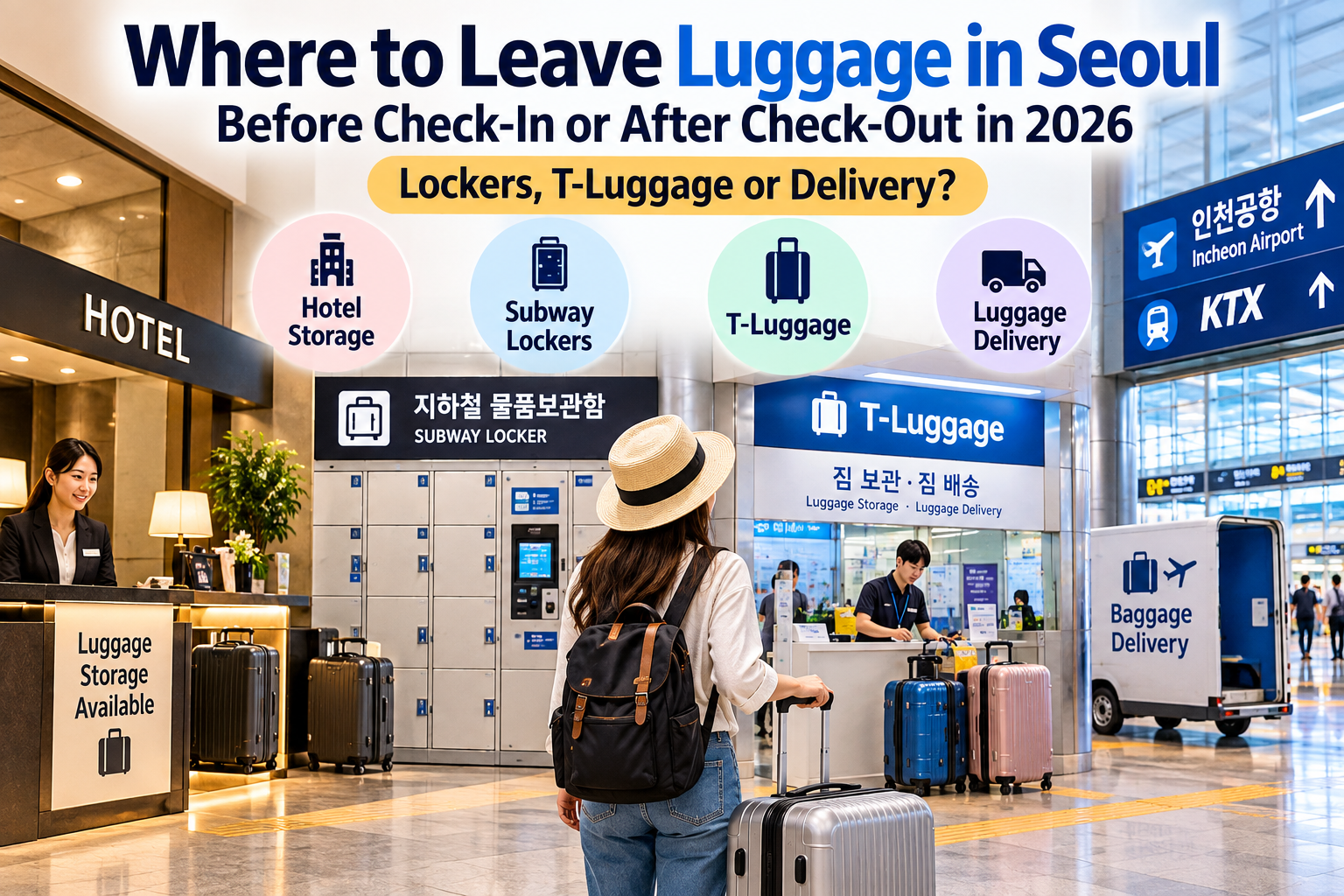
    Fortunately, Seoul has several ways to store or move luggage, including hotel storage, subway lockers, T-Luggage facilities and luggage delivery services.

    The important question is not simply where luggage storage exists.

    It is which option makes sense for your itinerary.

    Quick Answer: Which Luggage Option Should You Choose?

    If you will return to the same place later, storing your luggage there is usually the simplest choice.

    If your hotel will hold your bags and you plan to return to the hotel before leaving Seoul, hotel storage is often the first option to check.

    If you need storage near a subway station for a few hours, T-Locker or another station locker may be more convenient.

    If you have a large suitcase, want staff assistance or cannot find a suitable locker, T-Luggage can be easier.

    And if your sightseeing route ends somewhere completely different from where it begins, luggage delivery may save you from backtracking across Seoul just to retrieve a suitcase.

    That last point is especially important.

    The cheapest storage option is not always the best option if retrieving your luggage adds an hour to your journey.

    Option 1: Ask Your Hotel Before Paying for Storage

    Before searching for a locker, ask your accommodation whether it can hold your luggage.

    Many hotels and other accommodations provide luggage storage for guests before check-in or after check-out, although policies, available space and fees can vary.

    This works particularly well when your itinerary brings you back to the hotel anyway.

    For example:

    You check out in Myeongdong in the morning, spend several hours nearby and return to Myeongdong before heading to the airport.

    Leaving your suitcase at the hotel may be much easier than moving it to a subway locker.

    But consider your route before choosing this option.

    If your hotel is in Hongdae and your final sightseeing stop is around Seoul Station, returning to Hongdae solely to collect your luggage could add unnecessary travel.

    Best for: Travelers who will naturally return to their accommodation later.

    Check first: Storage availability, collection hours, fees and whether storage is available after check-out.

    Option 2: Use a Subway Locker for Short-Term Storage

    Subway lockers are useful when you need to leave your luggage somewhere for several hours and return to the same station.

    Seoul’s subway storage network includes T-Locker, with lockers available across hundreds of stations.

    This can be convenient if you arrive at a neighborhood before hotel check-in and want to explore without your suitcase.

    For example, suppose you arrive near Jamsil in the morning but cannot check in until mid-afternoon.

    If a suitable locker is available, you can store your luggage, explore the area and retrieve it before going to your accommodation.

    When a Locker Works Best

    A locker makes the most sense when:

    • you know which station you will return to,
    • your suitcase fits the available locker size,
    • you only need temporary storage,
    • and you can retrieve the luggage within the facility’s operating conditions.

    The biggest mistake is assuming that finding a subway station automatically means finding an empty locker large enough for your suitcase.

    Availability can vary by station and time.

    Large luggage can also be more difficult to accommodate than a backpack or cabin-size bag.

    Best for: Short storage periods and travelers returning to the same station.

    Less suitable for: Oversized luggage, uncertain itineraries or travelers who do not want to return to the same location.

    Option 3: Use T-Luggage When a Locker Is Not Enough

    T-Luggage is different from a standard unattended subway locker.

    It provides staffed luggage services at selected major transportation and tourist locations, including places such as Seoul Station, Hongik University, Myeongdong, Jamsil and Gimpo Airport, with additional locations in Seoul’s subway network.

    For travelers with large suitcases, this can be more comfortable than searching for an available locker.

    It is also useful when you prefer handing your bag to staff rather than figuring out a locker system after a long flight.

    What Does T-Luggage Cost?

    Prices vary according to luggage size, storage duration, day and service.

    As one reference point, Seoul’s official guidance lists short-term storage pricing for large luggage that can be higher on weekends than on weekdays, with additional charges when storage time extends beyond the initial period.

    Because prices and operating details can change, check the current rate for your location and luggage size before using the service.

    This is especially important if you plan to leave luggage for most of the day rather than only a few hours.

    Best for: Large luggage, travelers wanting staffed service and major transit hubs.

    Check first: Location hours, luggage size, current price and pickup deadline.

    Option 4: Consider Luggage Delivery Instead of Storage

    This is where many travelers overlook a potentially better option.

    Sometimes the real problem is not storing your suitcase.

    It is having to return for it.

    Suppose you check out near Hongdae in the morning, spend the afternoon in central Seoul and then plan to continue toward the airport.

    Leaving your suitcase in Hongdae means you eventually have to travel back to Hongdae before continuing your journey.

    In that situation, luggage delivery may be worth paying for.

    T-Luggage services can include luggage transportation between participating locations, and airport-related delivery options may also be available depending on the route and service conditions.

    Instead of asking:

    Where can I store my luggage cheaply?

    ask:

    Where do I want my luggage to be when I finish sightseeing?

    That question often produces a better travel plan.

    Best for: Travelers whose final destination is different from their starting point.

    Potential downside: Delivery costs more than simply leaving a bag somewhere, and you must follow the service’s acceptance and collection times.

    A New Option Around Seoul Station: 24-Hour Luggage Storage

    Seoul Station deserves special attention because it is one of the places where travelers most often need luggage storage.

    You may arrive by KTX before hotel check-in, check out before taking a train later in the day, or spend several hours in Seoul before continuing to another city.

    In 2026, travelers also have access to a 24-hour luggage storage option near Seoul Station known as LuggageDot.

    The service is designed for travelers who need storage outside the practical hours of some traditional facilities and can accommodate large suitcases, including luggage up to around 32 inches according to Seoul’s official tourism information.

    It also offers features such as checking availability and making reservations.

    This can be particularly useful if your schedule starts very early or ends late at night.

    However, do not assume that “24-hour” means every luggage option around Seoul Station operates 24 hours.

    Always check the specific facility you plan to use.

    Before Hotel Check-In: What Should You Do?

    Your best choice depends on where you arrive and what you want to do before checking in.

    If You Arrive Near Your Hotel

    Ask the hotel to store your luggage first.

    If that is possible, there is usually little reason to move your suitcase somewhere else.

    If You Arrive at Seoul Station

    Consider storage at or around Seoul Station if your sightseeing route brings you back there.

    If you have a large suitcase or want staffed service, compare T-Luggage with available storage facilities rather than assuming a locker will be easiest.

    If You Want to Explore a Different Neighborhood First

    Think carefully before leaving luggage at your arrival point.

    For example, if you arrive at Seoul Station but plan to spend the entire afternoon in Hongdae before checking into a Hongdae hotel, storing your suitcase at Seoul Station may create unnecessary backtracking.

    In that case, moving closer to your eventual destination before storing the bag can make more sense.

    After Hotel Check-Out: Think About Your Final Route

    Departure day requires a slightly different decision.

    Do not automatically leave your luggage at the hotel just because the hotel offers storage.

    First look at your final sightseeing location and your route to the airport or train station.

    Example 1: Hotel → Nearby Sightseeing → Hotel → Airport

    Hotel storage is probably the easiest solution.

    Example 2: Hotel → Sightseeing Across Seoul → Airport

    Delivery or storage near your final sightseeing area may save considerable travel time.

    Example 3: Hotel → Seoul Station → KTX

    If you are continuing to another city by train, check your schedule in advance — Korea’s updated KTX ticket booking rules now allow travelers to plan many rail journeys earlier than before.

    Storage around Seoul Station can make sense if you want to explore central Seoul before catching your train.

    The key is to avoid crossing the city twice simply to retrieve a suitcase.

    What About Large Suitcases?

    Large luggage changes the decision.

    A traveler with a backpack can use far more storage options than someone carrying a 28- or 32-inch suitcase.

    Before relying on a locker, check its dimensions and availability.

    If your suitcase is large, a staffed luggage facility can reduce the risk of arriving at a station only to discover that the available lockers are too small or already occupied.

    This becomes even more important when traveling as a family with several suitcases.

    Four travelers do not just need “a locker.”

    They may need several large lockers at the same location.

    At that point, comparing staffed storage or luggage delivery becomes much more worthwhile.

    Storage Price vs Travel Time: Which Matters More?

    It is easy to focus on a difference of a few thousand won between storage options.

    But Seoul is a large city.

    If choosing the cheapest locker requires an unnecessary subway journey to retrieve your bags, the savings may not be worth the lost time.

    A better comparison includes:

    storage fee + retrieval time + extra transportation + inconvenience

    For a traveler with only two days in Seoul, an extra hour of sightseeing may be more valuable than saving a small amount on luggage storage.

    For a budget traveler staying near the storage location, the cheaper locker may make perfect sense.

    Neither choice is automatically better.

    Common Luggage Storage Mistakes in Seoul

    One common mistake is waiting until arrival to think about luggage.

    Another is assuming every station has enough large lockers available.

    Travelers also sometimes store luggage somewhere convenient in the morning without considering where they will be in the evening.

    And do not leave essential items inside luggage that you may not be able to access easily.

    Keep your passport, medication, wallet, phone, travel documents and other important valuables with you unless the service specifically provides a secure arrangement appropriate for those items.

    The Simplest Way to Decide

    Before choosing luggage storage in Seoul, answer three questions:

    1. Where will I be when I drop off the luggage?

    2. Where will I be when I need the luggage again?

    3. Do I actually need storage, or would delivery remove an unnecessary return trip?

    If both locations are the same, a hotel or locker is often enough.

    If they are different, compare delivery.

    If your luggage is unusually large, prioritize size and availability before price.

    And if your schedule involves very early or late hours, check operating times before building your itinerary around a storage location.

    Final Takeaway

    Seoul has plenty of places to leave luggage before check-in or after check-out.

    The harder part is choosing the one that fits your route.

    Hotel storage works well when you will return to the hotel.

    Subway lockers are convenient for short-term storage when you will return to the same station.

    T-Luggage can be easier for larger bags or travelers who prefer staffed service.

    Luggage delivery becomes valuable when it prevents you from backtracking across Seoul.

    And around major transport hubs such as Seoul Station, newer 24-hour storage options can help travelers with early or late schedules.

    So before comparing a few thousand won in storage fees, open your map and look at your day from beginning to end.

    In Seoul, the best place to leave your luggage is usually not the cheapest place.

    It is the place that keeps you moving forward.

  • Korea Tax Refund 2026: VAT Refund, Immediate Refund and Airport Guide for Foreign Tourists

    Korea Tax Refund 2026: VAT Refund, Immediate Refund and Airport Guide for Foreign Tourists

    Korea Tax Refund in 2026: The Quick Answer

    If you are visiting South Korea and plan to shop for cosmetics, clothes, shoes, bags, electronics or other taxable goods, you may be able to get part of the tax refunded.

    But there is one thing that confuses many first-time visitors:

    You do not always need to wait until the airport to get your tax refund.

    Depending on the store, purchase amount and refund method, you may be able to receive an immediate tax refund at checkout, claim it later at a downtown refund counter, or complete the process when you leave Korea.

    For most tourists, the easiest strategy is simple:

    Ask about an immediate tax refund before paying. If it is available and your purchase qualifies, it is usually the least complicated option.

    If immediate refund is not available, keep your refund documents and purchased goods together and plan how you will complete the refund before departure.

    This guide explains the differences and, more importantly, which method is likely to be easiest for your trip.

    Duty Free and Tax Refund Are Not the Same Thing

    Before shopping, it helps to understand one important distinction.

    A duty-free purchase and a tax-refund purchase are not the same process.

    At a duty-free store, applicable taxes are generally excluded from the price when you purchase the product.

    With the tourist tax-refund system, you normally buy eligible goods from a participating store and receive the applicable refund either immediately or through a later refund procedure.

    So if you see both “Duty Free” and “Tax Refund” during your trip, do not assume they mean exactly the same thing.

    For ordinary shopping in department stores, cosmetics shops, fashion stores and other participating retailers, the tax-refund system is often the one you will encounter.

    Who Can Get a Tax Refund in Korea?

    The system is intended for eligible non-resident visitors.

    Foreign travelers staying in South Korea for less than six months can generally qualify, provided they meet the applicable requirements.

    Eligible overseas Koreans may also qualify under separate residency and length-of-stay conditions.

    For most short-term international tourists, the practical question is not whether Korea has a tax-refund system.

    It is whether:

    • the store participates in the system,
    • the purchase meets the minimum amount,
    • the goods are eligible,
    • and you follow the required procedure before leaving Korea.

    A purchase generally needs to be at least KRW 15,000 to qualify for the tourist tax-refund system.

    That KRW 15,000 figure is important because travelers may still find older guides online showing a higher minimum purchase amount.

    Option 1: Immediate Tax Refund at the Store

    For many tourists, this is the simplest option.

    At participating stores offering immediate tax refunds, your eligibility is checked when you make the purchase, usually using your passport.

    Instead of paying the full tax-inclusive price and recovering the tax later, the applicable tax refund is deducted at the time of purchase.

    In practical terms:

    You shop → show your passport → the store verifies eligibility → you pay the reduced amount.

    There is no separate airport refund claim for that transaction.

    What Are the Immediate Refund Limits?

    For an immediate tax refund in 2026:

    • The purchase must be at least KRW 15,000.
    • A single transaction must be less than KRW 1 million.
    • Total purchases processed through the immediate refund system during your stay must be KRW 5 million or less.

    Not every tax-refund store necessarily offers the immediate-refund option.

    That is why one of the best habits for tourists is to ask before paying:

    “Is immediate tax refund available?”

    It can save you another procedure later.

    When Should You Choose Immediate Tax Refund?

    Immediate refund is particularly convenient if you are making ordinary tourist purchases that fall within the limits.

    For example, imagine you are buying skincare products, clothing or souvenirs and the store offers immediate refund.

    If your transaction qualifies, there is usually little benefit in deliberately postponing the refund until the airport.

    Immediate refund can be especially useful if:

    • you are making several small or medium-sized purchases,
    • you do not want to keep track of multiple refund vouchers,
    • you have a tight airport schedule,
    • or you simply want the refund process finished while you are still in the store.

    But it is not always available.

    That is when the general tax-refund process becomes important.

    Option 2: Get Your Refund Later

    If the store does not offer immediate refund, you may pay the tax-inclusive price first and receive the refund later.

    Depending on the refund provider and your transaction, later refunds may be available through options such as:

    • downtown refund counters or kiosks,
    • airport refund counters or kiosks,
    • mobile refund services,
    • or designated mailbox procedures.

    The exact method available to you can depend on the tax-refund company shown on your refund document.

    So after purchasing, do not throw away the refund voucher just because you have the normal sales receipt.

    Keep the documents until the process is complete.

    Downtown Refund vs Airport Refund: Which Is Better?

    This is where the best choice depends on your travel style.

    Downtown Refund May Be Better If…

    You are still in Seoul, Busan or another major shopping area and would rather deal with the refund before departure.

    This can reduce the amount of refund processing you need to do at the airport.

    For a downtown general tax refund, qualifying purchases start at KRW 15,000, and a single receipt must generally not exceed KRW 6 million.

    However, receiving money downtown does not necessarily mean every departure requirement has disappeared.

    You may still need to complete the required customs/export procedure when leaving Korea.

    Also, downtown refund counters may only process refunds from their own refund company.

    Airport Refund May Be Better If…

    You have only a few refund purchases and prefer to handle everything when you leave Korea.

    Airport refund facilities can be convenient because you are already completing departure procedures.

    They can also be useful when your shopping involved different tax-refund companies.

    The trade-off is time.

    If you have multiple purchases, checked baggage containing refund goods or a transaction that requires customs verification, arriving at the airport with very little spare time is not a good plan.

    Airport refund is convenient only when you leave enough time to complete it.

    The Biggest Airport Mistake: Checking Your Bag Too Early

    This is one of the most practical things to understand before departure.

    For purchases that require customs export confirmation, customs may need to verify the goods you are taking out of Korea.

    If those goods are already inside checked baggage that has disappeared down the baggage belt, the process can become much more difficult.

    At Incheon Airport, the procedure can involve scanning your passport and sales confirmation at the appropriate kiosk and, if your purchase is selected for inspection, presenting the goods to customs.

    For goods that will go into checked baggage, deal with the required customs verification before the bag is finally handed over.

    So if you have tax-refund purchases in your suitcase, do not automatically:

    check in → drop the suitcase → start thinking about tax refund.

    Instead, check whether your purchases require customs confirmation first.

    Do Not Use or Open Refund Goods Too Early

    Another easy mistake is buying a tax-refund item and immediately opening or using it in Korea.

    Tax-refund goods are supposed to be taken out of the country, and goods subject to export verification should remain unused and unopened.

    This matters especially for products travelers naturally want to start using immediately, such as:

    • cosmetics,
    • perfume,
    • electronics,
    • fashion accessories,
    • and other personal purchases.

    If getting the refund matters to you, the safest approach is to keep eligible purchases unused until you have completed the required process.

    The goods also need to be taken out of Korea within the required period, generally within three months of purchase.

    What Should You Keep After Shopping?

    Until your refund is finished, keep:

    • your passport available,
    • the tax-refund voucher or sales confirmation,
    • the purchased goods,
    • and any payment information required by the refund provider.

    Do not assume the ordinary shop receipt alone is always enough for customs processing.

    If you are doing a lot of shopping, one practical trick is to keep all tax-refund documents in one envelope or travel pouch rather than mixing them with restaurant and transportation receipts.

    That can make departure day much easier.

    What Can You Usually Get a Tax Refund On?

    Many taxable retail goods can qualify, including common tourist purchases such as:

    • clothing,
    • shoes,
    • bags and accessories,
    • cosmetics and perfume,
    • home appliances,
    • ginseng and red ginseng products.

    But eligibility is not simply based on whether you spent money in Korea.

    Some purchases and services are not eligible.

    For example, ordinary services that cannot be physically presented for customs verification are treated differently from exportable goods.

    Products that have already been opened or used can also lose eligibility.

    And if you bought an item through a duty-free system where the relevant taxes were already excluded, you cannot claim the same tax again through the tourist tax-refund system.

    Three Shopping Situations: What Should You Do?

    Rather than memorizing every rule, it may be easier to think about your actual shopping situation.

    Situation 1: You Are Buying KRW 100,000 of Cosmetics

    The store participates in immediate tax refund and your purchase qualifies.

    Best first choice: Ask for the immediate refund at checkout.

    There is little reason to create another airport task if the transaction can be completed immediately.

    Situation 2: You Make Several Purchases at Stores Without Immediate Refund

    You receive refund vouchers from the shops.

    Best approach: Keep the documents and goods organized, then check whether downtown, mobile or airport refund is available for your refund provider.

    If airport processing will be necessary, allow extra departure time.

    Situation 3: You Buy an Expensive Item

    The transaction is outside the immediate-refund limit.

    Best approach: Do not assume you have lost the ability to receive a tax refund simply because immediate refund is unavailable.

    Check whether the purchase qualifies for the general tax-refund procedure and carefully follow the export/customs instructions on your refund documents.

    This distinction is important:

    “Not eligible for immediate refund” does not automatically mean “not eligible for any tax refund.”

    A Simple Tax Refund Strategy for First-Time Visitors

    If this is your first trip to Korea, you do not need to make the system more complicated than it is.

    Use this order:

    1. Look for a Tax Refund or Tax Free sign before buying.

    2. Keep your passport accessible while shopping.

    3. Ask whether immediate tax refund is available before payment.

    4. If it is available and your purchase qualifies, complete the refund immediately.

    5. If it is not available, get and keep the proper refund document.

    6. Keep refund goods unused and organized.

    7. Before leaving Korea, check whether customs export confirmation is required.

    8. If the goods are going into checked baggage, handle any required verification before handing over your suitcase.

    This approach prevents most of the confusion travelers experience.

    Is Korea’s Tax Refund Worth the Trouble?

    For a single inexpensive purchase, the amount refunded may not be large enough to justify spending a lot of your vacation time searching for a refund counter.

    But the calculation changes if you plan to buy several eligible products or make larger purchases.

    That is why the best strategy is not necessarily:

    “Claim every possible refund.”

    It is:

    “Use the easiest refund method available for the purchases that are worth processing.”

    If immediate refund is offered at checkout, the inconvenience is minimal.

    If you need a later refund, consider the value of the refund against the time and departure-day complexity involved.

    That is particularly important for travelers with early flights, tight connections or lots of checked baggage.

    Final Takeaway

    Korea’s tourist tax-refund system is easier to use when you decide how you will receive the refund at the time you shop, rather than waiting until you reach the airport.

    For many ordinary purchases, immediate tax refund is the most convenient choice when it is available.

    For purchases that require a later refund, keep the proper documents, keep eligible goods unused and plan the customs and refund steps before departure.

    Most importantly, remember these three numbers:

    KRW 15,000 — the general minimum qualifying purchase amount.

    Under KRW 1 million — the single-transaction limit for immediate tax refund.

    KRW 5 million or less — the total immediate-refund purchase limit during your stay.

    You do not need to memorize every refund procedure before arriving in Korea.

    Just remember to ask before paying, keep your documents and plan before checking your baggage.

    That will make tax-free shopping in Korea much easier.

  • K-Tour Pass Busan 2026: Is the 15,000 Won Pass Worth It for Foreign Tourists?

    K-Tour Pass Busan 2026: Is the 15,000 Won Pass Worth It for Foreign Tourists?

    Busan has a new travel pass for international visitors in 2026.

    The K-Tour Pass, launched as a pilot program on October 1, combines discounts on transportation to Busan with attraction benefits, local discounts, and a WOWPASS card.

    Both versions cost KRW 15,000, which makes the obvious question:

    Is the K-Tour Pass actually worth buying, or are you better off paying for transportation and attractions separately?

    The answer depends less on how long you stay in Busan and more on how you are getting there and what you plan to do after you arrive.

    Here is how to decide.

    What Is the K-Tour Pass?

    The K-Tour Pass is a travel pass designed specifically for international tourists visiting Korea.

    The pilot program began in Busan on October 1, 2026. There are two versions:

    • K-Tour Pass 1: designed mainly for travelers making a trip to Busan
    • K-Tour Pass 2: designed for travelers using a multi-day KORAIL Pass

    Both cost KRW 15,000.

    Whichever version you choose, the pass also includes an AREX discount, free admission to one participating Busan attraction, discounts at participating businesses, and a WOWPASS card.

    The transportation discount coupons and K-Tour Pass mobile ticket are currently valid through December 31, 2026.

    K-Tour Pass 1 vs Pass 2: Which One Should You Choose?

    This is the most important decision.

    K-Tour Pass 1

    Pass 1 includes a 40% discount on eligible transportation to Busan, up to KRW 24,000.

    Depending on the seller and transportation option, the discount can apply to eligible train or bus travel to Busan.

    This makes Pass 1 particularly interesting if your itinerary looks something like:

    Seoul → Busan

    or another eligible city-to-Busan journey.

    Because the pass itself costs KRW 15,000, the transportation discount can potentially recover much or all of the purchase price before you use any of the Busan attraction benefits.

    K-Tour Pass 2

    Pass 2 works differently.

    Instead of the 40% Busan-bound transportation discount, it provides a KRW 24,000 discount coupon for a KORAIL Pass.

    This is more relevant if Busan is only one part of a longer rail itinerary around Korea.

    For example:

    Seoul → Busan → another Korean city

    may make Pass 2 worth considering if you were already planning to purchase a multi-day KORAIL Pass.

    If you are simply traveling from Seoul to Busan once, however, do not automatically assume that Pass 2 is better just because it is connected to rail travel.

    Compare the actual ticket plan first.

    What Do Both Passes Include?

    The two versions share several benefits.

    1. AREX Discount

    K-Tour Pass includes a 50% discount coupon for an AREX one-way ticket, with a maximum discount of KRW 6,000.

    This is useful for travelers arriving through Incheon Airport and traveling toward Seoul before continuing to Busan.

    But if your itinerary does not involve the AREX, this benefit has little value to you.

    That is an important principle when evaluating the pass:

    Do not add up benefits that you were never going to use.

    2. One Free Busan Attraction

    You can choose one participating attraction from a list of about 35 options and use it once for free.

    The current list includes attractions such as:

    • Lotte World Adventure Busan
    • Songdo Marine Cable Car
    • Skyline Luge Busan

    This can significantly change the value calculation.

    If the attraction you already planned to visit costs more than a large portion of the KRW 15,000 pass price, the pass becomes easier to justify.

    But choosing an attraction simply because it is free does not really save money if it was never part of your itinerary.

    3. Discounts at Around 50 Partner Locations

    The pass also provides discounts at around 50 participating locations, including attractions, experience facilities, cafés, souvenir shops and other businesses.

    Unlike the free-attraction benefit, participating discount merchants can generally be used multiple times.

    Again, think of these as extra savings rather than the main reason to buy the pass.

    The WOWPASS Benefit Is Useful, but Understand What You Are Getting

    A physical WOWPASS card is also included.

    It can function as a prepaid payment card and includes a T-money transportation function for buses and subways.

    However, an important detail is easy to miss:

    The card does not come with transportation money already loaded onto it.

    You need to top it up separately.

    The prepaid WOWPASS balance and the T-money transportation balance are also not simply the same balance. Travelers should follow the appropriate top-up method for each function.

    K-Tour Pass holders can currently collect their WOWPASS card at dedicated kiosks at locations including:

    • Incheon Airport
    • Gimpo Airport
    • Gimhae Airport
    • Seoul Station
    • Busan Station

    So do not interpret “WOWPASS included” as “free public transportation in Busan.”

    It is the card that is included, not unlimited bus or subway fares.

    For local transportation after you arrive, see our guide to paying for buses in Busan, including T-Money, fares, and the payment options foreign travelers should know.

    When Is the K-Tour Pass Worth It?

    The pass makes the most sense when several benefits match things you were already going to pay for.

    Scenario 1: You Are Traveling from Seoul to Busan

    This is probably one of the strongest cases for considering Pass 1.

    If your eligible transportation receives a meaningful 40% discount and you also plan to visit one of the included Busan attractions, the combined value can exceed the KRW 15,000 purchase price.

    The key is to check your actual transportation option before buying.

    If you plan to take the train, check our guide to booking KTX tickets in Korea, including the new two-month advance booking window for 2026.

    If you are planning to travel by train, you may also want to read our guide:

    [Internal link: How to Book KTX Tickets in Korea in 2026: New 2-Month Advance Booking Rule for Foreign Travelers]

    Scenario 2: You Are Traveling Around Korea by Rail

    If you already intend to purchase a multi-day KORAIL Pass, compare Pass 2.

    Its KRW 24,000 KORAIL Pass discount is larger than the KRW 15,000 purchase price of the K-Tour Pass itself.

    But that does not mean everyone should buy a KORAIL Pass just to use this discount.

    First decide whether a KORAIL Pass makes financial sense for your itinerary. Then evaluate the K-Tour Pass.

    Scenario 3: You Plan to Visit an Included Paid Attraction

    Suppose Lotte World Busan, Songdo Marine Cable Car, Skyline Luge Busan, or another participating attraction is already on your itinerary.

    The free admission benefit then has real value.

    Combine that with transportation savings and the pass can become considerably more attractive.

    Scenario 4: You Are Already in Busan

    This is where the decision changes.

    If you have already arrived in Busan and cannot make meaningful use of the Busan-bound transportation benefit, do not buy the pass simply because it sounds convenient.

    Calculate the value of:

    one free attraction + discounts you will actually use + WOWPASS card

    against the KRW 15,000 purchase price.

    For some travelers that may still work.

    For others, paying separately will be simpler.

    When Would I Probably Skip the K-Tour Pass?

    Consider skipping it if:

    • you are already in Busan and will not benefit from the main transportation discount;
    • none of the free attractions are places you planned to visit;
    • you already have the payment and transportation cards you need;
    • you will use few or none of the partner discounts;
    • your actual savings are likely to stay below KRW 15,000.

    The mistake would be treating every listed benefit as money saved.

    A discount only has value if it applies to something you were going to buy anyway.

    What If You Are Taking an Express or Intercity Bus to Busan?

    Do not assume every bus ticket automatically qualifies.

    The transportation benefit depends on the K-Tour Pass option, booking channel, and eligible transportation product.

    Check the current conditions before paying for the pass or booking your bus.

    If you are still deciding how to reserve long-distance buses in Korea, see:

    [Internal link: How to Book Express and Intercity Buses in Korea in 2026: A First-Time Traveler’s Guide]

    That guide explains the difference between express and intercity buses, booking platforms, terminals, tickets and what foreign travelers should expect.

    If you are considering a bus instead of the train, our guide to booking express and intercity buses in Korea explains the booking platforms, terminals, tickets, and common mistakes for first-time travelers.

    How Do You Buy the K-Tour Pass?

    The K-Tour Pass is currently available through participating online travel platforms including Klook and HopnHop.

    After purchasing, you receive a mobile ticket.

    One detail is especially important:

    Do not rely on a screenshot of the ticket.

    Participating locations scan the barcode displayed in the mobile ticket, and screenshots or printed copies may not be accepted.

    Open the live mobile ticket when using a benefit.

    Can You Get a Refund?

    Yes, but only while the benefits remain unused.

    According to the current rules, you can receive a full refund if you have not used the transportation coupons or mobile-ticket benefits.

    Once certain benefits have been registered or used—including transportation coupons, the WOWPASS issuance code, or participating attraction/merchant benefits—the purchase may no longer be refundable.

    If your plans are uncertain, avoid activating benefits before you are sure you will use the pass.

    A Simple Way to Decide Before Buying

    Before purchasing, write down four things:

    1. How are you getting to Busan?

    If Pass 1 applies to your transportation, calculate the actual discount.

    2. Are you buying a KORAIL Pass anyway?

    If yes, compare Pass 2.

    3. Which free attraction would you choose?

    Check its normal admission price.

    4. Which other benefits would you genuinely use?

    Count only those benefits—not every discount advertised with the pass.

    Then compare the realistic total savings with KRW 15,000.

    That is a much better way to decide than buying the pass simply because it bundles many benefits.

    Final Verdict: Who Should Consider the K-Tour Pass?

    The K-Tour Pass is most compelling for an international visitor who is traveling to Busan and can combine a transportation discount with an attraction they already planned to visit.

    Pass 1 is particularly worth checking for a straightforward trip to Busan.

    Pass 2 deserves attention if you already plan to use a multi-day KORAIL Pass.

    The value is less obvious for travelers who are already in Busan or who will not use the included attractions and transportation discounts.

    So the real question is not:

    “Does the K-Tour Pass include a lot of benefits?”

    It does.

    The better question is:

    “Will this pass reduce the cost of the Busan trip I have already planned?”

    If the answer is yes and your realistic savings exceed KRW 15,000, the K-Tour Pass can be a useful addition to a 2026 Busan itinerary.


  • How to Pay for Buses in Busan in 2026: QR Payments, T-Money and Fares for Foreign Tourists

    How to Pay for Buses in Busan in 2026: QR Payments, T-Money and Fares for Foreign Tourists

    Getting around Busan by bus has become easier for international travelers in 2026.

    Starting September 21, foreign visitors can pay for Busan city buses by scanning a QR code with supported overseas payment apps. This means some travelers can now ride a bus without buying a Korean transportation card or preparing Korean cash first.

    However, QR payment is not always the cheapest or most convenient option. If you plan to use buses and the subway frequently, a transportation card such as T-Money can still be the better choice.

    Here is what foreign travelers need to know about paying for buses in Busan in 2026.

    Three Ways to Pay for a Bus in Busan

    For most international visitors, there are three practical ways to pay for a city bus in Busan:

    • a transportation card such as T-Money
    • cash in Korean won
    • the new QR payment system using a supported overseas payment app

    The best option depends on how often you plan to use public transportation and whether your mobile payment app supports the new QR service.

    1. Paying with T-Money or Another Transportation Card

    For travelers who will use public transportation several times during their trip, a transportation card remains one of the easiest options.

    T-Money and other compatible Korean transportation cards can be used on buses and the subway in Busan.

    For a regular city bus, the adult transportation-card fare is 1,550 won, compared with 1,700 won when paying cash.

    Using a transportation card also gives you access to eligible transfer discounts between public transportation services.

    This makes a transportation card particularly useful if you plan to:

    • take several buses in one day
    • transfer between buses
    • combine buses and the subway
    • travel around Busan for several days

    Transportation cards can also be recharged at locations such as subway stations and convenience stores.

    Is T-Money Only for Seoul?

    No.

    This is a common point of confusion for first-time visitors. Although T-Money is strongly associated with Seoul, it can also be used on public transportation in Busan.

    So if you already bought and loaded a T-Money card in Seoul, you generally do not need to buy another transportation card just because you arrived in Busan.

    2. New QR Bus Payment for Foreign Tourists

    Busan introduced a new QR payment option for foreign tourists on September 21, 2026.

    The system uses Zeropay’s global payment network and allows travelers with supported overseas payment apps to scan a QR code posted inside the bus.

    Supported services include major mobile payment platforms such as Alipay and WeChat Pay, along with other participating overseas payment services.

    You do not need to install a separate Korean transportation app simply to use this QR payment method if you already have a supported payment app.

    How to Pay by QR Code

    The process is straightforward.

    After boarding the bus:

    1. Open your supported mobile payment app.
    2. Scan the Zeropay QR code inside the bus.
    3. Confirm the payment.
    4. Show the completed payment screen to the bus driver.

    Currency conversion is handled through the payment system.

    Multilingual instructions and QR codes are being provided on Busan city buses, with additional information available around major tourist areas and transportation gateways.

    How Much Does QR Bus Payment Cost?

    The QR fare is 1,700 won per person.

    That is the same as the standard adult cash fare for a regular city bus.

    There are two important differences compared with using a transportation card.

    First, transfer discounts do not apply to QR payments.

    Second, the QR system charges the same 1,700-won fare for adults, teenagers and children.

    If several people are traveling together, each passenger requires a separate payment.

    For families or travelers making multiple transfers, this can make a transportation card more economical.

    3. Paying Cash on Busan Buses

    Cash remains another option on Busan city buses.

    For a regular city bus, the adult cash fare is 1,700 won.

    However, cash has two disadvantages for most tourists.

    The fare is higher than the standard transportation-card fare, and cash passengers cannot receive the same transfer discount available when using a transportation card.

    For that reason, cash is most useful as a backup rather than the main payment method for a multi-day trip.

    Busan Bus Fares in 2026

    For a regular Busan city bus, the basic fares are:

    Payment MethodAdult FareTransfer Discount
    Transportation card1,550 wonAvailable when eligible
    Cash1,700 wonNo
    Foreign tourist QR payment1,700 wonNo

    These figures apply to regular city buses. Express and late-night buses can have different fares.

    QR Payment vs T-Money: Which Is Better?

    For most tourists, the answer depends on the trip.

    Choose QR payment if:

    You only need an occasional bus ride, already use a supported overseas payment app, and do not want to buy or recharge a Korean transportation card.

    Choose T-Money or another compatible transportation card if:

    You plan to use buses and the subway frequently, expect to make transfers, or will travel around Korea for several days.

    The new QR system is mainly about convenience. A transportation card can still be better for frequent public transportation use because of the lower regular bus fare and transfer benefits.

    Can You Use the Same T-Money Card in Seoul and Busan?

    Yes.

    For many international travelers, this is the simplest solution.

    If your itinerary includes both Seoul and Busan, you can generally continue using the same T-Money card instead of purchasing a separate card for each city.

    That makes T-Money especially practical for travelers arriving in Seoul and later traveling to Busan.

    What About the Busan Subway?

    Do not confuse the new onboard bus QR payment system with QR tickets used for the Busan Metro.

    They are different payment systems.

    For tourists who plan to use both buses and the subway regularly, using a compatible transportation card is usually simpler because the same card can be used across the public transportation network.

    How to Ride a Bus in Busan

    If you have never used a Korean city bus before, the basic process is simple.

    Check your bus number and direction before boarding. Enter through the front door and pay your fare when you board.

    If using a transportation card, tap it on the card reader.

    If using the new foreign-tourist QR payment system, scan the QR code inside the bus, complete payment and show the confirmation screen to the driver.

    Before your stop, press one of the stop buttons inside the bus.

    Passengers normally exit through the rear door.

    When using a transportation card, remember to tap your card when getting off as well, especially if you may transfer to another bus or the subway.

    Which Payment Method Should First-Time Visitors Use?

    If you are spending several days in Busan, a transportation card is still the most flexible choice.

    You can use it for buses and the subway, and it is more convenient when making transfers.

    But the new QR payment system solves a real problem for short-term visitors.

    If you arrive in Busan without a transportation card and simply need to take a bus, you may now be able to pay using a familiar overseas mobile payment app instead of finding a place to purchase and recharge a card.

    That makes spontaneous bus trips considerably easier for international travelers.

    Final Tips for Using Buses in Busan

    Busan’s subway is convenient, but many beaches, hillside neighborhoods, temples and scenic areas are easier to reach by bus.

    For frequent public transportation use, keep a transportation card loaded with enough balance.

    For occasional trips, check whether your existing mobile payment app supports Busan’s new Zeropay QR bus payment system.

    And remember one important difference: QR payment offers convenience, while a transportation card generally offers better value for travelers making multiple trips and transfers.

    With both options now available, exploring Busan by bus has become easier for foreign visitors in 2026.


  • How to Book KTX Tickets in Korea in 2026: New 2-Month Advance Booking Rule for Foreign Travelers

    How to Book KTX Tickets in Korea in 2026: New 2-Month Advance Booking Rule for Foreign Travelers

    If you are planning a trip to South Korea in late 2026, booking your KTX train tickets is about to become easier.

    Starting October 1, 2026, travelers will be able to book KTX and other eligible train tickets up to two months before departure. Previously, most regular train tickets could only be booked about one month in advance.

    For international travelers planning popular routes such as Seoul to Busan, Seoul to Gyeongju, or Seoul to Gangneung, the change means you can secure your train tickets much earlier — especially useful when arranging hotels, flights, and a multi-city Korea itinerary.

    Here is what foreign travelers need to know about booking KTX tickets in Korea in 2026.

    What Is Changing for KTX Booking in October 2026?

    The biggest change is simple:

    From October 1, 2026, regular train tickets can be booked up to two months before departure.

    The previous advance booking window was generally one month.

    This applies to KTX and other eligible Korail train services, making it possible to organize long-distance travel much earlier.

    For example, if you are visiting Korea in November or December, you will no longer have to wait until roughly one month before your journey to start checking many regular train tickets.

    This is particularly helpful for international visitors who often book their flights and hotels several months ahead.

    Why the New 2-Month Booking Window Matters for Foreign Travelers

    KTX is one of the easiest ways to travel between major Korean cities.

    A traveler visiting Seoul and Busan, for example, can travel between the two cities by high-speed train rather than taking another domestic flight.

    The same rail network can also be useful for destinations such as Gyeongju, Daegu, Daejeon, Gangneung, Jeonju, and other parts of Korea.

    Until now, the shorter booking window sometimes created an awkward gap.

    You might have booked your international flight and hotels months in advance but still had to wait before buying your KTX ticket.

    The new system makes it easier to organize the transportation part of your itinerary at the same time.

    How to Book KTX Tickets in Korea

    For most foreign travelers, the safest starting point is Korail’s official booking service.

    Korail provides an English-language booking interface, along with other language options.

    The basic booking process is straightforward:

    1. Select your departure station.
    2. Select your destination.
    3. Choose your travel date.
    4. Search for available trains.
    5. Select your preferred departure time and seat.
    6. Enter the required passenger information.
    7. Complete payment.
    8. Keep your ticket or booking information available for your journey.

    When searching for trains, always check the station name carefully.

    Seoul has several major railway stations, and different trains may depart from different locations.

    Seoul to Busan: The Most Popular KTX Route for Tourists

    The Seoul–Busan route is one of the most useful KTX journeys for international travelers.

    It connects South Korea’s capital with its largest coastal city and makes a Seoul-and-Busan itinerary relatively easy to organize.

    Direct KTX services typically make the journey in roughly 2.5 to 3 hours, depending on the train.

    That means you can have breakfast in Seoul and arrive in Busan around lunchtime without going through an airport.

    Because this is such a popular route, booking earlier can be useful when your travel dates are fixed.

    What About Seoul to Gyeongju?

    Travelers visiting Gyeongju should pay particular attention to the station name.

    High-speed KTX trains serving the area use Gyeongju Station, which is outside the historic center.

    After arriving, you will still need local transportation to reach central Gyeongju and major attractions.

    Even with that extra transfer, KTX is often one of the most convenient ways to reach Gyeongju from Seoul.

    If Gyeongju is one of the main stops on your Korea itinerary, booking your train and accommodation together can make the trip much easier to organize.

    KTX to Gangneung and Korea’s East Coast

    KTX is also useful if you want to travel from Seoul toward Gangneung and the east coast.

    Gangneung is popular for beaches, cafes, seafood, and access to destinations around Gangwon Province.

    For travelers who do not want to rent a car, the train can be one of the simplest ways to leave Seoul and reach the east coast.

    Weekend services can attract significant demand, so travelers with a fixed itinerary should avoid assuming that their preferred train will always have seats available at the last minute.

    Should You Book KTX Tickets as Soon as They Become Available?

    Not necessarily.

    If your schedule is flexible and you are traveling on an ordinary weekday, you may have several train options.

    However, booking earlier makes more sense when:

    • you are traveling on a Friday evening or weekend,
    • your itinerary depends on a specific departure time,
    • you are traveling with several people,
    • you are visiting during a major Korean holiday,
    • or you are traveling during a particularly busy tourism period.

    For a carefully planned multi-city itinerary, there is little advantage in waiting unnecessarily once your dates are confirmed.

    Be Careful During Korean Public Holidays

    The new two-month booking window does not mean every train ticket will always follow exactly the same booking process.

    Major Korean holidays, especially Seollal (Lunar New Year) and Chuseok, can have special reservation periods and procedures.

    Demand during these periods is extremely high, and Korail may announce a separate holiday booking schedule.

    If your trip overlaps with a major Korean holiday, check the latest Korail announcement rather than relying only on the normal advance booking rule.

    This is one of the most important differences between ordinary KTX travel and holiday-period travel.

    Can Foreign Travelers Use the KTX Booking System?

    Yes.

    Korail provides foreign-language services, including English, and the Korean government has announced further improvements aimed at making rail booking more convenient for international visitors.

    These plans include expanded multilingual services and global payment options.

    Still, payment compatibility can vary depending on the card, issuing country, and booking platform.

    If an overseas card does not work, do not immediately assume that the train is sold out. Check the payment method and make sure you are using an official Korail booking channel.

    KTX or SRT: What Is the Difference?

    Foreign visitors may also encounter SRT when searching for high-speed trains.

    Both KTX and SRT operate high-speed rail services, but they traditionally used different booking systems and key departure stations.

    KTX commonly serves Seoul Station and Yongsan Station, while many SRT services use Suseo Station in southern Seoul.

    Korea has also been moving toward greater integration of KTX and SRT booking services, which can make comparing train options easier.

    For tourists, the most important consideration is usually not the brand of train but:

    Which station is easiest to reach, what time the train departs, where it stops, and whether seats are available.

    Do You Need a Korail Pass?

    Not every traveler needs a rail pass.

    If you are only taking one or two long-distance train journeys, buying individual tickets may be simpler.

    A rail pass becomes more relevant when you plan several eligible train journeys within a relatively short period.

    Before purchasing any pass, compare the current pass price with the actual cost of the individual trains you intend to take.

    Do not buy a rail pass simply because you plan to ride the KTX once.

    Tips for Booking KTX as a Foreign Visitor

    A few simple habits can prevent common problems.

    First, use official railway booking channels whenever possible.

    Second, double-check both your departure and arrival stations before paying.

    Third, keep a copy of your booking information available on your phone.

    Fourth, arrive at the station with enough time to find the correct platform.

    Korean railway stations are generally well organized, but major stations such as Seoul Station and Busan Station can be busy.

    Finally, remember that a confirmed seat is especially valuable when your hotel check-in, tour, or onward transportation depends on arriving at a particular time.

    Frequently Asked Questions

    How early can I book KTX tickets in Korea in 2026?

    Starting October 1, 2026, the normal advance reservation period for KTX and other eligible rail tickets expands from one month to two months before departure.

    Can foreigners book KTX tickets online?

    Yes. Korail provides foreign-language booking services, including English.

    Should I book Seoul to Busan KTX tickets in advance?

    It is a good idea if you need a particular departure time, especially on weekends, busy travel dates, or when traveling with a group.

    How long does the KTX take from Seoul to Busan?

    Many direct KTX services take roughly 2.5 to 3 hours, although journey times vary by service and stopping pattern.

    Can KTX tickets sell out?

    Yes. Popular trains and departure times can sell out, particularly during weekends and major travel periods.

    Is the two-month rule the same during Chuseok and Seollal?

    Do not assume so. Major Korean holidays can use special reservation schedules announced separately by Korail.

    Is KTX better than flying from Seoul to Busan?

    For many travelers, KTX is more convenient because it connects city centers and avoids the additional airport travel and procedures required for a domestic flight. The better choice still depends on your itinerary and fare.

    Final Thoughts

    The new two-month KTX booking window is a small change that can make planning a Korea trip much easier.

    From October 1, 2026, international travelers will be able to organize many train journeys earlier instead of waiting until about one month before departure.

    That is especially useful if you are building a multi-city itinerary connecting Seoul with Busan, Gyeongju, Gangneung, or other destinations around Korea.

    Once your itinerary is fixed, check your train options early, confirm the correct stations, and pay extra attention to special booking rules if your trip overlaps with a major Korean holiday.

    For travelers who want to explore beyond Seoul, Korea’s high-speed rail network remains one of the easiest ways to see more of the country.

  • T-Money vs Climate Card in Seoul 2026: Which Transportation Card Is Best for Tourists?

    T-Money vs Climate Card in Seoul 2026: Which Transportation Card Is Best for Tourists?

    Getting around Seoul is easy once you understand the city’s transportation system. But for first-time visitors, choosing the right transportation card can be surprisingly confusing.

    Two of the most useful options are T-Money and the Climate Card.

    Both can make traveling around Seoul much easier, but they work very differently. T-Money is a rechargeable transportation card that can be used across Korea, while the Climate Card offers unlimited rides within its designated Seoul transportation network for a fixed period.

    So which one should you buy?

    This 2026 guide explains the differences between T-Money and the Climate Card, how much they cost, where you can use them, and which option may make more sense for your Korea itinerary.

    Quick Answer: T-Money or Climate Card?

    For most travelers, the choice depends on where you are traveling.

    Choose T-Money if you:

    • Plan to travel outside Seoul
    • Will visit places such as Busan, Gyeongju, Jeju, or other Korean cities
    • Prefer paying for transportation based on actual usage
    • Want one transportation card that works across much of Korea
    • Expect to use taxis or other transportation outside the Climate Card service area

    Choose the Climate Card if you:

    • Will spend most of your trip inside Seoul
    • Expect to use buses and subways frequently
    • Want unlimited eligible public transportation during your pass period
    • Prefer knowing your transportation cost in advance
    • Are staying in Seoul for between one and seven days

    For many first-time visitors traveling around Korea, T-Money offers greater flexibility.

    For travelers spending several busy sightseeing days almost entirely in Seoul, however, a short-term Climate Card can be very convenient.

    What Is a T-Money Card?

    T-Money is one of Korea’s most widely used prepaid transportation cards.

    Instead of buying an individual ticket every time you ride a subway or bus, you load money onto the card and tap it when entering and leaving the transportation system.

    T-Money can be purchased at many convenience stores, including chains such as CU, GS25, and 7-Eleven, as well as at transportation facilities.

    The standard card generally costs around KRW 3,000–5,000, before adding transportation credit.

    One of T-Money’s biggest advantages for international travelers is its wide coverage.

    It can be used on public transportation across many parts of Korea, making it particularly useful for travelers visiting several cities during one trip.

    Where Can You Use T-Money?

    T-Money can be used on many:

    • Subways
    • City buses
    • Express and intercity buses
    • Taxis
    • Other participating transportation services

    It can also be used at some convenience stores, vending machines, and other participating merchants displaying the T-Money logo.

    This makes T-Money particularly useful for itineraries such as:

    Seoul → Busan → Gyeongju → Seoul

    Instead of buying a new local transportation card in every destination, travelers can continue using the same T-Money card for many local transportation needs.

    What Is the Seoul Climate Card?

    The Climate Card was introduced by the Seoul Metropolitan Government as an unlimited public transportation pass.

    For tourists, the most important products are the short-term Climate Card passes.

    As of 2026, short-term passes are available for:

    • 1 day — KRW 5,000
    • 2 days — KRW 8,000
    • 3 days — KRW 10,000
    • 5 days — KRW 15,000
    • 7 days — KRW 20,000

    A physical Climate Card costs an additional KRW 3,000.

    These passes are particularly attractive for travelers who plan to take public transportation repeatedly while sightseeing around Seoul.

    Important Climate Card Change in 2026

    Visitors may see older online guides discussing the Climate Card’s 30-day prepaid pass.

    This information is changing.

    Seoul announced that recharging the existing 30-day prepaid Climate Card ends after August 31, 2026, as the city transitions toward its newer Climate Pass system.

    However, this does not mean tourists can no longer use the Climate Card.

    The short-term tourist passes for 1, 2, 3, 5, and 7 days continue to be available.

    This distinction is important when reading older travel guides about Seoul transportation.

    Can Foreign Tourists Buy the Climate Card With an International Credit Card?

    Yes, and this became significantly easier in 2026.

    Seoul expanded payment support at hundreds of new subway vending machines, allowing travelers to use internationally issued credit and debit cards such as Visa and Mastercard to purchase Climate Cards and recharge short-term passes.

    International card payments are supported at new vending machines installed across Seoul Metro Lines 1–8.

    An average service fee of approximately 3.7% may apply when using an internationally issued card.

    This is an important improvement for international visitors because transportation card purchases in Korea have traditionally relied heavily on Korean won cash or locally issued cards.

    T-Money vs Climate Card: Main Differences

    Here is the simplest way to understand the two cards.

    T-Money

    Payment system: Pay per ride

    Best for: Flexible travel throughout Korea

    Coverage: Widely usable across Korea

    Main advantage: One card can be used for transportation in many Korean cities

    Best traveler: Someone visiting Seoul plus other destinations

    Climate Card

    Payment system: Unlimited eligible transportation during the pass period

    Best for: Frequent transportation within Seoul

    Coverage: Limited primarily to eligible Seoul transportation services

    Main advantage: Unlimited rides without worrying about individual fares

    Best traveler: Someone sightseeing intensively within Seoul

    Is the Climate Card Really Unlimited?

    Within its eligible transportation network, the Climate Card allows unlimited rides during the validity period.

    However, “unlimited” does not mean that every transportation service in Korea is included.

    The Climate Card has a defined service area and exclusions. Travelers planning trips outside Seoul should therefore check whether their destination is covered before relying exclusively on the card.

    This is one of the biggest differences between the Climate Card and T-Money.

    T-Money does not provide unlimited transportation, but its geographical flexibility is much greater.

    Which Card Is Better for a 3-Day Seoul Trip?

    Consider a traveler spending three full days sightseeing around Seoul.

    The itinerary might include:

    Day 1: Gyeongbokgung Palace → Bukchon Hanok Village → Insadong → Myeongdong

    Day 2: Hongdae → Yeonnam-dong → Han River → Gangnam

    Day 3: Seongsu → Seoul Forest → Dongdaemun → Namsan

    This traveler may take multiple subway and bus rides each day.

    A 3-day Climate Card costs KRW 10,000, plus the KRW 3,000 physical card cost if a card needs to be purchased.

    For a transportation-heavy itinerary like this, the Climate Card can be particularly convenient.

    Which Card Is Better for a 7-Day Korea Trip?

    Now consider this itinerary:

    Days 1–3: Seoul
    Days 4–5: Gyeongju
    Days 6–7: Busan

    In this situation, T-Money is generally more practical because the traveler is moving beyond Seoul.

    The Climate Card’s main value comes from frequent eligible transportation within Seoul, whereas T-Money can continue to be useful in other Korean cities.

    Can You Use Both T-Money and the Climate Card?

    Yes.

    In fact, some travelers may find that carrying both is convenient.

    You could use the Climate Card during several intensive sightseeing days in Seoul and keep a T-Money card for transportation outside the Climate Card coverage area or later trips to other Korean cities.

    You do not necessarily have to choose only one card for your entire Korea trip.

    Where Can Tourists Buy T-Money?

    T-Money cards are widely available.

    Travelers can commonly find them at convenience stores such as:

    • CU
    • GS25
    • 7-Eleven
    • Other participating convenience stores

    They are also available at transportation-related sales locations.

    According to VISITKOREA, a standard T-Money card generally costs approximately KRW 3,000–5,000 before adding transportation credit.

    One detail international travelers should know is that ordinary T-Money purchases and top-ups may still require Korean won cash in many situations, so carrying some cash after arriving in Korea remains useful. Korea Tourism Organization’s 2026 transportation guide specifically notes cash-only purchasing/top-up for standard prepaid T-Money.

    Where Can Tourists Buy a Climate Card?

    Physical Climate Cards are available through designated subway vending machines and participating sales locations in Seoul.

    New transportation-card vending machines across Seoul Metro Lines 1–8 have made purchasing the card considerably easier for international visitors.

    Remember that the physical card itself costs KRW 3,000, and the short-term pass is loaded separately.

    Unlike an ordinary T-Money balance, a short-term Climate Card begins according to the rules associated with the pass, so travelers should check the activation timing before loading it.

    What About Airport Transportation?

    This is where travelers should be careful.

    Not every airport transportation option is included with every Seoul transportation pass.

    For example, the AREX Express Train operates differently from ordinary Seoul subway transportation.

    Travelers arriving at Incheon International Airport should therefore check their airport-to-hotel transportation separately instead of assuming that a Climate Card covers every airport option.

    We will cover this in a separate guide comparing AREX Express, AREX All-Stop Train, airport limousine buses, and taxis from Incheon Airport to Seoul.

    What About WOWPASS?

    WOWPASS is another popular option for international visitors.

    Unlike T-Money, which is primarily a transportation card, WOWPASS combines several traveler-focused functions, including prepaid payments, transportation functionality, and currency-related services.

    That makes it a different type of product.

    For travelers wondering whether WOWPASS or T-Money is better, we will compare those options separately because the decision involves more than transportation alone.

    T-Money vs Climate Card: Which Should First-Time Visitors Choose?

    There is no single card that is ideal for every Korea itinerary.

    For a traveler spending almost the entire trip sightseeing around Seoul and taking public transportation many times each day, the Climate Card can be a simple and convenient choice.

    For travelers visiting multiple Korean cities or wanting maximum transportation flexibility, T-Money is usually easier to use throughout the trip.

    And for some travelers, carrying both can make sense.

    The key is to choose based on your itinerary rather than simply buying whichever transportation card you see first.

    Frequently Asked Questions

    Is T-Money only available in Seoul?

    No. One of T-Money’s biggest advantages is that it can be used on public transportation in many areas throughout Korea.

    Can tourists still use the Climate Card in 2026?

    Yes. Although Seoul is changing its longer-term Climate Card system, short-term tourist passes for 1, 2, 3, 5, and 7 days remain available.

    How much is a 3-day Climate Card?

    The 3-day short-term pass costs KRW 10,000. A physical Climate Card costs an additional KRW 3,000 if you do not already have one.

    Can I buy a Climate Card with a foreign credit card?

    Internationally issued credit and debit cards are accepted at supported new transportation-card vending machines for Climate Card purchases and short-term pass recharging.

    Can I use T-Money in Busan?

    Yes. T-Money is widely usable on public transportation beyond Seoul, including major Korean cities.

    Should I buy T-Money at Incheon Airport?

    For many visitors, getting a transportation card soon after arrival is convenient, especially if they plan to use public transportation frequently during their trip.

    Final Thoughts

    Choosing between T-Money and the Climate Card becomes much easier once you know your itinerary.

    If your trip is focused almost entirely on Seoul and you expect to ride buses and subways frequently, a short-term Climate Card can provide simple, predictable transportation costs.

    If your Korea itinerary includes several cities, T-Money offers greater flexibility and can remain useful throughout your trip.

    Before traveling, always check the latest transportation rules because Seoul’s transit card system continues to evolve.

    For most international travelers, the best strategy is simple:

    Choose the Climate Card for intensive Seoul sightseeing. Choose T-Money for flexibility across Korea.