Tag: Korea travel

  • Busan and Gyeongsangnam-do Without Seoul: How to Plan a Korea Trip via Gimhae Airport

    Busan and Gyeongsangnam-do Without Seoul: How to Plan a Korea Trip via Gimhae Airport

    Most first-time visitors to South Korea automatically think of flying into Seoul. But if your trip is focused on Busan and southern Korea, starting at Gimhae International Airport can save you a surprising amount of time.

    Gimhae Airport gives international travelers direct access to Busan and Gyeongsangnam-do, making it possible to build an entire Korea itinerary without traveling through Seoul first.

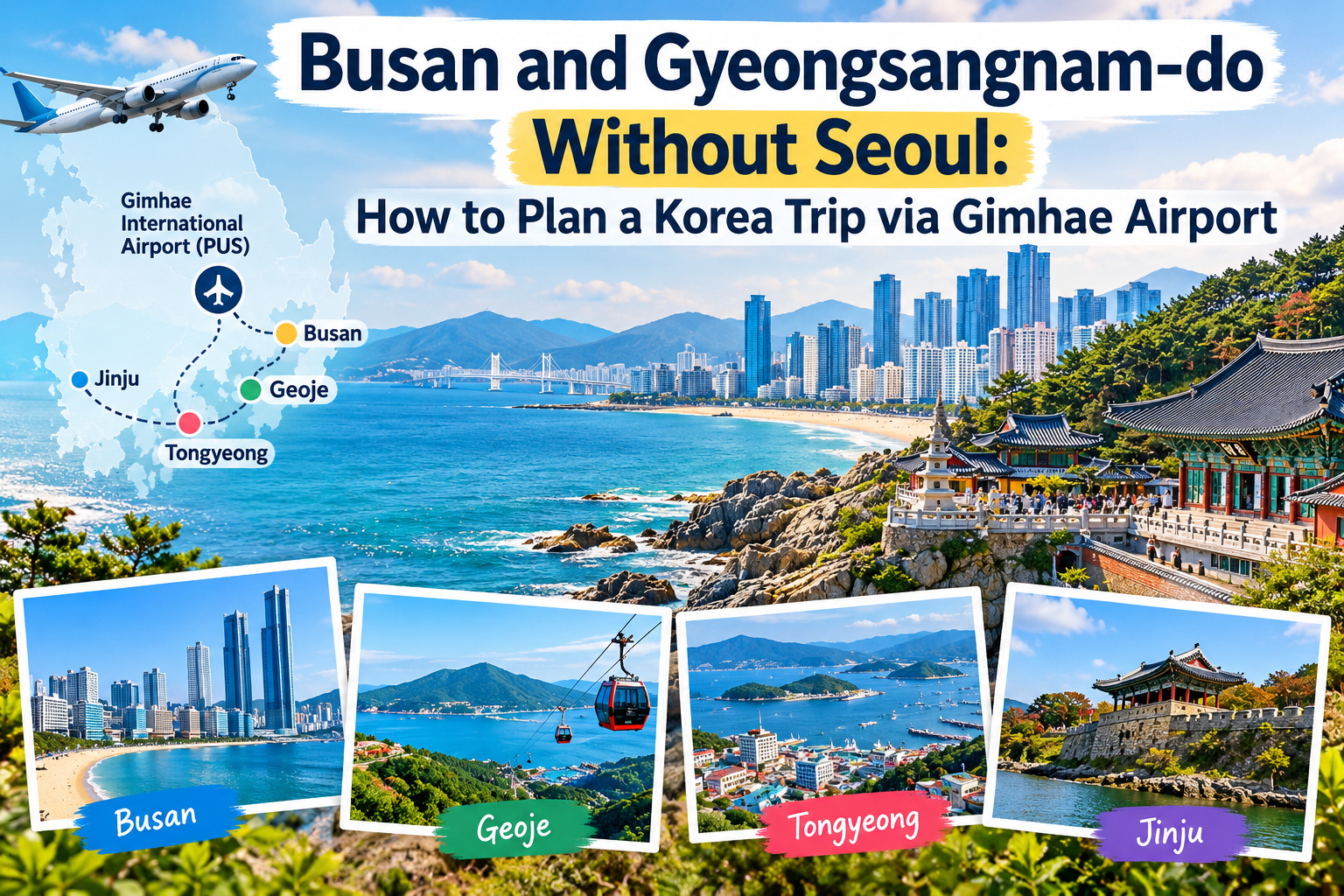
    You could spend a few days exploring Busan, continue to coastal cities such as Geoje and Tongyeong, visit historic Jinju, or travel farther into the southern part of Korea before returning to Gimhae Airport.

    Here is how to plan a Busan and Gyeongsangnam-do trip via Gimhae International Airport in 2026.

    Why Start Your Korea Trip at Gimhae Airport?

    Gimhae International Airport (PUS) is the main international gateway for Busan and southeastern Korea.

    For travelers whose main destinations are Busan and Gyeongsangnam-do, arriving here can be much more convenient than flying into Seoul and then traveling several hours south.

    This route makes particular sense if you want to focus on:

    • Busan
    • Geoje
    • Tongyeong
    • Jinju
    • other destinations in Gyeongsangnam-do

    It can also work well for travelers returning home through Gimhae Airport, allowing you to create a southern Korea itinerary without backtracking to Seoul.

    First Stop: Spend 2–4 Days in Busan

    For most international travelers, Busan is the easiest place to begin.

    After arriving at Gimhae Airport, head into the city and use Busan as your first base.

    Popular areas to stay include:

    Haeundae

    Choose Haeundae if beaches, ocean views, cafes and coastal attractions are your priorities.

    It works especially well for travelers who want to visit Haeundae Beach, Dongbaekseom, Cheongsapo and the eastern coastline.

    Seomyeon

    Seomyeon is a convenient choice if transportation and nightlife matter more than staying next to the beach.

    Its central location makes it relatively easy to travel to different parts of Busan.

    Busan Station

    Staying near Busan Station can be useful if you plan to continue your trip by train.

    It also gives you convenient access to areas such as Nampo, Jagalchi Market and the older downtown districts.

    If you need detailed transportation instructions after landing, see our Gimhae Airport to Busan guide for ways to reach Haeundae, Seomyeon and Busan Station.

    How Many Days Do You Need in Busan?

    For a southern Korea itinerary, I would generally allow at least two full days in Busan, with three or four days being more comfortable.

    A simple first visit could look like this:

    Day 1: Haeundae and the eastern coastline
    Day 2: Nampo, Jagalchi and Gamcheon
    Day 3: Additional coastal attractions, temples, markets or neighborhoods

    Instead of trying to see every famous attraction, group places geographically. Busan is a large city, and crossing from one side to the other can take longer than first-time visitors expect.

    Where Should You Go After Busan?

    This is where starting at Gimhae Airport becomes especially interesting.

    Rather than returning north toward Seoul, you can continue into Gyeongsangnam-do, the province surrounding much of Busan.

    Several destinations work particularly well.

    Option 1: Geoje

    Geoje is a good choice for travelers interested in dramatic coastal scenery and islands.

    The area is known for its coastline, viewpoints and access to nearby islands.

    Compared with Busan, Geoje feels less urban and gives your trip a more relaxed coastal character.

    It can work well as a one- or two-night stop after Busan.

    Who should choose Geoje?

    Geoje is especially suitable if you prefer:

    • coastal scenery
    • island landscapes
    • slower travel
    • scenic drives
    • nature rather than big-city attractions

    Travelers who want a Busan trip with a quieter second half may find Geoje particularly appealing.

    Option 2: Tongyeong

    Tongyeong is another strong addition to a southern Korea itinerary.

    It is a compact coastal city surrounded by islands and is known for harbor views, seafood and scenic landscapes.

    For travelers who enjoy smaller cities, Tongyeong provides a very different atmosphere from Busan.

    A typical itinerary might be:

    Busan → Geoje → Tongyeong

    or simply:

    Busan → Tongyeong

    if you have limited time.

    Tongyeong is worth considering for at least one night rather than treating it only as a rushed day trip.

    Option 3: Jinju

    If you want to add history rather than another coastal destination, consider Jinju.

    The city’s best-known historic landmark is Jinjuseong Fortress, which played an important role during the Japanese invasions of Korea in the late 16th century.

    Jinju provides a useful contrast to Busan, Geoje and Tongyeong because the focus shifts from beaches and coastal scenery toward history and local culture.

    It can therefore fit nicely into a longer southern itinerary.

    Busan + Gyeongsangnam-do: Sample 5-Day Itinerary

    If you only have five days, keep the route simple.

    Day 1 — Arrive at Gimhae Airport

    Travel into Busan, check into your hotel and explore the neighborhood around your accommodation.

    Avoid planning too much for arrival day, especially after a long international flight.

    Day 2 — Explore Busan

    Choose one side of the city rather than trying to cross Busan repeatedly.

    For example, spend the day around Haeundae and the eastern coastline.

    Day 3 — Explore More of Busan

    Visit the Nampo and Jagalchi area or another part of the city you missed on Day 2.

    Day 4 — Gyeongsangnam-do

    Travel to either Geoje, Tongyeong or Jinju.

    With only five days, choose one rather than trying to visit all three.

    Stay overnight if possible.

    Day 5 — Return Toward Gimhae Airport

    Travel back toward Busan or Gimhae Airport depending on your flight time.

    If you have an early international departure, returning to Busan the night before may make the final day less stressful.

    A Better 7-Day Southern Korea Itinerary

    Seven days gives you much more flexibility.

    One possible route is:

    Day 1: Arrive at Gimhae Airport → Busan
    Day 2: Busan
    Day 3: Busan
    Day 4: Busan → Geoje
    Day 5: Geoje → Tongyeong
    Day 6: Tongyeong → Busan
    Day 7: Busan → Gimhae Airport

    Another option is:

    Gimhae Airport → Busan → Tongyeong → Jinju → Busan → Gimhae Airport

    The better route depends on whether you prefer coastal scenery or history and city exploration.

    Do You Need a Rental Car?

    Not necessarily.

    Busan itself has an extensive public transportation network, so renting a car solely for sightseeing in Busan is usually unnecessary.

    Intercity buses also connect Busan with many cities in Gyeongsangnam-do.

    However, a rental car can become more useful once you leave Busan, particularly if you want to visit smaller coastal attractions or move between places that are inconvenient by public transportation.

    Public transportation is better if:

    • you mainly visit cities
    • you do not want to drive in Korea
    • your itinerary is Busan plus one or two major destinations
    • you are comfortable using intercity buses

    A rental car may be better if:

    • you want to explore rural or coastal areas
    • you have several countryside stops
    • you are traveling with family or significant luggage
    • flexibility matters more than minimizing costs

    International visitors planning to drive should check Korea’s current license and International Driving Permit requirements before their trip.

    Train or Bus for Gyeongsangnam-do?

    One important planning mistake is assuming that trains are always the easiest way to travel around Korea.

    South Korea has an excellent rail system, but intercity buses can be more practical for some destinations in Gyeongsangnam-do.

    The best option depends on the exact city.

    For destinations such as Tongyeong and Geoje, buses are often particularly useful because rail access is limited compared with major railway cities.

    Always compare the complete journey rather than simply choosing the fastest-looking train.

    Should You Visit Seoul on the Same Trip?

    You certainly can, but you do not have to.

    If this is your first trip to Korea and you have ten days or more, combining Seoul and Busan may still make sense.

    But travelers with only five to seven days sometimes spend too much of their vacation moving between cities.

    If beaches, seafood, coastal scenery and southern Korea are your priorities, a trip focused entirely on Busan and Gyeongsangnam-do can be a worthwhile alternative.

    This is particularly true if you can fly directly to Gimhae Airport.

    Who Is This Route Best For?

    A Gimhae-based itinerary works particularly well for:

    • travelers who have already visited Seoul
    • repeat visitors looking for a different side of Korea
    • travelers interested in Busan and the southern coast
    • visitors with direct flights to Gimhae Airport
    • people who prefer slower regional travel
    • travelers who want to combine a major city with smaller coastal destinations

    It may be less suitable if most of the attractions on your wish list are in Seoul, northern Korea or the Seoul metropolitan area.

    Practical Tips Before You Go

    Check your international flight options first

    Direct international routes to Gimhae Airport vary depending on your departure city and travel date.

    Check the actual flight schedule before building the rest of your itinerary.

    Do not underestimate Busan travel times

    Busan is geographically spread out.

    Two attractions that both appear to be “in Busan” can still require a substantial journey between them.

    Keep your final night flexible

    If you have an early flight from Gimhae Airport, consider spending your final night in Busan rather than traveling from a distant city on departure morning.

    Check bus schedules before changing cities

    Intercity transportation frequencies can vary by destination and day.

    Check current schedules close to your travel date rather than relying solely on an old itinerary online.

    Travel lighter if possible

    A regional trip involving buses and multiple hotels is much easier with manageable luggage.

    FAQ

    Can I travel to Korea without visiting Seoul?

    Absolutely. Seoul is not required for every Korea itinerary. Travelers focused on southern Korea can arrive through Gimhae International Airport and build a trip around Busan and Gyeongsangnam-do.

    Is Gimhae Airport actually in Busan?

    Gimhae International Airport serves Busan and the surrounding region and is located on the western side of Busan, despite the “Gimhae” name.

    How many days should I spend in Busan?

    For a first visit, around three days is a useful starting point. Two days can work for a short trip, while four or more allows for a slower itinerary.

    Can I visit Tongyeong from Busan?

    Yes. Busan and Tongyeong are connected by intercity transportation, making Tongyeong a practical addition to a southern Korea itinerary.

    Should I choose Geoje or Tongyeong?

    Choose Geoje if island scenery and exploring the coastline are your priority. Tongyeong may suit travelers who prefer a compact coastal city with harbor views, food and easy access to scenic attractions.

    Do I need a car to explore Gyeongsangnam-do?

    No. Major cities can be reached by public transportation. A car becomes more useful if you want to explore rural areas, remote viewpoints or multiple smaller attractions.

    Final Thoughts

    For international visitors, Korea does not have to mean Seoul first, everywhere else second.

    If your interests are concentrated in the south, Gimhae International Airport can become the starting point for an entirely different Korea itinerary.

    Begin with a few days in Busan, then continue into Gyeongsangnam-do for coastal scenery, smaller cities and regional experiences before returning to Gimhae Airport.

    For a short trip, keep it simple with Busan plus one additional destination.

    With a full week, a route such as Busan → Geoje → Tongyeong → Busan gives you a mix of big-city energy and Korea’s southern coastline without spending a large part of your vacation traveling to and from Seoul.
  • Seoul Welcome Week 2026: Free Tourist Pass, Events and Discounts for Foreign Visitors

    Seoul Welcome Week 2026: Free Tourist Pass, Events and Discounts for Foreign Visitors

    Seoul Welcome Week 2026 Is Here

    If you are visiting Seoul this fall, there is an extra reason to explore the city right now.

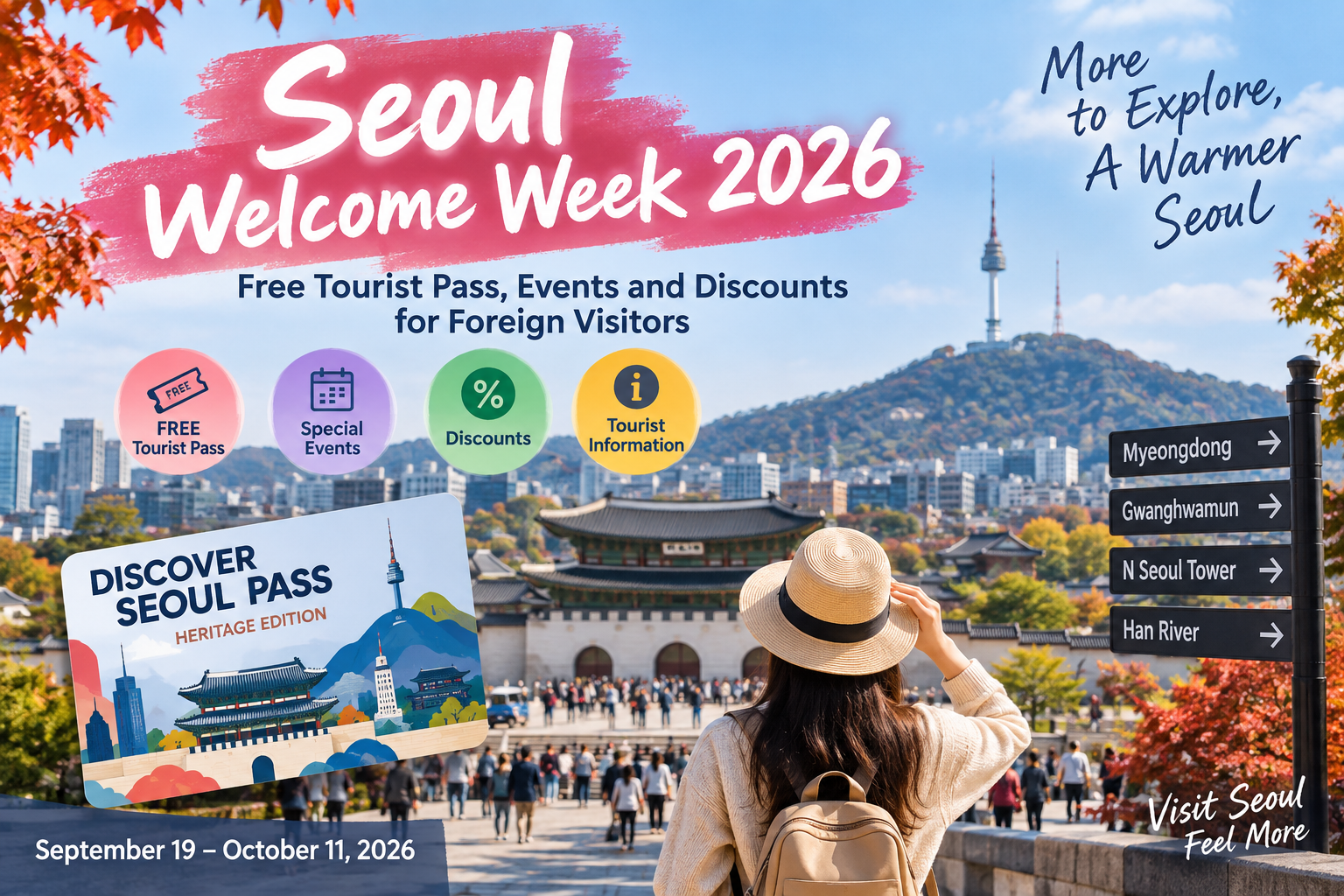
    Seoul Welcome Week 2026 runs from September 19 to October 11, 2026, with special programs and benefits designed for international visitors. The campaign overlaps with Korea’s Chuseok holiday period, making it especially useful for travelers who are worried about what will be open or what they can do during the holiday.

    Visitors can find special welcome programs, tourism information, discounts, and limited benefits at locations including airports and central Seoul.

    One of the most interesting benefits is a special edition of the Discover Seoul Pass, which can help travelers visit major attractions while spending less.

    In this guide, we will look at what Seoul Welcome Week offers, who can use the benefits, where to find them, and what international travelers should know before heading out.

    Seoul Welcome Week 2026 at a Glance

    Here are the key dates to know:

    • Dates: September 19–October 11, 2026
    • Location: Seoul, with programs at major visitor touchpoints including airports and Myeongdong
    • Who it is for: International visitors to Seoul
    • Main benefits: Tourist information, special events, attraction benefits, and selected discounts

    Some programs are available only during specific dates within the Welcome Week period, and limited-quantity benefits may run out early.

    Tip: Do not assume every benefit is available throughout the entire September 19–October 11 period. Check the dates and conditions for the specific program you want to use before making a special trip.

    Free Discover Seoul Pass for International Visitors

    One of the headline benefits of Seoul Welcome Week 2026 is a special Discover Seoul Pass Heritage Edition for international travelers.

    According to the Seoul Metropolitan Government, a limited number of passes are being provided to eligible foreign visitors through welcome events at Seoul’s major gateways.

    The Heritage Edition is designed around Seoul’s cultural heritage and gives travelers access to 12 major heritage attractions, along with discounts or benefits at more than 110 participating locations.

    Because the free passes are limited and distribution conditions can vary by location, travelers should not plan their entire itinerary around receiving one. Think of it as a valuable bonus if you are eligible and passes are still available.

    If you receive a pass, check its validity period and included attractions before activating or using it. This will help you get the most value from the pass rather than using it for an attraction you would have visited cheaply anyway.

    Visit the Myeongdong Welcome Center

    Travelers staying in central Seoul should also pay attention to the temporary Welcome Center in Myeongdong, one of the city’s busiest areas for international visitors.

    The Welcome Center is scheduled to operate from October 1 to October 8, 2026.

    Visitors can stop by for tourism information and special Welcome Week programs while exploring Myeongdong and nearby areas such as Namdaemun, Euljiro, Cheonggyecheon, and central Seoul.

    This can be particularly useful during the Chuseok period, when travelers may be unsure about holiday schedules or need help adjusting their plans.

    Look for Special Seoul Travel Discounts

    Welcome Week is not limited to information booths and events.

    Selected tourism experiences are also offering visitor benefits during the campaign. One highlighted example is a 20% discount on selected Han River cruise experiences.

    If a Han River cruise is already on your Seoul itinerary, it is worth checking the current Welcome Week conditions before booking.

    However, discounts can have specific dates, reservation requirements, or eligibility rules. Always confirm the current terms with the participating operator before paying.

    How to Make the Most of Seoul Welcome Week

    The easiest way to use Seoul Welcome Week is to combine its benefits with places you already plan to visit.

    For example, if you are staying in Myeongdong, visiting the Welcome Center can fit naturally into a day exploring central Seoul. If you are planning a Han River cruise, check whether the Welcome Week discount applies to your preferred date and booking.

    Travelers arriving during the campaign period should also pay attention to welcome programs at the airport before leaving the arrivals area.

    A simple strategy is:

    1. Check which Welcome Week benefits are available on your travel dates.
    2. See whether any of them match attractions already on your itinerary.
    3. Confirm eligibility, operating dates, and reservation requirements.
    4. Use limited benefits only when they actually save you money or improve your trip.

    This is better than changing an entire Seoul itinerary simply to chase a free pass or discount.

    Visiting Seoul During Chuseok 2026

    Seoul Welcome Week overlaps with Chuseok, one of Korea’s most important holidays.

    For travelers, this does not mean Seoul shuts down completely. Major tourist areas, cultural attractions, shopping districts, and events can still give visitors plenty to do.

    However, opening hours may change, and individual restaurants, cafes, shops, museums, or attractions may operate on special holiday schedules.

    Before visiting a specific place during the holiday period, check its official operating information rather than relying only on normal opening hours shown in older travel guides.

    Transportation can also be busier around Chuseok as many people travel between Seoul and other parts of Korea. This is especially important if your trip includes KTX or other intercity transportation.

    Good Areas to Combine With Welcome Week Activities

    If you visit the Myeongdong Welcome Center, you can easily combine it with several nearby areas.

    Myeongdong is convenient for shopping, food, beauty stores, and first-time visitors.

    Namdaemun Market is within easy reach and offers a very different traditional market atmosphere.

    Cheonggyecheon Stream is a good option for an easy walk through central Seoul.

    Gwanghwamun and the palace area are also nearby and work well for travelers interested in Seoul’s history and cultural heritage.

    Instead of treating Welcome Week as a separate event, use it as an extra layer of benefits while following the Seoul itinerary you already wanted to experience.

    FAQ About Seoul Welcome Week 2026

    When is Seoul Welcome Week 2026?

    Seoul Welcome Week runs from September 19 to October 11, 2026. Individual programs may operate for shorter periods, so check the dates for each benefit before visiting.

    Is Seoul Welcome Week only for foreign tourists?

    Many of the special welcome programs and benefits are designed specifically for international visitors. Eligibility can vary by program, so bring your passport or other identification if a benefit requires proof of international visitor status.

    Is the Discover Seoul Pass really free?

    A limited number of special Discover Seoul Pass Heritage Edition passes are being offered to eligible international visitors through Welcome Week programs. Because quantities are limited, receiving one is not guaranteed.

    What does the Discover Seoul Pass Heritage Edition include?

    The special pass provides access to 12 major heritage attractions and benefits or discounts at more than 110 participating locations, according to the Seoul Metropolitan Government.

    Always check the current list of included attractions and usage conditions before planning around the pass.

    Where is the Seoul Welcome Center in Myeongdong?

    A temporary Welcome Center is scheduled to operate in the Myeongdong area from October 1 to October 8, 2026. Check Seoul’s official tourism information for the latest location and operating details before visiting.

    Is Seoul worth visiting during Chuseok?

    Yes. Seoul can still offer plenty to do during Chuseok, particularly in major tourist and cultural areas. The main difference is that some businesses and attractions may have special holiday hours.

    Check individual opening schedules in advance, especially for restaurants, smaller businesses, and specific attractions you do not want to miss.

    Final Thoughts

    Seoul Welcome Week 2026 gives international visitors a useful opportunity to get more from a fall trip to the Korean capital.

    The most valuable benefits are not necessarily the ones that sound the biggest. A free attraction pass can save money, a discount can make an activity more affordable, and a Welcome Center can be useful when holiday schedules make travel planning confusing.

    The key is to check what is available on your actual travel dates and combine those benefits with the Seoul itinerary you already have.

    If you are visiting during Chuseok, plan important transportation and must-see attractions in advance, but do not assume the holiday means there will be nothing to do. Seoul continues to offer cultural experiences, events, shopping, food, and sightseeing opportunities throughout the season.

    With a little preparation, Seoul Welcome Week can make an already exciting fall trip to Korea even better.

  • Seongsu-dong Seoul Travel Guide 2026: Cafes, K-Beauty, Shopping, Pop-Ups and Seoul Forest

    Seongsu-dong Seoul Travel Guide 2026: Cafes, K-Beauty, Shopping, Pop-Ups and Seoul Forest

    Introduction

    Seoul is famous for palaces, traditional markets, K-pop, and late-night shopping, but one neighborhood has become especially popular with travelers looking for a more contemporary side of the city: Seongsu-dong.

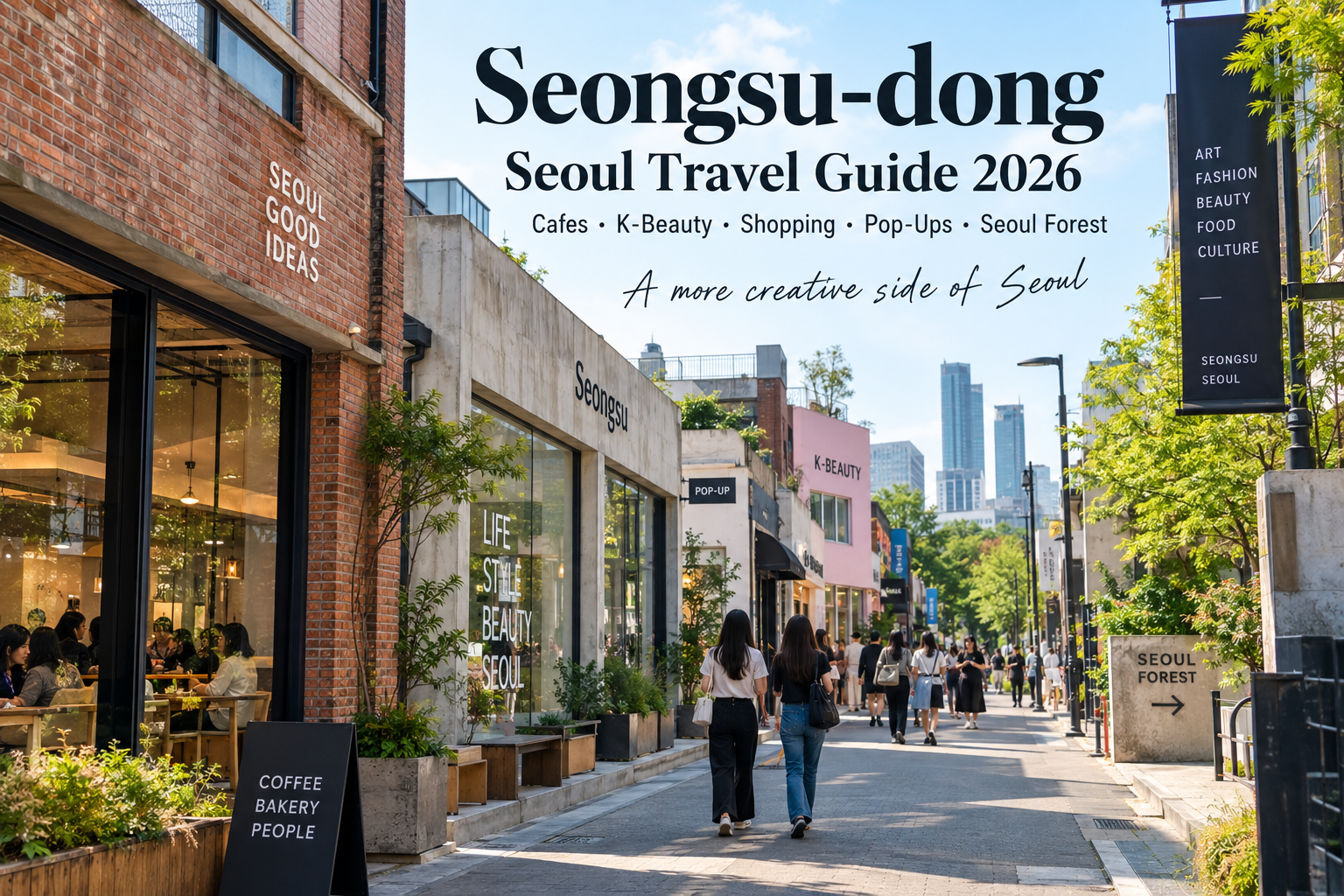
    Once known for warehouses, factories, and handmade shoe workshops, Seongsu has evolved into one of Seoul’s most creative neighborhoods. Old industrial buildings now house specialty coffee shops, fashion boutiques, art spaces, K-beauty stores, restaurants, and constantly changing pop-up shops.

    What makes Seongsu particularly interesting is that it offers more than shopping. You can spend the morning exploring cafes and local streets, discover Korean beauty and fashion brands in the afternoon, and then walk to Seoul Forest for a relaxing break from the city.

    For international visitors—especially travelers returning to Seoul after already seeing major attractions such as Gyeongbokgung Palace, Myeongdong, and N Seoul Tower—Seongsu offers a different way to experience everyday Seoul.

    In this Seongsu-dong Seoul travel guide for 2026, you’ll learn what to see, where to explore, how to get there, when to visit, and how to combine Seongsu’s cafes, K-beauty, shopping, pop-ups, and Seoul Forest into an easy half-day or full-day itinerary.

    Why Is Seongsu-dong So Popular?

    Seongsu-dong is often described as one of Seoul’s most creative neighborhoods because it combines the area’s industrial past with Korea’s fast-moving fashion, beauty, cafe, and pop-up culture.

    Instead of replacing every old building with something new, many businesses have transformed former factories and warehouses into stylish cafes, showrooms, galleries, restaurants, and retail spaces. The contrast between exposed brick buildings and modern Korean brands gives Seongsu a distinctive atmosphere that feels different from more traditional shopping districts.

    Cafes and Industrial Spaces

    Seongsu is especially famous for its cafe culture. Large warehouse-style cafes, small specialty coffee shops, bakeries, and dessert cafes are scattered throughout the neighborhood.

    Rather than visiting Seongsu for one specific attraction, many travelers simply walk through the streets, stop at a cafe that catches their attention, and continue exploring.

    Pop-Up Stores and Korean Brands

    Pop-up stores are another major reason people visit Seongsu. Korean fashion, beauty, food, entertainment, and lifestyle brands frequently use the neighborhood for temporary exhibitions, product launches, and interactive experiences.

    Because pop-ups change regularly, the neighborhood can feel different each time you visit.

    K-Beauty and Shopping

    Seongsu has also developed into an important destination for travelers interested in K-beauty and Korean fashion. Flagship stores and brand experience spaces allow visitors to explore products in a more immersive setting than a conventional shopping mall.

    Seoul Forest

    One of Seongsu’s biggest advantages is its proximity to Seoul Forest, one of the city’s most popular urban green spaces.

    After spending several hours exploring busy shopping streets and cafes, visitors can walk toward the park and enjoy a quieter side of Seoul.

    This combination of cafes, shopping, K-beauty, pop-ups, creative spaces, and nature is what makes Seongsu particularly appealing to travelers who want to experience contemporary Seoul beyond the city’s traditional sightseeing route.

    How to Get to Seongsu-dong

    Seongsu is easy to reach by Seoul’s subway system, but there are two useful stations depending on which part of the neighborhood you want to explore.

    Seongsu Station

    Seongsu Station (Line 2) is usually the most convenient starting point if your main goal is to explore Seongsu’s cafes, shops, pop-up stores, restaurants, and creative spaces.

    After leaving the station, you can explore the neighborhood on foot. Many of Seongsu’s popular streets and businesses are spread across several blocks, so comfortable walking shoes are recommended.

    Seoul Forest Station

    Seoul Forest Station (Suin-Bundang Line) is more convenient if you want to begin your visit near Seoul Forest and then walk toward the main Seongsu shopping and cafe areas.

    This can be a good option for travelers who want to combine nature, shopping, and cafes in one route.

    Which Station Should You Use?

    A simple rule is:

    • Start at Seongsu Station if cafes, shopping, K-beauty, and pop-ups are your priorities.
    • Start at Seoul Forest Station if Seoul Forest is your first destination.

    For a half-day or full-day trip, you do not necessarily need to return to the station where you started. One convenient strategy is to enter the neighborhood through one station, explore Seongsu on foot, and leave through the other.

    Getting There From Popular Areas of Seoul

    From neighborhoods such as Myeongdong, Hongdae, or Gangnam, the subway is generally the easiest option. Depending on where you start, you may need to transfer lines.

    Instead of relying on a fixed travel time, check your route shortly before leaving because transfer combinations and travel times vary by starting location.

    For navigation in Korea, travelers may also find Korean map apps useful when locating individual cafes, stores, and pop-up venues.

    Best Things to Do in Seongsu-dong

    Seongsu is best explored on foot rather than by rushing from one famous attraction to another. Part of the experience is discovering new stores, cafes, and pop-ups as you walk through the neighborhood.

    Here are some of the best ways to experience Seongsu in 2026.

    1. Explore Seongsu’s Cafe Streets

    Cafe hopping is one of the most popular things to do in Seongsu.

    The neighborhood is known for transforming former factories, warehouses, and industrial buildings into distinctive coffee shops and bakeries. Some are large destination cafes, while others are smaller specialty coffee shops hidden along side streets.

    Instead of planning every cafe in advance, consider choosing one or two places that interest you and leaving time to discover others while walking.

    Weekends and afternoons can be particularly busy, so visiting earlier in the day can provide a more relaxed experience.

    2. Discover the Latest Pop-Up Stores

    Seongsu has become one of Seoul’s best-known neighborhoods for pop-up stores and temporary brand experiences.

    Beauty companies, fashion labels, food brands, entertainment companies, and lifestyle brands regularly open short-term spaces where visitors can see new products, take photos, participate in events, or receive samples.

    The important thing to remember is that Seongsu pop-ups change constantly. A store mentioned in an older travel guide may already be closed by the time you arrive.

    For that reason, check current pop-up information shortly before your visit rather than building your itinerary around an old list.

    3. Explore K-Beauty Flagship Stores

    If you are interested in Korean skincare and cosmetics, Seongsu is becoming much more than a cafe neighborhood.

    Beauty brands increasingly use Seongsu for flagship stores and experience-focused spaces where visitors can test products, discover new releases, and experience the brand beyond a traditional cosmetics counter.

    One of the neighborhood’s major beauty destinations is Olive Young N Seongsu, a large beauty-focused space designed around products, trends, and brand experiences.

    Even travelers who already plan to shop for K-beauty in Myeongdong may find Seongsu worthwhile because the experience here is often more focused on discovering brands and trends rather than simply purchasing products.

    4. Shop Korean Fashion and Lifestyle Brands

    Seongsu is one of the best neighborhoods in Seoul for discovering contemporary Korean fashion and lifestyle brands.

    Rather than concentrating everything inside a large department store, Seongsu is filled with flagship stores, showrooms, concept shops, and smaller boutiques spread throughout the neighborhood. This makes shopping feel like part of exploring the area itself.

    You may find Korean clothing, shoes, accessories, fragrances, home goods, stationery, and design products that are less visible in Seoul’s traditional tourist shopping districts.

    New stores also open frequently, so it is worth leaving some flexibility in your itinerary rather than planning every stop in advance.

    5. Take a Break at Seoul Forest

    After exploring Seongsu’s busy streets, Seoul Forest provides a completely different atmosphere.

    The large urban park includes walking paths, lawns, trees, gardens, and spaces where visitors can slow down and take a break from shopping and cafe hopping.

    Spring and autumn are particularly pleasant seasons for walking, but the park can be enjoyed throughout much of the year.

    Combining Seongsu with Seoul Forest also makes the neighborhood suitable for travelers who do not want to spend an entire day shopping.

    A convenient itinerary is to explore Seongsu’s cafes and shops first and then finish the afternoon with a walk through Seoul Forest.

    6. Walk Through Seongsu’s Industrial Streets

    Do not limit your visit to the newest flagship stores.

    Part of Seongsu’s character comes from the contrast between its industrial history and its modern transformation. Older workshops, brick buildings, warehouses, small factories, and narrow streets still exist alongside fashionable cafes and contemporary retail spaces.

    Walking between these different areas helps explain why Seongsu feels different from purpose-built shopping districts.

    For photographers and travelers interested in urban neighborhoods, simply exploring the streets can be one of the most memorable parts of visiting Seongsu.

    Where to Eat and Drink in Seongsu

    Seongsu’s food scene is almost as varied as its shopping. Alongside its famous cafes, the neighborhood has Korean restaurants, bakeries, casual dining spots, dessert shops, and restaurants serving international cuisine.

    Coffee and Desserts

    Cafe hopping is part of the Seongsu experience, but you do not need to visit every famous cafe you see on social media.

    Choose a cafe based on what matters most to you—specialty coffee, baked goods, unusual architecture, outdoor seating, or simply a convenient break during your walk.

    Because popular cafes can become crowded on weekends, having one or two backup options nearby can save time.

    Korean Food

    If you want a proper meal between shopping stops, explore the streets beyond the busiest cafe areas. You can find Korean dishes ranging from casual everyday meals to more contemporary interpretations of Korean cuisine.

    Looking a few streets away from the most crowded shopping areas can also lead to a quieter dining experience.

    Bakeries and Quick Snacks

    Seongsu is also a good neighborhood for travelers who prefer to eat smaller meals throughout the day. Bakeries, dessert shops, and takeaway snacks make it easy to combine eating with sightseeing rather than planning a long restaurant stop.

    Half-Day Seongsu Itinerary

    If you have around four to five hours, try this route:

    Seongsu Station → Cafe → Pop-Up Stores → K-Beauty & Shopping → Lunch or Snack → Seoul Forest

    Start at Seongsu Station and explore the cafe and shopping streets while your energy is high. Check any current pop-ups you want to visit, browse Korean beauty and fashion stores, and then gradually walk toward Seoul Forest.

    Finish with a relaxed walk through the park and leave from Seoul Forest Station.

    Full-Day Seongsu Itinerary

    With a full day, you can explore at a slower pace:

    Morning: Arrive at Seongsu Station and have coffee or brunch.

    Late Morning: Explore industrial streets, boutiques, and Korean fashion stores.

    Afternoon: Visit K-beauty spaces and current pop-ups, followed by lunch and another cafe.

    Late Afternoon: Walk toward Seoul Forest and spend time exploring the park.

    Evening: Return toward Seongsu for dinner or continue to another nearby Seoul neighborhood.

    A full day works particularly well for travelers interested in shopping, photography, cafes, Korean brands, and contemporary Seoul culture.

    Best Time to Visit Seongsu

    Seongsu can be visited throughout the year, but the experience changes depending on the day and time.

    Weekdays vs. Weekends

    If your schedule allows, a weekday visit is usually more comfortable. Popular cafes, flagship stores, and pop-up spaces can become crowded on weekends, particularly in the afternoon.

    For travelers visiting on Saturday or Sunday, arriving earlier in the day can make it easier to explore before the busiest period.

    Spring and Autumn

    Spring and autumn are especially pleasant if you plan to combine Seongsu with Seoul Forest. Mild temperatures make walking between the neighborhood’s shops, cafes, and the park more enjoyable.

    Summer can be hot and humid, while winter temperatures can make long outdoor walks less comfortable. Fortunately, Seongsu has plenty of indoor cafes and shops where you can take breaks.

    Practical Tips for International Travelers

    Check Pop-Ups Shortly Before Your Visit

    Pop-up stores are temporary by nature. Do not rely entirely on a travel article or social media post published months earlier.

    Search for current Seongsu pop-ups shortly before your visit and confirm dates and operating hours.

    Save Places on Your Map

    Seongsu is spread across many streets rather than concentrated inside one shopping complex. Save the places you most want to visit before arriving, but leave room for spontaneous discoveries.

    Wear Comfortable Shoes

    Expect to walk considerably more than you might think. Cafes, shops, pop-ups, and Seoul Forest are spread across the neighborhood, so comfortable shoes will make the day much easier.

    Carry a Payment Backup

    Cards are widely accepted in Seoul, but carrying more than one payment option can be useful when traveling. A small amount of Korean won can also be helpful for occasional situations where cash is more convenient.

    Check Tax Refund Eligibility

    International visitors shopping for Korean beauty, fashion, and other products may encounter stores participating in Korea’s tax-refund system. Eligibility and procedures can vary, so look for tax-refund information at the store and keep your passport available when required.

    Do Not Overplan

    Seongsu changes quickly. New stores appear, pop-ups rotate, and unexpected places are often part of the experience.

    Plan a few priority stops, but leave enough time simply to walk around and see what you find.

    Frequently Asked Questions About Seongsu-dong

    Is Seongsu-dong worth visiting?

    Yes, especially if you are interested in contemporary Seoul culture. Seongsu combines cafes, Korean fashion and beauty brands, pop-up stores, creative spaces, industrial architecture, and Seoul Forest in one walkable area.

    It can be particularly interesting for repeat visitors who have already explored Seoul’s major historical attractions.

    How much time do you need in Seongsu?

    Allow at least four to five hours if you want to visit cafes, browse shops, explore pop-ups, and walk through Seoul Forest without rushing.

    Travelers interested in shopping, photography, K-beauty, and cafe hopping can easily spend most of a day in the neighborhood.

    Is Seongsu better on weekdays or weekends?

    Weekdays are generally more comfortable for travelers who want to avoid the largest crowds. Weekends can be lively, but popular cafes, stores, and pop-ups may have longer waits.

    What is Seongsu famous for?

    Seongsu is best known for its warehouse-style cafes, Korean fashion and lifestyle brands, K-beauty stores, temporary pop-ups, creative spaces, and its proximity to Seoul Forest.

    Is Seongsu good for K-beauty shopping?

    Yes. Seongsu has become an increasingly important destination for Korean beauty brands, flagship stores, and brand experience spaces. It offers a different experience from traditional cosmetics shopping areas such as Myeongdong.

    Should I use Seongsu Station or Seoul Forest Station?

    Use Seongsu Station on Line 2 if you want to begin with cafes, shopping, and pop-ups. Seoul Forest Station on the Suin-Bundang Line is convenient if you want to start near the park.

    A good strategy is to enter through one station and leave through the other.

    Can I visit Seongsu and Seoul Forest on the same day?

    Absolutely. They are close enough to combine naturally, which is one reason Seongsu works so well as a half-day or full-day Seoul itinerary.

    Final Thoughts

    Seongsu represents a side of Seoul that is constantly changing.

    Its appeal does not come from one famous landmark. Instead, it comes from the combination of old industrial streets, creative cafes, Korean fashion and beauty brands, temporary pop-ups, restaurants, and the greenery of Seoul Forest.

    For first-time visitors, Seongsu can add contemporary Korean culture to a traditional Seoul itinerary. For repeat visitors, it offers a reason to explore beyond the city’s most familiar tourist districts.

    Most importantly, do not try to schedule every minute. Choose a few places you genuinely want to visit, check the latest pop-ups before you go, and leave time to explore.

    Seongsu is one of those Seoul neighborhoods where discovering something you did not plan can become the best part of the day.

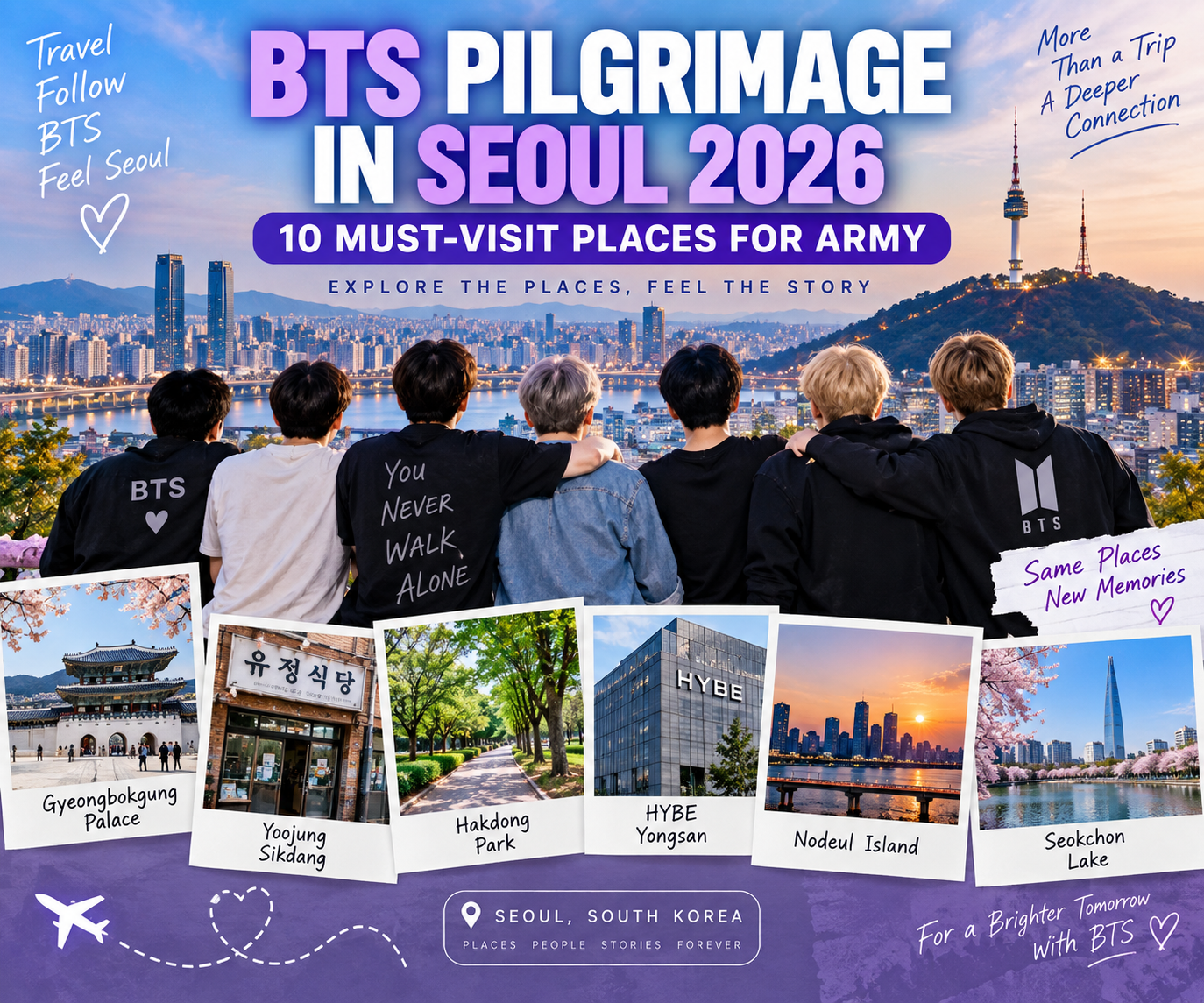
  • BTS Pilgrimage in Seoul 2026: 10 Must-Visit Places Every ARMY Should See

    BTS Pilgrimage in Seoul 2026: 10 Must-Visit Places Every ARMY Should See

    Introduction

    For ARMY visiting South Korea, Seoul is more than palaces, shopping streets, and famous cafés. Hidden throughout the city are places connected to BTS’s journey — from the neighborhood where the members spent their early years to locations that appeared in performances, videos, and memorable moments in BTS history.

    Some of these places are closely associated with BTS before they became global superstars. Others allow fans to experience locations they may recognize from BTS content while also discovering Seoul itself.

    This guide introduces 10 BTS-related places in Seoul that ARMY can add to a Korea itinerary in 2026, with practical travel tips and ideas for combining the stops into an enjoyable day of sightseeing.

    Rather than simply checking places off a list, think of this as a journey through different chapters of the BTS story — while experiencing the neighborhoods, food, culture, and everyday atmosphere of Seoul along the way.

    1. Yoojung Sikdang — A Restaurant from BTS’s Trainee Days

    For many longtime ARMY, Yoojung Sikdang (유정식당) is one of the most meaningful BTS-related stops in Seoul.

    Located in the Nonhyeon area of Gangnam, the restaurant became known among fans because BTS members ate there during their trainee and early debut years, when their practice space was nearby.

    Today, the restaurant attracts BTS fans from around the world. Inside, visitors can find BTS-related decorations and memorabilia while enjoying a Korean meal.

    Rather than visiting only for a photograph, consider eating here and exploring the surrounding neighborhood. It gives fans a glimpse into the part of Seoul connected to BTS long before stadium tours and worldwide fame.

    Travel tip: Combine Yoojung Sikdang with Hakdong Park and the area around BTS’s former BigHit building. These locations are close enough to make them part of the same ARMY walking route.

    2. Hakdong Park — A Place Connected to BTS’s Early Years

    Hakdong Park (학동공원) is another meaningful stop for fans interested in BTS’s pre-debut and early-career years.

    Located near the group’s former practice area in Nonhyeon-dong, the park has become associated with stories and memories from the period when the members were still trainees and young artists working toward their debut.

    Unlike a major tourist attraction, Hakdong Park is an ordinary neighborhood park. That is part of its appeal. Visiting gives ARMY a chance to experience the everyday surroundings connected with BTS’s beginnings rather than only the polished landmarks associated with their later global success.

    Because it is close to Yoojung Sikdang and BTS’s former BigHit neighborhood, the three stops work especially well as one walking itinerary.

    Travel tip: Be considerate of local residents when visiting. Hakdong Park is a public neighborhood space, so keep noise low and avoid blocking paths while taking photos.

    3. BTS’s Former BigHit Building — Where the Early Story Took Shape

    Before HYBE became a major entertainment company with its headquarters in Yongsan, BTS spent an important part of their early career around BigHit Entertainment’s former offices and practice spaces in Gangnam.

    For longtime ARMY, the area is meaningful because it represents the years when BTS was still building its career, practicing, recording, and gradually growing from a newly debuted group into an international phenomenon.

    The building is not an official BTS tourist attraction, and visitors should remember that it is private property. The best way to experience this stop is to view the exterior respectfully and then continue exploring the surrounding neighborhood.

    Together with Yoojung Sikdang and Hakdong Park, this area creates one of the most interesting walking routes for fans who want to understand BTS’s beginnings in Seoul.

    Travel tip: Do not enter private property or disturb people using nearby buildings. A quick exterior visit is enough before continuing your BTS walking tour.

    4. HYBE Headquarters in Yongsan — BTS’s Present-Day Home Base

    BTS’s story eventually moved from the small offices of BigHit Entertainment to HYBE’s headquarters in Yongsan, reflecting just how dramatically the group and its company grew.

    The modern HYBE building is located in Yongsan, one of Seoul’s most accessible central districts. For ARMY, seeing the building from outside can be an interesting contrast to the former BigHit locations in Gangnam — from BTS’s humble beginnings to the global scale of their career today.

    However, visitors should know that HYBE headquarters is an office building, not a general BTS tourist attraction, and access to working areas is restricted. Fans should respect the property and avoid waiting around entrances or interfering with employees.

    Also, the former HYBE INSIGHT museum at the headquarters is no longer operating, so travelers should not plan a visit expecting to enter a BTS museum there.

    Travel tip: Combine an exterior stop at HYBE with other attractions around Yongsan rather than making the building your only destination.

    5. Gyeongbokgung Palace — BTS’s Iconic Seoul Performance Location

    Gyeongbokgung Palace is one of Seoul’s most famous historical attractions, but for ARMY it also holds a special connection to BTS.

    In 2020, BTS filmed performances at Gyeongbokgung for The Tonight Show Starring Jimmy Fallon. The spectacular setting brought together K-pop and traditional Korean architecture, introducing millions of international viewers to one of Korea’s most important royal palaces.

    This makes Gyeongbokgung especially valuable for BTS fans visiting Seoul: it is not only a filming location but also a major cultural attraction worth exploring on its own.

    Allow enough time to walk through the palace grounds rather than visiting only for a BTS-related photo. Nearby attractions such as Bukchon, Insadong, and Gwanghwamun can also be combined into the same day.

    Travel tip: Check the palace’s current opening hours and closing days before visiting, as schedules can vary by season.

    6. Nodeul Island — A Scenic BTS Filming Location on the Han River

    Nodeul Island (노들섬) sits in the middle of the Han River and offers a very different atmosphere from Seoul’s busy shopping and entertainment districts.

    For ARMY, the island is especially recognizable as a filming location connected to BTS’s 2021 Season’s Greetings. Its open spaces and Han River scenery have made it a popular stop for fans who enjoy visiting places seen in BTS content.

    Nodeul Island is also worth visiting even without the BTS connection. Travelers can walk along the river, relax outdoors, take photographs, and enjoy views of Seoul from a quieter setting.

    Travel tip: Visit in the late afternoon and stay toward sunset for beautiful Han River views. It can easily be combined with other Yongsan-area stops on your BTS itinerary.

    7. Seokchon Lake — A BTS-Connected Stop in Jamsil

    Seokchon Lake (석촌호수) in Jamsil is another Seoul destination that has appeared in BTS-related content and is a pleasant place to include in an ARMY itinerary.

    Surrounded by walking paths and city views, the lake is particularly popular during spring cherry blossom season. It also sits beside Lotte World and close to Lotte World Tower, making this stop easy to combine with a full day in Jamsil.

    For international visitors, this is a good example of how a BTS-themed trip can lead to discovering other parts of Seoul. Rather than traveling across the city only to recreate a photo, spend some time walking around the lake, exploring Jamsil, or visiting nearby attractions.

    Travel tip: If you visit during cherry blossom season, expect large crowds. Early morning is usually more comfortable for walking and photography.

    8. Seoul Forest — Walk Through a Place Loved by BTS Fans

    Seoul Forest (서울숲) is one of Seoul’s most relaxing green spaces and has also become a familiar destination for ARMY.

    Over the years, fans have created BTS-related commemorative spaces and adopted trees in and around the park to celebrate members’ birthdays and other special occasions. These fan-supported spots have helped turn parts of Seoul Forest into places where ARMY can experience the fan culture surrounding BTS.

    The park itself is worth exploring beyond its BTS connection. With walking paths, gardens, open lawns, and cafés in the nearby Seongsu neighborhood, it is an easy place to spend several hours.

    Travel tip: Combine Seoul Forest with Seongsu-dong, one of Seoul’s popular café and shopping neighborhoods. This turns a BTS-related stop into a fuller half-day Seoul itinerary.

    9. Yeouido Hangang Park — A Place Connected to BTS and Seoul’s Han River

    Yeouido Hangang Park (여의도한강공원) is one of Seoul’s most popular riverside destinations and has a special connection to BTS history.

    The Yeouido area has hosted major BTS-related events, including celebrations connected to BTS FESTA, when large numbers of ARMY gathered along the Han River to celebrate the group’s anniversary.

    Even when there is no BTS event taking place, the park offers international visitors a classic Seoul experience. You can walk or cycle beside the river, enjoy Korean convenience-store food, have a picnic, and watch the city lights after sunset.

    For ARMY, it is a good place to experience both BTS fan culture and the everyday Han River lifestyle that is such an important part of Seoul.

    Travel tip: Visit in the evening and combine the stop with a Han River picnic. During major events or festivals, check official announcements in advance because access and transportation arrangements may change.

    10. Seoul Olympic Stadium — A Landmark in BTS Concert History

    Seoul Olympic Stadium (서울올림픽주경기장) in Jamsil holds an important place in BTS history as the setting for some of the group’s major concerts in South Korea.

    For ARMY, the stadium represents a very different chapter from the small restaurants, parks, and practice spaces associated with BTS’s early years. Performing at a massive stadium in Seoul became a powerful symbol of how far the group had come.

    The stadium area has undergone major redevelopment, so travelers should check current access and construction conditions before visiting rather than expecting the same appearance seen in older BTS concert footage.

    Even when access to the stadium itself is limited, Jamsil is easy to combine with other attractions, including Seokchon Lake, Lotte World Tower, shopping, restaurants, and cafés.

    Travel tip: Do not make a special trip solely to enter the stadium. Check its current status first and combine the area with your Jamsil itinerary.

    How to Plan Your BTS Pilgrimage in Seoul

    Trying to visit all 10 locations in a single day would mean spending too much time traveling across Seoul. A better option is to group the destinations by neighborhood.

    For fans interested in BTS’s early history, start with Yoojung Sikdang, Hakdong Park, and the former BigHit area in Gangnam. These locations work naturally as one walking route.

    On another part of your trip, explore HYBE’s Yongsan area and Nodeul Island, followed by an evening along the Han River.

    Gyeongbokgung Palace deserves several hours because it is also one of Seoul’s most important historical attractions. Likewise, Seoul Forest and Seongsu work well together for a relaxed half-day of parks, cafés, shopping, and BTS fan culture.

    Finally, Seokchon Lake and the Jamsil area can be combined into another itinerary.

    The best BTS pilgrimage is not about rushing between photo spots. Give yourself time to experience the Seoul neighborhoods that became part of the BTS story.

    Frequently Asked Questions About BTS Places in Seoul

    Where can BTS fans go in Seoul?
    Popular BTS-related stops include Yoojung Sikdang, Hakdong Park, the former BigHit area, HYBE’s Yongsan headquarters area, Gyeongbokgung Palace, Nodeul Island, Seoul Forest, and several Han River locations.

    Can fans enter the HYBE headquarters?
    HYBE headquarters is primarily an office building, not a general BTS tourist attraction. Visitors should not expect access to working areas and should respect the building, employees, and surrounding property.

    Is the old BigHit building open to tourists?
    No. The former BigHit location should be treated as private property. Fans can respectfully see the area from outside without entering or disturbing occupants.

    Can I visit BTS places in Seoul in one day?
    It is possible to see several locations in one day, but the sites are spread across Seoul. For a more enjoyable trip, divide them into neighborhood-based routes over two or more days.

    What is the best area for BTS fans visiting Seoul for the first time?
    Fans especially interested in BTS’s early history may want to start around Nonhyeon-dong with Yoojung Sikdang, Hakdong Park, and the former BigHit area.

    Are there BTS places outside Seoul?
    Yes. BTS-related filming and photo locations can be found in several other parts of South Korea. One of the most famous is the BTS Bus Stop at Jumunjin Beach in Gangneung.

    Final Thoughts

    A BTS pilgrimage in Seoul is more than a tour of places connected to a famous K-pop group. It is also a journey through different parts of the city and different chapters of BTS’s history.

    From the modest streets around Yoojung Sikdang and Hakdong Park to Gyeongbokgung Palace, the Han River, and the neighborhoods associated with BTS today, each stop offers ARMY a different perspective on the group’s journey.

    Most importantly, take time to enjoy Seoul itself. Eat Korean food, explore the neighborhoods, visit cafés, walk along the Han River, and experience the culture surrounding these locations.

    And Seoul is only the beginning. Beyond the capital, destinations such as Gangneung’s famous BTS Bus Stop give ARMY even more reasons to explore South Korea.

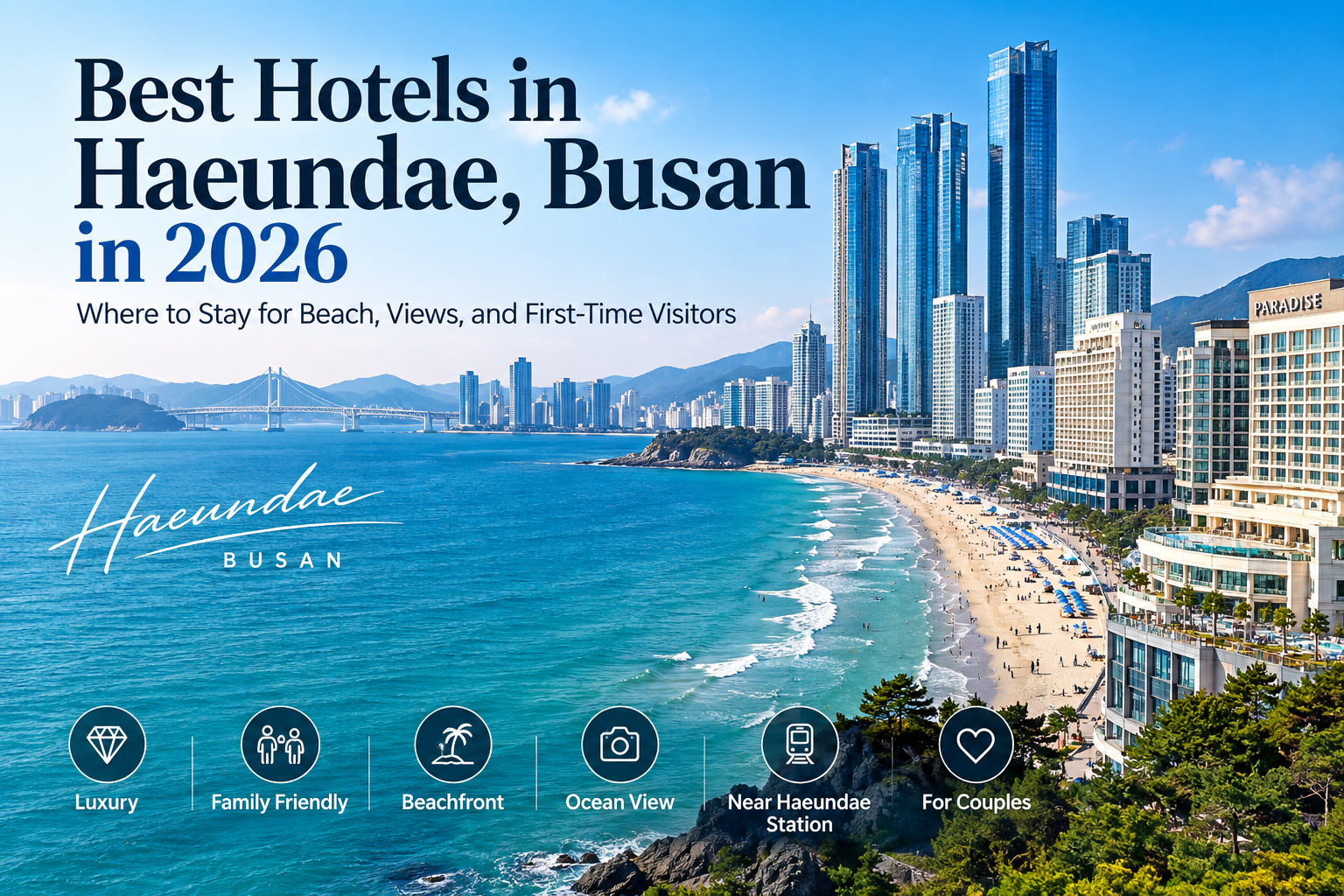
  • Best Hotels in Haeundae, Busan in 2026: Where to Stay for Beach, Views, and First-Time Visitors

    Best Hotels in Haeundae, Busan in 2026: Where to Stay for Beach, Views, and First-Time Visitors

    Best Hotels in Haeundae, Busan in 2026

    If you are planning your first trip to Busan, there is a good chance Haeundae is already on your list.

    Haeundae is one of Busan’s most famous coastal areas, combining a long sandy beach with hotels, restaurants, cafes, nightlife, shopping, and easy access to some of the city’s most popular attractions.

    It also has one of the widest selections of accommodation in Busan.

    You can stay in a luxury oceanfront hotel, a stylish mid-range property, or a practical hotel close to Haeundae Station.

    But which hotel should you choose?

    This guide compares some of the best hotels in Haeundae in 2026 for first-time visitors, couples, families, beach lovers, luxury travelers, and travelers who simply want a convenient location.

    Quick Guide: Best Haeundae Hotels by Traveler Type

    If you want the short answer:

    SIGNIEL Busan — Best for a luxury ocean-view experience

    Paradise Hotel Busan — Best for a classic beachfront resort stay

    Grand Josun Busan — Best for families and modern beachfront luxury

    The Westin Josun Busan — Best for beach access and Dongbaekseom location

    Park Hyatt Busan — Best for luxury, marina atmosphere, and Gwangan Bridge views

    Shilla Stay Haeundae — Best for practical comfort and value near the beach

    L7 Haeundae by Lotte — Best for a modern, lifestyle-focused stay

    There is no single hotel that is best for everyone.

    The right choice depends on whether you value beachfront location, ocean views, transportation, luxury facilities, family convenience, or price.

    Why Stay in Haeundae?

    For first-time visitors, Haeundae is one of the easiest areas in Busan to understand.

    The neighborhood offers much more than the beach itself.

    Around Haeundae you can find:

    • Haeundae Beach
    • Restaurants and cafes
    • Traditional market food
    • Nightlife
    • Shopping
    • Coastal walks
    • Easy subway access
    • Luxury hotels
    • Family-friendly attractions

    It is particularly convenient if your idea of Busan includes waking up near the sea and ending the day with a walk along the coast.

    Haeundae is also a useful base for exploring eastern Busan.

    1. SIGNIEL Busan — Best for Luxury Ocean Views

    For travelers looking for one of the most luxurious stays in Haeundae, SIGNIEL Busan is an obvious hotel to consider.

    Located in the Haeundae area near the beachfront, it is designed for travelers who want the hotel itself to be a major part of the trip.

    This is not simply somewhere to sleep between sightseeing days.

    It is the type of property travelers choose for the overall experience.

    Best For

    • Luxury travelers
    • Couples
    • Honeymoons
    • Special occasions
    • Ocean-view seekers
    • Travelers who enjoy premium hotel facilities

    Why Choose It?

    The biggest reason is the combination of location, elevated sea views, and luxury positioning.

    If you are celebrating an anniversary or simply want to make your Busan accommodation one of the highlights of the trip, this is the kind of property worth comparing.

    What to Check Before Booking

    Ocean-view categories can differ.

    Do not assume every room has exactly the same view.

    Check the specific room description and view category before paying a premium rate.

    2. Paradise Hotel Busan — Best for a Classic Beachfront Resort Experience

    Paradise Hotel Busan is another well-known luxury option directly associated with the Haeundae beachfront experience.

    Its location makes it especially appealing to travelers who want the beach immediately outside their hotel rather than several streets away.

    Best For

    • Beach lovers
    • Couples
    • Families
    • Resort-style travelers
    • First-time Busan visitors
    • Travelers who want to minimize walking to the beach

    Why Stay Here?

    The biggest advantage is simple:

    You are staying right at one of Korea’s most famous beaches.

    This can make a major difference during summer or for travelers planning a relaxed coastal vacation.

    You can spend the morning sightseeing, return to the hotel, and enjoy the Haeundae area without another long journey across Busan.

    Possible Downside

    Prime beachfront luxury comes at a price.

    During popular travel periods, rates can rise substantially.

    Compare room types and cancellation conditions rather than booking the first rate you see.

    3. Grand Josun Busan — Best for Families and Modern Beachfront Luxury

    Grand Josun Busan combines a prime Haeundae location with a contemporary luxury-hotel experience.

    Its beachfront position makes it convenient for travelers who want easy access to the sea while still enjoying the facilities of a full-service hotel.

    Best For

    • Families
    • Couples
    • Luxury travelers
    • Multi-night Haeundae stays
    • Travelers who want the beach nearby

    Why Choose Grand Josun Busan?

    For families, hotel facilities can matter just as much as location.

    Parents traveling with children often value:

    • Convenient dining
    • Swimming facilities
    • Easy beach access
    • Comfortable common areas
    • Minimal transportation after a long sightseeing day

    Grand Josun is particularly worth comparing with Paradise Hotel Busan if you want a higher-end Haeundae stay.

    Grand Josun vs Paradise Hotel Busan

    These hotels appeal to similar travelers, so how do you choose?

    Choose Grand Josun Busan if you prefer a modern luxury atmosphere and family-oriented hotel experience.

    Choose Paradise Hotel Busan if a classic Haeundae resort experience is your priority.

    For either hotel, compare the exact room category, included benefits, breakfast, cancellation policy, and current rate before booking.

    4. The Westin Josun Busan — Best for Haeundae Beach and Dongbaekseom

    The Westin Josun Busan occupies an especially interesting position at the western end of Haeundae Beach near Dongbaekseom.

    This makes it attractive for travelers who want both the beach and scenic coastal walks.

    The hotel also offers views toward Haeundae, Marine City, and the wider coastal skyline depending on the room and location.

    Best For

    • Couples
    • Beach lovers
    • Walking enthusiasts
    • Families
    • Travelers who like scenic locations
    • Repeat Busan visitors

    Why Choose It?

    Location is the strongest reason.

    You can enjoy Haeundae while also being close to the Dongbaekseom walking area.

    That gives the stay a slightly different feeling from being directly in the busiest central streets of Haeundae.

    For travelers who enjoy morning or evening walks, that can be a significant advantage.

    5. Park Hyatt Busan — Best for Marina and Gwangan Bridge Views

    Park Hyatt Busan is located in Marine City rather than directly in the busiest central section of Haeundae Beach.

    That distinction is important.

    Choose this hotel if you are attracted to modern architecture, luxury interiors, marina surroundings, and views toward the ocean and Gwangan Bridge.

    Best For

    • Luxury travelers
    • Couples
    • Design-focused travelers
    • Business travelers
    • Special occasions
    • Travelers who value skyline and bridge views

    Why Choose Park Hyatt Busan?

    The atmosphere is different from a traditional beachfront resort.

    Marine City feels sleek and urban.

    You are surrounded by modern towers and waterfront scenery rather than the busiest beach streets.

    For some travelers, that makes Park Hyatt one of the most appealing luxury choices in Busan.

    Who Should Choose Another Hotel?

    If your number-one priority is walking out of the lobby and immediately reaching the central section of Haeundae Beach, consider a beachfront property instead.

    Location within Haeundae matters.

    Park Hyatt vs SIGNIEL Busan

    Both appeal to luxury travelers, but the experience differs.

    Choose SIGNIEL Busan if you want a high-end stay closely associated with Haeundae’s beach and oceanfront atmosphere.

    Choose Park Hyatt Busan if you prefer Marine City’s sophisticated waterfront setting and views toward Gwangan Bridge.

    This is less about which hotel is “better” and more about which Busan experience you want.

    6. Shilla Stay Haeundae — Best for Comfort and Value

    Not every traveler needs a five-star resort.

    Shilla Stay Haeundae is useful for visitors who want a recognizable hotel experience in a convenient location without necessarily paying luxury-resort prices.

    The hotel is close to Haeundae Beach and approximately an eight-minute walk from Haeundae Station.

    It also offers a rooftop pool and bar with views over the Haeundae area.

    Best For

    • First-time visitors
    • Couples
    • Business travelers
    • Travelers who prioritize location
    • Visitors looking for mid-range comfort
    • Travelers using the subway frequently

    Why Choose It?

    The biggest strength is balance.

    You can stay near the beach while remaining reasonably close to Haeundae Station.

    That matters because Busan is a large city.

    If you plan to spend several days sightseeing beyond Haeundae, convenient subway access can save a surprising amount of time.

    7. L7 Haeundae by Lotte — Best for a Modern Lifestyle Stay

    L7 Haeundae by Lotte is another option for travelers who want a contemporary hotel in the Haeundae area.

    The L7 brand generally targets travelers looking for a more modern, lifestyle-oriented atmosphere rather than a traditional luxury-hotel experience.

    Best For

    • Couples
    • Younger travelers
    • Friends
    • Design-conscious travelers
    • Short city breaks
    • Travelers who want to stay near Haeundae Beach

    Why Consider It?

    For some visitors, a hotel should feel modern and fun without moving into the highest luxury price category.

    That is where lifestyle hotels can be appealing.

    Compare it directly with Shilla Stay when deciding between practical convenience and a more lifestyle-focused hotel experience.

    Luxury vs Mid-Range: How Much Should You Spend?

    The right hotel budget depends heavily on how you plan to use the property.

    If your itinerary is packed from morning until night, paying significantly more for extensive hotel facilities may not provide much value.

    But if your Busan trip is partly a beach vacation, paying more for:

    • Ocean views
    • Swimming pools
    • Resort facilities
    • Larger rooms
    • Beachfront access

    may be worthwhile.

    Think about how many hours you will actually spend at the hotel.

    That is often a better guide than star ratings alone.

    Best Haeundae Hotel for Couples

    For a romantic trip, consider:

    SIGNIEL Busan for a premium ocean-view experience.

    Park Hyatt Busan for luxury and sophisticated waterfront views.

    The Westin Josun Busan for beach access and scenic walks.

    Grand Josun Busan for modern beachfront luxury.

    The right choice depends on whether your ideal trip feels more like a resort vacation, city escape, or special-occasion hotel stay.

    Best Haeundae Hotel for Families

    Families should prioritize more than the room photograph.

    Check:

    • Room size
    • Bed configuration
    • Pool access
    • Breakfast
    • Children’s facilities
    • Beach distance
    • Laundry options
    • Nearby restaurants

    Grand Josun Busan and other full-service beachfront properties are worth comparing when facilities matter.

    But families spending most of the day sightseeing may find a well-located mid-range hotel more practical.

    Best Haeundae Hotel for First-Time Visitors

    For first-time visitors, location is especially important.

    If you want easy access to restaurants, the beach, and Haeundae’s main streets, staying close to the central beach area can simplify the trip.

    If you also plan to use the subway frequently, check walking distance to Haeundae Station before booking.

    A beautiful ocean-view hotel can still be inconvenient if it does not fit your actual itinerary.

    Best Haeundae Hotels for Ocean Views

    Ocean-view travelers have several strong options in the broader Haeundae area.

    Properties worth comparing include:

    • SIGNIEL Busan
    • Paradise Hotel Busan
    • Grand Josun Busan
    • The Westin Josun Busan
    • Park Hyatt Busan

    However, remember:

    Hotel name does not guarantee ocean view.

    Room category matters.

    Always confirm the exact view listed for the room you are booking.

    Should You Stay Directly on Haeundae Beach?

    For many visitors, yes.

    Beachfront accommodation is especially useful if:

    • You are visiting in summer
    • You enjoy morning walks
    • You are traveling with children
    • You want a resort atmosphere
    • You plan to spend significant time around Haeundae

    But beachfront is not automatically necessary.

    A hotel several minutes inland may cost less while still giving you easy access to the beach.

    Haeundae Beach vs Marine City

    This is an important distinction.

    Choose Haeundae Beach If You Want:

    • Immediate beach atmosphere
    • Restaurants
    • Tourist energy
    • Easy access to Haeundae’s central streets
    • A classic first-time Busan experience

    Choose Marine City If You Want:

    • Modern skyline
    • Waterfront towers
    • Luxury atmosphere
    • Marina scenery
    • Gwangan Bridge views

    Park Hyatt is particularly relevant to the second experience.

    How Close Should You Stay to Haeundae Station?

    If you plan to explore Busan extensively, staying near Haeundae Station can be very useful.

    Busan’s attractions are spread across a large area.

    Travel between Haeundae and western parts of the city can take time.

    A hotel within comfortable walking distance of the subway makes sightseeing easier.

    This is particularly important for travelers planning to visit places such as:

    • Seomyeon
    • Nampo-dong
    • Jagalchi
    • Gamcheon Culture Village
    • Other parts of central and western Busan

    How Many Nights Should You Stay in Haeundae?

    For many first-time Busan trips:

    2 nights — enough for a short beach-focused visit

    3 nights — comfortable for Haeundae plus major Busan sightseeing

    4 nights — better for a relaxed trip with beaches, cafes, markets, and coastal attractions

    If you are staying five nights or longer, some travelers may even consider splitting their stay between Haeundae and another part of Busan.

    When Are Haeundae Hotels Most Expensive?

    Rates can change dramatically according to:

    • Season
    • Weekends
    • Festivals
    • Concerts
    • Conferences
    • School holidays
    • Major events
    • Room availability

    Summer is naturally a popular period around Haeundae Beach.

    But major events in Busan can also push accommodation prices higher outside the traditional peak beach season.

    Booking early is particularly useful when your dates coincide with a major event.

    Should You Book a Hotel With Breakfast?

    Not necessarily.

    Haeundae has plenty of cafes and restaurants.

    If your hotel breakfast is expensive and you enjoy exploring local food, a room-only rate may be perfectly reasonable.

    On the other hand, breakfast can be convenient for:

    • Families
    • Early sightseeing days
    • Business travelers
    • Travelers who prefer predictable morning meals

    Compare the room-only price with the breakfast-inclusive rate rather than assuming one option is automatically better.

    What to Check Before Booking a Haeundae Hotel

    Before paying, check these seven things.

    1. Exact Location

    “Haeundae” covers a wider area than many first-time visitors expect.

    Check the property on a map.

    2. Beach Distance

    If the beach is important, check the actual walking route.

    3. Subway Distance

    This matters if you plan to explore the rest of Busan.

    4. Room View

    Ocean view, partial ocean view, city view, and harbor view are not the same.

    5. Room Size

    Compare actual square meters rather than relying on photographs.

    6. Pool Rules

    Some hotels may have operating periods, time slots, additional conditions, or specific access rules.

    Check the hotel’s current policy before booking.

    7. Cancellation Policy

    Compare refundable and non-refundable rates carefully.

    A cheaper non-refundable room may not be worth the savings if your itinerary could change.

    How to Choose the Right Haeundae Hotel

    Use this simple approach.

    Want the biggest luxury experience?
    Compare SIGNIEL Busan and other five-star beachfront properties.

    Want a classic beach resort?
    Consider Paradise Hotel Busan.

    Traveling with family?
    Compare Grand Josun Busan and other full-service beachfront hotels.

    Want scenic walks and a quieter edge of the beach?
    Consider The Westin Josun Busan.

    Want luxury with Marine City and bridge views?
    Consider Park Hyatt Busan.

    Want convenient mid-range comfort?
    Consider Shilla Stay Haeundae.

    Want a modern lifestyle hotel?
    Consider L7 Haeundae.

    Frequently Asked Questions

    Is Haeundae a good place to stay in Busan?

    Yes. Haeundae is especially good for first-time visitors who want beaches, restaurants, hotels, cafes, and coastal attractions nearby.

    What is the best luxury hotel in Haeundae?

    There are several high-end choices, including SIGNIEL Busan, Paradise Hotel Busan, Grand Josun Busan, The Westin Josun Busan, and Park Hyatt Busan in the broader Haeundae area.

    The best choice depends on your preferred location and type of view.

    Is it better to stay in Haeundae or Gwangalli?

    Choose Haeundae for a larger beach resort area and extensive hotel selection.

    Choose Gwangalli if views of Gwangan Bridge and a lively cafe-and-night atmosphere are more important.

    Is Haeundae convenient for sightseeing?

    Yes, but Busan is very large.

    Haeundae is excellent for eastern Busan, while trips to western attractions can take longer.

    Do I need an ocean-view room?

    No.

    If you plan to spend most of your day outside, a city-view room in a better hotel or location may provide better value.

    How early should I book a Haeundae hotel?

    For summer weekends and major Busan events, booking earlier can provide more room choices.

    For other periods, compare flexible rates and monitor availability.

    Final Thoughts

    Haeundae has accommodation for almost every type of traveler.

    Choose SIGNIEL Busan if luxury and ocean views are central to the trip.

    Consider Paradise Hotel Busan for a classic beachfront resort experience.

    Look at Grand Josun Busan for modern beachfront luxury and family travel.

    Choose The Westin Josun Busan if you value Haeundae Beach and Dongbaekseom.

    Consider Park Hyatt Busan for Marine City and Gwangan Bridge views.

    And compare Shilla Stay Haeundae and L7 Haeundae if you want a more practical or contemporary alternative to the top luxury properties.

    Most importantly, do not choose a hotel by star rating alone.

    In Busan, location can change your entire trip.

    Choose the part of Haeundae that matches how you actually want to travel—and then choose the hotel.


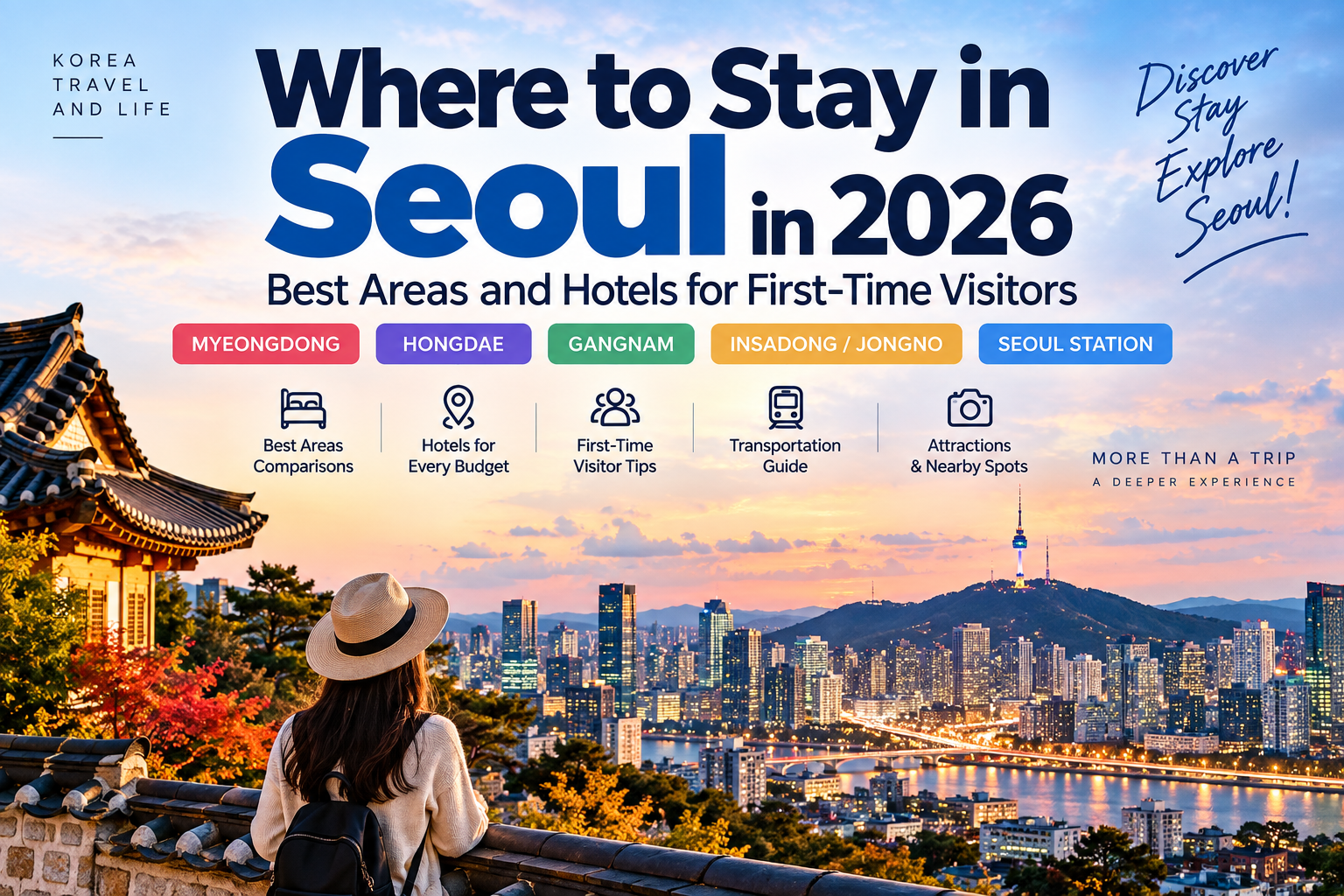
  • Where to Stay in Seoul in 2026: Best Areas and Hotels for First-Time Visitors

    Where to Stay in Seoul in 2026: Best Areas and Hotels for First-Time Visitors

    Where to Stay in Seoul in 2026

    Choosing where to stay in Seoul can be surprisingly difficult for a first-time visitor.

    Seoul is enormous, and there is no single neighborhood that is best for everyone.

    One traveler may want to walk to palaces and traditional streets. Another may care more about nightlife and cafes. A family might prioritize convenience, while a first-time visitor arriving from Incheon Airport may simply want an area that makes transportation easy.

    The good news is that Seoul has excellent neighborhoods for almost every type of traveler.

    In this guide, we compare Myeongdong, Hongdae, Gangnam, Insadong/Jongno, and Seoul Station to help you decide where to stay in Seoul in 2026.

    Quick Answer: Where Should You Stay in Seoul?

    If you want the simplest answer:

    Myeongdong — Best overall for first-time visitors
    Hongdae — Best for nightlife, cafes, and younger travelers
    Gangnam — Best for modern Seoul, shopping, and upscale stays
    Insadong/Jongno — Best for history, palaces, and traditional culture
    Seoul Station — Best for transportation and travelers taking trains around Korea

    For many first-time visitors, Myeongdong is the easiest all-around choice because of its central location and convenient access to major attractions.

    But the best area for you depends on how you plan to spend your trip.

    1. Myeongdong — Best Overall for First-Time Visitors

    For a first trip to Seoul, Myeongdong is one of the easiest areas to recommend.

    It is centrally located and puts you close to many of the places travelers want to see during their first few days in the city.

    Myeongdong is particularly convenient for travelers interested in:

    • Shopping
    • Korean beauty products
    • Street food
    • Restaurants
    • Central Seoul sightseeing
    • Easy public transportation

    You can also reach areas such as Namsan, Namdaemun Market, City Hall, and central historic Seoul relatively easily.

    Why Stay in Myeongdong?

    The biggest advantage is convenience.

    When you only have three or four days in Seoul, spending less time moving across the city can make a major difference.

    Myeongdong has a large concentration of hotels across different price ranges, from practical mid-range properties to more upscale options.

    It is also an area accustomed to international travelers.

    That can make a first visit to Korea feel less intimidating.

    Who Should Stay in Myeongdong?

    Myeongdong works especially well for:

    • First-time visitors
    • Short stays
    • Shoppers
    • Couples
    • Families
    • Travelers who want a central base
    • Visitors interested in Korean beauty and food

    Possible Downsides

    Myeongdong is highly commercial and busy.

    If your dream of Seoul involves quiet residential streets and neighborhood cafes, another area may feel more atmospheric.

    But for convenience, it remains difficult to beat.

    2. Hongdae — Best for Nightlife, Cafes, and Young Travelers

    Hongdae offers a completely different Seoul experience.

    Located around Hongik University, the area is known for youthful energy, cafes, restaurants, shopping, nightlife, music, and street culture.

    During the evening, the neighborhood becomes particularly lively.

    For travelers who want to step outside their hotel and immediately feel Seoul’s younger social scene, Hongdae can be an excellent choice.

    Why Stay in Hongdae?

    One major advantage is transportation from Incheon International Airport.

    The AREX airport railroad connects the airport with Hongik University Station, making Hongdae convenient for many international arrivals.

    That can be especially useful if you have heavy luggage.

    The neighborhood itself also offers plenty to do without needing to travel elsewhere every evening.

    Hongdae Is Best For

    • Younger travelers
    • Solo travelers
    • Nightlife
    • Cafes
    • Casual dining
    • Fashion
    • Music and entertainment
    • Travelers arriving through Incheon Airport

    Possible Downsides

    Hongdae can be noisy.

    If your hotel is located near the busiest nightlife streets, weekends can feel especially active.

    Travelers who prioritize quiet evenings should check the hotel’s exact location rather than choosing purely by the word “Hongdae.”

    Myeongdong vs Hongdae: Which Is Better?

    This is one of the most common decisions first-time travelers face.

    Choose Myeongdong if your priority is:

    • Central sightseeing
    • Shopping
    • Convenient access to historic attractions
    • A straightforward first trip

    Choose Hongdae if your priority is:

    • Nightlife
    • Cafes
    • Youth culture
    • Evening entertainment
    • Convenient airport rail access

    For a traditional first-time sightseeing itinerary, Myeongdong generally makes the easier base.

    For travelers who care about nightlife and neighborhood atmosphere, Hongdae may be more enjoyable.

    3. Insadong and Jongno — Best for History and Traditional Seoul

    If you are coming to Korea because you want to experience palaces, hanok streets, temples, traditional food, and Korean history, consider staying around Insadong or Jongno.

    This part of central Seoul puts you close to some of the city’s most important cultural attractions.

    Depending on your exact accommodation, you can have convenient access to places such as:

    • Gyeongbokgung Palace
    • Changdeokgung Palace
    • Bukchon Hanok Village
    • Insadong
    • Jogyesa Temple
    • Gwanghwamun
    • Cheonggyecheon Stream

    This makes the area particularly attractive for cultural travelers.

    Why Stay in Insadong or Jongno?

    The atmosphere is different from Gangnam or Hongdae.

    Instead of skyscrapers and clubs, you are closer to historic neighborhoods, traditional architecture, museums, tea houses, and palaces.

    You can spend a morning visiting a royal palace, walk through traditional streets in the afternoon, and enjoy Korean food in the evening without traveling across the entire city.

    Best For

    • History lovers
    • Cultural travelers
    • Couples
    • Photographers
    • First-time visitors
    • Travelers interested in traditional Korea

    What About Hanok Accommodation?

    Travelers looking for something more memorable can also consider a traditional-style hanok stay.

    A hanok stay provides a very different experience from a conventional hotel and can be particularly appealing for visitors interested in Korean architecture and culture.

    However, traditional accommodation may offer different room layouts and amenities from international-style hotels, so check the property details carefully before booking.

    4. Gangnam — Best for Modern Seoul and Upscale Stays

    Gangnam is internationally famous, but it is important to understand its location before booking.

    Gangnam is south of the Han River, while many of Seoul’s most famous historic attractions are north of the river.

    That does not make Gangnam a bad place to stay.

    It simply makes it best for a different type of trip.

    Why Stay in Gangnam?

    Gangnam is ideal if you want to experience Seoul as a modern global city.

    The broader area offers:

    • Upscale hotels
    • Shopping
    • Restaurants
    • Cafes
    • Business districts
    • Modern architecture
    • Nightlife
    • Beauty and fashion
    • Convenient access to southern Seoul

    Popular destinations such as COEX and the surrounding neighborhoods are also located in this part of the city.

    Gangnam Is Best For

    • Business travelers
    • Repeat visitors
    • Luxury travelers
    • Shopping
    • Modern Seoul
    • Travelers with activities mainly south of the Han River

    Is Gangnam Good for a First Visit?

    It can be.

    But if most of your itinerary includes Gyeongbokgung Palace, Bukchon, Insadong, Myeongdong, and other central or northern attractions, staying in Gangnam means more travel time.

    For many first-time tourists, central Seoul is therefore more practical.

    5. Seoul Station — Best for Transportation

    Seoul Station is not necessarily the most atmospheric neighborhood on this list.

    But it may be the most practical for certain itineraries.

    Seoul Station is one of Korea’s major transportation hubs.

    From here, travelers can connect to:

    • KTX high-speed trains
    • Subway lines
    • Airport transportation
    • Regional rail services
    • Buses and taxis

    This makes it particularly useful for travelers using Seoul as the starting point for a larger Korea trip.

    Who Should Stay Near Seoul Station?

    Consider this area if you plan to visit destinations such as:

    • Busan
    • Gyeongju
    • Daegu
    • Daejeon
    • Other cities accessible by rail

    It can also be convenient for a one-night stay before or after a train journey.

    Possible Downsides

    If your main goal is to experience Seoul’s nightlife or neighborhood atmosphere, Hongdae or another district may feel more exciting.

    Seoul Station is primarily about convenience.

    Best Area in Seoul for Couples

    For couples, the best neighborhood depends on the style of trip.

    Myeongdong works well for couples visiting Seoul for the first time.

    Insadong/Jongno offers a more cultural and atmospheric experience.

    Gangnam can be attractive for couples interested in upscale hotels, dining, and shopping.

    Hongdae suits couples who enjoy nightlife and lively cafes.

    For a romantic first trip combining sightseeing and food, central Seoul is often the easiest choice.

    Best Area in Seoul for Families

    Families often benefit from staying somewhere central with easy transportation.

    Myeongdong can work particularly well because it provides access to:

    • Restaurants
    • Shopping
    • Subway stations
    • Major sightseeing areas

    When booking as a family, pay close attention to room size.

    Hotel rooms in Seoul can be smaller than some international travelers expect.

    Check:

    • Bed configuration
    • Maximum occupancy
    • Room size
    • Breakfast options
    • Laundry facilities
    • Distance from the subway

    These details can matter more than the hotel’s star rating.

    Best Area for Solo Travelers

    Solo travelers have several excellent choices.

    Hongdae is attractive if you want social energy, cafes, and nightlife.

    Myeongdong is convenient if this is your first visit and you want straightforward sightseeing.

    Jongno can be excellent for travelers who enjoy exploring cultural sites on foot.

    Seoul is a large city, so solo travelers should prioritize a location that matches what they plan to do most often.

    Best Area for Nightlife

    Hongdae is one of the most obvious choices for travelers looking for a lively evening atmosphere.

    Gangnam also offers nightlife, but the experience is different.

    Hongdae generally feels younger and more casual.

    Gangnam tends to feel more polished and spread across several entertainment districts.

    If nightlife is a major part of your trip, check how close your hotel is to the specific streets or venues you plan to visit.

    Best Area for Shopping

    For many first-time visitors:

    Myeongdong is excellent for cosmetics, fashion, and tourist-friendly shopping.

    Gangnam offers department stores, luxury shopping, and modern commercial districts.

    Hongdae is popular for youthful fashion, accessories, and trend-driven shops.

    The best choice depends on what you want to buy.

    Best Area for Korean Food

    There is excellent food throughout Seoul.

    You do not need to choose your hotel solely around restaurants.

    However:

    Jongno and Insadong are useful for traditional Korean food and historic dining areas.

    Myeongdong offers enormous variety and easy access for visitors.

    Hongdae has casual restaurants, cafes, and late-night options.

    Because Seoul’s public transportation is excellent, serious food travelers can explore multiple neighborhoods regardless of where they sleep.

    Best Area for Airport Access

    For travelers arriving at Incheon International Airport, Hongdae and Seoul Station can be especially convenient because of the AREX airport railroad.

    Other central areas can also be reached using airport transportation, subway connections, buses, or taxis.

    Do not choose accommodation based only on distance from the airport.

    Consider what happens during the rest of your trip.

    Saving a little time on arrival is less useful if you then spend an extra hour commuting every day.

    How Close Should Your Hotel Be to a Subway Station?

    This is one of the most important booking tips in Seoul.

    Try to stay within approximately 5–10 minutes’ walk of a useful subway station when possible.

    Seoul is extremely walkable in individual neighborhoods, but attractions are spread across a very large metropolitan area.

    A convenient subway station can save considerable time.

    Before booking, check the hotel on a map and identify:

    1. The nearest subway station
    2. The subway line
    3. Walking distance
    4. Whether transfers are required for your main attractions

    A cheaper hotel far from transportation is not always the better deal.

    How Many Nights Should You Stay in Seoul?

    For first-time visitors:

    3 nights — enough for major highlights, but fast-paced

    4–5 nights — comfortable for most first trips

    6–7 nights — better for slower travel, neighborhoods, shopping, cafes, and day trips

    If Seoul is your only destination in Korea, staying longer is easy to justify.

    If you are combining Seoul with Busan, Jeju, or Gyeongju, four or five nights can be a useful starting point.

    Budget Hotels vs Mid-Range vs Luxury Hotels

    Seoul offers accommodation at almost every price level.

    Budget

    Budget travelers can consider:

    • Hostels
    • Guesthouses
    • Small hotels
    • Simple business hotels

    Location should remain a priority.

    Saving money on accommodation is less helpful if transportation becomes inconvenient.

    Mid-Range

    For many international travelers, mid-range hotels offer the best balance.

    You can often find:

    • Private bathrooms
    • Convenient locations
    • Reliable Wi-Fi
    • Front desk service
    • Modern rooms

    This category is especially competitive in Myeongdong and other central areas.

    Luxury

    Seoul has an extensive luxury hotel market.

    High-end properties may offer:

    • Larger rooms
    • City views
    • Fine dining
    • Spas
    • Pools
    • Executive lounges
    • Premium service

    Luxury travelers should decide whether they value the hotel experience itself or primarily want the best sightseeing location.

    What to Check Before Booking a Seoul Hotel

    Before clicking “Book,” check these details carefully.

    1. Exact Location

    Do not rely only on the neighborhood name.

    A property marketed as being in a famous district may actually be a substantial walk from its main attractions.

    2. Subway Distance

    Look at the real walking route to the station.

    3. Room Size

    Check the square meters or square feet.

    Photos can make rooms appear larger than they are.

    4. Bed Type

    A “double room” does not always mean two beds.

    Confirm the exact configuration.

    5. Cancellation Policy

    Travel plans change.

    Compare refundable and non-refundable rates before deciding.

    6. Recent Reviews

    Read recent reviews rather than relying only on the overall score.

    Look especially for comments about:

    • Cleanliness
    • Noise
    • Location
    • Beds
    • Air conditioning
    • Staff
    • Luggage storage

    7. Check-In Time

    This matters particularly if your flight arrives early in the morning or late at night.

    Where Should First-Time Visitors Stay?

    For most first-time visitors who want a straightforward sightseeing trip, Myeongdong or the wider central Seoul area is a strong starting point.

    You will have convenient access to many classic attractions while remaining well connected to the rest of the city.

    Choose Hongdae instead if nightlife and youthful culture matter more.

    Choose Jongno/Insadong if history is your priority.

    Choose Gangnam if your itinerary focuses on modern southern Seoul.

    Choose Seoul Station if transportation around Korea is the deciding factor.

    A Simple Decision Guide

    Still unsure?

    Use this quick decision tree.

    Is this your first trip to Seoul?
    Start with Myeongdong.

    Do you care most about nightlife and cafes?
    Choose Hongdae.

    Do you want palaces and traditional culture?
    Choose Insadong/Jongno.

    Do you prefer modern, upscale Seoul?
    Choose Gangnam.

    Will you take several trains to other Korean cities?
    Consider Seoul Station.

    That simple choice can narrow hundreds of hotels down to a manageable list.

    Frequently Asked Questions

    What is the best area to stay in Seoul for first-time visitors?

    Myeongdong is one of the most convenient choices because of its central location, shopping, restaurants, and access to major sightseeing areas.

    Is Myeongdong or Hongdae better?

    Myeongdong is generally better for traditional first-time sightseeing and shopping. Hongdae is better for nightlife, cafes, and a younger atmosphere.

    Is Gangnam a good place for tourists?

    Yes, particularly for travelers interested in modern Seoul, shopping, business, nightlife, and upscale accommodation. However, it is less convenient for some historic attractions north of the Han River.

    Where should I stay in Seoul for easy airport transportation?

    Hongdae and Seoul Station are convenient choices for many travelers using the AREX airport railroad.

    Where should I stay for traditional Korean culture?

    Insadong and Jongno provide convenient access to royal palaces, traditional streets, temples, and historic central Seoul.

    Should I stay near Seoul Station?

    It is especially useful if you plan to take KTX trains to destinations such as Busan or other Korean cities.

    How far should my Seoul hotel be from the subway?

    For most travelers, staying within a 5–10 minute walk of a useful station is ideal.

    Final Thoughts

    Choosing where to stay in Seoul is less about finding the single “best” hotel and more about choosing the right neighborhood for your trip.

    For many first-time visitors, Myeongdong provides the easiest balance of sightseeing, shopping, food, and transportation.

    Choose Hongdae for nightlife and youthful energy.

    Choose Insadong/Jongno for history and traditional culture.

    Choose Gangnam for modern Seoul and upscale experiences.

    Choose Seoul Station when transportation is your highest priority.

    Once you choose the right area, selecting a hotel becomes much easier.

    And that is the real secret to booking accommodation in Seoul:

    Choose the neighborhood first. Choose the hotel second.


  • Korea Fall Foliage 2026: Best Places and When to See Autumn Colors

    Korea Fall Foliage 2026: Best Places and When to See Autumn Colors

    Autumn is one of the most beautiful seasons to visit South Korea. As the weather becomes cooler, mountains, royal palaces, parks, and historic temples across the country turn brilliant shades of red, orange, and gold.

    For travelers planning a trip to Korea in October or early November, seeing the fall foliage can easily become one of the highlights of the journey.

    The good news is that you do not have to travel far into the countryside to enjoy Korea’s autumn colors. Beautiful foliage can be found in Seoul, while famous destinations such as Nami Island, Seoraksan National Park, and Gyeongju offer completely different autumn experiences.

    This guide explains the best places to see fall foliage in Korea in 2026, when the colors are likely to appear, and how to plan your autumn trip.

    When Is the Best Time to See Fall Foliage in Korea in 2026?

    Fall foliage in Korea usually begins in the northern and mountainous regions before gradually moving south.

    According to the 2026 fall foliage forecast shared by VISITKOREA, the first autumn colors are expected to appear at Seoraksan around early October. Other mountain areas follow during October, while peak foliage generally arrives from mid-October through early November depending on the region and elevation.

    For most international travelers, late October to early November is one of the safest periods for combining comfortable autumn weather with colorful scenery.

    However, fall colors depend on temperature and weather conditions, so exact peak dates can change from year to year.

    1. Seoraksan National Park

    If you want to experience dramatic Korean autumn scenery, Seoraksan National Park should be near the top of your list.

    Located in Gangwon Province, Seoraksan is famous for rocky mountain peaks, deep valleys, temples, hiking trails, and forests that become covered with vivid autumn colors.

    Because of its northern location and elevation, Seoraksan is normally one of the first major destinations in Korea to show fall foliage.

    October is especially popular, so weekends can become very crowded.

    Travelers who enjoy hiking can explore the park’s trails, while visitors who prefer a more relaxed experience can still enjoy beautiful scenery around the main park areas.

    Best for: Mountain scenery, hiking, photography
    Recommended period: October

    2. Nami Island

    Nami Island is one of the most recognizable autumn destinations near Seoul.

    The island is famous for its tree-lined walking paths, particularly its rows of ginkgo and metasequoia trees. During autumn, the landscape changes into shades of yellow, orange, and red.

    It is also relatively easy to visit as a day trip from Seoul, which makes it popular with international travelers.

    Walking or cycling around the island is a relaxing way to enjoy the season.

    Because Nami Island attracts many visitors during peak foliage season, arriving earlier in the day can make the experience more comfortable.

    Best for: Couples, families, photography, easy day trips
    Recommended period: Mid-October to early November

    3. Gyeongbokgung Palace, Seoul

    You do not need to leave Seoul to enjoy beautiful autumn scenery.

    Gyeongbokgung Palace combines traditional Korean architecture with colorful trees and mountain views, creating one of the most distinctive autumn scenes in the capital.

    The contrast between palace roofs, stone courtyards, ponds, and fall foliage makes this an excellent location for photography.

    Visitors can also rent a hanbok from shops around the palace area and explore nearby attractions such as Bukchon Hanok Village and Insadong on the same day.

    Best for: Korean culture, photography, first-time visitors
    Recommended period: Late October to early November

    4. Changdeokgung Palace and the Secret Garden

    Changdeokgung is another excellent place to experience autumn in Seoul.

    Its famous Secret Garden, known as Huwon, contains wooded paths, traditional pavilions, ponds, and historic buildings surrounded by nature.

    In autumn, the garden becomes especially beautiful as the leaves change color.

    Unlike some modern city parks, Changdeokgung offers an atmosphere where nature and traditional Korean architecture feel closely connected.

    Access conditions and tour arrangements for the Secret Garden can change, so check current visitor information before going.

    Best for: History, quiet walks, traditional scenery
    Recommended period: Late October to early November

    5. Seoul Forest

    For travelers who prefer parks to palaces, Seoul Forest is an easy autumn destination.

    The large urban park offers walking paths, open spaces, trees, and seasonal scenery without requiring a long trip outside the city.

    It can also be combined with Seongsu-dong, one of Seoul’s popular neighborhoods for cafés, shops, and restaurants.

    This makes Seoul Forest particularly useful for travelers who want a relaxed half-day itinerary rather than a full-day excursion.

    Best for: Relaxed walks, cafés, couples, families
    Recommended period: Late October to early November

    6. Olympic Park

    Olympic Park is another convenient place to enjoy autumn colors in Seoul.

    Its spacious grounds, walking paths, grassy areas, and famous Lone Tree provide plenty of opportunities for seasonal photography.

    Because the park is large, it is possible to spend several hours walking without feeling as confined as in some of Seoul’s busiest tourist districts.

    It is a good choice for travelers who want to experience everyday Seoul while enjoying autumn scenery.

    Best for: Walking, photography, relaxed city travel
    Recommended period: Late October to early November

    7. Gyeongju

    Gyeongju offers something very different from Seoul.

    Known for its heritage from the ancient Silla kingdom, the city is filled with royal tombs, temples, historic sites, traditional architecture, and peaceful landscapes.

    During autumn, places such as Bulguksa Temple become surrounded by colorful foliage, creating a beautiful combination of history and nature.

    Visitors can also explore Daereungwon Tomb Complex, Cheomseongdae, Donggung Palace and Wolji Pond, and nearby historic areas.

    Gyeongju is particularly suitable for travelers who want to experience Korean history beyond Seoul.

    Best for: History, temples, culture, photography
    Recommended period: Late October to early November

    8. Naejangsan National Park

    Naejangsan is one of Korea’s classic autumn foliage destinations.

    Located in Jeolla Province, the park is especially famous for its colorful maple trees. During peak season, paths through the park can become surrounded by brilliant red and orange leaves.

    The area around Naejangsa Temple is particularly popular for autumn photography.

    Naejangsan is farther from Seoul than destinations such as Nami Island, but travelers who are willing to make the journey can experience some of Korea’s most famous fall scenery.

    Best for: Maple leaves, nature, photography
    Recommended period: Late October to early November

    9. Jeju Island

    Autumn in Jeju has a different character from Korea’s mountain destinations.

    Instead of visiting only for colorful forests, travelers can combine seasonal scenery with volcanic landscapes, coastal drives, hiking, and fields of silver grass.

    Hallasan National Park is one of the main places to experience autumn nature on the island.

    Because conditions vary significantly by elevation, foliage timing around Hallasan can differ from lower areas of Jeju.

    Best for: Nature, road trips, hiking, longer stays
    Recommended period: October to early November

    A Simple Fall Foliage Itinerary

    If you are visiting Korea for about a week in late October, you could build your trip around both city and nature experiences.

    Spend your first few days exploring Seoul, including Gyeongbokgung Palace, Changdeokgung, and Seoul Forest. Then take a day trip to Nami Island.

    If you have additional time, travel to Seoraksan for mountain scenery or spend one or two nights in Gyeongju for a combination of autumn foliage and Korean history.

    Travelers staying longer can continue south toward Busan or Jeju.

    Tips for Traveling in Korea During Fall Foliage Season

    Autumn is a popular travel season in Korea, especially on weekends. Famous destinations can become crowded when foliage reaches its peak.

    Whenever possible, visit major attractions on weekdays and start early in the morning.

    Bring layers because temperatures can vary considerably between morning and afternoon, particularly in mountainous regions.

    Comfortable walking shoes are also important. Even travelers who are not planning serious hikes may spend much of the day walking through parks, palaces, temples, and historic districts.

    For mountain destinations, always check current weather, trail conditions, transportation information, and park notices before leaving.

    Is Autumn a Good Time to Visit Korea?

    For many travelers, the answer is yes.

    Autumn combines comfortable temperatures, seasonal food, cultural attractions, hiking opportunities, and some of Korea’s most photogenic landscapes.

    October offers excellent mountain scenery, while late October and early November can be particularly attractive for visitors staying in Seoul and traveling through central and southern Korea.

    The biggest challenge is popularity. Hotels, trains, buses, and famous foliage destinations can become busy during peak weekends, so booking important parts of your trip in advance is a good idea.

    Final Thoughts

    Korea’s autumn colors offer much more than a single famous destination.

    You can hike through the mountains of Seoraksan, walk beneath colorful trees on Nami Island, explore royal palaces in Seoul, visit historic temples in Gyeongju, or combine autumn scenery with a trip to Jeju Island.

    If this is your first autumn trip to South Korea, try to combine at least one city destination with one nature destination.

    And remember that foliage dates are forecasts rather than guarantees. Check the latest local conditions shortly before your trip, especially if seeing peak autumn colors is one of your main reasons for visiting Korea.

    With good timing and a flexible itinerary, autumn 2026 could be one of the most beautiful times to experience South Korea.

  • Best Fine Dining Restaurants in Jeju Island: Unique Culinary Experiences and Special Occasion Dining

    Best Fine Dining Restaurants in Jeju Island: Unique Culinary Experiences and Special Occasion Dining

    Fine Dining in Jeju: A Different Side of the Island’s Food Culture

    Jeju Island is famous for black pork, seafood, abalone, gogi-guksu, and traditional local dishes.

    But there is another side to Jeju’s food scene.

    Across the island, chefs and luxury hotels are using Jeju’s seafood, vegetables, pork, seasonal produce, and local traditions to create more refined dining experiences.

    These restaurants are particularly worth considering for a honeymoon, anniversary, birthday, romantic dinner, or simply one memorable meal during your trip.

    Unlike our guide to local Jeju restaurants, this article focuses on places where the atmosphere, presentation, service, and culinary experience are as important as the food itself.

    1. Yeoumul — A Refined Culinary Journey Inspired by Jeju

    One of the most distinctive luxury dining experiences in Seogwipo can be found at Yeoumul, inside JW Marriott Jeju Resort & Spa.

    The restaurant builds its dining experience around ingredients from Jeju’s sea and land, with dishes changing according to the seasons.

    Rather than simply serving famous Jeju specialties, Yeoumul interprets the island through a contemporary Korean dining experience.

    The concept is also influenced by Jeju’s culture and natural environment, making the meal feel connected to the destination rather than like a restaurant that could exist anywhere in the world.

    For international visitors who want to experience Jeju ingredients in a more sophisticated setting, this can be an excellent choice.

    Best for: Couples, anniversaries, honeymoons, and travelers interested in contemporary Korean cuisine.

    Location: JW Marriott Jeju Resort & Spa, Seogwipo.

    2. The Flying Hog — Wood-Fired Dining at JW Marriott Jeju

    Also at JW Marriott Jeju Resort & Spa, The Flying Hog offers a different type of special-occasion experience.

    The restaurant focuses on wood-fire grilling, bringing fire, smoke, and carefully selected ingredients together in a more dramatic style of cooking.

    This is a good choice for travelers who prefer grilled dishes and bold flavors rather than a traditional Korean course meal.

    The luxury resort setting also makes it easy to combine dinner with a sunset walk or a relaxing evening in Seogwipo.

    Advance planning is recommended for signature restaurants at the resort.

    Best for: Couples, meat lovers, special occasions, and luxury travelers.

    Location: JW Marriott Jeju Resort & Spa, Seogwipo.

    3. Island Kitchen — A Luxury Jeju Dining Experience

    Island Kitchen is another dining option at JW Marriott Jeju Resort & Spa.

    Rather than focusing on one single cooking style, Island Kitchen offers a broader experience built around seasonal ingredients and the flavors of Jeju.

    The resort’s signature Jeju Brunch Royale is designed as a leisurely dining experience, combining table-served dishes with premium ingredients and local flavors.

    This makes Island Kitchen particularly attractive for travelers who prefer a special daytime meal rather than a formal dinner.

    A long brunch can also work beautifully on a slower day when you do not want to rush from one tourist attraction to another.

    Best for: Luxury brunch, couples, resort guests, and relaxed special occasions.

    4. Confetti — Seasonal Jeju Ingredients with an Ocean View

    At Parnas Hotel Jeju in the Jungmun area, Confetti combines hotel dining with panoramic views of the Jeju coastline.

    The restaurant emphasizes seasonal ingredients grown and produced on Jeju Island.

    For travelers staying in Jungmun, this can be especially convenient because you can enjoy a more polished dining experience without driving across the island.

    The ocean setting is also part of the appeal.

    Jeju’s landscape is one of the reasons people travel to the island, and a restaurant that allows you to enjoy the scenery while eating can turn dinner into part of the travel experience.

    Best for: Families, couples, luxury hotel guests, and travelers staying in Jungmun.

    Location: Parnas Hotel Jeju, Jungmun.

    5. The Parkview — Luxury Hotel Dining in Jungmun

    For travelers who enjoy premium hotel buffets, The Parkview at The Shilla Jeju is another well-known option in the Jungmun resort area.

    A luxury buffet can be particularly useful when traveling with family or a group because everyone can choose according to their own preferences.

    It also provides a different experience from a chef-led tasting menu.

    Instead of spending the evening focused on a fixed sequence of dishes, diners can explore a wider selection at their own pace.

    If you are already staying in or visiting the Jungmun area, combining dinner with the resort atmosphere can make for a relaxing evening.

    Best for: Families, groups, celebrations, and travelers who prefer variety.

    6. La Tavola — An Intimate Fine-Dining Option in Jeju City

    Fine dining in Jeju is not limited to luxury resorts.

    La Tavola in Jeju City offers another option for travelers looking for a more intimate restaurant experience.

    Choosing an independent restaurant can provide a welcome contrast after visiting large resorts and hotels.

    It is also useful for travelers spending their first or final night near Jeju City, especially when they want a special meal without traveling all the way to southern Jeju.

    Best for: Couples, intimate dinners, and travelers staying in Jeju City.

    7. WooHwa — A Special-Occasion Restaurant in Jeju City

    WooHwa is another option for travelers searching for a more refined meal in Jeju City.

    Restaurants like this demonstrate how Jeju’s dining scene has expanded beyond traditional island dishes.

    That does not mean abandoning local food.

    Instead, a good Jeju itinerary can include both experiences: a simple bowl of pork noodles one day and a carefully planned dinner the next.

    The contrast helps travelers appreciate how diverse Jeju’s food culture has become.

    Best for: Date nights, celebrations, couples, and travelers seeking an upscale meal in Jeju City.

    8. Nansanri Restaurant — Dining Away from the Resort Districts

    Nansanri Restaurant in Seongsan offers another style of dining experience.

    Its eastern Jeju location makes it particularly interesting for travelers who are already exploring Seongsan and the quieter countryside on that side of the island.

    One of the pleasures of traveling around Jeju is discovering restaurants outside the major hotel districts.

    A memorable meal does not always require a luxury resort setting.

    Sometimes the surrounding village, landscape, and slower pace of eastern Jeju become part of the experience.

    Best for: Eastern Jeju road trips, couples, and travelers looking beyond the major resort areas.

    Fine Dining or Local Restaurant?

    You should try both.

    Jeju’s traditional restaurants tell the story of the island through dishes that have been eaten for generations.

    Black pork, momguk, dombe-gogi, seafood, abalone, and gogi-guksu provide an accessible introduction to Jeju’s culinary traditions.

    Fine dining offers a different perspective.

    Chefs can take the same island environment — its sea, farms, seasons, and local ingredients — and interpret it through contemporary techniques and presentation.

    One experience does not replace the other.

    Together, they provide a much richer understanding of Jeju food.

    Jeju City or Seogwipo for Special-Occasion Dining?

    Your choice should depend on your itinerary.

    Jeju City works well at the beginning or end of a trip because it is convenient for Jeju International Airport.

    It also offers independent restaurants that can provide a more intimate alternative to resort dining.

    Seogwipo and Jungmun are especially attractive for luxury dining.

    Many of Jeju’s major resorts are located in southern Jeju, making this area convenient for travelers who want to combine accommodation, ocean scenery, and a special dinner.

    Eastern Jeju is worth considering if you prefer smaller restaurants and a quieter road-trip atmosphere.

    Instead of driving across the island for dinner, choose a restaurant that fits naturally into the area where you are already spending the day.

    How Much Should You Budget?

    Fine dining in Jeju can vary considerably in price.

    An independent restaurant may cost much less than a luxury resort tasting menu, while premium hotel restaurants can become one of the more expensive meals of your trip.

    For this reason, check the current menu and prices before visiting.

    If you are traveling on a mixed budget, you do not need to eat expensive meals every day.

    A useful strategy is to enjoy inexpensive local restaurants for most of your trip and reserve one evening for a special dining experience.

    That combination can make the expensive meal feel even more memorable.

    Should You Make a Reservation?

    For high-end restaurants, reservations are strongly recommended.

    This is particularly important for chef-led course dining and signature restaurants inside luxury hotels.

    Some restaurants may have limited seating, fixed dining times, or menus that require preparation in advance.

    Weekends, Korean holidays, and peak travel seasons can also be busy.

    If there is one restaurant that matters especially to your trip, reserve it before arriving in Jeju rather than waiting until the same day.

    What to Look for on a Jeju Fine-Dining Menu

    When choosing a restaurant, look beyond familiar luxury ingredients.

    One of the most interesting reasons to dine in Jeju is the opportunity to experience ingredients connected to the island.

    Depending on the season and restaurant, menus may feature seafood, abalone, local vegetables, pork, citrus, herbs, and other ingredients produced on Jeju.

    Seasonal menus can change, which is part of the experience.

    Instead of expecting exactly the same dishes throughout the year, allow the restaurant to show you what Jeju tastes like during your visit.

    A Special Meal Can Be Part of the Journey

    Travelers sometimes treat restaurants as something to fit between sightseeing stops.

    In Jeju, it can be worth doing the opposite.

    Choose one evening when dinner itself is the main event.

    Spend the afternoon slowly exploring the coast, return to your hotel, and prepare for dinner without rushing.

    For couples, this can become one of the most memorable evenings of the trip.

    For families, a celebratory meal can mark the end of a special vacation.

    And for food lovers, it provides another way to understand an island whose identity has always been closely connected to the land and sea.

    Final Thoughts

    Jeju Island’s culinary identity cannot be explained by one type of restaurant.

    A tiny noodle shop, a busy black pork barbecue restaurant, a seafood restaurant near the coast, and an elegant tasting menu can all reveal something different about the island.

    For most travelers, the best approach is balance.

    Eat local dishes during your road trips. Visit markets. Try Jeju seafood. Enjoy black pork.

    Then, if your budget allows, choose one special restaurant where you can slow down and experience Jeju ingredients in a more refined setting.

    The combination of everyday local food and special-occasion dining is what makes exploring Jeju’s food scene so rewarding.


  • Best Cafes in Jeju Island: Beautiful Coffee Shops with Ocean Views and Unique Atmospheres

    Best Cafes in Jeju Island: Beautiful Coffee Shops with Ocean Views and Unique Atmospheres

    Why Jeju Island Has One of Korea’s Best Cafe Scenes

    Jeju Island is famous for volcanic landscapes, beaches, waterfalls, and hiking trails, but there is another reason many travelers love the island: its cafés.

    Across Jeju, old stone houses, coastal buildings, tangerine farms, gardens, and modern architectural spaces have been transformed into distinctive coffee shops.

    Some cafés are destinations in themselves.

    You can drink coffee while looking directly at the ocean in Aewol, stop at a quiet café during an eastern Jeju road trip, or spend an afternoon surrounded by gardens and tangerine trees in Seogwipo.

    Here are some cafés and café areas worth considering on your Jeju itinerary.

    1. Bomnal Cafe — A Classic Aewol Ocean-View Cafe

    Bomnal Cafe

    Cafe•영업 마감웹사이트

    •경로

    •050-71494-4999

    Aewol is one of the best-known café destinations on Jeju Island, and Bomnal Cafe helped make this coastline especially popular.

    Located beside the sea, the café combines ocean views with Jeju stone walls and a colorful, relaxed atmosphere.

    Bomnal also became known as a filming location associated with the Korean drama Warm and Cozy. Jeju’s official tourism site describes it as a beach-view café and suggests combining a visit with nearby Handam Beach or the Olle Trail.

    This is less about searching for the most sophisticated cup of coffee and more about enjoying one of Jeju’s classic coastal café experiences.

    Best for: First-time visitors, couples, K-drama fans, and Aewol coastal walks.

    2. Haejigae Cafe — Watch the Sea in Aewol

    해지개 카페

    4.8•카페웹사이트

    •경로

    •064-799-8585

    Another option in the Aewol area is Haejigae Cafe.

    Its coastal location makes it particularly attractive for travelers who want to build a relaxed afternoon around the Aewol shoreline rather than simply stopping somewhere for a quick coffee.

    The café is currently listed on Aewolbukseo-gil, close to the famous café district. Its location makes it easy to combine with a walk along the coast.

    Best for: Ocean views, couples, photography, and relaxed Aewol afternoons.

    3. Delmoondo — Coffee Right Beside Hamdeok Beach

    델문도

    4.1•카페웹사이트

    •경로

    •064-702-0007

    On the northeastern side of Jeju, Hamdeok is famous for its clear blue water and beautiful beach.

    Delmoondo sits directly beside this coastal scenery.

    It is a useful stop if your itinerary already includes Hamdeok Beach because you can enjoy coffee without making a major detour.

    On a sunny day, the contrast between Jeju’s dark volcanic rock and bright turquoise water creates one of the island’s most recognizable coastal scenes.

    Best for: Hamdeok Beach visitors, ocean views, couples, and eastern Jeju road trips.

    4. Cafe Lucia — Dramatic Scenery in Southwestern Jeju

    카페루시아 본점

    4.4•카페웹사이트

    •경로

    •064-738-8879

    Travelers exploring the southwestern side of Jeju should not feel that they have to drive back to Aewol for a beautiful café.

    Cafe Lucia is located in Andeok, Seogwipo.

    This part of Jeju is known for dramatic coastal scenery and works well with an itinerary around Sanbangsan, Yongmeori Coast, and the southwestern shoreline.

    A café stop here can become a natural break between sightseeing destinations rather than a separate trip.

    Best for: Southwestern Jeju road trips, couples, scenic breaks, and slow travel.

    5. Viewst — A Scenic Stop Near the Southwest Coast

    뷰스트

    4.4•카페웹사이트

    •경로

    •010-7759-9272

    Viewst is another café option in Andeok, located along Hyeongjehaean-ro.

    For travelers driving around southwestern Jeju, this area offers a very different atmosphere from busy Jeju City or Aewol.

    Instead of planning your entire day around one famous café, consider choosing a café that fits naturally into your driving route.

    That approach saves time and allows the coffee stop to become part of the landscape you are already exploring.

    Best for: Road trips, coastal scenery, couples, and travelers exploring Andeok.

    6. Gyulkkot Darak — Tangerine-Island Atmosphere in Seogwipo

    귤꽃다락

    4.4•카페웹사이트

    •경로

    •064-739-2323

    Jeju is not only an island of beaches. It is also famous for its tangerines.

    Gyulkkot Darak in Seogwipo offers a café experience that fits this agricultural side of Jeju particularly well.

    A garden or tangerine-inspired café can be a refreshing contrast after visiting several ocean-view coffee shops.

    This is the kind of place that helps visitors understand why Jeju’s café culture is so diverse: the island’s farms, gardens, traditional houses, and countryside can be just as important as the sea.

    Best for: Garden lovers, photography, couples, and travelers seeking a quieter Jeju atmosphere.

    7. Yudong Coffee — For Travelers Who Care About the Coffee

    유동커피

    4.4•카페웹사이트

    •경로

    •064-733-6662

    Not every great Jeju café needs a dramatic ocean view.

    Yudong Coffee in central Seogwipo is a good option for travelers who want the coffee itself to be a bigger part of the experience.

    Its city location also makes it easy to combine with a day exploring central Seogwipo, local restaurants, markets, waterfalls, and nearby coastal areas.

    After several large destination cafés, visiting a more coffee-focused shop can provide a welcome change of pace.

    Best for: Coffee lovers, solo travelers, and visitors staying in central Seogwipo.

    8. Blue Bottle Jeju — Modern Coffee Culture in Eastern Jeju

    블루보틀 제주

    4.2•카페웹사이트

    •경로

    •1533-6906

    Travelers heading through Gujwa can also find a very different style of café experience at Blue Bottle Jeju.

    Rather than sitting directly on a crowded beach, its eastern Jeju location makes it suitable for a road trip through the island’s quieter inland and eastern landscapes.

    It is also an interesting example of how international coffee culture has become part of Jeju’s rapidly evolving café scene.

    Best for: Coffee enthusiasts, design lovers, eastern Jeju itineraries, and travelers who prefer modern café spaces.

    9. Geu Chorok — A Green Escape in Gujwa

    그초록

    4.4•카페웹사이트

    •경로

    •010-7777-4244

    Gujwa is one of the best parts of Jeju for travelers who prefer a slower atmosphere.

    Geu Chorok offers another reason to explore this eastern side of the island.

    Instead of treating cafés only as places to photograph the ocean, look for spaces that reflect Jeju’s quieter countryside, vegetation, and local landscape.

    Combining one of these cafés with beaches, villages, or an eastern Jeju drive can create a much more relaxed day.

    Best for: Slow travel, couples, eastern Jeju road trips, and travelers looking for a peaceful break.

    10. Over the Window — A Relaxed Cafe Stop in Seogwipo

    오버더윈도우(Cafe over the window)

    4.7•카페웹사이트

    •경로

    •010-3419-9371

    If you are staying in Seogwipo, you do not need to spend hours driving simply to find a pleasant café.

    Over the Window is located on Taepyeong-ro in Seogwipo and can fit easily into a city-based itinerary.

    Pair a café stop with a local meal, market visit, waterfall, or coastal walk and you can experience Seogwipo at a much slower pace.

    Best for: Seogwipo stays, solo travelers, couples, and relaxed afternoons.

    Aewol: Best for the Classic Jeju Cafe Experience

    If this is your first trip to Jeju and you imagine drinking coffee beside the ocean, Aewol is an obvious place to start.

    The Handam coastal area became particularly well known for cafés such as Bomnal and other seaside establishments. Jeju’s official tourism information continues to highlight the area as a café and coastal-walking destination.

    The disadvantage is popularity.

    Weekends and peak travel periods can be busy, so visiting earlier in the day can provide a more relaxed experience.

    Hamdeok and Eastern Jeju: Best for Blue Water and Road Trips

    Hamdeok and the eastern side of Jeju are excellent choices if cafés are only one part of your sightseeing day.

    Combine coffee with beaches, villages, volcanic landscapes, or a drive toward Seongsan.

    This approach is particularly good for travelers renting a car because you can stop at smaller cafés as you move around the island.

    Seogwipo: Best for Variety

    Seogwipo offers perhaps the widest variety of café experiences.

    You can find urban coffee shops, coastal cafés, garden spaces, countryside cafés, and places connected to Jeju’s tangerine-growing landscape.

    It is also easy to combine café visits with local food.

    If you have already explored Jeju’s black pork, seafood, gogi-guksu, and traditional dishes, an afternoon coffee stop can provide a relaxing break between meals and sightseeing.

    Ocean-View Cafe or Hidden Cafe?

    Both deserve a place in a Jeju itinerary.

    Ocean-view cafés are popular for good reason. Few things feel more like a Jeju vacation than sitting beside the water with a drink while looking across the island’s volcanic coastline.

    But do not overlook smaller cafés away from the famous beaches.

    A quiet café beside a stone wall, garden, village, or tangerine field can sometimes become a more memorable experience than a crowded Instagram-famous destination.

    What Should You Order at a Jeju Cafe?

    Coffee is only the beginning.

    Many Jeju cafés use ingredients associated with the island in drinks and desserts.

    Look for seasonal items featuring Jeju tangerines, hallabong, green tea, peanuts, or other locally inspired ingredients.

    Menus change frequently, so rather than searching for one specific drink, check the seasonal specialties when you arrive.

    Trying a local ingredient can turn an ordinary café stop into another small taste of Jeju.

    How Many Cafes Should You Visit?

    It is easy to over-plan a Jeju café trip.

    Social media can make it seem as though you need to visit five famous cafés every day.

    You do not.

    One or two carefully chosen cafés that fit your daily route are usually enough.

    Spend the rest of your time walking along the coast, exploring markets, eating local food, hiking, or simply enjoying the island.

    The best café itinerary is the one that complements your Jeju trip rather than taking it over.

    Tips Before Visiting Jeju Cafes

    Opening hours, closing days, menus, and reservation policies can change, especially at independent cafés.

    Check current information shortly before visiting.

    Also remember that many of Jeju’s most scenic cafés are easiest to reach by car.

    If you are traveling by public transportation, group your café visits by area instead of crossing the island repeatedly.

    And if a famous café has a long queue, do not worry.

    Jeju has hundreds of cafés, and sometimes the unexpected place you discover nearby becomes the one you remember most.

    Final Thoughts

    Jeju’s café culture is about much more than coffee.

    It reflects the island itself: ocean, volcanic stone, tangerine farms, villages, gardens, modern design, and a slower rhythm of travel.

    Choose Aewol if you want the classic ocean-view café experience. Explore Hamdeok and eastern Jeju for beaches and road trips. Spend time in Seogwipo if you want cafés mixed with local food, gardens, and southern Jeju sightseeing.

    And leave room for spontaneity.

    Some of the best moments in Jeju happen when you see a small café beside a stone wall, decide to stop, order a coffee, and stay much longer than you planned.


  • Unique Places to Stay in Jeju Island: Boutique Hotels, Hanok-Inspired Stays and Hidden Retreats

    Unique Places to Stay in Jeju Island: Boutique Hotels, Hanok-Inspired Stays and Hidden Retreats

    Why Choose a Unique Stay in Jeju Island?

    A trip to Jeju Island does not have to begin and end with a large resort.

    Across the island, travelers can find small boutique hotels, contemporary hanok stays, renovated Jeju stone houses, private villas, and peaceful retreats surrounded by nature.

    These accommodations offer something different from conventional hotels. Instead of simply providing a room, many reflect the landscapes, architecture, and slower rhythm of island life.

    For travelers who want their accommodation to become part of the Jeju experience, here are several styles of unique stays worth considering.

    1. Jeju Miheon Hanok Stay — Traditional Korea with Modern Comfort

    제주미헌 한옥(Jeju Miheon Hanok)

    4.6•숙박업소(B&B)웹사이트

    •경로

    •050-71385-2045

    Travelers who want to experience Korean architecture without giving up modern comforts can consider Jeju Miheon.

    This contemporary hanok stay combines elements of traditional Korean design with clean, minimalist interiors.

    Guests can choose private accommodations with bedrooms, living spaces, kitchens, and bathrooms, while the garden and rooftop provide quiet places to relax.

    Its location in Jeju City also makes it an interesting option for travelers who want a distinctive stay without being too far from the airport and city conveniences.

    Best for: Couples, small families, first-time hanok guests, and travelers who want tradition with modern convenience.

    2. Hallagung Hanok Hotel — A Traditional Stay in Seogwipo

    한옥호텔 한라궁

    4.1•호텔웹사이트

    •경로

    •064-732-7900

    Hallagung offers another way to experience traditional Korean-style accommodation on Jeju.

    Located in Seogwipo, the property incorporates wooden architecture, Korean-paper windows, ondol-style rooms, and traditional design elements.

    Its location is especially convenient for travelers planning to explore southern Jeju. Seogwipo’s waterfalls, markets, restaurants, and coastal attractions can all become part of the itinerary.

    For international visitors who have never stayed in a hanok before, Hallagung provides an accessible introduction to this style of Korean accommodation.

    Best for: Culture-focused travelers, families, and visitors exploring Seogwipo.

    3. Hadohado 1929 — A Reborn Jeju Stone House

    For something distinctly Jeju, look beyond the traditional mainland-style hanok.

    Jeju has its own architectural identity, shaped by volcanic stone, strong winds, and island life.

    Hadohado 1929 in Gujwa transforms a traditional Jeju stone house into a private accommodation with modern design.

    According to Visit Jeju, the property is reserved for one group per day and includes two bedrooms, a living room, an indoor open-air bath, and a space designed to look toward the sea.

    Its eastern Jeju location also works well for travelers interested in places such as Sehwa, Woljeong-ri, and Seongsan.

    Best for: Couples, families, photographers, and travelers looking for an authentic Jeju atmosphere.

    4. The Seaes Hotel & Resort — Jeju Tradition Meets Luxury

    For travelers who like the idea of traditional design but still want resort-level comfort, The Seaes Hotel & Resort offers an interesting middle ground.

    Located along the Jungmun coast, the property incorporates architectural elements inspired by traditional Jeju houses, including volcanic stone walls and traditional-style structures.

    Some accommodations combine these exterior influences with contemporary interiors, while traditional-inspired spaces create a stronger connection to Jeju’s architectural past.

    Its Jungmun location also places travelers close to major attractions in southern Jeju.

    Best for: Couples, special occasions, and travelers who want traditional atmosphere with luxury.

    5. A Boutique Stay in Seogwipo

    제주봄 스테이

    4.5•호텔웹사이트

    •경로

    •064-732-6500

    Not every memorable Jeju stay needs to be a traditional house.

    Small properties around Seogwipo can offer a quieter, more personal atmosphere than large resort complexes.

    Jeju Bom Stay is one example for travelers looking for accommodation away from the scale of the major Jungmun resorts.

    Staying in this part of Seogwipo can be particularly appealing if your itinerary focuses on waterfalls, coastal scenery, local restaurants, cafés, and southern Jeju.

    Best for: Independent travelers, couples, and visitors who prefer smaller properties.

    6. A Private Pool Villa Experience

    베이힐풀앤빌라

    4.5•호텔웹사이트

    •경로

    •064-801-9000

    Private villas are another popular way to experience Jeju.

    Bayhill Pool & Villa in Seogwipo offers an alternative to both traditional accommodation and large conventional hotels.

    This type of stay works particularly well when privacy is a priority and travelers want to spend more time relaxing at their accommodation.

    For couples or families, a villa-style stay can make a slower Jeju itinerary feel more like a private island retreat.

    Best for: Couples, families, celebrations, and privacy-focused travelers.

    7. A Quiet Stay Near Jeju’s Southwestern Coast

    썬 앤 문 리조트

    4.6•리조트웹사이트

    •경로

    •064-794-6633

    Jeju’s southwestern coast is a good choice for travelers who want dramatic scenery and a quieter atmosphere.

    Sun & Moon Resort is located in the Andeok area of Seogwipo, away from central Jeju City.

    This part of the island works well for a road trip that includes the southwestern coast and nearby natural attractions.

    Choosing a smaller resort here can give travelers a different experience from staying in the busy Jungmun tourism district.

    Best for: Road trips, couples, repeat Jeju visitors, and travelers who prefer a quieter base.

    8. Boutique Accommodation Around Aewol

    빌라 드 애월

    4.1•호텔웹사이트

    •경로

    •064-720-9000

    Aewol has become one of Jeju’s best-known coastal areas, especially among travelers interested in cafés, ocean views, and scenic drives.

    Staying around Aewol can be a good compromise for visitors who want to leave Jeju City behind without traveling all the way to Seogwipo.

    Villa de Aewol is one accommodation option in this area.

    The real advantage of choosing Aewol, however, is the location itself: mornings and evenings can be spent exploring the coast, while Jeju City and the airport remain relatively accessible.

    Best for: Café lovers, couples, coastal road trips, and shorter Jeju stays.

    Hanok or Traditional Jeju Stone House: What’s the Difference?

    International travelers sometimes use the word hanok for almost every traditional-looking Korean accommodation.

    But Jeju has its own architectural heritage.

    Traditional Korean hanok architecture is known for features such as wooden structures, tiled roofs, ondol heating, and paper-covered doors and windows.

    Traditional Jeju houses developed differently in response to the island’s volcanic landscape, strong winds, and local materials.

    Stone walls and low structures became characteristic parts of the landscape.

    Experiencing both styles can therefore reveal two different sides of Korean architectural culture.

    Boutique Hotel vs. Private Stay

    A boutique hotel is usually the easier choice for travelers who value hotel-style services and straightforward check-in.

    A private stay or independent house can provide greater privacy and a more residential experience.

    However, travelers should check the facilities carefully.

    Some private accommodations may have kitchens, washing machines, outdoor baths, gardens, or barbecue spaces, while others may offer fewer hotel-style services.

    Always check the latest rules, occupancy limits, transportation options, and check-in procedures before booking.

    Which Part of Jeju Is Best for a Unique Stay?

    Jeju City works well for short trips and travelers who want convenient airport access.

    Aewol and western Jeju are attractive for coastal drives, cafés, sunsets, and relaxed itineraries.

    Seogwipo and southern Jeju offer waterfalls, dramatic coastline, markets, and access to many major attractions.

    Gujwa and eastern Jeju are excellent for travelers interested in quieter villages, beaches, volcanic landscapes, and a slower pace.

    There is no single best area.

    The right location depends on what you plan to do each day.

    Consider Splitting Your Jeju Stay

    One of the best strategies for a longer Jeju trip is to stay in more than one part of the island.

    For example, you could spend the first nights near Jeju City or Aewol and then move to Seogwipo or eastern Jeju.

    This reduces unnecessary driving and allows you to experience different sides of the island.

    It also creates an opportunity to combine two very different accommodation experiences — perhaps a luxury hotel for part of the trip and a small traditional or boutique stay for the rest.

    Luxury Hotel or Unique Jeju Stay?

    Neither option is automatically better.

    A 5-star hotel can provide extensive facilities, restaurants, pools, spas, and polished service.

    A smaller boutique or traditional stay may offer more privacy, personality, and connection to the local environment.

    For many travelers, the ideal Jeju itinerary combines both.

    Spend a few nights enjoying a luxury resort, then move to a distinctive accommodation where volcanic stone walls, gardens, villages, or ocean scenery become part of everyday life.

    Final Thoughts

    Where you sleep can become one of the most memorable parts of a Jeju Island trip.

    A contemporary hanok introduces travelers to Korean architectural traditions. A restored Jeju stone house offers a closer connection to the island’s distinctive heritage. Boutique hotels and private villas provide yet another way to slow down and enjoy Jeju.

    Instead of choosing accommodation only by price or star rating, think about the kind of Jeju experience you want.

    Sometimes the most memorable stay is not the biggest hotel.

    It is the small house behind a volcanic stone wall, the quiet garden outside your room, or the morning when you wake up and realize that your accommodation itself has become part of the journey.