
Tag: Korean Culture

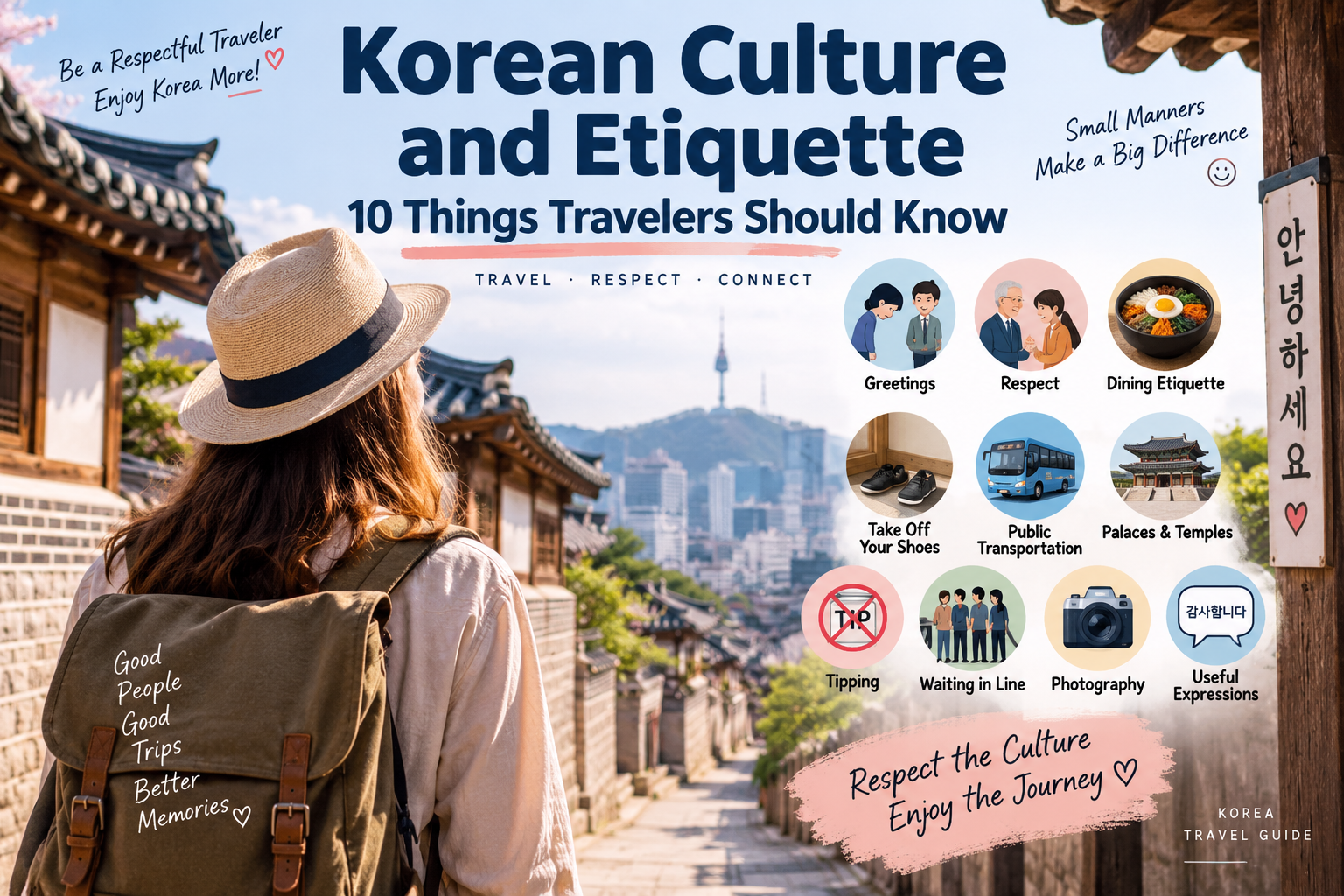
  • Korean Culture and Etiquette: 10 Things Travelers Should Know

    Korean Culture and Etiquette: 10 Things Travelers Should Know

    When you travel to a new country, learning a few local customs can make your experience more comfortable and enjoyable.

    Korea has a modern lifestyle, but traditional ideas about respect, consideration, and social manners are still important in many situations.

    You do not need to understand every Korean custom before your trip.

    Learning a few basic points can help you communicate more comfortably and show respect for local people and places.

    Here are 10 simple things travelers should know about Korean culture and etiquette.

    1. A Polite Greeting Goes a Long Way

    A simple greeting is an important part of everyday interaction in Korea.

    You may hear “Annyeonghaseyo,” which means “Hello.”

    A small bow or a polite nod can also be used when greeting someone.

    In formal situations, using polite language is generally appreciated.

    You do not need to worry about perfect Korean. A friendly greeting and respectful attitude are usually more important.

    2. Respect for Older People Is Important

    Korean culture traditionally places importance on showing respect to older people.

    You may notice this in family relationships, workplaces, restaurants, and other social situations.

    When interacting with someone older, using polite language and a respectful tone is generally appropriate.

    Travelers do not need to know every rule, but being considerate and observant can help.

    3. Understand Basic Dining Etiquette

    Korean meals are often shared, with several dishes placed in the middle of the table.

    It is common for people to share side dishes and other food.

    When eating with others, wait until everyone is ready before beginning the meal in formal or social situations.

    Try to avoid making excessive noise while eating and be considerate of the people around you.

    If you are unsure about what to do, simply observe the people you are dining with.


    4. Take Your Shoes Off When Required

    In Korea, shoes are usually removed before entering many homes.

    You may also encounter restaurants, guesthouses, traditional accommodations, or other spaces where you are expected to take off your shoes.

    Look for a raised floor, shoe racks, or signs near the entrance.

    If other visitors are removing their shoes, that is usually a good indication that you should do the same.

    Travel tip: Wear clean socks and comfortable shoes that are easy to take off and put back on.

    5. Be Considerate on Public Transportation

    Korean buses and subways can become very busy, especially during commuting hours.

    Give priority seats to people who may need them, such as elderly passengers, pregnant people, or passengers with disabilities.

    Keep your voice at a reasonable level and avoid blocking doors or aisles with large luggage.

    When getting on or off, allow passengers to exit before you enter.

    Small acts of consideration can make public transportation more comfortable for everyone.

    6. Show Respect at Palaces and Temples

    Korea has many historical palaces, temples, museums, and cultural sites.

    When visiting these places, follow signs and instructions from staff.

    Avoid touching objects or entering restricted areas.

    At temples and other religious sites, behave quietly and respectfully.

    Photography may not be permitted in certain areas, so check the rules before taking pictures.

    Travel tip: Take a moment to read information signs. They can help you understand the history and meaning of the place you are visiting.

    7. Understand Tipping Culture

    Tipping is not generally a standard part of everyday dining in Korea in the same way it is in some countries.

    At many restaurants and cafes, you normally pay the listed price without adding a tip.

    Some businesses may have their own policies or optional service charges, so check the bill if you are unsure.

    You do not need to feel uncomfortable if you are not familiar with local practices. Simply follow the information provided by the business.

    8. Be Patient When Waiting in Line

    Queues are common at popular restaurants, cafes, attractions, and transportation facilities.

    When a line has formed, wait your turn rather than moving ahead of other people.

    Some restaurants use a waiting list or electronic system instead of a traditional line.

    Follow the instructions provided by the staff and keep your phone available if you are asked to enter your information.

    A little patience can make busy places much easier to navigate.

    9. Ask Before Taking Photos of People

    Korea is a highly connected and visually interesting country, so you may want to take many photographs during your trip.

    When photographing strangers, however, be considerate.

    Avoid taking close-up photographs of people without permission, especially in situations where they may reasonably expect privacy.

    At cultural sites, restaurants, markets, and events, also follow any photography rules.

    If someone is clearly the main subject of your photograph, asking permission is a polite choice.

    10. A Little Consideration Makes a Big Difference

    You do not need to know every Korean custom to have a wonderful trip.

    Being polite, observing your surroundings, following signs, and showing consideration for other people will take you a long way.

    If you make a small cultural mistake, do not panic.

    A sincere apology and a willingness to follow local customs are usually much more important than being perfect.

    A Few Useful Korean Expressions

    Learning a few simple Korean expressions can make everyday interactions easier.

    Annyeonghaseyo — Hello

    Gamsahamnida — Thank you

    Joesonghamnida — Excuse me / I’m sorry

    Juseyo — Please give me / Please

    You do not need perfect pronunciation. Even a simple attempt can make an interaction friendlier.

    Final Thoughts

    Travel is not only about seeing famous places.

    It is also about understanding and respecting the people, culture, and everyday life of the country you visit.

    Korea is a modern and diverse country, and customs can vary depending on the situation and individual.

    Rather than trying to memorize every rule, focus on being polite, observant, and considerate.

    Respect the culture, stay curious, and enjoy discovering Korea from a local perspective.

    A little cultural awareness can make your journey more comfortable and help create positive experiences with the people you meet.

  • Hanok Stays in Korea: A Guide to Traditional Korean Accommodation

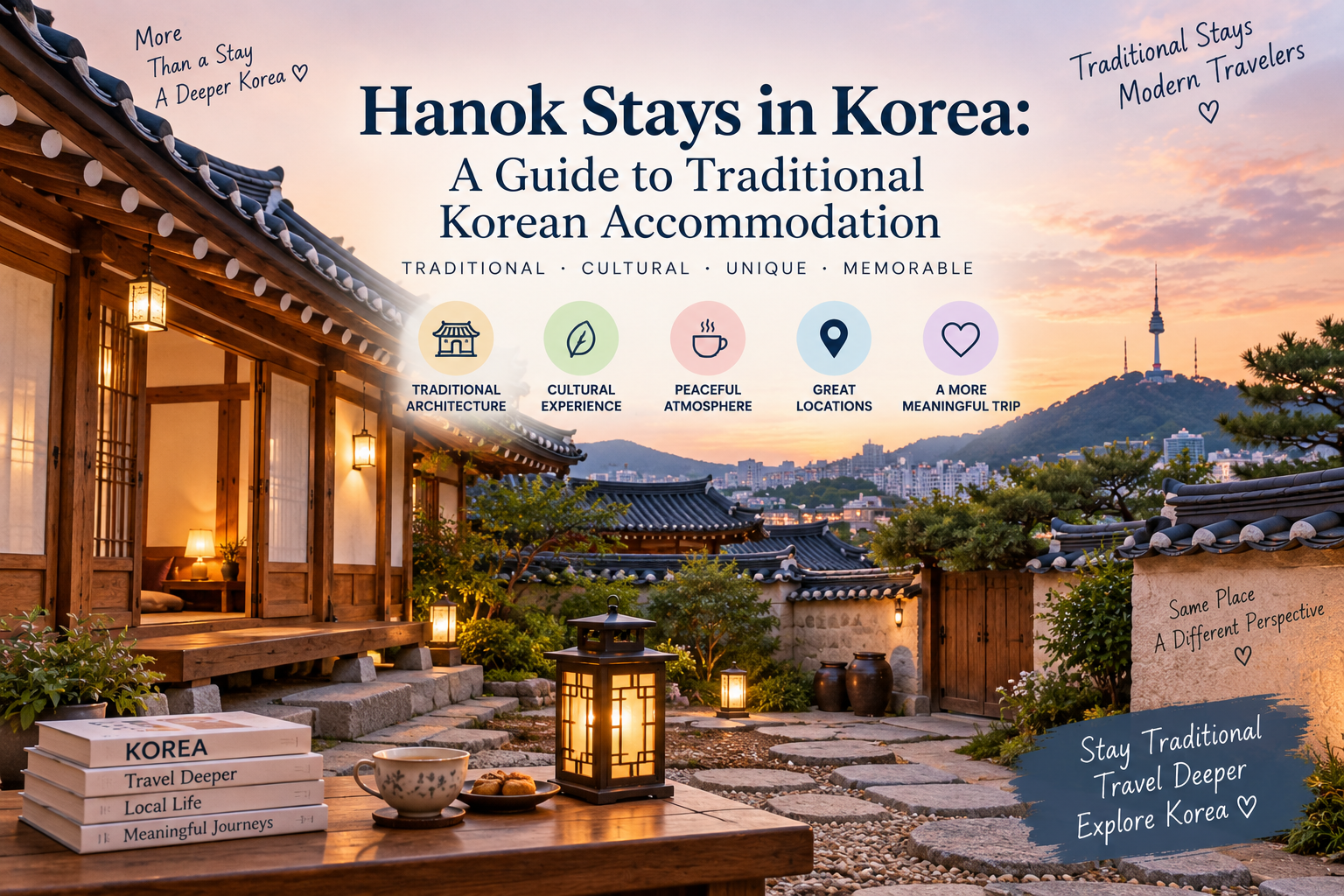
    Hanok Stays in Korea: A Guide to Traditional Korean Accommodation

    If you want to experience a different side of Korea, staying in a traditional hanok can be a memorable part of your trip.

    A hanok is a traditional Korean house designed around traditional architecture, natural materials, and a layout suited to the Korean way of life.

    Today, some traditional houses have been renovated and adapted for travelers while preserving important elements of traditional Korean architecture.

    A hanok stay can offer an experience that feels very different from staying in a modern hotel.

    However, it is important to understand what to expect before making a reservation.

    This guide explains what a hanok stay is, what the experience can be like, and what to check before booking.

    1. What Is a Hanok?

    Hanok refers to traditional Korean houses.

    Traditional hanok architecture often includes wooden structures, tiled roofs, courtyards, and spaces designed to connect the interior with the surrounding environment.

    Different regions and periods of Korean history have produced different styles of hanok.

    Some hanok accommodations are historic buildings, while others are newer properties designed in a traditional style.

    For travelers, this means that the experience can vary considerably from one accommodation to another.

    2. What Is a Hanok Stay?

    A hanok stay allows visitors to spend the night in a traditional-style Korean house.

    Some properties offer private rooms, while others may have shared areas.

    Depending on the accommodation, guests may sleep on a traditional-style floor mattress rather than a Western-style bed.

    Some hanok stays also have courtyards, gardens, traditional furniture, or other cultural features.

    The atmosphere is often quieter and more intimate than a large hotel.

    3. Understanding Ondol

    One traditional feature you may encounter is ondol, Korea’s traditional underfloor heating system.

    Instead of heating the room through radiators or vents, traditional ondol warms the floor.

    Modern hanok accommodations may use updated heating systems while maintaining the experience of warm floors.

    If you are used to sleeping on a Western-style bed, sleeping on a floor mattress may feel different at first.

    For many visitors, however, experiencing a traditional-style sleeping arrangement is one of the memorable parts of a hanok stay.

    Travel tip: Check the sleeping arrangement carefully before booking, especially if you have mobility concerns or prefer a standard bed.

    4. A Different Travel Experience

    One of the biggest advantages of a hanok stay is the opportunity to experience a traditional side of Korea.

    Instead of simply visiting a traditional building during the day, you can actually spend time in a traditional-style space.

    You may enjoy a quiet courtyard in the morning, walk through nearby historic neighborhoods, or experience traditional architecture at a slower pace.

    For international visitors, this can make a trip feel more connected to Korean culture and everyday traditions.

    5. A Quiet and Relaxing Atmosphere

    Many hanok accommodations are located in traditional neighborhoods or quieter residential areas.

    The atmosphere can be peaceful, especially in the evening.

    Some properties have small courtyards or gardens where guests can relax.

    However, the level of privacy and quietness varies between properties.

    Read recent guest reviews to understand the actual environment before booking.

    6. Hanok Stays Can Be Different from Hotels

    A hanok stay may not provide the same facilities as a modern hotel.

    Some properties have smaller rooms, traditional bathrooms, limited storage space, or fewer common facilities.

    Some may not have elevators, particularly if the property is a traditional building.

    This does not necessarily mean the accommodation is unsuitable.

    It simply means that the experience is different from staying in a modern hotel.

    Understanding this difference can help you choose a hanok stay that matches your expectations.

    7. Consider Your Comfort

    Traditional accommodation can be beautiful and memorable, but comfort should still be a priority.

    Before booking, check whether the room has air conditioning, heating, a private bathroom, Wi-Fi, and the type of bedding you prefer.

    If you are sensitive to noise, check reviews about sound insulation.

    If you have large luggage, look at the property’s access and storage options.

    Travel tip: A traditional atmosphere is wonderful, but make sure the basic facilities meet your needs.

    8. Check the Location Before Booking

    Location is important when choosing a hanok stay.

    Many traditional neighborhoods are close to historical attractions, but some streets can be narrow or difficult to reach by car.

    Check the walking distance from the nearest subway station or bus stop.

    If you are carrying heavy luggage, consider how easy it will be to reach the accommodation.

    It is also useful to check whether restaurants, convenience stores, and other basic services are nearby.

    9. Who Should Consider a Hanok Stay?

    A hanok stay can be a great choice for travelers who:

    • want to experience traditional Korean architecture;
    • enjoy cultural and historical experiences;
    • prefer a quieter neighborhood;
    • are interested in Korean traditions;
    • want a memorable alternative to a modern hotel.

    It may be less suitable for travelers who strongly prefer large hotel rooms, elevators, extensive facilities, or a standard Western-style bed.

    There is no right or wrong choice.

    The best accommodation is the one that matches your expectations and travel style.

    10. What to Check Before Booking

    Before booking a hanok stay, check:

    • sleeping arrangements;
    • private or shared bathroom;
    • heating and air conditioning;
    • Wi-Fi availability;
    • luggage storage;
    • stairs or elevator access;
    • check-in and check-out times;
    • cancellation policy;
    • recent guest reviews;
    • exact location and access.

    Taking a few minutes to check these details can help you avoid surprises after arrival.

    Final Thoughts

    A hanok stay can be one of the most memorable experiences of a trip to Korea.

    It gives travelers an opportunity to slow down and experience traditional Korean architecture and atmosphere in a more personal way.

    At the same time, a hanok is different from a modern hotel, so it is important to understand the facilities and sleeping arrangements before booking.

    If you choose a property that matches your expectations, a hanok stay can add a special cultural experience to your Korean journey.

    Stay somewhere traditional, slow down, and experience another side of Korea.