
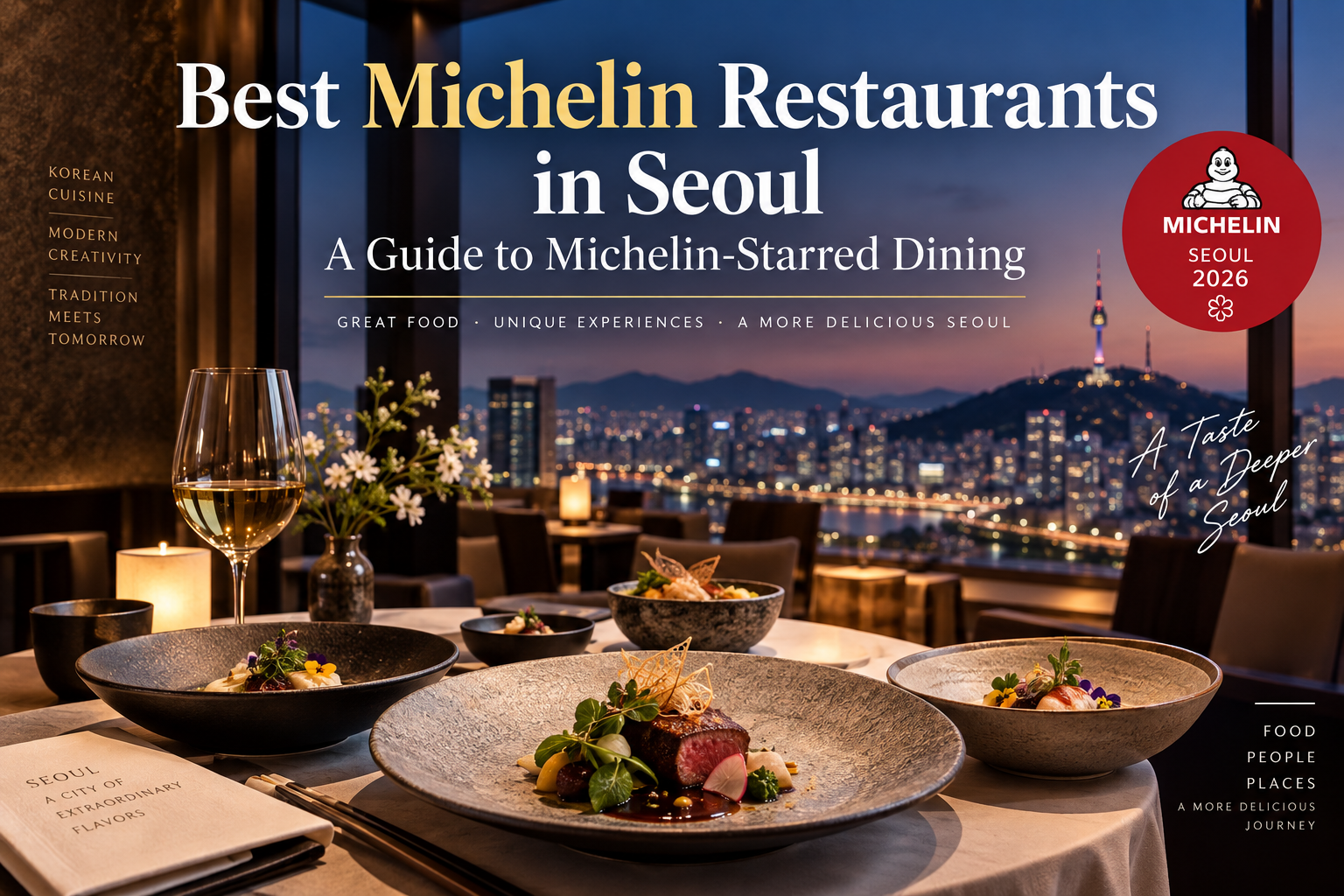
Seoul has become one of Asia’s most exciting destinations for fine dining.
The city’s Michelin-starred restaurants show how Korean chefs are combining traditional ingredients, fermentation, seasonal produce and Korean culinary philosophy with modern techniques and international influences.
The MICHELIN Guide Seoul & Busan 2026 selected 178 restaurants in Seoul, including 42 Michelin-starred restaurants: one Three-Star restaurant, ten Two-Star restaurants and thirty-one One-Star restaurants. The selection also includes Bib Gourmand and Michelin Selected restaurants.
For travelers visiting Korea for the first time, Michelin-starred dining can be an excellent way to experience a more refined side of Korean food culture.
Here are some of the Seoul restaurants that stand out in the 2026 Michelin Guide.
1. Mingles – Seoul’s Three-Michelin-Star Experience
Mingles is the highest-rated Michelin restaurant in Seoul in the 2026 guide.
Chef Mingoo Kang’s restaurant retained Three Michelin Stars for the second consecutive year, continuing to represent the highest level of Korean gastronomy recognized by the Michelin Guide.
Mingles focuses on Korean culinary traditions while presenting them through a contemporary tasting-menu format.
The restaurant makes particularly thoughtful use of Korean fermented ingredients and traditional flavors. Its cuisine aims to connect familiar Korean tastes with modern fine-dining techniques.
Michelin Rating: ★★★ Three Michelin Stars
Cuisine: Korean
Price Level: ₩₩₩₩
Address: 2F, 19 Dosan-daero 67-gil, Gangnam-gu, Seoul 06016, South Korea
Telephone: +82-2-515-7306
Best for: Special occasions, food enthusiasts and travelers looking for an exceptional Korean fine-dining experience.
Why Visit?
Mingles is especially interesting for international visitors because the experience demonstrates how Korean cuisine can be interpreted at the highest level without losing its identity.
2. La Yeon – Refined Korean Cuisine with a Seoul Skyline
La Yeon is another important name in Seoul’s fine-dining scene.
The restaurant focuses on Korean cuisine presented with precision and refinement. Traditional ingredients and dishes are interpreted through a sophisticated contemporary dining experience.
La Yeon is also located within The Shilla Seoul, making the restaurant particularly attractive to travelers who want to combine a luxury hotel stay with a Michelin-starred meal.
Michelin Rating: ★★ Two Michelin Stars
Cuisine: Korean
Price Level: ₩₩₩₩
Best for: Luxury travelers, couples and special celebrations.
The restaurant’s setting adds another dimension to the experience, especially for visitors who want to enjoy Korean cuisine in an elegant environment.
3. Mosu – Modern Korean Cuisine in Yongsan
Mosu returned to Seoul with a new chapter and received Two Michelin Stars in the 2026 guide.
Chef Sung Anh’s cuisine emphasizes precision, balance and carefully controlled textures rather than unnecessary complexity.
The restaurant’s current location is in Yongsan, and the dining room provides different experiences depending on where guests sit.
The Michelin Guide highlights dishes such as abalone taco, sesame tofu, burdock tarte and steamed tilefish in anchovy broth.
Michelin Rating: ★★ Two Michelin Stars
Cuisine: Modern Cuisine
Price Level: ₩₩₩₩
Address: 4 Hoenamu-ro 41-gil, Yongsan-gu, Seoul 04344, South Korea
Telephone: +82-2-6272-5678
Best for: Experienced food travelers, couples and diners interested in contemporary Korean-inspired cuisine.
A Special Point About Mosu
Mosu’s return is one of the notable stories of the 2026 Seoul Michelin selection.
The restaurant previously reached Three Michelin Stars before closing temporarily in 2024. It reopened in the same general area in 2025 and received Two Stars in the 2026 edition.
4. Sosuheon – Sushi in a Traditional Hanok Setting
Sosuheon offers an unusual combination of Japanese sushi and traditional Korean architectural atmosphere.
The restaurant was promoted to Two Michelin Stars in 2026. The Michelin Guide describes it as an eight-seat counter located within a traditional hanok against Seoul’s modern skyline.
The intimate setting makes the experience very different from a large fine-dining restaurant.
Michelin Rating: ★★ Two Michelin Stars
Cuisine: Sushi
Price Level: ₩₩₩₩
Best for: Sushi lovers, couples and travelers looking for an intimate dining experience.
Why Is It Interesting?
The combination of a traditional Korean building and high-level Japanese sushi creates a particularly Seoul-specific atmosphere.
It is a good example of how different culinary traditions coexist within the city.
5. Onjium – Contemporary Korean Cuisine Rooted in Tradition
Onjium focuses on Korean cuisine while exploring traditional Korean ingredients, techniques and food culture through a contemporary approach.
The restaurant is particularly interesting for visitors who want a fine-dining experience that remains closely connected to Korean culinary heritage.
Michelin Rating: ★ One Michelin Star
Cuisine: Korean
Price Level: ₩₩₩₩
Best for: Cultural travelers, Korean food enthusiasts and visitors interested in traditional ingredients.
6. JUEUN – Modern Korean Dining
JUEUN is a Korean restaurant recognized with One Michelin Star in the 2026 selection.
Its cuisine explores Korean flavors through a contemporary fine-dining format, making it suitable for travelers who want to experience Korean ingredients in a more modern setting.
The Michelin Guide also highlights dishes such as japchae in its 2026 inspector recommendations.
Michelin Rating: ★ One Michelin Star
Cuisine: Korean
Price Level: ₩₩₩₩
Best for: Travelers interested in contemporary Korean cuisine.
7. Kwonsooksoo – Elegant Korean Fine Dining
Kwonsooksoo is another important Korean fine-dining restaurant in Seoul.
The restaurant has maintained its Michelin recognition through a cuisine that focuses on Korean ingredients, seasonal flavors and refined presentation.
Michelin Rating: ★★ Two Michelin Stars
Cuisine: Korean
Price Level: ₩₩₩₩
Best for: Special occasions and travelers looking for sophisticated Korean cuisine.
8. Jungsik – Contemporary Korean Cuisine with Global Influence
Jungsik is one of Seoul’s best-known contemporary Korean restaurants.
Its approach combines Korean ingredients and culinary ideas with techniques and presentation associated with contemporary fine dining.
The restaurant is particularly interesting for international visitors because it demonstrates how Korean cuisine can move beyond traditional formats while maintaining recognizable Korean elements.
Michelin Rating: ★★ Two Michelin Stars
Cuisine: Contemporary
Price Level: ₩₩₩₩
Best for: International food lovers and travelers looking for contemporary Korean cuisine.
9. Evett – Innovative Cuisine in Seoul
Evett is known for its innovative approach to ingredients and Korean culinary influences.
The restaurant received Two Michelin Stars in the 2026 Seoul selection.
Its cuisine can be a good choice for adventurous diners who want something beyond a conventional Korean meal.
Michelin Rating: ★★ Two Michelin Stars
Cuisine: Innovative
Price Level: ₩₩₩₩
Best for: Adventurous food travelers and diners interested in creative tasting menus.
10. Restaurant Allen – Contemporary Fine Dining
Restaurant Allen is another restaurant holding Two Michelin Stars in the 2026 Seoul selection.
Its cuisine is contemporary and designed around a refined tasting experience.
Michelin Rating: ★★ Two Michelin Stars
Cuisine: Contemporary
Price Level: ₩₩₩₩
Best for: Couples, special occasions and experienced fine-dining travelers.
Understanding Michelin Stars in Seoul
The Michelin Guide uses stars to recognize restaurants according to the quality of their cooking.
One Michelin Star represents high-quality cooking.
Two Michelin Stars indicate excellent cooking that is worth a detour.
Three Michelin Stars represent exceptional cuisine considered worth a special journey.
In Seoul’s 2026 selection, there is only one Three-Star restaurant: Mingles.
That makes a meal at Mingles particularly significant for travelers interested in the highest level of Korean gastronomy.
Michelin-Starred Korean Food vs. Traditional Korean Restaurants
A Michelin-starred Korean restaurant can be very different from the traditional restaurants featured in our Seoul food guide.
A traditional restaurant might specialize in one dish—such as gomtang, naengmyeon or samgyetang—and have been serving it for generations.
A Michelin-starred restaurant may instead present Korean ingredients through a multi-course tasting menu.
Neither experience is necessarily better.
They simply show different sides of Korean food culture.
For a first trip to Seoul, experiencing both can be particularly rewarding.
How Much Does Michelin Dining in Seoul Cost?
Most Michelin-starred restaurants are significantly more expensive than everyday Korean restaurants.
The Michelin Guide’s price categories show that many Seoul two- and three-star restaurants fall into the highest price category, ₩₩₩₩.
Tasting menus can also require a significant time commitment, often lasting several hours.
Travelers should therefore think of Michelin dining as an experience rather than simply another meal.
Should You Make a Reservation?
Yes.
Popular Michelin-starred restaurants can have limited seating, and many operate only on selected days or during specific lunch and dinner periods.
The Michelin Guide currently provides reservation information for some restaurants, while others ask guests to contact the restaurant directly. For example, Mosu manages its own bookings and provides its direct telephone number.
Always check the restaurant’s latest reservation policy before making your travel plans.
What Should First-Time Visitors Expect?
Fine dining in Seoul may include several courses that are unfamiliar to international visitors.
You may encounter Korean fermented ingredients, seasonal seafood, traditional sauces, unusual vegetables and modern interpretations of classic dishes.
Do not worry if you do not recognize every ingredient.
One of the pleasures of a tasting menu is allowing the chefs to introduce Korean flavors in a way that may be completely different from what you have experienced before.
Best Michelin Experience for Different Travelers
For the highest level of Korean cuisine: choose Mingles.
For modern cuisine and an innovative tasting menu: consider Mosu.
For sushi in an unusual Korean setting: consider Sosuheon.
For traditional Korean culinary ideas presented in a refined format: consider La Yeon, Onjium or Kwonsooksoo.
For creative and innovative cuisine: explore Evett or other contemporary Michelin-starred restaurants.
Michelin Restaurants and Seoul Neighborhoods
Many of Seoul’s Michelin restaurants are concentrated in areas such as Gangnam, Cheongdam, Apgujeong, Hannam-dong, Yongsan and central Seoul.
This makes it possible to combine fine dining with sightseeing or shopping.
For example, a restaurant visit in Gangnam can be combined with COEX, Apgujeong or Sinsa.
A meal in Yongsan or Hannam can be combined with museums, galleries and the Hangang area.
Choosing your restaurant according to your daily itinerary can save considerable travel time.
Michelin Dining as Part of Your Seoul Trip
A Michelin dinner does not have to be the only reason to visit a neighborhood.
Instead, plan the entire day around it.
Visit a palace or museum during the afternoon, explore a nearby neighborhood, enjoy a café and then finish the day with a Michelin tasting menu.
This turns the restaurant reservation into the final part of a complete Seoul experience.
A Note About the Michelin Guide
Michelin selections can change every year.
Restaurants may gain stars, lose stars, move locations, close temporarily or reopen under new concepts.
The 2026 Michelin Guide Seoul & Busan was announced on March 5, 2026, so this article uses the 2026 edition as its reference point.
Always check the latest Michelin Guide listing and the restaurant’s own information before traveling.
Final Thoughts
Seoul’s Michelin dining scene shows how Korean cuisine continues to evolve.
Restaurants such as Mingles demonstrate the possibilities of contemporary Korean gastronomy, while places such as La Yeon, Onjium and Kwonsooksoo show how traditional Korean culinary ideas can be transformed into sophisticated fine dining.
Mosu’s return, Sosuheon’s promotion to Two Stars and the continued success of Mingles also demonstrate how quickly Seoul’s fine-dining landscape is changing.
But perhaps the most important thing to remember is that Michelin dining is only one part of Seoul’s food culture.
A Michelin-starred tasting menu, a bowl of noodles in a neighborhood restaurant, a traditional market snack and a cup of coffee in a small café can all tell different stories about the same city.
The best way to taste Seoul is to experience all of them.