
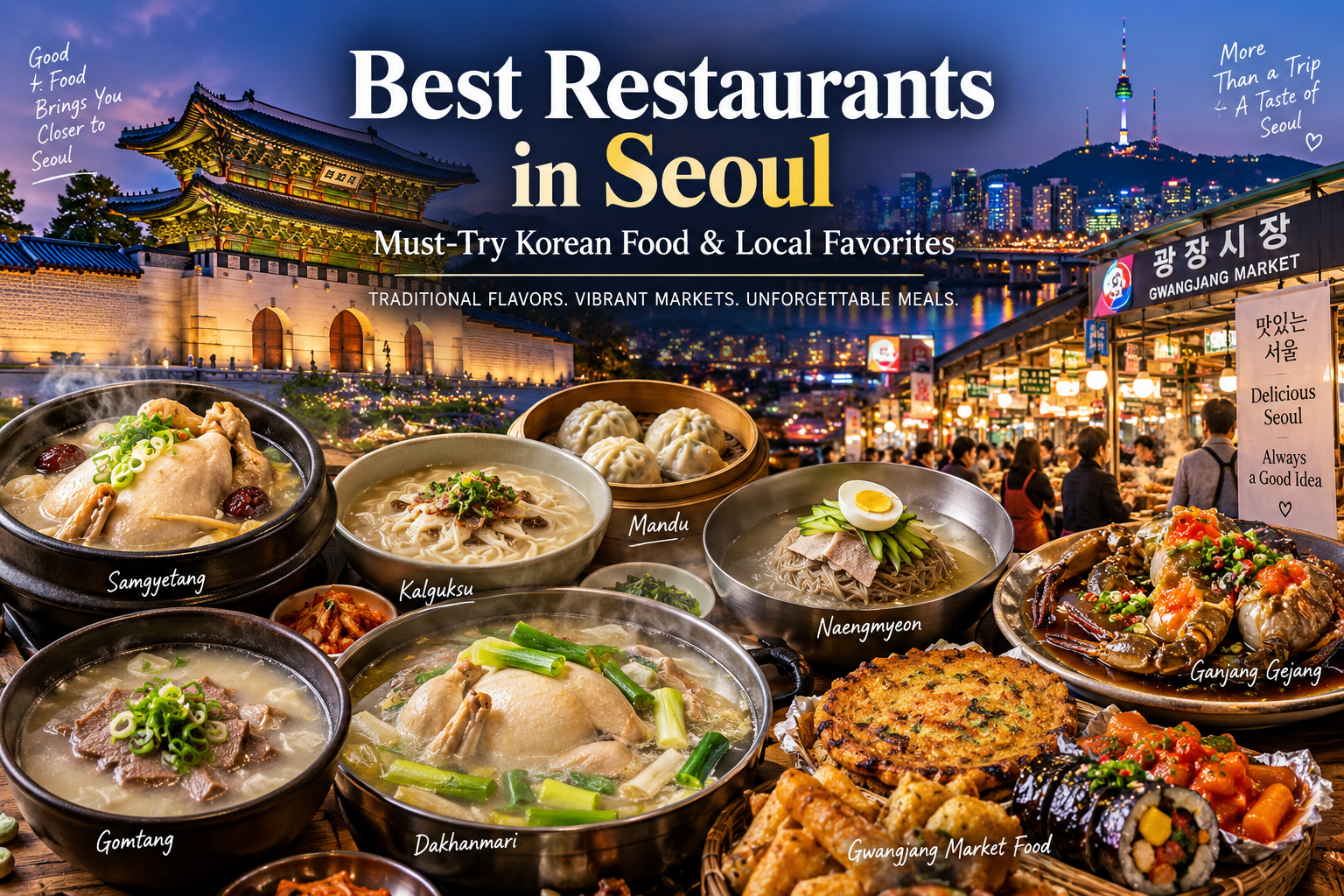
Food is one of the best reasons to visit Seoul.
The city offers everything from decades-old soup restaurants and traditional chicken dishes to handmade noodles, Korean barbecue, marinated crab and busy market food stalls.
For first-time visitors, however, deciding where to eat can be difficult. Seoul is enormous, and thousands of restaurants compete for attention.
This guide focuses on places where travelers can experience some of Korea’s most recognizable dishes while exploring different neighborhoods of Seoul.
Addresses, telephone numbers and practical information are included to make planning easier.
1. Tosokchon Samgyetang – Traditional Ginseng Chicken Soup Near Gyeongbokgung
Tosokchon Samgyetang is one of Seoul’s best-known restaurants for samgyetang, a traditional Korean soup made with a whole young chicken filled with ingredients such as glutinous rice, garlic, jujube and ginseng.
The restaurant has operated near Gyeongbokgung Palace since 1983, and its traditional hanok-style setting adds to the experience. Seoul’s official tourism guide continues to list it as a samgyetang specialty restaurant and notes that multilingual menus are available.
Signature dish: Samgyetang (Ginseng Chicken Soup)
Address: 5 Jahamun-ro 5-gil, Jongno-gu, Seoul 03041, South Korea
Telephone: +82-2-737-7444
Price level: ₩₩
Best for: First-time visitors, traditional Korean food and lunch after palace sightseeing.
Nearby attractions: Gyeongbokgung Palace, Seochon, Gwanghwamun and Tongin Market.
Why Eat Here?
Samgyetang is particularly associated with Korea’s summer food culture. Koreans traditionally eat the hot, nourishing soup during the hottest days of summer—a custom connected with the idea of fighting heat with heat.
Combining Gyeongbokgung Palace, Seochon and a samgyetang lunch makes an excellent half-day Seoul itinerary.
2. Myeongdong Kyoja – Kalguksu and Mandu in the Heart of Myeongdong
Myeongdong Kyoja has been serving diners since 1966 and is famous for a remarkably small menu centered on kalguksu, handmade noodle soup, and mandu, Korean dumplings.
Its location makes it particularly convenient for travelers exploring Myeongdong.
The kalguksu combines soft noodles with a rich, savory broth, while the dumplings are another long-standing favorite.
Signature dishes: Kalguksu and Mandu
Address: 29 Myeongdong 10-gil, Jung-gu, Seoul 04537, South Korea
Telephone: +82-2-776-5348
Price level: ₩
Best for: Budget-friendly Korean food, noodle lovers and Myeongdong visitors.
Nearby attractions: Myeongdong, Namsan, Namdaemun Market and central Seoul.
Why Eat Here?
This is the kind of restaurant that works particularly well for first-time travelers because the menu is easy to understand and the food represents a familiar side of everyday Korean dining.
Seoul’s official tourism guide currently lists the restaurant as operating daily and identifies kalguksu as its specialty.
3. Hadongkwan – Historic Seoul-Style Gomtang
Hadongkwan is one of Seoul’s classic restaurants for gomtang, a clear beef soup served with rice.
The restaurant dates back to 1939 and has become a long-standing Myeongdong institution. Its menu remains focused on gomtang and suyuk, or boiled beef.
Unlike heavily seasoned soups, the attraction here is the clean but deep beef flavor.
Signature dish: Gomtang
Address: 12 Myeongdong 9-gil, Jung-gu, Seoul 04538, South Korea
Telephone: +82-2-776-5656
Price level: ₩
Best for: Traditional Seoul food, breakfast or an early lunch.
Nearby attractions: Myeongdong, Euljiro, Cheonggyecheon Stream and Seoul City Hall.
Travel Tip
Hadongkwan opens early and traditionally stops serving when the day’s prepared soup is sold out, so visiting earlier in the day is a sensible choice.
4. Wonhalmae Wonjo Dakhanmari – A Dongdaemun Favorite
Dakhanmari literally means “a whole chicken.”
The dish is strongly associated with Dongdaemun, where restaurants serve whole chicken simmered at the table in broth. Diners typically eat the chicken first and then add noodles to the remaining broth.
Wonhalmae Wonjo Dakhanmari is one of the restaurants associated with the origins of Dongdaemun’s famous Dakhanmari Street. Seoul’s official tourism guide currently lists its whole-chicken stew set for two among its signature offerings.
Signature dish: Dakhanmari (Whole Chicken Stew)
Address: 25 Jong-ro 40ga-gil, Jongno-gu, Seoul 03197, South Korea
Telephone: +82-2-2279-2078
Price level: ₩₩
Best for: Couples, families and small groups.
Nearby attractions: Dongdaemun, Gwangjang Market, DDP and Cheonggyecheon Stream.
Why Eat Here?
Dakhanmari is a social meal.
The pot sits in the middle of the table, making it especially enjoyable when shared with another traveler or a group of friends.
5. Woo Lae Oak – Pyongyang Naengmyeon Since 1946
Woo Lae Oak is one of Seoul’s most established names for Pyongyang naengmyeon, cold buckwheat noodles served in a delicate broth.
The restaurant has operated since 1946. Its broth is made from beef and is known for a restrained flavor that can seem surprisingly subtle to travelers encountering Pyongyang-style noodles for the first time.
Bulgogi is another popular choice here and can be paired with naengmyeon.
Signature dishes: Pyongyang Naengmyeon and Bulgogi
Address: 62-29 Changgyeonggung-ro, Jung-gu, Seoul 04546, South Korea
Telephone: +82-2-2265-0151
Price level: ₩–₩₩
Best for: Korean food enthusiasts and travelers interested in historic restaurants.
Nearby attractions: Euljiro, Dongdaemun, Gwangjang Market and central Seoul.
What Should You Expect?
Pyongyang naengmyeon is not designed to overwhelm you with spice or sweetness.
Its appeal is subtle. The broth, buckwheat noodles and meat create a restrained combination that becomes more interesting as you continue eating.
6. Pro Soy Crab – Try Ganjang Gejang in Sinsa
Pro Soy Crab is one of Seoul’s long-established restaurants specializing in ganjang gejang, raw crab marinated in soy sauce.
The main restaurant in Sinsa dates back to 1980 and serves several crab and seafood dishes.
Ganjang gejang has an intense combination of salty, sweet and rich seafood flavors. It is traditionally eaten with rice, which absorbs the seasoned crab sauce.
Signature dish: Ganjang Gejang (Soy Sauce Marinated Crab)
Address: 9 Gangnam-daero 97-gil, Seocho-gu, Seoul 06526, South Korea
Telephone: +82-2-543-4126
Price level: ₩₩₩
Best for: Seafood lovers and adventurous first-time visitors.
Nearby attractions: Sinsa, Garosu-gil, Gangnam and the Hangang River.
Before Ordering Raw Crab
Ganjang gejang is raw marinated seafood, so it may not suit every traveler.
Visitors with shellfish allergies, pregnancy-related dietary restrictions or concerns about raw seafood should choose another dish.
7. Jin Ok-Hwa Original Chicken Restaurant – Another Dongdaemun Classic
Jin Ok-Hwa Original Chicken Restaurant is another famous name associated with Dongdaemun’s dakhanmari scene.
The experience is casual and energetic: chicken cooks in a large pot at the table and diners customize dipping sauces before adding noodles or other ingredients later in the meal.
Signature dish: Dakhanmari
Address: 18 Jong-ro 40ga-gil, Jongno-gu, Seoul, South Korea
Telephone: +82-2-2275-9666
Price level: ₩–₩₩
Best for: Groups, casual dining and travelers exploring Dongdaemun.
Nearby attractions: Dongdaemun Market, Gwangjang Market, DDP and Cheonggyecheon Stream.
8. Gwangjang Market – For a Korean Street-Food Experience
Not every memorable Seoul meal needs to happen inside a traditional restaurant.
Gwangjang Market is one of the best places for travelers to experience several Korean foods in one area.
Popular foods include bindaetteok (mung bean pancakes), mayak gimbap (small seaweed rice rolls), yukhoe (Korean-style raw beef) and various noodles, dumplings and market snacks.
Instead of choosing one large meal, walk through the market and try several smaller dishes.
Area: Jongno-gu, Seoul
Price level: ₩
Best for: Street-food lovers, first-time visitors and travelers who enjoy busy traditional markets.
Nearby attractions: Jongmyo Shrine, Dongdaemun, Cheonggyecheon Stream and Euljiro.
Market Tip
Bring an appetite but do not order too much at the first stall.
One of the pleasures of Gwangjang Market is trying several different foods as you walk.
What Korean Foods Should First-Time Visitors Try?
If this is your first trip to Seoul, do not feel that you need to try everything in one day.
Start with a few representative dishes.
Try samgyetang for traditional chicken soup, kalguksu for handmade noodles, gomtang for a classic Seoul beef soup, dakhanmari for a shared meal, and Korean barbecue for one of the country’s most social dining experiences.
Then explore dishes such as naengmyeon, bibimbap, tteokbokki, mandu and ganjang gejang as your trip continues.
What About Korean BBQ?
Korean barbecue deserves its own guide.
Seoul has everything from inexpensive neighborhood pork barbecue restaurants to premium Hanwoo beef establishments.
Instead of adding one random barbecue restaurant to this list, a dedicated Seoul Korean BBQ guide will allow us to compare neighborhoods, meat types, prices and ordering styles properly.
For first-time visitors, remember that many barbecue restaurants expect at least two portions of meat to be ordered, although policies vary by restaurant.
Where Should Food Lovers Stay in Seoul?
Jongno is an excellent base for traditional Korean food, markets and historic sightseeing.
Myeongdong and Euljiro combine famous restaurants with convenient transportation and central sightseeing.
Hongdae and Yeonnam-dong are good choices for younger dining culture, casual restaurants, cafés and nightlife.
Gangnam, Sinsa and Apgujeong offer everything from Korean barbecue to contemporary restaurants and luxury dining.
Your hotel location can therefore influence your food experience almost as much as your restaurant choices.
Traditional Restaurants vs. Michelin Dining
Seoul’s food culture operates on many levels.
A bowl of soup from a restaurant that has served generations of Seoul residents can be just as meaningful as a carefully designed tasting menu.
That is why this guide focuses primarily on traditional and accessible restaurants.
Seoul also has an increasingly important fine-dining scene, including restaurants recognized by the MICHELIN Guide. We will explore those restaurants separately in our dedicated guide to Michelin dining in Seoul.
How Much Does Eating in Seoul Cost?
Seoul can accommodate very different food budgets.
Market snacks and simple noodle dishes can be relatively inexpensive, while Korean barbecue, premium seafood and high-end dining can cost considerably more.
Prices also change over time, so travelers should check the restaurant’s current menu rather than relying entirely on older online price lists.
A useful strategy is to mix inexpensive local meals with one or two special dining experiences.
Restaurant Etiquette for First-Time Visitors
At many Korean restaurants, side dishes called banchan are served automatically.
Water and utensils may be self-service in casual restaurants, while table service is more common at higher-end establishments.
Some restaurants specialize in only one or two dishes. A small menu is not necessarily a disadvantage—in Korea, it can be a sign that a restaurant has spent decades focusing on one specialty.
Busy traditional restaurants may also expect customers to eat and leave relatively quickly, particularly during peak lunch periods.
A Simple Seoul Food Day
A food-focused day in central Seoul could begin with a traditional beef soup in Myeongdong, continue with market snacks at Gwangjang Market and finish with dakhanmari near Dongdaemun.
Another day could combine Gyeongbokgung Palace with samgyetang in Seochon before heading to Sinsa or Gangnam for dinner.
Planning meals around neighborhoods reduces unnecessary travel and gives you more time to experience the city.
Before You Visit
Restaurant hours, prices, holidays and menus can change.
Popular restaurants may also have long lines during lunch, dinner, weekends and holidays.
Check the latest information before traveling across the city specifically for one restaurant. For particularly popular places, arriving outside peak meal times can make the experience easier.
Final Thoughts
The best way to understand Seoul is not only through palaces, museums and neighborhoods.
It is also through food.
A bowl of gomtang in a restaurant that has survived for generations, noodles in crowded Myeongdong, chicken bubbling in a Dongdaemun pot or a few dishes shared at a traditional market can reveal a side of Seoul that sightseeing alone cannot provide.
Do not simply ask, “What is the most famous restaurant in Seoul?”
Ask instead, “What part of Seoul do I want to taste today?”
That question can lead to some of the best memories of your trip.