
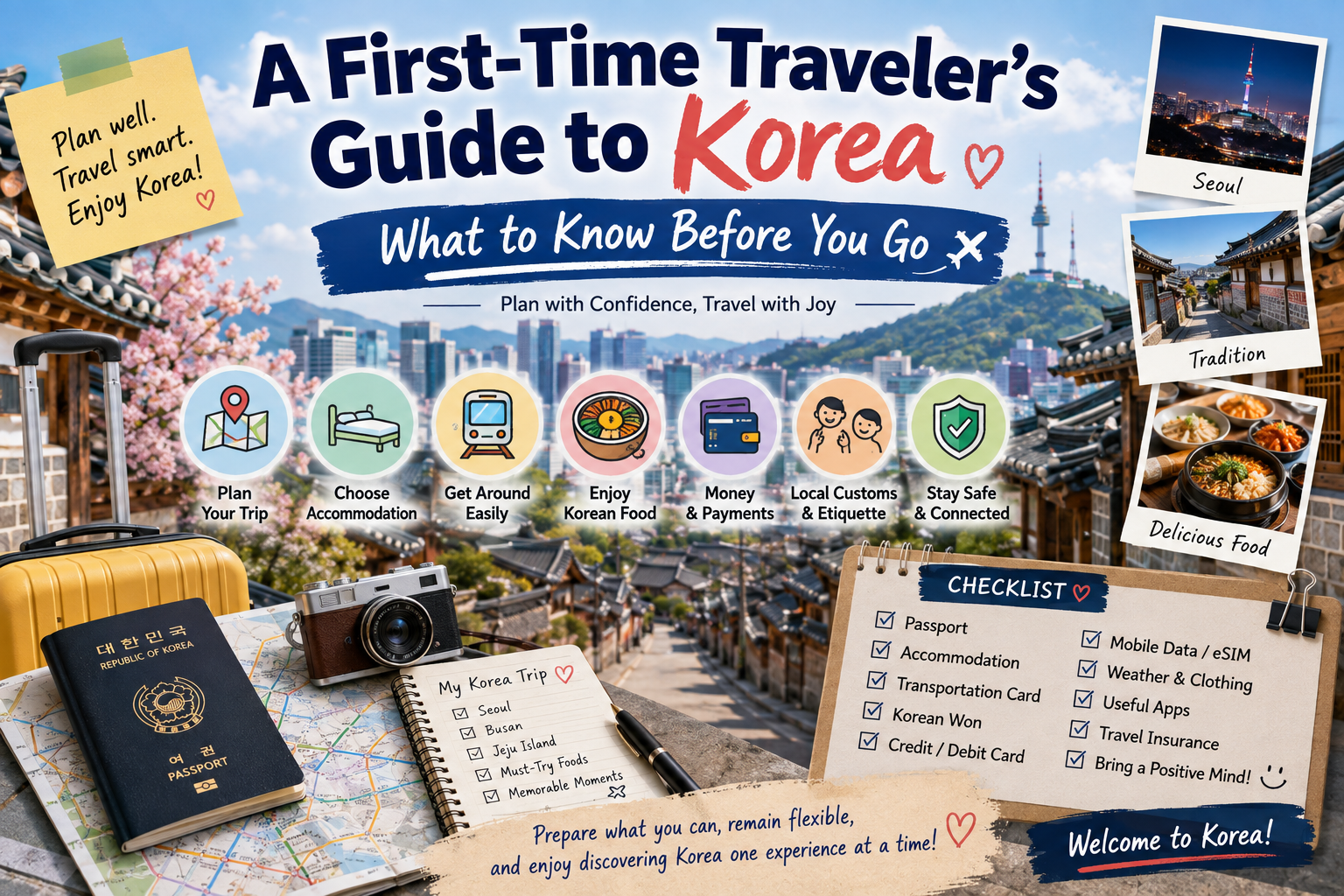
Planning your first trip to Korea can feel exciting and a little overwhelming.
There are many things to think about before you leave, including where to stay, how to get around, what to eat, how to pay for things, and what local customs to know.
The good news is that you do not need to know everything before your trip.
A little preparation can make your journey much more comfortable and help you spend more time enjoying Korea.
This guide brings together some of the most useful things first-time travelers should know before visiting Korea.
1. Decide What Kind of Trip You Want
Before making detailed plans, think about what you want from your trip.
Do you want to explore Korean history and traditional culture?
Would you rather spend your time shopping, enjoying cafes, trying local food, or experiencing nightlife?
Perhaps you want a mixture of city sightseeing, nature, food, and cultural experiences.
Knowing your priorities will make it easier to choose where to stay and how to plan your daily activities.
You do not need to visit every famous attraction.
A relaxed itinerary can sometimes create better memories than trying to see everything in a short period.
2. Choose the Right Time to Visit
Korea has four distinct seasons, and each one offers a different travel experience.
Spring can be beautiful with flowers and comfortable temperatures.
Summer is warm and can be a good time for beaches and island trips.
Autumn offers pleasant weather and colorful scenery.
Winter is cold but provides opportunities to experience winter landscapes, seasonal food, and indoor cultural activities.
Think about the activities you enjoy before choosing your travel dates.
3. Choose Your Accommodation Area Carefully
Where you stay can have a major effect on your daily travel experience.
Myeongdong can be convenient for first-time visitors who want shopping and easy access to tourist attractions.
Hongdae is popular with travelers who enjoy cafes, music, shopping, and nightlife.
Jongno and Insadong are good choices for travelers interested in history and traditional Korean culture.
Gangnam offers a modern atmosphere, shopping, restaurants, and business facilities.
Itaewon is known for its international atmosphere and diverse food options.
Seoul Station can be particularly useful if you plan to travel to other Korean cities by train.
Before booking, check the exact location and the distance to public transportation.
4. Decide What Type of Accommodation You Need
Your accommodation does not have to be the most expensive option.
Luxury hotels can offer excellent comfort and service, while mid-range and budget hotels may provide better value for travelers who spend most of their day sightseeing.
A hanok stay can provide a memorable traditional Korean experience.
Guesthouses and Airbnb-style accommodations may offer a more local atmosphere or useful facilities for longer stays.
The important thing is to choose accommodation that matches your travel style, budget, and expectations.
5. Learn the Basics of Public Transportation
Korea has a convenient public transportation system, especially in major cities.
Subways and buses are useful for exploring Seoul, while trains can make it easier to travel between different cities.
A transportation card such as T-money can be useful if you plan to use buses and subways frequently.
Before leaving your accommodation, check your route and allow extra time if you need to transfer between subway lines or buses.
If you are carrying large luggage, a route with fewer transfers may be more comfortable even if it takes slightly longer.
6. Try Different Korean Foods
Food is one of the most enjoyable parts of traveling in Korea.
Popular choices include bibimbap, bulgogi, gimbap, Korean fried chicken, tteokbokki, samgyeopsal, and many different soups and stews.
Do not feel that you have to eat at expensive restaurants.
Traditional markets, neighborhood restaurants, cafes, and casual food shops can all provide interesting experiences.
If you are sensitive to spicy food, ask about the level of spiciness before ordering.
Trying a small portion of an unfamiliar dish can be an easy way to discover new flavors.
7. Understand How Payments Work
The currency used in Korea is the South Korean won, or KRW.
Credit and debit cards are widely accepted, especially in cities and tourist areas.
However, carrying some Korean won can still be useful for small businesses, traditional markets, street food, or situations where card payment is unavailable.
It is also a good idea to have a backup payment method while traveling.
Before your trip, check whether your bank or card provider charges international transaction or ATM fees.
8. Learn a Few Local Customs
You do not need to memorize every Korean custom before your trip.
A few simple habits can make everyday interactions easier.
Use polite language when speaking with people, follow local rules at cultural sites, and be considerate on public transportation.
In some places, such as homes and certain traditional accommodations or restaurants, you may be expected to remove your shoes.
When taking photographs, be respectful of people’s privacy and follow photography rules at cultural or religious sites.
A friendly attitude and willingness to learn go a long way.
9. Prepare for the Weather
Check the weather forecast before your trip and pack accordingly.
Korea can have significant seasonal differences, so the clothing you need will depend on when you visit.
Comfortable walking shoes are especially important because many sightseeing days involve walking between attractions, subway stations, restaurants, and shopping areas.
An umbrella can also be useful depending on the season.
10. Stay Connected
Having reliable internet access can make traveling much easier.
You may need mobile data for maps, translation apps, transportation information, restaurant searches, and communication.
Depending on your phone and travel plans, you can consider options such as an international roaming plan, a travel eSIM, or a local SIM.
Check compatibility and pricing before your trip so you can choose the option that works best for you.
11. Plan Your Days, But Leave Some Flexibility
A basic itinerary is helpful, but you do not need to plan every minute.
Group attractions that are located near each other so you do not spend unnecessary time traveling across the city.
Leave some free time for unexpected discoveries.
You may find a small restaurant, traditional market, cafe, park, or neighborhood that was not in your original plan.
Some of the best travel memories can come from experiences you did not plan in advance.
12. Be Prepared, But Enjoy the Journey
A successful trip is not about following a perfect schedule.
Things can change because of weather, transportation, opening hours, or unexpected circumstances.
If something does not go according to plan, take a breath and look for another option.
Korea has many different places to explore, and there is usually more than one way to enjoy a day.
Final Checklist Before Leaving for Korea
Before your trip, consider checking these basics:
- passport and travel documents;
- accommodation reservations;
- transportation plans;
- international payment cards;
- some Korean won;
- mobile data or an eSIM;
- weather and appropriate clothing;
- useful navigation and translation apps;
- important addresses saved on your phone;
- and travel insurance appropriate for your circumstances.
Final Thoughts
Your first trip to Korea does not have to be complicated.
Choose an area that suits your travel plans, find accommodation that fits your needs, learn the basics of public transportation, and prepare a few simple payment and communication options.
Try Korean food, explore traditional and modern neighborhoods, and take some time to experience everyday life.
Most importantly, stay curious.
You do not have to understand everything before you arrive.
Prepare what you can, remain flexible, and enjoy discovering Korea one experience at a time.
We hope this guide helps you feel more confident about your first trip to Korea.
Welcome to Korea, and have a wonderful journey!