
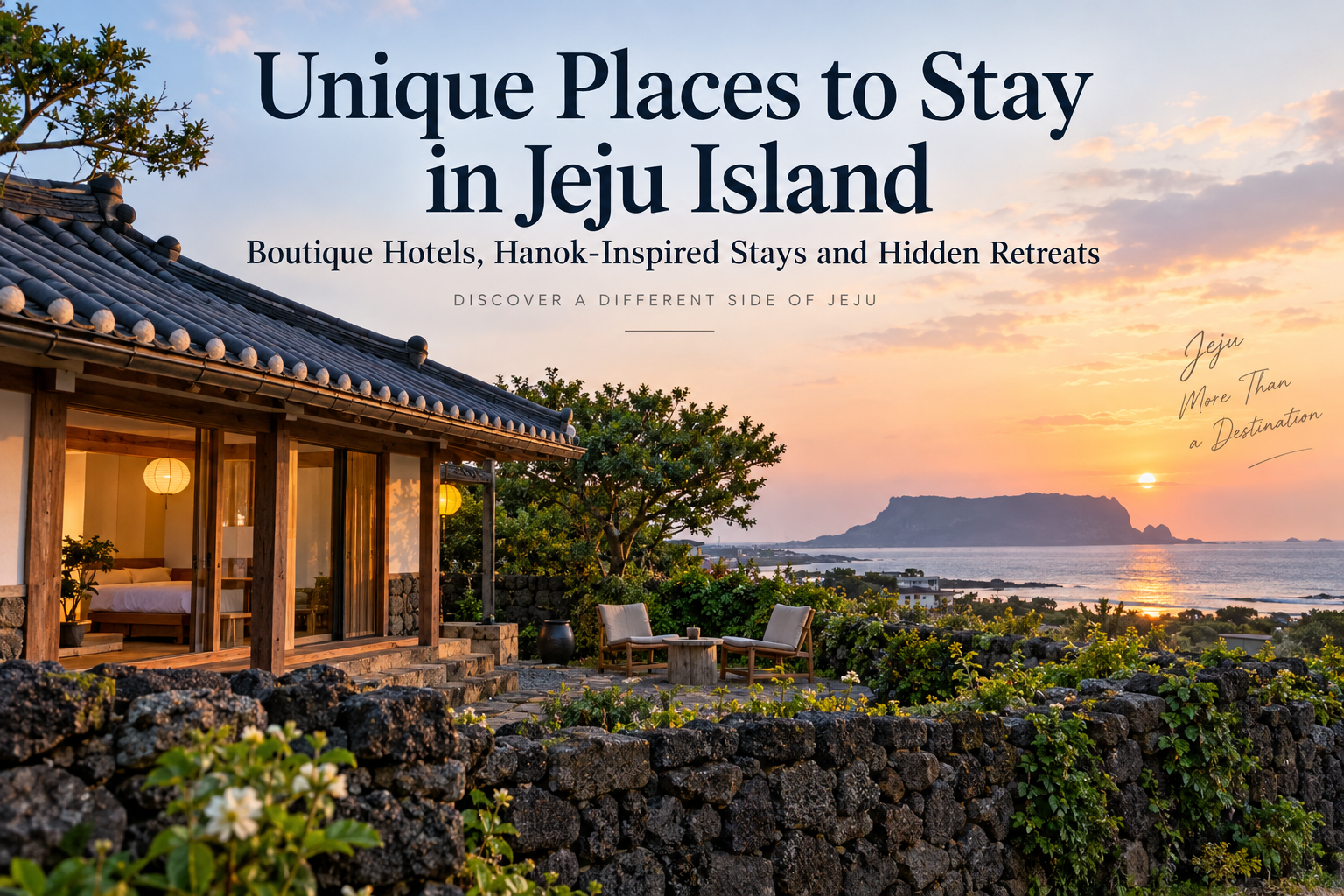
Why Choose a Unique Stay in Jeju Island?
A trip to Jeju Island does not have to begin and end with a large resort.
Across the island, travelers can find small boutique hotels, contemporary hanok stays, renovated Jeju stone houses, private villas, and peaceful retreats surrounded by nature.
These accommodations offer something different from conventional hotels. Instead of simply providing a room, many reflect the landscapes, architecture, and slower rhythm of island life.
For travelers who want their accommodation to become part of the Jeju experience, here are several styles of unique stays worth considering.
1. Jeju Miheon Hanok Stay — Traditional Korea with Modern Comfort
제주미헌 한옥(Jeju Miheon Hanok)
4.6•숙박업소(B&B)웹사이트
•경로
•050-71385-2045
Travelers who want to experience Korean architecture without giving up modern comforts can consider Jeju Miheon.
This contemporary hanok stay combines elements of traditional Korean design with clean, minimalist interiors.
Guests can choose private accommodations with bedrooms, living spaces, kitchens, and bathrooms, while the garden and rooftop provide quiet places to relax.
Its location in Jeju City also makes it an interesting option for travelers who want a distinctive stay without being too far from the airport and city conveniences.
Best for: Couples, small families, first-time hanok guests, and travelers who want tradition with modern convenience.
2. Hallagung Hanok Hotel — A Traditional Stay in Seogwipo
한옥호텔 한라궁
4.1•호텔웹사이트
•경로
•064-732-7900
Hallagung offers another way to experience traditional Korean-style accommodation on Jeju.
Located in Seogwipo, the property incorporates wooden architecture, Korean-paper windows, ondol-style rooms, and traditional design elements.
Its location is especially convenient for travelers planning to explore southern Jeju. Seogwipo’s waterfalls, markets, restaurants, and coastal attractions can all become part of the itinerary.
For international visitors who have never stayed in a hanok before, Hallagung provides an accessible introduction to this style of Korean accommodation.
Best for: Culture-focused travelers, families, and visitors exploring Seogwipo.
3. Hadohado 1929 — A Reborn Jeju Stone House
For something distinctly Jeju, look beyond the traditional mainland-style hanok.
Jeju has its own architectural identity, shaped by volcanic stone, strong winds, and island life.
Hadohado 1929 in Gujwa transforms a traditional Jeju stone house into a private accommodation with modern design.
According to Visit Jeju, the property is reserved for one group per day and includes two bedrooms, a living room, an indoor open-air bath, and a space designed to look toward the sea.
Its eastern Jeju location also works well for travelers interested in places such as Sehwa, Woljeong-ri, and Seongsan.
Best for: Couples, families, photographers, and travelers looking for an authentic Jeju atmosphere.
4. The Seaes Hotel & Resort — Jeju Tradition Meets Luxury
For travelers who like the idea of traditional design but still want resort-level comfort, The Seaes Hotel & Resort offers an interesting middle ground.
Located along the Jungmun coast, the property incorporates architectural elements inspired by traditional Jeju houses, including volcanic stone walls and traditional-style structures.
Some accommodations combine these exterior influences with contemporary interiors, while traditional-inspired spaces create a stronger connection to Jeju’s architectural past.
Its Jungmun location also places travelers close to major attractions in southern Jeju.
Best for: Couples, special occasions, and travelers who want traditional atmosphere with luxury.
5. A Boutique Stay in Seogwipo
제주봄 스테이
4.5•호텔웹사이트
•경로
•064-732-6500
Not every memorable Jeju stay needs to be a traditional house.
Small properties around Seogwipo can offer a quieter, more personal atmosphere than large resort complexes.
Jeju Bom Stay is one example for travelers looking for accommodation away from the scale of the major Jungmun resorts.
Staying in this part of Seogwipo can be particularly appealing if your itinerary focuses on waterfalls, coastal scenery, local restaurants, cafés, and southern Jeju.
Best for: Independent travelers, couples, and visitors who prefer smaller properties.
6. A Private Pool Villa Experience
베이힐풀앤빌라
4.5•호텔웹사이트
•경로
•064-801-9000
Private villas are another popular way to experience Jeju.
Bayhill Pool & Villa in Seogwipo offers an alternative to both traditional accommodation and large conventional hotels.
This type of stay works particularly well when privacy is a priority and travelers want to spend more time relaxing at their accommodation.
For couples or families, a villa-style stay can make a slower Jeju itinerary feel more like a private island retreat.
Best for: Couples, families, celebrations, and privacy-focused travelers.
7. A Quiet Stay Near Jeju’s Southwestern Coast
썬 앤 문 리조트
4.6•리조트웹사이트
•경로
•064-794-6633
Jeju’s southwestern coast is a good choice for travelers who want dramatic scenery and a quieter atmosphere.
Sun & Moon Resort is located in the Andeok area of Seogwipo, away from central Jeju City.
This part of the island works well for a road trip that includes the southwestern coast and nearby natural attractions.
Choosing a smaller resort here can give travelers a different experience from staying in the busy Jungmun tourism district.
Best for: Road trips, couples, repeat Jeju visitors, and travelers who prefer a quieter base.
8. Boutique Accommodation Around Aewol
빌라 드 애월
4.1•호텔웹사이트
•경로
•064-720-9000
Aewol has become one of Jeju’s best-known coastal areas, especially among travelers interested in cafés, ocean views, and scenic drives.
Staying around Aewol can be a good compromise for visitors who want to leave Jeju City behind without traveling all the way to Seogwipo.
Villa de Aewol is one accommodation option in this area.
The real advantage of choosing Aewol, however, is the location itself: mornings and evenings can be spent exploring the coast, while Jeju City and the airport remain relatively accessible.
Best for: Café lovers, couples, coastal road trips, and shorter Jeju stays.
Hanok or Traditional Jeju Stone House: What’s the Difference?
International travelers sometimes use the word hanok for almost every traditional-looking Korean accommodation.
But Jeju has its own architectural heritage.
Traditional Korean hanok architecture is known for features such as wooden structures, tiled roofs, ondol heating, and paper-covered doors and windows.
Traditional Jeju houses developed differently in response to the island’s volcanic landscape, strong winds, and local materials.
Stone walls and low structures became characteristic parts of the landscape.
Experiencing both styles can therefore reveal two different sides of Korean architectural culture.
Boutique Hotel vs. Private Stay
A boutique hotel is usually the easier choice for travelers who value hotel-style services and straightforward check-in.
A private stay or independent house can provide greater privacy and a more residential experience.
However, travelers should check the facilities carefully.
Some private accommodations may have kitchens, washing machines, outdoor baths, gardens, or barbecue spaces, while others may offer fewer hotel-style services.
Always check the latest rules, occupancy limits, transportation options, and check-in procedures before booking.
Which Part of Jeju Is Best for a Unique Stay?
Jeju City works well for short trips and travelers who want convenient airport access.
Aewol and western Jeju are attractive for coastal drives, cafés, sunsets, and relaxed itineraries.
Seogwipo and southern Jeju offer waterfalls, dramatic coastline, markets, and access to many major attractions.
Gujwa and eastern Jeju are excellent for travelers interested in quieter villages, beaches, volcanic landscapes, and a slower pace.
There is no single best area.
The right location depends on what you plan to do each day.
Consider Splitting Your Jeju Stay
One of the best strategies for a longer Jeju trip is to stay in more than one part of the island.
For example, you could spend the first nights near Jeju City or Aewol and then move to Seogwipo or eastern Jeju.
This reduces unnecessary driving and allows you to experience different sides of the island.
It also creates an opportunity to combine two very different accommodation experiences — perhaps a luxury hotel for part of the trip and a small traditional or boutique stay for the rest.
Luxury Hotel or Unique Jeju Stay?
Neither option is automatically better.
A 5-star hotel can provide extensive facilities, restaurants, pools, spas, and polished service.
A smaller boutique or traditional stay may offer more privacy, personality, and connection to the local environment.
For many travelers, the ideal Jeju itinerary combines both.
Spend a few nights enjoying a luxury resort, then move to a distinctive accommodation where volcanic stone walls, gardens, villages, or ocean scenery become part of everyday life.
Final Thoughts
Where you sleep can become one of the most memorable parts of a Jeju Island trip.
A contemporary hanok introduces travelers to Korean architectural traditions. A restored Jeju stone house offers a closer connection to the island’s distinctive heritage. Boutique hotels and private villas provide yet another way to slow down and enjoy Jeju.
Instead of choosing accommodation only by price or star rating, think about the kind of Jeju experience you want.
Sometimes the most memorable stay is not the biggest hotel.
It is the small house behind a volcanic stone wall, the quiet garden outside your room, or the morning when you wake up and realize that your accommodation itself has become part of the journey.