
Arriving in Seoul at 9 a.m. when your hotel check-in starts at 3 p.m. creates an immediate problem: what do you do with your suitcase for the next six hours?
The same thing happens on departure day. You may need to check out before noon even though your flight leaves late in the evening.
Carrying luggage through Myeongdong, Hongdae or Seoul Station for half a day is rarely the best solution.
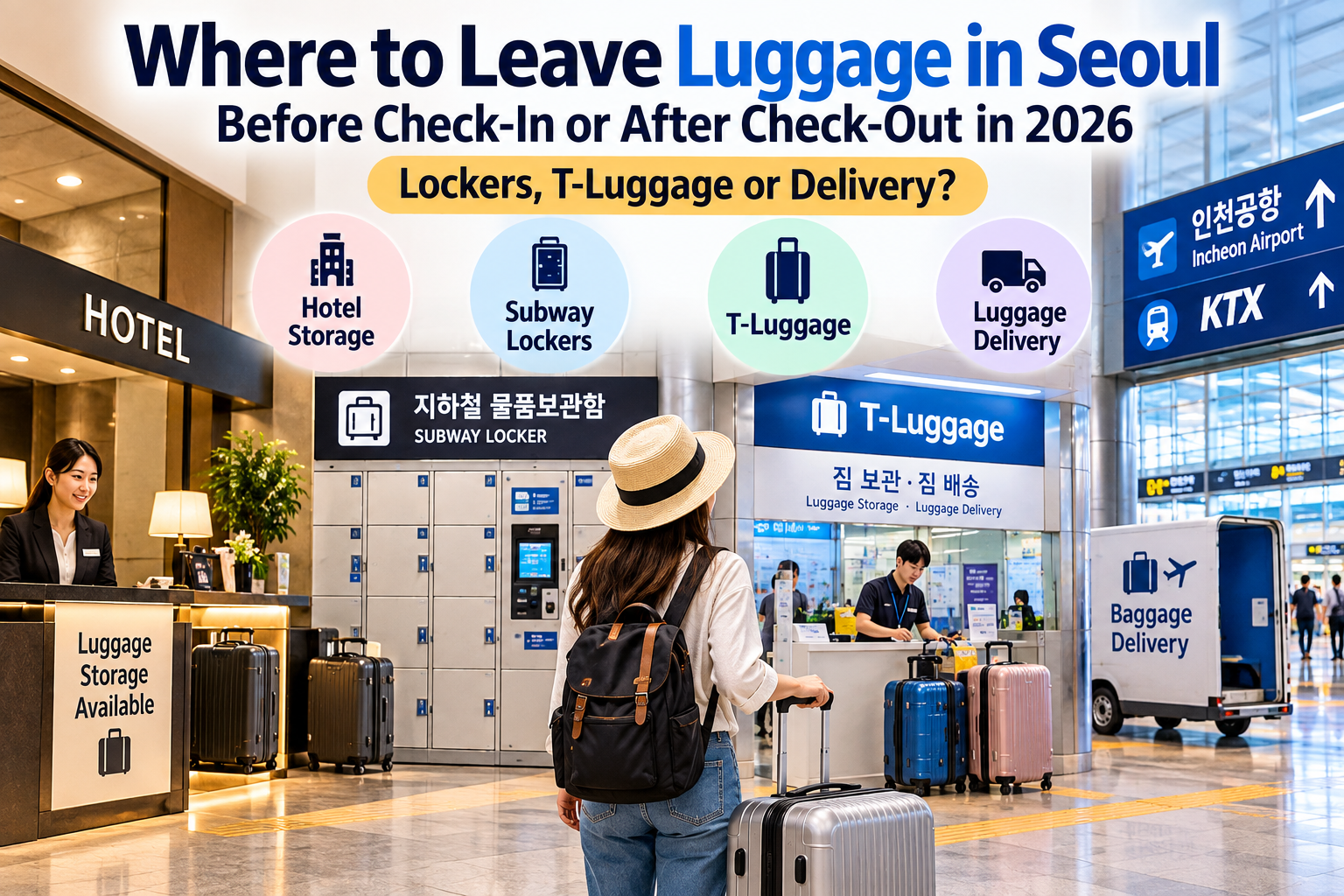
Fortunately, Seoul has several ways to store or move luggage, including hotel storage, subway lockers, T-Luggage facilities and luggage delivery services.
The important question is not simply where luggage storage exists.
It is which option makes sense for your itinerary.
Quick Answer: Which Luggage Option Should You Choose?
If you will return to the same place later, storing your luggage there is usually the simplest choice.
If your hotel will hold your bags and you plan to return to the hotel before leaving Seoul, hotel storage is often the first option to check.
If you need storage near a subway station for a few hours, T-Locker or another station locker may be more convenient.
If you have a large suitcase, want staff assistance or cannot find a suitable locker, T-Luggage can be easier.
And if your sightseeing route ends somewhere completely different from where it begins, luggage delivery may save you from backtracking across Seoul just to retrieve a suitcase.
That last point is especially important.
The cheapest storage option is not always the best option if retrieving your luggage adds an hour to your journey.
Option 1: Ask Your Hotel Before Paying for Storage
Before searching for a locker, ask your accommodation whether it can hold your luggage.
Many hotels and other accommodations provide luggage storage for guests before check-in or after check-out, although policies, available space and fees can vary.
This works particularly well when your itinerary brings you back to the hotel anyway.
For example:
You check out in Myeongdong in the morning, spend several hours nearby and return to Myeongdong before heading to the airport.
Leaving your suitcase at the hotel may be much easier than moving it to a subway locker.
But consider your route before choosing this option.
If your hotel is in Hongdae and your final sightseeing stop is around Seoul Station, returning to Hongdae solely to collect your luggage could add unnecessary travel.
Best for: Travelers who will naturally return to their accommodation later.
Check first: Storage availability, collection hours, fees and whether storage is available after check-out.
Option 2: Use a Subway Locker for Short-Term Storage
Subway lockers are useful when you need to leave your luggage somewhere for several hours and return to the same station.
Seoul’s subway storage network includes T-Locker, with lockers available across hundreds of stations.
This can be convenient if you arrive at a neighborhood before hotel check-in and want to explore without your suitcase.
For example, suppose you arrive near Jamsil in the morning but cannot check in until mid-afternoon.
If a suitable locker is available, you can store your luggage, explore the area and retrieve it before going to your accommodation.
When a Locker Works Best
A locker makes the most sense when:
- you know which station you will return to,
- your suitcase fits the available locker size,
- you only need temporary storage,
- and you can retrieve the luggage within the facility’s operating conditions.
The biggest mistake is assuming that finding a subway station automatically means finding an empty locker large enough for your suitcase.
Availability can vary by station and time.
Large luggage can also be more difficult to accommodate than a backpack or cabin-size bag.
Best for: Short storage periods and travelers returning to the same station.
Less suitable for: Oversized luggage, uncertain itineraries or travelers who do not want to return to the same location.
Option 3: Use T-Luggage When a Locker Is Not Enough
T-Luggage is different from a standard unattended subway locker.
It provides staffed luggage services at selected major transportation and tourist locations, including places such as Seoul Station, Hongik University, Myeongdong, Jamsil and Gimpo Airport, with additional locations in Seoul’s subway network.
For travelers with large suitcases, this can be more comfortable than searching for an available locker.
It is also useful when you prefer handing your bag to staff rather than figuring out a locker system after a long flight.
What Does T-Luggage Cost?
Prices vary according to luggage size, storage duration, day and service.
As one reference point, Seoul’s official guidance lists short-term storage pricing for large luggage that can be higher on weekends than on weekdays, with additional charges when storage time extends beyond the initial period.
Because prices and operating details can change, check the current rate for your location and luggage size before using the service.
This is especially important if you plan to leave luggage for most of the day rather than only a few hours.
Best for: Large luggage, travelers wanting staffed service and major transit hubs.
Check first: Location hours, luggage size, current price and pickup deadline.
Option 4: Consider Luggage Delivery Instead of Storage
This is where many travelers overlook a potentially better option.
Sometimes the real problem is not storing your suitcase.
It is having to return for it.
Suppose you check out near Hongdae in the morning, spend the afternoon in central Seoul and then plan to continue toward the airport.
Leaving your suitcase in Hongdae means you eventually have to travel back to Hongdae before continuing your journey.
In that situation, luggage delivery may be worth paying for.
T-Luggage services can include luggage transportation between participating locations, and airport-related delivery options may also be available depending on the route and service conditions.
Instead of asking:
Where can I store my luggage cheaply?
ask:
Where do I want my luggage to be when I finish sightseeing?
That question often produces a better travel plan.
Best for: Travelers whose final destination is different from their starting point.
Potential downside: Delivery costs more than simply leaving a bag somewhere, and you must follow the service’s acceptance and collection times.
A New Option Around Seoul Station: 24-Hour Luggage Storage
Seoul Station deserves special attention because it is one of the places where travelers most often need luggage storage.
You may arrive by KTX before hotel check-in, check out before taking a train later in the day, or spend several hours in Seoul before continuing to another city.
In 2026, travelers also have access to a 24-hour luggage storage option near Seoul Station known as LuggageDot.
The service is designed for travelers who need storage outside the practical hours of some traditional facilities and can accommodate large suitcases, including luggage up to around 32 inches according to Seoul’s official tourism information.
It also offers features such as checking availability and making reservations.
This can be particularly useful if your schedule starts very early or ends late at night.
However, do not assume that “24-hour” means every luggage option around Seoul Station operates 24 hours.
Always check the specific facility you plan to use.
Before Hotel Check-In: What Should You Do?
Your best choice depends on where you arrive and what you want to do before checking in.
If You Arrive Near Your Hotel
Ask the hotel to store your luggage first.
If that is possible, there is usually little reason to move your suitcase somewhere else.
If You Arrive at Seoul Station
Consider storage at or around Seoul Station if your sightseeing route brings you back there.
If you have a large suitcase or want staffed service, compare T-Luggage with available storage facilities rather than assuming a locker will be easiest.
If You Want to Explore a Different Neighborhood First
Think carefully before leaving luggage at your arrival point.
For example, if you arrive at Seoul Station but plan to spend the entire afternoon in Hongdae before checking into a Hongdae hotel, storing your suitcase at Seoul Station may create unnecessary backtracking.
In that case, moving closer to your eventual destination before storing the bag can make more sense.
After Hotel Check-Out: Think About Your Final Route
Departure day requires a slightly different decision.
Do not automatically leave your luggage at the hotel just because the hotel offers storage.
First look at your final sightseeing location and your route to the airport or train station.
Example 1: Hotel → Nearby Sightseeing → Hotel → Airport
Hotel storage is probably the easiest solution.
Example 2: Hotel → Sightseeing Across Seoul → Airport
Delivery or storage near your final sightseeing area may save considerable travel time.
Example 3: Hotel → Seoul Station → KTX
If you are continuing to another city by train, check your schedule in advance — Korea’s updated KTX ticket booking rules now allow travelers to plan many rail journeys earlier than before.
Storage around Seoul Station can make sense if you want to explore central Seoul before catching your train.
The key is to avoid crossing the city twice simply to retrieve a suitcase.
What About Large Suitcases?
Large luggage changes the decision.
A traveler with a backpack can use far more storage options than someone carrying a 28- or 32-inch suitcase.
Before relying on a locker, check its dimensions and availability.
If your suitcase is large, a staffed luggage facility can reduce the risk of arriving at a station only to discover that the available lockers are too small or already occupied.
This becomes even more important when traveling as a family with several suitcases.
Four travelers do not just need “a locker.”
They may need several large lockers at the same location.
At that point, comparing staffed storage or luggage delivery becomes much more worthwhile.
Storage Price vs Travel Time: Which Matters More?
It is easy to focus on a difference of a few thousand won between storage options.
But Seoul is a large city.
If choosing the cheapest locker requires an unnecessary subway journey to retrieve your bags, the savings may not be worth the lost time.
A better comparison includes:
storage fee + retrieval time + extra transportation + inconvenience
For a traveler with only two days in Seoul, an extra hour of sightseeing may be more valuable than saving a small amount on luggage storage.
For a budget traveler staying near the storage location, the cheaper locker may make perfect sense.
Neither choice is automatically better.
Common Luggage Storage Mistakes in Seoul
One common mistake is waiting until arrival to think about luggage.
Another is assuming every station has enough large lockers available.
Travelers also sometimes store luggage somewhere convenient in the morning without considering where they will be in the evening.
And do not leave essential items inside luggage that you may not be able to access easily.
Keep your passport, medication, wallet, phone, travel documents and other important valuables with you unless the service specifically provides a secure arrangement appropriate for those items.
The Simplest Way to Decide
Before choosing luggage storage in Seoul, answer three questions:
1. Where will I be when I drop off the luggage?
2. Where will I be when I need the luggage again?
3. Do I actually need storage, or would delivery remove an unnecessary return trip?
If both locations are the same, a hotel or locker is often enough.
If they are different, compare delivery.
If your luggage is unusually large, prioritize size and availability before price.
And if your schedule involves very early or late hours, check operating times before building your itinerary around a storage location.
Final Takeaway
Seoul has plenty of places to leave luggage before check-in or after check-out.
The harder part is choosing the one that fits your route.
Hotel storage works well when you will return to the hotel.
Subway lockers are convenient for short-term storage when you will return to the same station.
T-Luggage can be easier for larger bags or travelers who prefer staffed service.
Luggage delivery becomes valuable when it prevents you from backtracking across Seoul.
And around major transport hubs such as Seoul Station, newer 24-hour storage options can help travelers with early or late schedules.
So before comparing a few thousand won in storage fees, open your map and look at your day from beginning to end.
In Seoul, the best place to leave your luggage is usually not the cheapest place.
It is the place that keeps you moving forward.