
Tag: Seoul Subway

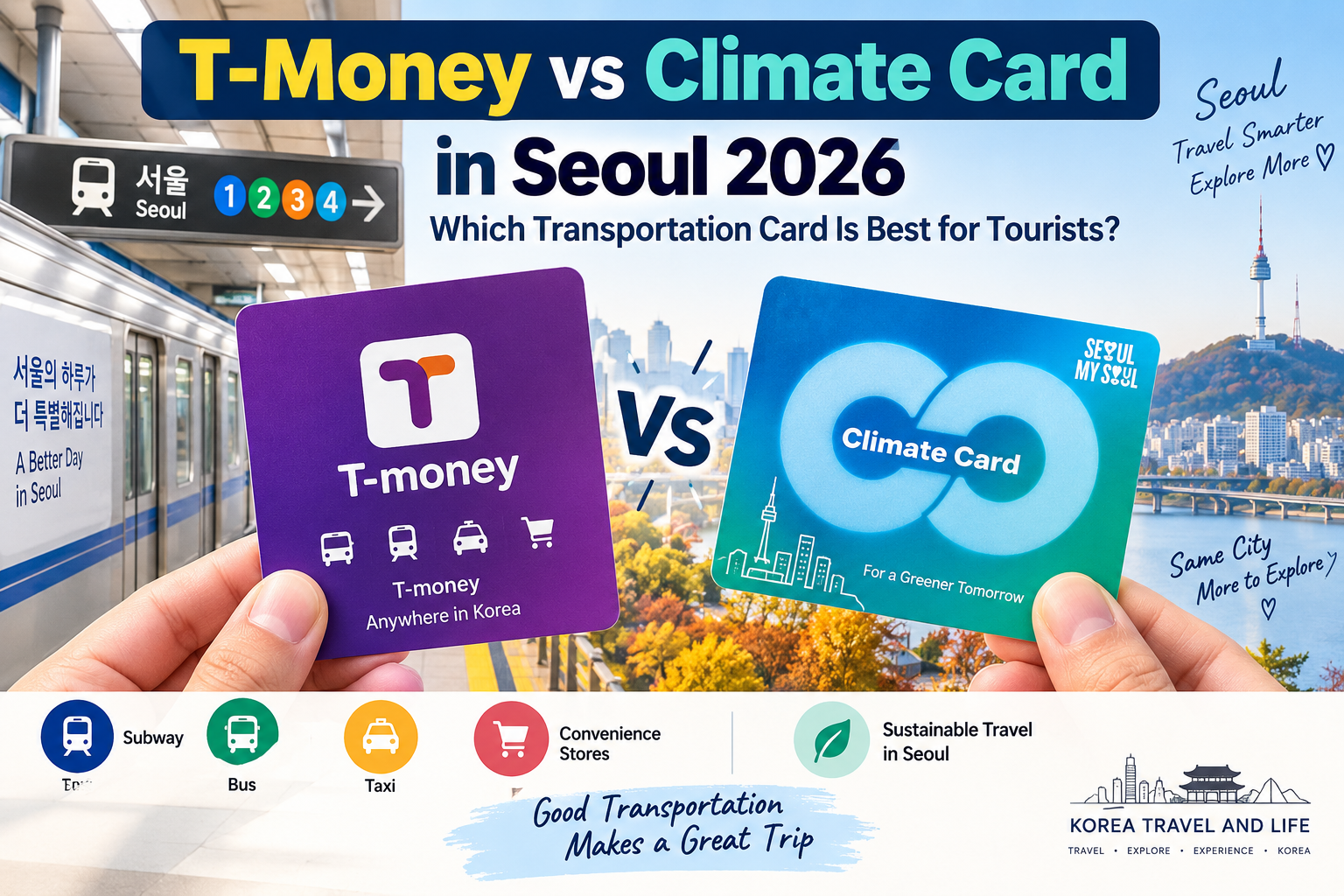
  • T-Money vs Climate Card in Seoul 2026: Which Transportation Card Is Best for Tourists?

    T-Money vs Climate Card in Seoul 2026: Which Transportation Card Is Best for Tourists?

    Getting around Seoul is easy once you understand the city’s transportation system. But for first-time visitors, choosing the right transportation card can be surprisingly confusing.

    Two of the most useful options are T-Money and the Climate Card.

    Both can make traveling around Seoul much easier, but they work very differently. T-Money is a rechargeable transportation card that can be used across Korea, while the Climate Card offers unlimited rides within its designated Seoul transportation network for a fixed period.

    So which one should you buy?

    This 2026 guide explains the differences between T-Money and the Climate Card, how much they cost, where you can use them, and which option may make more sense for your Korea itinerary.

    Quick Answer: T-Money or Climate Card?

    For most travelers, the choice depends on where you are traveling.

    Choose T-Money if you:

    • Plan to travel outside Seoul
    • Will visit places such as Busan, Gyeongju, Jeju, or other Korean cities
    • Prefer paying for transportation based on actual usage
    • Want one transportation card that works across much of Korea
    • Expect to use taxis or other transportation outside the Climate Card service area

    Choose the Climate Card if you:

    • Will spend most of your trip inside Seoul
    • Expect to use buses and subways frequently
    • Want unlimited eligible public transportation during your pass period
    • Prefer knowing your transportation cost in advance
    • Are staying in Seoul for between one and seven days

    For many first-time visitors traveling around Korea, T-Money offers greater flexibility.

    For travelers spending several busy sightseeing days almost entirely in Seoul, however, a short-term Climate Card can be very convenient.

    What Is a T-Money Card?

    T-Money is one of Korea’s most widely used prepaid transportation cards.

    Instead of buying an individual ticket every time you ride a subway or bus, you load money onto the card and tap it when entering and leaving the transportation system.

    T-Money can be purchased at many convenience stores, including chains such as CU, GS25, and 7-Eleven, as well as at transportation facilities.

    The standard card generally costs around KRW 3,000–5,000, before adding transportation credit.

    One of T-Money’s biggest advantages for international travelers is its wide coverage.

    It can be used on public transportation across many parts of Korea, making it particularly useful for travelers visiting several cities during one trip.

    Where Can You Use T-Money?

    T-Money can be used on many:

    • Subways
    • City buses
    • Express and intercity buses
    • Taxis
    • Other participating transportation services

    It can also be used at some convenience stores, vending machines, and other participating merchants displaying the T-Money logo.

    This makes T-Money particularly useful for itineraries such as:

    Seoul → Busan → Gyeongju → Seoul

    Instead of buying a new local transportation card in every destination, travelers can continue using the same T-Money card for many local transportation needs.

    What Is the Seoul Climate Card?

    The Climate Card was introduced by the Seoul Metropolitan Government as an unlimited public transportation pass.

    For tourists, the most important products are the short-term Climate Card passes.

    As of 2026, short-term passes are available for:

    • 1 day — KRW 5,000
    • 2 days — KRW 8,000
    • 3 days — KRW 10,000
    • 5 days — KRW 15,000
    • 7 days — KRW 20,000

    A physical Climate Card costs an additional KRW 3,000.

    These passes are particularly attractive for travelers who plan to take public transportation repeatedly while sightseeing around Seoul.

    Important Climate Card Change in 2026

    Visitors may see older online guides discussing the Climate Card’s 30-day prepaid pass.

    This information is changing.

    Seoul announced that recharging the existing 30-day prepaid Climate Card ends after August 31, 2026, as the city transitions toward its newer Climate Pass system.

    However, this does not mean tourists can no longer use the Climate Card.

    The short-term tourist passes for 1, 2, 3, 5, and 7 days continue to be available.

    This distinction is important when reading older travel guides about Seoul transportation.

    Can Foreign Tourists Buy the Climate Card With an International Credit Card?

    Yes, and this became significantly easier in 2026.

    Seoul expanded payment support at hundreds of new subway vending machines, allowing travelers to use internationally issued credit and debit cards such as Visa and Mastercard to purchase Climate Cards and recharge short-term passes.

    International card payments are supported at new vending machines installed across Seoul Metro Lines 1–8.

    An average service fee of approximately 3.7% may apply when using an internationally issued card.

    This is an important improvement for international visitors because transportation card purchases in Korea have traditionally relied heavily on Korean won cash or locally issued cards.

    T-Money vs Climate Card: Main Differences

    Here is the simplest way to understand the two cards.

    T-Money

    Payment system: Pay per ride

    Best for: Flexible travel throughout Korea

    Coverage: Widely usable across Korea

    Main advantage: One card can be used for transportation in many Korean cities

    Best traveler: Someone visiting Seoul plus other destinations

    Climate Card

    Payment system: Unlimited eligible transportation during the pass period

    Best for: Frequent transportation within Seoul

    Coverage: Limited primarily to eligible Seoul transportation services

    Main advantage: Unlimited rides without worrying about individual fares

    Best traveler: Someone sightseeing intensively within Seoul

    Is the Climate Card Really Unlimited?

    Within its eligible transportation network, the Climate Card allows unlimited rides during the validity period.

    However, “unlimited” does not mean that every transportation service in Korea is included.

    The Climate Card has a defined service area and exclusions. Travelers planning trips outside Seoul should therefore check whether their destination is covered before relying exclusively on the card.

    This is one of the biggest differences between the Climate Card and T-Money.

    T-Money does not provide unlimited transportation, but its geographical flexibility is much greater.

    Which Card Is Better for a 3-Day Seoul Trip?

    Consider a traveler spending three full days sightseeing around Seoul.

    The itinerary might include:

    Day 1: Gyeongbokgung Palace → Bukchon Hanok Village → Insadong → Myeongdong

    Day 2: Hongdae → Yeonnam-dong → Han River → Gangnam

    Day 3: Seongsu → Seoul Forest → Dongdaemun → Namsan

    This traveler may take multiple subway and bus rides each day.

    A 3-day Climate Card costs KRW 10,000, plus the KRW 3,000 physical card cost if a card needs to be purchased.

    For a transportation-heavy itinerary like this, the Climate Card can be particularly convenient.

    Which Card Is Better for a 7-Day Korea Trip?

    Now consider this itinerary:

    Days 1–3: Seoul
    Days 4–5: Gyeongju
    Days 6–7: Busan

    In this situation, T-Money is generally more practical because the traveler is moving beyond Seoul.

    The Climate Card’s main value comes from frequent eligible transportation within Seoul, whereas T-Money can continue to be useful in other Korean cities.

    Can You Use Both T-Money and the Climate Card?

    Yes.

    In fact, some travelers may find that carrying both is convenient.

    You could use the Climate Card during several intensive sightseeing days in Seoul and keep a T-Money card for transportation outside the Climate Card coverage area or later trips to other Korean cities.

    You do not necessarily have to choose only one card for your entire Korea trip.

    Where Can Tourists Buy T-Money?

    T-Money cards are widely available.

    Travelers can commonly find them at convenience stores such as:

    • CU
    • GS25
    • 7-Eleven
    • Other participating convenience stores

    They are also available at transportation-related sales locations.

    According to VISITKOREA, a standard T-Money card generally costs approximately KRW 3,000–5,000 before adding transportation credit.

    One detail international travelers should know is that ordinary T-Money purchases and top-ups may still require Korean won cash in many situations, so carrying some cash after arriving in Korea remains useful. Korea Tourism Organization’s 2026 transportation guide specifically notes cash-only purchasing/top-up for standard prepaid T-Money.

    Where Can Tourists Buy a Climate Card?

    Physical Climate Cards are available through designated subway vending machines and participating sales locations in Seoul.

    New transportation-card vending machines across Seoul Metro Lines 1–8 have made purchasing the card considerably easier for international visitors.

    Remember that the physical card itself costs KRW 3,000, and the short-term pass is loaded separately.

    Unlike an ordinary T-Money balance, a short-term Climate Card begins according to the rules associated with the pass, so travelers should check the activation timing before loading it.

    What About Airport Transportation?

    This is where travelers should be careful.

    Not every airport transportation option is included with every Seoul transportation pass.

    For example, the AREX Express Train operates differently from ordinary Seoul subway transportation.

    Travelers arriving at Incheon International Airport should therefore check their airport-to-hotel transportation separately instead of assuming that a Climate Card covers every airport option.

    We will cover this in a separate guide comparing AREX Express, AREX All-Stop Train, airport limousine buses, and taxis from Incheon Airport to Seoul.

    What About WOWPASS?

    WOWPASS is another popular option for international visitors.

    Unlike T-Money, which is primarily a transportation card, WOWPASS combines several traveler-focused functions, including prepaid payments, transportation functionality, and currency-related services.

    That makes it a different type of product.

    For travelers wondering whether WOWPASS or T-Money is better, we will compare those options separately because the decision involves more than transportation alone.

    T-Money vs Climate Card: Which Should First-Time Visitors Choose?

    There is no single card that is ideal for every Korea itinerary.

    For a traveler spending almost the entire trip sightseeing around Seoul and taking public transportation many times each day, the Climate Card can be a simple and convenient choice.

    For travelers visiting multiple Korean cities or wanting maximum transportation flexibility, T-Money is usually easier to use throughout the trip.

    And for some travelers, carrying both can make sense.

    The key is to choose based on your itinerary rather than simply buying whichever transportation card you see first.

    Frequently Asked Questions

    Is T-Money only available in Seoul?

    No. One of T-Money’s biggest advantages is that it can be used on public transportation in many areas throughout Korea.

    Can tourists still use the Climate Card in 2026?

    Yes. Although Seoul is changing its longer-term Climate Card system, short-term tourist passes for 1, 2, 3, 5, and 7 days remain available.

    How much is a 3-day Climate Card?

    The 3-day short-term pass costs KRW 10,000. A physical Climate Card costs an additional KRW 3,000 if you do not already have one.

    Can I buy a Climate Card with a foreign credit card?

    Internationally issued credit and debit cards are accepted at supported new transportation-card vending machines for Climate Card purchases and short-term pass recharging.

    Can I use T-Money in Busan?

    Yes. T-Money is widely usable on public transportation beyond Seoul, including major Korean cities.

    Should I buy T-Money at Incheon Airport?

    For many visitors, getting a transportation card soon after arrival is convenient, especially if they plan to use public transportation frequently during their trip.

    Final Thoughts

    Choosing between T-Money and the Climate Card becomes much easier once you know your itinerary.

    If your trip is focused almost entirely on Seoul and you expect to ride buses and subways frequently, a short-term Climate Card can provide simple, predictable transportation costs.

    If your Korea itinerary includes several cities, T-Money offers greater flexibility and can remain useful throughout your trip.

    Before traveling, always check the latest transportation rules because Seoul’s transit card system continues to evolve.

    For most international travelers, the best strategy is simple:

    Choose the Climate Card for intensive Seoul sightseeing. Choose T-Money for flexibility across Korea.
  • First Time in Seoul: From Incheon Airport to Exploring the City

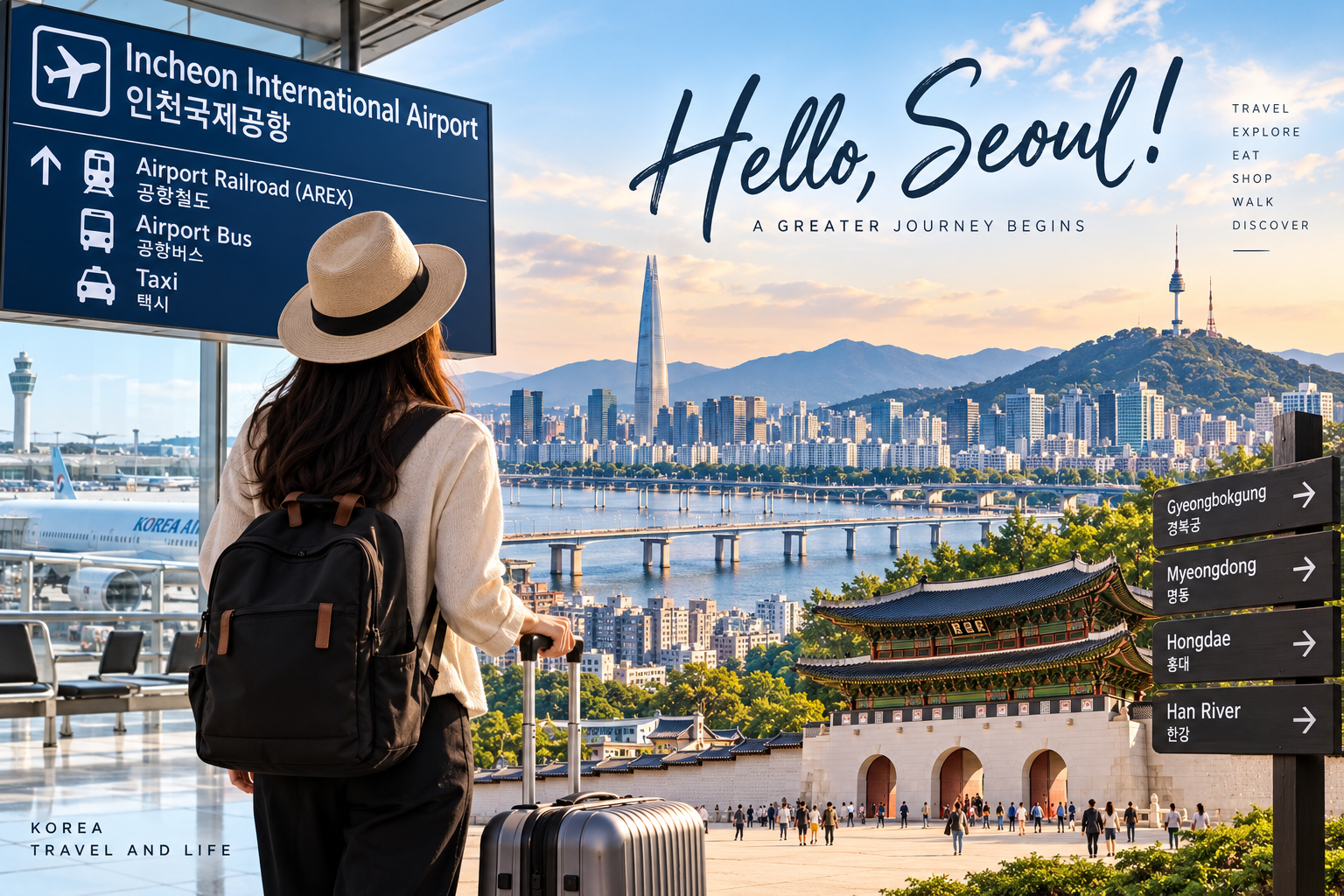
    First Time in Seoul: From Incheon Airport to Exploring the City

    Your First Journey into Seoul Begins at Incheon Airport

    For many international travelers, the first experience of Seoul does not begin at a palace, a market, or a busy shopping street.

    It begins at Incheon International Airport.

    After a long flight, immigration, baggage claim, and customs, one practical question quickly becomes more important than anything else:

    How do I get from Incheon Airport to Seoul?

    The answer depends on where you are staying, how much luggage you have, when you arrive, and whether you value speed, convenience, or cost.

    Fortunately, travelers have several practical ways to reach Seoul from Incheon International Airport, including the Airport Railroad, airport buses, and taxis.

    Understanding the differences before leaving the airport can make your first few hours in Korea much easier.

    First, Check Which Terminal You Arrived At

    Incheon International Airport has two main passenger terminals: Terminal 1 and Terminal 2.

    Before buying a train ticket or looking for a bus, confirm your terminal and your accommodation address.

    This sounds simple, but it can prevent unnecessary confusion after a long international flight.

    Your hotel may be described as being in Seoul, but Seoul is a very large city. A traveler staying near Seoul Station may make a different transportation choice from someone staying in Myeongdong, Hongdae, Gangnam, or another neighborhood.

    So instead of asking only, “What is the fastest way to Seoul?” ask a more useful question:

    What is the easiest way to reach my particular part of Seoul?

    Option 1: Airport Railroad — A Convenient Way to Reach Seoul by Train

    The Airport Railroad, commonly known as AREX, connects Incheon International Airport with Seoul.

    For many first-time visitors, the railway is one of the easiest transportation systems to understand because it avoids road traffic and connects travelers with Seoul’s wider public transportation network.

    There are different train services, so travelers should check the service and destination before boarding.

    If your accommodation is near Seoul Station, traveling by rail can be especially convenient.

    If you are staying elsewhere, you may need to transfer to Seoul’s subway system or use another form of transportation for the final part of the journey.

    That final transfer matters.

    A train may look like the simplest choice when you compare travel times, but carrying two large suitcases through a crowded subway station can change the experience completely.

    For a solo traveler with light luggage, the railway may be an excellent option.

    For a family with children and several large bags, an airport bus or taxi may be more comfortable.

    Travel tip: Do not choose transportation based on speed alone. Consider the entire journey from the airport terminal to the door of your accommodation.

    Option 2: Airport Bus — Useful When Your Destination Is Away from Seoul Station

    Airport buses can be particularly useful for travelers whose hotels or accommodations are located near one of the bus routes.

    Instead of taking a train into central Seoul and transferring again, a bus may take you closer to the neighborhood where you are staying.

    This can make a significant difference when traveling with heavy luggage.

    The trade-off is traffic.

    Unlike the railway, buses travel on roads, so journey times can vary depending on congestion and the time of day.

    Before boarding, check the destination, route, and stop carefully rather than assuming that every Seoul-bound airport bus goes to the same part of the city.

    Incheon International Airport provides bus-route and bus-stop information for travelers, including information for late-night services.

    For many visitors, the best airport bus is therefore not necessarily the fastest one.

    It is the one that leaves you closest to where you actually need to go.

    Option 3: Taxi — The Simplest Door-to-Door Choice

    A taxi offers something trains and buses cannot: direct transportation from the airport to your accommodation.

    This can be valuable if you arrive late at night, have several suitcases, are traveling with young children or older family members, or simply want the easiest possible arrival after a long flight.

    The disadvantage is cost.

    Taxi travel will generally cost considerably more than public transportation, and nighttime surcharges can apply. Incheon International Airport currently advises passengers to use designated taxi stands and warns travelers against illegal solicitation by vehicles posing as legitimate taxis.

    This is an important rule for first-time visitors:

    Use the official taxi stands rather than accepting unsolicited transportation offers inside or around the terminal.

    The airport also provides designated international taxi services for foreign travelers traveling between Incheon Airport and Seoul.

    Which Airport Transportation Should You Choose?

    There is no single best choice for every traveler.

    Think about your situation instead.

    Choose the Airport Railroad if you want predictable rail travel and your route works well with Seoul Station or the subway network.

    Consider an airport bus if a route stops conveniently near your hotel and you would rather avoid carrying luggage through several stations.

    Consider a taxi if door-to-door convenience is more important than price, particularly when traveling as a family, carrying substantial luggage, or arriving at an inconvenient hour.

    The cheapest option is not always the easiest.

    The fastest option on paper is not always the fastest from the airport terminal to your hotel room.

    Good travel planning begins by looking at the whole journey.

    Arriving in Seoul Is Only the Beginning

    Once you reach the city, Seoul can initially seem enormous.

    The capital stretches across both sides of the Han River, and neighborhoods that look close together on a tourist map may require more travel time than expected.

    Yet Seoul becomes much easier to understand once you stop thinking of it as one giant collection of attractions.

    Instead, think of it as a city of connected neighborhoods.

    Historic palaces and traditional streets tell one story of Seoul.

    Hongdae and other youthful districts tell another.

    Major shopping areas reveal the city’s fashion and consumer culture.

    Parks, mountains, walking trails, and the Han River show a completely different side of the capital.

    The key to enjoying Seoul is not trying to see everything at once.

    It is learning how to move through the city intelligently.

    And that is where the next stage of your first Seoul journey begins.


    Understanding Seoul Before You Start Exploring

    Seoul can feel overwhelming on a first visit.

    It is a huge metropolitan city filled with historic districts, modern business centers, shopping streets, universities, mountains, parks, markets, and neighborhoods with very different personalities.

    The good news is that travelers do not need to understand the entire city at once.

    A better approach is to learn a few basic geographic ideas and then explore Seoul area by area.

    One of the most important landmarks for understanding the city is the Han River.

    The river runs through Seoul and broadly separates many northern and southern parts of the city.

    North of the river, travelers will find much of historic Seoul, including royal palaces and traditional neighborhoods.

    South of the river are areas associated with modern business, shopping, entertainment, and contemporary urban culture.

    This distinction is not absolute, but it provides first-time visitors with a useful mental map.

    Seoul Is Better Explored by Neighborhood

    One of the most common mistakes first-time visitors make is choosing attractions individually without considering their locations.

    A palace in the morning, a café on the opposite side of the city at lunchtime, and a shopping district somewhere else in the evening may all sound reasonable when viewed separately.

    Together, however, they can create an exhausting day of unnecessary travel.

    Instead, group nearby experiences together.

    For example, a day focused on historic Seoul might include a royal palace, traditional streets, cultural neighborhoods, and a nearby market.

    Another day might focus on the Han River and modern Seoul.

    A different day could be devoted to shopping, cafés, fashion, and nightlife.

    This neighborhood-based approach reduces transportation time and allows travelers to experience the atmosphere of each area rather than simply moving from attraction to attraction.

    Using Seoul’s Subway System

    For many visitors, the subway becomes the backbone of their Seoul trip.

    The network connects major tourist districts, transportation hubs, shopping areas, residential neighborhoods, and many attractions.

    At first, a large subway map can look intimidating.

    Do not try to memorize it.

    Instead, focus on three things:

    your starting station, your destination station, and the direction of travel.

    When transferring between lines, follow the station signs carefully. Large interchange stations can involve surprisingly long walks, so allow extra time rather than assuming every transfer takes only a minute or two.

    Also remember that the station closest to an attraction is not always the most convenient exit.

    Large stations may have many exits, and choosing the correct one can save a considerable amount of walking.

    Before leaving the station, check which exit is closest to your destination.

    Buses Can Take You Beyond the Subway

    Seoul’s buses reach many places that are less convenient by subway alone.

    They can also be a great way to see the city above ground.

    However, buses may feel more challenging to first-time international visitors because routes, stops, and traffic conditions require more attention.

    A practical strategy is to become comfortable with the subway first and then use buses when they clearly make a journey easier.

    Navigation apps can be especially useful when comparing routes.

    Travelers should also remember that digital services commonly used in their home countries may not always provide the same level of local navigation detail in Korea. Using Korea-focused navigation tools can therefore make route planning easier.

    Transportation Cards Make Everyday Travel Easier

    A rechargeable transportation card can make repeated journeys on public transportation more convenient.

    Instead of buying a separate ticket every time you use the subway or bus, travelers can use a compatible transportation card for eligible journeys and recharge it when necessary.

    This becomes especially useful on a multi-day trip when you may use public transportation several times each day.

    The exact cards, purchase locations, payment options, and visitor products available can change over time, so travelers should check current information when planning their trip.

    The important point is simple:

    prepare your local transportation method early rather than solving the same payment problem every time you travel.

    Do Not Underestimate Walking in Seoul

    Public transportation is excellent, but some of the best experiences in Seoul happen between stations.

    Walking from a palace toward a traditional neighborhood can reveal small streets, cafés, galleries, shops, and architecture that disappear when every journey is treated only as transportation.

    The same is true around markets, university districts, riverside areas, and older neighborhoods.

    Comfortable shoes are therefore more important than many first-time travelers expect.

    A day in Seoul can easily involve a great deal of walking even when you regularly use the subway.

    Historic Seoul: Palaces, Traditional Streets and Old Neighborhoods

    For travelers interested in Korean history and traditional culture, the northern part of central Seoul is an excellent place to begin.

    The city’s royal palaces provide a visible connection to the Joseon Dynasty, while nearby streets and neighborhoods reveal how historic spaces continue to exist within a modern capital.

    Gyeongbokgung is often the first palace international visitors encounter, but Seoul’s palace experience is larger than a single landmark.

    Nearby cultural areas can make a palace visit part of a broader day rather than an isolated sightseeing stop.

    This is one reason planning by area works so well.

    Instead of rushing from one famous attraction to another, travelers can spend several hours understanding how history, architecture, food, streets, and contemporary life overlap.

    The Han River: Seoul’s Open Space

    The Han River is more than a geographic dividing line.

    It is also one of Seoul’s defining public spaces.

    Along different sections of the river, people walk, cycle, exercise, meet friends, relax, and enjoy views of the city.

    For visitors who have spent several days moving through crowded commercial districts, time beside the river can reveal a very different Seoul.

    The experience also changes with the season and time of day.

    A riverside visit in the afternoon can feel completely different from an evening spent watching the city lights.

    Rather than treating the Han River as one attraction to check off a list, think of it as part of everyday Seoul.

    Seoul Is Also a City of Mountains and Trails

    One of Seoul’s most distinctive characteristics is how closely dense urban life exists alongside mountains and hiking trails.

    Travelers do not necessarily need to leave the capital to experience outdoor Korea.

    Some routes offer relatively accessible walks with city views, while others require more time, preparation, and physical effort.

    This means Seoul can work surprisingly well for travelers who want to combine urban sightseeing with hiking or trekking.

    A morning can begin among busy streets and subway stations and later lead to a trail overlooking the city.

    For visitors who enjoy walking, this contrast is one of Seoul’s greatest strengths.

    Shopping Depends on What You Want to Find

    There is no single “best shopping area” in Seoul because different neighborhoods serve different interests.

    A traveler looking for cosmetics may choose differently from someone interested in designer fashion, streetwear, traditional souvenirs, department stores, markets, or independent Korean brands.

    The same principle applies to cafés and nightlife.

    Instead of asking, “Where should I shop in Seoul?” ask:

    What do I want to shop for?

    That simple question makes choosing an area much easier.

    Later in this Seoul series, we will explore these districts in greater detail and compare what different parts of the city offer.

    Build Your Seoul Trip Around Experiences, Not Checklists

    First-time visitors often arrive with a long list of famous places.

    That is understandable.

    But a memorable Seoul trip is not necessarily the one with the greatest number of attractions.

    It is the one that gives you enough time to understand the places you visit.

    Spend time in a palace rather than photographing only its entrance.

    Walk through a neighborhood rather than visiting a single famous street.

    Sit beside the Han River instead of seeing it only through a subway window.

    Explore a market when you are hungry enough to try something unfamiliar.

    And leave room for discoveries that were not on your original itinerary.

    Seoul rewards curiosity.

    Once you understand how the city fits together, it becomes much easier to decide what deserves your time.

    How to Plan Your First Few Days in Seoul

    Once you understand the basic geography of Seoul, planning becomes much easier.

    The goal should not be to visit every famous attraction. Seoul is too large and too diverse for that.

    Instead, organize each day around a part of the city or a type of experience.

    A first visit might combine three broad sides of Seoul:

    historic Seoul, outdoor Seoul, and contemporary Seoul.

    This approach creates variety while reducing unnecessary travel.

    Day One: Begin with Historic Seoul

    For many first-time visitors, historic central Seoul is a natural place to begin.

    A royal palace can provide an introduction to Korea’s history before you explore nearby traditional streets, neighborhoods, markets, museums, or cultural spaces.

    Gyeongbokgung is one of the best-known starting points, but the experience becomes more meaningful when the palace is not treated as an isolated photo stop.

    Look at the surrounding city.

    Modern buildings rise beyond palace walls. Busy roads exist beside historic gates. Traditional architecture, cafés, offices, shops, and residential streets occupy the same urban landscape.

    This contrast is part of what makes Seoul interesting.

    Rather than trying to visit several palaces in a single day simply because they appear on a list, first-time visitors may enjoy choosing fewer places and spending more time understanding them.

    Day Two: Discover Seoul Outdoors

    After a day among historic streets and major attractions, explore Seoul’s outdoor side.

    Depending on your interests and physical condition, this could mean a riverside walk, a large urban park, a gentle hill with city views, or a more demanding mountain trail.

    The Han River is one of the easiest ways to experience how residents use the city recreationally.

    But Seoul’s outdoor identity extends far beyond the river.

    The capital is surrounded and crossed by mountains, and hiking has a strong place in Korean recreational culture.

    For travelers who enjoy trekking, this creates an unusual opportunity: you can experience a major global city and a mountain landscape during the same trip.

    Bukhansan offers a very different experience from a casual riverside walk. Inwangsan, Namsan, and other elevated routes can provide different combinations of accessibility, history, nature, and city views.

    Not every trail is suitable for every traveler.

    Weather, season, footwear, fitness, trail conditions, daylight, and route difficulty should all be considered before setting out.

    This is especially important in summer heat, winter conditions, or wet weather.

    A future guide in this Seoul series will compare walking, hiking, park, and riverside options in greater detail so travelers can choose according to their interests and abilities.

    Day Three: Experience Contemporary Seoul

    Seoul is not only a city that preserves its past.

    It constantly produces new culture.

    Fashion, beauty, cafés, design, music, technology, food trends, department stores, pop-up stores, and independent brands all contribute to the experience of contemporary Seoul.

    Different neighborhoods express this in different ways.

    Myeongdong has long been associated with central-city shopping and beauty products.

    Hongdae is known for a youthful atmosphere connected with universities, entertainment, cafés, shopping, and nightlife.

    Gangnam presents another side of modern Seoul, with major commercial areas and large-scale urban development.

    Seongsu has become widely associated with cafés, design, fashion, brands, and pop-up retail culture.

    Traditional markets provide yet another kind of shopping experience.

    This variety is why a list titled “the best place to shop in Seoul” can be misleading.

    The best district depends on what you want to experience and buy.

    Later in this series, we will compare Seoul’s major shopping areas so visitors can choose destinations that match their interests rather than simply following the largest crowds.

    Do Not Plan Every Hour

    A tightly scheduled itinerary can look efficient before a trip and feel exhausting once the trip begins.

    Seoul requires flexibility.

    You may spend longer than expected inside a palace.

    You may discover a small restaurant while walking.

    A neighborhood that seemed like a one-hour stop may become your favorite part of the day.

    Rain may change your hiking plans.

    Jet lag may make your first morning slower than expected.

    Leave space between major activities.

    A useful itinerary should guide your trip, not control every minute of it.

    Consider Travel Time When Crossing the City

    One of the easiest ways to make a Seoul itinerary inefficient is to repeatedly cross large sections of the city.

    If two attractions are far apart, the journey between them can consume time and energy that could have been spent exploring.

    Before finalizing a day, look at all of your destinations together on a map.

    Ask whether they form a sensible route.

    If they do not, move one attraction to another day.

    This simple habit can dramatically improve a Seoul itinerary.

    Weather Can Change the Best Plan

    Seoul has four distinct seasons, and the experience of the city can change significantly throughout the year.

    Hot and humid conditions can make a long summer walking itinerary more demanding.

    Cold winter weather requires appropriate clothing, particularly when spending extended periods outdoors.

    Spring and autumn can be excellent for walking, but temperatures and conditions still vary.

    Rain can also affect palace visits, outdoor photography, parks, riverside activities, and hiking.

    For that reason, it is useful to have both an outdoor plan and an indoor alternative.

    Museums, shopping districts, cafés, markets, cultural spaces, and other indoor attractions can become valuable alternatives when the weather changes.

    Your Accommodation Influences Your Daily Experience

    Where you stay affects more than the place where you sleep.

    It influences how much time you spend commuting, how easily you return to your room during the day, and what kind of neighborhood you experience in the morning and evening.

    A traveler focused on historic attractions may value a different location from someone whose priorities are nightlife or shopping.

    Budget, luggage, transportation access, and travel style also matter.

    For a broader introduction to choosing accommodation, see our guide to where to stay in Korea and how to choose the right area.

    Travelers can also explore our separate guides to luxury hotels, mid-range and budget hotels, hanok stays, and Airbnb and guesthouses in Korea.

    Choosing accommodation becomes easier when you begin with your itinerary rather than choosing a hotel first and planning everything else around it.

    Prepare for Everyday Travel, Not Just Sightseeing

    Small practical decisions can have a large effect on a trip.

    Know how you plan to pay for everyday purchases.

    Understand the basics of using Korean public transportation.

    Keep your accommodation address accessible on your phone.

    Check the operating hours of places that are important to your itinerary.

    Allow extra time when traveling to an airport, train station, or reserved activity.

    And learn a little about local etiquette before arriving.

    These preparations may not be as exciting as choosing attractions, but they reduce stress and leave more energy for the experiences that brought you to Korea in the first place.

    Seoul Series: Where We Go Next

    This article is only the starting point.

    Seoul deserves more than one general guide, so Korea Travel and Life will explore the capital as a series.

    In Seoul Series 2, we will move outdoors and into the city’s historical landscape, exploring royal palaces, parks, the Han River, walking routes, and some of the best places for hiking and trekking.

    We will look at the differences between a relaxed urban walk and a more demanding mountain experience, helping travelers decide what fits their schedule and ability.

    In Seoul Series 3, we will explore the contemporary city through shopping districts, markets, fashion, beauty, cafés, and distinctive neighborhoods.

    Rather than simply listing famous places, the goal will be to explain which areas are best for different kinds of travelers and why.

    After Seoul, the journey will continue to other parts of Korea.

    Busan will bring a different urban experience shaped by beaches, mountains, seafood, markets, coastal walks, and port-city culture.

    Other regional guides can then take us further into Korea, each with its own landscape, food, history, and travel rhythm.

    Final Thoughts: Let Seoul Unfold Slowly

    Your first trip to Seoul does not need to be perfect.

    You do not need to visit every palace, hike every mountain, shop in every famous district, or photograph every landmark.

    A city this large cannot be understood through a checklist.

    Start with the journey from Incheon Airport.

    Learn how Seoul’s transportation system works.

    Explore one neighborhood at a time.

    Walk through a palace gate and notice the mountains behind the city.

    Spend an evening beside the Han River.

    Try a market you had not planned to visit.

    Walk a trail when you want a break from crowded streets.

    Explore contemporary neighborhoods and see how quickly the city changes from one district to another.

    The most memorable Seoul experience may not be the attraction you planned months in advance.

    It may be the moment when the city begins to make sense.

    And once that happens, Seoul stops feeling like a collection of famous places.

    It begins to feel like a city you know how to explore.


  • How to Use Public Transportation in Korea: A Beginner’s Guide

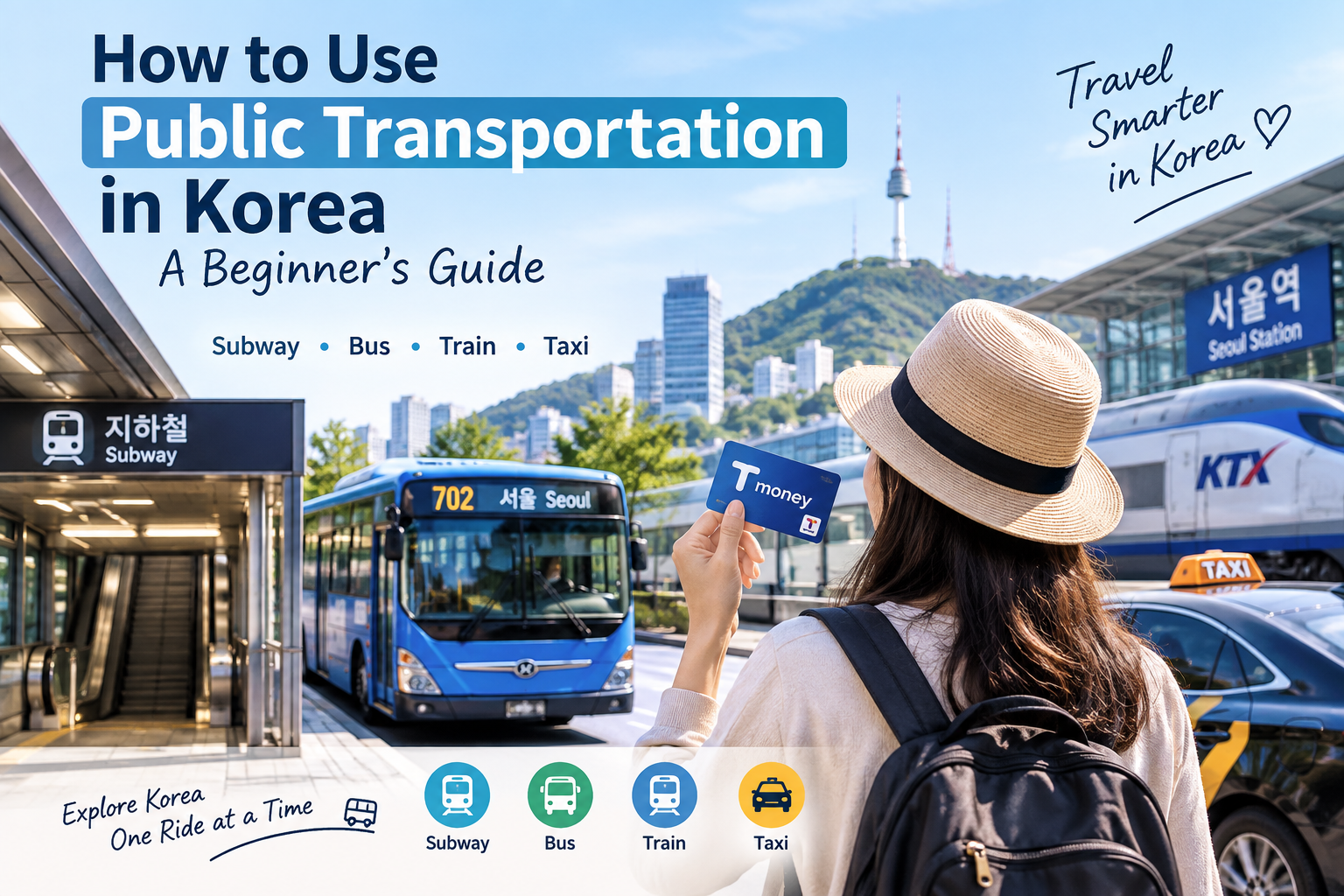
    How to Use Public Transportation in Korea: A Beginner’s Guide

    Planning your first trip to Korea? One of the easiest ways to make your journey more comfortable is to understand how public transportation works.

    Korea has an extensive transportation system, especially in major cities. Subways, buses, trains, and taxis make it possible to travel around without renting a car.

    For first-time visitors, however, using a new transportation system can feel confusing at first.

    The good news is that with a few basic tips, getting around Korea can be quite simple.

    In this beginner’s guide, we will explain how to use public transportation in Korea, including transportation cards, subways, buses, trains, and useful travel tips.

    1. Get a Transportation Card

    A transportation card is one of the most useful things to have when traveling around Korea.

    Cards such as T-money can generally be used on buses and subways in many parts of Korea. They can also be used for some other transportation-related payments and at participating stores.

    You can usually purchase and recharge a transportation card at convenience stores or subway stations.

    Before getting on a bus or entering the subway, make sure your card has enough balance.

    Using a transportation card is often more convenient than buying a separate ticket for every journey.

    2. How to Use a Transportation Card

    Using the card is simple.

    When entering a bus, tap your card on the card reader.

    When leaving a bus, you may also need to tap your card again. This is important because the transportation system may use the entry and exit information to calculate fares or transfers.

    On the subway, tap your card when entering and again when leaving through the station gates.

    Keep your transportation card easily accessible so you do not have to search for it every time you use public transportation.

    The subway is one of the most convenient ways to travel around major Korean cities.

    Seoul, in particular, has an extensive subway network connecting many neighborhoods and tourist attractions.

    Before you travel, check your route using a reliable map or navigation app.

    Look at the subway line number or color and check the direction of the train.

    When you arrive at the station, follow the signs to the correct platform.

    Korean subway stations usually have signs in Korean and English, and many major stations also provide information in other languages.

    Pay attention to the station name and the direction of the train before boarding.

    4. Understanding Transfers

    You may need to transfer between subway lines during your trip.

    Follow the signs marked for the line you need to transfer to.

    Some stations are very large, so changing lines may require a few minutes of walking.

    If you are traveling with luggage, allow extra time for transfers.

    It is also helpful to check your complete route before leaving your hotel or accommodation.

    5. Using Navigation Apps

    A navigation app can make public transportation much easier for international visitors.

    You can use a map or transportation app to check subway routes, bus routes, travel times, and transfer information.

    Before leaving, check the destination name carefully and make sure you are going in the correct direction.

    If possible, save important locations such as your accommodation, airport, train station, and major attractions.

    This can be especially useful if your phone connection becomes temporarily unavailable.


    6. How to Use City Buses

    Buses are another convenient way to get around Korean cities.

    Bus stops usually display route numbers and information about destinations. Major stops may also provide information in English.

    Before boarding, check the bus number and direction carefully.

    When you get on the bus, tap your transportation card on the card reader.

    When getting off, tap your card again if required.

    If you are not sure where to get off, use a navigation app to follow your route.

    It is also helpful to watch the names of upcoming bus stops so you know when your destination is approaching.

    7. Traveling Between Cities by Train

    If you want to travel between major Korean cities, trains can be a convenient option.

    Korea has several types of passenger trains, including high-speed services such as KTX.

    For popular routes and busy travel periods, consider checking schedules and purchasing tickets in advance.

    Keep your ticket or reservation information available until you arrive at your destination.

    If you have large luggage, check the available luggage storage areas before boarding.

    8. Using Taxis in Korea

    Taxis can be useful when public transportation is inconvenient or when you are traveling with luggage.

    You can usually find taxis at designated taxi stands, near major transportation hubs, or request one through a taxi-hailing app.

    Before getting into a taxi, make sure the destination is correct.

    Having the destination written in Korean can be helpful, especially when traveling to a smaller hotel, restaurant, or residential area.

    Most taxis use a meter to calculate the fare. Check the fare and payment method before completing your journey.

    9. Tips for Saving Time and Money

    Public transportation is often an economical way to travel around Korea.

    If you plan to use buses and subways frequently, a transportation card can be more convenient than purchasing individual tickets for every trip.

    Before traveling, compare different routes and check whether a transfer is required.

    Traveling a little earlier can also help you avoid the busiest times on popular routes.

    If you are carrying large luggage, consider choosing a route with fewer transfers, even if it takes slightly longer.

    A simple and comfortable route is sometimes better than the fastest route.

    10. A Few Safety Tips

    Public transportation in Korea is generally convenient, but travelers should still take normal precautions.

    Keep your passport, wallet, phone, and other valuables secure.

    Pay attention when walking through busy stations and when getting on or off buses and trains.

    If you are traveling late at night, stay aware of your surroundings and use well-lit areas whenever possible.

    If you are unsure about a route, do not hesitate to ask station staff or check a navigation app again.

    Final Thoughts

    Using public transportation in Korea may seem complicated when you first arrive, but it becomes much easier after a few trips.

    Start with a transportation card, check your route before leaving, and give yourself enough time for transfers.

    Subways and buses are especially useful for exploring cities, while trains are a convenient choice when traveling between major destinations.

    You do not need to understand everything on your first day.

    Take your time, check the signs, and enjoy the journey.

    With a little preparation, public transportation can become one of the easiest and most enjoyable ways to experience Korea.