Tag: Seoul travel 2026

  • Seoul Welcome Week 2026: Free Tourist Pass, Events and Discounts for Foreign Visitors

    Seoul Welcome Week 2026: Free Tourist Pass, Events and Discounts for Foreign Visitors

    Seoul Welcome Week 2026 Is Here

    If you are visiting Seoul this fall, there is an extra reason to explore the city right now.

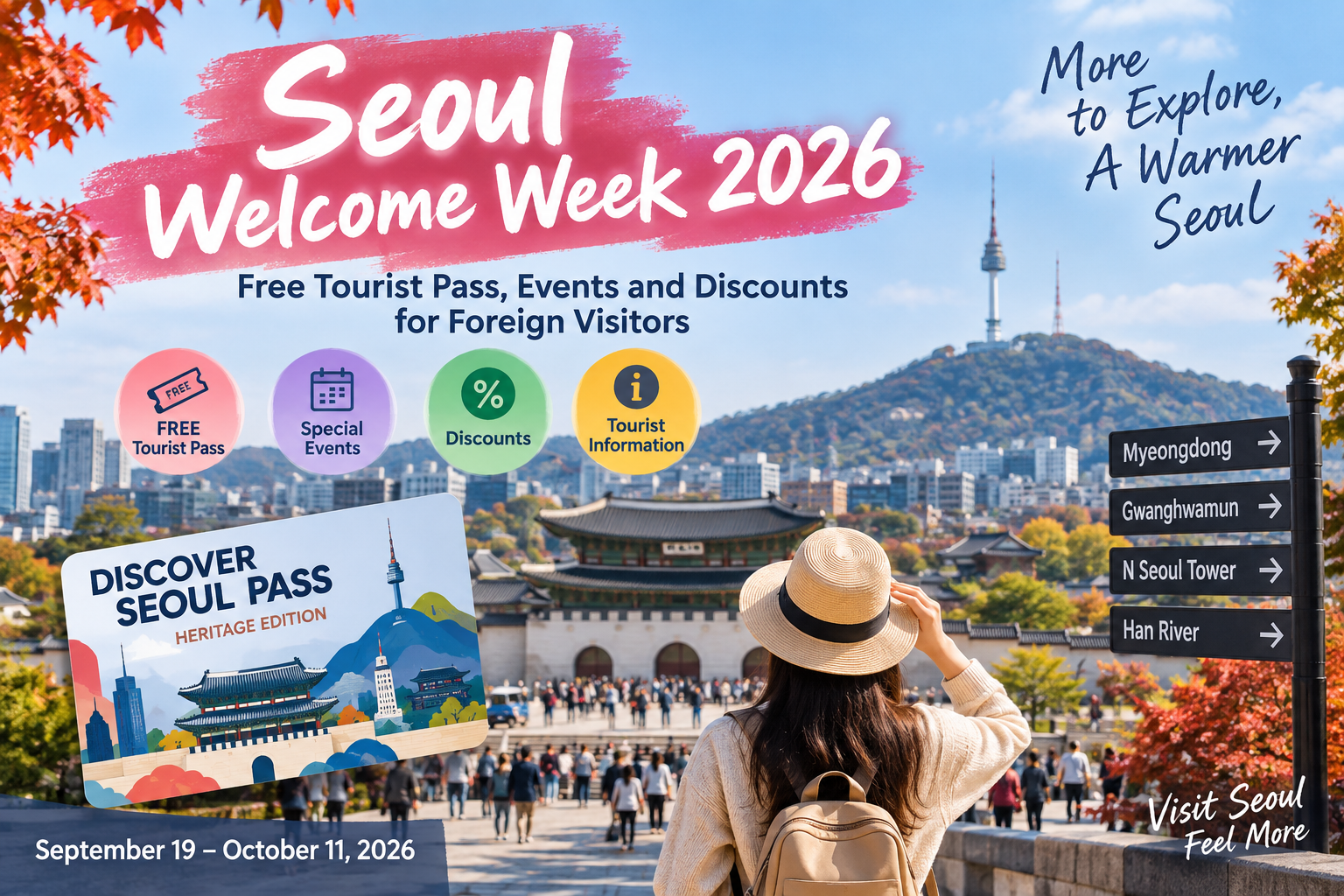
    Seoul Welcome Week 2026 runs from September 19 to October 11, 2026, with special programs and benefits designed for international visitors. The campaign overlaps with Korea’s Chuseok holiday period, making it especially useful for travelers who are worried about what will be open or what they can do during the holiday.

    Visitors can find special welcome programs, tourism information, discounts, and limited benefits at locations including airports and central Seoul.

    One of the most interesting benefits is a special edition of the Discover Seoul Pass, which can help travelers visit major attractions while spending less.

    In this guide, we will look at what Seoul Welcome Week offers, who can use the benefits, where to find them, and what international travelers should know before heading out.

    Seoul Welcome Week 2026 at a Glance

    Here are the key dates to know:

    • Dates: September 19–October 11, 2026
    • Location: Seoul, with programs at major visitor touchpoints including airports and Myeongdong
    • Who it is for: International visitors to Seoul
    • Main benefits: Tourist information, special events, attraction benefits, and selected discounts

    Some programs are available only during specific dates within the Welcome Week period, and limited-quantity benefits may run out early.

    Tip: Do not assume every benefit is available throughout the entire September 19–October 11 period. Check the dates and conditions for the specific program you want to use before making a special trip.

    Free Discover Seoul Pass for International Visitors

    One of the headline benefits of Seoul Welcome Week 2026 is a special Discover Seoul Pass Heritage Edition for international travelers.

    According to the Seoul Metropolitan Government, a limited number of passes are being provided to eligible foreign visitors through welcome events at Seoul’s major gateways.

    The Heritage Edition is designed around Seoul’s cultural heritage and gives travelers access to 12 major heritage attractions, along with discounts or benefits at more than 110 participating locations.

    Because the free passes are limited and distribution conditions can vary by location, travelers should not plan their entire itinerary around receiving one. Think of it as a valuable bonus if you are eligible and passes are still available.

    If you receive a pass, check its validity period and included attractions before activating or using it. This will help you get the most value from the pass rather than using it for an attraction you would have visited cheaply anyway.

    Visit the Myeongdong Welcome Center

    Travelers staying in central Seoul should also pay attention to the temporary Welcome Center in Myeongdong, one of the city’s busiest areas for international visitors.

    The Welcome Center is scheduled to operate from October 1 to October 8, 2026.

    Visitors can stop by for tourism information and special Welcome Week programs while exploring Myeongdong and nearby areas such as Namdaemun, Euljiro, Cheonggyecheon, and central Seoul.

    This can be particularly useful during the Chuseok period, when travelers may be unsure about holiday schedules or need help adjusting their plans.

    Look for Special Seoul Travel Discounts

    Welcome Week is not limited to information booths and events.

    Selected tourism experiences are also offering visitor benefits during the campaign. One highlighted example is a 20% discount on selected Han River cruise experiences.

    If a Han River cruise is already on your Seoul itinerary, it is worth checking the current Welcome Week conditions before booking.

    However, discounts can have specific dates, reservation requirements, or eligibility rules. Always confirm the current terms with the participating operator before paying.

    How to Make the Most of Seoul Welcome Week

    The easiest way to use Seoul Welcome Week is to combine its benefits with places you already plan to visit.

    For example, if you are staying in Myeongdong, visiting the Welcome Center can fit naturally into a day exploring central Seoul. If you are planning a Han River cruise, check whether the Welcome Week discount applies to your preferred date and booking.

    Travelers arriving during the campaign period should also pay attention to welcome programs at the airport before leaving the arrivals area.

    A simple strategy is:

    1. Check which Welcome Week benefits are available on your travel dates.
    2. See whether any of them match attractions already on your itinerary.
    3. Confirm eligibility, operating dates, and reservation requirements.
    4. Use limited benefits only when they actually save you money or improve your trip.

    This is better than changing an entire Seoul itinerary simply to chase a free pass or discount.

    Visiting Seoul During Chuseok 2026

    Seoul Welcome Week overlaps with Chuseok, one of Korea’s most important holidays.

    For travelers, this does not mean Seoul shuts down completely. Major tourist areas, cultural attractions, shopping districts, and events can still give visitors plenty to do.

    However, opening hours may change, and individual restaurants, cafes, shops, museums, or attractions may operate on special holiday schedules.

    Before visiting a specific place during the holiday period, check its official operating information rather than relying only on normal opening hours shown in older travel guides.

    Transportation can also be busier around Chuseok as many people travel between Seoul and other parts of Korea. This is especially important if your trip includes KTX or other intercity transportation.

    Good Areas to Combine With Welcome Week Activities

    If you visit the Myeongdong Welcome Center, you can easily combine it with several nearby areas.

    Myeongdong is convenient for shopping, food, beauty stores, and first-time visitors.

    Namdaemun Market is within easy reach and offers a very different traditional market atmosphere.

    Cheonggyecheon Stream is a good option for an easy walk through central Seoul.

    Gwanghwamun and the palace area are also nearby and work well for travelers interested in Seoul’s history and cultural heritage.

    Instead of treating Welcome Week as a separate event, use it as an extra layer of benefits while following the Seoul itinerary you already wanted to experience.

    FAQ About Seoul Welcome Week 2026

    When is Seoul Welcome Week 2026?

    Seoul Welcome Week runs from September 19 to October 11, 2026. Individual programs may operate for shorter periods, so check the dates for each benefit before visiting.

    Is Seoul Welcome Week only for foreign tourists?

    Many of the special welcome programs and benefits are designed specifically for international visitors. Eligibility can vary by program, so bring your passport or other identification if a benefit requires proof of international visitor status.

    Is the Discover Seoul Pass really free?

    A limited number of special Discover Seoul Pass Heritage Edition passes are being offered to eligible international visitors through Welcome Week programs. Because quantities are limited, receiving one is not guaranteed.

    What does the Discover Seoul Pass Heritage Edition include?

    The special pass provides access to 12 major heritage attractions and benefits or discounts at more than 110 participating locations, according to the Seoul Metropolitan Government.

    Always check the current list of included attractions and usage conditions before planning around the pass.

    Where is the Seoul Welcome Center in Myeongdong?

    A temporary Welcome Center is scheduled to operate in the Myeongdong area from October 1 to October 8, 2026. Check Seoul’s official tourism information for the latest location and operating details before visiting.

    Is Seoul worth visiting during Chuseok?

    Yes. Seoul can still offer plenty to do during Chuseok, particularly in major tourist and cultural areas. The main difference is that some businesses and attractions may have special holiday hours.

    Check individual opening schedules in advance, especially for restaurants, smaller businesses, and specific attractions you do not want to miss.

    Final Thoughts

    Seoul Welcome Week 2026 gives international visitors a useful opportunity to get more from a fall trip to the Korean capital.

    The most valuable benefits are not necessarily the ones that sound the biggest. A free attraction pass can save money, a discount can make an activity more affordable, and a Welcome Center can be useful when holiday schedules make travel planning confusing.

    The key is to check what is available on your actual travel dates and combine those benefits with the Seoul itinerary you already have.

    If you are visiting during Chuseok, plan important transportation and must-see attractions in advance, but do not assume the holiday means there will be nothing to do. Seoul continues to offer cultural experiences, events, shopping, food, and sightseeing opportunities throughout the season.

    With a little preparation, Seoul Welcome Week can make an already exciting fall trip to Korea even better.
  • T-Money vs Climate Card in Seoul 2026: Which Transportation Card Is Best for Tourists?

    T-Money vs Climate Card in Seoul 2026: Which Transportation Card Is Best for Tourists?

    Getting around Seoul is easy once you understand the city’s transportation system. But for first-time visitors, choosing the right transportation card can be surprisingly confusing.

    Two of the most useful options are T-Money and the Climate Card.

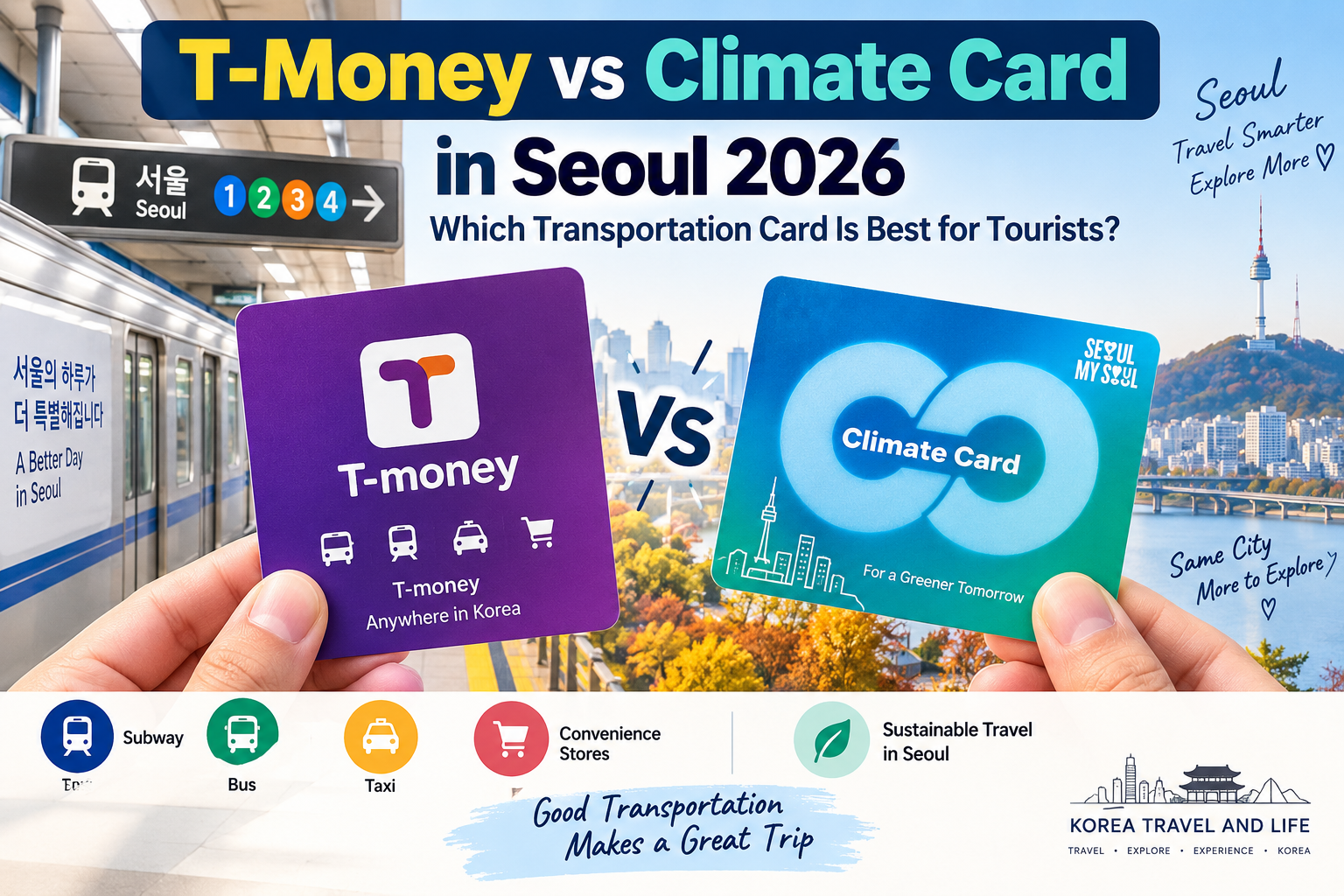
    Both can make traveling around Seoul much easier, but they work very differently. T-Money is a rechargeable transportation card that can be used across Korea, while the Climate Card offers unlimited rides within its designated Seoul transportation network for a fixed period.

    So which one should you buy?

    This 2026 guide explains the differences between T-Money and the Climate Card, how much they cost, where you can use them, and which option may make more sense for your Korea itinerary.

    Quick Answer: T-Money or Climate Card?

    For most travelers, the choice depends on where you are traveling.

    Choose T-Money if you:

    • Plan to travel outside Seoul
    • Will visit places such as Busan, Gyeongju, Jeju, or other Korean cities
    • Prefer paying for transportation based on actual usage
    • Want one transportation card that works across much of Korea
    • Expect to use taxis or other transportation outside the Climate Card service area

    Choose the Climate Card if you:

    • Will spend most of your trip inside Seoul
    • Expect to use buses and subways frequently
    • Want unlimited eligible public transportation during your pass period
    • Prefer knowing your transportation cost in advance
    • Are staying in Seoul for between one and seven days

    For many first-time visitors traveling around Korea, T-Money offers greater flexibility.

    For travelers spending several busy sightseeing days almost entirely in Seoul, however, a short-term Climate Card can be very convenient.

    What Is a T-Money Card?

    T-Money is one of Korea’s most widely used prepaid transportation cards.

    Instead of buying an individual ticket every time you ride a subway or bus, you load money onto the card and tap it when entering and leaving the transportation system.

    T-Money can be purchased at many convenience stores, including chains such as CU, GS25, and 7-Eleven, as well as at transportation facilities.

    The standard card generally costs around KRW 3,000–5,000, before adding transportation credit.

    One of T-Money’s biggest advantages for international travelers is its wide coverage.

    It can be used on public transportation across many parts of Korea, making it particularly useful for travelers visiting several cities during one trip.

    Where Can You Use T-Money?

    T-Money can be used on many:

    • Subways
    • City buses
    • Express and intercity buses
    • Taxis
    • Other participating transportation services

    It can also be used at some convenience stores, vending machines, and other participating merchants displaying the T-Money logo.

    This makes T-Money particularly useful for itineraries such as:

    Seoul → Busan → Gyeongju → Seoul

    Instead of buying a new local transportation card in every destination, travelers can continue using the same T-Money card for many local transportation needs.

    What Is the Seoul Climate Card?

    The Climate Card was introduced by the Seoul Metropolitan Government as an unlimited public transportation pass.

    For tourists, the most important products are the short-term Climate Card passes.

    As of 2026, short-term passes are available for:

    • 1 day — KRW 5,000
    • 2 days — KRW 8,000
    • 3 days — KRW 10,000
    • 5 days — KRW 15,000
    • 7 days — KRW 20,000

    A physical Climate Card costs an additional KRW 3,000.

    These passes are particularly attractive for travelers who plan to take public transportation repeatedly while sightseeing around Seoul.

    Important Climate Card Change in 2026

    Visitors may see older online guides discussing the Climate Card’s 30-day prepaid pass.

    This information is changing.

    Seoul announced that recharging the existing 30-day prepaid Climate Card ends after August 31, 2026, as the city transitions toward its newer Climate Pass system.

    However, this does not mean tourists can no longer use the Climate Card.

    The short-term tourist passes for 1, 2, 3, 5, and 7 days continue to be available.

    This distinction is important when reading older travel guides about Seoul transportation.

    Can Foreign Tourists Buy the Climate Card With an International Credit Card?

    Yes, and this became significantly easier in 2026.

    Seoul expanded payment support at hundreds of new subway vending machines, allowing travelers to use internationally issued credit and debit cards such as Visa and Mastercard to purchase Climate Cards and recharge short-term passes.

    International card payments are supported at new vending machines installed across Seoul Metro Lines 1–8.

    An average service fee of approximately 3.7% may apply when using an internationally issued card.

    This is an important improvement for international visitors because transportation card purchases in Korea have traditionally relied heavily on Korean won cash or locally issued cards.

    T-Money vs Climate Card: Main Differences

    Here is the simplest way to understand the two cards.

    T-Money

    Payment system: Pay per ride

    Best for: Flexible travel throughout Korea

    Coverage: Widely usable across Korea

    Main advantage: One card can be used for transportation in many Korean cities

    Best traveler: Someone visiting Seoul plus other destinations

    Climate Card

    Payment system: Unlimited eligible transportation during the pass period

    Best for: Frequent transportation within Seoul

    Coverage: Limited primarily to eligible Seoul transportation services

    Main advantage: Unlimited rides without worrying about individual fares

    Best traveler: Someone sightseeing intensively within Seoul

    Is the Climate Card Really Unlimited?

    Within its eligible transportation network, the Climate Card allows unlimited rides during the validity period.

    However, “unlimited” does not mean that every transportation service in Korea is included.

    The Climate Card has a defined service area and exclusions. Travelers planning trips outside Seoul should therefore check whether their destination is covered before relying exclusively on the card.

    This is one of the biggest differences between the Climate Card and T-Money.

    T-Money does not provide unlimited transportation, but its geographical flexibility is much greater.

    Which Card Is Better for a 3-Day Seoul Trip?

    Consider a traveler spending three full days sightseeing around Seoul.

    The itinerary might include:

    Day 1: Gyeongbokgung Palace → Bukchon Hanok Village → Insadong → Myeongdong

    Day 2: Hongdae → Yeonnam-dong → Han River → Gangnam

    Day 3: Seongsu → Seoul Forest → Dongdaemun → Namsan

    This traveler may take multiple subway and bus rides each day.

    A 3-day Climate Card costs KRW 10,000, plus the KRW 3,000 physical card cost if a card needs to be purchased.

    For a transportation-heavy itinerary like this, the Climate Card can be particularly convenient.

    Which Card Is Better for a 7-Day Korea Trip?

    Now consider this itinerary:

    Days 1–3: Seoul
    Days 4–5: Gyeongju
    Days 6–7: Busan

    In this situation, T-Money is generally more practical because the traveler is moving beyond Seoul.

    The Climate Card’s main value comes from frequent eligible transportation within Seoul, whereas T-Money can continue to be useful in other Korean cities.

    Can You Use Both T-Money and the Climate Card?

    Yes.

    In fact, some travelers may find that carrying both is convenient.

    You could use the Climate Card during several intensive sightseeing days in Seoul and keep a T-Money card for transportation outside the Climate Card coverage area or later trips to other Korean cities.

    You do not necessarily have to choose only one card for your entire Korea trip.

    Where Can Tourists Buy T-Money?

    T-Money cards are widely available.

    Travelers can commonly find them at convenience stores such as:

    • CU
    • GS25
    • 7-Eleven
    • Other participating convenience stores

    They are also available at transportation-related sales locations.

    According to VISITKOREA, a standard T-Money card generally costs approximately KRW 3,000–5,000 before adding transportation credit.

    One detail international travelers should know is that ordinary T-Money purchases and top-ups may still require Korean won cash in many situations, so carrying some cash after arriving in Korea remains useful. Korea Tourism Organization’s 2026 transportation guide specifically notes cash-only purchasing/top-up for standard prepaid T-Money.

    Where Can Tourists Buy a Climate Card?

    Physical Climate Cards are available through designated subway vending machines and participating sales locations in Seoul.

    New transportation-card vending machines across Seoul Metro Lines 1–8 have made purchasing the card considerably easier for international visitors.

    Remember that the physical card itself costs KRW 3,000, and the short-term pass is loaded separately.

    Unlike an ordinary T-Money balance, a short-term Climate Card begins according to the rules associated with the pass, so travelers should check the activation timing before loading it.

    What About Airport Transportation?

    This is where travelers should be careful.

    Not every airport transportation option is included with every Seoul transportation pass.

    For example, the AREX Express Train operates differently from ordinary Seoul subway transportation.

    Travelers arriving at Incheon International Airport should therefore check their airport-to-hotel transportation separately instead of assuming that a Climate Card covers every airport option.

    We will cover this in a separate guide comparing AREX Express, AREX All-Stop Train, airport limousine buses, and taxis from Incheon Airport to Seoul.

    What About WOWPASS?

    WOWPASS is another popular option for international visitors.

    Unlike T-Money, which is primarily a transportation card, WOWPASS combines several traveler-focused functions, including prepaid payments, transportation functionality, and currency-related services.

    That makes it a different type of product.

    For travelers wondering whether WOWPASS or T-Money is better, we will compare those options separately because the decision involves more than transportation alone.

    T-Money vs Climate Card: Which Should First-Time Visitors Choose?

    There is no single card that is ideal for every Korea itinerary.

    For a traveler spending almost the entire trip sightseeing around Seoul and taking public transportation many times each day, the Climate Card can be a simple and convenient choice.

    For travelers visiting multiple Korean cities or wanting maximum transportation flexibility, T-Money is usually easier to use throughout the trip.

    And for some travelers, carrying both can make sense.

    The key is to choose based on your itinerary rather than simply buying whichever transportation card you see first.

    Frequently Asked Questions

    Is T-Money only available in Seoul?

    No. One of T-Money’s biggest advantages is that it can be used on public transportation in many areas throughout Korea.

    Can tourists still use the Climate Card in 2026?

    Yes. Although Seoul is changing its longer-term Climate Card system, short-term tourist passes for 1, 2, 3, 5, and 7 days remain available.

    How much is a 3-day Climate Card?

    The 3-day short-term pass costs KRW 10,000. A physical Climate Card costs an additional KRW 3,000 if you do not already have one.

    Can I buy a Climate Card with a foreign credit card?

    Internationally issued credit and debit cards are accepted at supported new transportation-card vending machines for Climate Card purchases and short-term pass recharging.

    Can I use T-Money in Busan?

    Yes. T-Money is widely usable on public transportation beyond Seoul, including major Korean cities.

    Should I buy T-Money at Incheon Airport?

    For many visitors, getting a transportation card soon after arrival is convenient, especially if they plan to use public transportation frequently during their trip.

    Final Thoughts

    Choosing between T-Money and the Climate Card becomes much easier once you know your itinerary.

    If your trip is focused almost entirely on Seoul and you expect to ride buses and subways frequently, a short-term Climate Card can provide simple, predictable transportation costs.

    If your Korea itinerary includes several cities, T-Money offers greater flexibility and can remain useful throughout your trip.

    Before traveling, always check the latest transportation rules because Seoul’s transit card system continues to evolve.

    For most international travelers, the best strategy is simple:

    Choose the Climate Card for intensive Seoul sightseeing. Choose T-Money for flexibility across Korea.


  • Where to Stay in Seoul in 2026: Best Areas and Hotels for First-Time Visitors

    Where to Stay in Seoul in 2026: Best Areas and Hotels for First-Time Visitors

    Where to Stay in Seoul in 2026

    Choosing where to stay in Seoul can be surprisingly difficult for a first-time visitor.

    Seoul is enormous, and there is no single neighborhood that is best for everyone.

    One traveler may want to walk to palaces and traditional streets. Another may care more about nightlife and cafes. A family might prioritize convenience, while a first-time visitor arriving from Incheon Airport may simply want an area that makes transportation easy.

    The good news is that Seoul has excellent neighborhoods for almost every type of traveler.

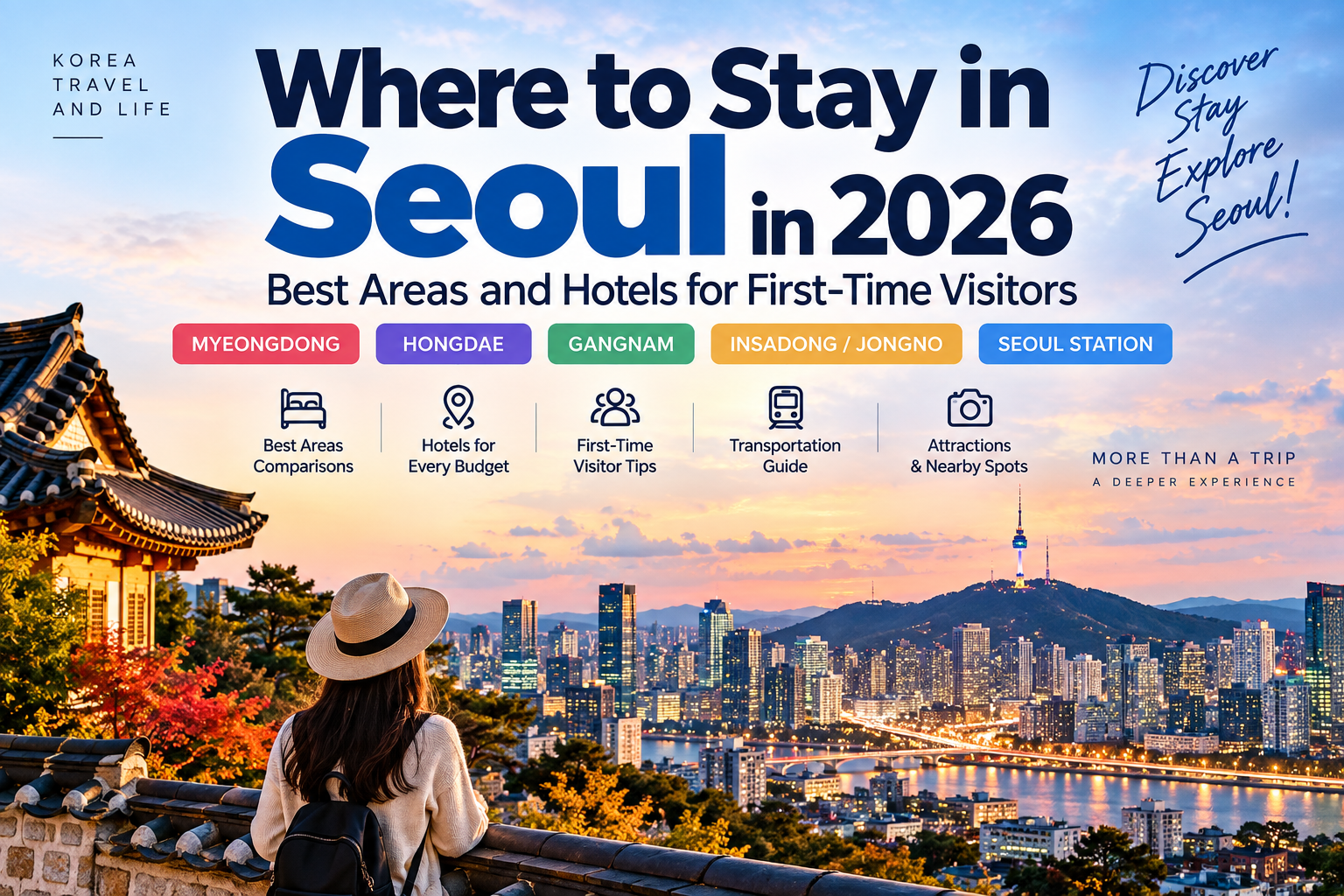
    In this guide, we compare Myeongdong, Hongdae, Gangnam, Insadong/Jongno, and Seoul Station to help you decide where to stay in Seoul in 2026.

    Quick Answer: Where Should You Stay in Seoul?

    If you want the simplest answer:

    Myeongdong — Best overall for first-time visitors
    Hongdae — Best for nightlife, cafes, and younger travelers
    Gangnam — Best for modern Seoul, shopping, and upscale stays
    Insadong/Jongno — Best for history, palaces, and traditional culture
    Seoul Station — Best for transportation and travelers taking trains around Korea

    For many first-time visitors, Myeongdong is the easiest all-around choice because of its central location and convenient access to major attractions.

    But the best area for you depends on how you plan to spend your trip.

    1. Myeongdong — Best Overall for First-Time Visitors

    For a first trip to Seoul, Myeongdong is one of the easiest areas to recommend.

    It is centrally located and puts you close to many of the places travelers want to see during their first few days in the city.

    Myeongdong is particularly convenient for travelers interested in:

    • Shopping
    • Korean beauty products
    • Street food
    • Restaurants
    • Central Seoul sightseeing
    • Easy public transportation

    You can also reach areas such as Namsan, Namdaemun Market, City Hall, and central historic Seoul relatively easily.

    Why Stay in Myeongdong?

    The biggest advantage is convenience.

    When you only have three or four days in Seoul, spending less time moving across the city can make a major difference.

    Myeongdong has a large concentration of hotels across different price ranges, from practical mid-range properties to more upscale options.

    It is also an area accustomed to international travelers.

    That can make a first visit to Korea feel less intimidating.

    Who Should Stay in Myeongdong?

    Myeongdong works especially well for:

    • First-time visitors
    • Short stays
    • Shoppers
    • Couples
    • Families
    • Travelers who want a central base
    • Visitors interested in Korean beauty and food

    Possible Downsides

    Myeongdong is highly commercial and busy.

    If your dream of Seoul involves quiet residential streets and neighborhood cafes, another area may feel more atmospheric.

    But for convenience, it remains difficult to beat.

    2. Hongdae — Best for Nightlife, Cafes, and Young Travelers

    Hongdae offers a completely different Seoul experience.

    Located around Hongik University, the area is known for youthful energy, cafes, restaurants, shopping, nightlife, music, and street culture.

    During the evening, the neighborhood becomes particularly lively.

    For travelers who want to step outside their hotel and immediately feel Seoul’s younger social scene, Hongdae can be an excellent choice.

    Why Stay in Hongdae?

    One major advantage is transportation from Incheon International Airport.

    The AREX airport railroad connects the airport with Hongik University Station, making Hongdae convenient for many international arrivals.

    That can be especially useful if you have heavy luggage.

    The neighborhood itself also offers plenty to do without needing to travel elsewhere every evening.

    Hongdae Is Best For

    • Younger travelers
    • Solo travelers
    • Nightlife
    • Cafes
    • Casual dining
    • Fashion
    • Music and entertainment
    • Travelers arriving through Incheon Airport

    Possible Downsides

    Hongdae can be noisy.

    If your hotel is located near the busiest nightlife streets, weekends can feel especially active.

    Travelers who prioritize quiet evenings should check the hotel’s exact location rather than choosing purely by the word “Hongdae.”

    Myeongdong vs Hongdae: Which Is Better?

    This is one of the most common decisions first-time travelers face.

    Choose Myeongdong if your priority is:

    • Central sightseeing
    • Shopping
    • Convenient access to historic attractions
    • A straightforward first trip

    Choose Hongdae if your priority is:

    • Nightlife
    • Cafes
    • Youth culture
    • Evening entertainment
    • Convenient airport rail access

    For a traditional first-time sightseeing itinerary, Myeongdong generally makes the easier base.

    For travelers who care about nightlife and neighborhood atmosphere, Hongdae may be more enjoyable.

    3. Insadong and Jongno — Best for History and Traditional Seoul

    If you are coming to Korea because you want to experience palaces, hanok streets, temples, traditional food, and Korean history, consider staying around Insadong or Jongno.

    This part of central Seoul puts you close to some of the city’s most important cultural attractions.

    Depending on your exact accommodation, you can have convenient access to places such as:

    • Gyeongbokgung Palace
    • Changdeokgung Palace
    • Bukchon Hanok Village
    • Insadong
    • Jogyesa Temple
    • Gwanghwamun
    • Cheonggyecheon Stream

    This makes the area particularly attractive for cultural travelers.

    Why Stay in Insadong or Jongno?

    The atmosphere is different from Gangnam or Hongdae.

    Instead of skyscrapers and clubs, you are closer to historic neighborhoods, traditional architecture, museums, tea houses, and palaces.

    You can spend a morning visiting a royal palace, walk through traditional streets in the afternoon, and enjoy Korean food in the evening without traveling across the entire city.

    Best For

    • History lovers
    • Cultural travelers
    • Couples
    • Photographers
    • First-time visitors
    • Travelers interested in traditional Korea

    What About Hanok Accommodation?

    Travelers looking for something more memorable can also consider a traditional-style hanok stay.

    A hanok stay provides a very different experience from a conventional hotel and can be particularly appealing for visitors interested in Korean architecture and culture.

    However, traditional accommodation may offer different room layouts and amenities from international-style hotels, so check the property details carefully before booking.

    4. Gangnam — Best for Modern Seoul and Upscale Stays

    Gangnam is internationally famous, but it is important to understand its location before booking.

    Gangnam is south of the Han River, while many of Seoul’s most famous historic attractions are north of the river.

    That does not make Gangnam a bad place to stay.

    It simply makes it best for a different type of trip.

    Why Stay in Gangnam?

    Gangnam is ideal if you want to experience Seoul as a modern global city.

    The broader area offers:

    • Upscale hotels
    • Shopping
    • Restaurants
    • Cafes
    • Business districts
    • Modern architecture
    • Nightlife
    • Beauty and fashion
    • Convenient access to southern Seoul

    Popular destinations such as COEX and the surrounding neighborhoods are also located in this part of the city.

    Gangnam Is Best For

    • Business travelers
    • Repeat visitors
    • Luxury travelers
    • Shopping
    • Modern Seoul
    • Travelers with activities mainly south of the Han River

    Is Gangnam Good for a First Visit?

    It can be.

    But if most of your itinerary includes Gyeongbokgung Palace, Bukchon, Insadong, Myeongdong, and other central or northern attractions, staying in Gangnam means more travel time.

    For many first-time tourists, central Seoul is therefore more practical.

    5. Seoul Station — Best for Transportation

    Seoul Station is not necessarily the most atmospheric neighborhood on this list.

    But it may be the most practical for certain itineraries.

    Seoul Station is one of Korea’s major transportation hubs.

    From here, travelers can connect to:

    • KTX high-speed trains
    • Subway lines
    • Airport transportation
    • Regional rail services
    • Buses and taxis

    This makes it particularly useful for travelers using Seoul as the starting point for a larger Korea trip.

    Who Should Stay Near Seoul Station?

    Consider this area if you plan to visit destinations such as:

    • Busan
    • Gyeongju
    • Daegu
    • Daejeon
    • Other cities accessible by rail

    It can also be convenient for a one-night stay before or after a train journey.

    Possible Downsides

    If your main goal is to experience Seoul’s nightlife or neighborhood atmosphere, Hongdae or another district may feel more exciting.

    Seoul Station is primarily about convenience.

    Best Area in Seoul for Couples

    For couples, the best neighborhood depends on the style of trip.

    Myeongdong works well for couples visiting Seoul for the first time.

    Insadong/Jongno offers a more cultural and atmospheric experience.

    Gangnam can be attractive for couples interested in upscale hotels, dining, and shopping.

    Hongdae suits couples who enjoy nightlife and lively cafes.

    For a romantic first trip combining sightseeing and food, central Seoul is often the easiest choice.

    Best Area in Seoul for Families

    Families often benefit from staying somewhere central with easy transportation.

    Myeongdong can work particularly well because it provides access to:

    • Restaurants
    • Shopping
    • Subway stations
    • Major sightseeing areas

    When booking as a family, pay close attention to room size.

    Hotel rooms in Seoul can be smaller than some international travelers expect.

    Check:

    • Bed configuration
    • Maximum occupancy
    • Room size
    • Breakfast options
    • Laundry facilities
    • Distance from the subway

    These details can matter more than the hotel’s star rating.

    Best Area for Solo Travelers

    Solo travelers have several excellent choices.

    Hongdae is attractive if you want social energy, cafes, and nightlife.

    Myeongdong is convenient if this is your first visit and you want straightforward sightseeing.

    Jongno can be excellent for travelers who enjoy exploring cultural sites on foot.

    Seoul is a large city, so solo travelers should prioritize a location that matches what they plan to do most often.

    Best Area for Nightlife

    Hongdae is one of the most obvious choices for travelers looking for a lively evening atmosphere.

    Gangnam also offers nightlife, but the experience is different.

    Hongdae generally feels younger and more casual.

    Gangnam tends to feel more polished and spread across several entertainment districts.

    If nightlife is a major part of your trip, check how close your hotel is to the specific streets or venues you plan to visit.

    Best Area for Shopping

    For many first-time visitors:

    Myeongdong is excellent for cosmetics, fashion, and tourist-friendly shopping.

    Gangnam offers department stores, luxury shopping, and modern commercial districts.

    Hongdae is popular for youthful fashion, accessories, and trend-driven shops.

    The best choice depends on what you want to buy.

    Best Area for Korean Food

    There is excellent food throughout Seoul.

    You do not need to choose your hotel solely around restaurants.

    However:

    Jongno and Insadong are useful for traditional Korean food and historic dining areas.

    Myeongdong offers enormous variety and easy access for visitors.

    Hongdae has casual restaurants, cafes, and late-night options.

    Because Seoul’s public transportation is excellent, serious food travelers can explore multiple neighborhoods regardless of where they sleep.

    Best Area for Airport Access

    For travelers arriving at Incheon International Airport, Hongdae and Seoul Station can be especially convenient because of the AREX airport railroad.

    Other central areas can also be reached using airport transportation, subway connections, buses, or taxis.

    Do not choose accommodation based only on distance from the airport.

    Consider what happens during the rest of your trip.

    Saving a little time on arrival is less useful if you then spend an extra hour commuting every day.

    How Close Should Your Hotel Be to a Subway Station?

    This is one of the most important booking tips in Seoul.

    Try to stay within approximately 5–10 minutes’ walk of a useful subway station when possible.

    Seoul is extremely walkable in individual neighborhoods, but attractions are spread across a very large metropolitan area.

    A convenient subway station can save considerable time.

    Before booking, check the hotel on a map and identify:

    1. The nearest subway station
    2. The subway line
    3. Walking distance
    4. Whether transfers are required for your main attractions

    A cheaper hotel far from transportation is not always the better deal.

    How Many Nights Should You Stay in Seoul?

    For first-time visitors:

    3 nights — enough for major highlights, but fast-paced

    4–5 nights — comfortable for most first trips

    6–7 nights — better for slower travel, neighborhoods, shopping, cafes, and day trips

    If Seoul is your only destination in Korea, staying longer is easy to justify.

    If you are combining Seoul with Busan, Jeju, or Gyeongju, four or five nights can be a useful starting point.

    Budget Hotels vs Mid-Range vs Luxury Hotels

    Seoul offers accommodation at almost every price level.

    Budget

    Budget travelers can consider:

    • Hostels
    • Guesthouses
    • Small hotels
    • Simple business hotels

    Location should remain a priority.

    Saving money on accommodation is less helpful if transportation becomes inconvenient.

    Mid-Range

    For many international travelers, mid-range hotels offer the best balance.

    You can often find:

    • Private bathrooms
    • Convenient locations
    • Reliable Wi-Fi
    • Front desk service
    • Modern rooms

    This category is especially competitive in Myeongdong and other central areas.

    Luxury

    Seoul has an extensive luxury hotel market.

    High-end properties may offer:

    • Larger rooms
    • City views
    • Fine dining
    • Spas
    • Pools
    • Executive lounges
    • Premium service

    Luxury travelers should decide whether they value the hotel experience itself or primarily want the best sightseeing location.

    What to Check Before Booking a Seoul Hotel

    Before clicking “Book,” check these details carefully.

    1. Exact Location

    Do not rely only on the neighborhood name.

    A property marketed as being in a famous district may actually be a substantial walk from its main attractions.

    2. Subway Distance

    Look at the real walking route to the station.

    3. Room Size

    Check the square meters or square feet.

    Photos can make rooms appear larger than they are.

    4. Bed Type

    A “double room” does not always mean two beds.

    Confirm the exact configuration.

    5. Cancellation Policy

    Travel plans change.

    Compare refundable and non-refundable rates before deciding.

    6. Recent Reviews

    Read recent reviews rather than relying only on the overall score.

    Look especially for comments about:

    • Cleanliness
    • Noise
    • Location
    • Beds
    • Air conditioning
    • Staff
    • Luggage storage

    7. Check-In Time

    This matters particularly if your flight arrives early in the morning or late at night.

    Where Should First-Time Visitors Stay?

    For most first-time visitors who want a straightforward sightseeing trip, Myeongdong or the wider central Seoul area is a strong starting point.

    You will have convenient access to many classic attractions while remaining well connected to the rest of the city.

    Choose Hongdae instead if nightlife and youthful culture matter more.

    Choose Jongno/Insadong if history is your priority.

    Choose Gangnam if your itinerary focuses on modern southern Seoul.

    Choose Seoul Station if transportation around Korea is the deciding factor.

    A Simple Decision Guide

    Still unsure?

    Use this quick decision tree.

    Is this your first trip to Seoul?
    Start with Myeongdong.

    Do you care most about nightlife and cafes?
    Choose Hongdae.

    Do you want palaces and traditional culture?
    Choose Insadong/Jongno.

    Do you prefer modern, upscale Seoul?
    Choose Gangnam.

    Will you take several trains to other Korean cities?
    Consider Seoul Station.

    That simple choice can narrow hundreds of hotels down to a manageable list.

    Frequently Asked Questions

    What is the best area to stay in Seoul for first-time visitors?

    Myeongdong is one of the most convenient choices because of its central location, shopping, restaurants, and access to major sightseeing areas.

    Is Myeongdong or Hongdae better?

    Myeongdong is generally better for traditional first-time sightseeing and shopping. Hongdae is better for nightlife, cafes, and a younger atmosphere.

    Is Gangnam a good place for tourists?

    Yes, particularly for travelers interested in modern Seoul, shopping, business, nightlife, and upscale accommodation. However, it is less convenient for some historic attractions north of the Han River.

    Where should I stay in Seoul for easy airport transportation?

    Hongdae and Seoul Station are convenient choices for many travelers using the AREX airport railroad.

    Where should I stay for traditional Korean culture?

    Insadong and Jongno provide convenient access to royal palaces, traditional streets, temples, and historic central Seoul.

    Should I stay near Seoul Station?

    It is especially useful if you plan to take KTX trains to destinations such as Busan or other Korean cities.

    How far should my Seoul hotel be from the subway?

    For most travelers, staying within a 5–10 minute walk of a useful station is ideal.

    Final Thoughts

    Choosing where to stay in Seoul is less about finding the single “best” hotel and more about choosing the right neighborhood for your trip.

    For many first-time visitors, Myeongdong provides the easiest balance of sightseeing, shopping, food, and transportation.

    Choose Hongdae for nightlife and youthful energy.

    Choose Insadong/Jongno for history and traditional culture.

    Choose Gangnam for modern Seoul and upscale experiences.

    Choose Seoul Station when transportation is your highest priority.

    Once you choose the right area, selecting a hotel becomes much easier.

    And that is the real secret to booking accommodation in Seoul:

    Choose the neighborhood first. Choose the hotel second.