Tag: Seoul Travel Tips

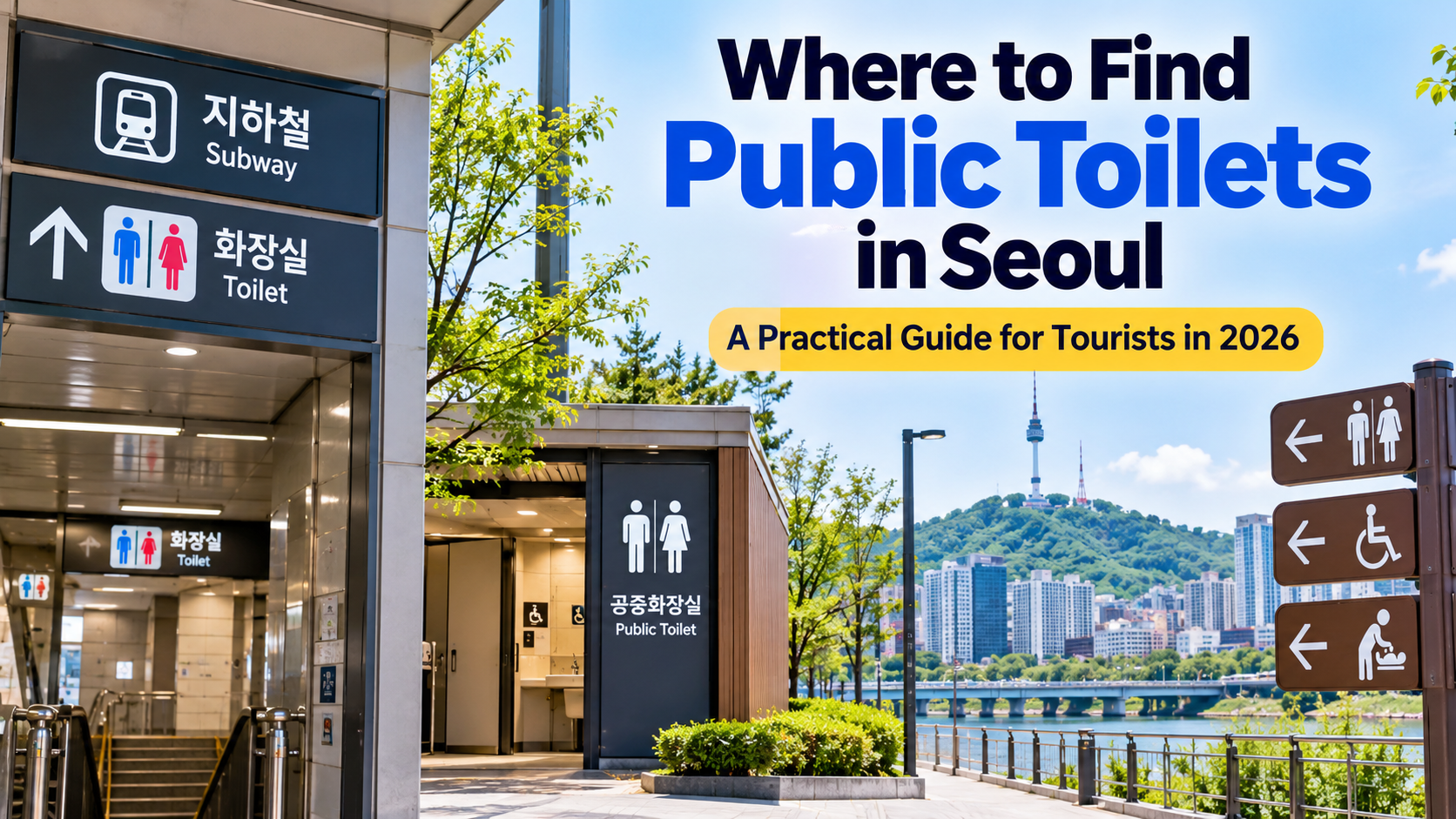
  • Where to Find Public Toilets in Seoul: A Practical Guide for Tourists in 2026

    Where to Find Public Toilets in Seoul: A Practical Guide for Tourists in 2026

    You are exploring Seoul when you suddenly need a restroom. You are nowhere near your hotel, and the nearest café may not have a toilet available to non-customers.

    Where should you go?

    The good news is that Seoul has public toilets in many subway stations, parks, public buildings, and tourist areas. The challenge is knowing which location to try first—and whether the restroom is actually accessible when you arrive.

    The quickest strategy is to look for a subway station, public facility, or officially marked public toilet rather than assuming every café or convenience store has one.

    This guide explains where tourists can find toilets in Seoul, how to search for them using Korean map apps, what signs to recognize, and what to do when the nearest option is unavailable.

    Where Can You Find a Public Toilet in Seoul?

    Not every restroom in Seoul is open to the public, but several types of locations are useful starting points.

    LocationWhy it may helpWhat to check
    Subway stationsMany have restrooms and clear signsSome toilets are inside fare gates
    Public parksOften have designated public facilitiesAvailability and operating hours vary
    Museums and cultural facilitiesRestrooms are generally available to visitorsAdmission or opening hours may apply
    Public offices and community facilitiesSome provide visitor restroomsAccess may be restricted outside business hours
    Shopping malls and department storesUsually have well-maintained customer restroomsBuilding opening hours
    Tourist information centersStaff may direct you to nearby facilitiesNot every center has its own toilet
    Cafés and restaurantsConvenient if you are already a customerRestrooms may be customer-only or shared

    If you need a toilet urgently, do not spend too long checking random businesses. Search for a clearly marked public facility first.

    1. Start With a Subway Station

    Seoul’s subway system is often one of the most practical places to look for a restroom.

    Many stations have toilets marked with recognizable restroom symbols and Korean or English signage.

    However, there is an important detail tourists sometimes overlook.

    Is the toilet inside or outside the ticket gates?

    Some station restrooms are located in areas accessible without paying a fare. Others may be beyond the ticket gates.

    If you are not already taking the subway, entering a paid area just to use the restroom may not be convenient.

    Look at the station’s information board or ask a station employee before tapping your transportation card.

    You can say:

    화장실이 어디에 있어요?

    Hwajangsiri eodie isseoyo?

    “Where is the restroom?”

    If you need to know whether the restroom is outside the gates, ask:

    개찰구 밖에 화장실이 있나요?

    Gaechalgu bakke hwajangsiri innayo?

    “Is there a restroom outside the ticket gates?”

    What if the nearest subway station is large?

    Major transfer stations may have several levels, exits, and underground corridors.

    Following the first restroom sign you see can sometimes involve a longer walk than expected.

    Check the station map for the nearest restroom location before changing levels.

    If you have luggage, a stroller, or limited mobility, also check whether an elevator provides a suitable route.

    2. Search for a Toilet Using Naver Map or KakaoMap

    Google Maps can be useful for general navigation in Seoul, but Korean mapping services are also valuable for finding local facilities.

    Two options to try are Naver Map and KakaoMap.

    The most useful Korean search term is:

    공중화장실

    Gongjung hwajangsil — public toilet

    You can also search:

    화장실

    Hwajangsil — restroom or toilet

    These searches may produce different results depending on the map service and your location.

    How to search step by step

    1. Open Naver Map or KakaoMap.
    2. Allow the app to use your current location.
    3. Enter 공중화장실 in the search field.
    4. Check the results near your current position.
    5. Open a result to examine its location and available details.
    6. Navigate to the entrance, not merely the center of the building.

    <underline>Important:</underline> A map listing does not guarantee that a restroom is open, accessible, or available to everyone at that moment.

    For an urgent visit, prefer a clearly identified public toilet or a facility whose entrance and opening hours you can confirm.

    Useful search terms to copy

    KoreanMeaning
    공중화장실Public toilet
    화장실Restroom
    무료 화장실Free restroom
    장애인 화장실Accessible restroom
    수유실Nursing room
    기저귀 교환대Diaper-changing station

    Searching for an accessible restroom or changing station does not guarantee that the facility meets your specific needs. Confirm the details whenever possible.

    3. Public Parks Can Be Useful—But Check the Location

    Seoul has many public parks and riverside recreation areas where restrooms may be available.

    If you are walking near the Han River, exploring a large urban park, or spending time in a public recreation area, look for designated toilet symbols on local information boards.

    In a large park, the nearest toilet may be some distance from your current position.

    Do not assume that every park entrance has a restroom.

    When walking along the Han River

    The Han River parks extend over long distances.

    If you are cycling, walking, or having a picnic, check restroom locations before moving far from busy facilities.

    Look for public signs, park maps, and official facility information.

    If you are traveling with children, it is especially useful to identify a restroom before settling into a picnic area.

    4. Shopping Malls and Department Stores Are Useful Backup Options

    When a clearly marked public toilet is not nearby, a large shopping mall or department store can be a practical alternative during business hours.

    These buildings generally provide restrooms for customers and visitors.

    They may also have elevators, family facilities, or accessible restrooms, although the available features vary by building.

    Why large buildings can be easier than small cafés

    A shopping center typically has directories and restroom signs.

    A small café may share a restroom with other tenants, require a key or access code, or reserve it for customers.

    If you are in a busy shopping district, identifying a large public-facing building may save time compared with asking at several small businesses.

    However, shopping facilities are not necessarily open early in the morning or late at night.

    Always consider the time of day.

    5. Can You Use a Café or Restaurant Toilet Without Buying Anything?

    Do not assume that café and restaurant restrooms are freely available to everyone.

    Some establishments allow non-customers to use their facilities, while others restrict access.

    In certain buildings, the restroom may be in a shared corridor or on another floor.

    You may also encounter a door code provided to customers.

    If you are already purchasing food or drinks, asking the staff is usually straightforward.

    If you are not a customer, ask politely rather than entering without permission.

    화장실 사용해도 될까요?

    Hwajangsil sayonghaedo doelkkayo?

    “May I use the restroom?”

    If the answer is no, thank the staff and look for another facility.

    Convenience stores should not be treated as a reliable restroom option. Many do not provide customer toilets.

    6. What Do Korean Restroom Signs Look Like?

    Most visitors will recognize the standard restroom pictograms used in subway stations, public buildings, and shopping centers.

    You may also see Korean signs.

    Korean signMeaning
    화장실Restroom
    남자 화장실Men’s restroom
    여자 화장실Women’s restroom
    장애인 화장실Accessible restroom
    공중화장실Public toilet
    사용 중Occupied / In use
    고장Out of order

    Some facilities use separate signs for accessible toilets or family-related facilities.

    If you cannot identify the correct entrance, ask a staff member rather than relying on assumptions about the building layout.

    7. Are Public Toilets in Seoul Free?

    Many public toilets in Seoul can be used without paying an admission fee.

    However, this does not mean every restroom in the city is freely accessible.

    A toilet inside a paid attraction may require admission to the facility.

    A café restroom may be restricted to customers.

    A subway restroom located beyond the fare gates may not be directly accessible to someone outside the paid area.

    The most useful distinction is therefore not simply free versus paid.

    It is publicly accessible versus restricted access.

    When checking a restroom, consider both the cost and the conditions for entering the building or area.

    8. What About Toilet Paper, Soap, and Cleanliness?

    Restroom conditions vary by location.

    Many modern public facilities provide toilet paper, running water, and soap, but supplies can run out.

    For longer sightseeing days, carrying a small packet of tissues and hand sanitizer is a sensible precaution.

    Where should used toilet paper go?

    Follow the instructions posted in the restroom.

    In many modern Korean toilets, ordinary toilet paper is intended to be flushed. However, specific facilities may post different instructions because of their plumbing conditions.

    Do not flush wet wipes, sanitary products, or other items that are not designed for toilet plumbing.

    If a restroom provides disposal instructions, follow them.

    What if a toilet is out of order?

    Look for signs such as 고장 or 사용 금지.

    Do not use a fixture that has been marked unavailable.

    If possible, ask staff where the nearest functioning restroom is located.

    9. Finding Toilets When Traveling With Children

    Traveling with children changes how you should plan restroom stops.

    A location that works for one adult may not be convenient for a family with a stroller or a child who needs assistance.

    Before entering a large park, market, or sightseeing area, identify at least one likely restroom location.

    For families with babies, look separately for changing facilities or nursing rooms.

    These are not automatically provided in every public restroom.

    Useful Korean phrases

    기저귀 교환대가 있나요?

    Gijeogwi gyohwandaega innayo?

    “Is there a diaper-changing station?”

    수유실이 어디에 있나요?

    Suyusiri eodie innayo?

    “Where is the nursing room?”

    Large shopping centers, transport hubs, and major public facilities may be useful places to ask about these services.

    10. Finding Accessible Restrooms in Seoul

    Travelers with mobility limitations should not rely solely on a standard restroom symbol.

    An accessible restroom may be located in a different part of a station or building.

    Even when a facility is marked accessible, the approach route, doorway, interior layout, or availability may not meet every person’s needs.

    What to check before going

    • Is there a step-free route to the restroom?
    • Is the facility open at the time of your visit?
    • Does the entrance provide enough clearance?
    • Is the restroom inside a restricted area?
    • Is an elevator required to reach it?

    For major transport facilities and attractions, official accessibility information may help with planning.

    If the information is incomplete, contact the facility directly when possible.

    Useful phrase:

    장애인 화장실이 어디에 있나요?

    Jangaein hwajangsiri eodie innayo?

    “Where is the accessible restroom?”

    11. What Should You Do If You Need a Toilet Urgently?

    If you are unfamiliar with the neighborhood, use this practical sequence.

    Step 1: Look for a visible public facility

    Check for a subway entrance, public park information board, museum, visitor center, or large shopping building.

    Step 2: Search 공중화장실 on a Korean map app

    Use your current location and check the nearest clearly identified result.

    Step 3: Confirm access

    Look for opening hours, building restrictions, and whether the restroom is inside a ticketed area.

    Step 4: Ask someone nearby

    If the map result is confusing, ask staff at a station, information center, or business.

    가장 가까운 화장실이 어디예요?

    Gajang gakkaun hwajangsiri eodiyeyo?

    “Where is the nearest restroom?”

    Step 5: Have a backup

    If your first choice is closed or unavailable, move to the next reliable public-facing facility rather than continuing to search the same building.

    This is particularly important late at night, when many shops and public buildings may be closed.

    12. Common Tourist Mistakes When Looking for Toilets in Seoul

    Assuming every subway toilet is outside the fare gates

    Check its location before entering the station.

    Assuming a café restroom is public

    Ask permission and respect customer-only restrictions.

    Relying on an outdated map listing

    A listed restroom may be temporarily closed, inside a restricted building, or difficult to access.

    Walking into a large park without checking facilities

    Restrooms may be farther apart than expected.

    Confusing a nursing room with a public toilet

    A nursing room or baby-care facility may be separate from the restroom.

    Ignoring opening hours

    Shopping centers, museums, and some public buildings may be useful during the day but unavailable late at night.

    Frequently Asked Questions

    Are there public toilets in Seoul?

    Yes. Public toilets are available in various subway stations, parks, public facilities, and other locations. Accessibility and opening hours vary.

    How do I find the nearest public toilet in Seoul?

    Try searching 공중화장실 or 화장실 on Naver Map or KakaoMap. Confirm the location and access conditions before walking there.

    Can tourists use subway station toilets in Seoul?

    Many subway stations have restrooms, but some are located beyond ticket gates. Check the station map or ask staff if you are not taking the train.

    Are public toilets in Seoul free?

    Many are free to use. However, some restrooms are inside paid attractions, restricted areas, or customer-only businesses.

    Can I use a convenience store toilet in Korea?

    Do not rely on convenience stores for restroom access. Many do not offer customer toilets.

    Is toilet paper provided in Korean public restrooms?

    Many modern facilities provide it, but availability varies. Carrying tissues is a useful precaution.

    Are public toilets in Seoul open 24 hours?

    Not all of them. Opening hours depend on the facility, building, and location. Check before relying on a restroom late at night.

    Final Thoughts: The Fastest Way to Find a Toilet in Seoul

    Finding a public toilet in Seoul is usually manageable once you know where to look.

    Start with a subway station, clearly marked public restroom, or public-facing facility.

    Use 공중화장실 in Naver Map or KakaoMap when you need to search nearby.

    Check whether the restroom is accessible without a ticket, purchase, or building access restriction.

    And if you are unsure, asking “화장실이 어디에 있어요?” is often the simplest solution.

    A little preparation can prevent an inconvenient interruption from becoming a stressful part of your Seoul trip.
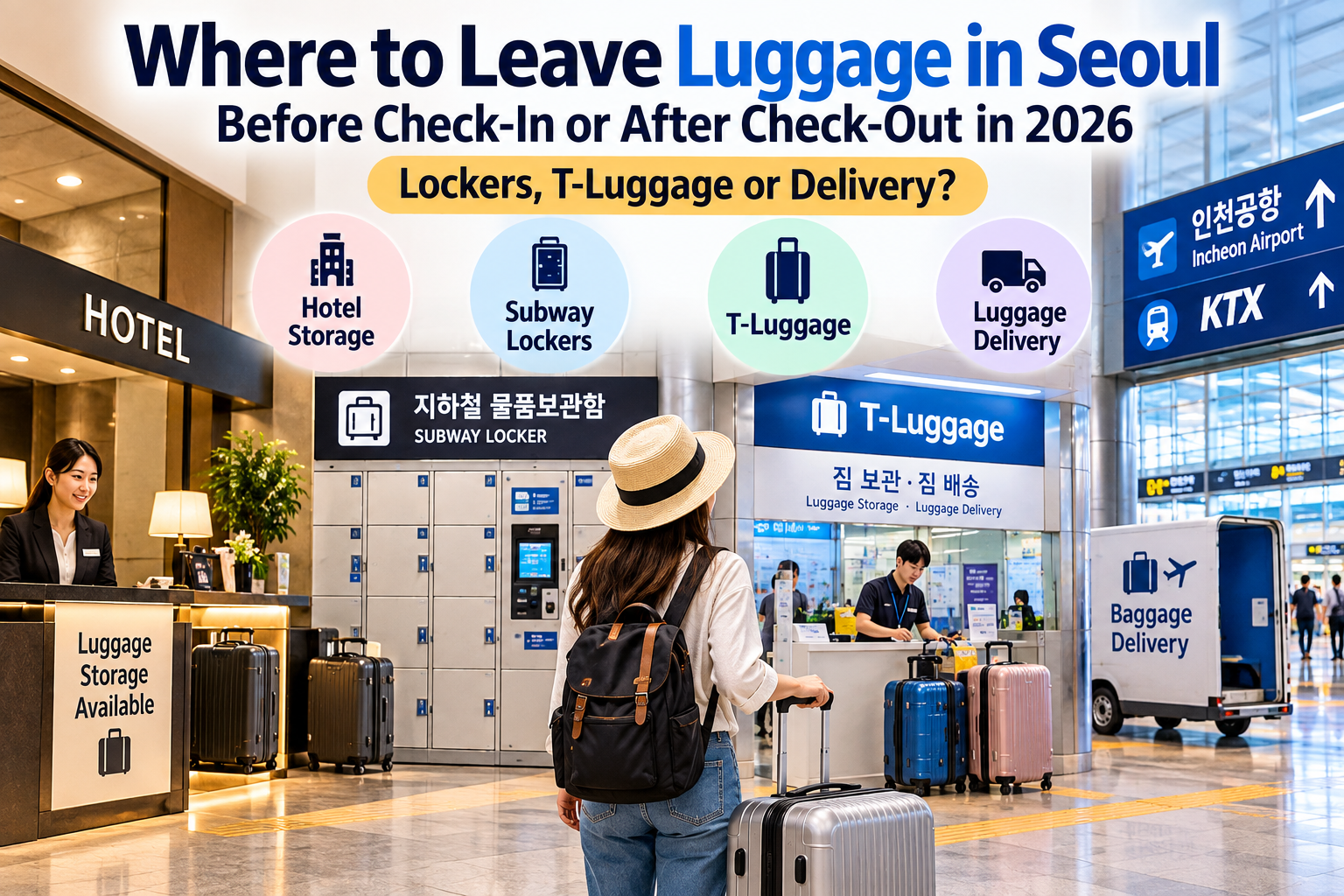
  • Where to Leave Luggage in Seoul Before Check-In or After Check-Out in 2026: Lockers, T-Luggage or Delivery?

    Where to Leave Luggage in Seoul Before Check-In or After Check-Out in 2026: Lockers, T-Luggage or Delivery?

    Arriving in Seoul at 9 a.m. when your hotel check-in starts at 3 p.m. creates an immediate problem: what do you do with your suitcase for the next six hours?

    The same thing happens on departure day. You may need to check out before noon even though your flight leaves late in the evening.

    Carrying luggage through Myeongdong, Hongdae or Seoul Station for half a day is rarely the best solution.

    Fortunately, Seoul has several ways to store or move luggage, including hotel storage, subway lockers, T-Luggage facilities and luggage delivery services.

    The important question is not simply where luggage storage exists.

    It is which option makes sense for your itinerary.

    Quick Answer: Which Luggage Option Should You Choose?

    If you will return to the same place later, storing your luggage there is usually the simplest choice.

    If your hotel will hold your bags and you plan to return to the hotel before leaving Seoul, hotel storage is often the first option to check.

    If you need storage near a subway station for a few hours, T-Locker or another station locker may be more convenient.

    If you have a large suitcase, want staff assistance or cannot find a suitable locker, T-Luggage can be easier.

    And if your sightseeing route ends somewhere completely different from where it begins, luggage delivery may save you from backtracking across Seoul just to retrieve a suitcase.

    That last point is especially important.

    The cheapest storage option is not always the best option if retrieving your luggage adds an hour to your journey.

    Option 1: Ask Your Hotel Before Paying for Storage

    Before searching for a locker, ask your accommodation whether it can hold your luggage.

    Many hotels and other accommodations provide luggage storage for guests before check-in or after check-out, although policies, available space and fees can vary.

    This works particularly well when your itinerary brings you back to the hotel anyway.

    For example:

    You check out in Myeongdong in the morning, spend several hours nearby and return to Myeongdong before heading to the airport.

    Leaving your suitcase at the hotel may be much easier than moving it to a subway locker.

    But consider your route before choosing this option.

    If your hotel is in Hongdae and your final sightseeing stop is around Seoul Station, returning to Hongdae solely to collect your luggage could add unnecessary travel.

    Best for: Travelers who will naturally return to their accommodation later.

    Check first: Storage availability, collection hours, fees and whether storage is available after check-out.

    Option 2: Use a Subway Locker for Short-Term Storage

    Subway lockers are useful when you need to leave your luggage somewhere for several hours and return to the same station.

    Seoul’s subway storage network includes T-Locker, with lockers available across hundreds of stations.

    This can be convenient if you arrive at a neighborhood before hotel check-in and want to explore without your suitcase.

    For example, suppose you arrive near Jamsil in the morning but cannot check in until mid-afternoon.

    If a suitable locker is available, you can store your luggage, explore the area and retrieve it before going to your accommodation.

    When a Locker Works Best

    A locker makes the most sense when:

    • you know which station you will return to,
    • your suitcase fits the available locker size,
    • you only need temporary storage,
    • and you can retrieve the luggage within the facility’s operating conditions.

    The biggest mistake is assuming that finding a subway station automatically means finding an empty locker large enough for your suitcase.

    Availability can vary by station and time.

    Large luggage can also be more difficult to accommodate than a backpack or cabin-size bag.

    Best for: Short storage periods and travelers returning to the same station.

    Less suitable for: Oversized luggage, uncertain itineraries or travelers who do not want to return to the same location.

    Option 3: Use T-Luggage When a Locker Is Not Enough

    T-Luggage is different from a standard unattended subway locker.

    It provides staffed luggage services at selected major transportation and tourist locations, including places such as Seoul Station, Hongik University, Myeongdong, Jamsil and Gimpo Airport, with additional locations in Seoul’s subway network.

    For travelers with large suitcases, this can be more comfortable than searching for an available locker.

    It is also useful when you prefer handing your bag to staff rather than figuring out a locker system after a long flight.

    What Does T-Luggage Cost?

    Prices vary according to luggage size, storage duration, day and service.

    As one reference point, Seoul’s official guidance lists short-term storage pricing for large luggage that can be higher on weekends than on weekdays, with additional charges when storage time extends beyond the initial period.

    Because prices and operating details can change, check the current rate for your location and luggage size before using the service.

    This is especially important if you plan to leave luggage for most of the day rather than only a few hours.

    Best for: Large luggage, travelers wanting staffed service and major transit hubs.

    Check first: Location hours, luggage size, current price and pickup deadline.

    Option 4: Consider Luggage Delivery Instead of Storage

    This is where many travelers overlook a potentially better option.

    Sometimes the real problem is not storing your suitcase.

    It is having to return for it.

    Suppose you check out near Hongdae in the morning, spend the afternoon in central Seoul and then plan to continue toward the airport.

    Leaving your suitcase in Hongdae means you eventually have to travel back to Hongdae before continuing your journey.

    In that situation, luggage delivery may be worth paying for.

    T-Luggage services can include luggage transportation between participating locations, and airport-related delivery options may also be available depending on the route and service conditions.

    Instead of asking:

    Where can I store my luggage cheaply?

    ask:

    Where do I want my luggage to be when I finish sightseeing?

    That question often produces a better travel plan.

    Best for: Travelers whose final destination is different from their starting point.

    Potential downside: Delivery costs more than simply leaving a bag somewhere, and you must follow the service’s acceptance and collection times.

    A New Option Around Seoul Station: 24-Hour Luggage Storage

    Seoul Station deserves special attention because it is one of the places where travelers most often need luggage storage.

    You may arrive by KTX before hotel check-in, check out before taking a train later in the day, or spend several hours in Seoul before continuing to another city.

    In 2026, travelers also have access to a 24-hour luggage storage option near Seoul Station known as LuggageDot.

    The service is designed for travelers who need storage outside the practical hours of some traditional facilities and can accommodate large suitcases, including luggage up to around 32 inches according to Seoul’s official tourism information.

    It also offers features such as checking availability and making reservations.

    This can be particularly useful if your schedule starts very early or ends late at night.

    However, do not assume that “24-hour” means every luggage option around Seoul Station operates 24 hours.

    Always check the specific facility you plan to use.

    Before Hotel Check-In: What Should You Do?

    Your best choice depends on where you arrive and what you want to do before checking in.

    If You Arrive Near Your Hotel

    Ask the hotel to store your luggage first.

    If that is possible, there is usually little reason to move your suitcase somewhere else.

    If You Arrive at Seoul Station

    Consider storage at or around Seoul Station if your sightseeing route brings you back there.

    If you have a large suitcase or want staffed service, compare T-Luggage with available storage facilities rather than assuming a locker will be easiest.

    If You Want to Explore a Different Neighborhood First

    Think carefully before leaving luggage at your arrival point.

    For example, if you arrive at Seoul Station but plan to spend the entire afternoon in Hongdae before checking into a Hongdae hotel, storing your suitcase at Seoul Station may create unnecessary backtracking.

    In that case, moving closer to your eventual destination before storing the bag can make more sense.

    After Hotel Check-Out: Think About Your Final Route

    Departure day requires a slightly different decision.

    Do not automatically leave your luggage at the hotel just because the hotel offers storage.

    First look at your final sightseeing location and your route to the airport or train station.

    Example 1: Hotel → Nearby Sightseeing → Hotel → Airport

    Hotel storage is probably the easiest solution.

    Example 2: Hotel → Sightseeing Across Seoul → Airport

    Delivery or storage near your final sightseeing area may save considerable travel time.

    Example 3: Hotel → Seoul Station → KTX

    If you are continuing to another city by train, check your schedule in advance — Korea’s updated KTX ticket booking rules now allow travelers to plan many rail journeys earlier than before.

    Storage around Seoul Station can make sense if you want to explore central Seoul before catching your train.

    The key is to avoid crossing the city twice simply to retrieve a suitcase.

    What About Large Suitcases?

    Large luggage changes the decision.

    A traveler with a backpack can use far more storage options than someone carrying a 28- or 32-inch suitcase.

    Before relying on a locker, check its dimensions and availability.

    If your suitcase is large, a staffed luggage facility can reduce the risk of arriving at a station only to discover that the available lockers are too small or already occupied.

    This becomes even more important when traveling as a family with several suitcases.

    Four travelers do not just need “a locker.”

    They may need several large lockers at the same location.

    At that point, comparing staffed storage or luggage delivery becomes much more worthwhile.

    Storage Price vs Travel Time: Which Matters More?

    It is easy to focus on a difference of a few thousand won between storage options.

    But Seoul is a large city.

    If choosing the cheapest locker requires an unnecessary subway journey to retrieve your bags, the savings may not be worth the lost time.

    A better comparison includes:

    storage fee + retrieval time + extra transportation + inconvenience

    For a traveler with only two days in Seoul, an extra hour of sightseeing may be more valuable than saving a small amount on luggage storage.

    For a budget traveler staying near the storage location, the cheaper locker may make perfect sense.

    Neither choice is automatically better.

    Common Luggage Storage Mistakes in Seoul

    One common mistake is waiting until arrival to think about luggage.

    Another is assuming every station has enough large lockers available.

    Travelers also sometimes store luggage somewhere convenient in the morning without considering where they will be in the evening.

    And do not leave essential items inside luggage that you may not be able to access easily.

    Keep your passport, medication, wallet, phone, travel documents and other important valuables with you unless the service specifically provides a secure arrangement appropriate for those items.

    The Simplest Way to Decide

    Before choosing luggage storage in Seoul, answer three questions:

    1. Where will I be when I drop off the luggage?

    2. Where will I be when I need the luggage again?

    3. Do I actually need storage, or would delivery remove an unnecessary return trip?

    If both locations are the same, a hotel or locker is often enough.

    If they are different, compare delivery.

    If your luggage is unusually large, prioritize size and availability before price.

    And if your schedule involves very early or late hours, check operating times before building your itinerary around a storage location.

    Final Takeaway

    Seoul has plenty of places to leave luggage before check-in or after check-out.

    The harder part is choosing the one that fits your route.

    Hotel storage works well when you will return to the hotel.

    Subway lockers are convenient for short-term storage when you will return to the same station.

    T-Luggage can be easier for larger bags or travelers who prefer staffed service.

    Luggage delivery becomes valuable when it prevents you from backtracking across Seoul.

    And around major transport hubs such as Seoul Station, newer 24-hour storage options can help travelers with early or late schedules.

    So before comparing a few thousand won in storage fees, open your map and look at your day from beginning to end.

    In Seoul, the best place to leave your luggage is usually not the cheapest place.

    It is the place that keeps you moving forward.

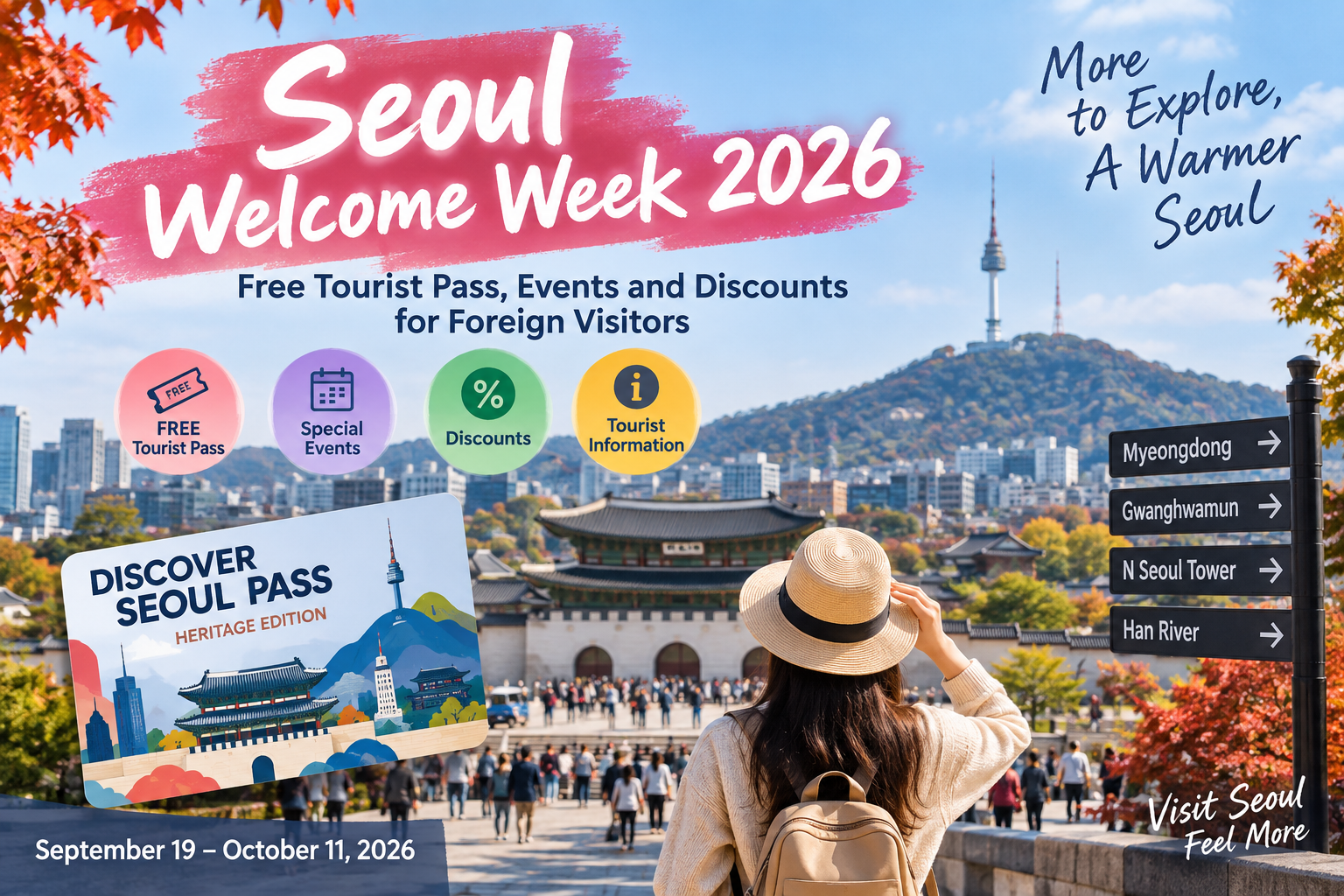
  • Seoul Welcome Week 2026: Free Tourist Pass, Events and Discounts for Foreign Visitors

    Seoul Welcome Week 2026: Free Tourist Pass, Events and Discounts for Foreign Visitors

    Seoul Welcome Week 2026 Is Here

    If you are visiting Seoul this fall, there is an extra reason to explore the city right now.

    Seoul Welcome Week 2026 runs from September 19 to October 11, 2026, with special programs and benefits designed for international visitors. The campaign overlaps with Korea’s Chuseok holiday period, making it especially useful for travelers who are worried about what will be open or what they can do during the holiday.

    Visitors can find special welcome programs, tourism information, discounts, and limited benefits at locations including airports and central Seoul.

    One of the most interesting benefits is a special edition of the Discover Seoul Pass, which can help travelers visit major attractions while spending less.

    In this guide, we will look at what Seoul Welcome Week offers, who can use the benefits, where to find them, and what international travelers should know before heading out.

    Seoul Welcome Week 2026 at a Glance

    Here are the key dates to know:

    • Dates: September 19–October 11, 2026
    • Location: Seoul, with programs at major visitor touchpoints including airports and Myeongdong
    • Who it is for: International visitors to Seoul
    • Main benefits: Tourist information, special events, attraction benefits, and selected discounts

    Some programs are available only during specific dates within the Welcome Week period, and limited-quantity benefits may run out early.

    Tip: Do not assume every benefit is available throughout the entire September 19–October 11 period. Check the dates and conditions for the specific program you want to use before making a special trip.

    Free Discover Seoul Pass for International Visitors

    One of the headline benefits of Seoul Welcome Week 2026 is a special Discover Seoul Pass Heritage Edition for international travelers.

    According to the Seoul Metropolitan Government, a limited number of passes are being provided to eligible foreign visitors through welcome events at Seoul’s major gateways.

    The Heritage Edition is designed around Seoul’s cultural heritage and gives travelers access to 12 major heritage attractions, along with discounts or benefits at more than 110 participating locations.

    Because the free passes are limited and distribution conditions can vary by location, travelers should not plan their entire itinerary around receiving one. Think of it as a valuable bonus if you are eligible and passes are still available.

    If you receive a pass, check its validity period and included attractions before activating or using it. This will help you get the most value from the pass rather than using it for an attraction you would have visited cheaply anyway.

    Visit the Myeongdong Welcome Center

    Travelers staying in central Seoul should also pay attention to the temporary Welcome Center in Myeongdong, one of the city’s busiest areas for international visitors.

    The Welcome Center is scheduled to operate from October 1 to October 8, 2026.

    Visitors can stop by for tourism information and special Welcome Week programs while exploring Myeongdong and nearby areas such as Namdaemun, Euljiro, Cheonggyecheon, and central Seoul.

    This can be particularly useful during the Chuseok period, when travelers may be unsure about holiday schedules or need help adjusting their plans.

    Look for Special Seoul Travel Discounts

    Welcome Week is not limited to information booths and events.

    Selected tourism experiences are also offering visitor benefits during the campaign. One highlighted example is a 20% discount on selected Han River cruise experiences.

    If a Han River cruise is already on your Seoul itinerary, it is worth checking the current Welcome Week conditions before booking.

    However, discounts can have specific dates, reservation requirements, or eligibility rules. Always confirm the current terms with the participating operator before paying.

    How to Make the Most of Seoul Welcome Week

    The easiest way to use Seoul Welcome Week is to combine its benefits with places you already plan to visit.

    For example, if you are staying in Myeongdong, visiting the Welcome Center can fit naturally into a day exploring central Seoul. If you are planning a Han River cruise, check whether the Welcome Week discount applies to your preferred date and booking.

    Travelers arriving during the campaign period should also pay attention to welcome programs at the airport before leaving the arrivals area.

    A simple strategy is:

    1. Check which Welcome Week benefits are available on your travel dates.
    2. See whether any of them match attractions already on your itinerary.
    3. Confirm eligibility, operating dates, and reservation requirements.
    4. Use limited benefits only when they actually save you money or improve your trip.

    This is better than changing an entire Seoul itinerary simply to chase a free pass or discount.

    Visiting Seoul During Chuseok 2026

    Seoul Welcome Week overlaps with Chuseok, one of Korea’s most important holidays.

    For travelers, this does not mean Seoul shuts down completely. Major tourist areas, cultural attractions, shopping districts, and events can still give visitors plenty to do.

    However, opening hours may change, and individual restaurants, cafes, shops, museums, or attractions may operate on special holiday schedules.

    Before visiting a specific place during the holiday period, check its official operating information rather than relying only on normal opening hours shown in older travel guides.

    Transportation can also be busier around Chuseok as many people travel between Seoul and other parts of Korea. This is especially important if your trip includes KTX or other intercity transportation.

    Good Areas to Combine With Welcome Week Activities

    If you visit the Myeongdong Welcome Center, you can easily combine it with several nearby areas.

    Myeongdong is convenient for shopping, food, beauty stores, and first-time visitors.

    Namdaemun Market is within easy reach and offers a very different traditional market atmosphere.

    Cheonggyecheon Stream is a good option for an easy walk through central Seoul.

    Gwanghwamun and the palace area are also nearby and work well for travelers interested in Seoul’s history and cultural heritage.

    Instead of treating Welcome Week as a separate event, use it as an extra layer of benefits while following the Seoul itinerary you already wanted to experience.

    FAQ About Seoul Welcome Week 2026

    When is Seoul Welcome Week 2026?

    Seoul Welcome Week runs from September 19 to October 11, 2026. Individual programs may operate for shorter periods, so check the dates for each benefit before visiting.

    Is Seoul Welcome Week only for foreign tourists?

    Many of the special welcome programs and benefits are designed specifically for international visitors. Eligibility can vary by program, so bring your passport or other identification if a benefit requires proof of international visitor status.

    Is the Discover Seoul Pass really free?

    A limited number of special Discover Seoul Pass Heritage Edition passes are being offered to eligible international visitors through Welcome Week programs. Because quantities are limited, receiving one is not guaranteed.

    What does the Discover Seoul Pass Heritage Edition include?

    The special pass provides access to 12 major heritage attractions and benefits or discounts at more than 110 participating locations, according to the Seoul Metropolitan Government.

    Always check the current list of included attractions and usage conditions before planning around the pass.

    Where is the Seoul Welcome Center in Myeongdong?

    A temporary Welcome Center is scheduled to operate in the Myeongdong area from October 1 to October 8, 2026. Check Seoul’s official tourism information for the latest location and operating details before visiting.

    Is Seoul worth visiting during Chuseok?

    Yes. Seoul can still offer plenty to do during Chuseok, particularly in major tourist and cultural areas. The main difference is that some businesses and attractions may have special holiday hours.

    Check individual opening schedules in advance, especially for restaurants, smaller businesses, and specific attractions you do not want to miss.

    Final Thoughts

    Seoul Welcome Week 2026 gives international visitors a useful opportunity to get more from a fall trip to the Korean capital.

    The most valuable benefits are not necessarily the ones that sound the biggest. A free attraction pass can save money, a discount can make an activity more affordable, and a Welcome Center can be useful when holiday schedules make travel planning confusing.

    The key is to check what is available on your actual travel dates and combine those benefits with the Seoul itinerary you already have.

    If you are visiting during Chuseok, plan important transportation and must-see attractions in advance, but do not assume the holiday means there will be nothing to do. Seoul continues to offer cultural experiences, events, shopping, food, and sightseeing opportunities throughout the season.

    With a little preparation, Seoul Welcome Week can make an already exciting fall trip to Korea even better.

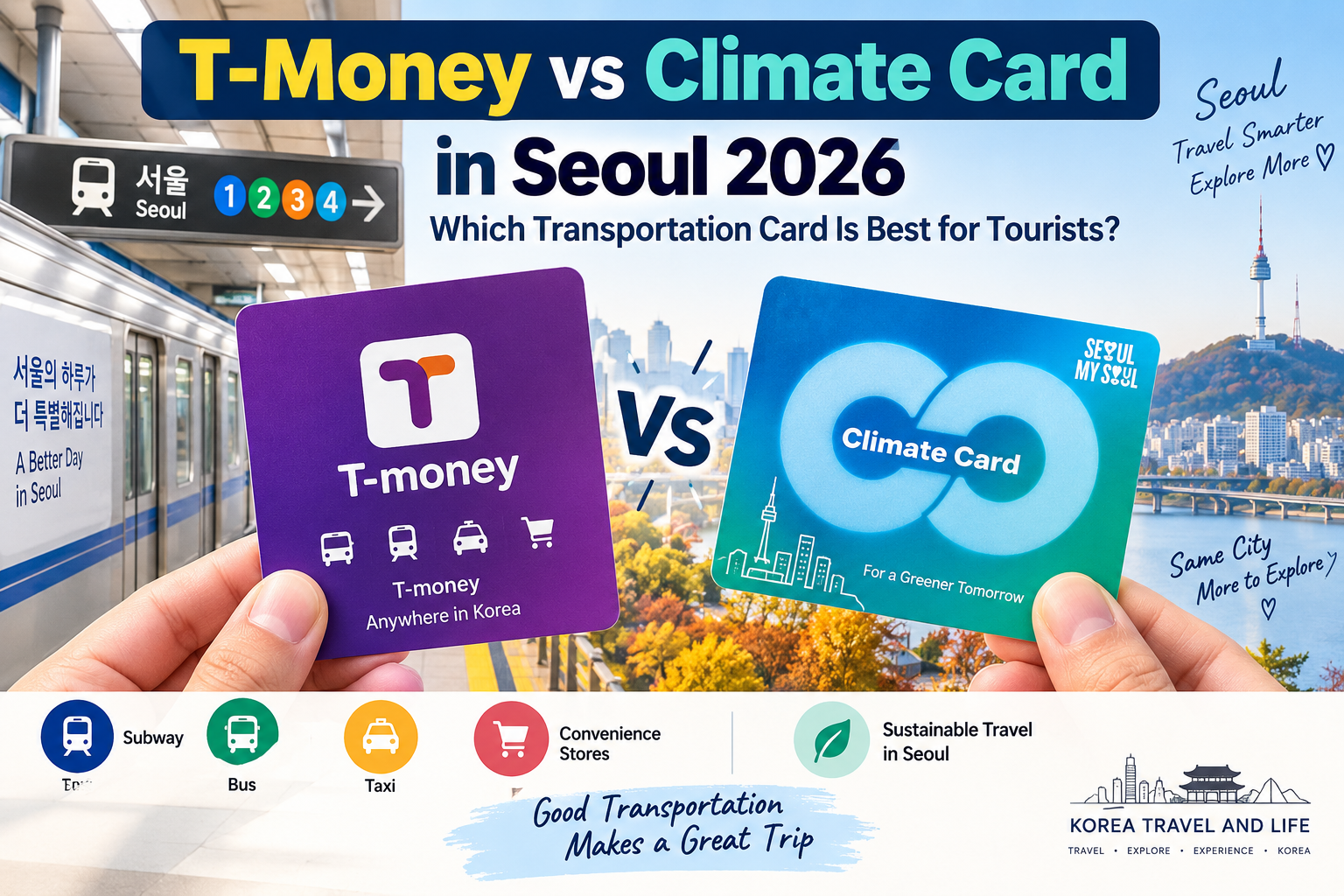
  • T-Money vs Climate Card in Seoul 2026: Which Transportation Card Is Best for Tourists?

    T-Money vs Climate Card in Seoul 2026: Which Transportation Card Is Best for Tourists?

    Getting around Seoul is easy once you understand the city’s transportation system. But for first-time visitors, choosing the right transportation card can be surprisingly confusing.

    Two of the most useful options are T-Money and the Climate Card.

    Both can make traveling around Seoul much easier, but they work very differently. T-Money is a rechargeable transportation card that can be used across Korea, while the Climate Card offers unlimited rides within its designated Seoul transportation network for a fixed period.

    So which one should you buy?

    This 2026 guide explains the differences between T-Money and the Climate Card, how much they cost, where you can use them, and which option may make more sense for your Korea itinerary.

    Quick Answer: T-Money or Climate Card?

    For most travelers, the choice depends on where you are traveling.

    Choose T-Money if you:

    • Plan to travel outside Seoul
    • Will visit places such as Busan, Gyeongju, Jeju, or other Korean cities
    • Prefer paying for transportation based on actual usage
    • Want one transportation card that works across much of Korea
    • Expect to use taxis or other transportation outside the Climate Card service area

    Choose the Climate Card if you:

    • Will spend most of your trip inside Seoul
    • Expect to use buses and subways frequently
    • Want unlimited eligible public transportation during your pass period
    • Prefer knowing your transportation cost in advance
    • Are staying in Seoul for between one and seven days

    For many first-time visitors traveling around Korea, T-Money offers greater flexibility.

    For travelers spending several busy sightseeing days almost entirely in Seoul, however, a short-term Climate Card can be very convenient.

    What Is a T-Money Card?

    T-Money is one of Korea’s most widely used prepaid transportation cards.

    Instead of buying an individual ticket every time you ride a subway or bus, you load money onto the card and tap it when entering and leaving the transportation system.

    T-Money can be purchased at many convenience stores, including chains such as CU, GS25, and 7-Eleven, as well as at transportation facilities.

    The standard card generally costs around KRW 3,000–5,000, before adding transportation credit.

    One of T-Money’s biggest advantages for international travelers is its wide coverage.

    It can be used on public transportation across many parts of Korea, making it particularly useful for travelers visiting several cities during one trip.

    Where Can You Use T-Money?

    T-Money can be used on many:

    • Subways
    • City buses
    • Express and intercity buses
    • Taxis
    • Other participating transportation services

    It can also be used at some convenience stores, vending machines, and other participating merchants displaying the T-Money logo.

    This makes T-Money particularly useful for itineraries such as:

    Seoul → Busan → Gyeongju → Seoul

    Instead of buying a new local transportation card in every destination, travelers can continue using the same T-Money card for many local transportation needs.

    What Is the Seoul Climate Card?

    The Climate Card was introduced by the Seoul Metropolitan Government as an unlimited public transportation pass.

    For tourists, the most important products are the short-term Climate Card passes.

    As of 2026, short-term passes are available for:

    • 1 day — KRW 5,000
    • 2 days — KRW 8,000
    • 3 days — KRW 10,000
    • 5 days — KRW 15,000
    • 7 days — KRW 20,000

    A physical Climate Card costs an additional KRW 3,000.

    These passes are particularly attractive for travelers who plan to take public transportation repeatedly while sightseeing around Seoul.

    Important Climate Card Change in 2026

    Visitors may see older online guides discussing the Climate Card’s 30-day prepaid pass.

    This information is changing.

    Seoul announced that recharging the existing 30-day prepaid Climate Card ends after August 31, 2026, as the city transitions toward its newer Climate Pass system.

    However, this does not mean tourists can no longer use the Climate Card.

    The short-term tourist passes for 1, 2, 3, 5, and 7 days continue to be available.

    This distinction is important when reading older travel guides about Seoul transportation.

    Can Foreign Tourists Buy the Climate Card With an International Credit Card?

    Yes, and this became significantly easier in 2026.

    Seoul expanded payment support at hundreds of new subway vending machines, allowing travelers to use internationally issued credit and debit cards such as Visa and Mastercard to purchase Climate Cards and recharge short-term passes.

    International card payments are supported at new vending machines installed across Seoul Metro Lines 1–8.

    An average service fee of approximately 3.7% may apply when using an internationally issued card.

    This is an important improvement for international visitors because transportation card purchases in Korea have traditionally relied heavily on Korean won cash or locally issued cards.

    T-Money vs Climate Card: Main Differences

    Here is the simplest way to understand the two cards.

    T-Money

    Payment system: Pay per ride

    Best for: Flexible travel throughout Korea

    Coverage: Widely usable across Korea

    Main advantage: One card can be used for transportation in many Korean cities

    Best traveler: Someone visiting Seoul plus other destinations

    Climate Card

    Payment system: Unlimited eligible transportation during the pass period

    Best for: Frequent transportation within Seoul

    Coverage: Limited primarily to eligible Seoul transportation services

    Main advantage: Unlimited rides without worrying about individual fares

    Best traveler: Someone sightseeing intensively within Seoul

    Is the Climate Card Really Unlimited?

    Within its eligible transportation network, the Climate Card allows unlimited rides during the validity period.

    However, “unlimited” does not mean that every transportation service in Korea is included.

    The Climate Card has a defined service area and exclusions. Travelers planning trips outside Seoul should therefore check whether their destination is covered before relying exclusively on the card.

    This is one of the biggest differences between the Climate Card and T-Money.

    T-Money does not provide unlimited transportation, but its geographical flexibility is much greater.

    Which Card Is Better for a 3-Day Seoul Trip?

    Consider a traveler spending three full days sightseeing around Seoul.

    The itinerary might include:

    Day 1: Gyeongbokgung Palace → Bukchon Hanok Village → Insadong → Myeongdong

    Day 2: Hongdae → Yeonnam-dong → Han River → Gangnam

    Day 3: Seongsu → Seoul Forest → Dongdaemun → Namsan

    This traveler may take multiple subway and bus rides each day.

    A 3-day Climate Card costs KRW 10,000, plus the KRW 3,000 physical card cost if a card needs to be purchased.

    For a transportation-heavy itinerary like this, the Climate Card can be particularly convenient.

    Which Card Is Better for a 7-Day Korea Trip?

    Now consider this itinerary:

    Days 1–3: Seoul
    Days 4–5: Gyeongju
    Days 6–7: Busan

    In this situation, T-Money is generally more practical because the traveler is moving beyond Seoul.

    The Climate Card’s main value comes from frequent eligible transportation within Seoul, whereas T-Money can continue to be useful in other Korean cities.

    Can You Use Both T-Money and the Climate Card?

    Yes.

    In fact, some travelers may find that carrying both is convenient.

    You could use the Climate Card during several intensive sightseeing days in Seoul and keep a T-Money card for transportation outside the Climate Card coverage area or later trips to other Korean cities.

    You do not necessarily have to choose only one card for your entire Korea trip.

    Where Can Tourists Buy T-Money?

    T-Money cards are widely available.

    Travelers can commonly find them at convenience stores such as:

    • CU
    • GS25
    • 7-Eleven
    • Other participating convenience stores

    They are also available at transportation-related sales locations.

    According to VISITKOREA, a standard T-Money card generally costs approximately KRW 3,000–5,000 before adding transportation credit.

    One detail international travelers should know is that ordinary T-Money purchases and top-ups may still require Korean won cash in many situations, so carrying some cash after arriving in Korea remains useful. Korea Tourism Organization’s 2026 transportation guide specifically notes cash-only purchasing/top-up for standard prepaid T-Money.

    Where Can Tourists Buy a Climate Card?

    Physical Climate Cards are available through designated subway vending machines and participating sales locations in Seoul.

    New transportation-card vending machines across Seoul Metro Lines 1–8 have made purchasing the card considerably easier for international visitors.

    Remember that the physical card itself costs KRW 3,000, and the short-term pass is loaded separately.

    Unlike an ordinary T-Money balance, a short-term Climate Card begins according to the rules associated with the pass, so travelers should check the activation timing before loading it.

    What About Airport Transportation?

    This is where travelers should be careful.

    Not every airport transportation option is included with every Seoul transportation pass.

    For example, the AREX Express Train operates differently from ordinary Seoul subway transportation.

    Travelers arriving at Incheon International Airport should therefore check their airport-to-hotel transportation separately instead of assuming that a Climate Card covers every airport option.

    We will cover this in a separate guide comparing AREX Express, AREX All-Stop Train, airport limousine buses, and taxis from Incheon Airport to Seoul.

    What About WOWPASS?

    WOWPASS is another popular option for international visitors.

    Unlike T-Money, which is primarily a transportation card, WOWPASS combines several traveler-focused functions, including prepaid payments, transportation functionality, and currency-related services.

    That makes it a different type of product.

    For travelers wondering whether WOWPASS or T-Money is better, we will compare those options separately because the decision involves more than transportation alone.

    T-Money vs Climate Card: Which Should First-Time Visitors Choose?

    There is no single card that is ideal for every Korea itinerary.

    For a traveler spending almost the entire trip sightseeing around Seoul and taking public transportation many times each day, the Climate Card can be a simple and convenient choice.

    For travelers visiting multiple Korean cities or wanting maximum transportation flexibility, T-Money is usually easier to use throughout the trip.

    And for some travelers, carrying both can make sense.

    The key is to choose based on your itinerary rather than simply buying whichever transportation card you see first.

    Frequently Asked Questions

    Is T-Money only available in Seoul?

    No. One of T-Money’s biggest advantages is that it can be used on public transportation in many areas throughout Korea.

    Can tourists still use the Climate Card in 2026?

    Yes. Although Seoul is changing its longer-term Climate Card system, short-term tourist passes for 1, 2, 3, 5, and 7 days remain available.

    How much is a 3-day Climate Card?

    The 3-day short-term pass costs KRW 10,000. A physical Climate Card costs an additional KRW 3,000 if you do not already have one.

    Can I buy a Climate Card with a foreign credit card?

    Internationally issued credit and debit cards are accepted at supported new transportation-card vending machines for Climate Card purchases and short-term pass recharging.

    Can I use T-Money in Busan?

    Yes. T-Money is widely usable on public transportation beyond Seoul, including major Korean cities.

    Should I buy T-Money at Incheon Airport?

    For many visitors, getting a transportation card soon after arrival is convenient, especially if they plan to use public transportation frequently during their trip.

    Final Thoughts

    Choosing between T-Money and the Climate Card becomes much easier once you know your itinerary.

    If your trip is focused almost entirely on Seoul and you expect to ride buses and subways frequently, a short-term Climate Card can provide simple, predictable transportation costs.

    If your Korea itinerary includes several cities, T-Money offers greater flexibility and can remain useful throughout your trip.

    Before traveling, always check the latest transportation rules because Seoul’s transit card system continues to evolve.

    For most international travelers, the best strategy is simple:

    Choose the Climate Card for intensive Seoul sightseeing. Choose T-Money for flexibility across Korea.