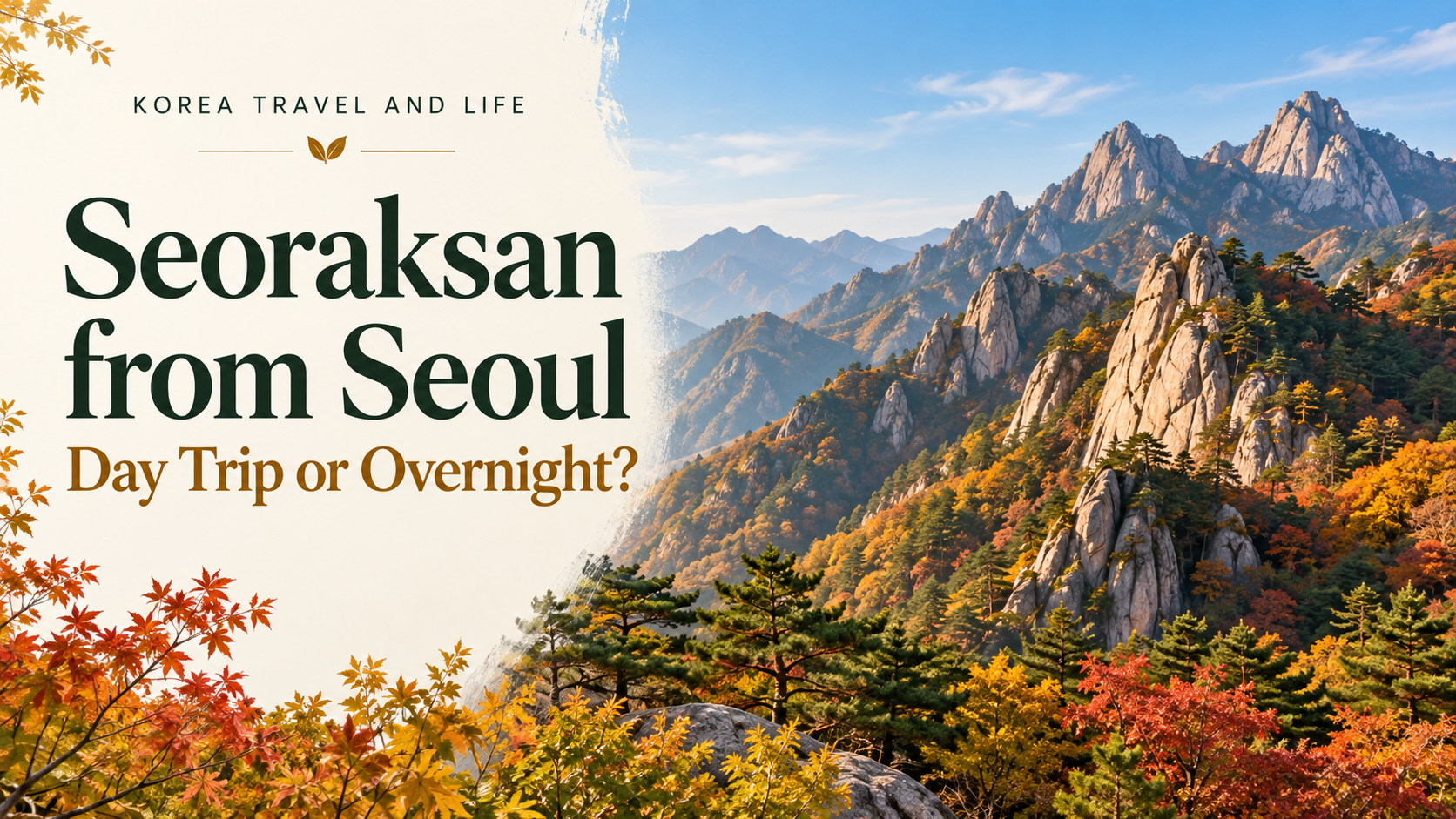
A Seoraksan day trip from Seoul can work. Whether it works for your trip depends on what you want to do after you arrive.
A temple visit and a short walk require a different schedule from climbing Ulsanbawi. A cable-car visit adds another uncertainty: you cannot reserve the ride in advance, and wind can stop operations.
Before booking, decide how much usable time you need in the park—not simply whether a bus can take you there and back.
This guide compares an independent day trip, an organized tour and an overnight stay in Sokcho, with a practical way to protect your return journey during autumn foliage season.
Quick Answer: Which Seoraksan Trip Should You Choose?
| Your priority | Best starting option | Main trade-off |
|---|---|---|
| A short introduction to mountain scenery | Independent day trip | You manage transfers and the return deadline |
| Simple transport with a fixed plan | Organized day tour | Less control over time at each stop |
| Ulsanbawi as the main activity | Overnight stay | Accommodation and an extra travel day |
| Cable car is your main reason to visit | Overnight if your schedule allows | More flexibility, but no guarantee of operation |
| Mountain visit plus a relaxed Sokcho evening | Overnight stay | Higher total trip cost |
| Very short Seoul stay and little tolerance for long road journeys | Stay in Seoul or choose a closer outing | You miss Seoraksan but retain more sightseeing time |
An independent day trip is most convincing when you have one modest park goal and can accept changing it. An overnight stay becomes more useful when the mountain is a major reason for your Korea trip.
1. Autumn Timing: A Forecast Is Not a Reservation
VISITKOREA’s 2026 forecast places Seoraksan’s first foliage around October 3 and its expected peak around October 25. Actual conditions can change with the weather.
Use that forecast to select a travel window, then check current conditions close to departure. Different elevations and paths will not necessarily look their best on the same day.
If your dates are flexible, compare weekday transport and accommodation availability before choosing a peak-season weekend.
Our Korea fall foliage guide covers destinations across the country. This article answers a narrower question: how to make Seoraksan fit the time you actually have.
2. Calculate Your Usable Park Time
The journey does not finish when your long-distance bus reaches Sokcho.
You still need to leave the terminal, find your onward transport, travel to the park and reach the activity’s starting point. The same steps apply in reverse.
Use this calculation:
Time available at the park = latest sensible park departure − actual park arrival.
Your latest sensible departure must leave room for the local journey, waiting time, a delay allowance and reaching the correct terminal before your Seoul-bound bus.
A hypothetical example
Suppose you arrive at the park at 10:30 a.m. and your booked bus leaves Sokcho at 5:30 p.m.
If you allocate a combined two hours for returning to the terminal, waiting and contingency, your park departure is 3:30 p.m. That leaves five hours for activities, food, queues and breaks.
These are planning assumptions, not published bus times or a guarantee that two hours is sufficient. Replace them with your actual booking, route and conditions.
Now ask whether your chosen activity fits those five hours. Do not spend the delay allowance on an extra attraction.
3. Independent Day Trip: Keep the Plan Small
For a first visit focused on Sinheungsa, scenery near the entrance and a short walk, an independent day trip can be a reasonable choice.
Its advantage is flexibility inside the park. Its disadvantage is that you carry the transfer and return-planning responsibility.
Before booking:
- Identify the exact Seoul departure terminal.
- Check which Sokcho terminal your service uses.
- Confirm your return departure terminal separately.
- Plan onward travel to the Seorakdong/Sogongwon entrance.
- Set your park departure time before choosing activities.
Sokcho’s official transport information lists buses 7 and 7-1 for the Seoraksan direction. Check the route from your actual arrival point; the bus number alone does not identify the correct stop or direction.
Useful Korean place names include:
- 속초고속버스터미널: Sokcho Express Bus Terminal
- 속초시외버스터미널: Sokcho Intercity Bus Terminal
- 설악산소공원: Seoraksan Sogongwon
Save the terminal and park destination in your map app. Seoraksan has multiple access areas, so a generic mountain search is not enough for planning this route.
For booking-platform guidance, see our guide to express and intercity buses in Korea.
4. Organized Day Tour: Compare Park Time, Not Just Price
A tour can simplify pickup and transport. It does not remove road traffic, weather uncertainty or attraction queues.
Compare these details before paying:
| Check | Why it matters |
|---|---|
| Actual time allocated to Seoraksan | A multi-stop tour may leave less time for the park |
| Pickup and drop-off locations | Hotel-to-meeting-point travel adds to your day |
| Included activities and charges | Transport and cable-car admission are different items |
| Walking expectations | A sightseeing tour may not suit an ambitious hike |
| Bad-weather arrangements | The operator’s alternative may differ from your priorities |
| Return-time wording | A stated arrival time may be an estimate |
If the mountain is your main goal, a Seoraksan-focused tour may fit better than a package combining several distant attractions. Choose the itinerary that protects time for your priority.
5. Cable Car: Keep a Second Plan
As checked on October 10, 2026, the operator lists round-trip fares of 16,000 won for middle-school age and above, 12,000 won for children aged 37 months through elementary school, and free rides for children under 37 months.
Tickets are purchased on site on the day. Advance reservations are not accepted. Operating hours vary, and strong wind or severe weather can interrupt service.
The ride goes to Gwongeumseong; it is not a cable-car route to Ulsanbawi or Daecheongbong. You must return by cable car because there is no walking descent route from the cable-car area.
On arrival, compare the available boarding time with your latest park departure. Include time at the top and the descent.
If the timing no longer fits, switch to your planned ground-level visit. If severe weather affects the park more broadly, reconsider the outing rather than assuming another outdoor activity is suitable.
An overnight stay provides more scheduling flexibility. It does not guarantee a seat or safe operating weather.
6. Ulsanbawi: Give the Hike Its Own Time
VISITKOREA describes the Ulsanbawi circuit from Sogongwon as approximately 7.6 km and four hours, including the return. The upper section beyond Heundeulbawi is steep.
Treat that duration as a reference, not a personal completion promise. Breaks, crowded sections, fitness and weather can change your pace.
For a first-time autumn visitor, staying overnight is the more forgiving starting plan when Ulsanbawi is the main goal. You can reach the park without first completing the Seoul-to-Sokcho journey that morning.
A fit traveler may make a carefully planned day trip work, but avoid automatically adding the cable car and a Sokcho market visit to the same hiking day.
Check current park notices, trail access and conditions before starting. Daecheongbong requires a separate mountain itinerary; it is not a casual addition to this sightseeing plan.
7. Where to Stay: Near the Park or in Sokcho?
| Base | Most useful when | What to verify |
|---|---|---|
| Near Seorakdong/Sogongwon | An early park visit is the priority | Actual walking or transport route to the entrance |
| Near your Sokcho bus terminal | Smooth arrival and onward travel matter most | Whether it is the terminal used by your booking |
| Central Sokcho | Food and an evening in the city are part of the trip | Morning route to the park and luggage arrangements |
A property advertised as “near Seoraksan” may still require transport. Check the map distance and the route you will actually use.
If you plan to visit the park after checking out, arrange luggage storage first. Returning across town for a suitcase can change which Seoul-bound bus is realistic.
8. Compare the Whole Trip Cost
For independent travel, add:
Return intercity transport + local transfers + optional cable car + meals + any luggage costs.
For an overnight visit, add accommodation and the extra meals or transfers created by the longer stay.
For a tour, separate the advertised price from excluded attraction charges, meals and travel to the pickup point.
Use current prices for your date and seat type. One universal “Seoraksan trip cost” hides too many differences.
The overnight premium is easier to justify when it buys time for your main hike or a Sokcho evening you actually want. It is less compelling when you only want a brief scenic introduction.
A Simple Final Decision
Choose an independent day trip when you can keep the visit modest, manage the connections and change activities if queues or weather intervene.
Choose an organized tour when transport simplicity matters more than controlling each hour.
Choose one night in Sokcho or near the park when a substantial hike, an earlier park arrival or a relaxed city evening is central to the trip.
Before you book, answer three questions: What is my main activity? How much usable park time do I have? What will I do if the cable car or transport plan changes?
Those answers make a better itinerary than trying to fit every famous Seoraksan attraction into one day.
Last reviewed: October 10, 2026. Foliage dates are forecasts; transport, fares and access conditions can change.