Tag: South Korea Travel

  • Korea e-Arrival Card 2026: Who Needs It, K-ETA Rules and How to Fill It Out

    Korea e-Arrival Card 2026: Who Needs It, K-ETA Rules and How to Fill It Out

    If you are traveling to South Korea in 2026, one of the most confusing pre-arrival questions is whether you need to complete the Korea e-Arrival Card.

    The answer depends on how you are entering Korea.

    Travelers with a valid K-ETA generally do not need to submit an e-Arrival Card. Travelers who are temporarily exempt from K-ETA, however, are generally required to submit an arrival card. Valid Korean residence card holders are also exempt, while many travelers entering with a Korean visa must complete one.

    The e-Arrival Card itself is free and can be submitted online starting three days before arrival in Korea.

    The important part is not simply knowing how to fill out the form. It is first knowing whether you need one at all.

    Do You Need a Korea e-Arrival Card in 2026?

    Use this as a quick starting point.

    Your situatione-Arrival Card?What to check
    You have a valid K-ETAUsually noEnter Korea using your valid K-ETA
    You are temporarily exempt from K-ETAUsually yesSubmit an arrival card before immigration
    You have a valid Korean visaGenerally yesVisa holders are among the declaration groups
    You have a valid Korean Residence CardNoResidence Card holders are excluded
    You are under 17 or over 65 and K-ETA-exemptGenerally yesK-ETA exemption does not automatically mean arrival-card exemption
    You are a Korean citizenNoEnter using the appropriate Korean travel document

    There are additional exceptions for certain group travelers, military personnel, crew members, ABTC holders, and other special categories.

    If your situation is unusual, use the eligibility navigator on the official Korea e-Arrival Card website rather than relying on a general travel guide.

    K-ETA vs e-Arrival Card: They Are Not the Same Thing

    This is the distinction that causes the most confusion.

    A K-ETA is an electronic travel authorization for eligible visa-free travelers.

    An e-Arrival Card is an arrival declaration containing information such as your passport details, travel schedule, purpose of entry, and place of stay in Korea.

    They are not two versions of the same application.

    In practical terms, a traveler who already holds a valid K-ETA generally does not need to submit an e-Arrival Card.

    But a traveler who can enter Korea without obtaining a K-ETA because of a temporary exemption may still need to submit an arrival card.

    That is why advice such as “I do not need K-ETA, so I do not need any form” can be wrong.

    Your K-ETA status and your arrival-card requirement should be checked separately.

    What About the Temporary K-ETA Exemption?

    Some travelers from K-ETA-eligible countries may be temporarily exempt from applying for K-ETA.

    This does not automatically exempt them from the arrival declaration requirement.

    The official e-Arrival Card system specifically lists K-ETA-exempt individuals among the groups that may be required to submit an arrival card.

    So if you are relying on a K-ETA exemption for your 2026 trip, do not stop after checking that you can board your flight without K-ETA.

    Check whether you need the e-Arrival Card as well.

    This is one of the most important pre-departure checks for travelers visiting Korea under a temporary K-ETA exemption.

    When Can You Submit the Korea e-Arrival Card?

    You can submit the e-Arrival Card starting three days before your arrival in Korea.

    The calculation is based on Korean Standard Time.

    This means there is little benefit in trying to complete the form weeks before your vacation. The submission window does not open that early.

    A practical approach is to complete it after your flight and first accommodation are confirmed and you enter the three-day submission window.

    For example, if you are flying to Korea later in the week, add the e-Arrival Card to your final pre-departure checklist rather than your early trip-planning checklist.

    Is the Korea e-Arrival Card Free?

    Yes.

    The official Korea e-Arrival Card is free.

    This is especially important in 2026 because fake websites impersonating the Korean government’s e-Arrival Card service have been reported.

    If a website asks you to enter payment information simply to submit the e-Arrival Card, stop.

    You should not have to pay an application fee for the official e-Arrival Card.

    The safest approach is to access the Korean government’s official e-Arrival Card service directly rather than clicking an unfamiliar sponsored result or third-party application service.

    What Do You Need Before Filling It Out?

    Prepare a few basic pieces of information before starting.

    You will normally need:

    • a valid passport
    • an email address
    • your arrival information
    • your expected departure information, if available
    • your accommodation address and contact information in Korea
    • your purpose of entry
    • basic occupation information

    Having your hotel booking open in another tab can make the accommodation section much easier.

    On supported devices, passport information can also be read from an uploaded or photographed passport information page, reducing the amount of manual typing required.

    Always check the imported information carefully before submitting.

    How to Fill Out the Korea e-Arrival Card

    The process itself is relatively straightforward once you know you are required to submit one.

    Step 1: Go to the Official e-Arrival Card Website

    Start with the official Korean government e-Arrival Card service.

    Before entering any personal information, make sure you are on the genuine government site.

    You should not be asked to purchase the form.

    Step 2: Enter Your Email Address

    Your email is important because information related to your submission, including the issuance number, can be sent there.

    Use an email account you can access while traveling.

    Step 3: Enter Your Passport Information

    Enter your details exactly as they appear on your passport.

    Pay particular attention to:

    • full name
    • nationality
    • passport number
    • date of birth
    • passport expiration date

    A small passport-number or name error is much more important than a formatting preference elsewhere in the form.

    Step 4: Enter Your Travel Information

    Provide your arrival details and requested travel information.

    It is useful to have your flight booking available so you do not have to rely on memory.

    Step 5: Enter Your Address in Korea

    For most tourists, this will be the address of the first hotel or accommodation where they will stay.

    This is one of the sections most likely to slow travelers down, so prepare the property’s full address and telephone number before starting.

    Step 6: Review Everything Before Submitting

    Check your passport information, arrival date, accommodation and contact details carefully.

    Then submit the declaration.

    You should receive confirmation information after successful submission.

    What Address Should You Enter If You Are Staying at a Hotel?

    Use the address of your accommodation in Korea.

    For a typical tourist, that means the hotel, guesthouse, hostel, or other accommodation where you will initially stay.

    Do not rely only on the property’s English marketing name.

    Have the actual street address available.

    If the address search does not immediately recognize your hotel, compare the address shown on your booking confirmation with the hotel’s official address. Korean addresses may appear in different formats, and a road-name address is often more useful than an informal location description.

    If necessary, copy the address directly from your confirmed booking or accommodation provider rather than guessing.

    What If You Are Staying at More Than One Hotel?

    Most tourists change hotels or cities at some point during a longer Korea trip.

    You do not need to turn your arrival declaration into a complete day-by-day itinerary.

    Use the accommodation information appropriate to your arrival and the information requested by the form.

    If your first stay changes after submission, check whether the accommodation information can be edited rather than submitting conflicting information unnecessarily.

    The important thing is that the information reflects your actual travel plan as accurately as possible.

    What If Your Departure Flight Is Not Booked Yet?

    Do not assume that an unfinished return itinerary prevents you from completing the form.

    If your departure date is not fixed, the system’s guidance allows an approximate departure date to be entered. A departure flight number is not necessarily required when it has not yet been scheduled.

    However, immigration officers may still ask about your intended departure from Korea.

    That means “not booked yet” and “I have no idea when I am leaving” are not necessarily the same situation from an immigration perspective.

    Enter truthful information based on your actual travel plan.

    Can You Edit an e-Arrival Card After Submitting It?

    Some information can be changed after submission.

    This is useful if details such as your accommodation, travel schedule, contact information, purpose of entry, or occupation change.

    The official service provides a Check/Edit function that can be accessed using submission information or email verification.

    There can be limits on what can be changed and when, so do not deliberately enter placeholder information simply because editing is possible later.

    Submit the most accurate information you have at the time.

    Do You Need to Print the e-Arrival Card?

    You generally do not need to carry a printed e-Arrival Card just to complete immigration inspection.

    After submission, an issuance number is provided and confirmation information can be retained for reference.

    Still, saving the confirmation or taking a screenshot can be useful while traveling.

    It gives you an easy reference if you want to check the submission later without searching through your email at the airport.

    Do You Still Need a Paper Arrival Card?

    The e-Arrival Card and paper arrival card serve the same arrival-declaration purpose.

    If you have successfully submitted the electronic version, you do not need to complete another paper arrival card for the same entry.

    The important distinction is between the arrival declaration itself and other entry requirements such as a visa or K-ETA.

    Submitting an e-Arrival Card does not replace a visa when a visa is required, and it does not function as a K-ETA.

    Can Families Submit Together?

    Yes, the system supports submissions for multiple travelers.

    The official service provides options for individual/small-group declarations as well as larger group submissions.

    This can be useful for families traveling together because one person can help organize the information rather than every traveler independently navigating the process.

    However, each traveler’s passport and entry information still needs to be accurate.

    Five Mistakes to Avoid Before Flying to Korea

    1. Assuming K-ETA Exemption Means e-Arrival Card Exemption

    This is probably the most important mistake to avoid.

    A temporary K-ETA exemption does not automatically remove the arrival-card requirement.

    2. Paying a Website to Submit the Card

    The official e-Arrival Card is free.

    A request for payment information is a warning sign that you may not be using the official government service.

    3. Trying to Apply Too Early

    The e-Arrival Card is designed to be submitted within the three-day window before arrival.

    Do not worry if you cannot complete it weeks in advance.

    4. Starting Without Your Hotel Address

    Having your accommodation address and phone number ready makes the application much easier.

    This is especially helpful when the property’s English name does not immediately match the address-search system.

    5. Treating the e-Arrival Card as Permission to Enter Korea

    An e-Arrival Card is a declaration, not a visa or travel authorization.

    You must still satisfy the immigration requirements that apply to your nationality and travel circumstances.

    Quick Decision Guide Before Your Korea Flight

    If you are unsure what to do, work through the questions in this order:

    Do I need a visa to enter Korea?

    Check that first. An e-Arrival Card cannot replace a required visa.

    Do I have a valid K-ETA?

    If yes, you generally do not need an e-Arrival Card when entering under that K-ETA.

    Am I entering under a K-ETA exemption?

    If yes, check your arrival-card requirement. Many K-ETA-exempt travelers are required to submit one.

    Do I have a valid Korean Residence Card?

    Residence Card holders are generally excluded from the arrival-card requirement.

    Am I still unsure?

    Use the official e-Arrival Card eligibility navigator with your actual passport and entry status.

    That is safer than relying on a social-media post written for a traveler with a different nationality or immigration status.

    Once your entry requirements are sorted out, planning how you will travel between Korean cities is another useful step before departure. First-time visitors can compare the main options in our guide to booking express and intercity buses in Korea.

    Final Checklist

    Before leaving for Korea:

    • confirm your visa or visa-free entry eligibility
    • check your current K-ETA status
    • determine whether you need an e-Arrival Card
    • wait until the three-day submission window opens
    • prepare your passport and accommodation information
    • use only the official free e-Arrival Card service
    • review your passport and travel information before submitting
    • save your confirmation or issuance number for reference

    For most travelers, the actual e-Arrival Card takes less planning than understanding whether they need it.

    Once you separate the three concepts — visa, K-ETA, and arrival declaration — the process becomes much easier.

    The most important rule for a 2026 Korea trip is simple: do not assume that being exempt from K-ETA means you are exempt from the e-Arrival Card too. Check your exact entry status, use the official free service, and complete the declaration within the correct window before immigration.
  • Where to Stay in Jeju Island in 2026: Best Areas and Hotels for First-Time Visitors

    Where to Stay in Jeju Island in 2026: Best Areas and Hotels for First-Time Visitors

    Choosing where to stay in Jeju Island can be surprisingly difficult for first-time visitors.

    Jeju is much larger than many travelers expect, and its attractions are spread across the island. Staying in the wrong area can mean spending a large part of your trip driving or sitting on buses, while choosing the right base can make exploring Jeju much easier.

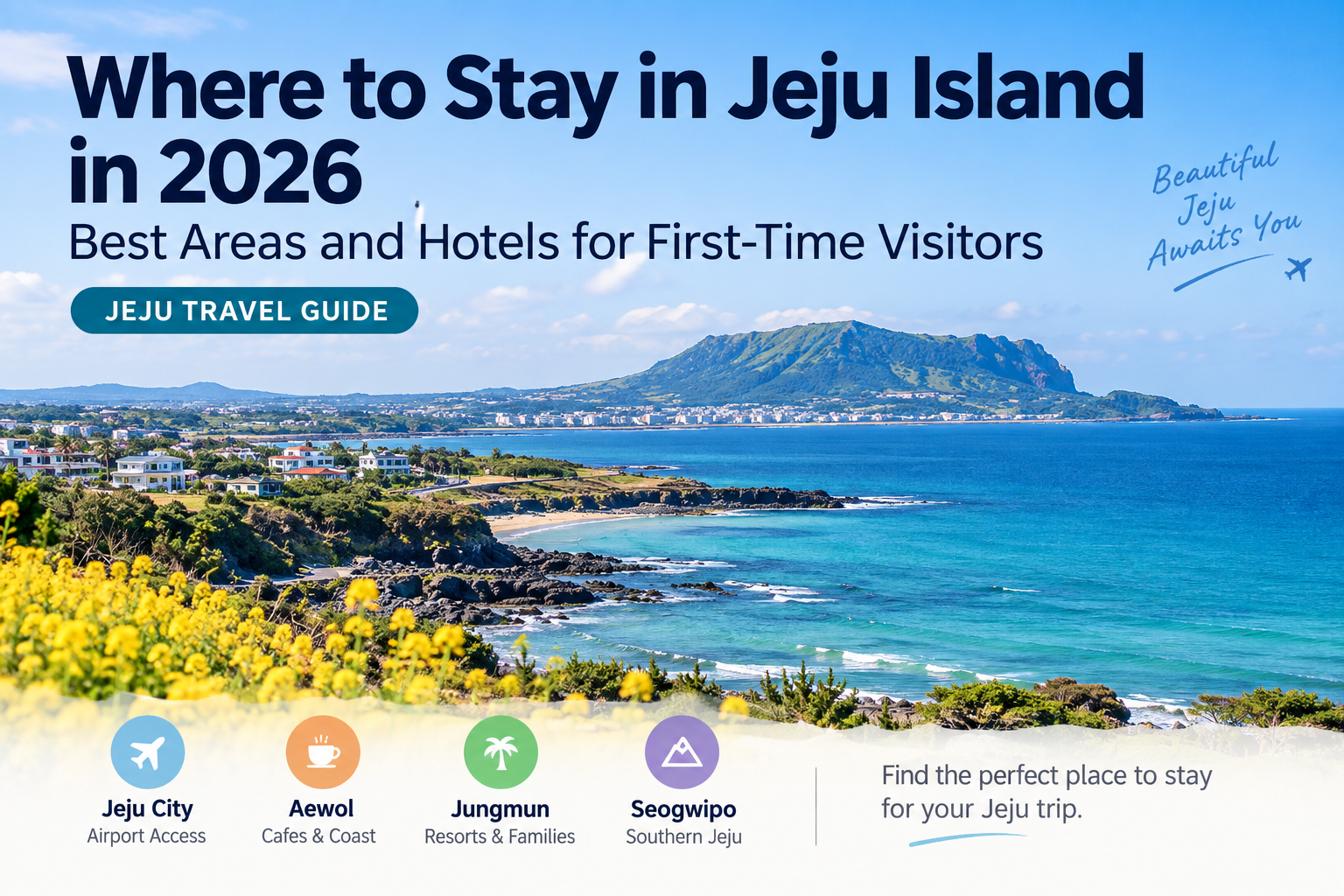
    The best area to stay depends on the kind of trip you are planning. Jeju City is convenient for airport access and short stays, Aewol is popular for coastal scenery and cafes, Jungmun is known for resorts and family-friendly attractions, and Seogwipo is a good base for exploring southern Jeju.

    Travelers looking for something beyond a standard hotel can also explore boutique hotels, distinctive local stays, and other unique places to stay in Jeju Island.

    Transportation matters too. Travelers renting a car have much more flexibility in choosing accommodation, while visitors relying on public transportation should pay close attention to bus routes, travel times, and the location of their hotel.

    For most travelers, there is no single “best” area in Jeju. The right choice depends on your itinerary.

    Here is the simplest way to think about it:

    AreaBest ForMain Advantage
    Jeju CityFirst or last night, short trips, travelers without a carClose to Jeju Airport
    AewolCouples, cafes, coastal sceneryRelaxed west-coast atmosphere
    JungmunFamilies, resorts, luxury staysMajor resort area with nearby attractions
    SeogwipoLonger stays, southern Jeju sightseeingGood base for exploring the south

    If this is your first trip to Jeju, your itinerary should determine your hotel location—not simply which hotel looks the nicest online.

    For a short two- or three-night trip, staying in one well-chosen area may be easiest. For a longer trip, splitting your stay between northern and southern Jeju can reduce unnecessary travel across the island.

    1. Jeju City: Best for Airport Access and Short Stays

    Jeju City is the most practical place to stay for travelers who want easy access to Jeju International Airport.

    Because most visitors arrive and depart through the airport, staying in Jeju City can be especially convenient on the first or last night of a trip. It is also one of the easier areas for travelers who are visiting Jeju without renting a car.

    The city has a wide range of accommodation, from affordable business hotels and guesthouses to upscale hotels. You will also find restaurants, traditional markets, shopping areas, cafes, and transportation connections nearby.

    One of the biggest advantages is convenience. Instead of beginning or ending your trip with a long journey across the island, you can stay relatively close to the airport and use Jeju City as a base for exploring northern Jeju.

    Jeju City Is Best For:

    • Travelers arriving late or departing early
    • First-time visitors who value convenience
    • Short two- or three-night trips
    • Travelers without a rental car
    • Visitors who want restaurants and shopping nearby
    • Travelers planning to explore northern Jeju

    What to Know Before Staying in Jeju City

    The main disadvantage is that Jeju City does not provide the same resort atmosphere or dramatic coastal setting that many travelers imagine when they think of Jeju.

    If your priority is waking up beside the ocean, relaxing at a resort, or exploring waterfalls and attractions in southern Jeju, another area may suit you better.

    However, for convenience and airport access, Jeju City remains one of the easiest choices for a first visit.

    2. Aewol: Best for Cafes, Couples and West-Coast Scenery

    Located west of Jeju City, Aewol has become one of Jeju’s most recognizable coastal areas.

    The area is particularly popular with travelers looking for ocean views, stylish cafes, coastal drives, and a slower atmosphere than central Jeju City. It can work especially well for couples or travelers who want their accommodation to feel like part of the Jeju experience rather than simply a place to sleep.

    Aewol is also convenient for exploring parts of western Jeju, making it a useful base if your itinerary includes beaches, cafes, coastal scenery, and attractions on the western side of the island.

    Aewol Is Best For:

    • Couples
    • Cafe lovers
    • Travelers looking for ocean views
    • West Jeju itineraries
    • Relaxed trips
    • Visitors with a rental car

    What to Know Before Staying in Aewol

    Aewol is spread out, so the exact location of your accommodation matters.

    A hotel or pension described as being “in Aewol” may still be some distance from the cafes, coastline, or attractions you want to visit. Check the map carefully before booking rather than choosing accommodation based only on the area name.

    Travelers relying entirely on public transportation should also plan their routes in advance. A rental car generally makes staying in Aewol much easier, particularly if you want to explore several places around western Jeju.

    3. Jungmun: Best for Resorts, Families and Luxury Stays

    If your idea of a Jeju vacation includes a comfortable resort, ocean views, swimming pools, and easy access to major attractions, Jungmun Tourist Complex is one of the strongest areas to consider.

    Located on Jeju’s southern coast, Jungmun is home to many of the island’s well-known upscale hotels and resorts. The area is particularly convenient for families, couples on a relaxing vacation, and travelers who prefer resort facilities over staying in a busy city center.

    Nearby attractions include Jungmun Saekdal Beach, Cheonjeyeon Falls, and several museums and family-oriented attractions. This makes it possible to combine sightseeing with time at your hotel rather than spending every day traveling long distances around the island.

    Jungmun Is Best For:

    • Families with children
    • Couples looking for a resort stay
    • Luxury travelers
    • Honeymoon-style trips
    • Travelers who want hotel facilities and nearby attractions
    • Visitors exploring southwestern Jeju

    What to Know Before Staying in Jungmun

    Accommodation in Jungmun can be more expensive than in some other parts of Jeju, particularly at major resorts.

    It is therefore worth considering how much time you will actually spend at the property. Paying more for a resort makes greater sense if you plan to enjoy its pools, restaurants, ocean views, spa facilities, or other amenities.

    If you intend to leave early every morning and spend the entire day driving around Jeju, a simpler hotel elsewhere may provide better value.

    4. Seogwipo: Best for Exploring Southern Jeju

    Seogwipo is one of the most useful bases for travelers who want to explore the southern half of Jeju Island.

    The city and surrounding area provide access to waterfalls, coastal scenery, local restaurants, markets, and many of Jeju’s southern attractions. Compared with a resort-focused stay in Jungmun, central Seogwipo can also feel more like a working local city.

    Popular places around the area include Jeongbang Falls, Cheonjiyeon Falls, Seogwipo Maeil Olle Market, and sections of the Jeju Olle Trail.

    Seogwipo can be particularly attractive for travelers staying several nights because it provides a practical base while still offering plenty to do in the evening.

    Seogwipo Is Best For:

    • Travelers spending several days in Jeju
    • Southern Jeju sightseeing
    • Waterfalls and coastal scenery
    • Jeju Olle Trail travelers
    • Visitors who enjoy markets and local restaurants
    • Travelers who want a city base outside Jeju City

    What to Know Before Staying in Seogwipo

    The biggest consideration is its distance from Jeju International Airport.

    Travel time between the airport and Seogwipo can be significant depending on traffic, your exact accommodation, and the transportation method you use. If you have an early flight, staying in Seogwipo on your final night may therefore be less convenient than moving closer to Jeju City.

    On the other hand, if most of your itinerary is concentrated in southern Jeju, staying in Seogwipo can save considerable back-and-forth travel during the rest of your trip.

    Should You Stay in Jeju City or Seogwipo?

    This is one of the most common decisions first-time visitors face.

    Choose Jeju City if airport convenience, public transportation, shopping, restaurants, and northern Jeju are more important to you.

    Choose Seogwipo if your itinerary focuses on waterfalls, coastal scenery, the Olle Trail, and attractions across southern Jeju.

    For a longer trip, you do not necessarily have to choose only one.

    A traveler spending four or five nights on the island could stay part of the trip in Jeju City or western Jeju and then move to Seogwipo or Jungmun. Splitting your stay can reduce repeated travel across the island, although changing hotels also means packing and checking in again.

    For a very short trip, however, one strategically located hotel is usually simpler than changing accommodation.

    Where to Stay in Jeju Without a Rental Car

    Jeju is much easier to explore by car than many first-time visitors expect.

    Public buses connect major areas, but attractions can be widely separated and some journeys require transfers. This makes hotel location particularly important if you are not renting a car.

    For travelers without a rental car, Jeju City is generally the easiest base because of its transportation connections and proximity to the airport.

    Central Seogwipo can also work if most of your itinerary is concentrated in southern Jeju.

    Wherever you stay, check the actual bus stops and routes near your accommodation before booking. A hotel that looks close to an attraction on a map may still require an inconvenient public-transport journey.

    Where to Stay in Jeju With a Rental Car

    Having a rental car gives you much more freedom.

    Aewol, Jungmun, and accommodations outside the main city centers become considerably easier to consider because you are less dependent on bus routes.

    However, do not choose a remote hotel simply because you have a car.

    Before booking, check:

    • Driving time to the attractions on your itinerary
    • Parking availability at the accommodation
    • Distance to restaurants and convenience stores
    • Whether you will want to drive after dinner
    • Driving time back to Jeju Airport on departure day

    A beautiful ocean-view hotel can be worthwhile, but not if you spend several unnecessary hours driving every day.

    Best Area in Jeju for Different Types of Travelers

    First-Time Visitors

    For a short first trip, Jeju City offers the simplest logistics.

    For a longer first visit focused on southern attractions, Seogwipo can be a better base.

    Couples

    Aewol is attractive for couples who enjoy cafes, coastal scenery, and relaxed drives.

    For couples who prefer a more luxurious vacation, Jungmun offers a stronger resort experience.

    Families

    Jungmun is particularly convenient for families who want comfortable resort facilities combined with nearby attractions.

    Families renting a car can also consider larger accommodations elsewhere on the island, depending on their itinerary.

    Luxury Travelers

    For travelers primarily looking for an upscale resort experience, Jungmun is one of the first areas to consider.

    However, luxury properties can also be found in other parts of Jeju, so location should still come before the hotel brand itself.

    Short-Stay Travelers

    If you have only one or two nights in Jeju, staying near Jeju City and the airport can minimize transportation time.

    With such a short visit, spending hours crossing the island can take away a large portion of your available sightseeing time.

    Should You Split Your Stay in Jeju?

    For travelers staying four nights or longer, splitting accommodation between two areas can sometimes make sense.

    For example, you could spend the first part of your trip around Jeju City or Aewol while exploring northern and western Jeju, then move to Seogwipo or Jungmun for the southern part of your itinerary.

    This approach can reduce long cross-island drives and allow you to experience different sides of Jeju.

    However, changing hotels also takes time. You need to pack, check out, move your luggage, and check in again.

    If you prefer a slower trip, choosing one well-located base may be better.

    The important question is not whether other travelers split their stay. It is whether changing accommodation will actually reduce travel time for your itinerary.

    What to Check Before Booking a Hotel in Jeju

    Before choosing your accommodation, check more than the room photos and guest rating.

    1. Actual Location

    Jeju accommodation names often refer to a broad area. Open the map and check exactly where the property is located.

    2. Transportation

    If you are not renting a car, check nearby bus stops and realistic travel routes before paying for the room.

    3. Parking

    If you are renting a car, confirm whether parking is available and whether there are any restrictions.

    4. Airport Travel Time

    Check how long it will take to reach Jeju International Airport, especially for an early departure.

    5. Your Daily Itinerary

    Plot several of your priority attractions on a map. If almost everything you want to visit is on the opposite side of the island from your hotel, reconsider the location.

    6. Hotel Facilities

    A swimming pool, spa, ocean-view room, breakfast, or resort facilities can be valuable if you intend to use them. If your days will be spent sightseeing from morning until night, location may matter more.

    Frequently Asked Questions

    What is the best area to stay in Jeju for first-time visitors?

    There is no single best area for everyone. Jeju City is particularly convenient for airport access and shorter trips, while Seogwipo works well for travelers concentrating on southern Jeju. Jungmun is attractive for resort stays, and Aewol suits travelers interested in western coastal scenery and cafes.

    Is Jeju City or Seogwipo better?

    Jeju City is generally more convenient for the airport and northern Jeju. Seogwipo is better positioned for many attractions in southern Jeju. Your itinerary should determine which is more convenient.

    Where should I stay in Jeju without a car?

    Jeju City is often the easiest option because of its transportation connections and proximity to the airport. Central Seogwipo can also be practical for a southern Jeju itinerary.

    Where should couples stay in Jeju?

    Aewol is popular with travelers looking for coastal scenery, cafes, and a relaxed atmosphere. Jungmun is another strong option for couples who prefer an upscale resort experience.

    Where should families stay in Jeju?

    Jungmun is worth considering because of its concentration of resorts and nearby attractions. Families renting a car have more flexibility to choose accommodation elsewhere based on their itinerary.

    How many nights should I stay in Jeju?

    The answer depends on what you want to see, but Jeju’s size makes very short visits challenging if you want to explore several parts of the island. With more time, you can travel at a slower pace or divide your stay between different areas.

    Final Thoughts

    Choosing where to stay in Jeju Island is ultimately a transportation decision as much as a hotel decision.

    Jeju City offers convenience and airport access. Aewol provides a relaxed west-coast atmosphere. Jungmun is well suited to resort and family vacations, while Seogwipo provides a useful base for exploring southern Jeju.

    Instead of starting with a list of hotels, build a rough itinerary first. Mark the places you most want to visit, decide whether you will rent a car, and then choose the area that minimizes unnecessary travel.

    Once you have chosen the right part of Jeju, selecting the right hotel becomes much easier.

    For a first visit, that simple decision can make the difference between spending your vacation experiencing Jeju and spending too much of it traveling from one side of the island to the other.

  • How to Pay in South Korea in 2026: Cash, Cards, ATMs and Cashless Payments for Travelers

    How to Pay in South Korea in 2026: Cash, Cards, ATMs and Cashless Payments for Travelers

    Do You Need Cash in South Korea? Best Ways to Pay as a Traveler

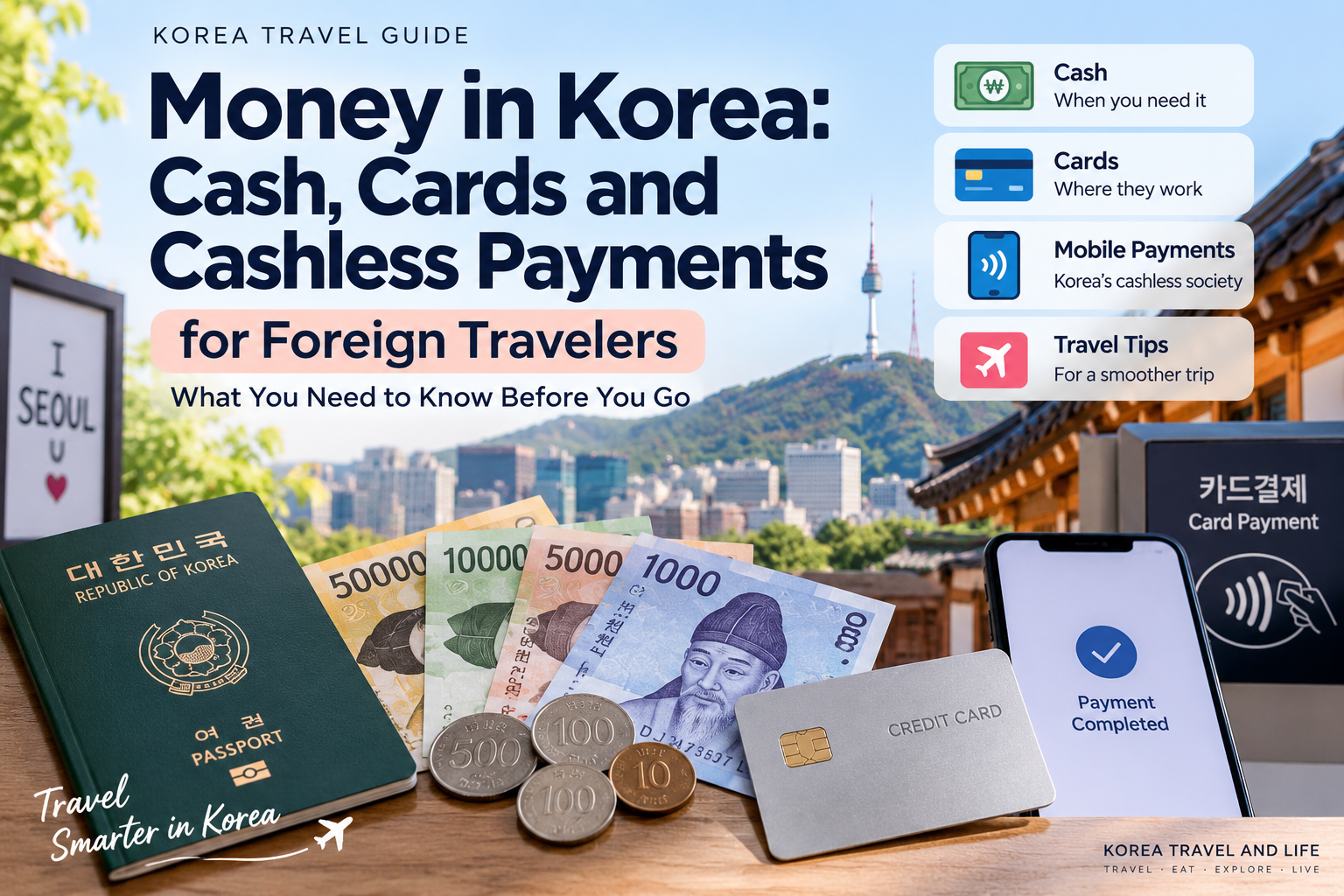
    You do not need to carry large amounts of cash in South Korea because credit and debit cards are widely accepted. However, foreign travelers should still carry some Korean won for places or situations where cards may not work, including some traditional markets, small businesses, transportation-related payments, or when a foreign card is declined.

    In this guide, you’ll learn when to carry cash, which foreign cards are most likely to work, how to use ATMs, whether mobile payments are practical for visitors, and how to avoid common payment problems in Korea.

    South Korea is highly developed in electronic payments, and cards are widely used in everyday life. However, travelers should not assume that they can complete an entire trip without carrying any Korean won.

    The most practical approach is to understand how cash, credit cards, transportation cards, ATMs, and mobile payments work before you travel.

    What Currency Is Used in South Korea?

    The official currency of South Korea is the South Korean won, commonly written as KRW or represented by the symbol ₩.

    Korean banknotes commonly include:

    • ₩1,000
    • ₩5,000
    • ₩10,000
    • ₩50,000

    Coins are also used for smaller amounts.

    Korean prices are usually shown in thousands of won, so seeing ₩10,000 or ₩20,000 on a restaurant menu is completely normal. Exchange rates change daily, so check a current rate shortly before or during your trip rather than relying on an old conversion.

    Is South Korea a Cashless Society?

    South Korea is very card-friendly, but travelers should still carry some cash for small purchases, traditional markets, transportation-related needs, and places where a foreign card may not be accepted.

    Credit cards and other electronic payment methods are widely used at restaurants, cafés, convenience stores, department stores, hotels, and many tourist attractions.

    Korean residents may complete much of their daily spending without using physical cash.

    For foreign travelers, however, the situation can be slightly different.

    Some payment systems are designed primarily for locally issued cards or Korean mobile-payment services. A foreign card may occasionally be declined even when the store normally accepts card payments.

    Do You Need Cash in Korea?

    You probably do not need to carry a large amount of cash, but having some cash available is a good idea.

    Cash may be useful for:

    • traditional markets
    • small food stalls
    • certain ticket machines
    • small independent businesses
    • topping up some transportation cards
    • situations where a foreign card is declined

    In central Seoul, Busan, and other major tourist areas, travelers can often use cards for most purchases.

    But keeping some won in your wallet provides a backup when electronic payment does not work as expected.

    Can Foreign Credit Cards Be Used in Korea?

    International credit and debit cards are widely accepted in many places in South Korea, especially in major cities and tourist areas.

    Hotels, large restaurants, shopping malls, department stores, cafés, convenience stores, and major attractions commonly accept card payments.

    However, acceptance of a card network does not guarantee that every foreign card will work at every terminal.

    Possible problems can include:

    • card issuer security blocks
    • overseas transactions being disabled
    • compatibility issues with a payment terminal
    • online services requiring a Korean-issued card
    • authentication requirements

    Before traveling, check that your card is enabled for international transactions.

    Should You Bring More Than One Card?

    Yes, if possible.

    Depending on a single credit or debit card can create unnecessary problems if the card is lost, damaged, blocked, or unexpectedly declined.

    A practical travel setup might include:

    one primary card + one backup card + some Korean won

    Keep the backup card separately from your main wallet when possible.

    You should also know how to contact your bank or card issuer if you encounter a payment problem abroad.

    Can You Withdraw Korean Won From an ATM?

    Foreign travelers can use many ATMs in South Korea, but not every ATM accepts every international card.

    Look for ATMs that indicate support for global or international cards.

    They are commonly found at airports, banks, convenience stores, transportation hubs, and busy commercial areas.

    Your home bank, the ATM operator, or both may charge fees.

    The exchange rate applied to the withdrawal can also vary.

    For this reason, check your own bank’s international ATM policies before leaving home.

    Should You Exchange Money Before Traveling to Korea?

    You do not necessarily need to exchange all of your travel money before arriving.

    Many travelers combine several methods:

    bringing a small amount of Korean won, exchanging currency after arrival, withdrawing cash from an ATM, and using cards for regular purchases.

    The best choice depends on the fees and exchange rates offered by your bank, card provider, or currency-exchange service.

    Avoid carrying unnecessarily large amounts of cash.

    For most travelers, having enough won for immediate expenses and using cards for many larger purchases can be more convenient.

    Can You Exchange Money at Incheon Airport?

    Currency-exchange services and ATMs are available at major international arrival points such as Incheon International Airport.

    This can be convenient if you arrive without Korean won and need cash immediately.

    After arriving in Seoul, you can also find currency-exchange services in major tourist and commercial areas.

    Convenience and exchange value are not always the same thing, so travelers who plan to exchange a larger amount may want to compare available rates and fees.

    What Is T-money?

    T-money is one of the most useful payment tools for travelers using public transportation in Korea.

    It is a rechargeable transportation card commonly used for buses and subways and can also be used for certain other payments where supported.

    Do You Need Cash to Recharge a Transportation Card?

    This is one reason travelers should keep some Korean won available.

    Depending on the transportation card, recharge location, and payment method, cash may still be required or be the simplest option for topping up.

    Can Foreign Travelers Use Korean Mobile Payments?

    South Korea has an advanced mobile-payment environment, but some domestic payment systems can be difficult for short-term foreign visitors to use.

    Certain services may require a Korean phone number, Korean bank account, local identity verification, or a locally issued card.

    International mobile wallets may work in some situations, but travelers should not assume that every shop or payment terminal will support their preferred service.

    A physical international card remains a useful primary payment method for many visitors.

    What If Your Card Is Declined in Korea?

    Do not immediately assume that the store does not accept foreign travelers’ cards.

    There can be several reasons for a declined transaction.

    Try another card if you have one.

    If the problem continues, contact your bank or card issuer and check whether overseas transactions have been blocked.

    This is also why carrying a small cash reserve is useful.

    Can You Use Cash at Restaurants and Shops?

    Cash is still legal currency and remains usable in many places.

    However, payment practices can vary, and some businesses may strongly prefer electronic payments.

    Use cards where they work conveniently and keep cash available as a backup.

    How Much Cash Should You Carry in Korea?

    There is no single amount that is correct for every traveler.

    It depends on your itinerary, spending habits, accommodation, transportation plans, and whether you will visit traditional markets or areas outside major tourist centers.

    Rather than carrying your entire travel budget in cash, consider keeping enough Korean won for small purchases and unexpected payment problems.

    For larger expenses such as hotels or major shopping purchases, cards are often more convenient when accepted.

    Are Traditional Markets More Cash-Friendly?

    Traditional markets are one place where carrying cash can be particularly useful.

    Many vendors now accept electronic payments, but payment options vary from stall to stall.

    If you plan to explore Korean street food, local markets, or smaller independent vendors, keeping Korean won available can make the experience easier.

    What About Tipping in Korea?

    Tipping is generally not a standard part of everyday Korean restaurant and café culture in the same way it is in some countries.

    Travelers usually pay the amount shown on the bill.

    However, practices can vary in specialized tourism or hospitality situations, so follow any clearly stated service policies.

    For ordinary restaurants, cafés, taxis, and shops, visitors should not assume that a percentage-based tip is expected.

    Should You Choose KRW When a Card Terminal Offers Currency Conversion?

    Some international card transactions may offer the option of paying in your home currency rather than Korean won.

    This is often called dynamic currency conversion (DCC).

    The exchange rate or fees associated with DCC may differ from the rate your own card provider would apply.

    Before accepting the option, check the displayed rate and understand your card’s foreign transaction policy.

    Do not automatically select your home currency simply because the amount looks more familiar.

    A Simple Payment Strategy for First-Time Visitors

    For many foreign travelers, the easiest approach is to avoid relying on only one payment method.

    A simple setup is:

    International card + backup card + small amount of Korean won + transportation card

    This gives you several options if one payment method fails.

    Use your international card for ordinary purchases where it works, keep cash for smaller transactions and backup situations, and use a transportation card for convenient public transit.

    Money in Korea: What Should You Prepare Before Your Trip?

    Before leaving for South Korea, consider doing a few simple things.

    Make sure your bank cards can be used internationally.

    Check your bank’s foreign transaction and ATM fees.

    Know the approximate exchange rate between your currency and the Korean won.

    Prepare more than one payment method.

    And once you arrive, obtain some Korean won rather than assuming your trip will be completely cashless.

    Final Thoughts

    South Korea is easy to navigate with cards, but travelers should still keep some Korean won for small purchases, transportation needs, and unexpected payment problems.

    The most practical setup is simple: use an international card for most purchases, carry a backup card, and keep a modest amount of cash available.

    With those options prepared, you can travel around Korea without worrying too much about how to pay.


  • Best 5-Star Hotels in Busan: Luxury Stays, Locations and Travel Tips

    Best 5-Star Hotels in Busan: Luxury Stays, Locations and Travel Tips

    Busan is one of South Korea’s most exciting coastal cities, combining beautiful beaches, ocean views, seafood, cafés, shopping districts, temples, and a growing fine-dining scene.

    For travelers looking for a more luxurious experience, Busan also offers several excellent five-star hotels.

    But choosing a hotel in Busan is not simply about finding the most luxurious room.

    Location matters.

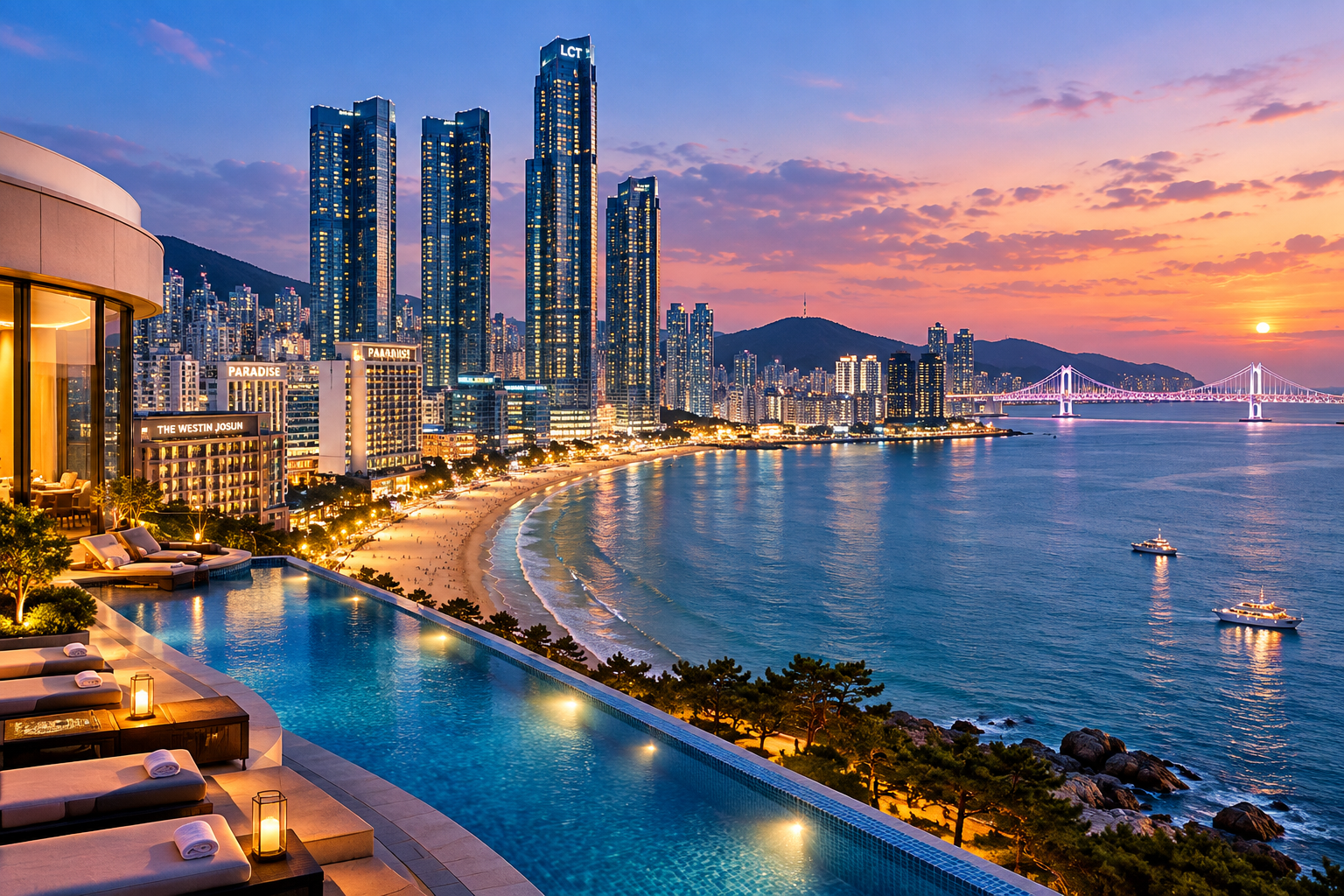
    A hotel near Haeundae Beach offers a very different travel experience from a hotel in Marine City or a resort-style property in Gijang.

    This guide introduces some of the best luxury hotels in Busan, including their location, address, phone number, nearby attractions, and the type of traveler each hotel may suit best.

    1. SIGNIEL Busan

    시그니엘 부산

    4.6•호텔웹사이트

    •경로

    •051-922-1000

    Located in the Haeundae area, SIGNIEL Busan is one of the city’s best-known luxury hotels.

    The hotel occupies part of the LCT complex near Haeundae Beach, giving guests convenient access to one of Busan’s most famous coastal areas.

    Address:
    30 Dalmaji-gil, Haeundae-gu, Busan, South Korea

    Phone:
    +82-51-922-1000

    For first-time visitors who want to combine a luxury stay with easy access to Haeundae, this is one of the most attractive locations in Busan.

    Haeundae Beach is nearby, while the surrounding district offers restaurants, cafés, shopping, nightlife, and coastal attractions.

    Best for

    Couples, luxury travelers, special occasions, and visitors who want to stay close to Haeundae Beach.

    2. Park Hyatt Busan

    파크 하얏트 부산

    4.6•호텔웹사이트

    •경로

    •051-990-1234

    Park Hyatt Busan offers a different experience from the beachfront hotels of Haeundae.

    It is located in Marine City, one of Busan’s most modern waterfront districts.

    Address:
    51, Marine City 1-ro, Haeundae-gu, Busan 48120, South Korea

    Phone:
    +82-51-990-1234

    The hotel’s official information confirms this address and telephone number.

    Marine City is known for its high-rise skyline and waterfront atmosphere, and the area provides impressive views toward the sea and Gwangan Bridge.

    Travelers who prefer sophisticated city scenery rather than being directly beside the busiest section of Haeundae Beach may particularly enjoy this location.

    Best for

    Couples, business travelers, luxury city breaks, and travelers who appreciate modern architecture and waterfront views.

    3. Paradise Hotel Busan

    파라다이스 호텔 부산

    4.5•호텔웹사이트

    •경로

    •051-742-2121

    Paradise Hotel Busan is one of the city’s long-established luxury hotels and enjoys an excellent location directly in the Haeundae Beach area.

    Address:
    296 Haeundaehaebyeon-ro, Haeundae-gu, Busan, South Korea

    Phone:
    +82-51-742-2121

    One of the biggest advantages of staying here is location.

    Guests can easily explore Haeundae Beach and the surrounding restaurants, cafés, shopping streets, and entertainment areas.

    For travelers visiting Busan for the first time, staying in this part of Haeundae can make sightseeing and dining particularly convenient.

    Best for

    Families, couples, first-time Busan visitors, and travelers who want a classic beachfront luxury-hotel experience.

    4. The Westin Josun Busan

    더웨스틴조선 부산

    4.5•리조트웹사이트

    •경로

    •051-749-7000

    The Westin Josun Busan occupies one of the most distinctive hotel locations in Haeundae.

    Situated near Dongbaekseom Island, it offers convenient access to both coastal walking routes and Haeundae Beach.

    Address:
    67 Dongbaek-ro, Haeundae-gu, Busan, South Korea

    Phone:
    +82-51-749-7000

    Its location is especially attractive for travelers who enjoy walking.

    Dongbaekseom’s coastal paths provide beautiful views of the sea and Busan skyline, while Haeundae’s restaurants and attractions remain within easy reach.

    Best for

    Couples, families, walkers, and travelers who want ocean scenery with convenient access to central Haeundae.

    5. Ananti at Busan Cove

    아난티 앳 부산 코브

    4.6•호텔웹사이트

    •경로

    •051-509-1111

    Travelers who want to escape the busiest parts of central Busan may prefer the resort atmosphere of Ananti at Busan Cove.

    It is located in Gijang, northeast of central Haeundae.

    Address:
    268-32 Gijanghaean-ro, Gijang-gun, Busan, South Korea

    Phone:
    +82-51-509-1111

    The Gijang coastline has developed into one of Busan’s interesting leisure areas, with oceanfront cafés, restaurants, resorts, and coastal scenery.

    The trade-off is distance.

    Travelers planning to spend most of their time sightseeing in central Busan should consider transportation time before choosing Gijang as their base.

    Best for

    Relaxing vacations, couples, families, resort stays, and travelers who prioritize ocean scenery over central-city convenience.

    Haeundae or Gijang: Where Should You Stay?

    This is one of the most important decisions when choosing a luxury hotel in Busan.

    If this is your first trip to Busan, Haeundae is generally the easier choice.

    You will have convenient access to the beach, restaurants, cafés, nightlife, shopping, and public transportation.

    Marine City is also a good choice for travelers who prefer a modern waterfront atmosphere.

    Gijang offers something different.

    It feels more like a coastal escape and can be particularly attractive for travelers who want to spend more time relaxing at their hotel or exploring Busan’s northeastern coastline.

    Which Busan Luxury Hotel Is Best for First-Time Visitors?

    There is no single hotel that is best for everyone.

    For convenient access to Haeundae Beach, SIGNIEL Busan and Paradise Hotel Busan are strong choices.

    For a sophisticated Marine City experience, Park Hyatt Busan stands out.

    For travelers who enjoy coastal walking and Dongbaekseom, The Westin Josun Busan has an appealing location.

    And for travelers who want a resort-style escape, Ananti at Busan Cove offers a very different experience from central Haeundae.

    Luxury Hotels and Busan’s Food Scene

    Luxury accommodation is only one part of a Busan trip.

    Busan has an exceptionally diverse food culture, ranging from traditional dishes such as dwaeji-gukbap and seafood to contemporary fine dining.

    The city’s international culinary profile has also grown significantly.

    The MICHELIN Guide Seoul & Busan 2026 includes 55 restaurants in Busan, and four Busan restaurants hold one MICHELIN Star.

    This means travelers planning a luxury trip can combine a five-star hotel stay with some of the city’s most highly regarded dining experiences.

    We will explore Busan’s MICHELIN restaurants separately in a dedicated guide.

    Transportation Tips for Luxury Hotel Guests

    Busan is a large city, and travel times can be longer than first-time visitors expect.

    Haeundae and Marine City are convenient for exploring eastern Busan, while attractions in other parts of the city may require subway, bus, taxi, or other transportation.

    If your itinerary includes places such as Jagalchi Market, Nampo-dong, Gamcheon Culture Village, or Songdo, allow sufficient travel time from Haeundae.

    Travelers staying in Gijang should pay even more attention to transportation planning.

    Choosing your hotel based on the places you most want to visit can save considerable time.

    How to Choose the Right 5-Star Hotel in Busan

    Before booking, think about what kind of Busan trip you want.

    If beaches and restaurants are your priority, stay around Haeundae.

    If skyline and waterfront views appeal to you, consider Marine City.

    If you want a quieter resort experience, look toward Gijang.

    Also compare the hotel’s current room conditions, breakfast options, swimming pools, spa facilities, cancellation policies, and transportation before making a reservation.

    Hotel services and policies can change, so always confirm important details directly with the hotel before traveling.

    Final Thoughts

    Busan offers several very different ways to experience luxury travel.

    You can wake up near Haeundae Beach, enjoy the modern skyline of Marine City, walk along Dongbaekseom, or escape to a resort on the Gijang coastline.

    For many first-time visitors, staying in Haeundae or Marine City provides the easiest combination of luxury and sightseeing convenience.

    Travelers looking for a slower coastal vacation may prefer Gijang.

    Whichever area you choose, the best hotel is not necessarily the most expensive one.

    It is the hotel whose location, atmosphere, and facilities match the way you want to experience Busan.


  • Unique Hotels in Seoul: Boutique, Design and Unusual Places to Stay

    Unique Hotels in Seoul: Boutique, Design and Unusual Places to Stay

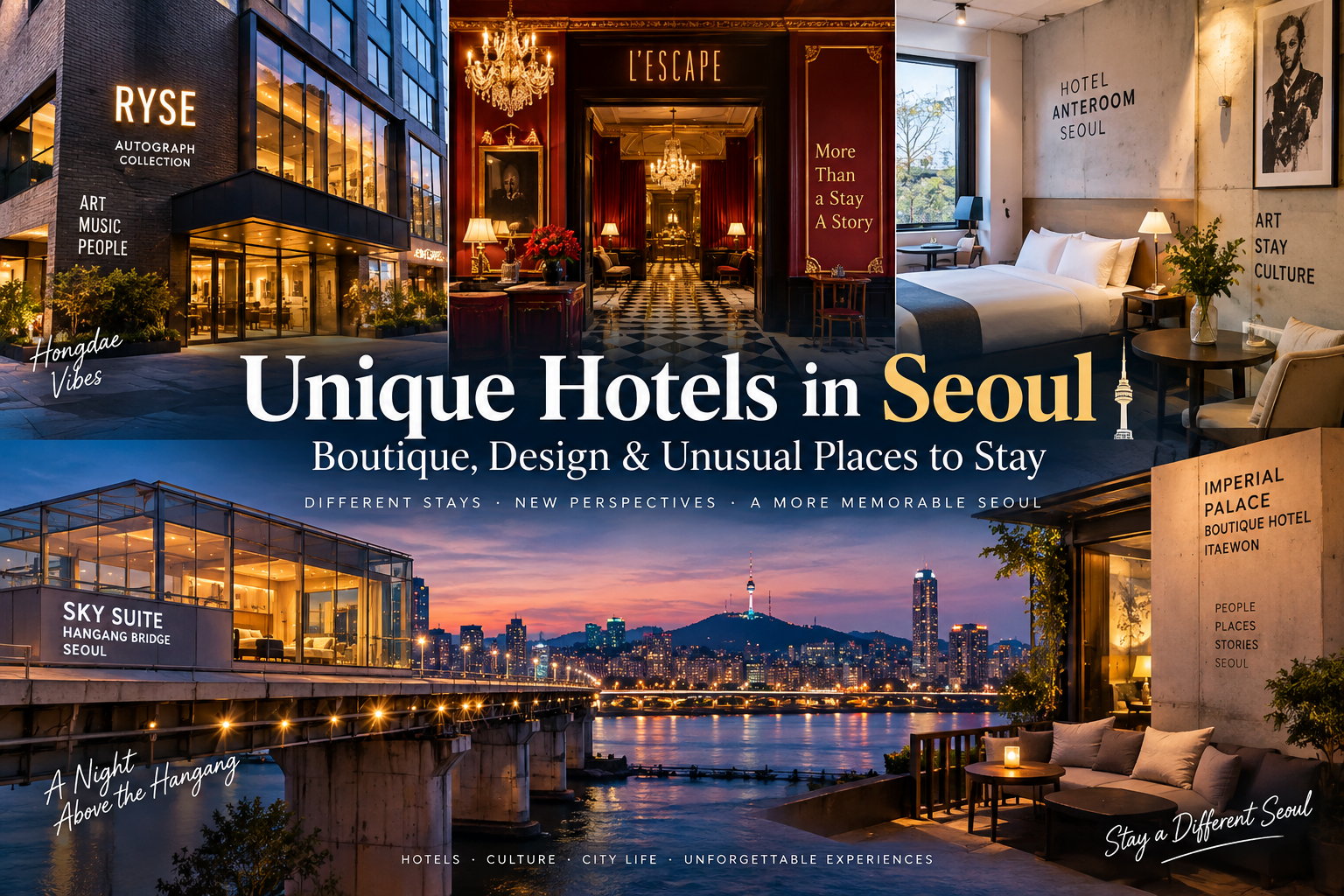
    Seoul has no shortage of excellent hotels, but sometimes travelers want something more memorable than a standard room.

    Perhaps you want to stay in the middle of Hongdae’s creative culture, sleep inside a dramatic Paris-inspired hotel, discover art inside your accommodation, experience Itaewon’s international atmosphere, or even spend a night above the Hangang River.

    These unique hotels and accommodations show very different sides of Seoul.

    If you have already experienced a traditional hanok or a classic five-star hotel, these distinctive stays offer another way to make your accommodation part of the journey.

    1. RYSE, Autograph Collection – Creative Energy in Hongdae

    RYSE, Autograph Collection is located in Hongdae, one of Seoul’s best-known neighborhoods for music, art, fashion and youth culture.

    Rather than feeling like a conventional business hotel, RYSE emphasizes contemporary design and the creative character of its neighborhood. Its location is especially convenient for travelers who want cafés, restaurants, shopping and nightlife within walking distance.

    Hongik University Station also provides convenient access to other parts of Seoul and the airport railroad.

    Address: 130 Yanghwa-ro, Mapo-gu, Seoul 04038, South Korea
    Telephone: +82-2-330-7700

    Best for: Younger travelers, couples, design lovers and visitors interested in Hongdae culture.

    Nearby attractions: Hongdae, Yeonnam-dong, Gyeongui Line Forest Park and Mangwon.

    Why Stay Here?

    RYSE is particularly appealing when you want your hotel to reflect the neighborhood outside it.

    Instead of traveling across Seoul every evening for entertainment, guests can step outside and immediately experience one of the city’s most energetic districts.

    2. L’Escape, a Luxury Collection Hotel, Seoul Myeongdong – Dramatic European-Inspired Design

    L’Escape offers one of the most theatrical hotel experiences in central Seoul.

    The property combines luxury accommodation with elaborate interiors inspired by European aesthetics, creating an atmosphere very different from the minimalist style common in many modern hotels.

    Its location in Jung-gu is another advantage. Travelers can easily explore Myeongdong, Namdaemun Market and central Seoul while staying in a hotel with a strong visual identity.

    Address: 67 Toegye-ro, Jung-gu, Seoul 04529, South Korea
    Telephone: +82-2-317-4000

    Best for: Couples, luxury travelers, design lovers and special occasions.

    Nearby attractions: Myeongdong, Namdaemun Market, Namsan and Seoul Station.

    Why Stay Here?

    L’Escape works particularly well for travelers who see the hotel itself as part of their Seoul experience.

    The contrast is also interesting: outside is the fast-moving center of Seoul, while inside the atmosphere is deliberately dramatic and immersive.

    3. Hotel Anteroom Seoul – Art and Local Culture in Gangnam

    Hotel Anteroom Seoul approaches the boutique-hotel idea through art, design and local culture.

    Located near Garosu-gil and Sinsa, the hotel describes itself as working with creators connected to Seoul’s local culture and lifestyle. It also incorporates cultural spaces, including Gallery 9.5.

    This makes Anteroom particularly interesting for visitors who prefer smaller, creative hotels over large international properties.

    Address: 153 Dosan-daero, Gangnam-gu, Seoul 06037, South Korea
    Telephone: +82-2-542-2300
    Reservation: +82-2-542-2391

    Best for: Art lovers, solo travelers, couples and visitors interested in contemporary Seoul.

    Nearby attractions: Garosu-gil, Sinsa-dong, Apgujeong and Gangnam.

    Why Stay Here?

    The attraction is not simply the room.

    Anteroom connects accommodation with art and neighborhood culture, which makes it a good choice for travelers interested in discovering Seoul beyond its most famous landmarks.

    4. Imperial Palace Boutique Hotel Itaewon – Colorful Seoul in Itaewon

    Imperial Palace Boutique Hotel offers another distinctive Seoul experience, this time in Itaewon.

    The hotel is positioned between Itaewon Station and Hangangjin Station, placing guests close to Itaewon, Hannam-dong, Gyeongridan-gil and Haebangchon. Its rooms include different styles and concepts rather than presenting one uniform design throughout the property.

    The neighborhood itself is part of the appeal. Itaewon has long been one of Seoul’s most internationally influenced areas, with restaurants, bars and cultural influences from around the world.

    Address: 221 Itaewon-ro, Yongsan-gu, Seoul 04349, South Korea
    Telephone: +82-2-3702-8000

    Best for: International travelers, couples, nightlife visitors and travelers interested in Itaewon and Hannam-dong.

    Nearby attractions: Itaewon, Hannam-dong, Leeum Museum of Art, Gyeongridan-gil and Namsan.

    Why Stay Here?

    This hotel works well for travelers who want a colorful boutique atmosphere combined with one of Seoul’s most diverse neighborhoods.

    5. Sky Suite Hangang Bridge, Seoul – Sleep Above the Hangang River

    This may be one of the most unusual places to stay in Seoul.

    Sky Suite Hangang Bridge, Seoul is not a typical hotel building. The accommodation was created by transforming a former bridge observation café into a single guest suite above the Hangang River.

    The space measures approximately 144 square meters and contains just one guest room, with a maximum occupancy of four people. Large windows provide panoramic views toward the river, Nodeul Island and Yeouido.

    Address: 3F, 495 Yangnyeong-ro, Yongsan-gu, Seoul, South Korea
    Telephone / Inquiries: +82-2-792-8810

    Best for: Couples, special occasions, photographers and travelers looking for a truly unusual Seoul stay.

    Nearby attractions: Hangang River, Nodeul Island, Yongsan and Yeouido.

    Why Stay Here?

    The answer is simple: the location.

    Instead of merely seeing the Hangang River from a hotel tower, guests actually spend the night in a special accommodation space built into Hangang Bridge.

    According to the Seoul Metropolitan Government, Sky Suite operates year-round and can accommodate up to four guests.

    For travelers searching for an experience that feels uniquely connected to Seoul, this is difficult to replicate elsewhere.

    Which Unique Seoul Hotel Should You Choose?

    The best choice depends on the Seoul experience you want.

    Choose RYSE if you want Hongdae’s creative energy right outside your door.

    Choose L’Escape if dramatic interiors and a romantic atmosphere are part of the attraction.

    Choose Hotel Anteroom Seoul if contemporary art, design and local culture appeal to you.

    Choose Imperial Palace Boutique Hotel Itaewon if you want to experience Itaewon and Seoul’s international side.

    And choose Sky Suite Hangang Bridge if the accommodation itself is meant to become one of the highlights of your trip.

    Boutique Hotel vs. 5-Star Hotel vs. Hanok Stay

    Seoul now offers very different styles of accommodation.

    A five-star hotel is usually the best choice for travelers prioritizing extensive facilities, luxury service and convenience.

    A hanok stay allows accommodation to become part of a traditional Korean cultural experience.

    A boutique or design hotel can provide something else: personality.

    These properties often reflect their neighborhoods more strongly, making them particularly attractive for travelers returning to Seoul or visitors looking for something beyond conventional sightseeing.

    Try Different Stays During One Seoul Trip

    Travelers staying in Seoul for a week or longer do not necessarily need to choose only one type of accommodation.

    For example, you could spend several nights near Seoul’s historic center, move to a hanok for a traditional experience, and finish the trip at a design hotel in Hongdae or Gangnam.

    Another option is to save an unusual accommodation such as Sky Suite for one special night.

    Changing hotels requires a little extra planning, but it can allow travelers to experience several very different sides of the city.

    Which Neighborhood Is Best?

    Hongdae is ideal for music, cafés, nightlife and younger creative culture.

    Myeongdong and central Seoul work well for first-time sightseeing, shopping and transportation.

    Sinsa and Gangnam appeal to travelers interested in contemporary fashion, cafés, design and modern city life.

    Itaewon and Hannam-dong provide an international atmosphere along with restaurants, nightlife, galleries and easy access to Namsan.

    Yongsan and the Hangang River are worth considering when river scenery or access to central Seoul is a priority.

    In a city as large as Seoul, choosing the right neighborhood can be just as important as choosing the hotel itself.

    Before You Book

    Unique hotels can have very different room types, policies and facilities.

    Always check the hotel’s official information before booking, especially if a particular room design, view or facility is important to you.

    For unusual properties such as Sky Suite, availability may be much more limited than at a conventional hotel because the property has only one guest room.

    Room rates can also change according to dates, seasons, weekends, events and promotions, so check current pricing directly when planning your trip.

    Final Thoughts

    Accommodation does not have to be simply somewhere to sleep.

    In Seoul, your hotel can introduce you to Hongdae’s creative culture, the contemporary design of Gangnam, Itaewon’s international character or the scenery of the Hangang River.

    After experiencing Seoul’s five-star hotels and traditional hanok stays, boutique and unusual accommodation adds another layer to the city.

    Sometimes the most memorable part of a journey begins after you return to your hotel.


  • Best Hanok Hotels and Traditional Stays in Seoul: Unique Korean Accommodation

    Best Hanok Hotels and Traditional Stays in Seoul: Unique Korean Accommodation

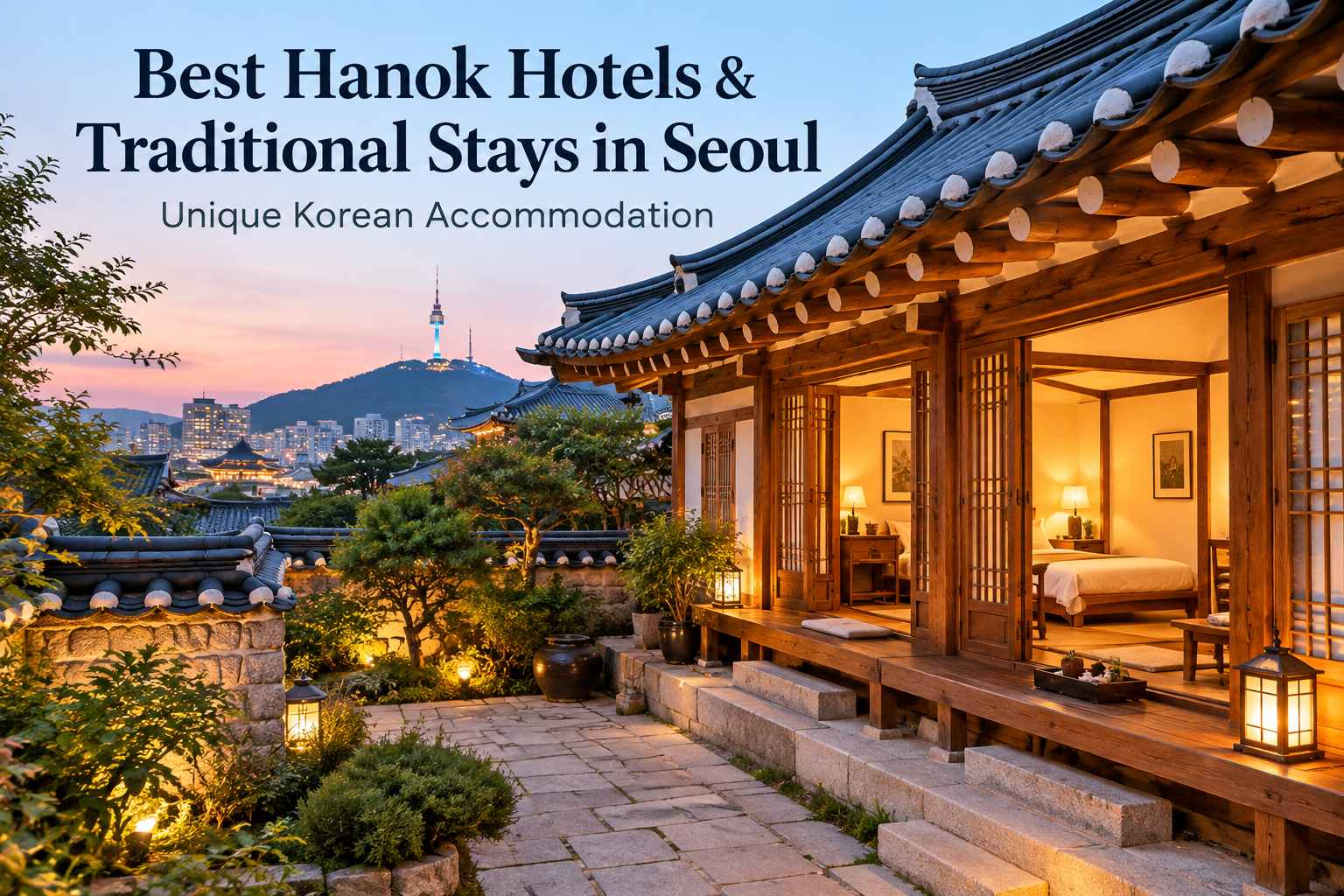
    Seoul is famous for its modern skyline, busy shopping districts and contemporary hotels, but travelers can also spend the night in a completely different side of the city: a traditional Korean hanok.

    A hanok stay offers more than a place to sleep. Wooden beams, tiled roofs, peaceful courtyards and traditional neighborhoods can turn accommodation itself into part of your Korean travel experience.

    Many of Seoul’s hanok stays are concentrated around Bukchon, Seochon and Jongno, close to royal palaces and some of the city’s most historic streets. Seoul also has traditional-style accommodation outside the busiest tourist areas, giving visitors several ways to experience Korean architecture.

    Here are some traditional hanok stays to consider in Seoul.

    1. Rakkojae Seoul – A Classic Luxury Hanok Experience

    Rakkojae Seoul Main Hanok is one of the best-known traditional accommodation experiences in Seoul.

    Located in the historic Bukchon area, Rakkojae offers travelers the opportunity to stay inside a traditional Korean setting while remaining close to major attractions in central Seoul.

    The atmosphere is very different from a conventional luxury hotel. Traditional architecture, wooden interiors and a quiet courtyard help create the feeling of stepping away from modern Seoul for a while.

    Its location is especially attractive for visitors who want to explore Bukchon, Changdeokgung Palace, Insadong and other historic neighborhoods.

    Address: 218 Gahoe-dong, Jongno-gu, Seoul, South Korea
    Telephone: +82-2-742-3410

    Best for: Couples, cultural travelers and visitors looking for a premium traditional Korean experience.

    Nearby attractions: Bukchon Hanok Village, Changdeokgung Palace, Insadong and Jongno.

    2. THE CHAE – A Private Premium Hanok Stay

    THE CHAE Premium Hanok Stay offers another style of hanok experience: a more private and contemporary interpretation of traditional Korean accommodation.

    Its location near the historic palace district makes it attractive for travelers who want privacy while staying close to some of Seoul’s most important cultural attractions.

    This type of accommodation is particularly interesting for couples, families or small groups who prefer the feeling of having a traditional space to themselves rather than staying in a conventional hotel.

    Address: 56-3 Hyoja-ro 9-gil, Jongno-gu, Seoul, South Korea
    Telephone: +82-1544-1431

    Best for: Couples, families, small groups and travelers looking for a private premium stay.

    Nearby attractions: Gyeongbokgung Palace, Seochon, Tongin Market and Gwanghwamun.

    3. Nostalgia Hanok Hotel – Traditional Seoul with a Boutique Feel

    노스텔지어 한옥호텔 (Nostalgia Hanok Hotel) is located in Jongno, close to the traditional neighborhoods that make northern Seoul especially appealing to first-time visitors.

    Its setting makes it possible to combine a distinctive accommodation experience with days spent exploring palaces, hanok streets, galleries and cafés.

    Address: 1 Bukchon-ro 8-gil, Jongno-gu, Seoul, South Korea
    Telephone: +82-2-3673-3666

    Best for: Couples and travelers who want a boutique-style stay near Bukchon.

    Nearby attractions: Bukchon Hanok Village, Gyeongbokgung Palace, Changdeokgung Palace and Samcheong-dong.

    4. Bukchonmaru Hanok Guesthouse – Stay Near Changdeokgung

    Bukchonmaru Hanok Guesthouse is another option for travelers who want to stay in the historic heart of Seoul.

    The surrounding area is particularly rewarding on foot. Traditional streets, palaces, small cafés and cultural attractions can all become part of the experience.

    Compared with Seoul’s large luxury hotels, a guesthouse-style hanok stay can also feel more intimate and personal.

    Address: 152 Changdeokgung-gil, Jongno-gu, Seoul, South Korea
    Telephone: +82-10-3253-8751

    Best for: Independent travelers and visitors who want an intimate traditional stay.

    Nearby attractions: Changdeokgung Palace, Bukchon Hanok Village and Jongmyo Shrine.

    5. Dajayon Hanok Stay – A Traditional Stay in Jongno

    다자연 한옥스테이 is listed among Seoul’s hanok accommodations and provides another alternative for travelers who want to stay in Jongno.

    Its central location makes it convenient for exploring Seoul’s royal palaces and traditional neighborhoods while experiencing a smaller-scale accommodation style.

    Address: 81-3 Yulgok-ro 10-gil, Jongno-gu, Seoul, South Korea
    Telephone: +82-10-7131-9685

    Best for: Independent travelers and visitors interested in Seoul’s historic neighborhoods.

    Nearby attractions: Changdeokgung Palace, Jongmyo Shrine, Ikseon-dong and Insadong.

    6. STAY256 Hanok Guesthouse – Close to the Palace District

    STAY256 한옥 게스트하우스 is situated in Jongno, making it another useful base for travelers who want to spend much of their trip around Seoul’s historic center.

    Staying in this part of the city means that palaces, traditional neighborhoods and many cultural attractions can be reached without crossing the entire capital.

    Address: 104-10 Palpan-dong, Jongno-gu, Seoul, South Korea
    Telephone: +82-10-3300-0256

    Best for: Travelers who prioritize sightseeing and a traditional neighborhood atmosphere.

    Nearby attractions: Gyeongbokgung Palace, Bukchon, Samcheong-dong and the National Folk Museum of Korea.

    7. Adam Hanok – A Quiet Seochon Alternative

    아담한옥 is located in the Seochon area west of Gyeongbokgung Palace.

    Seochon has a different atmosphere from Bukchon. Its narrow streets combine older homes with independent cafés, restaurants, galleries and small shops.

    For travelers who want to experience a more residential side of historic Seoul, staying around Seochon can be particularly enjoyable.

    Address: 21 Pilundae-ro 6-gil, Jongno-gu, Seoul, South Korea
    Telephone: +82-1670-4948

    Best for: Couples and independent travelers who prefer a quieter neighborhood.

    Nearby attractions: Gyeongbokgung Palace, Seochon, Tongin Market and Inwangsan Mountain.

    What Is It Like to Stay in a Hanok?

    A hanok stay can be quite different from staying in a conventional hotel.

    Traditional Korean houses were designed around natural materials, courtyards and seasonal living. Some accommodations preserve traditional sleeping arrangements, while others combine hanok architecture with modern beds, bathrooms and contemporary conveniences.

    That difference is part of the experience.

    Travelers should therefore check room descriptions carefully before booking. If sleeping on a traditional floor mattress is important to you—or if you specifically require a Western-style bed—confirm the room arrangement in advance.

    Bukchon or Seochon: Which Area Is Better?

    For first-time visitors, Bukchon is an excellent choice if your priority is being surrounded by famous historic attractions.

    Bukchon sits between Gyeongbokgung and Changdeokgung and is close to Samcheong-dong and Insadong. It is one of the most recognizable traditional neighborhoods in Seoul.

    Seochon, on the western side of Gyeongbokgung, tends to offer a slightly different atmosphere. Travelers can explore neighborhood cafés, Tongin Market, small galleries and streets that mix traditional and contemporary Seoul.

    Neither is necessarily better. They simply offer different versions of historic Seoul.

    Hanok Stay vs. 5-Star Hotel in Seoul

    Choosing between a hanok and a five-star hotel depends on what you want from your trip.

    A luxury hotel usually provides extensive facilities, larger rooms, restaurants, fitness centers and standardized services.

    A hanok stay offers something different: atmosphere, architecture and a closer connection with traditional Korean living.

    One interesting option for a longer Seoul trip is to experience both.

    You might spend the first few nights in a centrally located luxury hotel and then stay one or two nights in a hanok around Bukchon or Seochon.

    That way, accommodation becomes another part of discovering Seoul.

    Who Should Choose a Hanok Stay?

    A hanok stay can be particularly memorable for couples, photographers, architecture lovers, cultural travelers and anyone visiting Korea for the first time.

    Families may also enjoy the experience, but room configurations vary considerably between properties. Travelers with mobility concerns should check accessibility carefully because historic buildings can have steps, thresholds and layouts that differ from modern hotels.

    Before You Book a Hanok in Seoul

    Hanok accommodations are often much smaller than conventional hotels, which means popular properties may have limited availability.

    Before booking, check the property’s current room information, cancellation policy, check-in procedures and luggage arrangements.

    Also confirm whether the room includes a private bathroom and whether it uses a Western-style bed or traditional Korean bedding.

    Because accommodation details and contact information can change, travelers should reconfirm the latest information directly with the property before arrival.

    Final Thoughts

    A night in a Seoul hanok can become one of the most memorable parts of a trip to Korea.

    During the day, you can walk through royal palaces, traditional markets and historic neighborhoods. At night, instead of returning to an ordinary hotel room, you can continue the cultural experience inside a traditional Korean space.

    For travelers who want Seoul to feel like more than sightseeing, a hanok stay offers something a modern hotel simply cannot reproduce.

    Sometimes where you sleep becomes part of the journey itself.


  • Best 5-Star Hotels in Seoul: Luxury Stays, Locations and Contact Information

    Best 5-Star Hotels in Seoul: Luxury Stays, Locations and Contact Information

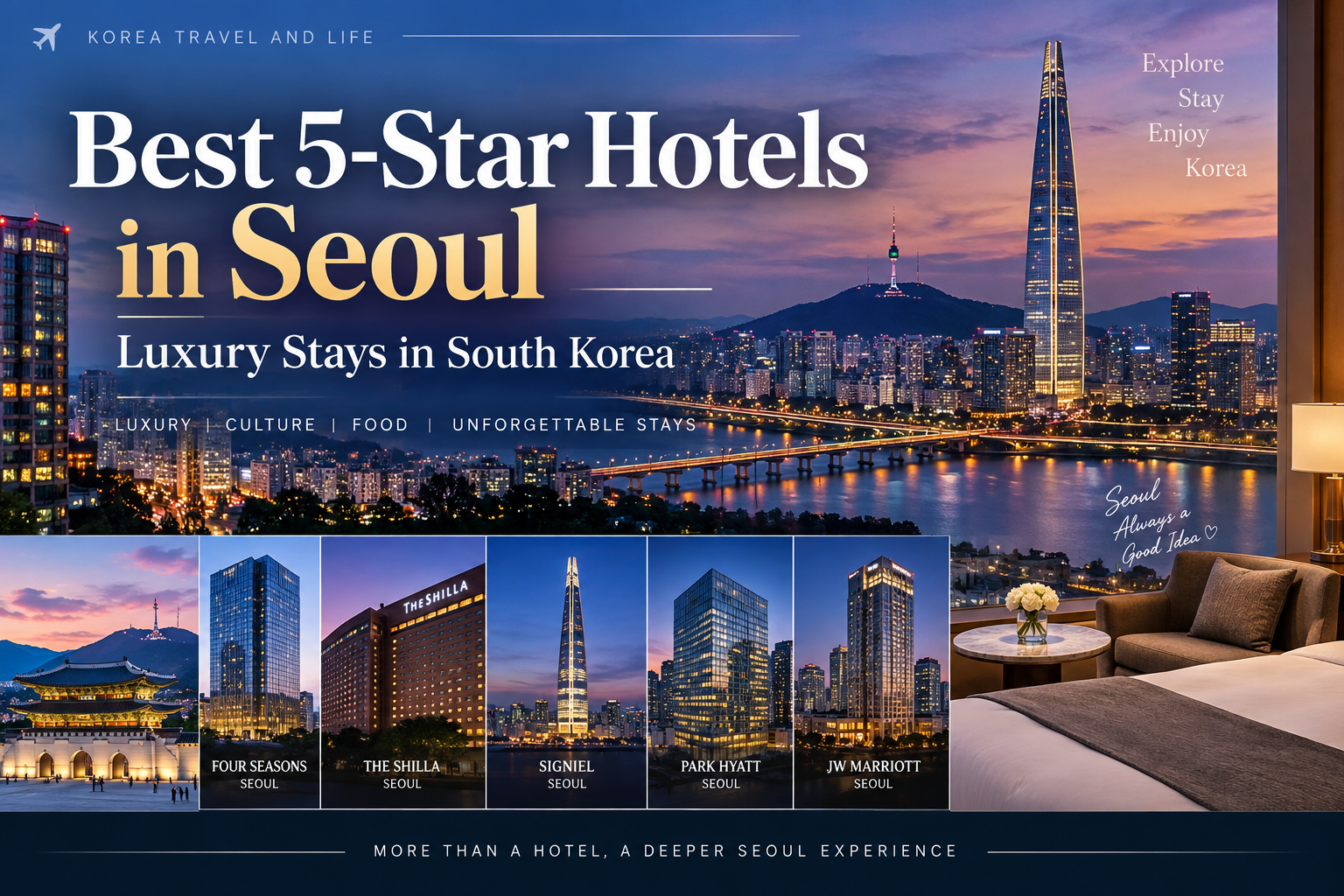
    Seoul’s best 5-star hotels are spread across very different areas, from central Seoul and Myeongdong to Gangnam, Jamsil and the Han River. The best choice depends on whether you prioritize sightseeing, shopping, business access, river views, or a quieter luxury stay.

    But choosing the right luxury hotel in Seoul is not simply about finding the most expensive room. Location can completely change your travel experience. Staying near Gwanghwamun makes it easy to explore historic Seoul, while a hotel in Gangnam places you closer to shopping, business districts and modern city life. Jamsil, meanwhile, offers spectacular skyline views and easy access to attractions around Lotte World.

    Here are some of the best five-star hotels in Seoul, along with their locations, contact information and the type of traveler each hotel may suit best.

    Best 5-Star Hotels in Seoul: Quick Picks

    Hotel Best for Area
    Four Seasons Hotel Seoul Historic Seoul & sightseeing Gwanghwamun
    The Shilla Seoul Classic Korean luxury Jung-gu / Namsan
    SIGNIEL SEOUL Skyline views & special occasions Jamsil
    Park Hyatt Seoul Business & Gangnam Gangnam
    JW Marriott Hotel Seoul Shopping & transportation Seocho
    Josun Palace Contemporary luxury Gangnam
    Grand Hyatt Seoul Namsan & city views Yongsan / Namsan
    The Westin Josun Seoul Myeongdong & central Seoul Myeongdong

    1. Four Seasons Hotel Seoul – Best for Historic Seoul

    Located near Gwanghwamun in central Seoul, Four Seasons Hotel Seoul is one of the most convenient luxury hotels for travelers who want to combine five-star comfort with sightseeing.

    The hotel is close to Gyeongbokgung Palace, Gwanghwamun Square and the historic neighborhoods of Jongno. Bukchon Hanok Village and Insadong are also within easy reach.

    The hotel offers spacious rooms, an urban spa, indoor pools, fitness facilities and several restaurants and bars. Its central location makes it especially attractive for first-time visitors who want to explore Seoul’s historic center without spending too much time traveling across the city.

    Address: 97 Saemunan-ro, Jongno-gu, Seoul 03183, South Korea
    Telephone: +82-2-6388-5000

    Best for: First-time visitors, couples and travelers interested in Korean history and culture.

    Nearby attractions: Gyeongbokgung Palace, Gwanghwamun Square, Bukchon Hanok Village, Insadong and Cheonggyecheon Stream.

    2. The Shilla Seoul – Best for Classic Korean Luxury

    THE SHILLA Seoul is one of Seoul’s best-known luxury hotels and has long been associated with refined Korean hospitality.

    Located near Namsan, the hotel provides a quieter atmosphere than many properties located directly in Seoul’s busiest commercial districts. It can be a particularly appealing choice for travelers who want luxury while remaining within easy reach of central Seoul.

    The Shilla combines modern hotel facilities with elements of Korean tradition, making it an interesting option for international travelers looking for a distinctly Korean luxury experience.

    Address: 249 Dongho-ro, Jung-gu, Seoul 04605, South Korea
    Telephone: +82-2-2233-3131

    Best for: Couples, luxury travelers and visitors looking for elegant Korean hospitality.

    Nearby attractions: Namsan, Dongdaemun, Jangchung-dong and central Seoul.

    3. SIGNIEL SEOUL – Best for Spectacular Skyline Views

    SIGNIEL SEOUL is located inside the iconic Lotte World Tower in Jamsil.

    For many travelers, the biggest attraction here is the view. Staying high above Seoul provides a very different experience from hotels in the historic center of the city.

    Jamsil is also a convenient location for travelers interested in Lotte World, shopping, entertainment and walks around Seokchon Lake.

    Address: 300 Olympic-ro, Songpa-gu, Seoul 05551, South Korea
    Telephone: +82-2-3213-1000

    Best for: Couples, special occasions, luxury travelers and visitors who love panoramic city views.

    Nearby attractions: Lotte World Tower, Lotte World, Seokchon Lake and Jamsil.

    4. Park Hyatt Seoul – Best for Gangnam

    Park Hyatt Seoul is located on Teheran-ro in Gangnam, directly in one of Seoul’s major business and commercial districts.

    Its location makes it particularly convenient for business travelers as well as visitors who prefer the modern side of Seoul. COEX, shopping facilities and numerous restaurants and cafés are nearby.

    The hotel is known for contemporary design and rooms with large windows overlooking the city.

    Address: 606 Teheran-ro, Gangnam-gu, Seoul 06174, South Korea
    Telephone: +82-2-2016-1234

    Best for: Business travelers, couples and visitors who want to stay in Gangnam.

    Nearby attractions: COEX, Starfield Library, Bongeunsa Temple and Gangnam.

    5. JW Marriott Hotel Seoul – Best for Shopping and Transportation

    JW Marriott Hotel Seoul is located in Seocho-gu near Express Bus Terminal, making it particularly convenient for travelers who want both luxury accommodation and excellent transportation connections.

    The surrounding area is also a major shopping destination, with large retail complexes nearby. Its location south of the Han River provides relatively easy access to Gangnam and other parts of southern Seoul.

    Address: 176 Sinbanpo-ro, Seocho-gu, Seoul, South Korea
    Telephone: +82-2-6282-6262

    Best for: Shoppers, business travelers and visitors planning trips outside Seoul.

    Nearby attractions: Central City, Express Bus Terminal, Banpo Hangang Park and Gangnam.

    6. Josun Palace, a Luxury Collection Hotel, Seoul Gangnam – Best for Contemporary Luxury

    Josun Palace, a Luxury Collection Hotel, Seoul Gangnam brings a glamorous contemporary luxury experience to Gangnam.

    Located on Teheran-ro, the hotel works well for travelers who want to experience Seoul’s modern business, dining and shopping districts while staying in an upscale environment.

    Its Gangnam location also makes it a useful base for exploring southern Seoul.

    Address: 231 Teheran-ro, Gangnam-gu, Seoul, South Korea
    Telephone: +82-2-727-7200

    Best for: Luxury travelers, couples and visitors who prefer contemporary design.

    Nearby attractions: Gangnam, Seolleung, COEX and the Teheran-ro business district.

    7. Grand Hyatt Seoul – Best for Namsan and City Views

    Grand Hyatt Seoul occupies a distinctive location on Namsan, between central Seoul and Itaewon.

    Its elevated setting provides a sense of separation from the dense streets below while still keeping guests relatively close to major neighborhoods.

    The location can work particularly well for travelers who want to explore Itaewon, Namsan and central Seoul during the same trip.

    Address: 322 Sowol-ro, Yongsan-gu, Seoul, South Korea
    Telephone: +82-2-797-1234

    Best for: Couples, families and travelers looking for a resort-like atmosphere within Seoul.

    Nearby attractions: Namsan, N Seoul Tower, Itaewon and Hannam-dong.

    8. The Westin Josun Seoul – Best for Myeongdong and Central Seoul

    The Westin Josun Seoul has one of the most convenient locations for travelers who want to stay in the heart of Seoul.

    The hotel is near Myeongdong, Seoul City Hall and major shopping areas, while historic attractions in Jongno are also relatively easy to reach.

    For first-time visitors who want shopping, sightseeing and public transportation close together, this part of Seoul can be particularly practical.

    Address: 106 Sogong-ro, Jung-gu, Seoul, South Korea
    Telephone: +82-2-771-0500

    Best for: First-time visitors, shoppers and travelers who value a central location.

    Nearby attractions: Myeongdong, Deoksugung Palace, Seoul City Hall and Namdaemun Market.

    Which Area of Seoul Should You Choose?

    Choosing the hotel is important, but choosing the right neighborhood may be even more important.

    Travelers interested in palaces, traditional neighborhoods and Korean history should consider Jongno or Gwanghwamun. Four Seasons Hotel Seoul is particularly well positioned for this type of trip.

    For shopping and a highly central location, Myeongdong and Jung-gu are practical choices.

    Travelers interested in modern Seoul, business districts, luxury shopping and contemporary nightlife may prefer Gangnam. Park Hyatt Seoul and Josun Palace are strong options in this area.

    For skyline views and attractions such as Lotte World, consider Jamsil, where SIGNIEL SEOUL is located.

    Visitors looking for Namsan views and convenient access to Itaewon may prefer the area around Namsan and Yongsan.

    Best 5-Star Hotel in Seoul for First-Time Visitors

    For a first visit to Korea, staying in central Seoul is usually the easiest option.

    Gwanghwamun, Jongno and Myeongdong provide convenient access to many of Seoul’s most recognizable attractions, including royal palaces, traditional neighborhoods, markets and shopping streets.

    Travelers who already know Seoul—or who are particularly interested in modern Korean city life—may enjoy staying in Gangnam or Jamsil instead.

    A Luxury Hotel Can Change Your Seoul Experience

    Seoul is enormous, and travelers can easily spend significant time moving between neighborhoods.

    Choosing a hotel close to the attractions you care about can therefore make your trip more relaxing.

    A traveler interested in Korean history may appreciate waking up near Gyeongbokgung Palace. Someone interested in modern Seoul may prefer the skyscrapers and shopping districts of Gangnam. Another traveler may simply want to watch Seoul’s lights from a room high above Jamsil.

    There is no single five-star hotel that is best for everyone. The best choice depends on the kind of Seoul experience you want.

    Before You Book

    Hotel rates in Seoul can change considerably depending on season, room type, weekends, holidays and special events.

    Before booking, check the hotel’s official website for current room availability, policies and rates. Travelers should also confirm check-in requirements and transportation options before arrival.

    Addresses and telephone numbers can occasionally change, so it is a good idea to reconfirm contact information with the hotel before your trip.

    Final Thoughts

    Seoul’s five-star hotels offer much more than luxurious rooms. Their locations can become part of the travel experience itself.

    Stay near Gwanghwamun and historic Seoul is outside your door. Choose Gangnam for a more modern side of the capital. Head to Jamsil for dramatic skyline views, or stay near Namsan for a quieter perspective on the city.

    Whichever area you choose, selecting the right hotel can make exploring Seoul easier, more comfortable and far more memorable.


  • Honam Travel Guide: Best Places to Visit in Southwestern Korea

    Honam Travel Guide: Best Places to Visit in Southwestern Korea

    Discover the Honam Region of Korea

    Honam is the traditional name for the southwestern region of Korea centered on Jeolla, today broadly associated with Jeonbuk State, Jeollanam-do (South Jeolla), and Gwangju. It is a regional and historical term rather than a single modern administrative area.

    For travelers, Honam offers a different side of Korea from Seoul and the better-known southeastern routes. The region is especially famous for its food, but it also includes historic cities, traditional hanok neighborhoods, coastlines, wetlands, islands, mountains, bamboo forests, and distinctive local markets.

    From eating bibimbap in Jeonju to watching the sea in Yeosu, walking through the wetlands of Suncheon, and exploring the historic port city of Mokpo, Honam rewards travelers who venture beyond Korea’s most familiar routes.

    Is Honam the Same as Jeolla?

    Honam and Jeolla refer to closely related parts of southwestern Korea, but the terms are not used in exactly the same way. Jeolla is the historical provincial name that survives today in Jeonbuk State and Jeollanam-do (South Jeolla), while Honam is a broader traditional regional term.

    In modern usage, Honam commonly refers to Jeonbuk, Jeollanam-do, and the metropolitan city of Gwangju. Travelers are therefore more likely to see Jeolla in province names and on maps, while Honam often appears when southwestern Korea is discussed as a broader historical, cultural, or regional area

    1. Jeonju – Hanok, History and Korean Food

    Jeonju is one of the best places to begin a journey through the Honam region.

    The city is famous for Jeonju Hanok Village, an area filled with hundreds of traditional Korean hanok buildings.

    Visitors can walk through narrow streets, see traditional architecture, visit cultural attractions, try Korean snacks, and experience a different atmosphere from modern Korean cities.

    Jeonju is also one of Korea’s most famous food destinations.

    The city is strongly associated with Jeonju bibimbap, but travelers will find many other dishes, traditional sweets, market foods, and local specialties.

    For international visitors interested in both Korean culture and food, Jeonju is an excellent introduction to southwestern Korea.

    2. Gwangju – Culture, Markets and Local Life

    Gwangju is the largest city in the Honam region and an important center of culture and history.

    The city offers museums, cultural spaces, traditional markets, shopping areas, restaurants, and easy access to surrounding destinations.

    Gwangju is also an excellent place to experience Jeolla-do’s reputation for generous and flavorful food.

    Rather than treating the city only as a transportation hub, spend time exploring its neighborhoods and markets.

    Gwangju can provide a more everyday view of urban life in Korea away from the country’s most heavily visited cities.

    3. Yeosu – Ocean Views and Night Scenery

    Yeosu is one of the most attractive coastal cities in southern Korea.

    Surrounded by sea and islands, the city is known for waterfront scenery, seafood, bridges, and beautiful night views.

    Travelers can spend time walking beside the coast, visiting viewpoints, exploring local markets, and enjoying fresh seafood.

    Yeosu becomes especially atmospheric in the evening when lights reflect across the water.

    For travelers who enjoy coastal cities, Yeosu offers a very different experience from Seoul or inland destinations.

    4. Suncheon – Wetlands and Gardens

    Suncheon is one of the best destinations in Korea for travelers interested in nature.

    The area is famous for Suncheon Bay Wetland, an important coastal wetland with reed fields, walking paths, and expansive natural scenery.

    Suncheon also offers gardens and other outdoor attractions that make it a good destination for slower travel.

    The landscape changes with the seasons, creating different experiences throughout the year.

    Suncheon and Yeosu are often easy to combine in the same regional itinerary because they are relatively close to each other.

    5. Mokpo – A Historic Port City

    Located in southwestern Korea, Mokpo has long been connected to the sea.

    The city offers harbor views, local seafood, markets, historic neighborhoods, and access to islands off Korea’s southwest coast.

    Mokpo’s atmosphere feels different from Korea’s largest cities.

    Travelers can explore the waterfront, visit local markets, discover regional dishes, and use the city as a gateway to nearby islands and coastal areas.

    It is a particularly interesting destination for travelers who enjoy port cities and regional food culture.

    6. Damyang – Walk Through a Bamboo Forest

    Damyang is famous for bamboo and is one of the most distinctive nature destinations in the Honam region.

    One of its best-known attractions is Juknokwon Bamboo Garden, where walking paths wind through tall bamboo.

    The cool shade and sound of bamboo moving in the wind create a peaceful atmosphere.

    Damyang is also known for local food and traditional landscapes, making it a good day trip or overnight destination from Gwangju.

    For travelers who want a break from busy cities, Damyang offers a quieter side of Korea.

    7. Boseong – Korea’s Green Tea Country

    Boseong is strongly associated with green tea.

    Its rolling tea fields create one of the most recognizable landscapes in southwestern Korea.

    The scenery is particularly beautiful when the tea plants are green and the hills are covered with carefully arranged rows of leaves.

    Visitors can walk through tea plantation areas and try green tea drinks, desserts, and other local products.

    Boseong is an excellent destination for photography, nature, and travelers interested in Korean tea culture.

    8. Explore the Islands of Southwestern Korea

    The southwest coast of Korea is surrounded by numerous islands.

    Some are connected by bridges, while others require ferry travel.

    Island trips can offer quiet fishing villages, beaches, walking trails, seafood, and landscapes far removed from Korea’s major cities.

    However, island transportation requires more planning.

    Ferry schedules can vary according to destination, season, and weather, so travelers should always check current transportation information before departure.

    For visitors with enough time, exploring an island can become one of the most memorable experiences in Honam.

    9. Experience Jeolla-do’s Famous Food Culture

    Food is one of the strongest reasons to visit Honam.

    Jeolla-do has long been celebrated in Korea for its rich culinary traditions and generous meals.

    A Korean meal in the region may arrive with numerous banchan, or side dishes, surrounding the main dish.

    Jeonju is famous for bibimbap, coastal cities such as Yeosu and Mokpo offer seafood, and smaller towns have their own local specialties.

    The best food experiences are not limited to expensive or famous restaurants.

    Traditional markets, neighborhood restaurants, and family-run establishments can be equally memorable.

    For food-focused travelers, Honam deserves several days of exploration.

    10. Visit Traditional Markets

    Traditional markets provide an excellent introduction to regional food and everyday life.

    Instead of seeing only polished tourist districts, visitors can explore stalls selling vegetables, seafood, meat, snacks, prepared dishes, and local specialties.

    Markets in Jeonju, Gwangju, Yeosu, Mokpo, and other cities offer different experiences depending on the region.

    They are also useful places to discover foods you may never encounter in restaurants aimed primarily at international visitors.

    Bring curiosity and an appetite.

    11. Discover Korea at a Slower Pace

    One of the pleasures of traveling through Honam is that many destinations encourage slower travel.

    Instead of rushing between major landmarks, you can spend an afternoon walking through a bamboo forest, sit beside the sea, explore a traditional market, or enjoy a long Korean meal with many side dishes.

    This slower rhythm can be especially refreshing after several busy days in Seoul.

    Honam gives travelers room to experience regional Korea rather than simply checking attractions off a list.

    How Many Days Do You Need in Honam?

    Honam covers a large area, so it is better to choose several destinations rather than attempting to see everything at once.

    For a short trip, three or four days can provide a good introduction.

    For example:

    Day 1: Seoul → Jeonju → Jeonju Hanok Village → local food

    Day 2: Jeonju → Gwangju → traditional market → local restaurants

    Day 3: Gwangju → Suncheon → Suncheon Bay → Yeosu

    Day 4: Yeosu → coastal sightseeing → seafood → return or continue traveling

    With five to seven days, travelers can add Damyang, Boseong, Mokpo, or an island destination.

    Food lovers may want even more time.

    How to Get to Honam from Seoul

    The best transportation option depends on which part of Honam you plan to visit.

    Seoul to Jeonju

    Jeonju is accessible from the Seoul area by train and express or intercity bus.

    Rail travel is a convenient option for many visitors, while buses can also be useful depending on your departure point and accommodation.

    Once you arrive in Jeonju, local buses and taxis can be used to reach the main sightseeing areas.

    Seoul to Gwangju

    High-speed rail makes Gwangju relatively easy to reach from the Seoul area.

    Travelers can use KTX services to Gwangju-Songjeong Station and continue by subway, bus, or taxi.

    Gwangju can also work as a transportation base for exploring nearby destinations such as Damyang.

    Seoul to Yeosu

    Yeosu can be reached from the Seoul area by rail, including KTX services.

    Because the journey is longer than a trip to Jeonju, staying overnight is generally more practical than treating Yeosu as a day trip from Seoul.

    Seoul to Mokpo

    Mokpo is connected to the Seoul area by high-speed rail.

    From Mokpo, travelers can explore the city or continue toward islands and other parts of the southwest coast.

    Always check current train and bus schedules before traveling because departure times and services can change.

    Getting Around the Honam Region

    Major cities are connected by trains and intercity buses, but transportation becomes less frequent in rural and coastal areas.

    Within cities such as Gwangju, Jeonju, Yeosu, and Mokpo, local buses and taxis can cover many tourist destinations.

    For places such as Boseong, smaller towns, remote coastal areas, and multi-stop regional trips, renting a car can provide more flexibility.

    If you plan to visit islands, check ferry schedules carefully and allow extra time for weather-related changes.

    When Is the Best Time to Visit Honam?

    Honam can be visited throughout the year.

    Spring is pleasant for outdoor sightseeing and seasonal flowers.

    Summer brings green landscapes and coastal travel, although the weather can be hot, humid, and rainy.

    Autumn offers comfortable temperatures and is an excellent season for markets, cities, gardens, and countryside trips.

    Winter is quieter and can be a good time for food-focused travel, although some outdoor destinations may feel less active.

    For a balanced combination of food, cities, and nature, spring and autumn are particularly attractive.

    Honam for First-Time Visitors

    If this is your first trip to southwestern Korea, Jeonju is one of the easiest places to start.

    It combines traditional architecture, Korean food, cultural experiences, and relatively convenient transportation from the Seoul area.

    Travelers with more time can continue to Gwangju and then choose between several directions.

    Go south toward Suncheon and Yeosu for wetlands and coastal scenery.

    Travel toward Damyang for bamboo forests.

    Continue southwest toward Mokpo for port-city culture and island connections.

    The best itinerary depends on whether you are most interested in food, nature, history, or the coast.

    Where Korean Food Becomes Part of the Journey

    Travelers often arrive in Honam because they have heard about Jeolla-do’s food.

    But food here is more than a list of famous dishes.

    Traditional markets, regional ingredients, seafood, banchan, family-run restaurants, and local specialties all reveal something about the communities that created them.

    A meal can become part of the sightseeing itself.

    That is why Honam will also be an important region for travelers who want to explore Korea through its restaurants and local food.

    Why Honam Belongs on Your Korea Itinerary

    Honam offers something that can be difficult to experience on a short trip limited to Korea’s largest cities.

    It combines traditional culture, regional cuisine, wetlands, bamboo forests, tea fields, port cities, islands, and coastal landscapes.

    You can begin with a bowl of bibimbap in Jeonju, walk beneath bamboo in Damyang, explore wetlands in Suncheon, eat seafood beside the sea in Yeosu or Mokpo, and discover places that many first-time international visitors never reach.

    For travelers willing to go beyond the familiar route, southwestern Korea offers a deeper and more flavorful journey.

    Come for the food, but leave time for everything else.


  • Yeongnam Travel Guide: Best Places to Visit in Southeastern Korea

    Yeongnam Travel Guide: Best Places to Visit in Southeastern Korea

    Discover the Yeongnam Region of Korea

    Yeongnam is the historical region of southeastern South Korea that includes Busan, Daegu, Ulsan, Gyeongsangbuk-do (North Gyeongsang), and Gyeongsangnam-do (South Gyeongsang). The name traditionally refers to the area south of the major mountain passes that separated this part of Korea from the central regions.

    For travelers, Yeongnam is useful as a way to understand southeastern Korea rather than as a single modern administrative region. It brings together some of the country’s most important historic cities, coastal destinations, traditional villages, mountains, temples, and regional food cultures.

    Many first-time visitors focus on Seoul, but traveling through Yeongnam reveals a very different side of Korea—from Busan’s coastline and Gyeongju’s historic sites to Daegu, Ulsan, and the smaller cities and countryside of the two Gyeongsang provinces.

    For travelers, Yeongnam offers remarkable variety. You can explore ancient royal tombs in Gyeongju, walk through a traditional village in Andong, enjoy seafood beside the ocean in Busan, discover colorful coastal towns, and travel through some of Korea’s most beautiful countryside.

    If you want to explore beyond Seoul, Yeongnam deserves a place on your Korea itinerary.

    Is Yeongnam the Same as Gyeongsang?

    Yeongnam and Gyeongsang refer to almost the same part of southeastern Korea, but the terms are used differently. Gyeongsang is the historical provincial name that survives today in Gyeongsangbuk-do (North Gyeongsang) and Gyeongsangnam-do (South Gyeongsang), while Yeongnam is a broader regional term.

    In modern usage, Yeongnam generally includes the two Gyeongsang provinces as well as the major metropolitan cities of Busan, Daegu, and Ulsan. Travelers are therefore more likely to see Gyeongsang on maps and administrative information, while Yeongnam may appear when Korea is discussed in broader regional, historical, or cultural terms.

    1. Busan – Korea’s Dynamic Coastal City

    Busan is South Korea’s second-largest city and one of the best places to begin exploring the Yeongnam region.

    The city combines beaches, mountains, seafood markets, temples, modern neighborhoods, and dramatic coastal scenery.

    Haeundae Beach is one of Korea’s best-known beaches, while Gwangalli Beach offers impressive views of Gwangan Bridge, especially after sunset.

    Travelers can also explore Jagalchi Market, walk through the colorful streets of Gamcheon Culture Village, or visit Haedong Yonggungsa, a Buddhist temple overlooking the sea.

    Busan is large enough to deserve several days on its own, but it also works as an excellent transportation base for exploring southeastern Korea.

    2. Gyeongju – Travel Back to Ancient Korea

    Gyeongju is one of Korea’s most important historical destinations.

    Once the capital of the ancient Silla Kingdom, the city is filled with royal tombs, archaeological sites, temples, and traditional architecture.

    Daereungwon Tomb Complex, Cheomseongdae, Donggung Palace and Wolji Pond, Bulguksa Temple, and Seokguram Grotto are among its best-known attractions.

    Hwangridan-gil adds a modern element with cafés, restaurants, shops, and renovated traditional buildings.

    Gyeongju is particularly rewarding for travelers who want to understand Korea’s history rather than only see its modern cities.

    3. Daegu – Markets, Food and Urban Culture

    Daegu is one of Korea’s largest cities but receives fewer international tourists than Seoul or Busan.

    That can be part of its appeal.

    The city offers traditional markets, shopping streets, local food, cafés, and easy access to nearby mountains.

    Seomun Market is one of Daegu’s best-known traditional markets and a good place to experience the city’s everyday food culture.

    Travelers interested in city views and outdoor activities can also explore areas around Apsan.

    Daegu provides a useful contrast to Korea’s more heavily visited tourist destinations.

    4. Andong – Traditional Korean Culture

    Andong is one of the best destinations in the region for travelers interested in traditional Korean culture.

    Its most famous attraction is Hahoe Folk Village, where traditional houses and village landscapes preserve an important part of Korea’s cultural heritage.

    The village is associated with Confucian traditions and offers visitors a glimpse of how communities were organized in earlier periods of Korean history.

    Andong is also known for regional foods, including Andong jjimdak, a savory braised chicken dish.

    For travelers interested in history, architecture, and traditional lifestyles, Andong can be one of the most memorable stops in Yeongnam.

    5. Tongyeong – Islands and Coastal Views

    Tongyeong is a beautiful southern coastal city surrounded by islands.

    The city is known for harbor scenery, seafood, hillside neighborhoods, and views across the sea.

    One of the pleasures of visiting Tongyeong is simply exploring the waterfront and experiencing the slower atmosphere of a smaller Korean coastal city.

    The surrounding islands also make the area attractive for travelers who enjoy ferries, walking, and ocean scenery.

    Tongyeong is particularly appealing when combined with other destinations along Korea’s southern coast.

    6. Geoje – Beaches, Islands and Scenic Drives

    Geoje is one of Korea’s largest islands and is connected to the mainland by bridges.

    The island is known for coastal roads, beaches, cliffs, forests, and views of smaller islands scattered across the sea.

    Travelers often combine Geoje with nearby Tongyeong.

    A car can be particularly useful here because attractions are spread around the island.

    Geoje is a good choice for travelers who want to leave the large cities behind and spend more time near nature and the coast.

    7. Ulsan – Industry Meets Nature

    Ulsan is widely known as one of Korea’s major industrial cities, but travelers may be surprised by the amount of nature surrounding it.

    The city and nearby areas offer coastal landscapes, parks, walking trails, and access to mountainous scenery.

    Ulsan can also serve as a useful stop between Busan and Gyeongju.

    It is not usually the first destination international visitors think of when planning a Korea trip, which makes it an interesting option for travelers looking for places beyond the most familiar tourist routes.

    8. Pohang – The East Coast and Local Seafood

    Pohang lies on Korea’s eastern coast and is closely associated with the sea.

    The city is known for seafood, coastal scenery, and sunrise views.

    Travelers interested in local food can explore markets and seafood restaurants, while coastal areas provide a different experience from inland destinations such as Daegu and Andong.

    Pohang can also be combined with Gyeongju because the two cities are relatively close.

    9. Jinju – History Along the Namgang River

    Jinju is known for its riverside scenery and historic fortress.

    Jinjuseong Fortress stands beside the Namgang River and is closely connected with important events in Korean history.

    The riverside setting makes the area pleasant for walking, especially when combined with the city’s historic attractions.

    Jinju offers another opportunity to explore a Korean regional city that many international visitors overlook.

    10. Explore Yeongnam Through Its Food

    One of the best reasons to travel through Yeongnam is food.

    Different cities have developed their own specialties, giving travelers an opportunity to experience Korean cuisine beyond the dishes most commonly found in Seoul.

    Busan is famous for seafood and dishes such as dwaeji gukbap, a pork-and-rice soup.

    Andong is known for Andong jjimdak.

    Coastal cities such as Tongyeong and Pohang offer fresh seafood, while traditional markets throughout the region provide snacks, noodles, local dishes, and seasonal ingredients.

    Instead of searching only for famous restaurants, make time for traditional markets and neighborhood restaurants as well.

    They can provide some of the most memorable meals of a trip.

    11. Traditional Markets Are Worth Exploring

    Traditional markets are an important part of regional travel in Korea.

    They offer much more than food.

    Visitors can see local ingredients, household goods, prepared dishes, snacks, and everyday interactions that are difficult to experience in major tourist attractions.

    Markets in Busan, Daegu, Andong, Pohang, and other Yeongnam cities each have their own atmosphere.

    For travelers interested in Korean food culture, a market visit should be part of the itinerary.

    How Many Days Do You Need in Yeongnam?

    Yeongnam is far too large to explore properly in one short trip.

    If you have only three or four days, it is better to focus on two destinations rather than trying to see the entire region.

    For example:

    Day 1: Seoul → Gyeongju → Daereungwon → Cheomseongdae → Hwangridan-gil

    Day 2: Bulguksa Temple → Busan → Gwangalli Beach

    Day 3: Busan → Jagalchi Market → Gamcheon Culture Village → Haeundae

    Day 4: Additional Busan sightseeing or a day trip nearby

    With five to seven days, you can add destinations such as Daegu, Andong, Tongyeong, Geoje, or Pohang.

    Travelers who enjoy slower travel could easily spend more than a week exploring southeastern Korea.

    How to Get to Yeongnam from Seoul

    Because Yeongnam covers a large part of southeastern Korea, the best transportation method depends on your destination.

    Seoul to Busan

    High-speed rail is one of the easiest ways to travel between Seoul and Busan.

    KTX trains connect the two cities, making Busan one of the most convenient long-distance destinations to reach from the capital.

    Express buses are another option, although the journey generally takes longer.

    Seoul to Daegu

    Daegu is also easily accessible by high-speed rail.

    Travelers can use KTX services to reach the Daegu area and continue by local transportation.

    This makes Daegu practical both as a destination and as part of a longer regional itinerary.

    Seoul to Gyeongju

    Travelers heading to Gyeongju can use high-speed rail to reach Gyeongju Station and then continue into the main sightseeing areas by local bus or taxi.

    Because Gyeongju and Busan are relatively close, the two destinations work particularly well together.

    Seoul to Andong

    Rail and intercity bus services provide options for reaching Andong from the Seoul area.

    The best choice depends on your departure point, schedule, and accommodation location.

    Always check current schedules before traveling.

    Getting Around the Yeongnam Region

    Public transportation works well between many major cities.

    KTX and other rail services are useful for destinations such as Busan, Daegu, and Gyeongju, while intercity buses connect many regional cities and towns.

    Within cities, local buses, subways where available, and taxis can usually handle most sightseeing.

    However, a rental car becomes more useful if you want to explore Geoje, smaller coastal towns, rural areas, mountains, or several destinations in one trip.

    Do not assume transportation will be as frequent as it is in central Seoul. Check routes and return times in advance when visiting smaller destinations.

    When Is the Best Time to Visit Yeongnam?

    Yeongnam can be visited throughout the year, but each season creates a different experience.

    Spring is excellent for walking, sightseeing, and seasonal flowers.

    Summer is popular for Busan and the southern coast, although the weather can be hot and humid.

    Autumn offers comfortable temperatures and beautiful foliage, making it one of the best seasons for regional travel.

    Winter is colder but generally quieter at many outdoor attractions.

    If your trip focuses on beaches and islands, summer may be appealing. For city exploration, historic sites, and walking, spring and autumn are particularly comfortable.

    Yeongnam for First-Time Visitors

    For a first trip to Yeongnam, combining Gyeongju and Busan is one of the easiest introductions to the region.

    The two destinations offer completely different experiences while being relatively close to each other.

    Gyeongju provides ancient history, temples, royal tombs, and traditional scenery.

    Busan provides beaches, seafood, modern city life, markets, and coastal views.

    Travelers with additional time can then choose a third destination based on their interests: Andong for traditional culture, Daegu for urban life and markets, or Tongyeong and Geoje for coastal scenery.

    From Ancient Kingdoms to Coastal Cities

    The appeal of Yeongnam lies in its variety.

    Few regions allow travelers to move so easily between ancient royal capitals, traditional villages, major modern cities, mountain landscapes, fishing communities, and island scenery.

    The region also tells an important part of Korea’s story.

    Gyeongju reveals the legacy of the Silla Kingdom, Andong preserves aspects of Confucian culture, and cities such as Busan, Daegu, and Ulsan show different sides of modern Korea.

    Why Yeongnam Belongs on Your Korea Itinerary

    Traveling beyond Seoul allows visitors to understand how diverse South Korea really is.

    In Yeongnam, you can begin the morning beside an ancient royal tomb, eat a regional specialty at a traditional market, and finish the day watching the sea from a coastal city.

    Whether you are interested in Korean history, local food, beaches, traditional culture, hiking, or simply discovering places that receive fewer international visitors, southeastern Korea has something to offer.

    Start with Gyeongju and Busan, then travel deeper.

    Yeongnam may become one of the most memorable parts of your journey through Korea.


  • Gangwon-do Travel Guide: Mountains, Beaches and the Best Places to Visit

    Gangwon-do Travel Guide: Mountains, Beaches and the Best Places to Visit

    Why Visit Gangwon-do?

    Gangwon-do is one of the best destinations in South Korea for travelers who love mountains, beaches, outdoor activities, and beautiful scenery.

    Located east of Seoul, the region stretches from the rugged mountains of the Korean Peninsula to the East Sea. This unique geography makes Gangwon-do a destination that can feel completely different depending on where you travel.

    You can hike through dramatic mountain landscapes in Seoraksan National Park, relax on the beaches of Gangneung and Sokcho, explore traditional markets, enjoy local food, and visit peaceful mountain temples.

    For travelers who want to experience Korea beyond Seoul, Gangwon-do is an excellent place to start.

    1. Explore Seoraksan National Park

    Seoraksan National Park is one of Korea’s most famous mountain destinations.

    Located near Sokcho, the park is known for dramatic granite peaks, forest trails, waterfalls, temples, and spectacular seasonal scenery.

    Autumn is particularly famous, when the mountains turn shades of red, orange, and gold. However, Seoraksan is worth visiting throughout much of the year.

    Visitors can choose from relatively easy walks as well as more challenging hiking routes.

    Even if you are not an experienced hiker, the scenery around the main entrance area makes Seoraksan one of the highlights of a trip to Gangwon-do.

    2. Visit Sokcho

    Sokcho is a coastal city and one of the most convenient bases for visiting Seoraksan.

    The city combines mountains, beaches, markets, and seafood, making it a great destination for travelers who want both nature and local culture.

    One of the most popular places to visit is Sokcho Tourist & Fishery Market, where you can try Korean street food and regional specialties.

    Sokcho Beach is another popular stop, especially during the warmer months.

    Because Seoraksan is nearby, many travelers combine Sokcho and the national park in the same trip.

    3. Discover Gangneung

    Gangneung is one of the most popular coastal destinations on Korea’s east coast.

    The city is known for beaches, coffee culture, historic sites, and relaxed seaside scenery.

    Gyeongpo Beach is one of the best-known beaches in the area, while nearby Anmok Beach has become famous for its seaside cafés and Coffee Street.

    Sitting in a café overlooking the East Sea is one of the simplest and most enjoyable experiences in Gangneung.

    The city is also relatively easy to reach from Seoul by train, making it a popular weekend destination.

    4. Walk Along Anmok Coffee Street

    Coffee has become an important part of Gangneung’s modern travel culture.

    Along Anmok Beach, numerous cafés face the sea, creating an area commonly known as Anmok Coffee Street.

    Visitors can order coffee, find a seat overlooking the water, and spend a relaxing afternoon watching the waves.

    The combination of coffee and ocean views has made this area particularly popular with couples, friends, and independent travelers.

    5. Visit Chuncheon

    Chuncheon is another easy destination to reach from Seoul and is especially famous for food and lakeside scenery.

    The city is surrounded by mountains, rivers, and lakes, giving it a very different atmosphere from central Seoul.

    Chuncheon is particularly associated with dakgalbi, a spicy stir-fried chicken dish that has become famous throughout Korea.

    Visitors can explore the city, walk around its lakeside areas, and enjoy a meal of authentic Chuncheon-style dakgalbi.

    6. Experience Pyeongchang

    Pyeongchang became internationally famous as the host of the 2018 Winter Olympics.

    Surrounded by mountains, the area is one of Korea’s major destinations for winter sports.

    During winter, travelers visit the region for skiing and snowboarding. Outside the winter season, the surrounding countryside offers green landscapes, mountain scenery, and a quieter rural atmosphere.

    Pyeongchang can be a good choice for travelers looking for a different side of Gangwon-do away from the busy coastal cities.

    7. Enjoy Gangwon-do’s Beaches

    Gangwon-do has some of South Korea’s most attractive beaches.

    The coastline along the East Sea is known for clear water, long sandy beaches, and beautiful sunrise views.

    Popular coastal areas include Gangneung, Sokcho, Yangyang, Donghae, and Samcheok.

    Summer attracts the largest number of beach visitors, but the coast is also beautiful during spring and autumn.

    Winter has its own appeal, when the beaches become quieter and travelers can enjoy peaceful ocean views.

    8. Discover Yangyang

    Yangyang has developed a reputation as one of Korea’s popular surfing destinations.

    The area attracts younger travelers with beaches, surf shops, cafés, and a relaxed coastal atmosphere.

    Surfing lessons are available for beginners, while experienced surfers can enjoy several beaches along the coast.

    Yangyang can also be combined with Sokcho because the two areas are relatively close to each other.

    9. Explore Traditional Markets and Local Food

    Food is an important part of traveling through Gangwon-do.

    Each city has its own specialties and traditional markets.

    In Sokcho, travelers can explore the local market and try seafood and popular snacks. Chuncheon is famous for dakgalbi and makguksu, a buckwheat noodle dish.

    Gangneung also offers seafood, local dishes, and cafés that have become part of the city’s travel culture.

    Instead of eating only at familiar chains, visiting a traditional market can be one of the best ways to experience everyday Korean food culture.

    10. Visit Mountain Temples

    Gangwon-do’s mountains are home to several beautiful Buddhist temples.

    These temples often combine Korean religious history with impressive natural surroundings.

    A temple visit can provide a quieter experience compared with busy beaches or city attractions.

    For international visitors, it can also be an opportunity to see traditional Korean architecture and learn more about the role Buddhism has played in Korean history and culture.

    How Many Days Do You Need in Gangwon-do?

    Because Gangwon-do covers a large area, the ideal length of a trip depends on where you want to go.

    For a short trip, two days can work well for one main destination such as Gangneung or Sokcho.

    A three- or four-day trip gives you more time to combine destinations.

    For example:

    Day 1: Seoul → Sokcho → Sokcho Market → Sokcho Beach

    Day 2: Seoraksan National Park → local food → Sokcho

    Day 3: Sokcho → Gangneung → Gyeongpo Beach → Anmok Coffee Street

    Travelers with more time can add Pyeongchang, Yangyang, or other parts of the region.

    How to Get to Gangwon-do from Seoul

    There is no single best way to travel from Seoul to Gangwon-do because Gangwon-do is a large region. The best transportation option depends on your destination.

    Seoul to Gangneung

    Train travel is one of the most convenient choices for Gangneung.

    KTX services connect the Seoul area with Gangneung, making the city an accessible destination for travelers who do not want to rent a car.

    Once you arrive in Gangneung, you can use local buses or taxis to reach beaches and other attractions.

    Seoul to Chuncheon

    Chuncheon is conveniently connected with the Seoul metropolitan area.

    The ITX-Cheongchun train is a popular option for reaching Chuncheon and is useful for travelers planning a day trip or short overnight visit.

    Seoul to Sokcho

    Sokcho does not currently have the same direct KTX access as Gangneung, so intercity or express buses are commonly used by travelers coming from Seoul.

    Buses connect Seoul with Sokcho, and after arriving in the city, local transportation can be used to reach Seoraksan and other attractions.

    Seoul to Pyeongchang

    Rail travel is also useful for reaching parts of Pyeongchang.

    Depending on your exact destination, KTX services and local transportation can be combined to reach the region.

    Always check current train and bus schedules before traveling because routes and departure times can change.

    Should You Rent a Car?

    A rental car is not essential if you are visiting only one major destination such as Gangneung, Chuncheon, or Sokcho.

    However, driving becomes much more useful if you want to explore several beaches, mountain areas, smaller towns, or attractions that are far from train and bus stations.

    For a multi-day road trip through Gangwon-do, renting a car can provide significantly more flexibility.

    Getting Around Gangwon-do

    Transportation within Gangwon-do requires more planning than transportation within Seoul.

    Major cities have local buses and taxis, but attractions can be spread far apart.

    If you are staying mainly in one city, public transportation and taxis may be enough.

    If your itinerary includes several cities, beaches, mountains, and rural destinations, a rental car may save considerable time.

    Before leaving your accommodation each morning, check the route to your next destination rather than assuming transportation will be as frequent as it is in Seoul.

    When Is the Best Time to Visit Gangwon-do?

    Each season offers a different experience.

    Spring brings mild weather and fresh mountain scenery.

    Summer is popular for beaches, surfing, and coastal trips.

    Autumn is one of the most beautiful seasons, particularly in mountain areas such as Seoraksan.

    Winter attracts visitors for snow, skiing, and winter resorts, especially around Pyeongchang and other mountainous areas.

    The best season depends on whether you prefer hiking, beaches, autumn foliage, or winter sports.

    Gangwon-do for First-Time Visitors

    If this is your first trip to Gangwon-do, avoid trying to see the entire region in one or two days.

    Choose one or two main areas and explore them properly.

    For nature and mountains, consider Sokcho and Seoraksan.

    For beaches and cafés, Gangneung is an excellent choice.

    For an easy trip from Seoul with food and lakeside scenery, Chuncheon works well.

    Travelers interested in winter activities can consider Pyeongchang and the surrounding mountain areas.

    Mountains Meet the East Sea

    One of the most memorable things about Gangwon-do is how quickly the landscape changes.

    You can spend the morning walking through mountain forests and later watch the sun set near the coast.

    Small cities, traditional markets, beaches, cafés, temples, and mountain landscapes give travelers many different ways to experience the region.

    Gangwon-do shows that traveling in South Korea is about much more than exploring its largest cities.

    Why Gangwon-do Belongs on Your Korea Itinerary

    Seoul may introduce you to modern Korea, but Gangwon-do introduces you to another side of the country.

    Here, mountains meet the East Sea, coastal cities develop their own food and café cultures, and outdoor experiences become an important part of the journey.

    Whether you want to hike in Seoraksan, drink coffee beside the sea in Gangneung, eat dakgalbi in Chuncheon, surf in Yangyang, or experience winter in Pyeongchang, Gangwon-do offers experiences that are difficult to find anywhere else in Korea.

    For first-time visitors who want to travel beyond Seoul, Gangwon-do deserves a place on the itinerary.