
Tag: Tongyeong

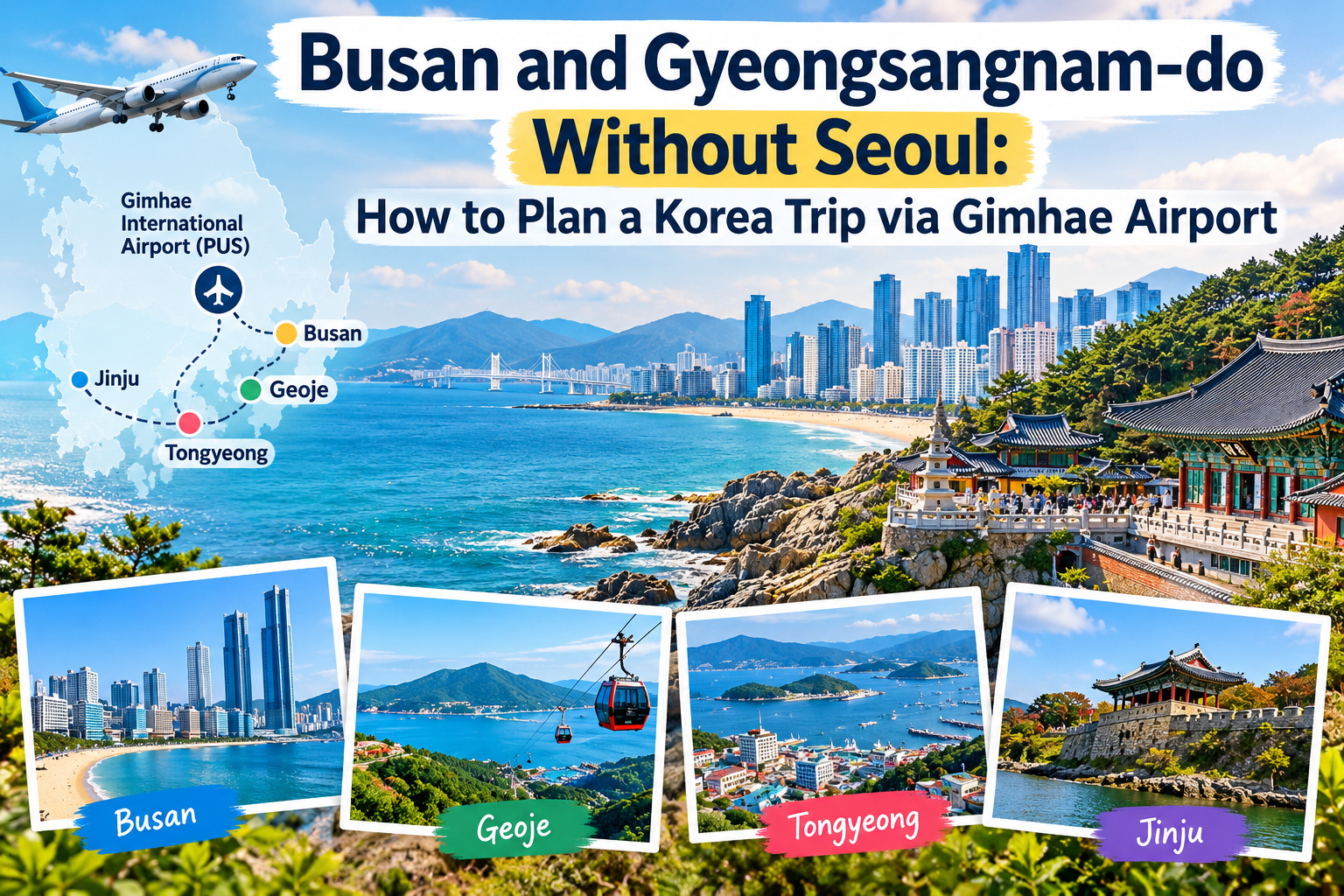
  • Busan and Gyeongsangnam-do Without Seoul: How to Plan a Korea Trip via Gimhae Airport

    Busan and Gyeongsangnam-do Without Seoul: How to Plan a Korea Trip via Gimhae Airport

    Most first-time visitors to South Korea automatically think of flying into Seoul. But if your trip is focused on Busan and southern Korea, starting at Gimhae International Airport can save you a surprising amount of time.

    Gimhae Airport gives international travelers direct access to Busan and Gyeongsangnam-do, making it possible to build an entire Korea itinerary without traveling through Seoul first.

    You could spend a few days exploring Busan, continue to coastal cities such as Geoje and Tongyeong, visit historic Jinju, or travel farther into the southern part of Korea before returning to Gimhae Airport.

    Here is how to plan a Busan and Gyeongsangnam-do trip via Gimhae International Airport in 2026.

    Why Start Your Korea Trip at Gimhae Airport?

    Gimhae International Airport (PUS) is the main international gateway for Busan and southeastern Korea.

    For travelers whose main destinations are Busan and Gyeongsangnam-do, arriving here can be much more convenient than flying into Seoul and then traveling several hours south.

    This route makes particular sense if you want to focus on:

    • Busan
    • Geoje
    • Tongyeong
    • Jinju
    • other destinations in Gyeongsangnam-do

    It can also work well for travelers returning home through Gimhae Airport, allowing you to create a southern Korea itinerary without backtracking to Seoul.

    First Stop: Spend 2–4 Days in Busan

    For most international travelers, Busan is the easiest place to begin.

    After arriving at Gimhae Airport, head into the city and use Busan as your first base.

    Popular areas to stay include:

    Haeundae

    Choose Haeundae if beaches, ocean views, cafes and coastal attractions are your priorities.

    It works especially well for travelers who want to visit Haeundae Beach, Dongbaekseom, Cheongsapo and the eastern coastline.

    Seomyeon

    Seomyeon is a convenient choice if transportation and nightlife matter more than staying next to the beach.

    Its central location makes it relatively easy to travel to different parts of Busan.

    Busan Station

    Staying near Busan Station can be useful if you plan to continue your trip by train.

    It also gives you convenient access to areas such as Nampo, Jagalchi Market and the older downtown districts.

    If you need detailed transportation instructions after landing, see our Gimhae Airport to Busan guide for ways to reach Haeundae, Seomyeon and Busan Station.

    How Many Days Do You Need in Busan?

    For a southern Korea itinerary, I would generally allow at least two full days in Busan, with three or four days being more comfortable.

    A simple first visit could look like this:

    Day 1: Haeundae and the eastern coastline
    Day 2: Nampo, Jagalchi and Gamcheon
    Day 3: Additional coastal attractions, temples, markets or neighborhoods

    Instead of trying to see every famous attraction, group places geographically. Busan is a large city, and crossing from one side to the other can take longer than first-time visitors expect.

    Where Should You Go After Busan?

    This is where starting at Gimhae Airport becomes especially interesting.

    Rather than returning north toward Seoul, you can continue into Gyeongsangnam-do, the province surrounding much of Busan.

    Several destinations work particularly well.

    Option 1: Geoje

    Geoje is a good choice for travelers interested in dramatic coastal scenery and islands.

    The area is known for its coastline, viewpoints and access to nearby islands.

    Compared with Busan, Geoje feels less urban and gives your trip a more relaxed coastal character.

    It can work well as a one- or two-night stop after Busan.

    Who should choose Geoje?

    Geoje is especially suitable if you prefer:

    • coastal scenery
    • island landscapes
    • slower travel
    • scenic drives
    • nature rather than big-city attractions

    Travelers who want a Busan trip with a quieter second half may find Geoje particularly appealing.

    Option 2: Tongyeong

    Tongyeong is another strong addition to a southern Korea itinerary.

    It is a compact coastal city surrounded by islands and is known for harbor views, seafood and scenic landscapes.

    For travelers who enjoy smaller cities, Tongyeong provides a very different atmosphere from Busan.

    A typical itinerary might be:

    Busan → Geoje → Tongyeong

    or simply:

    Busan → Tongyeong

    if you have limited time.

    Tongyeong is worth considering for at least one night rather than treating it only as a rushed day trip.

    Option 3: Jinju

    If you want to add history rather than another coastal destination, consider Jinju.

    The city’s best-known historic landmark is Jinjuseong Fortress, which played an important role during the Japanese invasions of Korea in the late 16th century.

    Jinju provides a useful contrast to Busan, Geoje and Tongyeong because the focus shifts from beaches and coastal scenery toward history and local culture.

    It can therefore fit nicely into a longer southern itinerary.

    Busan + Gyeongsangnam-do: Sample 5-Day Itinerary

    If you only have five days, keep the route simple.

    Day 1 — Arrive at Gimhae Airport

    Travel into Busan, check into your hotel and explore the neighborhood around your accommodation.

    Avoid planning too much for arrival day, especially after a long international flight.

    Day 2 — Explore Busan

    Choose one side of the city rather than trying to cross Busan repeatedly.

    For example, spend the day around Haeundae and the eastern coastline.

    Day 3 — Explore More of Busan

    Visit the Nampo and Jagalchi area or another part of the city you missed on Day 2.

    Day 4 — Gyeongsangnam-do

    Travel to either Geoje, Tongyeong or Jinju.

    With only five days, choose one rather than trying to visit all three.

    Stay overnight if possible.

    Day 5 — Return Toward Gimhae Airport

    Travel back toward Busan or Gimhae Airport depending on your flight time.

    If you have an early international departure, returning to Busan the night before may make the final day less stressful.

    A Better 7-Day Southern Korea Itinerary

    Seven days gives you much more flexibility.

    One possible route is:

    Day 1: Arrive at Gimhae Airport → Busan
    Day 2: Busan
    Day 3: Busan
    Day 4: Busan → Geoje
    Day 5: Geoje → Tongyeong
    Day 6: Tongyeong → Busan
    Day 7: Busan → Gimhae Airport

    Another option is:

    Gimhae Airport → Busan → Tongyeong → Jinju → Busan → Gimhae Airport

    The better route depends on whether you prefer coastal scenery or history and city exploration.

    Do You Need a Rental Car?

    Not necessarily.

    Busan itself has an extensive public transportation network, so renting a car solely for sightseeing in Busan is usually unnecessary.

    Intercity buses also connect Busan with many cities in Gyeongsangnam-do.

    However, a rental car can become more useful once you leave Busan, particularly if you want to visit smaller coastal attractions or move between places that are inconvenient by public transportation.

    Public transportation is better if:

    • you mainly visit cities
    • you do not want to drive in Korea
    • your itinerary is Busan plus one or two major destinations
    • you are comfortable using intercity buses

    A rental car may be better if:

    • you want to explore rural or coastal areas
    • you have several countryside stops
    • you are traveling with family or significant luggage
    • flexibility matters more than minimizing costs

    International visitors planning to drive should check Korea’s current license and International Driving Permit requirements before their trip.

    Train or Bus for Gyeongsangnam-do?

    One important planning mistake is assuming that trains are always the easiest way to travel around Korea.

    South Korea has an excellent rail system, but intercity buses can be more practical for some destinations in Gyeongsangnam-do.

    The best option depends on the exact city.

    For destinations such as Tongyeong and Geoje, buses are often particularly useful because rail access is limited compared with major railway cities.

    Always compare the complete journey rather than simply choosing the fastest-looking train.

    Should You Visit Seoul on the Same Trip?

    You certainly can, but you do not have to.

    If this is your first trip to Korea and you have ten days or more, combining Seoul and Busan may still make sense.

    But travelers with only five to seven days sometimes spend too much of their vacation moving between cities.

    If beaches, seafood, coastal scenery and southern Korea are your priorities, a trip focused entirely on Busan and Gyeongsangnam-do can be a worthwhile alternative.

    This is particularly true if you can fly directly to Gimhae Airport.

    Who Is This Route Best For?

    A Gimhae-based itinerary works particularly well for:

    • travelers who have already visited Seoul
    • repeat visitors looking for a different side of Korea
    • travelers interested in Busan and the southern coast
    • visitors with direct flights to Gimhae Airport
    • people who prefer slower regional travel
    • travelers who want to combine a major city with smaller coastal destinations

    It may be less suitable if most of the attractions on your wish list are in Seoul, northern Korea or the Seoul metropolitan area.

    Practical Tips Before You Go

    Check your international flight options first

    Direct international routes to Gimhae Airport vary depending on your departure city and travel date.

    Check the actual flight schedule before building the rest of your itinerary.

    Do not underestimate Busan travel times

    Busan is geographically spread out.

    Two attractions that both appear to be “in Busan” can still require a substantial journey between them.

    Keep your final night flexible

    If you have an early flight from Gimhae Airport, consider spending your final night in Busan rather than traveling from a distant city on departure morning.

    Check bus schedules before changing cities

    Intercity transportation frequencies can vary by destination and day.

    Check current schedules close to your travel date rather than relying solely on an old itinerary online.

    Travel lighter if possible

    A regional trip involving buses and multiple hotels is much easier with manageable luggage.

    FAQ

    Can I travel to Korea without visiting Seoul?

    Absolutely. Seoul is not required for every Korea itinerary. Travelers focused on southern Korea can arrive through Gimhae International Airport and build a trip around Busan and Gyeongsangnam-do.

    Is Gimhae Airport actually in Busan?

    Gimhae International Airport serves Busan and the surrounding region and is located on the western side of Busan, despite the “Gimhae” name.

    How many days should I spend in Busan?

    For a first visit, around three days is a useful starting point. Two days can work for a short trip, while four or more allows for a slower itinerary.

    Can I visit Tongyeong from Busan?

    Yes. Busan and Tongyeong are connected by intercity transportation, making Tongyeong a practical addition to a southern Korea itinerary.

    Should I choose Geoje or Tongyeong?

    Choose Geoje if island scenery and exploring the coastline are your priority. Tongyeong may suit travelers who prefer a compact coastal city with harbor views, food and easy access to scenic attractions.

    Do I need a car to explore Gyeongsangnam-do?

    No. Major cities can be reached by public transportation. A car becomes more useful if you want to explore rural areas, remote viewpoints or multiple smaller attractions.

    Final Thoughts

    For international visitors, Korea does not have to mean Seoul first, everywhere else second.

    If your interests are concentrated in the south, Gimhae International Airport can become the starting point for an entirely different Korea itinerary.

    Begin with a few days in Busan, then continue into Gyeongsangnam-do for coastal scenery, smaller cities and regional experiences before returning to Gimhae Airport.

    For a short trip, keep it simple with Busan plus one additional destination.

    With a full week, a route such as Busan → Geoje → Tongyeong → Busan gives you a mix of big-city energy and Korea’s southern coastline without spending a large part of your vacation traveling to and from Seoul.


  • Yeongnam Travel Guide: Best Places to Visit in Southeastern Korea

    Yeongnam Travel Guide: Best Places to Visit in Southeastern Korea

    Discover the Yeongnam Region of Korea

    Yeongnam is the historical region of southeastern South Korea that includes Busan, Daegu, Ulsan, Gyeongsangbuk-do (North Gyeongsang), and Gyeongsangnam-do (South Gyeongsang). The name traditionally refers to the area south of the major mountain passes that separated this part of Korea from the central regions.

    For travelers, Yeongnam is useful as a way to understand southeastern Korea rather than as a single modern administrative region. It brings together some of the country’s most important historic cities, coastal destinations, traditional villages, mountains, temples, and regional food cultures.

    Many first-time visitors focus on Seoul, but traveling through Yeongnam reveals a very different side of Korea—from Busan’s coastline and Gyeongju’s historic sites to Daegu, Ulsan, and the smaller cities and countryside of the two Gyeongsang provinces.

    For travelers, Yeongnam offers remarkable variety. You can explore ancient royal tombs in Gyeongju, walk through a traditional village in Andong, enjoy seafood beside the ocean in Busan, discover colorful coastal towns, and travel through some of Korea’s most beautiful countryside.

    If you want to explore beyond Seoul, Yeongnam deserves a place on your Korea itinerary.

    Is Yeongnam the Same as Gyeongsang?

    Yeongnam and Gyeongsang refer to almost the same part of southeastern Korea, but the terms are used differently. Gyeongsang is the historical provincial name that survives today in Gyeongsangbuk-do (North Gyeongsang) and Gyeongsangnam-do (South Gyeongsang), while Yeongnam is a broader regional term.

    In modern usage, Yeongnam generally includes the two Gyeongsang provinces as well as the major metropolitan cities of Busan, Daegu, and Ulsan. Travelers are therefore more likely to see Gyeongsang on maps and administrative information, while Yeongnam may appear when Korea is discussed in broader regional, historical, or cultural terms.

    1. Busan – Korea’s Dynamic Coastal City

    Busan is South Korea’s second-largest city and one of the best places to begin exploring the Yeongnam region.

    The city combines beaches, mountains, seafood markets, temples, modern neighborhoods, and dramatic coastal scenery.

    Haeundae Beach is one of Korea’s best-known beaches, while Gwangalli Beach offers impressive views of Gwangan Bridge, especially after sunset.

    Travelers can also explore Jagalchi Market, walk through the colorful streets of Gamcheon Culture Village, or visit Haedong Yonggungsa, a Buddhist temple overlooking the sea.

    Busan is large enough to deserve several days on its own, but it also works as an excellent transportation base for exploring southeastern Korea.

    2. Gyeongju – Travel Back to Ancient Korea

    Gyeongju is one of Korea’s most important historical destinations.

    Once the capital of the ancient Silla Kingdom, the city is filled with royal tombs, archaeological sites, temples, and traditional architecture.

    Daereungwon Tomb Complex, Cheomseongdae, Donggung Palace and Wolji Pond, Bulguksa Temple, and Seokguram Grotto are among its best-known attractions.

    Hwangridan-gil adds a modern element with cafés, restaurants, shops, and renovated traditional buildings.

    Gyeongju is particularly rewarding for travelers who want to understand Korea’s history rather than only see its modern cities.

    3. Daegu – Markets, Food and Urban Culture

    Daegu is one of Korea’s largest cities but receives fewer international tourists than Seoul or Busan.

    That can be part of its appeal.

    The city offers traditional markets, shopping streets, local food, cafés, and easy access to nearby mountains.

    Seomun Market is one of Daegu’s best-known traditional markets and a good place to experience the city’s everyday food culture.

    Travelers interested in city views and outdoor activities can also explore areas around Apsan.

    Daegu provides a useful contrast to Korea’s more heavily visited tourist destinations.

    4. Andong – Traditional Korean Culture

    Andong is one of the best destinations in the region for travelers interested in traditional Korean culture.

    Its most famous attraction is Hahoe Folk Village, where traditional houses and village landscapes preserve an important part of Korea’s cultural heritage.

    The village is associated with Confucian traditions and offers visitors a glimpse of how communities were organized in earlier periods of Korean history.

    Andong is also known for regional foods, including Andong jjimdak, a savory braised chicken dish.

    For travelers interested in history, architecture, and traditional lifestyles, Andong can be one of the most memorable stops in Yeongnam.

    5. Tongyeong – Islands and Coastal Views

    Tongyeong is a beautiful southern coastal city surrounded by islands.

    The city is known for harbor scenery, seafood, hillside neighborhoods, and views across the sea.

    One of the pleasures of visiting Tongyeong is simply exploring the waterfront and experiencing the slower atmosphere of a smaller Korean coastal city.

    The surrounding islands also make the area attractive for travelers who enjoy ferries, walking, and ocean scenery.

    Tongyeong is particularly appealing when combined with other destinations along Korea’s southern coast.

    6. Geoje – Beaches, Islands and Scenic Drives

    Geoje is one of Korea’s largest islands and is connected to the mainland by bridges.

    The island is known for coastal roads, beaches, cliffs, forests, and views of smaller islands scattered across the sea.

    Travelers often combine Geoje with nearby Tongyeong.

    A car can be particularly useful here because attractions are spread around the island.

    Geoje is a good choice for travelers who want to leave the large cities behind and spend more time near nature and the coast.

    7. Ulsan – Industry Meets Nature

    Ulsan is widely known as one of Korea’s major industrial cities, but travelers may be surprised by the amount of nature surrounding it.

    The city and nearby areas offer coastal landscapes, parks, walking trails, and access to mountainous scenery.

    Ulsan can also serve as a useful stop between Busan and Gyeongju.

    It is not usually the first destination international visitors think of when planning a Korea trip, which makes it an interesting option for travelers looking for places beyond the most familiar tourist routes.

    8. Pohang – The East Coast and Local Seafood

    Pohang lies on Korea’s eastern coast and is closely associated with the sea.

    The city is known for seafood, coastal scenery, and sunrise views.

    Travelers interested in local food can explore markets and seafood restaurants, while coastal areas provide a different experience from inland destinations such as Daegu and Andong.

    Pohang can also be combined with Gyeongju because the two cities are relatively close.

    9. Jinju – History Along the Namgang River

    Jinju is known for its riverside scenery and historic fortress.

    Jinjuseong Fortress stands beside the Namgang River and is closely connected with important events in Korean history.

    The riverside setting makes the area pleasant for walking, especially when combined with the city’s historic attractions.

    Jinju offers another opportunity to explore a Korean regional city that many international visitors overlook.

    10. Explore Yeongnam Through Its Food

    One of the best reasons to travel through Yeongnam is food.

    Different cities have developed their own specialties, giving travelers an opportunity to experience Korean cuisine beyond the dishes most commonly found in Seoul.

    Busan is famous for seafood and dishes such as dwaeji gukbap, a pork-and-rice soup.

    Andong is known for Andong jjimdak.

    Coastal cities such as Tongyeong and Pohang offer fresh seafood, while traditional markets throughout the region provide snacks, noodles, local dishes, and seasonal ingredients.

    Instead of searching only for famous restaurants, make time for traditional markets and neighborhood restaurants as well.

    They can provide some of the most memorable meals of a trip.

    11. Traditional Markets Are Worth Exploring

    Traditional markets are an important part of regional travel in Korea.

    They offer much more than food.

    Visitors can see local ingredients, household goods, prepared dishes, snacks, and everyday interactions that are difficult to experience in major tourist attractions.

    Markets in Busan, Daegu, Andong, Pohang, and other Yeongnam cities each have their own atmosphere.

    For travelers interested in Korean food culture, a market visit should be part of the itinerary.

    How Many Days Do You Need in Yeongnam?

    Yeongnam is far too large to explore properly in one short trip.

    If you have only three or four days, it is better to focus on two destinations rather than trying to see the entire region.

    For example:

    Day 1: Seoul → Gyeongju → Daereungwon → Cheomseongdae → Hwangridan-gil

    Day 2: Bulguksa Temple → Busan → Gwangalli Beach

    Day 3: Busan → Jagalchi Market → Gamcheon Culture Village → Haeundae

    Day 4: Additional Busan sightseeing or a day trip nearby

    With five to seven days, you can add destinations such as Daegu, Andong, Tongyeong, Geoje, or Pohang.

    Travelers who enjoy slower travel could easily spend more than a week exploring southeastern Korea.

    How to Get to Yeongnam from Seoul

    Because Yeongnam covers a large part of southeastern Korea, the best transportation method depends on your destination.

    Seoul to Busan

    High-speed rail is one of the easiest ways to travel between Seoul and Busan.

    KTX trains connect the two cities, making Busan one of the most convenient long-distance destinations to reach from the capital.

    Express buses are another option, although the journey generally takes longer.

    Seoul to Daegu

    Daegu is also easily accessible by high-speed rail.

    Travelers can use KTX services to reach the Daegu area and continue by local transportation.

    This makes Daegu practical both as a destination and as part of a longer regional itinerary.

    Seoul to Gyeongju

    Travelers heading to Gyeongju can use high-speed rail to reach Gyeongju Station and then continue into the main sightseeing areas by local bus or taxi.

    Because Gyeongju and Busan are relatively close, the two destinations work particularly well together.

    Seoul to Andong

    Rail and intercity bus services provide options for reaching Andong from the Seoul area.

    The best choice depends on your departure point, schedule, and accommodation location.

    Always check current schedules before traveling.

    Getting Around the Yeongnam Region

    Public transportation works well between many major cities.

    KTX and other rail services are useful for destinations such as Busan, Daegu, and Gyeongju, while intercity buses connect many regional cities and towns.

    Within cities, local buses, subways where available, and taxis can usually handle most sightseeing.

    However, a rental car becomes more useful if you want to explore Geoje, smaller coastal towns, rural areas, mountains, or several destinations in one trip.

    Do not assume transportation will be as frequent as it is in central Seoul. Check routes and return times in advance when visiting smaller destinations.

    When Is the Best Time to Visit Yeongnam?

    Yeongnam can be visited throughout the year, but each season creates a different experience.

    Spring is excellent for walking, sightseeing, and seasonal flowers.

    Summer is popular for Busan and the southern coast, although the weather can be hot and humid.

    Autumn offers comfortable temperatures and beautiful foliage, making it one of the best seasons for regional travel.

    Winter is colder but generally quieter at many outdoor attractions.

    If your trip focuses on beaches and islands, summer may be appealing. For city exploration, historic sites, and walking, spring and autumn are particularly comfortable.

    Yeongnam for First-Time Visitors

    For a first trip to Yeongnam, combining Gyeongju and Busan is one of the easiest introductions to the region.

    The two destinations offer completely different experiences while being relatively close to each other.

    Gyeongju provides ancient history, temples, royal tombs, and traditional scenery.

    Busan provides beaches, seafood, modern city life, markets, and coastal views.

    Travelers with additional time can then choose a third destination based on their interests: Andong for traditional culture, Daegu for urban life and markets, or Tongyeong and Geoje for coastal scenery.

    From Ancient Kingdoms to Coastal Cities

    The appeal of Yeongnam lies in its variety.

    Few regions allow travelers to move so easily between ancient royal capitals, traditional villages, major modern cities, mountain landscapes, fishing communities, and island scenery.

    The region also tells an important part of Korea’s story.

    Gyeongju reveals the legacy of the Silla Kingdom, Andong preserves aspects of Confucian culture, and cities such as Busan, Daegu, and Ulsan show different sides of modern Korea.

    Why Yeongnam Belongs on Your Korea Itinerary

    Traveling beyond Seoul allows visitors to understand how diverse South Korea really is.

    In Yeongnam, you can begin the morning beside an ancient royal tomb, eat a regional specialty at a traditional market, and finish the day watching the sea from a coastal city.

    Whether you are interested in Korean history, local food, beaches, traditional culture, hiking, or simply discovering places that receive fewer international visitors, southeastern Korea has something to offer.

    Start with Gyeongju and Busan, then travel deeper.

    Yeongnam may become one of the most memorable parts of your journey through Korea.