
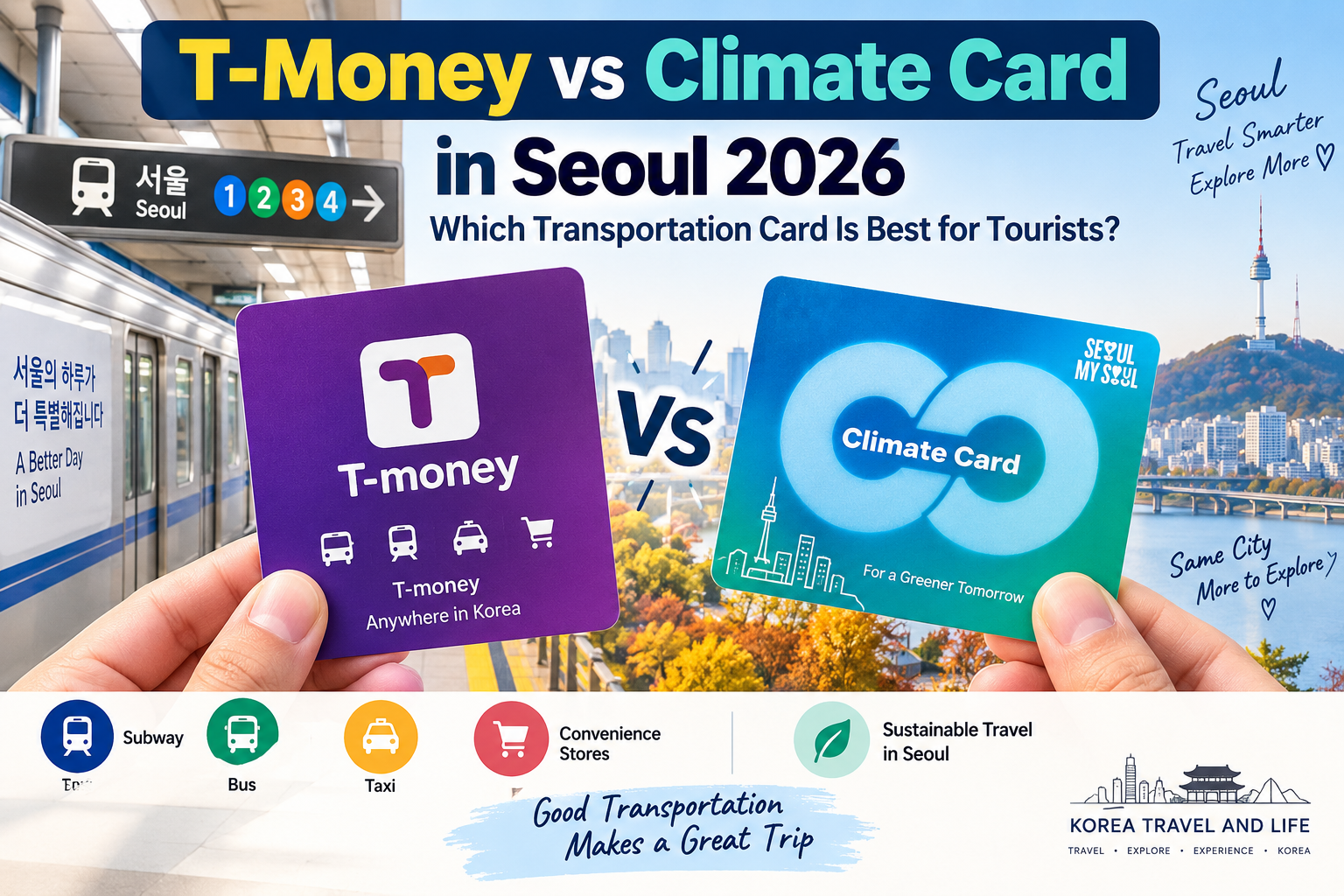
Getting around Seoul is easy once you understand the city’s transportation system. But for first-time visitors, choosing the right transportation card can be surprisingly confusing.
Two of the most useful options are T-Money and the Climate Card.
Both can make traveling around Seoul much easier, but they work very differently. T-Money is a rechargeable transportation card that can be used across Korea, while the Climate Card offers unlimited rides within its designated Seoul transportation network for a fixed period.
So which one should you buy?
This 2026 guide explains the differences between T-Money and the Climate Card, how much they cost, where you can use them, and which option may make more sense for your Korea itinerary.
Quick Answer: T-Money or Climate Card?
For most travelers, the choice depends on where you are traveling.
Choose T-Money if you:
- Plan to travel outside Seoul
- Will visit places such as Busan, Gyeongju, Jeju, or other Korean cities
- Prefer paying for transportation based on actual usage
- Want one transportation card that works across much of Korea
- Expect to use taxis or other transportation outside the Climate Card service area
Choose the Climate Card if you:
- Will spend most of your trip inside Seoul
- Expect to use buses and subways frequently
- Want unlimited eligible public transportation during your pass period
- Prefer knowing your transportation cost in advance
- Are staying in Seoul for between one and seven days
For many first-time visitors traveling around Korea, T-Money offers greater flexibility.
For travelers spending several busy sightseeing days almost entirely in Seoul, however, a short-term Climate Card can be very convenient.
What Is a T-Money Card?
T-Money is one of Korea’s most widely used prepaid transportation cards.
Instead of buying an individual ticket every time you ride a subway or bus, you load money onto the card and tap it when entering and leaving the transportation system.
T-Money can be purchased at many convenience stores, including chains such as CU, GS25, and 7-Eleven, as well as at transportation facilities.
The standard card generally costs around KRW 3,000–5,000, before adding transportation credit.
One of T-Money’s biggest advantages for international travelers is its wide coverage.
It can be used on public transportation across many parts of Korea, making it particularly useful for travelers visiting several cities during one trip.
Where Can You Use T-Money?
T-Money can be used on many:
- Subways
- City buses
- Express and intercity buses
- Taxis
- Other participating transportation services
It can also be used at some convenience stores, vending machines, and other participating merchants displaying the T-Money logo.
This makes T-Money particularly useful for itineraries such as:
Seoul → Busan → Gyeongju → Seoul
Instead of buying a new local transportation card in every destination, travelers can continue using the same T-Money card for many local transportation needs.
What Is the Seoul Climate Card?
The Climate Card was introduced by the Seoul Metropolitan Government as an unlimited public transportation pass.
For tourists, the most important products are the short-term Climate Card passes.
As of 2026, short-term passes are available for:
- 1 day — KRW 5,000
- 2 days — KRW 8,000
- 3 days — KRW 10,000
- 5 days — KRW 15,000
- 7 days — KRW 20,000
A physical Climate Card costs an additional KRW 3,000.
These passes are particularly attractive for travelers who plan to take public transportation repeatedly while sightseeing around Seoul.
Important Climate Card Change in 2026
Visitors may see older online guides discussing the Climate Card’s 30-day prepaid pass.
This information is changing.
Seoul announced that recharging the existing 30-day prepaid Climate Card ends after August 31, 2026, as the city transitions toward its newer Climate Pass system.
However, this does not mean tourists can no longer use the Climate Card.
The short-term tourist passes for 1, 2, 3, 5, and 7 days continue to be available.
This distinction is important when reading older travel guides about Seoul transportation.
Can Foreign Tourists Buy the Climate Card With an International Credit Card?
Yes, and this became significantly easier in 2026.
Seoul expanded payment support at hundreds of new subway vending machines, allowing travelers to use internationally issued credit and debit cards such as Visa and Mastercard to purchase Climate Cards and recharge short-term passes.
International card payments are supported at new vending machines installed across Seoul Metro Lines 1–8.
An average service fee of approximately 3.7% may apply when using an internationally issued card.
This is an important improvement for international visitors because transportation card purchases in Korea have traditionally relied heavily on Korean won cash or locally issued cards.
T-Money vs Climate Card: Main Differences
Here is the simplest way to understand the two cards.
T-Money
Payment system: Pay per ride
Best for: Flexible travel throughout Korea
Coverage: Widely usable across Korea
Main advantage: One card can be used for transportation in many Korean cities
Best traveler: Someone visiting Seoul plus other destinations
Climate Card
Payment system: Unlimited eligible transportation during the pass period
Best for: Frequent transportation within Seoul
Coverage: Limited primarily to eligible Seoul transportation services
Main advantage: Unlimited rides without worrying about individual fares
Best traveler: Someone sightseeing intensively within Seoul
Is the Climate Card Really Unlimited?
Within its eligible transportation network, the Climate Card allows unlimited rides during the validity period.
However, “unlimited” does not mean that every transportation service in Korea is included.
The Climate Card has a defined service area and exclusions. Travelers planning trips outside Seoul should therefore check whether their destination is covered before relying exclusively on the card.
This is one of the biggest differences between the Climate Card and T-Money.
T-Money does not provide unlimited transportation, but its geographical flexibility is much greater.
Which Card Is Better for a 3-Day Seoul Trip?
Consider a traveler spending three full days sightseeing around Seoul.
The itinerary might include:
Day 1: Gyeongbokgung Palace → Bukchon Hanok Village → Insadong → Myeongdong
Day 2: Hongdae → Yeonnam-dong → Han River → Gangnam
Day 3: Seongsu → Seoul Forest → Dongdaemun → Namsan
This traveler may take multiple subway and bus rides each day.
A 3-day Climate Card costs KRW 10,000, plus the KRW 3,000 physical card cost if a card needs to be purchased.
For a transportation-heavy itinerary like this, the Climate Card can be particularly convenient.
Which Card Is Better for a 7-Day Korea Trip?
Now consider this itinerary:
Days 1–3: Seoul
Days 4–5: Gyeongju
Days 6–7: Busan
In this situation, T-Money is generally more practical because the traveler is moving beyond Seoul.
The Climate Card’s main value comes from frequent eligible transportation within Seoul, whereas T-Money can continue to be useful in other Korean cities.
Can You Use Both T-Money and the Climate Card?
Yes.
In fact, some travelers may find that carrying both is convenient.
You could use the Climate Card during several intensive sightseeing days in Seoul and keep a T-Money card for transportation outside the Climate Card coverage area or later trips to other Korean cities.
You do not necessarily have to choose only one card for your entire Korea trip.
Where Can Tourists Buy T-Money?
T-Money cards are widely available.
Travelers can commonly find them at convenience stores such as:
- CU
- GS25
- 7-Eleven
- Other participating convenience stores
They are also available at transportation-related sales locations.
According to VISITKOREA, a standard T-Money card generally costs approximately KRW 3,000–5,000 before adding transportation credit.
One detail international travelers should know is that ordinary T-Money purchases and top-ups may still require Korean won cash in many situations, so carrying some cash after arriving in Korea remains useful. Korea Tourism Organization’s 2026 transportation guide specifically notes cash-only purchasing/top-up for standard prepaid T-Money.
Where Can Tourists Buy a Climate Card?
Physical Climate Cards are available through designated subway vending machines and participating sales locations in Seoul.
New transportation-card vending machines across Seoul Metro Lines 1–8 have made purchasing the card considerably easier for international visitors.
Remember that the physical card itself costs KRW 3,000, and the short-term pass is loaded separately.
Unlike an ordinary T-Money balance, a short-term Climate Card begins according to the rules associated with the pass, so travelers should check the activation timing before loading it.
What About Airport Transportation?
This is where travelers should be careful.
Not every airport transportation option is included with every Seoul transportation pass.
For example, the AREX Express Train operates differently from ordinary Seoul subway transportation.
Travelers arriving at Incheon International Airport should therefore check their airport-to-hotel transportation separately instead of assuming that a Climate Card covers every airport option.
We will cover this in a separate guide comparing AREX Express, AREX All-Stop Train, airport limousine buses, and taxis from Incheon Airport to Seoul.
What About WOWPASS?
WOWPASS is another popular option for international visitors.
Unlike T-Money, which is primarily a transportation card, WOWPASS combines several traveler-focused functions, including prepaid payments, transportation functionality, and currency-related services.
That makes it a different type of product.
For travelers wondering whether WOWPASS or T-Money is better, we will compare those options separately because the decision involves more than transportation alone.
T-Money vs Climate Card: Which Should First-Time Visitors Choose?
There is no single card that is ideal for every Korea itinerary.
For a traveler spending almost the entire trip sightseeing around Seoul and taking public transportation many times each day, the Climate Card can be a simple and convenient choice.
For travelers visiting multiple Korean cities or wanting maximum transportation flexibility, T-Money is usually easier to use throughout the trip.
And for some travelers, carrying both can make sense.
The key is to choose based on your itinerary rather than simply buying whichever transportation card you see first.
Frequently Asked Questions
Is T-Money only available in Seoul?
No. One of T-Money’s biggest advantages is that it can be used on public transportation in many areas throughout Korea.
Can tourists still use the Climate Card in 2026?
Yes. Although Seoul is changing its longer-term Climate Card system, short-term tourist passes for 1, 2, 3, 5, and 7 days remain available.
How much is a 3-day Climate Card?
The 3-day short-term pass costs KRW 10,000. A physical Climate Card costs an additional KRW 3,000 if you do not already have one.
Can I buy a Climate Card with a foreign credit card?
Internationally issued credit and debit cards are accepted at supported new transportation-card vending machines for Climate Card purchases and short-term pass recharging.
Can I use T-Money in Busan?
Yes. T-Money is widely usable on public transportation beyond Seoul, including major Korean cities.
Should I buy T-Money at Incheon Airport?
For many visitors, getting a transportation card soon after arrival is convenient, especially if they plan to use public transportation frequently during their trip.
Final Thoughts
Choosing between T-Money and the Climate Card becomes much easier once you know your itinerary.
If your trip is focused almost entirely on Seoul and you expect to ride buses and subways frequently, a short-term Climate Card can provide simple, predictable transportation costs.
If your Korea itinerary includes several cities, T-Money offers greater flexibility and can remain useful throughout your trip.
Before traveling, always check the latest transportation rules because Seoul’s transit card system continues to evolve.
For most international travelers, the best strategy is simple:
Choose the Climate Card for intensive Seoul sightseeing. Choose T-Money for flexibility across Korea.