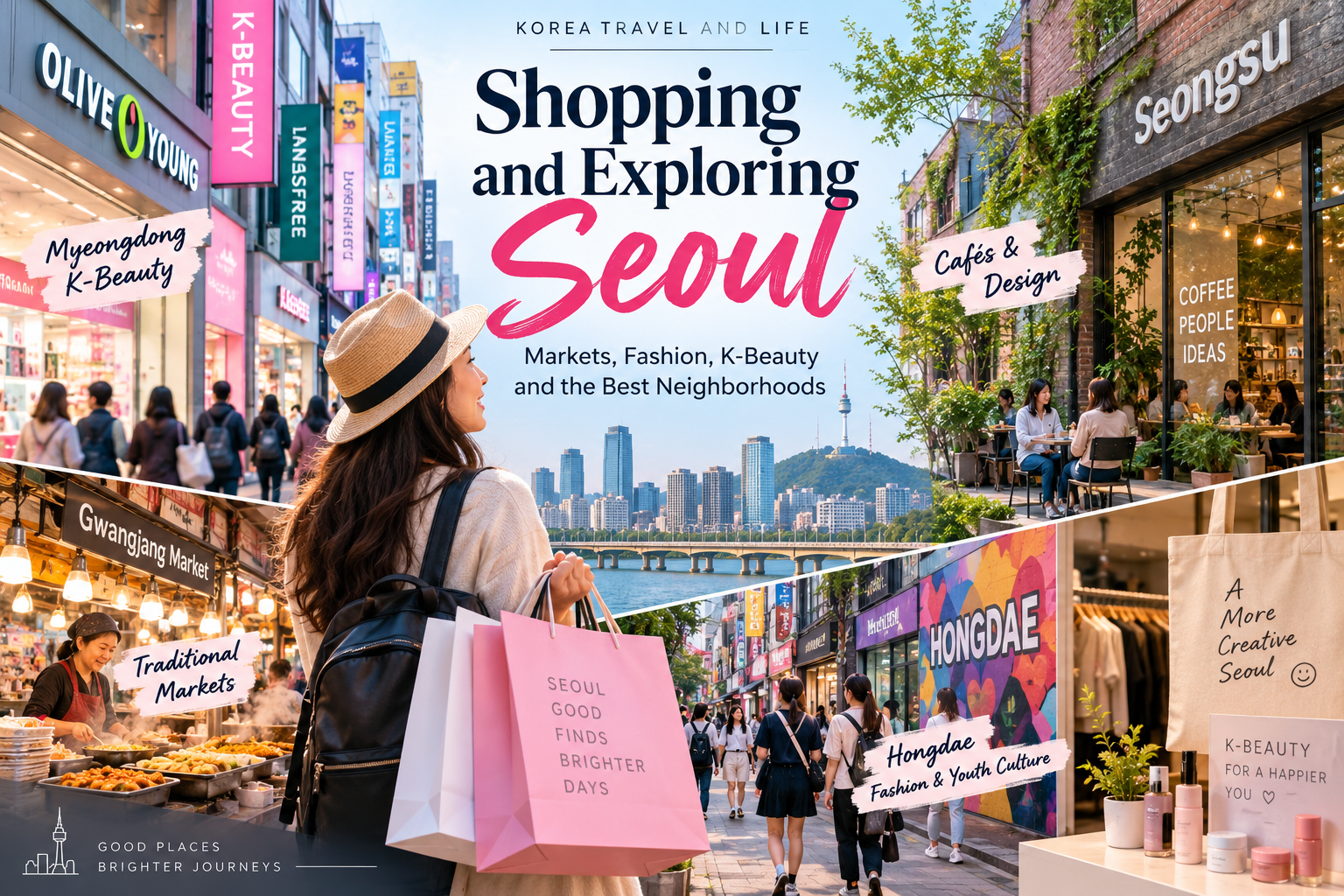
Shopping in Seoul Is Really About Choosing the Right Neighborhood
Shopping in Seoul can feel overwhelming for a first-time visitor.
There are enormous department stores, underground shopping areas, traditional markets, beauty stores, fashion districts, independent boutiques, souvenir shops, cafés, pop-up stores, and entire neighborhoods that seem to change character from one street to the next.
The biggest mistake is trying to visit all of them.
Instead of asking:
“Where is the best place to shop in Seoul?”
ask a more useful question:
“What kind of Seoul do I want to experience while I shop?”
Someone looking for Korean skincare has different priorities from a traveler searching for independent fashion.
A visitor interested in traditional souvenirs may prefer a completely different neighborhood from someone hoping to discover trendy cafés and design stores.
And travelers who enjoy markets may have a better day exploring local food and street life than spending hours inside a luxury department store.
This guide will help you understand some of Seoul’s best-known shopping areas and decide which ones actually belong in your itinerary.
Myeongdong: A Practical Introduction for First-Time Visitors
For many international travelers, Myeongdong is one of the first names associated with shopping in Seoul.
Its central location and concentration of shops make it convenient for visitors who want to explore several types of retail without traveling between distant neighborhoods.
Myeongdong is particularly well known among travelers interested in K-beauty, skincare, cosmetics, fashion, and popular Korean brands.
The neighborhood can also be easy to combine with other central Seoul experiences.
That makes it useful for first-time visitors with limited time.
But Myeongdong should not be treated as the definition of shopping in Seoul.
It is one version of it.
If your main goal is to compare popular beauty products, browse familiar brands, and experience a busy commercial district, Myeongdong can make sense.
If you are looking for independent design, a quieter neighborhood, traditional markets, or youth-oriented street culture, another area may suit you better.
Shopping for K-Beauty Without Buying Everything
Korean skincare and cosmetics are major attractions for many visitors.
The number of products can be exciting—and confusing.
Cleansers, toners, serums, masks, sunscreens, moisturizers, makeup, hair products, and beauty devices can quickly turn a casual shopping trip into several heavy bags.
Start with what you actually need.
If you already use Korean beauty products, make a short list before your trip.
If you are new to K-beauty, avoid assuming that every viral product is suitable for your skin.
Popularity is not the same as personal suitability.
Check product information carefully, especially if you have known sensitivities or allergies.
And remember that shopping should fit your luggage.
A large collection of liquids and cosmetics may create practical issues when packing for your flight home.
Hongdae: Youth Culture, Fashion and Energy
If Myeongdong feels like a central shopping destination, Hongdae feels more closely connected to youth culture.
The wider Hongdae area is associated with fashion, music, cafés, nightlife, entertainment, and a constantly changing collection of shops.
For travelers who enjoy energetic streets and discovering things without a strict shopping list, Hongdae can be fun simply to explore.
You might begin by looking for clothes and end up spending more time in a café, photo booth, accessory shop, or side street.
That unpredictability is part of the appeal.
Hongdae can be especially interesting for younger travelers and visitors curious about contemporary Korean trends.
However, the atmosphere changes according to the day and time.
A neighborhood that feels relatively relaxed earlier can become much busier later.
Think about whether you want shopping, cafés, nightlife, or a combination of them before deciding when to visit.
Seongsu: Contemporary Seoul, Design and Café Culture
Seongsu has become one of the most talked-about areas for visitors interested in contemporary Seoul.
The neighborhood is associated with cafés, fashion, design, brand spaces, and pop-up stores.
Its appeal is different from that of a conventional shopping district.
Rather than simply moving through a row of stores, visitors often come to Seongsu to explore the neighborhood itself.
A former industrial atmosphere, newer commercial spaces, cafés, and changing brand experiences can exist close together.
For travelers interested in design, trends, photography, and café culture, this can make Seongsu especially appealing.
But there is an important practical point:
Pop-up stores are temporary.
A brand experience you saw on social media several months ago may no longer exist when you arrive.
Do not build your entire visit around old posts or videos.
Check current information for any specific pop-up or temporary event you want to visit.
Otherwise, treat Seongsu as a neighborhood to explore rather than a checklist of temporary attractions.
Gangnam: More Than One Shopping Street
International visitors often know the word Gangnam long before they arrive in Korea.
But Gangnam is a large area, not a single attraction.
Depending on where you go, the experience can include major commercial streets, department stores, restaurants, cafés, beauty services, entertainment-related destinations, offices, and upscale neighborhoods.
This is why saying “I want to shop in Gangnam” is not yet a complete plan.
Decide what you actually want to find there.
Travelers interested in large-scale shopping may choose a different part of the area from visitors looking for luxury brands or contemporary Korean lifestyle experiences.
Because the district is extensive, checking the exact location of your destination before leaving your hotel can save considerable time.
Department Stores: Convenient but Easy to Underestimate
Seoul’s major department stores can be destinations in themselves.
They may combine fashion, beauty, luxury goods, food halls, restaurants, and other services under one roof.
For travelers visiting during uncomfortable weather, this can be particularly convenient.
A department store can also be useful when you want to compare several brands without walking long distances outdoors.
But these spaces can consume more time than expected.
If you enter without a purpose, an hour can easily become an afternoon.
Choose them because they fit your interests—not simply because they appear on a list of famous Seoul shopping destinations.
Dongdaemun: Fashion, Markets and a Different Rhythm
Dongdaemun has long been associated with Seoul’s fashion and wholesale ecosystem.
For visitors, the wider district can offer a very different experience from Myeongdong or Seongsu.
Fashion-related shopping, market environments, large commercial buildings, and late-day activity have all contributed to Dongdaemun’s identity.
However, travelers should avoid assuming that every part of the district operates in the same way or follows the same hours.
Retail conditions can change, and businesses serving different customers may keep different schedules.
If there is a particular market or shopping complex you want to visit, check its current operating information before going.
This is especially important if you are planning an evening visit.
Traditional Markets Show Another Side of Shopping
Shopping in Seoul does not have to mean fashion or cosmetics.
Traditional markets can offer a completely different experience.
They combine commerce with food, local routines, conversation, and the everyday movement of the city.
For travelers, markets can be places to buy something—but they can also be places to observe.
What are people eating?
What ingredients are being sold?
What kinds of goods are part of daily life?
How does the atmosphere differ from a modern shopping mall?
These questions can make a market visit more meaningful than simply searching for souvenirs.
Gwangjang Market: Come for the Atmosphere as Well as the Food
Gwangjang Market is one of the names many visitors encounter when researching traditional markets in Seoul.
Food is a major part of its appeal for travelers.
But the market should be approached as a functioning commercial space rather than only as a famous food attraction.
Walk slowly.
Observe before ordering.
Be considerate when photographing vendors or other people.
And do not assume that the most crowded stall is automatically the best choice for you.
A market experience is often more enjoyable when curiosity replaces the pressure to find one supposedly essential dish.
Namdaemun Market: A Broad Traditional Shopping Experience
Namdaemun Market offers another perspective on traditional commerce in central Seoul.
Its extensive shopping environment has historically included many categories of goods, making it quite different from a carefully curated modern retail district.
For a traveler, part of the experience is the density and variety.
It may feel less visually polished than a luxury shopping center, but that is precisely why it can be interesting.
Markets reveal a commercial Seoul that developed through very different traditions.
As with any large market, opening patterns can vary by section and business, so check current information if you are traveling specifically for a particular type of shop.
Insadong: When Shopping Is About Korean Culture
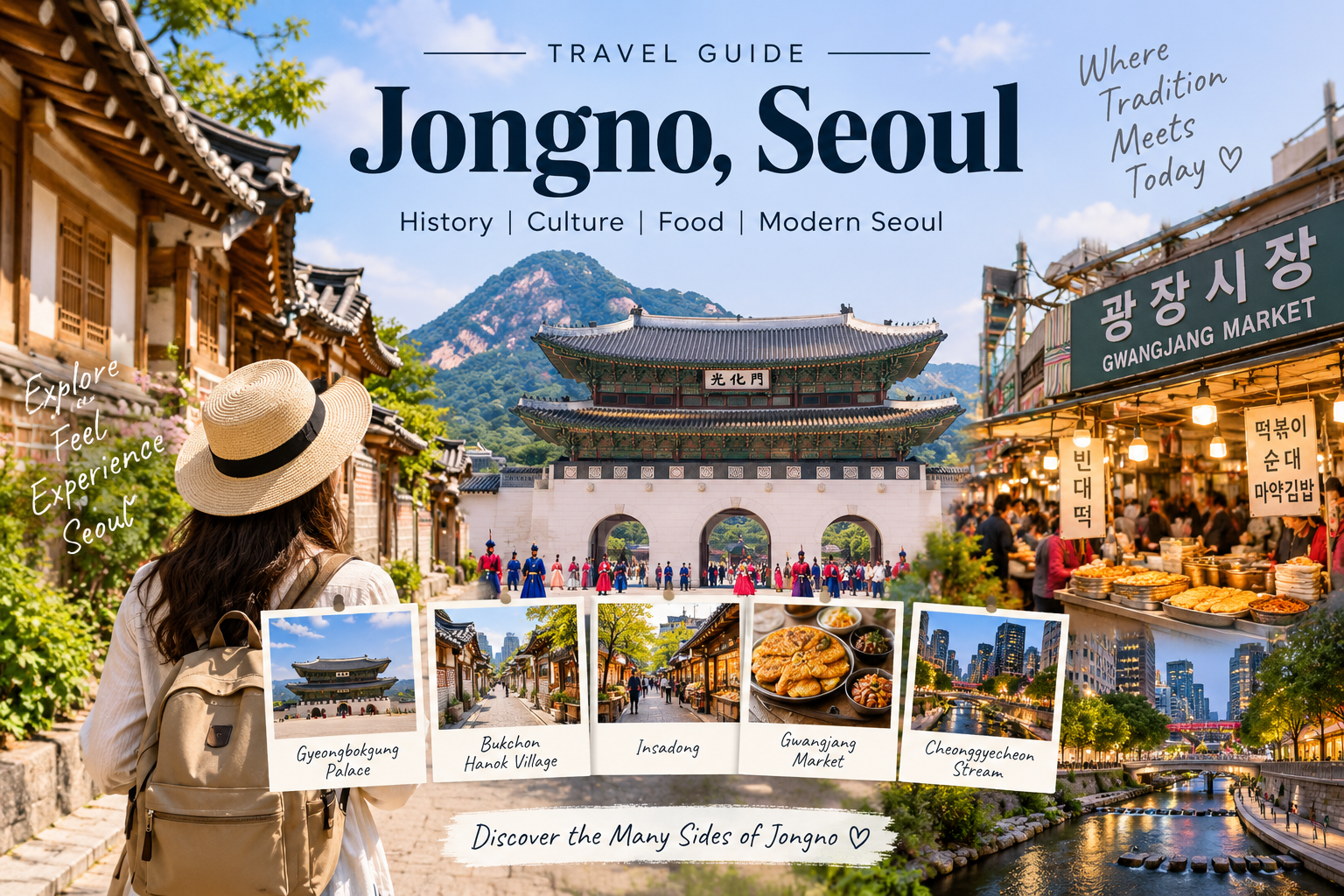
Travelers looking for gifts, crafts, cultural items, or a more traditional atmosphere may prefer Insadong.
Unlike districts primarily associated with fashion or beauty, Insadong works naturally with a day focused on historic Seoul.
A palace visit can lead into nearby streets, tea houses, galleries, craft shops, and souvenir browsing.
This makes it particularly useful for travelers who want shopping to complement cultural sightseeing rather than dominate the entire day.
When buying souvenirs, consider items you will actually value after returning home.
A small object connected to a meaningful travel experience can be more memorable than a bag filled with generic purchases.
Do Not Choose a Neighborhood Only Because It Is Famous
Myeongdong, Hongdae, Seongsu, Gangnam, Dongdaemun, Gwangjang Market, Namdaemun, and Insadong are all well-known names.
But fame does not make them interchangeable.
Think of them as different answers to different travel questions.
K-beauty and convenient central shopping?
Myeongdong may be useful.
Youth fashion and energetic streets?
Consider Hongdae.
Design, trends, cafés, and contemporary brand culture?
Explore Seongsu.
Large-scale modern shopping and different commercial areas?
Look more closely at Gangnam.
Fashion-oriented commercial districts and markets?
Dongdaemun may interest you.
Traditional market atmosphere and food?
Consider Gwangjang.
Broad traditional commerce?
Namdaemun offers another experience.
Cultural gifts and traditional atmosphere?
Insadong can fit naturally into a historic Seoul day.
The best choice is not the neighborhood with the most recommendations.
It is the neighborhood that matches you.
Shopping Is Also a Way to Explore Seoul
The most useful way to think about shopping in Seoul is not as an activity separate from sightseeing.
Shopping districts are neighborhoods.
They contain cafés, restaurants, streets, architecture, people, transportation, and local rhythms.
Instead of arriving, buying something, and immediately leaving, give yourself time to look around.
The places between stores often tell you as much about contemporary Seoul as the products on the shelves.
In the next part, we will go deeper into K-beauty, fashion, souvenirs, cafés, markets, tax-refund considerations, and practical shopping habits that can make shopping in Seoul easier for international travelers.
Make a Shopping Plan Before You Start
Seoul makes spontaneous shopping easy.
That is part of the fun, but it can also lead to wasted time, unnecessary purchases, and luggage problems.
Before heading out, divide your shopping interests into a few simple categories.
You might be looking for:
K-beauty and skincare
Fashion and accessories
Traditional gifts and souvenirs
Food products
K-pop or character merchandise
Design and lifestyle goods
You do not need a detailed shopping list for everything.
The purpose is simply to know what matters most to you.
Once you know that, choosing the right neighborhood becomes much easier.
K-Beauty: Compare Before You Buy
For travelers interested in Korean cosmetics, Seoul can feel like an enormous beauty showroom.
Products appear in dedicated brand stores, multi-brand retailers, department stores, shopping centers, and neighborhood shops.
The variety is one of the attractions.
It is also a reason not to buy everything at the first store you enter.
If you have several products in mind, compare availability and prices when practical.
Promotions can differ, and product selections may vary between stores.
More importantly, buy according to your own needs rather than social-media popularity.
A product that works beautifully for one person may not suit another person’s skin.
Read labels and instructions carefully.
If you have sensitive skin or known allergies, be especially cautious when trying unfamiliar products.
Travel is not the ideal time to experiment aggressively with a completely new skincare routine.
Think About Your Flight Home
Beauty shopping has another practical limitation:
your luggage.
Bottles, creams, masks, shampoos, and other products become surprisingly heavy when purchased in quantity.
Liquid restrictions can also matter depending on how items are packed and carried during air travel.
Before buying a large amount, think about your baggage allowance and how you will transport everything home.
Leaving some empty space in your suitcase before traveling to Korea can be useful if shopping is an important part of your trip.
Korean Fashion: Look Beyond a Single Style
There is no single “Korean fashion.”
Seoul contains everything from inexpensive trend-driven clothing to streetwear, independent labels, department-store brands, luxury fashion, vintage clothing, and experimental design.
This is why neighborhood choice matters.
Hongdae may appeal to travelers interested in youthful trends.
Seongsu can be interesting for contemporary brands and design-oriented spaces.
Gangnam and major department stores can offer a different, often more upscale, retail experience.
Dongdaemun has its own relationship with fashion and the broader clothing industry.
Rather than trying to identify one place as the “best,” decide which version of Korean fashion interests you.
Check Sizing Before Purchasing Clothing
International travelers should pay attention to clothing sizes.
A familiar size label does not always guarantee a familiar fit.
Sizing systems and brand standards vary, and some shops may offer a more limited range of sizes than travelers expect.
Whenever possible, check measurements or try clothing on according to the store’s rules.
This is especially important for items that may be difficult to exchange after you leave Korea.
Shoes deserve the same attention.
Korean shoe sizes are commonly expressed in millimeters, so knowing your approximate equivalent before shopping can save time.
Souvenirs Do Not Have to Say “Seoul”
A good souvenir does not necessarily need a large Korean flag or the word “SEOUL” printed across it.
Consider objects connected to something you genuinely enjoyed during the trip.
Traditional crafts, stationery, ceramics, tea-related items, small design objects, local food products, or practical everyday goods can sometimes make more meaningful souvenirs.
If you enjoyed Seoul’s historic areas, Insadong and related cultural shopping areas may be especially interesting.
If contemporary Korean design is what attracted you, another neighborhood may provide a better choice.
The best souvenir is often something that reminds you of a specific experience rather than simply proving that you visited Korea.
Food Souvenirs Require a Little Planning
Korean snacks, tea, packaged foods, and other edible products can make convenient gifts.
However, travelers should remember that customs and agricultural import rules differ by destination country.
An item that can be purchased legally in Korea is not automatically permitted to enter every other country.
Restrictions may apply to meat, fresh produce, seeds, plants, and other agricultural or animal products.
If you are unsure, check the official customs or border rules of the country you will enter.
This is especially important when buying food from markets.
Cafés Are Part of the Seoul Experience
For many visitors, cafés are almost as important as shopping.
Seoul has an enormous variety of coffee shops, bakeries, dessert cafés, themed spaces, independent cafés, and highly designed interiors.
In neighborhoods such as Seongsu and Hongdae, shopping and café culture often overlap naturally.
This creates a useful travel rhythm.
Explore for a while.
Stop for coffee.
Rest your feet.
Look at what you bought.
Then continue.
A café break is not wasted sightseeing time.
In a city where travelers can easily walk thousands of steps and spend hours moving between subway stations and commercial streets, rest is part of good itinerary planning.
Do Not Travel Across Seoul for Every Viral Café
Social media can make a café look like an essential attraction.
Sometimes it is worth visiting.
Sometimes you may spend a large part of the day traveling and waiting for an experience that lasts twenty minutes.
Before crossing Seoul for a particular café, ask whether the neighborhood itself interests you.
If the answer is yes, the café can become one stop within a larger exploration.
If the answer is no, consider finding a good café closer to the places you already plan to visit.
This principle applies to restaurants, shops, photo spots, and pop-ups as well.
Build days around neighborhoods, not isolated viral locations.
Markets Require a Different Shopping Mindset
Traditional markets are not department stores.
The environment may be crowded, narrow, noisy, fast-moving, and unfamiliar.
That is part of the experience.
Observe how people move through the space.
Avoid blocking busy passages while taking photographs or checking your phone.
Keep personal belongings secure in crowded areas, as you would in any busy city.
If you want to photograph a vendor closely, asking permission is considerate.
And remember that not every stall exists primarily for tourists.
Markets are workplaces and community spaces as well as attractions.
Cash, Cards and Payment
Card payments are widespread in South Korea, particularly in established stores and larger businesses.
However, travelers should still be prepared for situations in which another payment method is more convenient or necessary.
Smaller vendors and traditional market environments can differ from major retail stores.
Rather than assuming one payment method will work everywhere, carry a reasonable backup option.
Before your trip, it is also useful to understand how cash, cards and everyday payments in Korea generally work.
This can prevent unnecessary confusion when shopping, eating, or using local services.
Understand Prices Before You Pay
When shopping in an unfamiliar country, slow down enough to understand what you are buying and how much it costs.
Check the displayed price.
Confirm quantities when promotions are involved.
If a discount depends on buying multiple items, make sure you actually want them.
Do not let the pressure of a busy store turn a simple purchase into a confusing one.
This is particularly useful in beauty stores where promotions may encourage shoppers to purchase more than originally planned.
Tax Refunds: Check the Current Rules
International visitors may encounter tax-refund services while shopping in Korea.
Eligibility, participating stores, purchase requirements, procedures, and refund methods can change.
Some stores may provide immediate tax-refund arrangements under applicable conditions, while other situations may involve different procedures.
Because these details are subject to official rules, do not rely on an old blog post or social-media video for exact thresholds or procedures.
If tax refunds matter to your shopping budget, check the current information from official Korean tourism or tax-related sources and follow the instructions provided by the participating retailer.
Keep any required receipts or documentation until the process is complete.
Bring Your Passport When It Is Required
Certain tourist-related shopping or tax-refund procedures may require identification.
If you plan to use a particular tax-refund service, check its current requirements before shopping.
Do not assume that a photograph of your passport or another form of identification will always be accepted.
At the same time, treat your passport carefully.
It is one of your most important travel documents.
Plan ahead so that shopping convenience does not create unnecessary travel risk.
Be Careful with Counterfeit Goods
A low price can be tempting, especially in large shopping and market districts.
But travelers should be cautious about goods that appear to imitate protected brands.
Counterfeit products can create quality, legal, and customs issues.
If authenticity matters, purchase from reliable retailers and authorized sellers.
This is especially important for expensive fashion, cosmetics, electronics, and branded merchandise.
K-Pop Shopping: Know What You Are Looking For
For K-pop fans, shopping can become a major part of a Seoul trip.
Albums, photocards, light sticks, magazines, character collaborations, and other merchandise may be available through different retailers and official brand channels.
But availability changes quickly.
A product featured in an older travel video may be sold out or discontinued.
Temporary merchandise and pop-up events can also disappear.
For a specific artist or item, check current official information before making a special journey.
If you are browsing casually, allow the discovery itself to be part of the experience.
Leave Space in Your Schedule—and Your Suitcase
Shopping days often take longer than expected.
You may discover a side street you want to explore, wait at a popular shop, spend an hour in a café, or find a market that deserves more time.
Avoid scheduling several distant shopping neighborhoods on the same day.
It is usually better to explore one area properly and add another nearby experience than to spend the afternoon transferring between subway lines with shopping bags.
And remember the other kind of space:
luggage space.
If you know you enjoy shopping, packing slightly lighter at the beginning of the trip can make the return journey much easier.
Shop with Curiosity, Not Pressure
Seoul changes quickly.
A fashionable neighborhood can evolve.
A famous store can close.
A new café can become popular.
A pop-up can disappear.
A product can go viral and sell out.
Trying to chase every trend is exhausting.
Instead, use shopping as another way to observe the city.
Notice what people wear.
Look at packaging and design.
Explore unfamiliar stores.
Compare traditional markets with modern retail spaces.
Stop when you are tired.
Buy what genuinely interests you.
The purpose of shopping in Seoul is not to return home with the largest number of bags.
It is to experience another dimension of the city.
In the final part, we will turn these ideas into practical shopping itineraries for different travelers, including K-beauty shoppers, fashion lovers, market explorers, café enthusiasts, first-time visitors, and travelers with only one day available.
Build Your Seoul Shopping Day Around Your Interests
A successful shopping day in Seoul does not begin with a list of famous stores.
It begins with knowing what kind of experience you want.
Are you mainly interested in Korean skincare?
Do you want to discover fashion and design?
Would you rather spend the day exploring traditional markets?
Are cafés as important to you as shopping?
Or is this your first visit, and you simply want a balanced introduction to several sides of Seoul?
Once you answer that question, planning becomes much easier.
The following itinerary ideas are not strict schedules.
Use them as starting points and adjust them according to your accommodation, weather, energy level, and current opening information.
Itinerary 1: First-Time Visitor — Historic Seoul and Myeongdong
For a first visit, combining historic central Seoul with Myeongdong can create a balanced day.
Begin in the palace area.
Spend the morning exploring a royal palace and nearby historic streets rather than rushing through several palaces at once.
If you are interested in Korean culture and traditional gifts, continue toward Insadong.
This is a natural place to browse crafts, stationery, cultural items, tea-related products, and souvenirs while remaining connected to the historic atmosphere of central Seoul.
Take time for lunch or a café break.
Later, move toward Myeongdong.
The transition reveals another side of the capital.
Traditional architecture and cultural streets give way to bright commercial spaces, fashion, cosmetics, restaurants, and contemporary city energy.
If K-beauty interests you, this is a convenient opportunity to browse without dedicating an entire separate day to cosmetics.
The advantage of this itinerary is variety.
You experience both historic and commercial Seoul without trying to visit opposite ends of the city.
Itinerary 2: K-Beauty-Focused Shopping Day
If skincare and cosmetics are major priorities, do not spend the day randomly moving between every beauty store you see.
Start with a clear list of the products or categories you want to explore.
Choose a major shopping area with a strong concentration of beauty retail, such as Myeongdong, and give yourself enough time to compare products.
Take breaks.
Beauty stores can become surprisingly tiring when you are reading labels, comparing promotions, carrying bags, and making repeated purchasing decisions.
If you want to add another activity, choose something nearby rather than immediately crossing Seoul.
A good K-beauty shopping day should leave you satisfied with your purchases, not exhausted by them.
Remember to consider skin compatibility, luggage weight, liquid restrictions, and any tax-refund procedures that may apply.
Itinerary 3: Hongdae for Fashion, Youth Culture and Nightlife
Travelers interested in younger fashion trends and energetic street culture may prefer to build a day around Hongdae.
Arriving earlier can provide time to explore shops and cafés before the area becomes busier later in the day.
Browse fashion and accessories without feeling that you need to enter every store.
Explore side streets.
Stop for food.
Try a café.
If nightlife interests you, staying into the evening can allow you to experience how the atmosphere changes.
This is an itinerary where flexibility is particularly valuable.
Hongdae is often more enjoyable when you allow yourself to discover places rather than following a rigid sequence of destinations.
Itinerary 4: Seongsu for Design, Pop-Ups and Cafés
For travelers interested in contemporary Korean trends, Seongsu can easily occupy several hours.
Begin with the neighborhood rather than one specific viral location.
Walk through the area, explore stores that interest you, and check current pop-up information if there is a temporary event you genuinely want to see.
Then take a café break.
Because cafés, fashion, design, and branded spaces overlap in Seongsu, there is little need to rush elsewhere.
You can also combine the area with Seoul Forest for a more relaxed day that balances commercial exploration with outdoor time.
This pairing is especially useful after several days of intensive sightseeing.
It lets you experience contemporary Seoul without turning the day into a shopping marathon.
Itinerary 5: Traditional Markets and Everyday Seoul
Travelers more interested in food, local commerce, and market atmosphere can build a day around traditional shopping areas.
Gwangjang Market can provide a lively introduction to market food and commercial culture.
Rather than arriving only to find one famous dish, walk through the market and observe the wider environment.
If you want a broader traditional shopping experience, Namdaemun Market offers another option.
You do not necessarily need to explore both extensively on the same day.
Choose according to your interests and combine the market with nearby central Seoul attractions.
Market days are often most rewarding when you remain curious and patient.
The experience is not as controlled as shopping inside a mall, and that is precisely the point.
Itinerary 6: Fashion-Focused Seoul
If fashion is the main purpose of your shopping, first decide what type of fashion you mean.
Youth trends?
Independent Korean brands?
Luxury shopping?
Streetwear?
Accessories?
Large commercial complexes?
Your answer determines the neighborhood.
Hongdae, Seongsu, Gangnam, Dongdaemun, and major department stores all represent different parts of Seoul’s fashion landscape.
Trying to visit all of them in one day is rarely necessary.
Choose one primary area and perhaps one secondary destination if transportation is reasonable.
Spend more time looking and less time commuting.
Itinerary 7: A Rainy or Extremely Hot Day
Weather can change even a carefully planned Seoul itinerary.
Heavy rain, summer heat, winter cold, or poor outdoor conditions may make a long walking day uncomfortable.
This is when large indoor shopping environments can become useful.
Department stores, shopping malls, underground commercial areas, cafés, restaurants, and cultural venues can provide alternatives.
Instead of considering a weather change a ruined day, reorganize your schedule.
Save parks, mountain walks, and long outdoor neighborhoods for better conditions when possible.
Use difficult-weather days for activities that benefit from being indoors.
Flexibility is one of the most valuable travel skills you can bring to Seoul.
One Day for Shopping? Do Not Try to See Everything
Travelers with only one dedicated shopping day should be especially selective.
Choose two compatible areas at most, and one may be enough.
For example, a first-time visitor might combine central historic shopping with Myeongdong.
A trend-focused traveler might spend most of the day around Seongsu and nearby areas.
Someone interested in youth culture might simply allow Hongdae to develop from afternoon into evening.
The worst approach is often a schedule that looks like this:
Myeongdong → Hongdae → Seongsu → Gangnam → Dongdaemun.
It may appear efficient on a map.
In reality, transportation, walking, finding stores, eating, resting, and carrying purchases can turn the day into a race.
You came to experience Seoul, not to complete a shopping obstacle course.
Combine Shopping with Food
Shopping districts are also eating districts.
This sounds obvious, but it can improve an itinerary considerably.
Instead of leaving a neighborhood to visit a famous restaurant far away, consider exploring what is available nearby.
Markets can introduce you to Korean foods.
Commercial neighborhoods contain everything from quick meals to cafés and restaurants.
A planned meal also creates a useful break in a long shopping day.
If Korean food is an important part of your trip, our guide to 10 Korean foods every traveler should try can help you decide what to look for during your travels.
Shopping and eating do not need to compete for itinerary space.
They often work naturally together.
Know How You Will Pay
Before heading out with a long shopping list, understand the basics of payment in Korea.
Cards are widely used, but travelers can still encounter situations where having another option is useful.
Markets, small businesses, transportation, and individual services may not always feel identical to shopping in a major department store.
Our guide to cash, cards, and payments in Korea explains the basics for first-time visitors.
Knowing this before you shop is much easier than trying to solve a payment problem while standing at a counter.
Respect Local Culture While Shopping
Shopping is also a social interaction.
Simple consideration goes a long way.
Follow store policies.
Be patient when a shop is crowded.
Do not open sealed products unless permitted.
Ask before photographing people closely.
Avoid blocking narrow market passages.
And remember that not every store employee will necessarily be comfortable communicating in English.
A polite attitude and a little patience can make everyday interactions much easier.
Travelers who want a broader introduction to social expectations can also read our guide to Korean culture and etiquette before their trip.
Use Public Transportation Strategically
Seoul’s public transportation system makes it possible to explore many different neighborhoods, but that does not mean you should constantly cross the city.
Check where your shopping areas are located before starting the day.
Group nearby experiences together.
If you are unfamiliar with the system, our beginner’s guide to public transportation in Korea explains the basic concepts that can make getting around easier.
Once you understand the network, Seoul becomes much less intimidating.
But efficient travel still depends on good itinerary design.
A subway system can reduce travel time.
It cannot eliminate distance.
Think About Where You Are Staying
Your accommodation can also affect how easy a shopping itinerary feels.
A traveler staying near central Seoul may approach Myeongdong and historic areas differently from someone based closer to Gangnam.
There is no single best neighborhood for every visitor.
Your ideal location depends on your priorities.
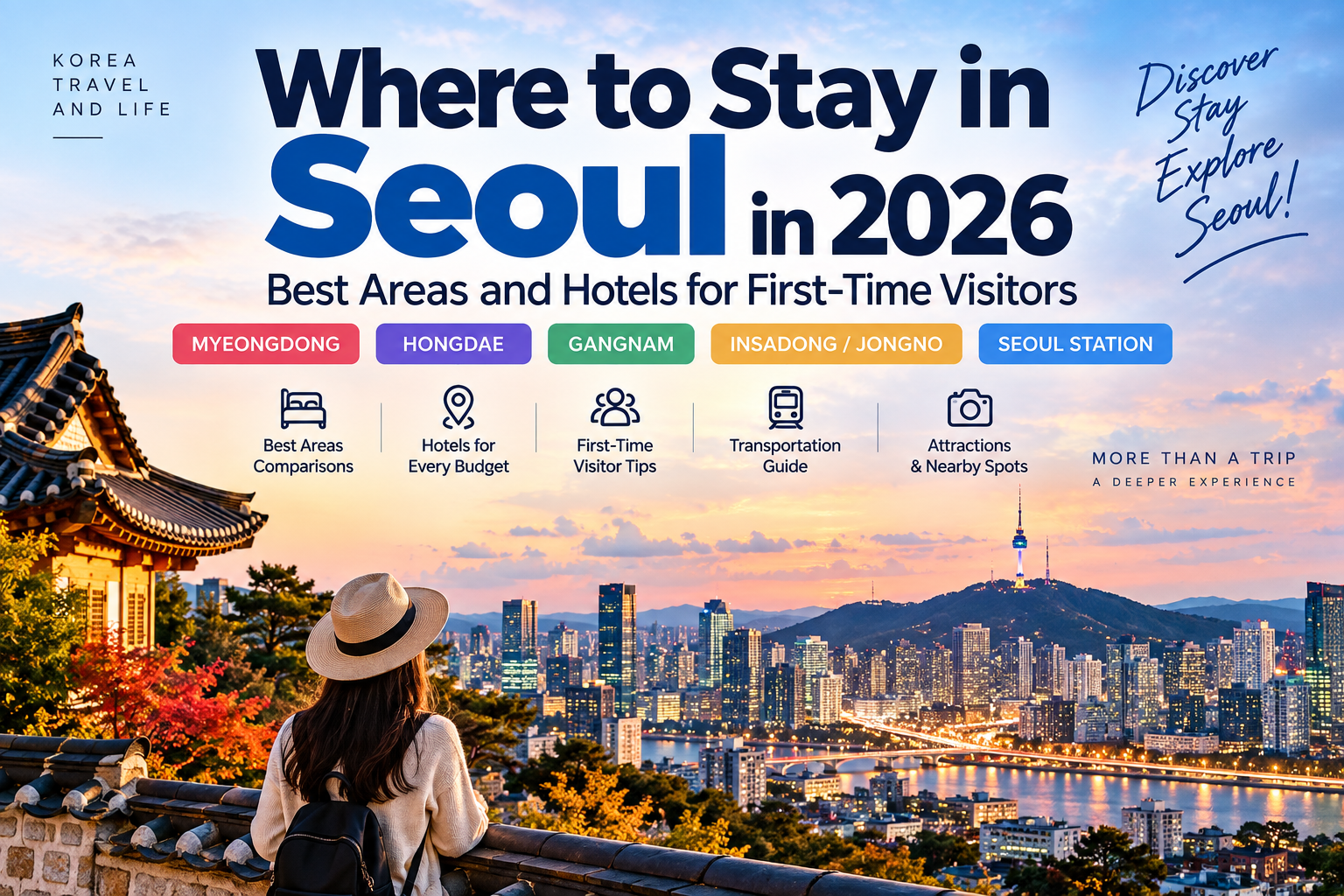
If you are still deciding where to base yourself, our guide to where to stay in seoul and how to choose the right area can help you think through the decision.
Accommodation is not simply where you sleep.
It shapes the beginning and end of every travel day.
Connect the Three Seoul Guides
This article is the third part of our introductory Seoul series.
If you are planning your first trip, start with:
First Time in Seoul: From Incheon Airport to Exploring the City
It covers the first stage of the journey, including arriving from Incheon International Airport, understanding Seoul, and organizing your first days.
Then continue with:
Seoul Outdoors: Palaces, Parks, the Han River and the Best Places to Walk and Hike
That guide focuses on historic Seoul, outdoor spaces, walking, mountains, parks, and the Han River.
This third guide adds the contemporary commercial side of the city:
markets, fashion, K-beauty, cafés, and shopping neighborhoods.
Together, the three guides provide a practical foundation for exploring Seoul without trying to reduce the city to a single checklist.
What Comes After Seoul?
Seoul deserves far more than three articles.
In the future, individual neighborhoods, palaces, hiking routes, markets, restaurants, and cultural experiences can each be explored in greater depth.
But Korea is much larger than its capital.
For many travelers, the next major destination is Busan.
The atmosphere changes.
The geography changes.
The sea becomes part of the journey.
Beaches, coastal neighborhoods, markets, mountains, temples, food, and seaside walks create a travel experience very different from Seoul.
Our next regional series will begin exploring how first-time visitors can understand and travel around Busan.
Final Thoughts: Shop Less, Explore More
Shopping in Seoul can be exciting because the city offers so many choices.
But the number of choices can become a distraction.
You do not need to visit every famous neighborhood.
You do not need every viral skincare product.
You do not need to stand in every pop-up queue.
And you do not need to return home with a suitcase that barely closes.
Choose the places that match your interests.
Explore the streets around the shops.
Stop for food.
Sit in a café.
Visit a market.
Notice how neighborhoods differ.
Talk to people when opportunities arise.
Leave room for something unexpected.
The most interesting shopping day in Seoul may begin with something you planned to buy.
But the memory you keep may be the neighborhood you discovered while looking for it.
In Seoul, shopping is not only about what you take home. It is another way to experience the city.