Tag: Korea Travel Guide

  • Damyang Metasequoia Road in Autumn 2026: Best Time to Visit, Transport, Costs and DIY vs Guided Tours

    Damyang Metasequoia Road in Autumn 2026: Best Time to Visit, Transport, Costs and DIY vs Guided Tours

    Some places in South Korea are worth visiting for a famous landmark. Others are worth visiting simply for the feeling of being there.

    Damyang Metasequoia Road belongs to the second category.

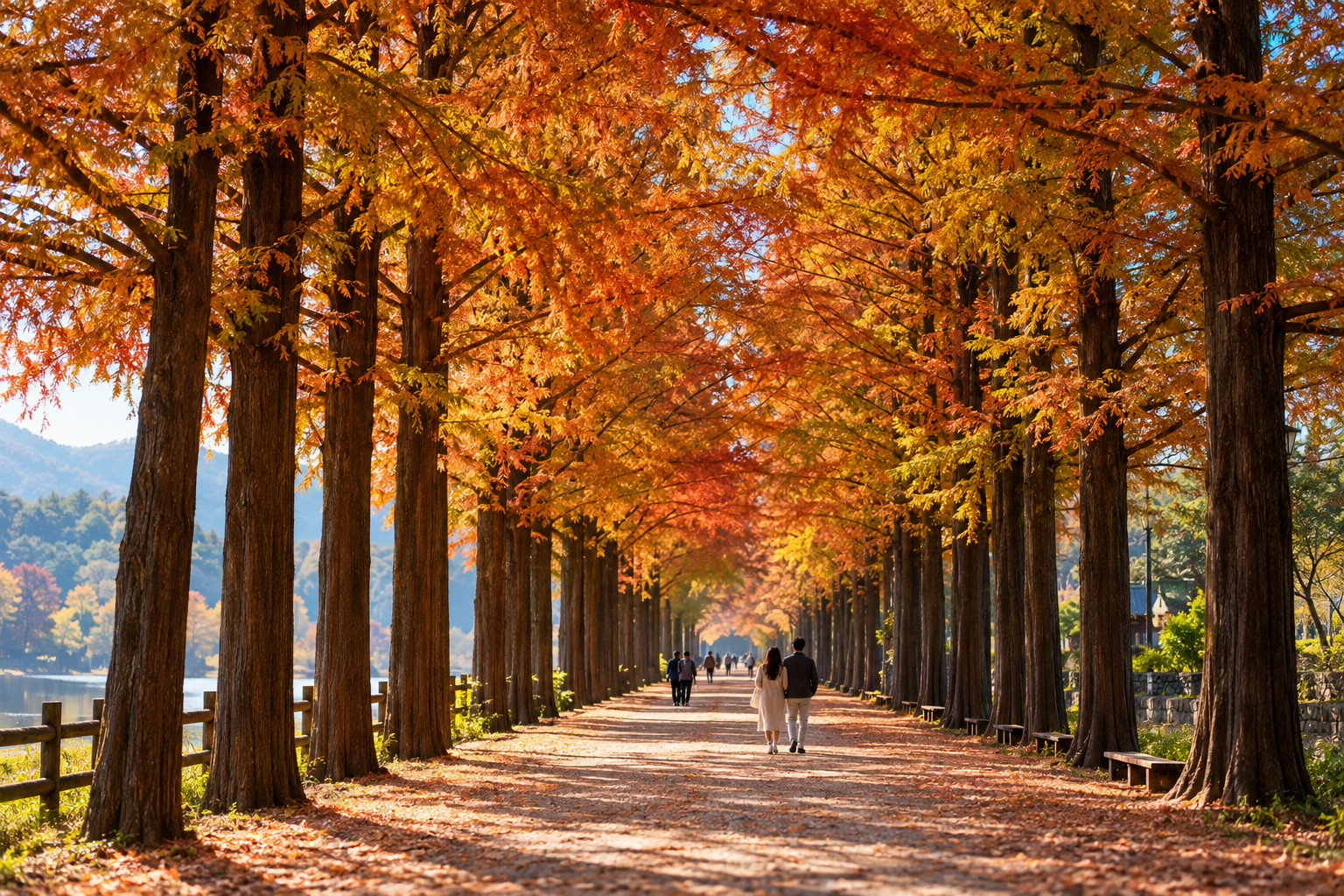
    Imagine walking between two long rows of towering trees, their branches forming a tunnel overhead. In autumn, the soft green foliage gradually gives way to copper, amber and reddish-brown.

    It’s a completely different atmosphere from the golden ginkgo avenues of Seoul or the mountain foliage of Seoraksan.

    But there’s one question that travel photographs rarely answer.

    Is Damyang worth the journey if you’re visiting Korea without a car?

    After all, Damyang doesn’t have a KTX station, and getting there from Seoul or Busan involves more planning than visiting Nami Island or a city park.

    This guide takes a practical approach. We’ll look at when to visit, how to reach the famous road, how much to budget, and whether a self-guided day trip or organized tour makes more sense.

    We’ll also explore how to combine the road with Juknokwon Bamboo Garden and Gwanbangjerim Forest without turning a relaxing autumn outing into a transportation marathon.

    Travel information reviewed: October 17, 2026. Operating hours, fares, bus schedules and autumn colors may change.

    1. What Makes Damyang Metasequoia Road Special?

    Damyang is a county near Gwangju in southwestern South Korea, best known for its bamboo forests and green landscapes.

    Its Metasequoia-lined Road, known in Korean as 담양 메타세쿼이아길, is one of the country’s distinctive tree-lined attractions.

    According to the Korea Tourism Organization, the wider metasequoia boulevard stretches approximately 8.5 kilometers and was recognized by the Korea Forest Service as one of Korea’s most beautiful roads.

    But don’t let that 8.5-kilometer figure confuse you.

    You do not need to walk the entire boulevard to enjoy the attraction.

    Most visitors concentrate on the dedicated scenic walking area, where rows of tall trees create the famous tunnel-like view.

    And while the trees are beautiful in summer, autumn gives the road a different character.

    The warm-colored leaves, long shadows and striking symmetry of the tree trunks create the kind of scenery that makes you want to slow down rather than rush to your next stop.

    There’s no complicated hiking route to complete.

    You can simply walk, take photographs, sit for a while and enjoy the changing season.

    Official attraction information: VISITKOREA — Damyang Metasequoia-lined Road

    2. When Is the Best Time to Visit in Autumn 2026?

    Here’s the part many visitors get wrong.

    They plan to visit Damyang at the same time as Seoul’s autumn foliage.

    But autumn colors don’t arrive everywhere in Korea at once.

    Damyang lies farther south, and the trees along the metasequoia road can change color later than mountain forests in northern Korea.

    For travelers planning an autumn visit, late October through November is a useful period to monitor, with early to mid-November often discussed as a promising window for deeper autumn colors.

    However, this is a planning window, not a confirmed 2026 peak date.

    Temperature, rainfall and weather conditions can shift the timing, and not every part of the road changes color simultaneously.

    Visiting periodWhat you may findHow to plan
    Mid-to-late OctoberMostly green foliage with possible early changesVisit for the tree tunnel itself, not guaranteed peak colors
    Early NovemberA greater possibility of mixed green, yellow and copper tonesCheck recent photographs before traveling
    Mid-NovemberPotential for richer autumn colorsPromising period, but not a guaranteed peak
    Late NovemberRemaining color or substantial leaf fallGo for the atmosphere rather than expecting full foliage

    If your travel dates are fixed, don’t cancel a visit simply because the trees aren’t at their deepest autumn color.

    Even without peak foliage, the architecture-like lines of the trees are impressive.

    But if you’re traveling several hours specifically for photographs, check recent local images and weather before committing.

    For a broader look at autumn timing across the country, read our Korea Fall Foliage 2026: Best Places and When to See Autumn Colors.

    What time of day is best for photographs?

    Many travel photographs make the road look completely empty.

    In reality, popular autumn weekends can attract plenty of visitors.

    Earlier in the morning is generally a better choice if you want fewer people in your photographs.

    Soft morning light may also create a gentler atmosphere between the trees.

    Later afternoon light can make the trunks and foliage look especially warm, although the effect depends on weather and the position of the sun.

    One important warning: the official opening hours for the paid attraction must take priority over a photograph you’ve seen online.

    Don’t assume you can enter the ticketed walking area before opening just because another traveler photographed nearby scenery at sunrise.

    3. Damyang Metasequoia Road: Entrance Fee and Opening Hours

    This is one of the easiest parts of the trip to budget for.

    According to the Korea Tourism Organization’s published visitor information:

    ItemPublished information
    Location12 Metasequoia-ro, Damyang-gun
    Korean address담양군 담양읍 메타세쿼이아로 12
    Adult admissionKRW 2,000
    Teenager admissionKRW 1,000
    Child admissionKRW 700
    September–April hours9:00 AM–6:00 PM
    May–August hours9:00 AM–7:00 PM
    ParkingAvailable

    The official listing also provides reduced group admission rates and certain age-based exemptions.

    Some local travel guides report a Damyang local-voucher return scheme linked to admission payments introduced in 2026. Because its conditions and availability can vary, don’t count a voucher as cash savings until you confirm the current arrangement at the ticket office.

    For an international traveler, the practical approach is simple.

    Budget the published admission price first, then treat any locally usable voucher as an additional benefit.

    You should also distinguish the paid scenic walking area from the broader metasequoia-lined road network.

    A statement that the road is accessible at any time does not necessarily mean the ticketed attraction is open around the clock.

    Official reference: VISITKOREA attraction listing

    4. How to Get to Damyang from Seoul

    Let’s deal with the biggest obstacle.

    Damyang has no KTX station of its own.

    So if you’re traveling independently from Seoul, there are two main approaches worth comparing.

    Option A: Travel through Gwangju

    Take a train from Seoul to Gwangju-Songjeong Station, then continue toward Damyang by local transportation.

    This can work particularly well if you’re already using Gwangju as a regional base.

    However, Gwangju-Songjeong Station is not in Damyang, and reaching the famous road still requires additional travel.

    You’ll need to account for the transfer across Gwangju, the regional bus or taxi connection, and the final journey to the attraction.

    Don’t compare only the KTX time with a direct bus journey.

    Compare the entire trip from your accommodation to the entrance.

    For the train reservation process, see our How to Book KTX Tickets in Korea in 2026.

    Option B: Check a direct intercity bus

    Depending on the travel date and current timetable, direct long-distance bus services may provide a simpler connection between Seoul and Damyang.

    This can be more convenient than arriving by train and making multiple transfers.

    But the exact departure terminal, timetable and return service are critical.

    Before booking, confirm that the service actually runs on your chosen date and that the return journey leaves enough time for sightseeing.

    You can check the appropriate reservation platforms using our Guide to Booking Express and Intercity Buses in Korea.

    Is a same-day round trip from Seoul worth it?

    It is possible to plan a same-day visit, but it is a long travel day.

    Consider what happens if you spend several hours reaching Damyang, then another stretch of time connecting to the road, and still need to make the last convenient trip back.

    You could end up watching the clock instead of enjoying the trees.

    That’s why I would approach a Seoul-origin day trip cautiously.

    If Damyang is your main reason for traveling, consider staying one night in Gwangju.

    It gives you a more flexible visit, especially if you want to combine the metasequoia road with Juknokwon Bamboo Garden.

    5. How to Get to Damyang from Gwangju

    For many independent travelers, Gwangju is the most practical gateway to Damyang.

    Regional buses connect Gwangju and Damyang, including services commonly identified with route 311.

    However, the exact boarding point, journey time and stopping pattern can vary.

    Don’t assume that every bus marked for Damyang will stop directly outside the metasequoia walking area.

    Before leaving, use an up-to-date Korean map app such as Naver Map or KakaoMap to confirm your specific departure point and destination.

    Search these Korean names:

    • 담양 메타세쿼이아길 — Damyang Metasequoia Road
    • 담양공용버스터미널 — Damyang Bus Terminal
    • 죽녹원 — Juknokwon Bamboo Garden
    • 광주종합버스터미널 — Gwangju U-Square Bus Terminal

    You may find that a bus connection is convenient for reaching central Damyang, while a short local taxi ride makes the final attraction-to-attraction journey easier.

    That’s perfectly reasonable.

    Trying to save every taxi fare can sometimes mean losing too much of your afternoon waiting for a less convenient bus.

    Should you use a taxi?

    A taxi is worth considering if you’re traveling as a couple, in a family or with friends who can share the fare.

    It can also be useful for the short transfer between Juknokwon and the metasequoia attraction.

    For a solo budget traveler, public transportation may make more sense, provided there is a convenient service.

    The right choice depends on the total route and the number of passengers — not just the price of one ride.

    6. What If You’re Coming from Busan?

    Busan is another possible starting point, particularly for travelers already exploring southern Korea.

    However, Damyang is not a straightforward urban excursion from Busan.

    Traveling independently generally involves a long-distance connection toward the Gwangju or Damyang area and then local transportation.

    You may also encounter organized autumn tours that combine Damyang’s bamboo forest and metasequoia road.

    These are worth comparing carefully.

    Some tours take care of the most difficult part — regional transportation — but give you less freedom to decide how long to stay at each attraction.

    Before reserving a tour, check whether the advertised package includes actual admission, how much time is allocated to Damyang Metasequoia Road, and whether the departure and return points work with your hotel.

    The word Damyang in a tour title doesn’t necessarily mean the famous road is the main stop.

    7. DIY Trip vs Guided Tour: Which Is Better?

    This decision can make a bigger difference to your experience than the season you choose.

    A self-guided visit gives you freedom.

    Want to spend an extra 40 minutes photographing the trees? You can.

    Want to stop for bamboo rice or traditional grilled tteokgalbi before visiting the garden? No problem, provided your return transport allows it.

    A guided tour, on the other hand, can remove much of the uncertainty around buses and transfers.

    FactorSelf-guided visitOrganized tour
    Transport planningYou arrange trains, buses and taxisUsually handled by the operator
    FlexibilityHighLimited by scheduled stops
    Photography timeYou control your scheduleDepends on the itinerary
    CostOften attractive for travelers already near GwangjuMay be worth the premium for simpler transport
    Language supportYou navigate independentlyVaries by operator
    Best forIndependent travelers, slower itinerariesFirst-time visitors, short trips, groups

    When a DIY trip makes sense

    Choose a self-guided trip if you’re already staying in Gwangju or have a flexible overnight itinerary.

    The travel planning becomes much simpler when you don’t need to return all the way to Seoul on the same day.

    When a tour may be worth it

    Consider a tour if you’re visiting from Busan, traveling with people who prefer not to navigate regional transfers, or trying to visit several attractions within a limited time.

    But don’t buy a tour based only on the number of locations listed.

    A four-stop tour with short visits may be less satisfying than a relaxed afternoon in Damyang.

    Ask how much usable time you will actually spend walking among the trees.

    8. The Best Damyang Autumn Itinerary: Three Places, One Relaxed Day

    One reason Damyang makes a rewarding day trip is that Metasequoia Road isn’t the only attraction worth seeing.

    Three places work particularly well together.

    Stop 1: Juknokwon Bamboo Garden

    Start with the bamboo forest.

    Juknokwon is one of Damyang’s best-known attractions, featuring paths through dense bamboo groves.

    Walking here feels different from walking along the metasequoia road.

    The bamboo creates a green, sheltered environment, while the tall metasequoia trees form a grand, open avenue.

    You don’t need to cover every trail inside Juknokwon to enjoy it.

    Set aside approximately 60–90 minutes for a relaxed visit, depending on how much walking you want to do.

    The Korea Tourism Organization lists the adult entrance fee at KRW 3,000.

    Note that the published operating hours change seasonally: March–October is 9:00 AM–7:00 PM, while November–February is 9:00 AM–6:00 PM, with last admission earlier than closing.

    Official guide: VISITKOREA — Juknokwon Bamboo Garden

    Stop 2: Gwanbangjerim Forest

    Next, slow down along the riverside.

    Gwanbangjerim is a historic forest planted along Damyangcheon Stream, with mature trees that create a different autumn atmosphere from both bamboo groves and the metasequoia road.

    The Korea Tourism Organization describes a forest corridor extending approximately two kilometers.

    It’s especially appealing if you want a quieter walk and a different kind of autumn photograph.

    You can also use this part of the day for a meal or rest around central Damyang.

    Official guide: VISITKOREA — Gwanbangjerim Forest

    Stop 3: Damyang Metasequoia Road

    Finish with the main attraction.

    Allow approximately 45–90 minutes depending on how much you enjoy photography.

    You don’t need to hurry from one end of the road to the other.

    The experience is about the trees, their symmetry and the changing light.

    If the timing works, you may also stop by nearby Meta Provence, a shopping and leisure complex beside the metasequoia attraction.

    It’s a convenient option for a coffee or break, rather than an essential stop for every traveler.

    A sample itinerary

    TimeActivityPlanning note
    10:00 AMArrive at JuknokwonAdjust for your actual transport arrival
    10:00–11:30 AMExplore the bamboo gardenChoose comfortable paths
    11:30 AM–1:00 PMLunch and GwanbangjerimAllow time to rest
    1:00–1:30 PMTransfer toward Metasequoia RoadWalk or take a taxi depending on conditions
    1:30–3:00 PMExplore the tree-lined roadPhotography and a relaxed walk
    After 3:00 PMReturn toward Gwangju or enjoy a caféConfirm your return connection first

    This is an illustrative schedule, not a published transport timetable. Distances, walking speed and waiting times vary, so leave enough flexibility for your actual journey.

    9. How Much Does a Damyang Day Trip Cost?

    The attraction fees are relatively modest.

    For a traveler visiting both the metasequoia road and Juknokwon, the standard adult admission costs currently listed by the Korea Tourism Organization are:

    ExpensePublished or planning amount
    Damyang Metasequoia Road admissionKRW 2,000
    Juknokwon adult admissionKRW 3,000
    Combined adult admissionKRW 5,000
    Meals and drinksDepends on your choices
    Gwangju–Damyang transportationCheck your route and fare
    Local taxisOptional
    Train or long-distance bus from Seoul/BusanDepends on date, class and route
    Organized tourCompare the final price and inclusions

    The entrance fees are not the expensive part of this journey.

    Transportation is what determines whether Damyang becomes an affordable outing or an expensive detour.

    If you’re already staying in Gwangju, the total cost can be relatively manageable.

    If you’re traveling from Seoul solely for one afternoon, intercity transportation may account for the majority of your spending.

    That’s why adding Damyang to an existing Gwangju or Jeolla itinerary may offer better value than making a special long-distance round trip.

    10. Where Should You Stay: Damyang or Gwangju?

    Not every traveler needs to stay overnight.

    But if you’re coming from Seoul or Busan and want a relaxed visit, spending a night in the region is worth considering.

    Stay in Gwangju if transport convenience matters

    Gwangju is a practical base for travelers using KTX, intercity buses or other regional connections.

    It can be easier to organize your onward journey from a major city than from a smaller destination.

    This is the option I would consider first for an international visitor without a car.

    Stay in Damyang if atmosphere matters more

    Damyang may appeal to travelers who want a slower countryside visit or accommodation near the area’s natural attractions.

    But check the exact location of your accommodation carefully.

    Not every stay described as being in Damyang will be within walking distance of the metasequoia road or Juknokwon.

    And if you’re dependent on public transportation, arriving late at night may complicate your plans.

    For most first-time visitors without a car, Gwangju is the more flexible base.

    11. Five Mistakes That Can Ruin a Damyang Day Trip

    Mistake 1: Assuming the trees peak on the same date every year

    Autumn colors respond to weather, not a calendar.

    Check recent photographs and conditions instead of treating a predicted peak date as guaranteed.

    Mistake 2: Assuming the entire 8.5-kilometer road is one ticketed walking trail

    The broader metasequoia boulevard and the main scenic attraction are not exactly the same thing.

    Use the attraction’s published address when planning your visit.

    Mistake 3: Planning around the fastest train without calculating transfers

    A fast KTX connection to Gwangju doesn’t mean you’ll be standing under Damyang’s trees immediately after leaving the station.

    Add the time required for regional buses or taxis.

    Mistake 4: Trying to squeeze too many attractions into one day

    Juknokwon, Gwanbangjerim and Metasequoia Road already make a satisfying outing.

    You don’t have to add distant gardens and mountain destinations just because they appear in the same regional guide.

    Mistake 5: Forgetting the return journey

    This is especially important for independent travelers.

    Before exploring the attractions, confirm how you’ll return to Gwangju, whether your long-distance connection still works, and how much extra time to allow.

    Don’t leave that decision until the ticketed attraction closes.

    12. Is Damyang Better Than Nami Island for Autumn Foliage?

    This is an interesting comparison, especially if you have only one free day in Korea.

    Both destinations offer beautiful tree-lined scenery.

    But they suit different kinds of trips.

    What matters to youDamyang Metasequoia RoadNami Island
    Main attractionTall metasequoia avenue and nearby bamboo forestIsland walks, multiple tree-lined paths
    Travel from SeoulLonger and more complicatedGenerally more convenient
    Regional characterSouthwestern countryside and local foodEstablished day-trip destination near Seoul
    Ideal travel styleGwangju-based trip or slower regional journeySeoul-based day trip
    Best reason to chooseDistinctive metasequoia scenery and Damyang attractionsEasier access and a broad range of activities

    If you’re visiting Korea for the first time and have just one spare day in Seoul, Nami Island may be easier to fit into your itinerary.

    If you’ve already visited the major Seoul attractions, are exploring southern Korea or specifically want the towering metasequoia tunnel, Damyang becomes more compelling.

    For a detailed breakdown of the easier Seoul-area alternative, see our Nami Island from Seoul in Autumn 2026: DIY Train Trip vs Guided Tour.

    13. Frequently Asked Questions

    Is Damyang Metasequoia Road worth visiting?

    Yes, especially if you enjoy photography, peaceful walking routes and distinctive seasonal scenery. However, whether it’s worth a special trip from Seoul depends on how much time and money you’re willing to spend reaching it.

    Can you visit Damyang without renting a car?

    Yes. Public transport connects the area with Gwangju, although reaching specific attractions may require local buses, walking or taxis.

    Is Damyang a good day trip from Seoul?

    It’s possible, but the round-trip journey can be demanding. A Gwangju-based day trip or an overnight itinerary may be more comfortable.

    Is the Metasequoia Road free?

    The Korea Tourism Organization lists admission fees for the paid scenic attraction, including KRW 2,000 for adults. Check current admission arrangements before visiting.

    When will the trees be at their best in autumn 2026?

    Early to mid-November may be promising for richer colors, but there is no guaranteed peak date. Check recent local conditions close to your travel date.

    How long should you spend at the road?

    For many visitors, around 45–90 minutes is a reasonable planning estimate. Those who enjoy photography may want longer.

    Can you combine Damyang Metasequoia Road with Juknokwon?

    Absolutely. The two attractions complement each other well, particularly with a stop at Gwanbangjerim Forest in between.

    Final Verdict: Who Should Visit Damyang Metasequoia Road?

    Damyang isn’t the most convenient autumn destination in Korea.

    And that is exactly why it’s worth thinking carefully before adding it to your itinerary.

    If you’re looking for an easy day trip from Seoul with minimal transfers, you may prefer Nami Island or a closer autumn destination.

    But if you’re already traveling through Gwangju, have an extra night in southern Korea or want to see one of the country’s most memorable avenues of tall trees, Damyang is an excellent place to consider.

    The best version of the trip isn’t the one with the most stops.

    It’s the one that gives you enough time to appreciate the bamboo forest, walk beneath the metasequoias and enjoy the quieter rhythm of the region.

    My recommended approach: Travel through Gwangju, give yourself a relaxed day in Damyang, and combine Metasequoia Road with Juknokwon and Gwanbangjerim.

    Most importantly, check the autumn colors, current operating information and return transport before leaving.

    Because the most rewarding part of Damyang isn’t simply taking a photograph beneath the trees.

    It’s having enough time to enjoy being there.

    Official Sources and Further Reading

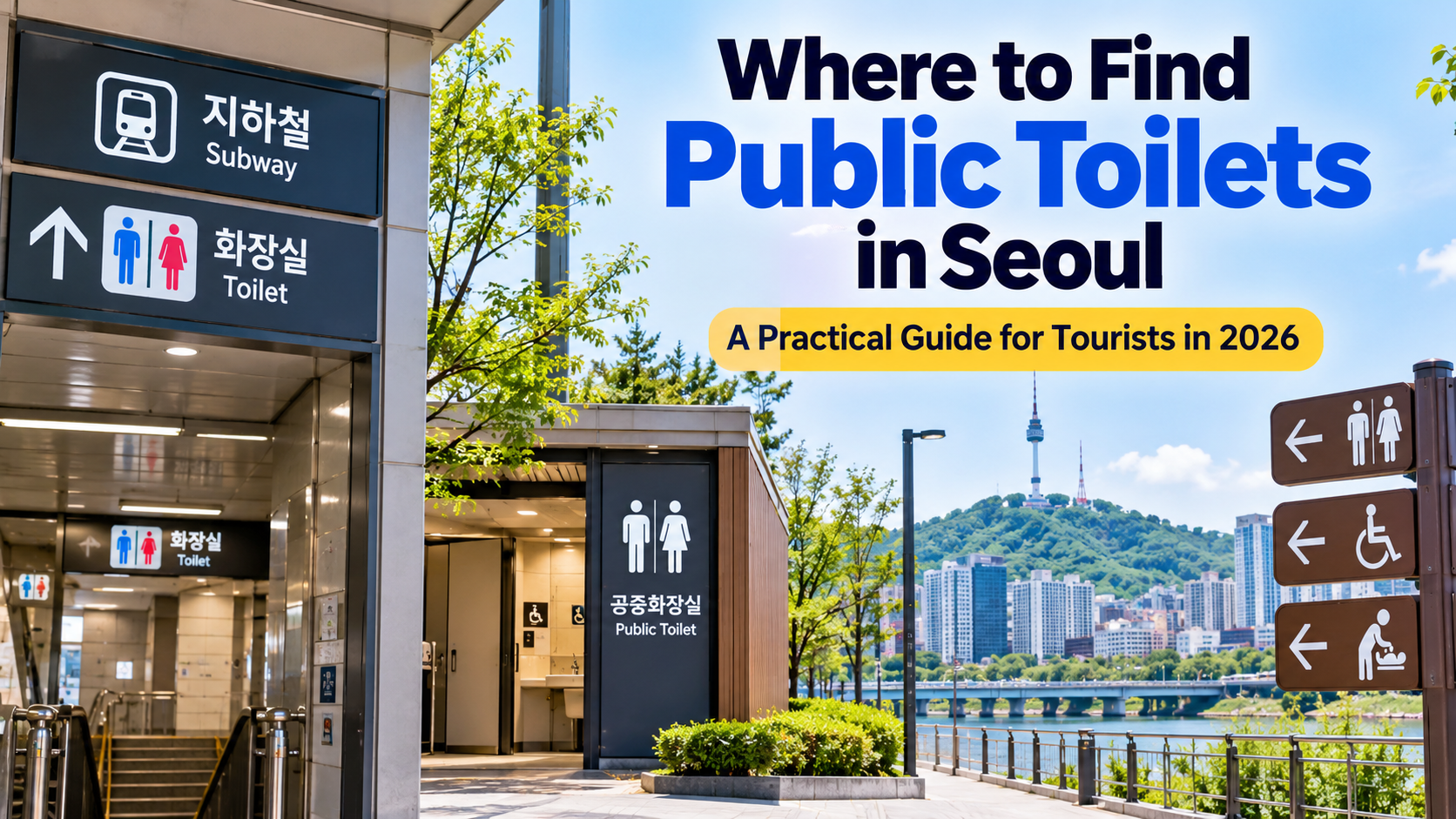
  • Where to Find Public Toilets in Seoul: A Practical Guide for Tourists in 2026

    Where to Find Public Toilets in Seoul: A Practical Guide for Tourists in 2026

    You are exploring Seoul when you suddenly need a restroom. You are nowhere near your hotel, and the nearest café may not have a toilet available to non-customers.

    Where should you go?

    The good news is that Seoul has public toilets in many subway stations, parks, public buildings, and tourist areas. The challenge is knowing which location to try first—and whether the restroom is actually accessible when you arrive.

    The quickest strategy is to look for a subway station, public facility, or officially marked public toilet rather than assuming every café or convenience store has one.

    This guide explains where tourists can find toilets in Seoul, how to search for them using Korean map apps, what signs to recognize, and what to do when the nearest option is unavailable.

    Where Can You Find a Public Toilet in Seoul?

    Not every restroom in Seoul is open to the public, but several types of locations are useful starting points.

    LocationWhy it may helpWhat to check
    Subway stationsMany have restrooms and clear signsSome toilets are inside fare gates
    Public parksOften have designated public facilitiesAvailability and operating hours vary
    Museums and cultural facilitiesRestrooms are generally available to visitorsAdmission or opening hours may apply
    Public offices and community facilitiesSome provide visitor restroomsAccess may be restricted outside business hours
    Shopping malls and department storesUsually have well-maintained customer restroomsBuilding opening hours
    Tourist information centersStaff may direct you to nearby facilitiesNot every center has its own toilet
    Cafés and restaurantsConvenient if you are already a customerRestrooms may be customer-only or shared

    If you need a toilet urgently, do not spend too long checking random businesses. Search for a clearly marked public facility first.

    1. Start With a Subway Station

    Seoul’s subway system is often one of the most practical places to look for a restroom.

    Many stations have toilets marked with recognizable restroom symbols and Korean or English signage.

    However, there is an important detail tourists sometimes overlook.

    Is the toilet inside or outside the ticket gates?

    Some station restrooms are located in areas accessible without paying a fare. Others may be beyond the ticket gates.

    If you are not already taking the subway, entering a paid area just to use the restroom may not be convenient.

    Look at the station’s information board or ask a station employee before tapping your transportation card.

    You can say:

    화장실이 어디에 있어요?

    Hwajangsiri eodie isseoyo?

    “Where is the restroom?”

    If you need to know whether the restroom is outside the gates, ask:

    개찰구 밖에 화장실이 있나요?

    Gaechalgu bakke hwajangsiri innayo?

    “Is there a restroom outside the ticket gates?”

    What if the nearest subway station is large?

    Major transfer stations may have several levels, exits, and underground corridors.

    Following the first restroom sign you see can sometimes involve a longer walk than expected.

    Check the station map for the nearest restroom location before changing levels.

    If you have luggage, a stroller, or limited mobility, also check whether an elevator provides a suitable route.

    2. Search for a Toilet Using Naver Map or KakaoMap

    Google Maps can be useful for general navigation in Seoul, but Korean mapping services are also valuable for finding local facilities.

    Two options to try are Naver Map and KakaoMap.

    The most useful Korean search term is:

    공중화장실

    Gongjung hwajangsil — public toilet

    You can also search:

    화장실

    Hwajangsil — restroom or toilet

    These searches may produce different results depending on the map service and your location.

    How to search step by step

    1. Open Naver Map or KakaoMap.
    2. Allow the app to use your current location.
    3. Enter 공중화장실 in the search field.
    4. Check the results near your current position.
    5. Open a result to examine its location and available details.
    6. Navigate to the entrance, not merely the center of the building.

    <underline>Important:</underline> A map listing does not guarantee that a restroom is open, accessible, or available to everyone at that moment.

    For an urgent visit, prefer a clearly identified public toilet or a facility whose entrance and opening hours you can confirm.

    Useful search terms to copy

    KoreanMeaning
    공중화장실Public toilet
    화장실Restroom
    무료 화장실Free restroom
    장애인 화장실Accessible restroom
    수유실Nursing room
    기저귀 교환대Diaper-changing station

    Searching for an accessible restroom or changing station does not guarantee that the facility meets your specific needs. Confirm the details whenever possible.

    3. Public Parks Can Be Useful—But Check the Location

    Seoul has many public parks and riverside recreation areas where restrooms may be available.

    If you are walking near the Han River, exploring a large urban park, or spending time in a public recreation area, look for designated toilet symbols on local information boards.

    In a large park, the nearest toilet may be some distance from your current position.

    Do not assume that every park entrance has a restroom.

    When walking along the Han River

    The Han River parks extend over long distances.

    If you are cycling, walking, or having a picnic, check restroom locations before moving far from busy facilities.

    Look for public signs, park maps, and official facility information.

    If you are traveling with children, it is especially useful to identify a restroom before settling into a picnic area.

    4. Shopping Malls and Department Stores Are Useful Backup Options

    When a clearly marked public toilet is not nearby, a large shopping mall or department store can be a practical alternative during business hours.

    These buildings generally provide restrooms for customers and visitors.

    They may also have elevators, family facilities, or accessible restrooms, although the available features vary by building.

    Why large buildings can be easier than small cafés

    A shopping center typically has directories and restroom signs.

    A small café may share a restroom with other tenants, require a key or access code, or reserve it for customers.

    If you are in a busy shopping district, identifying a large public-facing building may save time compared with asking at several small businesses.

    However, shopping facilities are not necessarily open early in the morning or late at night.

    Always consider the time of day.

    5. Can You Use a Café or Restaurant Toilet Without Buying Anything?

    Do not assume that café and restaurant restrooms are freely available to everyone.

    Some establishments allow non-customers to use their facilities, while others restrict access.

    In certain buildings, the restroom may be in a shared corridor or on another floor.

    You may also encounter a door code provided to customers.

    If you are already purchasing food or drinks, asking the staff is usually straightforward.

    If you are not a customer, ask politely rather than entering without permission.

    화장실 사용해도 될까요?

    Hwajangsil sayonghaedo doelkkayo?

    “May I use the restroom?”

    If the answer is no, thank the staff and look for another facility.

    Convenience stores should not be treated as a reliable restroom option. Many do not provide customer toilets.

    6. What Do Korean Restroom Signs Look Like?

    Most visitors will recognize the standard restroom pictograms used in subway stations, public buildings, and shopping centers.

    You may also see Korean signs.

    Korean signMeaning
    화장실Restroom
    남자 화장실Men’s restroom
    여자 화장실Women’s restroom
    장애인 화장실Accessible restroom
    공중화장실Public toilet
    사용 중Occupied / In use
    고장Out of order

    Some facilities use separate signs for accessible toilets or family-related facilities.

    If you cannot identify the correct entrance, ask a staff member rather than relying on assumptions about the building layout.

    7. Are Public Toilets in Seoul Free?

    Many public toilets in Seoul can be used without paying an admission fee.

    However, this does not mean every restroom in the city is freely accessible.

    A toilet inside a paid attraction may require admission to the facility.

    A café restroom may be restricted to customers.

    A subway restroom located beyond the fare gates may not be directly accessible to someone outside the paid area.

    The most useful distinction is therefore not simply free versus paid.

    It is publicly accessible versus restricted access.

    When checking a restroom, consider both the cost and the conditions for entering the building or area.

    8. What About Toilet Paper, Soap, and Cleanliness?

    Restroom conditions vary by location.

    Many modern public facilities provide toilet paper, running water, and soap, but supplies can run out.

    For longer sightseeing days, carrying a small packet of tissues and hand sanitizer is a sensible precaution.

    Where should used toilet paper go?

    Follow the instructions posted in the restroom.

    In many modern Korean toilets, ordinary toilet paper is intended to be flushed. However, specific facilities may post different instructions because of their plumbing conditions.

    Do not flush wet wipes, sanitary products, or other items that are not designed for toilet plumbing.

    If a restroom provides disposal instructions, follow them.

    What if a toilet is out of order?

    Look for signs such as 고장 or 사용 금지.

    Do not use a fixture that has been marked unavailable.

    If possible, ask staff where the nearest functioning restroom is located.

    9. Finding Toilets When Traveling With Children

    Traveling with children changes how you should plan restroom stops.

    A location that works for one adult may not be convenient for a family with a stroller or a child who needs assistance.

    Before entering a large park, market, or sightseeing area, identify at least one likely restroom location.

    For families with babies, look separately for changing facilities or nursing rooms.

    These are not automatically provided in every public restroom.

    Useful Korean phrases

    기저귀 교환대가 있나요?

    Gijeogwi gyohwandaega innayo?

    “Is there a diaper-changing station?”

    수유실이 어디에 있나요?

    Suyusiri eodie innayo?

    “Where is the nursing room?”

    Large shopping centers, transport hubs, and major public facilities may be useful places to ask about these services.

    10. Finding Accessible Restrooms in Seoul

    Travelers with mobility limitations should not rely solely on a standard restroom symbol.

    An accessible restroom may be located in a different part of a station or building.

    Even when a facility is marked accessible, the approach route, doorway, interior layout, or availability may not meet every person’s needs.

    What to check before going

    • Is there a step-free route to the restroom?
    • Is the facility open at the time of your visit?
    • Does the entrance provide enough clearance?
    • Is the restroom inside a restricted area?
    • Is an elevator required to reach it?

    For major transport facilities and attractions, official accessibility information may help with planning.

    If the information is incomplete, contact the facility directly when possible.

    Useful phrase:

    장애인 화장실이 어디에 있나요?

    Jangaein hwajangsiri eodie innayo?

    “Where is the accessible restroom?”

    11. What Should You Do If You Need a Toilet Urgently?

    If you are unfamiliar with the neighborhood, use this practical sequence.

    Step 1: Look for a visible public facility

    Check for a subway entrance, public park information board, museum, visitor center, or large shopping building.

    Step 2: Search 공중화장실 on a Korean map app

    Use your current location and check the nearest clearly identified result.

    Step 3: Confirm access

    Look for opening hours, building restrictions, and whether the restroom is inside a ticketed area.

    Step 4: Ask someone nearby

    If the map result is confusing, ask staff at a station, information center, or business.

    가장 가까운 화장실이 어디예요?

    Gajang gakkaun hwajangsiri eodiyeyo?

    “Where is the nearest restroom?”

    Step 5: Have a backup

    If your first choice is closed or unavailable, move to the next reliable public-facing facility rather than continuing to search the same building.

    This is particularly important late at night, when many shops and public buildings may be closed.

    12. Common Tourist Mistakes When Looking for Toilets in Seoul

    Assuming every subway toilet is outside the fare gates

    Check its location before entering the station.

    Assuming a café restroom is public

    Ask permission and respect customer-only restrictions.

    Relying on an outdated map listing

    A listed restroom may be temporarily closed, inside a restricted building, or difficult to access.

    Walking into a large park without checking facilities

    Restrooms may be farther apart than expected.

    Confusing a nursing room with a public toilet

    A nursing room or baby-care facility may be separate from the restroom.

    Ignoring opening hours

    Shopping centers, museums, and some public buildings may be useful during the day but unavailable late at night.

    Frequently Asked Questions

    Are there public toilets in Seoul?

    Yes. Public toilets are available in various subway stations, parks, public facilities, and other locations. Accessibility and opening hours vary.

    How do I find the nearest public toilet in Seoul?

    Try searching 공중화장실 or 화장실 on Naver Map or KakaoMap. Confirm the location and access conditions before walking there.

    Can tourists use subway station toilets in Seoul?

    Many subway stations have restrooms, but some are located beyond ticket gates. Check the station map or ask staff if you are not taking the train.

    Are public toilets in Seoul free?

    Many are free to use. However, some restrooms are inside paid attractions, restricted areas, or customer-only businesses.

    Can I use a convenience store toilet in Korea?

    Do not rely on convenience stores for restroom access. Many do not offer customer toilets.

    Is toilet paper provided in Korean public restrooms?

    Many modern facilities provide it, but availability varies. Carrying tissues is a useful precaution.

    Are public toilets in Seoul open 24 hours?

    Not all of them. Opening hours depend on the facility, building, and location. Check before relying on a restroom late at night.

    Final Thoughts: The Fastest Way to Find a Toilet in Seoul

    Finding a public toilet in Seoul is usually manageable once you know where to look.

    Start with a subway station, clearly marked public restroom, or public-facing facility.

    Use 공중화장실 in Naver Map or KakaoMap when you need to search nearby.

    Check whether the restroom is accessible without a ticket, purchase, or building access restriction.

    And if you are unsure, asking “화장실이 어디에 있어요?” is often the simplest solution.

    A little preparation can prevent an inconvenient interruption from becoming a stressful part of your Seoul trip.

  • Jeju Outdoors: Hallasan, Olle Trails, Volcanic Landscapes and the Best Coastal Walks

    Jeju Outdoors: Hallasan, Olle Trails, Volcanic Landscapes and the Best Coastal Walks

    Jeju Is an Island Built for Outdoor Travel

    Many travelers first imagine Jeju through a few familiar images: blue water, beaches, cafés, and Hallasan rising above the island.

    But Jeju becomes much more interesting when you experience it on foot.

    The island is shaped by volcanic activity, wind, water, forests, cliffs, fields, and mountains. Walking through these landscapes reveals details that are easy to miss when traveling only from one parking lot to another.

    You begin to notice dark volcanic stone beneath your feet.

    You see how villages meet the coastline.

    You hear waves before the ocean becomes visible.

    You watch the weather change around Hallasan.

    And you begin to understand that Jeju’s natural attractions are not separate destinations. They are parts of the same volcanic island.

    For travelers who enjoy nature, walking, or hiking, Jeju can become one of the most rewarding parts of a trip to Korea.

    Start with the Landscape, Not the Checklist

    A common mistake is to create a list of famous outdoor destinations and then try to visit all of them.

    Hallasan.

    Seongsan Ilchulbong.

    Olle trails.

    Waterfalls.

    Beaches.

    Forests.

    Volcanic cones.

    Coastal cliffs.

    Each may deserve a place in your itinerary.

    But outdoor travel works differently from ordinary sightseeing.

    Weather matters.

    Your fitness level matters.

    Daylight matters.

    Trail conditions matter.

    Transportation matters.

    And sometimes the most memorable experience is not the most famous location.

    Before choosing a trail, decide what kind of outdoor day you actually want.

    What Kind of Outdoor Experience Do You Want?

    Jeju offers outdoor experiences for very different travelers.

    You may want:

    a serious mountain hike

    a long coastal walk

    a short scenic trail

    a forest walk

    a volcanic landscape

    a waterfall and easy nature day

    a sunrise experience

    or simply

    a peaceful place to walk beside the sea

    These are not interchangeable.

    Someone who wants a relaxing coastal afternoon should not accidentally choose an itinerary designed for an all-day mountain hike.

    Likewise, an experienced hiker may want more than a short viewpoint walk.

    Choose the experience first.

    Then choose the place.

    Hallasan Is the Center of Jeju

    At the heart of the island rises Hallasan, the highest mountain in South Korea.

    Its presence defines Jeju physically and visually.

    Even when you are far from the mountain, Hallasan influences the island’s geography, climate, vegetation, roads, and views.

    On clear days, it can dominate the horizon.

    On other days, clouds may hide it almost completely.

    For many outdoor travelers, hiking Hallasan becomes one of the major goals of a Jeju trip.

    But it should never be treated as an ordinary sightseeing stop.

    Hallasan Requires Real Planning

    A serious Hallasan hike can take a substantial part of the day.

    The experience depends on the route, your pace, weather, season, trail conditions, and current access rules.

    Some routes are much more demanding than casual visitors expect.

    This is not the place to arrive in unsuitable shoes with little water because a photograph looked easy online.

    Before hiking, check current official information about:

    • trail access
    • operating or entry times
    • reservation requirements where applicable
    • weather
    • closures
    • route conditions
    • safety notices

    These details can change.

    An old travel blog should never be your final source for current mountain access information.

    Reaching the Summit Is Not the Only Goal

    Travelers sometimes treat Hallasan as a pass-or-fail challenge.

    Summit reached: success.

    Summit not reached: failure.

    That is not a useful way to experience a mountain.

    Weather may change.

    Your body may feel different from expected.

    Trail conditions may slow you down.

    You may simply decide that turning around is the safer choice.

    A good mountain day is one you return from safely.

    The landscape, forest, changing elevation, and experience of walking on Jeju are valuable even when your original plan changes.

    Know Your Fitness Level

    Do not choose a Hallasan route according to someone else’s social media post.

    Consider your own experience.

    How often do you hike?

    Are you comfortable walking uphill for several hours?

    How are your knees on long descents?

    Can you carry enough water and food?

    Are you accustomed to changing mountain weather?

    Have you allowed enough daylight?

    Being generally healthy does not automatically mean a long mountain hike will feel easy.

    And there is nothing wrong with choosing a less demanding outdoor experience.

    Descending Can Be Harder Than Expected

    Many first-time hikers focus almost entirely on climbing.

    But descending can be demanding too.

    After hours of uphill walking, your legs are already tired.

    Long descents can place additional stress on knees and ankles.

    Wet surfaces, rocks, snow, or ice can make the return journey slower.

    Save energy for the way down.

    Do not use all of your strength trying to reach a particular point.

    The hike is not finished until you are safely off the trail.

    Mountain Weather Is Different

    Jeju may look sunny near the coast while Hallasan is covered in cloud.

    Temperature can change with elevation.

    Wind can become stronger.

    Rain, snow, fog, or rapidly changing conditions may affect visibility and trail safety.

    This is why looking out of your hotel window is not enough.

    Check mountain-specific conditions when planning a hike.

    If official guidance indicates that conditions are unsuitable, change your plan.

    Jeju offers many other outdoor experiences.

    Start Early

    For major hikes, an early start can provide several advantages.

    You have more daylight.

    You have more time to adjust your pace.

    You reduce the pressure to rush.

    And if something unexpected slows you down, you have a larger safety margin.

    Starting early does not mean ignoring official entry times or trail regulations.

    Always follow current local rules.

    What Should You Carry?

    The exact equipment depends on the route and season, but basic preparation matters.

    For a substantial hike, think about:

    • appropriate walking or hiking shoes
    • enough water
    • food or snacks
    • weather-appropriate layers
    • sun protection
    • a charged phone
    • a portable battery
    • any personal essentials you may need

    In colder conditions, mountain equipment requirements can become much more serious.

    Research the actual conditions before you go.

    Hallasan Is Not Your Only Volcanic Experience

    One of the advantages of Jeju is that you can experience its volcanic identity without completing a major mountain hike.

    The island contains numerous smaller volcanic landforms known as oreum.

    These volcanic cones are scattered across Jeju and create some of its most distinctive scenery.

    Some offer relatively approachable walks and panoramic views.

    Others require more effort.

    As always, access, terrain, and conditions vary.

    What Is an Oreum?

    For a first-time international visitor, the word oreum may be unfamiliar.

    In Jeju, it refers to the island’s smaller parasitic volcanic cones formed through volcanic activity.

    They are an important part of the landscape and local identity.

    Once you begin noticing them, the island looks different.

    What first appeared to be a series of ordinary hills becomes evidence of Jeju’s volcanic history.

    Exploring an oreum can be a useful alternative for travelers who want elevation and scenery without committing to a full Hallasan hike.

    Choose an Oreum Carefully

    Do not assume every oreum is an easy hill.

    Trail length, slope, surfaces, facilities, and accessibility differ.

    Some may be popular and well developed.

    Others may feel much more natural.

    Weather can also change the difficulty.

    Before visiting, check current access information and choose according to your ability.

    Respect any closures or restrictions designed to protect the landscape.

    Seongsan Ilchulbong Shows Jeju’s Volcanic Story

    Seongsan Ilchulbong is one of the clearest places for first-time visitors to connect Jeju’s famous scenery with its volcanic origins.

    Its dramatic form beside the sea makes it visually different from Hallasan.

    The experience is also much shorter than a major mountain hike, making it accessible to a wider range of travelers.

    But even here, stairs, slopes, crowds, heat, and wind can affect how demanding the visit feels.

    Take your time.

    Sunrise Is Optional

    The name Sunrise Peak creates an obvious expectation.

    Many travelers feel they must visit at sunrise.

    You do not.

    Sunrise can be beautiful when the weather cooperates, especially if you are staying nearby.

    But waking extremely early, traveling a long distance, and arriving under heavy cloud may not be the best use of your energy.

    Visit at the time that works for your itinerary.

    A volcanic landscape does not stop being interesting after sunrise.

    Volcanic Stone Is Everywhere

    Jeju’s geology is not confined to famous attractions.

    Dark volcanic stone appears throughout the island.

    You see it in fields.

    Walls.

    Coastlines.

    Villages.

    Paths.

    Traditional structures.

    The stone becomes part of Jeju’s visual language.

    This is one reason walking can be so rewarding.

    A car quickly carries you past these details.

    On foot, you begin to notice them.

    The Coast Reveals Another Side of the Volcano

    Jeju’s volcanic identity continues where the land meets the sea.

    Dark rocks contrast with blue water.

    Cliffs expose dramatic formations.

    Waves shape the coastline.

    Some areas feel open and gentle.

    Others feel rugged and powerful.

    The coast is not simply a collection of beaches.

    It is part of the geological story of the island.

    Do Not Walk Everywhere You See a View

    Beautiful coastal scenery can tempt travelers to leave established paths.

    That can be dangerous and damaging.

    Rock surfaces may be slippery.

    Cliff edges may be unstable.

    Waves can be unpredictable.

    Protected vegetation can be harmed by repeated foot traffic.

    Private land may look like an open viewpoint.

    Stay on permitted routes and follow barriers and local instructions.

    The best photograph is never worth an unsafe step.

    Wind Changes Coastal Walking

    Wind is a major part of Jeju’s outdoor environment.

    A pleasant coastal walk can feel very different when strong wind arrives.

    It can make cool weather feel colder.

    It can make walking more tiring.

    And near exposed cliffs or rocky coastlines, it can affect safety.

    Check conditions rather than assuming that clear skies mean easy walking.

    Waterfalls Add Variety to an Outdoor Itinerary

    Not every nature day needs to involve a mountain or a long trail.

    Jeju’s waterfalls can provide shorter outdoor experiences that combine well with other nearby attractions.

    Around Seogwipo, well-known waterfalls can fit naturally into a southern Jeju day.

    These experiences are particularly useful when you want nature without committing to several hours of hiking.

    But even short waterfall visits may involve stairs, wet surfaces, or uneven terrain.

    Suitable footwear still matters.

    Forests Show a Quieter Jeju

    The island’s outdoor identity is not limited to open coastlines and mountain views.

    Forested areas can offer a completely different atmosphere.

    Trees reduce the sense of exposure.

    Sounds change.

    Light changes.

    The pace naturally becomes slower.

    A forest walk can also provide variety during a trip dominated by beaches and coastal roads.

    For travelers who do not want strenuous hiking, a well-chosen forest experience may be one of the most relaxing ways to enjoy Jeju outdoors.

    Nature Is Not a Backup Attraction

    Travel itineraries sometimes treat outdoor experiences as empty space between famous landmarks.

    In Jeju, nature is often the main attraction.

    A walk does not need a dramatic monument at the end.

    A forest does not need a viral café beside it.

    A coastline does not need to be famous to be beautiful.

    Allow some experiences to exist simply because walking through them feels good.

    Build the Day Around One Major Outdoor Activity

    If you are planning a demanding hike, make that the center of the day.

    Do not surround it with six other major attractions.

    If you are planning a long coastal walk, allow time for transportation, meals, rest, and unexpected stops.

    If you are exploring volcanic landscapes, group locations geographically.

    Outdoor days need margins.

    Without them, every delay creates stress.

    Always Have a Plan B

    Jeju’s weather makes flexibility especially important.

    If Hallasan is unsuitable, perhaps a lower-elevation walk works.

    If the coast is experiencing severe wind, an inland or sheltered experience may be better.

    If heavy rain makes your original trail inappropriate, use the day for a market, museum, café, or another safe activity.

    Changing your itinerary is not failure.

    It is part of traveling responsibly on an island shaped by weather.

    The Next Step: Walk Jeju Slowly

    Hallasan and volcanic landscapes explain how Jeju was formed.

    But there is another outdoor experience that shows how people move through this landscape today.

    The Jeju Olle Trail network connects coastlines, villages, fields, forests, and communities across the island.

    You do not need to be a serious hiker to experience it.

    In PART 2, we will explore Jeju Olle trails and coastal walks, including how to choose a route, how much to walk, what to carry, and why some of Jeju’s best experiences happen between the famous attractions rather than at them.


    Jeju Olle Trails: Seeing the Island at Walking Speed

    Jeju can be crossed by car, explored by bus, and photographed from famous viewpoints.

    But walking changes your relationship with the island.

    The Jeju Olle Trail network gives travelers a way to move through coastlines, villages, fields, forests, and rural landscapes at a human pace.

    Instead of asking only, “What attraction is next?” you begin noticing what exists between attractions.

    A stone wall.

    A small harbor.

    A quiet field.

    A village road.

    The sound of waves beyond a hill.

    These details are easy to miss from a vehicle.

    For travelers who want to experience Jeju rather than simply collect destinations, an Olle walk can become one of the highlights of the trip.

    You Do Not Need to Walk an Entire Route

    First-time visitors sometimes assume that choosing an Olle route means committing to the whole course.

    It does not have to.

    Your goal may be to walk for an hour.

    Perhaps you want half a day.

    Maybe you want a longer walking day.

    The right distance depends on your fitness, schedule, weather, transportation, and interest.

    Completing a route can be satisfying, but completion is not the only measure of a successful walk.

    A shorter section enjoyed slowly may fit your trip much better.

    Choose the Route by Experience

    Do not select a walking route only because it appears on a “best trails” list.

    Ask what you want to experience.

    Do you want dramatic ocean views?

    A quiet village?

    Fields and countryside?

    A forest?

    A harbor?

    Volcanic scenery?

    A route close to your accommodation?

    Different sections of Jeju offer different combinations.

    The best route is the one that matches the day you want to have.

    Transportation Matters Before You Start Walking

    Every walking plan has two transportation questions:

    How will you reach the starting point?

    and

    How will you leave when you finish?

    The second question is easy to forget.

    A beautiful route can become stressful if you reach the end tired and discover that returning to your accommodation is complicated.

    Before starting, check transportation at both ends.

    If you plan to walk only part of a route, identify realistic exit points in advance.

    Do Not Measure Difficulty by Distance Alone

    A 10-kilometer walk is not always easier than another 10-kilometer walk.

    Terrain matters.

    Elevation matters.

    Road surfaces matter.

    Weather matters.

    Wind matters.

    And your own condition matters.

    A flat urban walk and an exposed coastal trail of the same distance can feel completely different.

    Research the specific section rather than judging it only by the number of kilometers.

    Coastal Walking Is One of Jeju’s Great Experiences

    Jeju’s coastline constantly changes.

    One section may pass dark volcanic rock.

    Another may open toward a wide beach.

    You may walk beside fields before suddenly seeing the ocean again.

    Small harbors introduce working coastal communities.

    Villages create moments of everyday life between natural landscapes.

    This variety is what makes coastal walking so rewarding.

    The destination is only part of the experience.

    The Eastern Coast

    Eastern Jeju can be especially memorable for travelers interested in volcanic landscapes and open coastal scenery.

    The area around Seongsan Ilchulbong provides one of the island’s most recognizable backgrounds.

    But do not focus only on the famous peak.

    Walking allows you to experience the surrounding coastline at a different scale.

    From a distance, the landscape becomes part of a larger scene rather than a single attraction.

    Walking Near Seongsan

    If you already plan to visit Seongsan Ilchulbong, consider allowing additional time for the surrounding area.

    Instead of immediately returning to your vehicle or bus after the main attraction, explore an appropriate nearby walking section.

    This can transform Seongsan from a single sightseeing stop into a fuller eastern Jeju experience.

    As always, check current route conditions and permitted paths.

    Southern Jeju Offers Dramatic Variety

    The southern side of Jeju combines coastal scenery with cliffs, waterfalls, urban areas, and access to Seogwipo.

    This makes it particularly useful for travelers who want to mix walking with food, markets, and other sightseeing.

    A morning outdoor experience can be followed by lunch in Seogwipo.

    A shorter afternoon walk can lead naturally into an evening market visit.

    This kind of combination creates a balanced day without requiring constant long-distance travel.

    Western Jeju Encourages a Slower Pace

    Western Jeju is often associated with beaches, coastal roads, cafés, and relaxed scenery.

    For walkers, this can create an appealing rhythm.

    You do not necessarily need a dramatic summit or famous endpoint.

    A comfortable section of coastline followed by a meal or café can be enough.

    This is particularly useful for travelers who want outdoor time without making the entire day physically demanding.

    The North Can Be Practical Too

    Travelers staying in Jeju City sometimes assume that the best walking experiences require crossing the island first.

    Not necessarily.

    Depending on your schedule, exploring a convenient northern or northwestern section may be more enjoyable than spending hours traveling to a famous trail on the opposite side.

    Location matters.

    The most famous route is not automatically the best route for your day.

    Walking and Public Transportation Can Work Together

    Travelers without rental cars can still build strong walking itineraries.

    In fact, walking and public transportation can complement each other well when the route is planned carefully.

    Take a bus toward the area you want to explore.

    Walk an appropriate section.

    Then use another bus or taxi to continue or return.

    The important part is checking the entire journey in advance.

    Do not look only at how to reach the starting point.

    A Taxi Can Be a Useful Tool

    A short taxi ride can sometimes solve an awkward connection.

    This does not mean you need to use taxis for the entire trip.

    Think of them strategically.

    A bus may take you most of the way.

    A taxi may solve the final section.

    Or after a long walk, a taxi may save you from an inconvenient transfer.

    Time and energy are part of your travel budget too.

    What Should You Carry on a Coastal Walk?

    For a moderate walking day, basic preparation can make a large difference.

    Consider carrying:

    • water
    • a small snack
    • sun protection
    • a light weather layer
    • a charged phone
    • a portable battery
    • basic personal essentials

    Wear shoes suitable for the actual route.

    Even a scenic coastal path may include uneven surfaces, slopes, steps, or sections that become slippery when wet.

    Sun Exposure Can Be Strong

    Cool wind can make you forget how much sun exposure you are receiving.

    This is particularly easy near the coast.

    Use appropriate sun protection and carry water even when the temperature feels comfortable.

    In warmer months, avoid underestimating heat simply because the ocean breeze feels pleasant.

    Wind Can Change the Entire Walk

    Jeju is known for wind, and exposed coastal routes can make that especially noticeable.

    Strong wind can increase fatigue.

    It can affect balance.

    It can make temperatures feel much colder.

    And in certain exposed locations, it may affect safety.

    If conditions are poor, choose another route or another activity.

    There will always be another part of Jeju to explore.

    Rain Requires More Than an Umbrella

    Light rain may create a beautiful atmosphere.

    Heavy rain can create slippery surfaces, poor visibility, and uncomfortable or unsafe walking conditions.

    An umbrella alone does not make every trail appropriate.

    Check the route.

    Check conditions.

    Use suitable clothing.

    And be willing to stop or change plans.

    Outdoor travel requires judgment, not stubbornness.

    Do Not Walk Too Late

    A route that feels simple in daylight can become confusing after dark.

    Allow enough time to finish comfortably.

    Sunset photographs can be beautiful, but they should not leave you navigating an unfamiliar trail without adequate light.

    If you deliberately plan an evening viewpoint, understand the return route before sunset.

    Respect Villages Along the Way

    Some walking routes pass directly through communities.

    Remember that these are not outdoor theme parks.

    People live and work there.

    Keep noise reasonable.

    Do not enter private homes, gardens, farms, or fields.

    Do not photograph people intrusively.

    Keep pathways clear.

    And follow local signs.

    Responsible walking helps protect the relationship between tourism and the communities that make these routes possible.

    Leave the Landscape as You Found It

    Carry your waste until you find an appropriate place to dispose of it.

    Do not pick flowers or plants.

    Do not build rock piles.

    Do not remove volcanic stones as souvenirs.

    Do not leave food behind.

    The best evidence that you walked through a natural place is your memory, not a physical mark on the landscape.

    Slow Walking Creates Better Travel Memories

    Walking creates something that fast sightseeing often cannot:

    continuity.

    You remember how one village became a field.

    How the field became a stone wall.

    How the stone wall followed the road.

    How the road eventually opened toward the sea.

    These transitions create a sense of place.

    Jeju stops feeling like a collection of pins on a map.

    It begins to feel like an island.

    Take Breaks Before You Need Them

    Do not wait until you are exhausted to rest.

    Stop for water.

    Sit somewhere appropriate.

    Eat a snack.

    Look at the scenery without photographing it immediately.

    A walking day should have pauses.

    They are part of the experience, not wasted time.

    Cafés Can Become Natural Rest Stops

    Jeju’s café culture can work particularly well with walking.

    A café near the end of a coastal section can provide rest, shelter, food, and time to review the next part of the day.

    The key is to choose cafés that fit your route.

    Do not turn a walking itinerary into hours of extra transportation just to visit a famous café on the opposite side of the island.

    Let the route lead to the café, not the other way around.

    Combine Walking with Local Food

    Outdoor travel changes your appetite.

    A simple local meal after several hours of walking can become more memorable than an elaborate restaurant planned weeks in advance.

    Markets, small restaurants, seafood areas, and local specialties can fit naturally around walking routes.

    Check opening times where necessary, but leave some room for discovery.

    Not every meal needs to be a famous destination.

    Families Should Choose Shorter Sections

    Walking with children requires a different pace.

    Choose routes with realistic distances, easy exit options, food and restroom access where possible, and attractions that keep the day varied.

    A child may enjoy collecting visual memories of waves, rocks, boats, and villages more than completing a long trail.

    Success is not measured in kilometers.

    Older Travelers Should Prioritize Terrain

    Distance alone does not reveal accessibility.

    Steps, slopes, rocks, wet surfaces, and uneven paths may matter more.

    Research the particular section you are considering.

    Short scenic walks can provide excellent Jeju experiences without requiring a full trail.

    Using a taxi to connect easier sections is also a perfectly reasonable strategy.

    Solo Walkers Should Be Conservative

    Solo walking offers wonderful freedom.

    But it also requires more personal responsibility.

    Tell someone your general plan when appropriate.

    Keep your phone charged.

    Know your transportation options.

    Watch the weather.

    Pay attention to daylight.

    And avoid leaving established routes for photographs or shortcuts.

    There is no prize for turning a peaceful walk into an unnecessary risk.

    Photographers Need More Time

    If photography is important to you, reduce your planned distance.

    You will stop frequently.

    Light changes.

    Clouds move.

    A fishing boat enters the frame.

    A stone wall catches your attention.

    A ten-kilometer walk can take much longer when every few minutes offers another reason to pause.

    Plan for the way you actually travel.

    Do Not Turn Every View into Content

    Jeju is highly photogenic.

    It is easy to spend an entire walk looking through a screen.

    Take photographs.

    Then put the phone away occasionally.

    Listen to the wind.

    Watch the waves.

    Notice the smell of the sea.

    Look behind you.

    Some of the best travel memories will never become photographs.

    A Half-Day Walking Plan

    A simple half-day can work like this:

    Travel to one carefully chosen coastal area.

    Walk an appropriate section for two or three hours.

    Take breaks.

    Finish near a place where you can eat or rest.

    Then use the remainder of the day for a nearby market, café, beach, or town.

    This gives you a meaningful outdoor experience without exhausting the entire day.

    A Full-Day Walking Plan

    For a longer walking day, simplify everything else.

    Eat a good breakfast.

    Start with enough daylight.

    Carry what you need.

    Walk at a sustainable pace.

    Take a proper meal or rest break.

    Know where you can finish early if necessary.

    Afterward, keep the evening easy.

    A long walking day does not need a second sightseeing marathon.

    Walking Can Replace Sightseeing

    This idea is important.

    You do not always need to walk to an attraction.

    The walk itself can be the attraction.

    For travelers accustomed to planning around landmarks, this can feel unusual.

    But it is one of the best ways to understand Jeju.

    A few hours along the coast may tell you more about the island than several hurried photo stops.

    Check Current Trail Information

    Trail routes, temporary closures, construction, weather damage, and access conditions can change.

    Before beginning a significant walk, check current information from reliable local or official sources.

    If signs on the ground differ from an old online map, follow current local guidance.

    A saved screenshot from years ago should not override present conditions.

    Do Not Force a Route Because You Planned It

    You may have spent weeks choosing the perfect walk.

    Then the weather changes.

    Or you wake up tired.

    Or transportation takes longer than expected.

    Change the plan.

    Shorten the route.

    Choose a different section.

    Go to a forest instead.

    Visit a waterfall.

    A flexible traveler will usually have a better Jeju experience than a traveler determined to complete an outdated plan.

    The Best Coastal Walk Is the One That Fits Your Day

    There is no single Jeju walking route that every visitor must complete.

    The best choice depends on:

    your location,

    your fitness,

    your available time,

    the season,

    the weather,

    your transportation,

    and what kind of scenery you enjoy.

    That is why Jeju rewards travelers who understand the island before choosing the trail.

    What Comes Next

    Hallasan shows Jeju from above.

    The Olle trails reveal the island at walking speed.

    But forests, waterfalls, seasonal conditions, and different fitness levels create even more ways to experience Jeju outdoors.

    In PART 3, we will bring everything together with practical outdoor itineraries for easy, moderate, and active travelers, seasonal planning, safety, and a simple method for choosing the right Jeju nature experience without overloading your trip.


    Build Your Jeju Outdoor Day Around Your Energy Level

    The best outdoor itinerary is not necessarily the most difficult one.

    Jeju offers nature experiences for travelers with very different levels of fitness, mobility, experience, and available time.

    Some visitors want to spend an entire day hiking.

    Others would rather walk beside the sea for an hour, visit a waterfall, and enjoy a long lunch.

    Both can experience Jeju outdoors successfully.

    The key is choosing a day that matches your body rather than someone else’s travel itinerary.

    An Easy Jeju Nature Day

    An easy outdoor day can still include some of Jeju’s most memorable scenery.

    Start with a short coastal walk or accessible natural viewpoint.

    Take your time.

    Continue to a waterfall, beach, garden, forest, or other nearby attraction that does not require strenuous hiking.

    Have lunch in the same general region.

    Spend the afternoon exploring slowly.

    This type of itinerary works particularly well for families, older travelers, and anyone who wants nature without making physical activity the main challenge of the day.

    A Moderate Outdoor Day

    A moderate day might include several hours of walking on a suitable Olle section or another established trail.

    Begin early enough that you do not feel rushed.

    Carry water and basic supplies.

    Take breaks.

    After the walk, choose one nearby attraction rather than crossing the island for another major activity.

    Finish with a good meal and a relaxed evening.

    This balance allows you to feel physically active without turning the entire day into an endurance test.

    An Active Hiking Day

    For experienced and properly prepared travelers, a major Hallasan hike can become the central experience of the day.

    Treat it that way.

    Do not schedule a demanding mountain route in the morning and then expect to complete a full sightseeing itinerary afterward.

    Prepare in advance.

    Check current trail information.

    Start according to the applicable access rules and conditions.

    Carry appropriate supplies.

    Monitor your pace and the weather.

    After the hike, prioritize recovery.

    Dinner and rest may be the only plans you need.

    A Coastal Walking Day

    If the sea is your priority, build the day around one section of coastline.

    Choose a route that matches your ability.

    Travel to the starting area.

    Walk slowly enough to notice the landscape.

    Stop for photographs and breaks.

    Eat nearby.

    If you still have energy, add a short beach, harbor, market, or café visit.

    Avoid the temptation to finish the walk and immediately drive across Jeju to another famous destination.

    Let the coast be enough.

    A Forest and Waterfall Day

    Not every Jeju nature day needs a summit or a long trail.

    A forest walk paired with a waterfall or another southern attraction can create a quieter outdoor itinerary.

    Forests are especially valuable when you want to experience a different side of the island.

    The soundscape changes.

    The light becomes softer.

    The sense of wind and exposure may decrease.

    And the experience can feel far removed from the open coastline.

    Choose locations that fit geographically rather than combining distant places simply because they share the word “nature.”

    Jeju’s Forests Deserve Time

    Visitors often prioritize beaches and volcanic landmarks, leaving forests for whatever time remains.

    That can be a mistake.

    Jeju’s forest environments reveal another layer of the island’s ecology.

    Depending on the location and season, you may encounter dense vegetation, volcanic terrain, shaded paths, and a completely different atmosphere from the coast.

    A forest walk can also provide a useful change of pace between more exposed outdoor days.

    Bijarim Forest

    Bijarim Forest is one of Jeju’s well-known forest destinations.

    For travelers who enjoy trees, quiet walking, and a slower natural experience, it can provide a strong contrast to beaches and cliffs.

    As with any natural attraction, check current access information and conditions before visiting.

    Do not judge the experience by how dramatic it looks in a photograph.

    Forests often reward attention rather than spectacle.

    Saryeoni Forest Path

    Saryeoni Forest Path is another name outdoor travelers may encounter while researching Jeju.

    Its forest environment can appeal to visitors who prefer walking without the commitment of a major mountain ascent.

    However, route access, transportation, weather, and the section you choose all matter.

    Research the current situation before setting out.

    The phrase “forest trail” does not automatically mean that every section will suit every traveler.

    Waterfalls Work Well with Shorter Outdoor Days

    Jeju’s waterfalls can fit naturally into an itinerary when you want outdoor scenery without spending most of the day hiking.

    Around Seogwipo, waterfalls can be combined with meals, markets, coastal scenery, or shorter walks.

    This makes them especially useful on days when you want variety.

    Remember that stairs and wet surfaces may still require care.

    Easy sightseeing does not mean ignoring footwear or weather.

    Do Not Build a Nature Checklist

    It is easy to replace one type of overplanning with another.

    A traveler decides to avoid famous tourist attractions and then creates a new list:

    one mountain,

    two forests,

    three waterfalls,

    four beaches,

    and an Olle trail.

    The problem is the same.

    Outdoor travel needs time.

    Choose experiences that feel different from one another.

    A mountain day, a coastal walk, and a forest experience can provide more variety than visiting five similar viewpoints.

    Spring: A Season for Walking

    Spring can be a rewarding time for Jeju outdoor travel.

    Changing vegetation and seasonal flowers can add color to the landscape, while temperatures may be comfortable for walking.

    But spring weather is not guaranteed to be calm.

    Rain and wind remain possible.

    Mountain conditions may differ from coastal conditions.

    Check the forecast and prepare layers rather than packing only for the photographs you hope to take.

    Summer: Respect Heat and Humidity

    Summer can make Jeju’s coast particularly appealing.

    It can also make long walks and hikes much harder.

    Heat, humidity, sun exposure, and changing weather can increase fatigue quickly.

    Carry enough water.

    Use sun protection.

    Consider starting demanding activities earlier.

    Take breaks before you feel exhausted.

    And do not underestimate the physical effect of walking for hours in humid conditions.

    Autumn: Excellent for Active Travel

    For many outdoor travelers, autumn can offer attractive conditions for hiking and walking.

    Cooler temperatures may make longer activities more comfortable, and seasonal changes can transform mountain and forest scenery.

    Popular locations may also attract more visitors during desirable periods.

    Start early when appropriate and keep your schedule flexible.

    Good weather does not eliminate the need for preparation.

    Winter: A Different Kind of Jeju

    Winter can create beautiful coastal scenery and quieter walking experiences.

    But exposed areas may feel significantly colder because of wind.

    Hallasan requires particular caution.

    Snow, ice, changing mountain weather, closures, and equipment requirements can affect hiking plans.

    Never assume that conditions near your accommodation represent conditions on the mountain.

    Check current information before heading to higher elevations.

    There Is No Perfect Outdoor Season

    Every season offers advantages and disadvantages.

    Spring may provide comfortable walking and flowers.

    Summer may suit travelers focused on beaches.

    Autumn can be attractive for hiking.

    Winter may offer quieter landscapes and a completely different atmosphere.

    The best time to visit Korea depends partly on your priorities, and Jeju adds its own island and mountain conditions to that decision.

    Choose according to the experiences you value most.

    Check Conditions the Morning of Your Activity

    Outdoor planning does not end when you create the itinerary.

    Check conditions again on the day itself.

    Weather changes.

    Trails close.

    Access rules change.

    Transportation may be disrupted.

    A route that looked perfect when you planned your trip months earlier may not be the right choice today.

    Good travelers update their plans when reality changes.

    Use Official Information for Safety-Critical Details

    Travel blogs are useful for inspiration and general planning.

    But information involving trail closures, access restrictions, reservations, severe weather, or safety should be verified through current official sources.

    This is especially important for Hallasan and other significant outdoor activities.

    A beautiful article cannot see today’s mountain conditions.

    Current local information can.

    Know When to Turn Around

    Turning around is one of the most important outdoor skills.

    You may be tired.

    Weather may deteriorate.

    The trail may take longer than expected.

    Someone in your group may be struggling.

    Daylight may be disappearing.

    Changing the plan is not embarrassing.

    The objective is to enjoy Jeju and return safely.

    No viewpoint is worth ignoring clear warning signs.

    Do Not Depend Entirely on Your Phone

    Phones are extremely useful for maps, translation, transportation, weather, and communication.

    But batteries fail.

    Signals may weaken.

    Rain can make devices difficult to use.

    Carry a portable battery on longer outings.

    Know the basic route before starting.

    Pay attention to signs.

    And avoid beginning a trail with a nearly empty battery.

    Shoes Matter More Than Travel Fashion

    Jeju offers countless beautiful photo opportunities.

    That does not mean every location is suitable for fashion footwear.

    Uneven volcanic rock, wet surfaces, forest paths, stairs, and mountain trails require appropriate shoes.

    Choose footwear according to the activity.

    You can always change for dinner later.

    Carry Water Before You Need It

    Do not assume that every trail will have convenient shops or cafés.

    Carry enough water for the activity you are planning.

    In warm or humid weather, this becomes even more important.

    For longer hikes, food and other supplies also require more careful preparation.

    A little extra planning at the beginning can prevent a difficult situation later.

    Protect Jeju’s Natural Landscape

    Jeju’s popularity creates pressure on the places visitors come to enjoy.

    Stay on established routes.

    Respect closures.

    Carry out your waste.

    Do not remove stones or plants.

    Do not enter protected areas for photographs.

    Avoid disturbing wildlife.

    And follow local instructions even when another visitor appears to ignore them.

    Responsible tourism protects the experience for everyone who comes after you.

    Respect Private Land

    A beautiful field is not automatically a tourist attraction.

    A stone wall does not mean the property behind it is public.

    A quiet village road may lead directly past someone’s home.

    Do not climb fences, enter farms, block entrances, or create noise for photographs.

    Jeju’s scenery exists alongside everyday life.

    Respecting that relationship is part of traveling well.

    Outdoor Travel Without a Rental Car

    You do not need to abandon nature travel because you are not driving.

    But you should choose experiences carefully.

    Prioritize routes with practical transportation.

    Use buses where they work well.

    Use taxis strategically when they solve difficult connections.

    Consider tours for activities where transportation would otherwise consume too much of the day.

    And remember to plan how you will leave the destination, not just how you will arrive.

    Rental Cars Offer Freedom, Not Unlimited Time

    Driving makes many outdoor destinations easier to reach.

    It does not make Jeju smaller.

    You still need time to walk.

    You still need time to eat.

    You still need time to park.

    You still need to account for traffic and weather.

    Do not use a rental car as an excuse to double the number of attractions in your itinerary.

    Use the flexibility to travel better, not faster.

    Connect Your Outdoor Plans to Where You Stay

    Accommodation location can dramatically affect an outdoor itinerary.

    If your priority is eastern Jeju, staying nearby for part of the trip may reduce early-morning travel.

    If southern landscapes and Seogwipo are central to your plans, a southern base may be more practical.

    If you have an early flight, the final night may require a different calculation.

    Our first-time guide to Jeju Island explains these accommodation and transportation decisions in more detail.

    Outdoor planning becomes much easier when your hotel and daily route support each other.

    Jeju Outdoors and Busan Outdoors Are Different

    Travelers who enjoyed hiking and coastal walking in Busan will find familiar elements in Jeju.

    Both destinations combine mountains and sea.

    But the experience is different.

    Busan outdoors exists alongside a major city, dense neighborhoods, bridges, beaches, temples, and urban transportation.

    Jeju outdoors feels more strongly shaped by volcanic geology, rural landscapes, long coastlines, forests, oreum, and Hallasan.

    The two destinations complement each other rather than compete.

    Seoul Adds Another Outdoor Experience

    Seoul offers yet another version of outdoor Korea.

    Palaces connect with historic streets.

    Urban parks meet the Han River.

    Mountains rise directly beside dense neighborhoods.

    A traveler can move from a subway station to a hiking trail remarkably quickly.

    Comparing Seoul outdoors, Busan’s coastline, and Jeju’s volcanic landscapes shows how geographically diverse a trip to Korea can be.

    A Simple Three-Day Outdoor Jeju Plan

    For travelers who want nature to dominate their visit, a three-day structure might look like this:

    Day 1 — Volcanic Jeju

    Choose Seongsan Ilchulbong and nearby eastern landscapes.

    Add a manageable coastal walk rather than filling the day with distant attractions.

    Day 2 — Walking Jeju

    Choose an Olle section that matches your ability and transportation.

    Let the walk become the main experience.

    Finish with food, a market, or a nearby café.

    Day 3 — Mountain or Forest Jeju

    Experienced and properly prepared hikers may choose Hallasan when conditions allow.

    Other travelers can choose an oreum, forest, waterfall, or combination of shorter natural experiences.

    The itinerary should change according to weather.

    A Relaxed Outdoor Jeju Plan

    You do not need three demanding days.

    A relaxed itinerary might include:

    a short coastal walk,

    a waterfall,

    a forest,

    a scenic beach,

    a market,

    and plenty of time for meals and rest.

    This can still provide a deep connection with Jeju’s landscape.

    Physical exhaustion is not proof that you traveled well.

    The Best Jeju Outdoor Itinerary Has Empty Space

    Leave room between plans.

    A walk may take longer because the scenery is beautiful.

    A trail may be slower than expected.

    You may discover a quiet café.

    Weather may delay your morning.

    You may simply want to sit beside the sea.

    Empty space gives these experiences somewhere to happen.

    Final Thoughts: Experience Jeju One Step at a Time

    Jeju’s outdoor appeal is difficult to understand from a checklist.

    Hallasan may be the island’s highest point, but the summit is only one part of the story.

    The Olle trails reveal villages and coastlines.

    Oreum reveal the volcanic landscape on a smaller scale.

    Forests offer quiet.

    Waterfalls bring movement.

    Stone walls connect the land to everyday life.

    And the sea constantly reminds you that Jeju is an island.

    You do not need to hike everything.

    You do not need to complete every trail.

    You do not need perfect weather.

    Choose experiences that match your body, your schedule, and the conditions.

    Walk when walking feels right.

    Rest when you need to rest.

    Change direction when the weather demands it.

    And give yourself enough time to notice what exists between the famous places.

    The best way to experience Jeju outdoors is not to conquer the island, but to move through it slowly enough to understand why its landscape is so memorable.


  • First Time in Jeju Island: A Beginner’s Guide to Where to Stay, Getting Around and What to See

    First Time in Jeju Island: A Beginner’s Guide to Where to Stay, Getting Around and What to See

    Jeju Island Is Bigger Than Many First-Time Visitors Expect

    Jeju Island looks simple on a map.

    It is an island, there is one major airport, and many of its famous attractions appear to follow the coastline.

    That can make first-time visitors think they can stay anywhere and easily travel everywhere.

    In reality, Jeju requires more planning.

    The island is large enough that accommodation location, transportation, weather, and the direction of your daily route can significantly affect your trip.

    A beautiful café on the western coast, a waterfall near Seogwipo, and a sunrise destination in eastern Jeju may all look like reasonable additions to the same itinerary.

    They may not be.

    The first rule of planning a Jeju trip is therefore simple:

    Do not think of Jeju as one small tourist area.

    Think of it as several different regions connected by roads, coastline, villages, mountains, and natural landscapes.

    Once you understand that, Jeju becomes much easier to explore.

    Why Jeju Feels Different from Seoul and Busan

    Traveling in Seoul often means moving between dense neighborhoods by subway.

    Busan introduces beaches, mountains, markets, and a much more stretched-out urban geography.

    Jeju changes the travel rhythm again.

    Here, nature plays a much larger role in determining your day.

    Volcanic landscapes, coastal roads, beaches, forests, waterfalls, fields, villages, and Hallasan shape the island.

    Attractions can be separated by substantial driving or bus travel.

    Weather may also be very different on opposite sides of the island or at different elevations.

    This means Jeju rewards travelers who plan geographically rather than collecting famous attractions from social media.

    Jeju Is More Than a Checklist

    First-time visitors often arrive with a long list:

    Hallasan.

    Seongsan Ilchulbong.

    Waterfalls.

    Beaches.

    Cafés.

    Museums.

    Markets.

    Coastal roads.

    Olle trails.

    Each may be worth experiencing.

    The problem begins when they are treated as if they all exist beside one another.

    Jeju is best enjoyed when you leave enough time for the landscape between destinations.

    A coastal drive can become part of the experience.

    A small village may make you stop unexpectedly.

    Weather may encourage you to change direction.

    A café overlooking the sea may deserve more than twenty minutes.

    Jeju becomes much more enjoyable when the itinerary has room to breathe.

    Arriving at Jeju International Airport

    Most visitors arrive through Jeju International Airport, located near Jeju City on the northern side of the island.

    The airport is relatively close to the city, but your final destination may be much farther away.

    This distinction matters.

    Landing in Jeju does not mean you are close to every major attraction.

    If your accommodation is in Seogwipo or another part of the island, you still have another journey after leaving the airport.

    Before your flight, know where you are staying and how you plan to get there.

    Do not wait until you are standing outside the terminal with luggage to begin thinking about island transportation.

    Your First Decision: How Will You Get Around?

    Transportation is one of the most important decisions in a Jeju itinerary.

    Unlike Seoul, where many first-time visitors can rely heavily on the subway, Jeju requires a different strategy.

    Depending on your circumstances, you may use:

    a rental car, buses, taxis, organized tours, or a combination of several options.

    There is no single correct method.

    The best choice depends on your driving eligibility, confidence, budget, accommodation, destinations, group size, and preferred travel style.

    Renting a Car in Jeju

    For many travelers, a rental car provides the greatest flexibility.

    It can make it easier to reach natural attractions, move between coastal areas, carry luggage, and change plans when weather affects the day.

    But renting a car should not be treated as an automatic recommendation.

    International visitors need to confirm the current legal and rental-company requirements that apply to their driving credentials before the trip.

    Requirements can depend on factors such as your license and the documents accepted for driving in Korea.

    Do not rely on an old blog post or a social media comment for something this important.

    Check current official information and your rental company’s requirements before making a reservation.

    Driving Is Convenient, but It Changes the Trip

    A car provides freedom, but it also creates responsibilities.

    You need to navigate unfamiliar roads.

    You need to understand parking.

    You need to consider traffic.

    You cannot simply stop anywhere because the scenery looks beautiful.

    And the driver should remain focused rather than trying to admire every coastal view.

    If you are uncomfortable driving abroad, choosing a rental car only because other travelers say it is “necessary” may make the trip more stressful.

    Convenience should improve your vacation, not dominate it.

    Can You Visit Jeju Without a Car?

    Yes.

    A car is useful, but travelers without one can still experience Jeju.

    The key is planning differently.

    Public buses connect many parts of the island, but journeys may require more time, transfers, or walking than a car journey.

    Taxis can fill some gaps.

    Organized day tours can also be useful for travelers who want to visit several attractions without managing every transportation connection themselves.

    The important thing is to build an itinerary designed for your transportation method.

    A car-based itinerary copied by a bus traveler may be unrealistic.

    Jeju by Bus Requires Patience

    Bus travel can be a practical option for budget-conscious travelers or visitors who do not drive.

    But do not compare it directly with Seoul’s subway experience.

    Waiting times, transfers, walking distances, and the location of attractions all matter.

    A bus may take you near a destination without taking you directly to the entrance.

    Another destination that looks close on the map may require an indirect route.

    For this reason, travelers using buses should generally schedule fewer major destinations per day.

    That is not necessarily a disadvantage.

    Slower travel can create a more relaxed Jeju experience.

    Taxis Can Solve Specific Problems

    Taxis can be useful for shorter journeys, inconvenient connections, luggage, bad weather, or situations where waiting for public transportation would consume too much time.

    For two or more travelers, the cost may sometimes feel more reasonable when compared with the time saved.

    But using taxis for every long journey across the island can become expensive.

    A mixed strategy may work better:

    bus for a straightforward route,

    taxi for a difficult final connection,

    and perhaps a tour for a day containing several widely separated attractions.

    Organized Tours Can Be Practical

    Some independent travelers avoid tours because they want freedom.

    But a well-chosen day tour can solve a real transportation problem.

    This can be particularly helpful if you do not drive and want to see several natural attractions in one part of Jeju.

    The trade-off is flexibility.

    You follow a schedule.

    You may have limited time at each stop.

    And the itinerary may include places you would not have chosen independently.

    Before booking, look at the route rather than simply counting how many attractions are included.

    A tour with fewer geographically logical stops may be better than one with a long list and constant driving.

    Understand Jeju Through Regions

    For a first trip, you do not need to memorize every town and village.

    Start by thinking broadly about:

    Jeju City and the north

    Seogwipo and the south

    Eastern Jeju

    Western Jeju

    Hallasan and the central mountain area

    Each region offers a different travel experience.

    This simple framework will make accommodation and itinerary decisions much easier.

    Jeju City: Convenient for Arrival and Departure

    Jeju City is the island’s largest urban center and is close to the airport.

    That makes it convenient for travelers arriving late, departing early, or using transportation connections from the northern side of the island.

    The city also provides restaurants, markets, shopping, and practical services.

    For some visitors, staying in Jeju City for the entire trip is convenient.

    For others, it may feel too far from the natural areas they most want to experience.

    Convenience and atmosphere are not always the same thing.

    Seogwipo: A Strong Base for Southern Jeju

    Seogwipo on the southern side of the island is another major base for travelers.

    The surrounding region provides access to waterfalls, coastal scenery, natural attractions, restaurants, and different sections of southern Jeju.

    For visitors whose itinerary emphasizes the south, staying in or around Seogwipo can reduce unnecessary daily travel.

    But remember that traveling between the airport and Seogwipo takes time.

    If you have an early flight home, plan the final night and airport journey carefully.

    Eastern Jeju: Sunrise, Volcanic Landscapes and Coast

    Eastern Jeju contains some of the island’s most recognizable landscapes.

    The Seongsan Ilchulbong area is particularly famous and often appears on first-time itineraries.

    The east also offers coastal scenery, villages, beaches, and other natural attractions.

    Travelers who want to explore this side slowly may benefit from spending a night in the region rather than repeatedly traveling from the opposite side of the island.

    This is especially true if sunrise is part of your plan.

    A sunrise itinerary feels very different when your accommodation is nearby.

    Western Jeju: Beaches, Coastal Roads and a Slower Rhythm

    Western Jeju offers another combination of beaches, cafés, coastal scenery, villages, and countryside.

    It can work particularly well for travelers who enjoy driving or moving slowly along the coast.

    As elsewhere on the island, avoid assuming that every famous western destination belongs in one day.

    Choose a reasonable section and explore it properly.

    The pleasure of western Jeju often comes from the journey between destinations as much as the destinations themselves.

    Hallasan Changes the Geography of the Island

    At the center of Jeju rises Hallasan, the island’s dominant mountain.

    Even travelers who never hike it should understand its importance.

    The mountain influences roads, weather, scenery, and the way different sides of the island connect.

    A route that looks direct across the center of Jeju may not work the way you expect from a simple map.

    Hallasan also creates one of the island’s major outdoor experiences, but hiking it requires much more planning than a casual sightseeing stop.

    We will explore Hallasan and Jeju’s walking experiences in greater detail in a later guide.

    Where Should a First-Time Visitor Stay?

    There is no universally best area.

    Choose according to your itinerary.

    If airport convenience, urban services, and northern transportation connections matter most, Jeju City may be practical.

    If southern attractions are central to your trip, consider Seogwipo.

    If you want sunrise and eastern landscapes to shape your experience, staying in eastern Jeju for at least part of the trip may make sense.

    If beaches, cafés, and western coastal exploration are priorities, consider a base in the west.

    The correct question is not:

    “What is the best hotel area in Jeju?”

    It is:

    “Where should I sleep so that tomorrow’s journey makes sense?”

    One Hotel or Multiple Hotels?

    Changing accommodation takes time.

    You pack.

    Check out.

    Move luggage.

    Travel.

    Check in again.

    For a short trip, staying in one location may be simpler.

    But on a longer trip, dividing your stay between two regions can reduce repeated travel across the island.

    For example, a traveler might spend part of the trip in the north or east and another part around Seogwipo.

    That does not mean everyone should change hotels.

    Calculate whether the transportation time saved is worth the inconvenience of moving.

    Do Not Choose Accommodation by Price Alone

    A cheaper room can become expensive in another way if it adds hours of transportation to your trip.

    Before booking, map the places you most want to visit.

    Then compare accommodation areas.

    Look at the first destination of the morning.

    Look at where you expect to finish in the evening.

    Think about restaurants and transportation around the property.

    And consider what happens if the weather changes your plan.

    Location is part of the cost of accommodation.

    Your First Night in Jeju

    If you arrive late, keep the first night simple.

    Check in.

    Eat nearby.

    Learn the area around your accommodation.

    Prepare for the next morning.

    There is rarely a good reason to land, collect luggage, travel to your hotel, and then immediately begin crossing the island to complete a sightseeing checklist.

    Jeju rewards daylight.

    Save your energy for it.

    Your First Morning Should Match Your Location

    Wake up and use the region where you are staying.

    If you are in Jeju City, begin with something that fits the northern side before moving farther away.

    If you are in Seogwipo, explore the south.

    If you deliberately stayed in eastern Jeju, take advantage of being there.

    This sounds obvious, but many inefficient itineraries ignore accommodation location completely.

    They begin each morning by traveling long distances to the opposite side of the island.

    Weather Has More Power Over a Jeju Itinerary

    Jeju is an outdoor destination.

    That means weather can influence your trip more strongly than it might during several days of museums, shopping, and indoor attractions in a large city.

    Rain can affect hiking.

    Wind can change coastal experiences.

    Cloud can hide mountain views.

    Heat can make long walks more demanding.

    Conditions at Hallasan may differ significantly from conditions near the coast.

    Do not create an itinerary that collapses if Tuesday’s weather is different from what you imagined.

    Build Flexible Days

    Instead of deciding that one attraction must happen at exactly 10:00 a.m. three months from now, create groups of geographically compatible experiences.

    Then adjust the order according to weather and conditions.

    Have an outdoor priority.

    Have an indoor or lower-risk alternative.

    Know which experiences can move to another day.

    Flexibility is not poor planning.

    In Jeju, flexibility is often the result of good planning.

    The Island Should Determine Your Pace

    Jeju becomes frustrating when travelers try to force a Seoul-style schedule onto it.

    Ten attractions may fit neatly into an online list.

    They do not necessarily fit into one enjoyable day.

    Driving takes time.

    Parking takes time.

    Bus travel takes time.

    Walking takes time.

    Weather changes.

    And sometimes the best part of Jeju is the place you did not expect to stop.

    Plan fewer major destinations.

    Give them more time.

    Let the landscape become part of the trip.

    What Comes Next

    Now that you understand Jeju’s basic geography, accommodation choices, and transportation options, the island becomes much easier to plan.

    The next question is:

    What should a first-time visitor actually see?

    In PART 2, we will move through the experiences that define a first Jeju trip—from Seongsan Ilchulbong and the eastern coast to Seogwipo’s waterfalls, beaches, markets, volcanic landscapes, and the places worth choosing when you cannot see everything.


    What Should You See on Your First Trip to Jeju?

    Once you understand Jeju’s geography, the next challenge is choosing what to see.

    This is where many first-time itineraries become overloaded.

    Jeju has mountains, volcanic landscapes, beaches, waterfalls, forests, coastal trails, villages, markets, museums, cafés, and countless viewpoints.

    You cannot experience all of them properly in a short trip.

    And you do not need to.

    A better first trip includes a few experiences that reveal why Jeju is different from mainland Korea.

    For many travelers, that means combining volcanic scenery, coastline, local food, and at least one opportunity to slow down and experience the island on foot.

    Start with Jeju’s Volcanic Identity

    Jeju is a volcanic island, and that geological history is visible throughout the landscape.

    It shaped Hallasan, volcanic cones, caves, cliffs, rock formations, and much of the terrain visitors see today.

    Understanding this changes the way you look at Jeju.

    A hill is no longer simply a viewpoint.

    Dark rocks beside the ocean are not simply decoration.

    The landscape tells the story of how the island formed.

    You do not need to study geology before your vacation, but recognizing Jeju as a volcanic landscape makes many attractions more meaningful.

    Seongsan Ilchulbong: An Icon of Eastern Jeju

    Seongsan Ilchulbong is one of Jeju’s most recognizable natural landmarks.

    Rising dramatically near the eastern coastline, it is famous for its distinctive volcanic form and broad views of the surrounding landscape.

    It is often called Sunrise Peak, and sunrise is one reason travelers choose to visit.

    But you do not need to arrive at sunrise for the experience to be worthwhile.

    The landscape remains impressive throughout the day when conditions are suitable.

    For first-time visitors, Seongsan Ilchulbong can provide an excellent introduction to Jeju’s volcanic identity.

    Should You Visit at Sunrise?

    Sunrise sounds romantic.

    The practical reality depends on where you are staying, the season, weather, and how willing you are to wake up early.

    If your accommodation is nearby, a sunrise plan may be relatively easy.

    If you are staying far away, the journey can require a very early start.

    Clouds can also hide the sunrise completely.

    Do not build your entire impression of Seongsan around one perfect photograph.

    If sunrise fits naturally into your trip, enjoy it.

    If it does not, visit at another time.

    The volcanic landscape is still there after breakfast.

    Give Yourself Time Around Seongsan

    Do not arrive, climb, take one photograph, and immediately leave eastern Jeju.

    The surrounding region deserves consideration.

    Coastal scenery, villages, cafés, and other attractions can make Seongsan part of a larger eastern Jeju day.

    This is exactly the type of geographic grouping that makes island travel more efficient.

    Once you have traveled east, stay east long enough to experience it.

    Udo: A Smaller Island Experience

    Near eastern Jeju lies Udo, a smaller island that is a popular excursion for visitors.

    The appeal is easy to understand.

    Coastal scenery, beaches, rural landscapes, and a slower atmosphere can make Udo feel like a trip within your Jeju trip.

    But visiting Udo requires additional transportation and time.

    You need to consider ferry operations, weather, your schedule, and how you plan to move around after arriving.

    Do not add Udo simply because it appears on every popular itinerary.

    Give it enough time to be worth the journey.

    Ferry Plans Need Flexibility

    Any island excursion involving a ferry is more sensitive to conditions than an ordinary road journey.

    Schedules and operations can be affected by weather and other factors.

    Check current information close to your visit.

    Do not create a tightly connected schedule where a delayed or changed ferry ruins the rest of your day.

    If Udo is important to you, allow flexibility around it.

    Jeju’s Beaches Are Not All the Same

    Jeju’s coastline contains beaches with different scenery, atmosphere, facilities, and surrounding neighborhoods.

    Some visitors want swimming.

    Others want photography.

    Some want a café overlooking the water.

    Others simply want a quiet coastal walk.

    Choose a beach according to the experience you want and the region you are already exploring.

    Crossing the island only because one beach is currently famous on social media may not be the best use of your time.

    The Coast Is Worth Visiting Outside Summer

    Jeju’s beaches are not only summer destinations.

    In cooler seasons, the coastline can still be one of the most beautiful parts of the island.

    You may not be swimming, but you can walk, photograph the scenery, visit nearby cafés, and experience a quieter atmosphere.

    Weather and wind become more important, especially in colder months.

    Dress for the actual conditions rather than for the beach image in your imagination.

    Eastern Jeju Works Best as a Region

    A good eastern Jeju day might include one major natural landmark, coastal scenery, a meal, and one or two nearby experiences.

    That may sound less ambitious than a list of seven attractions.

    It is also more realistic.

    The purpose of geographic planning is not simply to reduce driving.

    It allows you to understand how places relate to one another.

    You begin experiencing eastern Jeju rather than collecting eastern Jeju attractions.

    Seogwipo Introduces Another Side of the Island

    Move south and the character of the trip changes again.

    Seogwipo and the surrounding southern region offer waterfalls, coastline, markets, restaurants, parks, and access to a wide range of natural attractions.

    For many first-time visitors, southern Jeju becomes one of the most rewarding parts of the island.

    If you are staying in Seogwipo, take advantage of your location instead of beginning every morning with a long drive elsewhere.

    Jeongbang Waterfall: Where Water Meets the Coast

    Jeongbang Waterfall is one of the best-known waterfalls around Seogwipo.

    Its coastal setting helps distinguish it from a typical inland waterfall experience.

    The combination of falling water, rock, and sea makes the location memorable.

    But as with many natural attractions, access conditions and the experience can vary with weather.

    Wet surfaces can be slippery.

    Wear appropriate shoes and follow local safety instructions.

    A photograph is not worth ignoring the terrain beneath your feet.

    Cheonjiyeon Waterfall: An Accessible Seogwipo Experience

    Cheonjiyeon Waterfall offers another well-known waterfall experience near Seogwipo.

    The surrounding walking environment can make it a convenient addition to a southern Jeju itinerary.

    Rather than asking which waterfall is universally “better,” consider how each fits your route.

    If one requires substantial backtracking while another is naturally near your accommodation or other plans, convenience may be the deciding factor.

    Not every comparison needs a winner.

    Do You Need to See Every Famous Waterfall?

    No.

    This principle applies throughout Jeju.

    If waterfalls are one of your main interests, seeing several may make sense.

    If they are only one part of your trip, choose one or two that fit naturally into your itinerary.

    The same rule applies to beaches, museums, cafés, and volcanic sites.

    More is not automatically better.

    Variety usually creates a stronger first trip than repetition.

    Seogwipo Maeil Olle Market

    Natural landscapes are only one part of Jeju.

    To experience a more everyday side of the island, spend time around Seogwipo Maeil Olle Market.

    Markets provide opportunities to encounter local food, snacks, ingredients, and the rhythm of daily commercial life.

    They also work well later in the day when you have finished a major outdoor activity.

    Instead of treating the market as a ten-minute stop, walk slowly.

    Look before buying.

    Try something that genuinely interests you.

    And remember that vendors are working, not performing for tourists.

    Food Should Be Part of the Jeju Experience

    Jeju has a regional food identity shaped by island life, local agriculture, and the sea.

    Visitors may encounter dishes featuring seafood, pork, noodles, local produce, and other specialties associated with the island.

    You do not need to eat every famous dish.

    Choose meals that fit your preferences and budget.

    If you do not eat seafood, Jeju still has plenty to offer.

    If a famous restaurant requires a long detour and a long wait, decide whether the meal is genuinely important to you.

    Food should improve the journey, not control it.

    Markets Are Good Places to Explore, Not Just Eat

    A market can also help you understand what people buy, what ingredients are common, and how regional products are presented.

    Walk through before deciding what to eat.

    Observe.

    Compare.

    Ask questions politely when necessary.

    Keep narrow passages clear.

    And avoid taking intrusive photographs of vendors or customers.

    A little awareness makes market travel much more respectful.

    Jeju’s Cafés Can Be Destinations—but Be Selective

    Jeju is famous for cafés with ocean views, distinctive architecture, gardens, and carefully designed interiors.

    They can be enjoyable places to rest between outdoor activities.

    But café hopping can also consume an entire trip without you realizing it.

    Choose cafés that fit the route you are already traveling.

    Do not drive across the island solely because a drink appeared in a viral video unless that experience is genuinely important to you.

    A café should support your Jeju day, not force you to reorganize the island around it.

    The Journey Between Places Matters

    One of the biggest differences between Jeju and a dense urban destination is that travel between attractions can itself become memorable.

    Fields.

    Stone walls.

    Small villages.

    Ocean glimpses.

    Wind turbines.

    Mountain views.

    Quiet roads.

    Unexpected weather.

    These details create the island experience.

    If you rush from parking lot to parking lot, you may see many attractions while missing Jeju.

    Jeju’s Stone Walls Tell a Story

    Across the island, dark volcanic stone appears in walls, fields, buildings, and landscapes.

    These walls are not simply decorative.

    They reflect the materials, environment, and agricultural history of the island.

    The more you travel through Jeju, the more you begin to recognize how volcanic stone shapes its visual identity.

    Small details like this can become as memorable as famous landmarks.

    Respect Rural Communities

    Some of Jeju’s most beautiful landscapes are also working agricultural areas and residential communities.

    Do not enter private fields for photographs.

    Do not block narrow roads.

    Park only where permitted.

    Keep noise reasonable.

    And do not assume every picturesque stone wall or flower field is a public tourist attraction.

    Responsible travel matters especially in places where tourism and everyday life exist side by side.

    Olle Trails Offer a Different Way to See Jeju

    For travelers who enjoy walking, Jeju Olle trails offer another way to experience the island.

    Rather than moving from attraction to attraction by vehicle, walking allows you to notice coastlines, villages, fields, forests, and smaller details at a slower pace.

    You do not need to walk every route.

    You do not even need to complete an entire route.

    A carefully chosen section can become one of the most memorable experiences of the trip.

    Choose Walking Routes According to Ability

    As with Busan’s coastal walks, distance alone does not determine difficulty.

    Terrain, weather, elevation, surfaces, and your own condition all matter.

    Research the specific route or section you plan to walk.

    Carry water.

    Wear suitable shoes.

    Keep your phone charged.

    Pay attention to daylight.

    And check current trail conditions before beginning.

    A walking holiday should not become a competition.

    Hallasan Deserves Its Own Plan

    It may be tempting to add Hallasan to a general sightseeing day.

    Do not.

    A serious Hallasan hike should be treated as the central activity of the day.

    Routes, access rules, weather, seasonal conditions, reservation requirements where applicable, and turnaround or entry times can change.

    Check current official information before attempting a hike.

    Do not rely on an old itinerary.

    Mountain conditions deserve more respect than a fixed vacation schedule.

    You Do Not Have to Climb Hallasan

    Hallasan is central to Jeju’s identity, but reaching a summit is not required to experience the island properly.

    Some travelers love long hikes.

    Others do not.

    There are many shorter walks, forests, coastal routes, volcanic landscapes, and viewpoints available.

    Choose outdoor experiences that match your ability and interests.

    A vacation is not an athletic examination.

    Build an Outdoor Day with an Alternative

    Suppose you plan a major outdoor experience.

    Also know what you will do if conditions become unsuitable.

    A market.

    A museum.

    A café.

    A shorter coastal route.

    A different region with better weather.

    This prevents disappointment from becoming panic.

    Jeju rewards travelers who can change direction.

    Do Not Chase the Weather Across the Island Recklessly

    Flexibility is useful, but constantly driving long distances in search of perfect weather can waste the day.

    If conditions are poor, check whether they are expected to improve.

    Consider nearby alternatives first.

    Sometimes accepting a cloudy coast is better than spending hours driving toward a blue patch on a weather map.

    The island does not need perfect sunshine to be beautiful.

    A Good First Jeju Day Is Not a Race

    Imagine two travelers.

    One visits eight famous locations and spends most of the day checking the clock.

    The other visits three, has a good meal, walks beside the sea, stops unexpectedly at a viewpoint, and watches the evening arrive slowly.

    Which traveler saw more?

    The answer depends on what “seeing” means.

    Jeju is one of those destinations where fewer stops can produce a richer experience.

    Connect the East and South Carefully

    Eastern Jeju and Seogwipo can both belong in a first-time itinerary.

    But that does not mean every eastern and southern attraction belongs on the same day.

    If you have several days, divide the island.

    Give the east its own time.

    Give the south its own time.

    Then use another day for the west, Hallasan, or a walking experience according to your interests.

    This structure is much easier to adjust when weather changes.

    What Comes Next

    By now, you know how Jeju’s regions differ and which experiences can define a first visit.

    The final challenge is turning those ideas into an itinerary that actually works.

    How many days should you stay?

    Should you change hotels?

    What can you realistically see in two, three, or four days?

    How should a traveler without a rental car plan differently?

    And how do the seasons change the experience?

    In PART 3, we will bring everything together into practical first-time Jeju itineraries, transportation strategies, seasonal planning, and the mistakes worth avoiding.


    How Many Days Do You Need in Jeju?

    Jeju can be visited quickly, but it becomes much easier to appreciate when you have enough time to slow down.

    For most first-time visitors, the question should not be:

    “How many attractions can I fit into Jeju?”

    A better question is:

    “How much of the island can I experience without spending the entire trip in transit?”

    Two full days can provide an introduction.

    Three days allow you to experience different regions more comfortably.

    Four days create much more flexibility for weather, walking, Hallasan, or a slower coastal day.

    If Jeju is one of the main reasons for your trip to Korea, staying longer can be worthwhile.

    If You Have Only Two Full Days

    With two days, be selective.

    Do not attempt to circle the entire island while stopping at every famous attraction.

    One practical approach is to dedicate each day to a different region.

    Day 1: Eastern Jeju

    Build the day around Seongsan Ilchulbong and nearby eastern experiences.

    Choose coastal scenery, a beach, a village, or another attraction that fits naturally into the route.

    If Udo is your priority, it may take a substantial part of the day, so reduce the number of other stops.

    Day 2: Southern Jeju

    Explore the Seogwipo area.

    Choose one or two natural attractions, spend time around the city or market, and allow yourself a proper meal.

    Two days will not show you all of Jeju.

    That is fine.

    A Practical Three-Day First Visit

    Three full days provide a stronger introduction.

    One possible structure is:

    Day 1: Eastern Jeju

    Explore Seongsan Ilchulbong and the surrounding eastern coast.

    Day 2: Seogwipo and Southern Jeju

    Visit selected waterfalls or coastal attractions and spend time around Seogwipo.

    Day 3: Choose Your Priority

    Use the third day for western Jeju, a Jeju Olle walking experience, Hallasan if properly planned, or another region that matches your interests.

    This structure gives each part of the island enough space to feel different.

    What a Fourth Day Changes

    A fourth day adds something extremely valuable in Jeju:

    flexibility.

    If rain disrupts one outdoor day, you have another opportunity.

    If you discover that you love the eastern coast, you can stay longer.

    If you want to walk rather than drive, you have time.

    If Hallasan is important, you can dedicate a day to the mountain without sacrificing most of the rest of your itinerary.

    Extra time does not need to mean extra attractions.

    Sometimes it simply means a better pace.

    Should You Change Hotels?

    For a two-night trip, changing accommodation may create more inconvenience than benefit.

    For a longer trip, two bases can sometimes make sense.

    For example, you might spend part of the journey closer to Jeju City or eastern Jeju and another part near Seogwipo.

    This can reduce repeated travel across the island.

    But moving hotels also costs time.

    Do not change accommodation simply because a sample itinerary tells you to.

    Compare the travel time you may save with the time and effort required to pack, check out, move, and check in again.

    Plan the Final Night Carefully

    Your departure time should influence your final night.

    If you have an early flight, staying far from Jeju International Airport may create unnecessary stress.

    Think backward from your flight.

    How will you reach the airport?

    How much time should you allow?

    When will you return a rental car if you have one?

    What happens if traffic or weather slows the journey?

    A peaceful final evening is usually better than beginning departure day with a race across the island.

    A Jeju Trip Without a Rental Car

    Travelers without a car should not think of their trip as an inferior version of a driving itinerary.

    It should be a different itinerary.

    Choose accommodation with transportation convenience in mind.

    Group destinations carefully.

    Use buses for routes that work well.

    Use taxis strategically for difficult connections.

    Consider a day tour when it solves a genuine transportation problem.

    Most importantly, schedule fewer destinations.

    Time saved by not parking or driving can be spent walking, eating, observing, or simply resting.

    Do Not Copy a Driving Itinerary if You Use Buses

    This is one of the most important rules for car-free Jeju travel.

    A driving itinerary may include several places that are easy to connect by road but inconvenient by public transportation.

    The same sequence can require transfers, waiting, and long walks when using buses.

    Build your plan around the transportation you will actually use.

    Check the full journey between stops.

    And always look at how you will return to your accommodation at the end of the day.

    When a Day Tour Makes Sense

    A tour can be particularly useful for a traveler with limited time who does not drive.

    It may provide transportation between several attractions in the same general region without requiring you to manage every connection.

    Before booking, examine the itinerary carefully.

    Ask whether the stops genuinely interest you.

    Look at how much time is spent at each location.

    Consider whether the route is geographically sensible.

    The longest attraction list is not necessarily the best tour.

    Families Should Reduce the Daily Schedule

    Jeju can be wonderful for families because of its open landscapes, beaches, nature, and variety.

    But family travel requires realistic pacing.

    Children may not enjoy long drives followed by long walks followed by another long drive.

    Choose one major experience and several flexible smaller ones.

    Plan meals.

    Allow rest.

    Keep weather alternatives.

    And remember that a destination adults find breathtaking may be less exciting to a tired child who wants dinner.

    Older Travelers Can Enjoy Jeju at a Slower Pace

    Jeju does not require difficult hiking.

    Travelers who prefer less strenuous days can focus on coastal scenery, markets, cafés, accessible viewpoints, gardens, museums, and shorter walks.

    Use taxis or other transportation strategically when they reduce unnecessary physical effort.

    Research accessibility for specific attractions in advance.

    Stairs, slopes, rocky surfaces, and long walking approaches can vary considerably.

    Choose the version of Jeju that suits your mobility rather than chasing someone else’s itinerary.

    Solo Travelers Have More Flexibility

    Solo travel can work particularly well in Jeju because the island rewards spontaneous decisions.

    You can stay longer at a beach.

    Change a café.

    Skip an attraction.

    Walk farther when the weather is good.

    Or return early when you are tired.

    But solo travelers should also make conservative decisions during hikes and remote walks.

    Know your route.

    Watch daylight.

    Keep your phone charged.

    Pay attention to weather.

    And avoid unnecessary risk for photographs.

    Spring in Jeju

    Spring can be an attractive period for outdoor travel.

    Temperatures may become more comfortable for walking, flowers and vegetation change the landscape, and the island begins moving away from winter conditions.

    However, weather can still vary.

    Wind and rain can affect coastal plans.

    Mountain conditions may differ from the coast.

    Pack for the actual forecast rather than assuming every spring day will be mild and sunny.

    Summer in Jeju

    Summer creates the classic island atmosphere many travelers imagine.

    Beaches become more central to the trip, and long daylight hours can provide more time outdoors.

    But summer also brings challenges.

    Heat and humidity can make hiking and long walks exhausting.

    Rain and severe weather can disrupt transportation and outdoor plans.

    Popular destinations may become crowded.

    Start demanding outdoor activities earlier when appropriate, stay hydrated, and remain flexible.

    Autumn in Jeju

    Autumn can be excellent for walking, hiking, and coastal exploration as temperatures become more comfortable.

    For travelers interested in Hallasan or longer outdoor days, cooler conditions may be particularly appealing.

    As always, weather still matters.

    Do not assume a season guarantees perfect conditions.

    Check the forecast and current information for the specific activities you plan to do.

    Winter in Jeju

    Winter shows a quieter side of the island.

    Some travelers enjoy the atmosphere of windswept beaches, fewer crowds, and clear coastal scenery.

    But Jeju can feel colder than expected because of strong wind.

    Mountain conditions require particular attention.

    Snow, ice, closures, or restrictions may affect higher areas.

    Dress appropriately and check current conditions before outdoor activities.

    When Is the Best Time to Visit?

    There is no single best month for every traveler.

    The ideal season depends on whether your priorities are beaches, hiking, flowers, quieter travel, or comfortable walking temperatures.

    Our broader guide to the best time to visit Korea can help you compare seasonal conditions as you plan the rest of your trip.

    Jeju should then be considered more specifically because island and mountain weather can create additional variation.

    Keep One Flexible Block in Your Itinerary

    One of the best things you can add to a Jeju itinerary is something that looks like nothing.

    An open half-day.

    Do not assign it months in advance.

    Use it when you arrive.

    Maybe the weather is perfect for a walk.

    Maybe you discover a coastal road you want to explore.

    Maybe you need rest.

    Maybe a local recommendation changes your plan.

    A flexible block gives the island permission to influence your itinerary.

    Common Mistake: Trying to Circle the Entire Island Too Quickly

    Driving around the coastline may sound like the perfect Jeju road trip.

    But if your schedule is short and you constantly stop, the journey can become a race.

    You may spend more time inside the vehicle than experiencing the places outside it.

    Instead of measuring success by how much of the island you physically covered, ask how much you actually experienced.

    One region explored slowly can be more memorable than an entire island seen through a windshield.

    Common Mistake: Choosing Too Many Famous Cafés

    Jeju’s café culture is part of its modern travel appeal.

    But a list of famous cafés can quietly take over the itinerary.

    Each one requires travel, parking or transportation, ordering, waiting, and time inside.

    Choose selectively.

    A beautiful café near your existing route can be an excellent break.

    Driving an hour each way for a drink may not be.

    Common Mistake: Ignoring Travel Time

    Two attractions may look close when viewing the entire island on a small map.

    Zoom in.

    Check the actual route.

    Then consider parking, bus transfers, walking, meals, and delays.

    Travel time is not empty space between attractions.

    It is part of your day.

    Planning honestly around it creates a much more enjoyable itinerary.

    Common Mistake: Treating Weather as a Minor Detail

    In Jeju, weather is part of the itinerary.

    A cloudy day may simply change the view.

    Heavy rain or strong wind can change whether an activity is appropriate at all.

    Mountain conditions can be different from coastal conditions.

    Check the weather each day and be willing to rearrange your plan.

    The island will not reorganize itself around your spreadsheet.

    Common Mistake: Planning Hallasan Casually

    Hallasan should not be added to the itinerary as an afterthought.

    If you want a serious hike, research the appropriate route and current rules.

    Check weather and trail conditions.

    Understand timing requirements.

    Prepare suitable clothing, water, food, and footwear.

    Confirm any current reservation or access requirements through official information.

    And be prepared to change the plan if conditions make the hike unsuitable.

    The mountain deserves its own day and its own preparation.

    Common Mistake: Forgetting That People Live Here

    Jeju is a major tourist destination.

    It is also home.

    People live in the villages you photograph.

    Farmers work in the fields beside scenic roads.

    Businesses serve local customers as well as visitors.

    Private property remains private even when it looks beautiful.

    Drive carefully.

    Park responsibly.

    Keep noise reasonable.

    Do not enter fields or residential spaces for photographs.

    Good tourism begins with remembering that your vacation takes place inside someone else’s everyday environment.

    Learn the Basics Before Arriving in Jeju

    If Jeju is part of your first trip to South Korea, understanding a few national travel basics will make the island easier.

    Our guide to cash, cards, and payments in Korea explains everyday payment habits.

    Our guide to Korean culture and etiquette can help with common social situations.

    And our first-time traveler’s guide to Korea provides a broader introduction to planning a trip around the country.

    Solving these questions before reaching Jeju leaves more time to focus on the island itself.

    Jeju After Seoul and Busan

    Jeju works particularly well as part of a trip that also includes Seoul and Busan.

    The three destinations reveal very different sides of Korea.

    Seoul introduces the capital’s palaces, neighborhoods, shopping, mountains, parks, and the Han River.

    Busan brings beaches, ports, markets, coastal walks, and a city shaped by mountains and the sea.

    Jeju shifts the focus toward volcanic landscapes, rural scenery, island culture, hiking, coastlines, and slower travel.

    Visiting all three is not about deciding which is best.

    Their differences are what make the journey interesting.

    What Should Come After This Guide?

    This first Jeju guide is about orientation.

    It helps you decide where to stay, how to move around, which regions to prioritize, and how many experiences belong in one day.

    The next Jeju guide can go deeper into the island’s outdoor identity:

    Hallasan, Jeju Olle trails, volcanic landscapes, coastal walks, waterfalls, forests, and the best outdoor experiences for different fitness levels.

    That is where Jeju becomes more than a destination.

    It becomes a landscape you experience on foot.

    Final Thoughts: Do Less and Experience More

    Jeju is easy to overplan.

    The island has too many beautiful places, too many saved photographs, and too many recommendations.

    The solution is not a longer checklist.

    It is better selection.

    Choose regions carefully.

    Stay somewhere that supports your itinerary.

    Use transportation that matches your travel style.

    Respect the weather.

    Leave room for walking.

    Leave room for food.

    Leave room for unexpected stops.

    And leave room to do nothing for a while.

    Stand beside the sea.

    Watch the wind move across the landscape.

    Notice the volcanic stone beneath your feet.

    Look toward Hallasan when the clouds allow it.

    Walk through a market without rushing.

    Take the slower road when your schedule permits.

    Jeju does not need to be completed.

    It needs to be experienced.

    Your first trip to Jeju will be better when you stop trying to see the entire island and start giving each part of it enough time to become memorable.


  • Busan Outdoors: Coastal Walks, Temples, Scenic Views and the Best Places to Hike

    Busan Outdoors: Coastal Walks, Temples, Scenic Views and the Best Places to Hike

    Busan Is a City Made for Outdoor Exploration

    Many travelers arrive in Busan thinking first about beaches.

    Haeundae and Gwangalli deserve their popularity, but the coastline of Busan offers much more than places to sit beside the water.

    Here, mountains meet the sea.

    Cliffs rise above the coastline. Walking paths follow rocky shores. Temples overlook the ocean. Hills create viewpoints across islands, bridges, ports, and neighborhoods.

    For travelers who enjoy being outdoors, this geography changes the entire experience of the city.

    You do not have to be an experienced hiker to enjoy it.

    Some of Busan’s best outdoor experiences are relatively relaxed walks. Others involve hills, stairs, longer distances, or exposed coastal terrain.

    The key is choosing a route that matches your fitness level, available time, weather, and interests.

    This guide will help you do exactly that.

    Beaches Are Only the Beginning

    A first visit to Busan often starts with the famous beaches.

    That makes sense.

    The beaches are accessible, visually impressive, and closely connected to the city’s identity.

    But if you only visit the sand, you see the coastline from one perspective.

    Walking along a coastal trail changes that perspective.

    You begin noticing cliffs, fishing areas, small bays, islands, forests, bridges, and the shape of the city itself.

    The sea stops being a background for photographs.

    It becomes part of the journey.

    Choose the Experience Before Choosing the Place

    One of the easiest mistakes when planning outdoor travel is collecting famous destination names without thinking about what each experience actually involves.

    Instead, begin with a question:

    What kind of outdoor day do you want?

    Do you want an easy scenic walk?

    A longer coastal route?

    A temple beside the ocean?

    A forested park?

    A mountain hike?

    A dramatic viewpoint?

    A route that combines several of these?

    Your answer should determine where you go.

    A traveler who wants a peaceful morning beside the sea should not automatically choose the same route as someone looking for several hours of hiking.

    Haedong Yonggungsa: A Temple Beside the Sea

    Among Busan’s best-known cultural attractions is Haedong Yonggungsa Temple.

    What makes the setting memorable is its relationship with the coast.

    Many Korean temples are associated with mountains, but Haedong Yonggungsa is famous for its seaside location.

    The combination of temple architecture, rocky coastline, and open ocean gives the area a very different atmosphere from an urban beach.

    For first-time visitors, it can provide an opportunity to experience both Korean Buddhist culture and Busan’s coastal landscape in the same trip.

    Visit the Temple as More Than a Photo Stop

    The dramatic setting naturally attracts photographers.

    But remember that this is a religious site, not simply a scenic attraction.

    Dress and behave respectfully.

    Keep your voice at an appropriate level.

    Do not interfere with people who are praying or participating in religious activities.

    Pay attention to signs and restricted areas.

    Photography may be part of your visit, but it should not become more important than the place itself.

    A slower visit often creates a much stronger memory than rushing between the most popular photo locations.

    Expect Stairs and Uneven Terrain

    A visit to Haedong Yonggungsa can involve stairs and walking over varied surfaces.

    That matters for travelers with limited mobility, families with small children, and anyone carrying heavy bags.

    Comfortable shoes are useful even when you are not planning a formal hike.

    Weather can also change the experience.

    Hot conditions can make stairs more tiring.

    Rain may make surfaces slippery.

    Strong coastal wind can make exposed areas feel colder than expected.

    Check conditions before you go and give yourself enough time.

    Combine Nearby Experiences Carefully

    Haedong Yonggungsa is located in eastern Busan, so it makes sense to consider it as part of an eastern Busan day.

    This is where geographic planning becomes important again.

    Do not visit the temple in the morning, cross the entire city for lunch, and then return east for another coastal attraction unless you have a specific reason.

    Group nearby experiences whenever possible.

    Busan is large enough that inefficient routing can consume a surprising amount of your day.

    Taejongdae: Forest, Cliffs and the Open Sea

    On a very different side of Busan, Taejongdae offers another type of outdoor experience.

    Located on Yeongdo, it is known for forested scenery, coastal cliffs, and views toward the sea.

    The atmosphere is different from both Haeundae and Haedong Yonggungsa.

    Instead of a modern beach district or a temple complex, Taejongdae gives travelers the feeling of moving through a natural coastal landscape.

    For visitors who want scenery without committing to a major mountain hike, it can be an appealing option.

    Why Taejongdae Feels Different

    Busan is a major port city, but places such as Taejongdae remind visitors that dramatic natural landscapes exist within the urban area.

    Trees can temporarily hide the city.

    Then the landscape opens toward cliffs and ocean views.

    This contrast is one of the reasons outdoor travel in Busan is so rewarding.

    You can spend the morning surrounded by buildings and markets and later find yourself looking across open water from a forested coastline.

    Plan Taejongdae According to Your Energy

    Do not assume every visitor will experience Taejongdae in exactly the same way.

    The amount of walking you do can vary according to your chosen route, transportation options available within the area, current access conditions, and the viewpoints you decide to visit.

    Before setting out, check current visitor information.

    Then decide whether you want a more active walking experience or a more relaxed sightseeing visit.

    This is particularly important if Taejongdae is only one part of a larger day.

    Saving energy is sometimes better than proving that you can walk every possible section.

    Weather Matters at Coastal Viewpoints

    A coastal viewpoint can look completely different depending on conditions.

    Clear weather may provide wide ocean views.

    Cloud, fog, or rain can reduce visibility.

    Strong wind may make exposed areas uncomfortable or potentially unsafe.

    Do not judge a coastal destination only by perfect photographs taken under perfect conditions.

    Instead, check the weather and decide whether the experience makes sense that day.

    If visibility is poor, moving an indoor activity forward and returning later may be the better choice.

    Igidae Coastal Walk: See Busan from the Edge of the City

    For travelers who want walking to become a central part of the experience, the Igidae coastal area offers a different perspective on Busan.

    The landscape combines sea views, rocky shoreline, urban scenery, and sections where the route feels removed from the busy streets nearby.

    Depending on the section you choose, this can become a more active experience than simply walking along a beach promenade.

    This is where travelers should begin thinking seriously about distance, terrain, and fitness level.

    Do Not Judge a Trail Only by Distance

    A five-kilometer coastal route is not necessarily equivalent to a five-kilometer walk through a flat city center.

    Outdoor routes may include:

    • slopes
    • stairs
    • uneven surfaces
    • exposed sections
    • limited shade
    • fewer convenient rest stops

    Weather also changes difficulty.

    A route that feels pleasant in mild conditions may become exhausting during summer heat.

    The same path can feel significantly more difficult in rain or strong wind.

    When planning, consider terrain and conditions, not just kilometers.

    Oryukdo: Where the Coast Opens Up

    The Oryukdo area is another well-known part of Busan’s southern coastline.

    The scenery here emphasizes the meeting of land and open sea.

    For travelers interested in coastal walking and viewpoints, Oryukdo can become an important part of a larger route or a destination in its own right.

    As with other exposed coastal locations, conditions matter.

    Wind, rain, visibility, and trail access can all affect the experience.

    Check current information before beginning a long walk.

    Igidae and Oryukdo Can Be Part of a Bigger Walking Story

    Rather than thinking of Igidae and Oryukdo only as separate attractions, experienced walkers may consider how sections of Busan’s coastal routes connect into longer journeys.

    However, a first-time visitor does not need to complete the longest possible route.

    There is no prize for exhaustion.

    Choose the section that gives you the scenery you want while leaving enough energy to enjoy the rest of the day.

    A shorter walk completed comfortably is often a better travel experience than a longer route finished only because an itinerary said you should do it.

    Coastal Walking Requires Basic Preparation

    Even an accessible coastal route deserves preparation.

    Carry water.

    Wear shoes with appropriate grip.

    Protect yourself from strong sun when necessary.

    Check the forecast.

    Keep your phone charged.

    Know where your route begins and where you plan to finish.

    And avoid assuming that food, water, toilets, or transportation will appear exactly when you want them.

    Basic preparation allows you to concentrate on the scenery rather than solving preventable problems.

    Summer Requires Extra Caution

    Busan summers can be hot and humid.

    Outdoor walking during the hottest part of the day may be much more demanding than international visitors expect.

    If you travel during hot weather, consider starting earlier.

    Take breaks.

    Drink water regularly.

    Use sun protection.

    And be willing to shorten your route.

    Completing an itinerary is never more important than responding sensibly to the conditions around you.

    Winter Has Its Own Challenges

    Winter can provide beautiful, quieter coastal experiences.

    But the wind can make temperatures near the water feel significantly colder.

    Dress for the conditions rather than relying only on the temperature displayed on your phone.

    Layers can be useful because conditions may change as you move between sheltered streets, public transportation, and exposed coastal areas.

    Shorter daylight hours should also be considered when planning longer outdoor routes.

    Rain Changes More Than the View

    Rain does not automatically mean that every outdoor plan must be canceled.

    But it changes the calculation.

    Wet stairs and rocks can become slippery.

    Visibility may decline.

    Some paths may become unpleasant or unsuitable.

    Transportation can take longer.

    If conditions do not look appropriate, choose another activity.

    Busan has markets, cafés, museums, shopping areas, restaurants, and other experiences that can fill a day while you wait for better weather.

    Flexibility is part of good outdoor planning.

    Respect Barriers and Trail Closures

    If a path is closed, do not treat the closure as a suggestion.

    Coastal routes can be affected by weather, maintenance, erosion, construction, or other safety issues.

    Never cross barriers simply to reach a viewpoint or photograph.

    Online photographs may show routes that are no longer accessible in the same way.

    Always prioritize current local information over an old travel post or social media video.

    The Best View Is Not Worth an Unsafe Decision

    Outdoor destinations encourage people to search for dramatic photographs.

    Cliffs and coastal viewpoints can make that temptation stronger.

    Stay behind barriers.

    Avoid unstable surfaces.

    Do not move toward dangerous edges for a better photograph.

    Do not climb structures or rocks where access is restricted.

    And pay attention to waves around rocky coastal areas.

    The goal is to return with good memories, not simply impressive images.

    A Good Outdoor Day Has a Rhythm

    Do not fill an outdoor day with several demanding walks simply because they fit on a map.

    A better rhythm might be:

    a scenic morning walk,

    a proper lunch,

    a cultural or neighborhood experience,

    and a relaxed waterfront evening.

    This creates variety while allowing your body to recover.

    Outdoor travel should add energy to your trip, not remove all of it.

    Busan Rewards Travelers Who Walk Slowly

    One of the greatest pleasures of coastal walking is that the destination does not have to be the only important part.

    Stop when the view changes.

    Watch fishing boats.

    Notice how neighborhoods meet the coastline.

    Listen to the water.

    Look back toward the skyline.

    Allow yourself to sit.

    Busan’s outdoor landscapes are not simply routes between famous points.

    They are places where slowing down becomes part of the experience.

    What Comes Next

    Haedong Yonggungsa, Taejongdae, Igidae, and Oryukdo show several different ways to experience Busan outdoors.

    But they are only part of the story.

    Busan also has mountain trails and elevated viewpoints that reveal just how unusual the city’s geography really is.

    From above, the relationship between mountains, neighborhoods, bridges, ports, and ocean becomes much easier to understand.

    In PART 2, we will move upward into Busan’s mountain landscapes, hiking experiences and panoramic viewpoints, while helping first-time visitors choose routes that match their ability rather than simply following the most famous names.


    Busan Is a Mountain City Too

    The ocean dominates many images of Busan, but look behind the beaches and high-rise buildings and another landscape appears.

    Mountains.

    They rise between neighborhoods, shape roads and transportation routes, and create natural boundaries throughout the city.

    For travelers, this means Busan offers something unusual: you can spend part of the day beside the sea and another part looking down on the city from a mountain.

    You do not need to climb the highest peak to appreciate this geography.

    Even a moderate hike or elevated viewpoint can completely change the way you understand Busan.

    Hiking Shows You the Shape of Busan

    At street level, Busan can feel fragmented.

    One neighborhood may seem disconnected from another.

    The coastline bends.

    Mountains interrupt direct routes.

    Bridges connect areas separated by water.

    From higher ground, these pieces begin to make sense.

    You can see how urban districts fit between mountains and coastline.

    You may see the port, bridges, apartment towers, islands, and sea within the same panorama.

    That is why hiking in Busan is not only about exercise.

    It is also a way to understand the city.

    Geumjeongsan: One of Busan’s Major Mountain Experiences

    For travelers interested in a more substantial hike, Geumjeongsan is one of the important mountain areas to know.

    The mountain landscape provides a dramatic contrast to Busan’s beaches and dense urban neighborhoods.

    Depending on the route you choose, a visit can include forest trails, elevated views, historic sites, and sections connected with Geumjeongsanseong Fortress.

    This makes the area attractive to travelers who want both nature and history.

    But Geumjeongsan should not be treated as one simple trail.

    Different routes can create very different experiences.

    Geumjeongsanseong Adds History to the Landscape

    The Geumjeongsanseong Fortress area gives hikers another reason to slow down.

    Rather than thinking only about reaching a summit, you can experience sections where historical remains and mountain scenery exist together.

    This changes the purpose of the walk.

    The goal does not have to be:

    “How quickly can I reach the top?”

    It can instead be:

    “What can I understand about this landscape while I move through it?”

    For many travelers, that creates a more memorable day.

    Beomeosa: Culture at the Foot of the Mountain

    A mountain day in this part of Busan may also involve Beomeosa Temple.

    Located on the slopes of Geumjeongsan, Beomeosa offers a very different temple experience from Haedong Yonggungsa.

    Haedong Yonggungsa is strongly associated with the sea.

    Beomeosa is surrounded by a mountain environment.

    Experiencing both can show how Korean Buddhist temples relate differently to the landscapes around them.

    For travelers interested in culture as well as hiking, Beomeosa can become an important part of a Geumjeongsan day.

    A Temple Is Not Simply the Beginning of a Trail

    If your route brings you through a temple area, remember that the temple deserves respect independently of the hike.

    Do not rush through religious spaces as if they are only trail access points.

    Observe signs.

    Keep noise reasonable.

    Respect worshippers.

    Avoid interfering with ceremonies or private religious activities.

    A hiking trip can also be a cultural experience if you give both parts appropriate attention.

    Choose Your Geumjeongsan Route Carefully

    Before hiking, decide what kind of day you actually want.

    Do you want a relatively short mountain experience?

    Do you want to combine a temple visit with walking?

    Are you interested in fortress sections?

    Do you want a longer hike?

    Where will you begin?

    Where will you finish?

    How will you return to your accommodation?

    These questions matter because mountain routes are not interchangeable.

    Do not simply search for “Geumjeongsan hike” and assume the first route you find is appropriate for you.

    Hiking Difficulty Is Personal

    Words such as “easy,” “moderate,” and “difficult” are useful, but they are subjective.

    A route described as easy by an experienced local hiker may feel demanding to a visitor who has spent the previous week walking all day through Seoul and Busan.

    Fitness is only one factor.

    Heat matters.

    Humidity matters.

    Sleep matters.

    Footwear matters.

    The weight of your backpack matters.

    Your knees may have opinions about stairs that your travel itinerary did not consider.

    Plan according to the person actually taking the trip—you.

    Hwangnyeongsan: A Different Kind of View

    Not every elevated Busan experience needs to become a long mountain hike.

    Hwangnyeongsan is well known for panoramic views over the city.

    From elevated areas, travelers can appreciate the scale of Busan and see how urban districts, mountains, bridges, and coastline relate to one another.

    The experience can be particularly striking as daylight fades and city lights begin to appear.

    For travelers who want a dramatic view without dedicating an entire day to a long trail, Hwangnyeongsan may fit more naturally into the itinerary.

    Daytime and Nighttime Views Tell Different Stories

    A viewpoint changes with the time of day.

    During daylight, geography is easier to read.

    You can identify mountains, neighborhoods, coastline, bridges, and the shape of the city.

    Around sunset, the colors and atmosphere begin to change.

    After dark, roads, buildings, and bridges form a different landscape made of light.

    If you are planning a sunset or nighttime viewpoint visit, think about transportation back afterward.

    The beautiful view is only part of the plan.

    Getting safely and conveniently back to your accommodation matters too.

    Do Not Build a Trip Around a Perfect Sunset

    Travel photographs can create unrealistic expectations.

    You may imagine arriving at exactly the right moment, under a clear sky, with dramatic colors spreading over Busan.

    Nature may have another plan.

    Clouds can arrive.

    Visibility can change.

    Rain can begin.

    The horizon may look completely different from the photograph that inspired your visit.

    Enjoy the experience you actually receive.

    A cloudy view over Busan can still be memorable.

    Travel becomes frustrating when reality is required to reproduce social media.

    Mountain Weather Can Differ from Street-Level Weather

    Do not assume conditions at your hotel will be identical to conditions on an exposed ridge or viewpoint.

    Wind can be stronger.

    Temperatures may feel cooler.

    Fog can reduce visibility.

    Surfaces can remain wet.

    Weather can change while you are walking.

    For a longer hike, check the forecast before leaving and continue paying attention to conditions during the day.

    If the situation becomes uncomfortable or unsafe, turning around is a successful decision.

    Start Earlier for Longer Hikes

    If you are planning a substantial mountain route, beginning earlier usually provides more flexibility.

    You have more daylight.

    You can take breaks without worrying as much about finishing late.

    You have time to adjust the route if conditions change.

    And during warmer seasons, an earlier start may help you avoid some of the hottest part of the day.

    Do not begin a long unfamiliar trail late simply because your morning schedule became crowded.

    Move the hike to another day if necessary.

    Carry What You Actually Need

    For a normal day hike, preparation does not need to become complicated.

    But a few basics matter.

    Carry enough water for your planned route.

    Bring appropriate sun protection.

    Keep your phone charged.

    Consider a portable battery for a longer day.

    Wear footwear suitable for the terrain.

    Carry an extra layer when conditions may become cooler or windy.

    And bring any personal necessities you cannot easily replace on the trail.

    The longer and more isolated the route, the more carefully you should prepare.

    Navigation Deserves Attention

    Do not assume every trail will have signs in the language you prefer.

    Before starting, understand your general route.

    Know your starting point and intended finishing point.

    Pay attention at intersections.

    Use reliable navigation information where appropriate.

    If you realize you have moved away from your planned route, stop and reassess rather than continuing in the hope that everything will somehow reconnect.

    Confidence is useful.

    Guessing is not navigation.

    Do Not Depend on Mobile Service for Everything

    Phones are extremely useful for transportation, navigation, translation, weather, and communication.

    But outdoor travel is a good reason to avoid making your entire plan dependent on one device.

    Keep the battery charged.

    Save essential information when practical.

    Know the name of your destination.

    Understand roughly where you are going before you begin.

    Technology should support your awareness, not replace it.

    Solo Hiking Requires Additional Judgment

    Solo travelers can enjoy Busan’s mountain and coastal routes, but should make conservative decisions.

    Choose established routes appropriate to your experience.

    Avoid unnecessary risk for photographs.

    Pay attention to daylight.

    Let someone know your general plan when undertaking a longer hike.

    And if weather, trail conditions, or your own energy level begins to concern you, change the plan.

    There is always another trail.

    Families Should Choose Routes for the Whole Family

    A route suitable for an active adult is not automatically suitable for young children.

    Families should consider stairs, drop-offs, distance, toilets, rest opportunities, weather, and how easily the route can be shortened.

    A child who happily walks two kilometers through a park may react very differently to two kilometers of steep trail.

    Choose the experience around the least experienced member of the group.

    That usually creates a better day for everyone.

    Travelers with Limited Mobility Should Research Access in Advance

    Busan’s mountains, cliffs, stairs, and hillside attractions can create accessibility challenges.

    Some viewpoints or facilities may be easier to reach than others, but access conditions can change and not every scenic location is suitable for every traveler.

    Research current accessibility information for the specific destination you plan to visit.

    When necessary, choose an alternative viewpoint rather than forcing a route that creates unnecessary difficulty.

    The value of a view does not depend on how hard it was to reach.

    Hiking Etiquette Matters

    Popular Korean hiking areas can become busy, particularly during favorable weather and weekends.

    Share the trail.

    Allow faster hikers to pass where practical.

    Do not block narrow sections for photographs.

    Keep music and other noise at a considerate level.

    Take your rubbish with you.

    Respect restricted areas and natural surroundings.

    A mountain may be part of your vacation, but it is shared space.

    Combine Hiking with Food and Rest

    After several hours outdoors, Busan’s food culture becomes even more appealing.

    Instead of scheduling another demanding attraction immediately after a hike, consider giving yourself a proper meal and recovery time.

    This is particularly useful if your evening plans involve more walking.

    A mountain morning followed by lunch, rest, and a relaxed coastal evening can be much more enjoyable than trying to complete three physically demanding experiences in one day.

    Coastal Walk or Mountain Hike?

    If your itinerary has room for only one major outdoor experience, decide what you want to see.

    Choose a coastal walk if you want the sea to remain central to the journey.

    Choose a mountain hike if you want elevation, forest, broader panoramas, and a clearer sense of Busan’s geography.

    Choose a temple-and-nature combination if culture is equally important.

    There is no correct choice.

    The best route is the one that matches your interests and physical comfort.

    What If You Do Not Like Hiking?

    You can still enjoy Busan outdoors.

    Walk beside a beach.

    Choose a shorter coastal section.

    Visit a scenic temple.

    Spend time in a waterfront park.

    Find an accessible viewpoint.

    Enjoy a slow evening near Gwangalli.

    Outdoor travel does not have to mean climbing a mountain.

    Busan offers many ways to experience its landscape without turning your vacation into an endurance challenge.

    Do Not Turn Nature into Another Checklist

    Travelers sometimes make the same mistake outdoors that they make in cities.

    They collect locations.

    One trail.

    One viewpoint.

    One temple.

    One beach.

    Then the next.

    But natural places reward attention.

    A single long coastal walk may become more memorable than five short viewpoint stops.

    One mountain morning may teach you more about Busan than a day spent moving between famous photographs.

    Give the landscape enough time to become an experience.

    From Mountain Peaks Back to the Sea

    Busan’s mountains and coastline are not separate travel themes.

    They explain each other.

    From the mountains, you understand the shape of the coast.

    From the coast, you see the mountains rising behind the city.

    Temples occupy both landscapes.

    Neighborhoods fit between them.

    Roads and bridges respond to them.

    This relationship is what makes Busan’s geography so distinctive.

    In PART 3, we will bring everything together into practical outdoor itineraries for different travelers—easy scenic days, moderate walking days, more active hiking days, seasonal planning, safety, and how to combine outdoor Busan with the rest of your Korea trip.


    Build an Outdoor Busan Day Around Your Energy

    The best outdoor itinerary in Busan is not necessarily the one with the most famous places.

    It is the one that matches your energy.

    A traveler who wants a peaceful coastal morning should plan differently from someone who wants several hours on a mountain trail.

    Before choosing destinations, ask yourself three questions:

    How much walking do I actually want to do?

    How much time do I have?

    What will the weather be like?

    Those answers can prevent an enjoyable outdoor day from becoming an exhausting one.

    An Easy Scenic Day

    You do not need to complete a long trail to experience Busan outdoors.

    An easier day can focus on scenery with manageable amounts of walking.

    You might begin with a seaside temple or another coastal attraction, take time for lunch, and spend the later part of the day beside the water.

    A beach walk or accessible viewpoint can complete the day without requiring a major hike.

    This type of itinerary works particularly well for travelers who have already spent several days walking around Korea.

    Rest is part of travel too.

    A Moderate Coastal Walking Day

    If you enjoy walking but do not want a full mountain hike, make the coastline the main event.

    Choose a suitable section around Igidae or Oryukdo based on current trail conditions and your ability.

    Start with enough daylight.

    Carry water.

    Take breaks when the scenery gives you a reason to stop.

    Afterward, have a proper meal rather than immediately beginning another demanding activity.

    If your energy remains good, a relaxed evening near the waterfront can provide a satisfying end to the day.

    A More Active Mountain Day

    Travelers looking for a stronger hiking experience can dedicate much of a day to Geumjeongsan.

    The exact route should depend on your fitness, available time, weather, and interest in places such as Beomeosa Temple or Geumjeongsanseong Fortress.

    Begin earlier rather than later.

    Do not underestimate the time required for breaks, photographs, navigation, and transportation at both ends of the hike.

    After finishing, keep the evening flexible.

    You may discover that dinner and rest are all the itinerary you need.

    A Temple and Nature Day

    For some travelers, outdoor Busan is most interesting when nature and culture appear together.

    Busan provides two particularly different temple settings.

    Haedong Yonggungsa connects religious architecture with the rocky coastline and open sea.

    Beomeosa places the temple within a mountain environment.

    They do not need to be visited on the same day.

    In fact, separating them may help you appreciate how different their landscapes feel.

    A temple should not become another item to collect.

    Give yourself time to observe the architecture, surroundings, and atmosphere respectfully.

    A Viewpoint Evening

    If a full hike does not fit your schedule, an elevated viewpoint can still reveal Busan’s geography.

    A visit around Hwangnyeongsan can work well later in the day when conditions are suitable.

    Watching daylight fade over the city can help connect many of the places you have already visited.

    Beaches, bridges, neighborhoods, mountains, and coastline begin to form one landscape.

    Before going, however, think about how you will return.

    Night views are more enjoyable when transportation afterward is already part of the plan.

    Do Not Combine Everything in One Day

    It may be tempting to create a schedule containing a coastal walk, mountain hike, temple, beach, and night viewpoint.

    On paper, it looks efficient.

    In reality, it may involve too much transportation and physical effort.

    Outdoor attractions also depend more heavily on weather and daylight than many indoor attractions.

    Leave room for delays.

    Leave room for rest.

    And leave room to stay longer when somewhere turns out to be better than expected.

    Use Geography to Reduce Travel Time

    Busan’s size makes geographic planning especially important.

    When possible, combine experiences in the same general part of the city.

    An eastern Busan day can focus on attractions that naturally fit that side of the city.

    A mountain day can be organized around one hiking area instead of adding distant coastal destinations.

    A southern coastal walk should not automatically be followed by an attraction on the opposite side of Busan.

    Every hour you save in transit is an hour you can spend actually experiencing the city.

    Your Accommodation Changes the Plan

    Where you stay affects how early you can begin and how easily you can return after an outdoor day.

    Travelers based near Haeundae have different starting points from those staying around Nampo, Gwangalli, or Seomyeon.

    Before committing to a route, check the journey from your accommodation to the trail or attraction.

    Then check the journey back.

    The return route is easy to ignore when planning in the comfort of a hotel room.

    It becomes much more important after several hours of walking.

    Public Transportation Is Part of Outdoor Planning

    Busan’s public transportation system makes many outdoor areas accessible, but reaching a trail or viewpoint may involve more than one step.

    A subway ride may be followed by a bus.

    A bus stop may still be some distance from the beginning of your walk.

    A route that looks simple on a map may require a transfer and an uphill approach.

    Check the entire journey rather than only the nearest station.

    Our broader guide to public transportation in Korea can help first-time visitors understand the basic transportation system before traveling around Busan.

    Know When a Taxi Makes Sense

    There are situations when a taxi can be a practical part of an outdoor itinerary.

    After a long hike, reducing an inconvenient transfer may be worth the cost.

    A taxi may also help when several travelers are sharing the fare or when weather conditions make a difficult connection less appealing.

    This does not mean taxis are always the best choice.

    It means transportation should support the experience.

    Use the option that makes sense for that particular journey.

    Spring in Outdoor Busan

    Spring can be an attractive season for walking and hiking as conditions become milder.

    Vegetation changes, outdoor spaces become more inviting, and longer walks may feel more comfortable than during extreme heat or cold.

    However, spring weather is not perfectly predictable.

    Temperatures can vary, rain can affect plans, and some days may still feel cool near the coast.

    Check the forecast rather than relying only on the season name.

    Summer Requires a Different Strategy

    Summer gives Busan its famous beach energy.

    It can also bring heat, humidity, intense sun, and periods of heavy rain.

    For outdoor walking, timing becomes especially important.

    Starting early can make a substantial difference.

    Carry water.

    Use sun protection.

    Take breaks.

    Avoid assuming that a route will feel easy simply because the distance appears short.

    And during severe weather, change the plan rather than forcing an exposed coastal or mountain route.

    Autumn Is Excellent for Walking

    For many travelers, autumn conditions can make outdoor exploration particularly enjoyable.

    Cooler temperatures may make longer walks and mountain routes more comfortable.

    The atmosphere in forested areas also changes as the season progresses.

    But popular hiking areas may become busy during favorable weekends.

    If possible, consider starting earlier and allowing extra time.

    Good weather attracts local hikers too.

    Winter Can Be Beautiful and Quiet

    Winter gives Busan’s coastline another personality.

    Beaches and walking areas can feel quieter, and clear days may provide beautiful views.

    But wind is a major consideration.

    Conditions beside the ocean or at elevated viewpoints can feel much colder than sheltered city streets.

    Dress in layers.

    Watch daylight hours.

    And choose routes conservatively when surfaces are wet, icy, or otherwise unsuitable.

    There Is No Single Best Season

    The best season depends on what you want to do.

    A beach-focused traveler may have different priorities from a mountain hiker.

    Someone who dislikes heat may prefer spring or autumn.

    A traveler seeking quieter coastal scenery may enjoy winter.

    Our guide to the best time to visit Korea provides a broader overview of seasonal travel considerations throughout the country.

    Use seasonal information to make decisions—not to search for a mythical week when every destination has perfect weather.

    Always Check Current Conditions

    Outdoor information can change.

    Trails may close.

    Construction can affect access.

    Transportation routes and schedules can change.

    Weather can make a normally accessible route unsuitable.

    Facilities may operate differently depending on the season or day.

    For anything important to your itinerary, check current information close to your visit.

    A travel guide should help you understand what to plan.

    Current official information should help you confirm whether that plan works today.

    Leave No Trace of Your Visit

    Busan’s coastline and mountains are shared environments.

    Take rubbish with you when appropriate disposal is not available.

    Do not damage plants.

    Do not remove natural objects simply as souvenirs.

    Stay on established routes.

    Respect wildlife.

    Follow local rules regarding food, fires, camping, or restricted areas.

    The best way to appreciate a beautiful place is to avoid making it less beautiful for the next visitor.

    Respect Residential Areas

    Some scenic routes and viewpoints pass near places where people live.

    Travelers should remember that a photogenic neighborhood is still a neighborhood.

    Keep noise reasonable.

    Do not enter private property.

    Do not photograph residents intrusively.

    Avoid blocking doors, roads, and narrow passages.

    Responsible travel is not complicated.

    It begins with recognizing that your destination may be someone else’s home.

    Outdoor Safety Is More Important Than the Itinerary

    If conditions become unsafe, stop.

    If you are exhausted, shorten the route.

    If visibility disappears, reconsider an exposed viewpoint.

    If a trail is closed, choose another trail.

    If you are unsure whether continuing is sensible, turning around is always an option.

    A changed itinerary is not a failed trip.

    Outdoor travel requires judgment, and good judgment sometimes means deciding not to continue.

    Connect Outdoor Busan with the Rest of Your Trip

    Busan is often one part of a longer journey through Korea.

    If you arrive after several intense days in Seoul, consider your existing fatigue before scheduling a major hike on your first morning.

    If you plan to continue to another destination afterward, leave enough recovery time.

    Your body does not reset simply because you changed cities.

    The best Korea itinerary balances busy urban days, cultural experiences, food, transportation, and time outdoors.

    First Time in Busan?

    If you have not yet decided where to stay or how to organize the city, start with our first-time guide to Busan.

    Understanding Haeundae, Gwangalli, Nampo, Jagalchi, Seomyeon, transportation, and the basic geography of the city will make this outdoor guide much easier to use.

    Once you know where the major areas are, you can choose outdoor experiences that fit naturally into the rest of your itinerary.

    From Seoul Outdoors to Busan Outdoors

    Travelers who enjoyed walking through Seoul will notice an interesting contrast in Busan.

    Seoul combines royal palaces, urban parks, the Han River, historic neighborhoods, and mountains.

    Busan combines mountains with beaches, cliffs, islands, ports, temples, and the open sea.

    Both cities reward travelers who explore on foot.

    But the landscapes feel completely different.

    Our guide to Seoul outdoors can help travelers compare the two cities and build a Korea itinerary with varied walking experiences.

    Do Not Measure a Hike Only by the Summit

    It is easy to think of hiking as a mission to reach the highest point.

    But some of the best moments happen before the summit.

    A view through the trees.

    A temple bell.

    A section of fortress wall.

    A glimpse of the ocean.

    A quiet place to rest.

    A conversation with another traveler.

    A change in weather.

    A mountain becomes memorable through these smaller experiences.

    Reaching the summit can be satisfying.

    It does not have to be the only definition of success.

    The Same Is True of Coastal Walking

    A coastal walk does not need to be completed from the first possible point to the last.

    Choose a section.

    Walk at your own pace.

    Stop when you want.

    Turn back when appropriate.

    Sit beside the water.

    The coastline is not a racecourse.

    Travelers sometimes become so focused on completing a famous route that they forget to look at the place they came to see.

    Let the Landscape Set the Pace

    Busan is a large city, but its outdoor spaces encourage a different rhythm.

    The mountains slow you down.

    The coastline invites you to stop.

    The weather forces you to adapt.

    The sea changes with the light.

    These are not inconveniences.

    They are part of the experience.

    Outdoor travel becomes more rewarding when you stop trying to control every minute.

    Final Thoughts: Discover the Busan Beyond the Beaches

    Busan’s beaches may introduce you to the city.

    Its outdoor landscapes can help you understand it.

    Walk along the coastline and you see how neighborhoods meet the sea.

    Climb higher and you understand why the city spreads the way it does.

    Visit a seaside temple and then a mountain temple, and you experience two very different relationships between culture and landscape.

    Follow a forested path.

    Look across a cliff.

    Watch a bridge appear in the distance.

    Stand above the city and find the coastline you walked the previous day.

    These experiences connect Busan together.

    You do not need to complete every trail.

    You do not need to climb every mountain.

    And you do not need perfect weather or a perfect photograph.

    Choose an experience that matches your ability.

    Prepare for the conditions.

    Respect the landscape.

    Give yourself enough time.

    Then walk.

    Busan looks impressive from the beach, but some of its best stories begin when you follow the coast or start climbing above it.


  • First Time in Busan: A Beginner’s Guide to Beaches, Neighborhoods and Getting Around

    First Time in Busan: A Beginner’s Guide to Beaches, Neighborhoods and Getting Around

    Busan Is Not Just Seoul by the Sea

    For many first-time visitors to South Korea, Seoul is the beginning of the journey.

    Then comes Busan.

    At first glance, the country’s major southern city may seem easier to understand. There are famous beaches, seafood markets, colorful hillside neighborhoods, temples, cafés, and coastal views.

    But Busan can surprise travelers with its scale.

    The city stretches across a landscape shaped by mountains, bays, rivers, ports, and the sea. Neighborhoods that appear relatively close on a map can require more travel time than expected.

    That means a successful Busan trip begins with one important idea:

    Do not treat the entire city as one neighborhood.

    Instead, understand Busan as a collection of different areas, each offering a different travel experience.

    Haeundae feels different from Nampo.

    Gwangalli offers a different evening from Jagalchi.

    The atmosphere around Busan Station is different from the coastal neighborhoods farther east.

    Once you understand these differences, planning Busan becomes much easier.

    Why Busan Deserves More Than a Quick Stop

    Some travelers try to fit Busan into a single rushed day.

    It is possible to see a few famous places that way, but it is difficult to understand the city.

    Busan is not simply a checklist of attractions.

    Its identity is closely connected to the sea.

    You notice it in the beaches, ports, seafood markets, bridges, coastal roads, hillside communities, and walking routes overlooking the water.

    The pace can also feel different from Seoul.

    Busan is still a large modern city, but its geography creates moments when the urban landscape suddenly opens toward the ocean.

    That contrast is one of its greatest attractions.

    If your Korea itinerary allows it, giving Busan more than one day makes it much easier to experience both the famous sights and the atmosphere between them.

    Getting to Busan

    Many international travelers reach Busan after spending time in Seoul.

    High-speed rail is one of the most practical ways to travel between the two cities, with trains arriving at Busan Station.

    Other rail and intercity transportation options are also available depending on your starting point, schedule, and budget.

    Busan also has Gimhae International Airport, which serves domestic and international routes.

    The best arrival method depends on the rest of your Korea itinerary.

    If you are already traveling in Seoul, rail may fit naturally into your trip.

    If Busan is your first destination or you are arriving from another city or country, air travel may be more convenient.

    Do not choose transportation based only on the time spent on the train or airplane.

    Consider the entire journey:

    Where are you starting? Where is your accommodation? How much luggage do you have? And how will you travel from the station or airport to your final destination?

    Door-to-door travel time matters more than one impressive number on a booking screen.

    Arriving at Busan Station

    Busan Station is an important gateway for travelers arriving by rail.

    But arriving at the station does not mean you have arrived at every part of “central Busan.”

    Your next step depends on where you are staying.

    Travelers based around Nampo or the older downtown areas have a different onward journey from visitors staying near Haeundae or Gwangalli.

    This is why accommodation choice matters so much in Busan.

    A hotel that looks inexpensive may be less convenient if most of the places you want to visit are on the opposite side of the city.

    Before booking, look at your planned attractions on a map.

    A few minutes of planning can save hours of unnecessary transportation over several days.

    Arriving Through Gimhae International Airport

    Travelers flying into Busan generally arrive through Gimhae International Airport.

    From there, public transportation and other ground-transport options connect travelers with different parts of the city.

    As with Busan Station, the most useful question is not simply:

    “How do I get from the airport to Busan?”

    You are already entering the Busan metropolitan area.

    The better question is:

    “How do I get from the airport to my specific neighborhood?”

    A traveler staying near Haeundae may need a different plan from someone staying near Nampo.

    Check your accommodation location before arrival and consider luggage, transfers, arrival time, and the operating hours of the transportation you plan to use.

    Understand Busan Through Its Major Areas

    For a first visit, you do not need to memorize every district.

    Start with a few names that frequently appear in travel itineraries:

    Haeundae

    Gwangalli

    Nampo and Jagalchi

    Seomyeon

    Busan Station area

    Each can play a different role in your trip.

    Understanding those roles is more useful than memorizing a long list of attractions.

    Haeundae: The Famous Beach Side of Busan

    For many international visitors, Haeundae Beach is the image that first comes to mind when they think of Busan.

    The area combines the beach with hotels, restaurants, cafés, modern development, and access to other attractions in eastern Busan.

    This makes Haeundae an appealing base for travelers who want the coastal side of the city to be central to their trip.

    Walking beside the beach early in the morning can feel very different from visiting later when the area becomes busier.

    In the evening, lights from the surrounding city change the atmosphere again.

    But Haeundae is not the only place to experience the sea.

    Choosing it simply because it is the most famous beach can cause travelers to overlook neighborhoods that may fit their preferences better.

    Gwangalli: A Beach with a City View

    Gwangalli Beach offers another version of coastal Busan.

    One of its defining visual features is the view toward Gwangan Bridge.

    The relationship between the beach, water, bridge, cafés, restaurants, and surrounding city gives Gwangalli a distinctive atmosphere.

    It can be particularly appealing later in the day as the city lights become more visible.

    Travelers who enjoy an urban beach environment may find Gwangalli especially attractive.

    Haeundae and Gwangalli should not necessarily be treated as competitors.

    They provide different experiences.

    If you have enough time, experiencing both can help you understand the variety of Busan’s coastline.

    Nampo and Jagalchi: Markets, Port History and Older Downtown Busan

    The Nampo and Jagalchi area offers a very different introduction to the city.

    Here, the experience is less about resort-style beach scenery and more about markets, food, shopping streets, port culture, and the older commercial heart of Busan.

    Jagalchi Market is closely associated with seafood and Busan’s maritime identity.

    Nearby streets and markets make the wider area worth exploring rather than visiting only one building and leaving.

    For travelers interested in food, traditional commercial areas, and a more densely urban experience, this part of Busan can be especially rewarding.

    It also combines naturally with several attractions in the western and central parts of the city.

    Seomyeon: A Practical Urban Base

    Seomyeon does not provide the classic beach view many travelers imagine when planning Busan.

    Its advantage is different.

    It is a busy urban area with shopping, restaurants, nightlife, and useful transportation connections.

    For travelers who want to explore different sides of Busan rather than staying primarily near the coast, Seomyeon can be a practical base.

    This illustrates an important rule when choosing accommodation:

    The most scenic location is not always the most convenient location.

    A beach hotel may be perfect for one traveler.

    A well-connected urban neighborhood may be better for another.

    Which Area Should You Stay In?

    There is no single best place to stay in Busan.

    Choose according to your priorities.

    If waking up near a famous beach matters most, Haeundae may be appealing.

    If you enjoy beach evenings, bridge views, cafés, and a lively coastal atmosphere, consider Gwangalli.

    If markets, seafood, older downtown streets, and port culture are high on your list, the Nampo and Jagalchi area may suit you.

    If transportation convenience and access to different parts of the city are more important than being directly beside the sea, Seomyeon deserves consideration.

    Your accommodation is not simply a bed.

    It determines where your day begins and where it ends.

    In a geographically spread-out city, that matters.

    Busan’s Geography Changes How You Travel

    Seoul teaches visitors to think in neighborhoods.

    Busan requires that same habit, but geography makes it even more important.

    Mountains and water influence the way roads and rail lines move through the city.

    A route that looks straightforward on a flat map may involve transfers or longer travel times.

    Do not assume that two coastal attractions are close simply because both face the sea.

    And do not schedule several famous places on opposite sides of Busan without checking the actual travel time between them.

    A better strategy is to group your itinerary geographically.

    Spend part of a day exploring one area deeply.

    Then move to another area when the transition makes sense.

    This reduces transportation fatigue and gives you more time to experience the places you came to see.

    Public Transportation in Busan

    Busan has an extensive public transportation network that includes subway and bus services.

    For many visitors, these will be the foundation of getting around the city.

    The subway can be particularly useful for connecting major urban areas, while buses expand access to places not located directly beside subway stations.

    However, some coastal or hillside attractions may require more planning than simply riding one subway line.

    Always check the complete route.

    Look at transfers.

    Consider the walk from the station or bus stop to the attraction.

    And remember that a route that seems easy without luggage can feel very different when you are carrying a suitcase.

    Taxis Can Be Useful Strategically

    Public transportation is often practical, but taxis can sometimes save time or reduce unnecessary physical effort.

    This can be particularly useful when several people are traveling together, when you have luggage, when weather conditions are uncomfortable, or when the final part of a journey is inconvenient by public transportation.

    The goal is not to choose between “only public transportation” and “only taxis.”

    Use each where it makes sense.

    Good travel planning is about the whole journey, not loyalty to one method of transportation.

    Do Not Underestimate Walking

    Busan is a wonderful city for walking, but not every walk is flat.

    Hills and slopes are part of the city’s character.

    Some famous neighborhoods and viewpoints involve stairs or inclines.

    Coastal walks can also cover substantial distances.

    Comfortable shoes matter.

    So does realistic scheduling.

    If you plan a long coastal walk in the morning, several hillside attractions in the afternoon, and a large market in the evening, your legs may remember Busan more clearly than your camera does.

    Balance active days with easier experiences.

    Your First Evening in Busan

    After arriving, resist the temptation to immediately cross the entire city for a famous attraction.

    If possible, spend your first evening near your accommodation.

    Staying in Haeundae?

    Walk toward the beach.

    Staying near Gwangalli?

    See the bridge and waterfront after dark.

    Staying around Nampo?

    Explore nearby streets and begin discovering the older downtown atmosphere.

    Staying in Seomyeon?

    Find dinner, walk through the neighborhood, and learn where your nearest transportation connections are.

    A simple first evening helps you understand your surroundings and recover from the journey.

    Busan will still be there tomorrow.

    The Sea Changes the Experience of the City

    What makes Busan special is not simply that it has beaches.

    It is how frequently the sea becomes part of the urban experience.

    You may see it from a beach, a bridge, a coastal path, a hillside neighborhood, a market area, or a temple overlooking the water.

    Sometimes the sea is the destination.

    Sometimes it is the background.

    That relationship between city and coastline gives Busan an identity very different from Seoul.

    And once you understand how the neighborhoods fit together, you can begin exploring that identity more deeply.

    In the next part, we will look at Haeundae, Gwangalli, coastal scenery, hillside neighborhoods, markets, and how to build a realistic first Busan itinerary without spending your entire trip in transit.


    Experience Busan by Following the Coast

    Once you understand Busan’s major neighborhoods, the city becomes easier to explore.

    But there is another useful way to understand it:

    Follow the relationship between the city and the sea.

    Busan’s coastline is not one continuous tourist zone. Different sections offer beaches, ports, cliffs, bridges, markets, residential neighborhoods, cafés, and walking routes.

    This variety means that two places described as “coastal Busan” can feel completely different.

    For a first visit, choose a few experiences that show those differences rather than trying to cover the entire coastline.

    Start with Haeundae

    If you are staying in eastern Busan, Haeundae is an obvious place to begin.

    The beach is famous, but the surrounding area is part of the experience as well.

    Walk along the waterfront.

    Explore nearby streets.

    Stop for coffee or a meal.

    Look toward the high-rise skyline and then back toward the sea.

    This combination of beach and modern city is one of the defining images of contemporary Busan.

    During warmer periods, the area can become particularly busy. At other times of year, the same beach may feel much calmer.

    That seasonal difference is important.

    A beach does not need swimming weather to be worth visiting.

    Cooler months can be excellent for walking, photography, and simply enjoying the coast without planning a traditional beach day.

    Do Not Rush Through the Beach

    Travelers sometimes approach famous beaches the same way they approach monuments.

    Arrive.

    Take a photograph.

    Leave.

    That misses the point.

    The appeal of a beach is partly the time you spend there.

    Walk without a destination for a while.

    Sit and watch the water.

    Visit a nearby café.

    Return after sunset if it fits your schedule.

    A slower visit can tell you much more about Busan than a five-minute photograph with the beach in the background.

    Explore Beyond Haeundae Beach

    Eastern Busan contains more than one famous stretch of sand.

    Depending on your interests and current access conditions, the wider Haeundae area can be combined with coastal walks, viewpoints, cafés, and other seaside attractions.

    The important planning principle is to keep nearby experiences together.

    If you have already traveled to eastern Busan, explore that part of the city properly rather than immediately crossing to the opposite side for one additional attraction.

    This is one of the easiest ways to make a Busan itinerary feel less rushed.

    Gwangalli Is Especially Memorable in the Evening

    Gwangalli Beach provides a different coastal experience.

    The view toward Gwangan Bridge gives the waterfront a strong urban identity.

    During the day, the beach can be a pleasant place to walk and look across the water.

    As evening arrives, the atmosphere changes.

    Lights appear along the surrounding buildings and bridge, restaurants and cafés become part of the experience, and the waterfront can feel like an outdoor living room for the city.

    For this reason, many travelers may prefer to place Gwangalli later in the day.

    You do not need a complicated activity.

    Dinner, a walk, and time beside the water can be enough.

    Haeundae or Gwangalli?

    First-time visitors often ask which beach is better.

    That question has no universal answer.

    Choose Haeundae if you want one of Korea’s best-known beaches, a large modern coastal district, and convenient access to several eastern Busan attractions.

    Choose Gwangalli if the bridge view, cafés, restaurants, and an urban evening atmosphere are more important to you.

    Or visit both if your schedule allows.

    The useful question is not which beach wins.

    It is when each beach fits naturally into your trip.

    Busan Is Also a City of Hills

    The sea is only half of Busan’s geography.

    Mountains and hills shape many neighborhoods and create some of the city’s most recognizable views.

    This is especially noticeable when you move away from the flat waterfront and into hillside communities.

    Stairs, narrow streets, steep roads, and layered houses remind visitors that Busan developed around difficult terrain as well as the coast.

    That geography creates beautiful views.

    It can also make walking more demanding than expected.

    Gamcheon Culture Village: More Than a Photograph

    Gamcheon Culture Village is one of Busan’s most recognizable hillside destinations.

    Its colorful buildings spread across the slopes, creating views that have become widely shared in travel photography.

    But the village should not be reduced to a photo background.

    It has a history and remains connected to the lives of local residents.

    Walk respectfully.

    Keep noise under control.

    Follow signs regarding restricted areas.

    Do not enter private spaces for photographs.

    And remember that people may live behind the doors and windows that appear in your pictures.

    Responsible tourism is especially important in residential destinations that receive large numbers of visitors.

    Take Your Time in Gamcheon

    Because of the slopes and stairs, exploring Gamcheon can require more energy than a map suggests.

    Do not schedule it as if you were walking through a flat shopping center.

    Wear comfortable shoes.

    Allow time to stop.

    And pay attention to weather conditions.

    On a hot summer day, steep streets can feel very different from the same route during mild weather.

    The goal is not to photograph every colorful corner.

    It is to experience the landscape and understand how the neighborhood fits into Busan’s hillside geography.

    Nampo and Jagalchi Reveal Busan’s Maritime Character

    After hillside views, the Nampo and Jagalchi area can introduce another side of the city.

    Busan has long been shaped by maritime trade, fishing, and port activity.

    That history remains visible in the atmosphere of its markets and older commercial areas.

    For travelers, this part of the city can feel very different from the polished beachfront districts farther east.

    That contrast is valuable.

    A trip focused only on modern beaches would show only one version of Busan.

    Jagalchi Market and Seafood Culture

    Jagalchi Market is strongly associated with seafood and is one of the best-known market names in Busan.

    Even travelers who do not plan to buy seafood may find the surrounding area interesting because it reflects the city’s relationship with the ocean.

    If you choose to eat seafood, take time to understand what you are ordering and how pricing works.

    Ask questions when necessary.

    Check displayed information where available.

    Do not feel pressured to order something simply because it is famous.

    Food experiences are most enjoyable when they match your preferences and budget.

    Explore the Wider Market Area

    Do not think of Jagalchi as an isolated attraction.

    Nearby commercial streets and markets can be incorporated into the same walking experience.

    This is another example of why neighborhood-based travel works well in Busan.

    Instead of traveling across the city for several individual “must-see” places, spend time understanding one area.

    Walk.

    Eat.

    Browse.

    Watch the movement of the streets.

    Then continue when you are ready.

    Markets Are Working Places

    Markets can be fascinating for travelers because they feel visually and culturally different from familiar retail environments.

    But remember that vendors are working.

    Avoid blocking narrow passages.

    Ask before taking close photographs of people.

    Keep your belongings secure in crowded spaces.

    Be patient when communication takes time.

    And approach unfamiliar foods with curiosity rather than treating them as spectacles.

    Respect improves the experience for everyone.

    Food Is One of the Best Ways to Understand Busan

    Busan’s food culture deserves more than a quick mention.

    Seafood is important, but it is not the entire story.

    The city has dishes and food traditions connected to its regional identity and modern history.

    Markets, neighborhood restaurants, street food, and local specialties can all become part of the trip.

    Rather than trying to eat every famous Busan dish in one day, spread food experiences across your itinerary.

    A market lunch, a casual neighborhood dinner, and a meal near the coast can each show a different side of the city.

    We will explore Busan’s food and market culture more deeply in a later guide.

    Build Your Day Geographically

    A first-time visitor can save significant time by grouping destinations.

    For example, a day focused on the Nampo, Jagalchi, and nearby western or central attractions is generally more logical than repeatedly moving between Nampo and Haeundae.

    Similarly, an eastern Busan day can focus on Haeundae and nearby coastal experiences.

    Gwangalli can work well as an evening destination when it fits your route.

    The exact itinerary depends on your accommodation, but the principle remains the same:

    Do not zigzag across Busan without a reason.

    A Sample Eastern Busan Day

    A relaxed eastern Busan day might begin around Haeundae.

    Spend the morning walking near the beach and exploring the surrounding area.

    Add another nearby coastal experience according to your interests and current conditions.

    Take a proper lunch break.

    Do not fill every hour.

    Later, depending on your route and energy, transition toward another neighborhood.

    If Gwangalli fits naturally into the journey, arriving toward the evening can provide a different beach atmosphere and views of the illuminated bridge.

    This is a full day without requiring a long checklist.

    A Sample Older Downtown Day

    Another day might focus on Busan’s older downtown and market areas.

    Begin around Gamcheon Culture Village if it is part of your itinerary.

    Allow enough time for the slopes and walking.

    Then move toward the Nampo and Jagalchi area.

    Explore the market environment, have a meal, browse nearby streets, and experience the commercial energy of this part of the city.

    Because these experiences are geographically more compatible than a random collection of famous attractions, the day can feel much more coherent.

    Leave Space for Weather

    Coastal travel is affected by weather.

    Rain can change a beach day.

    Strong wind can make exposed coastal areas uncomfortable.

    Summer heat can make hillside walking exhausting.

    Cold winter conditions can turn a relaxed waterfront walk into a very short one.

    Always keep an alternative plan.

    A rainy morning does not have to ruin the day.

    Move an indoor activity forward and save a coastal walk for better conditions if your schedule allows.

    Flexibility is particularly valuable in a city where so many memorable experiences happen outdoors.

    The Best Busan Itinerary Is Not the Longest One

    It is easy to create a Busan itinerary that looks impressive on paper.

    Five neighborhoods.

    Three beaches.

    Two markets.

    A temple.

    A cable car.

    A mountain.

    A famous café.

    All in one day.

    The result is often more transportation than travel.

    A better itinerary may contain only a few major experiences.

    But you will remember them.

    You will have time to walk beside the sea rather than simply photograph it.

    You will have time to eat without checking the clock.

    You will notice how neighborhoods change.

    And you will begin to understand why Busan feels different from Seoul.

    From the City to the Coast

    So far, we have focused on the parts of Busan that help first-time visitors understand the city: its major neighborhoods, beaches, markets, and basic travel patterns.

    But Busan’s coastline offers another level of exploration.

    There are places where walking becomes the main attraction.

    There are coastal paths, viewpoints, temples, cliffs, and routes where the city gives way to wider ocean scenery.

    Those experiences require different planning from a simple beach visit.

    In PART 3, we will bring the first Busan trip together with practical itineraries, accommodation choices, transportation strategy, trip length, and the experiences worth saving for the next Busan guide.


    How Many Days Do You Need in Busan?

    There is no perfect number of days for Busan.

    A traveler interested mainly in one beach and a market will need less time than someone who wants to explore coastal walks, temples, neighborhoods, food, and several parts of the city.

    For a first visit, the most important thing is to be realistic about distance.

    Busan rewards travelers who slow down.

    With only one day, choose one side of the city and focus on a few experiences.

    With two days, you can begin comparing the coastal side of Busan with its older downtown and market areas.

    With three days, there is much more room for a coastal walk, a temple, a slower neighborhood experience, or simply time beside the sea.

    More days do not automatically create a better trip.

    But enough time allows Busan to become more than a collection of photographs.

    If You Have Only One Full Day

    A one-day Busan visit requires difficult choices.

    Do not try to see everything.

    If beaches and modern coastal scenery are your priorities, concentrate on the eastern side of the city.

    Build the day around Haeundae, add another nearby experience, and consider Gwangalli later if the route remains reasonable.

    If markets, food, hillside scenery, and older downtown Busan interest you more, build the day around Gamcheon, Nampo, and Jagalchi instead.

    Trying to combine every famous location from both sides can turn your only Busan day into a transportation exercise.

    Choose the version of Busan you most want to experience.

    Then experience it properly.

    A Practical Two-Day First Visit

    Two full days provide a much better introduction.

    One possible structure is:

    Day 1: Eastern and Coastal Busan

    Begin around Haeundae.

    Spend time at the beach and explore the surrounding area.

    Add another nearby coastal attraction or walking experience if your energy and the weather allow.

    Later, move toward Gwangalli if it fits your route.

    Finish the evening with dinner and the waterfront atmosphere.

    Day 2: Hillside and Older Downtown Busan

    Explore Gamcheon Culture Village earlier in the day.

    Then move toward Nampo and Jagalchi.

    Walk through market and commercial areas, eat something local, and allow time to experience the streets rather than rushing through them.

    This simple division prevents much of the unnecessary back-and-forth that makes short Busan trips tiring.

    What a Third Day Adds

    A third day creates something valuable:

    choice.

    You no longer need to squeeze every important experience into two packed days.

    You can dedicate more time to the coastline.

    You can explore a temple.

    You can choose a longer walking route.

    You can spend several hours in a neighborhood that interested you unexpectedly.

    Or you can simply enjoy a slower morning.

    Travel itineraries often treat free time as wasted time.

    It is not.

    Free time is what allows a trip to respond to weather, fatigue, curiosity, and discovery.

    Build Your Schedule Around Your Accommodation

    Where you sleep should influence how you organize each day.

    If you stay in Haeundae, it makes sense to use your location.

    An early beach walk requires almost no transportation.

    You can explore eastern Busan before travelers staying farther away arrive.

    If you stay around Nampo, use that access to markets and older downtown areas.

    If you stay near Gwangalli, enjoy the waterfront when you do not have to worry about crossing the city afterward.

    If you stay in Seomyeon, take advantage of its transportation connections to divide your days geographically.

    Do not create an itinerary as if every traveler starts from the same point.

    Your hotel is part of your transportation plan.

    First-Time Visitors Should Prioritize Variety

    Busan contains enough attractions to fill a long trip, but a first visit benefits from contrast.

    Try to experience more than one side of the city.

    A beach shows you one Busan.

    A traditional market shows another.

    A hillside neighborhood reveals the terrain.

    A coastal viewpoint changes your perspective again.

    Food adds another layer.

    The goal is not to visit the greatest possible number of places.

    It is to leave with a sense of what makes Busan distinctive.

    For Beach Lovers

    If the sea is your main reason for visiting Busan, give it time.

    Do not treat Haeundae and Gwangalli as quick photography stops.

    Walk along the waterfront.

    Visit at different times of day.

    Explore nearby streets.

    Have a meal overlooking or close to the coast.

    Consider adding a coastal walking experience during a longer stay.

    And remember that Busan’s beaches can still be enjoyable outside the traditional swimming season.

    The ocean does not close when summer ends.

    For Food Travelers

    Travelers who organize trips around food will find plenty to explore in Busan.

    Markets are an obvious starting point, but do not limit yourself to famous market stalls.

    Neighborhood restaurants can be just as memorable.

    Seafood is closely associated with the city, yet Busan’s food identity extends beyond seafood alone.

    Instead of attempting a huge food checklist, leave room for several types of meals.

    Try something in a market.

    Eat in a neighborhood restaurant.

    Have a casual meal after a coastal walk.

    Ask yourself what people around you are eating.

    Food can become a way of understanding the city rather than simply another category of attractions.

    For Families

    Families should be especially cautious about overplanning.

    A route that seems simple to an adult looking at a map may involve long transfers, hills, stairs, waiting, and considerable walking.

    Choose one main area for part of the day.

    Allow time for meals and rest.

    Be prepared to shorten an activity if children become tired.

    Beaches and open waterfront areas can provide useful flexibility, but families should always pay attention to water safety, weather, and local restrictions.

    A successful family day is not the one with the most completed attractions.

    It is the one everyone still enjoys at the end.

    For Older Travelers

    Busan can be physically demanding because of its hills, stairs, long stations, and spread-out geography.

    That does not mean older travelers cannot enjoy the city comfortably.

    It means route selection matters.

    Use public transportation strategically.

    Consider taxis when they significantly reduce difficult transfers or steep approaches.

    Do not combine several physically demanding locations simply because they appear close on a map.

    Take breaks.

    Choose viewpoints and coastal experiences appropriate to your mobility.

    Busan offers many ways to enjoy its scenery without turning every day into a hiking day.

    For Solo Travelers

    Busan can be rewarding for solo travelers because many of its best experiences work naturally alone.

    Walking beside the beach, exploring a market, sitting in a café, photographing the coast, or wandering through a neighborhood does not require a group.

    Solo travel also provides flexibility.

    You can stay longer somewhere you enjoy and leave quickly when a place does not interest you.

    Normal travel awareness still matters.

    Keep track of your belongings.

    Know how you will return to your accommodation.

    Pay attention to the last practical transportation options for late evenings.

    And take extra care when walking alone in more isolated coastal or mountain environments.

    For Travelers Coming from Seoul

    If Busan follows Seoul in your itinerary, do not expect the same travel rhythm.

    The public transportation experience may feel familiar in some ways, but the geography is different.

    Busan is more stretched out, and mountains and coastline strongly influence movement.

    This is why the basic principles you learned about public transportation in Korea remain useful while the actual itinerary needs to change.

    Do not try to recreate your Seoul schedule in Busan.

    Let the city determine the pace.

    Check the Weather Before Building an Outdoor Day

    Weather matters everywhere, but it becomes particularly important when beaches and coastal scenery are central to your plans.

    Rain, strong wind, summer heat, cold temperatures, or poor visibility can change the experience considerably.

    Check conditions before committing to a long outdoor route.

    If the weather becomes unsuitable, move a market, café, shopping area, museum, or other indoor activity into that part of the day.

    Then return to the coast when conditions improve if your itinerary allows.

    A flexible itinerary is usually stronger than a perfect-looking schedule that cannot adapt.

    Seasonal Travel Changes Busan

    Busan is often associated with summer because of its beaches, but the city is not only a summer destination.

    Spring can provide comfortable conditions for walking and outdoor exploration, although temperatures and weather vary.

    Summer brings the classic beach atmosphere but also heat, humidity, rain, and larger crowds.

    Autumn can be excellent for walking and outdoor travel as conditions become cooler.

    Winter creates a quieter coastal experience, although wind and cold can make waterfront activities feel much more demanding.

    If you are deciding when to travel, think about what you want to do rather than searching for one universally “best” season.

    Our broader guide to the best time to visit Korea can help you understand how the seasons affect a Korea itinerary.

    Keep Everyday Travel Simple

    A little preparation makes Busan much easier.

    Understand how you will use public transportation.

    Know how you plan to pay for everyday purchases.

    Keep your phone charged.

    Have access to navigation information.

    Wear shoes appropriate for the amount of walking you expect.

    Check operating information for places that matter to your itinerary.

    And avoid scheduling every minute.

    Travel problems become more stressful when there is no room in the schedule to solve them.

    Learn the Basics Before Your Korea Trip

    If Busan is part of a larger journey around South Korea, several practical topics are worth understanding before you arrive.

    Knowing the basics of cash, cards, and payments in Korea can make markets, restaurants, cafés, and everyday purchases easier.

    Understanding Korean culture and etiquette can also help you navigate daily interactions more comfortably.

    And if this is your first trip to the country, our first-time traveler’s guide to Korea provides a broader introduction to planning your journey.

    Busan becomes easier when you have already solved the basic questions of traveling in Korea.

    Do Not Plan Every Meal Before You Arrive

    Research is useful, but leave some room for discovery.

    A restaurant you saved months ago may be closed, crowded, inconvenient, or simply far from where you happen to be when you are hungry.

    Instead of crossing the city for every famous meal, combine planned food experiences with spontaneous ones.

    Look at the neighborhood around you.

    Check what is open.

    See where people are eating.

    Sometimes the unplanned meal becomes the one you remember.

    Give Yourself Time to Do Nothing

    This may be the most underrated Busan travel advice.

    Sit beside the sea.

    Watch the bridge lights.

    Have coffee without checking the next destination.

    Walk along the beach without counting attractions.

    Spend longer at a market because you find it interesting.

    Busan’s geography encourages these pauses.

    The ocean creates open space in a large city.

    Use it.

    A trip does not become more valuable because every hour contains an attraction.

    What Should You Save for the Next Busan Guide?

    This first guide is designed to help you understand Busan and organize your first visit.

    But several experiences deserve much more detail than we can give them here.

    The next Busan guide will move beyond the basic city introduction and focus on coastal walks, scenic viewpoints, temples, trekking, and outdoor experiences.

    That means exploring Busan not simply as a city with beaches, but as a destination where mountains and ocean meet.

    We will look more closely at how to choose walks for different fitness levels, how to combine coastal attractions geographically, and how weather and terrain should influence your plans.

    From Seoul to Busan: Two Very Different Cities

    Travelers sometimes compare Seoul and Busan as if one must be better.

    That misses what makes a Korea trip interesting.

    Seoul offers the intensity of the capital: royal history, dense neighborhoods, shopping districts, major cultural institutions, mountains, and the Han River.

    Busan offers another perspective: ports, beaches, seafood markets, hillside communities, coastal scenery, and a city shaped by the ocean.

    Experiencing both makes the differences more meaningful.

    If Seoul introduces you to the scale and energy of modern Korea, Busan shows how differently Korean urban life can develop when the sea becomes part of the landscape.

    Final Thoughts: Let Busan Be Busan

    The easiest mistake a first-time visitor can make is arriving in Busan with a list instead of a sense of the city.

    Haeundae.

    Gwangalli.

    Gamcheon.

    Jagalchi.

    A photograph at each place.

    Then back to the train.

    You will have seen Busan.

    But you may not have experienced it.

    Slow down enough to notice the differences.

    Watch the city wake up beside the beach.

    Walk through a market where people are actually working.

    Look down from a hillside and understand why the streets developed the way they did.

    Eat without rushing.

    Sit beside the ocean after dark.

    Choose neighborhoods instead of chasing attractions.

    Use transportation to connect experiences rather than allowing transportation to become the experience.

    Most importantly, leave some room for the city to surprise you.

    Busan is not simply Korea’s second stop after Seoul.

    It is a destination with its own geography, rhythm, history, food, neighborhoods, and relationship with the sea.

    Once you stop trying to see all of it at once, you can finally begin to experience it.


  • Shopping and Exploring Seoul: Markets, Fashion, K-Beauty and the Best Neighborhoods

    Shopping and Exploring Seoul: Markets, Fashion, K-Beauty and the Best Neighborhoods

    Shopping in Seoul Is Really About Choosing the Right Neighborhood

    Shopping in Seoul can feel overwhelming for a first-time visitor.

    There are enormous department stores, underground shopping areas, traditional markets, beauty stores, fashion districts, independent boutiques, souvenir shops, cafés, pop-up stores, and entire neighborhoods that seem to change character from one street to the next.

    The biggest mistake is trying to visit all of them.

    Instead of asking:

    “Where is the best place to shop in Seoul?”

    ask a more useful question:

    “What kind of Seoul do I want to experience while I shop?”

    Someone looking for Korean skincare has different priorities from a traveler searching for independent fashion.

    A visitor interested in traditional souvenirs may prefer a completely different neighborhood from someone hoping to discover trendy cafés and design stores.

    And travelers who enjoy markets may have a better day exploring local food and street life than spending hours inside a luxury department store.

    This guide will help you understand some of Seoul’s best-known shopping areas and decide which ones actually belong in your itinerary.

    Myeongdong: A Practical Introduction for First-Time Visitors

    For many international travelers, Myeongdong is one of the first names associated with shopping in Seoul.

    Its central location and concentration of shops make it convenient for visitors who want to explore several types of retail without traveling between distant neighborhoods.

    Myeongdong is particularly well known among travelers interested in K-beauty, skincare, cosmetics, fashion, and popular Korean brands.

    The neighborhood can also be easy to combine with other central Seoul experiences.

    That makes it useful for first-time visitors with limited time.

    But Myeongdong should not be treated as the definition of shopping in Seoul.

    It is one version of it.

    If your main goal is to compare popular beauty products, browse familiar brands, and experience a busy commercial district, Myeongdong can make sense.

    If you are looking for independent design, a quieter neighborhood, traditional markets, or youth-oriented street culture, another area may suit you better.

    Shopping for K-Beauty Without Buying Everything

    Korean skincare and cosmetics are major attractions for many visitors.

    The number of products can be exciting—and confusing.

    Cleansers, toners, serums, masks, sunscreens, moisturizers, makeup, hair products, and beauty devices can quickly turn a casual shopping trip into several heavy bags.

    Start with what you actually need.

    If you already use Korean beauty products, make a short list before your trip.

    If you are new to K-beauty, avoid assuming that every viral product is suitable for your skin.

    Popularity is not the same as personal suitability.

    Check product information carefully, especially if you have known sensitivities or allergies.

    And remember that shopping should fit your luggage.

    A large collection of liquids and cosmetics may create practical issues when packing for your flight home.

    Hongdae: Youth Culture, Fashion and Energy

    If Myeongdong feels like a central shopping destination, Hongdae feels more closely connected to youth culture.

    The wider Hongdae area is associated with fashion, music, cafés, nightlife, entertainment, and a constantly changing collection of shops.

    For travelers who enjoy energetic streets and discovering things without a strict shopping list, Hongdae can be fun simply to explore.

    You might begin by looking for clothes and end up spending more time in a café, photo booth, accessory shop, or side street.

    That unpredictability is part of the appeal.

    Hongdae can be especially interesting for younger travelers and visitors curious about contemporary Korean trends.

    However, the atmosphere changes according to the day and time.

    A neighborhood that feels relatively relaxed earlier can become much busier later.

    Think about whether you want shopping, cafés, nightlife, or a combination of them before deciding when to visit.

    Seongsu: Contemporary Seoul, Design and Café Culture

    Seongsu has become one of the most talked-about areas for visitors interested in contemporary Seoul.

    The neighborhood is associated with cafés, fashion, design, brand spaces, and pop-up stores.

    Its appeal is different from that of a conventional shopping district.

    Rather than simply moving through a row of stores, visitors often come to Seongsu to explore the neighborhood itself.

    A former industrial atmosphere, newer commercial spaces, cafés, and changing brand experiences can exist close together.

    For travelers interested in design, trends, photography, and café culture, this can make Seongsu especially appealing.

    But there is an important practical point:

    Pop-up stores are temporary.

    A brand experience you saw on social media several months ago may no longer exist when you arrive.

    Do not build your entire visit around old posts or videos.

    Check current information for any specific pop-up or temporary event you want to visit.

    Otherwise, treat Seongsu as a neighborhood to explore rather than a checklist of temporary attractions.

    Gangnam: More Than One Shopping Street

    International visitors often know the word Gangnam long before they arrive in Korea.

    But Gangnam is a large area, not a single attraction.

    Depending on where you go, the experience can include major commercial streets, department stores, restaurants, cafés, beauty services, entertainment-related destinations, offices, and upscale neighborhoods.

    This is why saying “I want to shop in Gangnam” is not yet a complete plan.

    Decide what you actually want to find there.

    Travelers interested in large-scale shopping may choose a different part of the area from visitors looking for luxury brands or contemporary Korean lifestyle experiences.

    Because the district is extensive, checking the exact location of your destination before leaving your hotel can save considerable time.

    Department Stores: Convenient but Easy to Underestimate

    Seoul’s major department stores can be destinations in themselves.

    They may combine fashion, beauty, luxury goods, food halls, restaurants, and other services under one roof.

    For travelers visiting during uncomfortable weather, this can be particularly convenient.

    A department store can also be useful when you want to compare several brands without walking long distances outdoors.

    But these spaces can consume more time than expected.

    If you enter without a purpose, an hour can easily become an afternoon.

    Choose them because they fit your interests—not simply because they appear on a list of famous Seoul shopping destinations.

    Dongdaemun: Fashion, Markets and a Different Rhythm

    Dongdaemun has long been associated with Seoul’s fashion and wholesale ecosystem.

    For visitors, the wider district can offer a very different experience from Myeongdong or Seongsu.

    Fashion-related shopping, market environments, large commercial buildings, and late-day activity have all contributed to Dongdaemun’s identity.

    However, travelers should avoid assuming that every part of the district operates in the same way or follows the same hours.

    Retail conditions can change, and businesses serving different customers may keep different schedules.

    If there is a particular market or shopping complex you want to visit, check its current operating information before going.

    This is especially important if you are planning an evening visit.

    Traditional Markets Show Another Side of Shopping

    Shopping in Seoul does not have to mean fashion or cosmetics.

    Traditional markets can offer a completely different experience.

    They combine commerce with food, local routines, conversation, and the everyday movement of the city.

    For travelers, markets can be places to buy something—but they can also be places to observe.

    What are people eating?

    What ingredients are being sold?

    What kinds of goods are part of daily life?

    How does the atmosphere differ from a modern shopping mall?

    These questions can make a market visit more meaningful than simply searching for souvenirs.

    Gwangjang Market: Come for the Atmosphere as Well as the Food

    Gwangjang Market is one of the names many visitors encounter when researching traditional markets in Seoul.

    Food is a major part of its appeal for travelers.

    But the market should be approached as a functioning commercial space rather than only as a famous food attraction.

    Walk slowly.

    Observe before ordering.

    Be considerate when photographing vendors or other people.

    And do not assume that the most crowded stall is automatically the best choice for you.

    A market experience is often more enjoyable when curiosity replaces the pressure to find one supposedly essential dish.

    Namdaemun Market: A Broad Traditional Shopping Experience

    Namdaemun Market offers another perspective on traditional commerce in central Seoul.

    Its extensive shopping environment has historically included many categories of goods, making it quite different from a carefully curated modern retail district.

    For a traveler, part of the experience is the density and variety.

    It may feel less visually polished than a luxury shopping center, but that is precisely why it can be interesting.

    Markets reveal a commercial Seoul that developed through very different traditions.

    As with any large market, opening patterns can vary by section and business, so check current information if you are traveling specifically for a particular type of shop.

    Insadong: When Shopping Is About Korean Culture

    Travelers looking for gifts, crafts, cultural items, or a more traditional atmosphere may prefer Insadong.

    Unlike districts primarily associated with fashion or beauty, Insadong works naturally with a day focused on historic Seoul.

    A palace visit can lead into nearby streets, tea houses, galleries, craft shops, and souvenir browsing.

    This makes it particularly useful for travelers who want shopping to complement cultural sightseeing rather than dominate the entire day.

    When buying souvenirs, consider items you will actually value after returning home.

    A small object connected to a meaningful travel experience can be more memorable than a bag filled with generic purchases.

    Do Not Choose a Neighborhood Only Because It Is Famous

    Myeongdong, Hongdae, Seongsu, Gangnam, Dongdaemun, Gwangjang Market, Namdaemun, and Insadong are all well-known names.

    But fame does not make them interchangeable.

    Think of them as different answers to different travel questions.

    K-beauty and convenient central shopping?
    Myeongdong may be useful.

    Youth fashion and energetic streets?
    Consider Hongdae.

    Design, trends, cafés, and contemporary brand culture?
    Explore Seongsu.

    Large-scale modern shopping and different commercial areas?
    Look more closely at Gangnam.

    Fashion-oriented commercial districts and markets?
    Dongdaemun may interest you.

    Traditional market atmosphere and food?
    Consider Gwangjang.

    Broad traditional commerce?
    Namdaemun offers another experience.

    Cultural gifts and traditional atmosphere?
    Insadong can fit naturally into a historic Seoul day.

    The best choice is not the neighborhood with the most recommendations.

    It is the neighborhood that matches you.

    Shopping Is Also a Way to Explore Seoul

    The most useful way to think about shopping in Seoul is not as an activity separate from sightseeing.

    Shopping districts are neighborhoods.

    They contain cafés, restaurants, streets, architecture, people, transportation, and local rhythms.

    Instead of arriving, buying something, and immediately leaving, give yourself time to look around.

    The places between stores often tell you as much about contemporary Seoul as the products on the shelves.

    In the next part, we will go deeper into K-beauty, fashion, souvenirs, cafés, markets, tax-refund considerations, and practical shopping habits that can make shopping in Seoul easier for international travelers.


    Make a Shopping Plan Before You Start

    Seoul makes spontaneous shopping easy.

    That is part of the fun, but it can also lead to wasted time, unnecessary purchases, and luggage problems.

    Before heading out, divide your shopping interests into a few simple categories.

    You might be looking for:

    K-beauty and skincare

    Fashion and accessories

    Traditional gifts and souvenirs

    Food products

    K-pop or character merchandise

    Design and lifestyle goods

    You do not need a detailed shopping list for everything.

    The purpose is simply to know what matters most to you.

    Once you know that, choosing the right neighborhood becomes much easier.

    K-Beauty: Compare Before You Buy

    For travelers interested in Korean cosmetics, Seoul can feel like an enormous beauty showroom.

    Products appear in dedicated brand stores, multi-brand retailers, department stores, shopping centers, and neighborhood shops.

    The variety is one of the attractions.

    It is also a reason not to buy everything at the first store you enter.

    If you have several products in mind, compare availability and prices when practical.

    Promotions can differ, and product selections may vary between stores.

    More importantly, buy according to your own needs rather than social-media popularity.

    A product that works beautifully for one person may not suit another person’s skin.

    Read labels and instructions carefully.

    If you have sensitive skin or known allergies, be especially cautious when trying unfamiliar products.

    Travel is not the ideal time to experiment aggressively with a completely new skincare routine.

    Think About Your Flight Home

    Beauty shopping has another practical limitation:

    your luggage.

    Bottles, creams, masks, shampoos, and other products become surprisingly heavy when purchased in quantity.

    Liquid restrictions can also matter depending on how items are packed and carried during air travel.

    Before buying a large amount, think about your baggage allowance and how you will transport everything home.

    Leaving some empty space in your suitcase before traveling to Korea can be useful if shopping is an important part of your trip.

    Korean Fashion: Look Beyond a Single Style

    There is no single “Korean fashion.”

    Seoul contains everything from inexpensive trend-driven clothing to streetwear, independent labels, department-store brands, luxury fashion, vintage clothing, and experimental design.

    This is why neighborhood choice matters.

    Hongdae may appeal to travelers interested in youthful trends.

    Seongsu can be interesting for contemporary brands and design-oriented spaces.

    Gangnam and major department stores can offer a different, often more upscale, retail experience.

    Dongdaemun has its own relationship with fashion and the broader clothing industry.

    Rather than trying to identify one place as the “best,” decide which version of Korean fashion interests you.

    Check Sizing Before Purchasing Clothing

    International travelers should pay attention to clothing sizes.

    A familiar size label does not always guarantee a familiar fit.

    Sizing systems and brand standards vary, and some shops may offer a more limited range of sizes than travelers expect.

    Whenever possible, check measurements or try clothing on according to the store’s rules.

    This is especially important for items that may be difficult to exchange after you leave Korea.

    Shoes deserve the same attention.

    Korean shoe sizes are commonly expressed in millimeters, so knowing your approximate equivalent before shopping can save time.

    Souvenirs Do Not Have to Say “Seoul”

    A good souvenir does not necessarily need a large Korean flag or the word “SEOUL” printed across it.

    Consider objects connected to something you genuinely enjoyed during the trip.

    Traditional crafts, stationery, ceramics, tea-related items, small design objects, local food products, or practical everyday goods can sometimes make more meaningful souvenirs.

    If you enjoyed Seoul’s historic areas, Insadong and related cultural shopping areas may be especially interesting.

    If contemporary Korean design is what attracted you, another neighborhood may provide a better choice.

    The best souvenir is often something that reminds you of a specific experience rather than simply proving that you visited Korea.

    Food Souvenirs Require a Little Planning

    Korean snacks, tea, packaged foods, and other edible products can make convenient gifts.

    However, travelers should remember that customs and agricultural import rules differ by destination country.

    An item that can be purchased legally in Korea is not automatically permitted to enter every other country.

    Restrictions may apply to meat, fresh produce, seeds, plants, and other agricultural or animal products.

    If you are unsure, check the official customs or border rules of the country you will enter.

    This is especially important when buying food from markets.

    Cafés Are Part of the Seoul Experience

    For many visitors, cafés are almost as important as shopping.

    Seoul has an enormous variety of coffee shops, bakeries, dessert cafés, themed spaces, independent cafés, and highly designed interiors.

    In neighborhoods such as Seongsu and Hongdae, shopping and café culture often overlap naturally.

    This creates a useful travel rhythm.

    Explore for a while.

    Stop for coffee.

    Rest your feet.

    Look at what you bought.

    Then continue.

    A café break is not wasted sightseeing time.

    In a city where travelers can easily walk thousands of steps and spend hours moving between subway stations and commercial streets, rest is part of good itinerary planning.

    Do Not Travel Across Seoul for Every Viral Café

    Social media can make a café look like an essential attraction.

    Sometimes it is worth visiting.

    Sometimes you may spend a large part of the day traveling and waiting for an experience that lasts twenty minutes.

    Before crossing Seoul for a particular café, ask whether the neighborhood itself interests you.

    If the answer is yes, the café can become one stop within a larger exploration.

    If the answer is no, consider finding a good café closer to the places you already plan to visit.

    This principle applies to restaurants, shops, photo spots, and pop-ups as well.

    Build days around neighborhoods, not isolated viral locations.

    Markets Require a Different Shopping Mindset

    Traditional markets are not department stores.

    The environment may be crowded, narrow, noisy, fast-moving, and unfamiliar.

    That is part of the experience.

    Observe how people move through the space.

    Avoid blocking busy passages while taking photographs or checking your phone.

    Keep personal belongings secure in crowded areas, as you would in any busy city.

    If you want to photograph a vendor closely, asking permission is considerate.

    And remember that not every stall exists primarily for tourists.

    Markets are workplaces and community spaces as well as attractions.

    Cash, Cards and Payment

    Card payments are widespread in South Korea, particularly in established stores and larger businesses.

    However, travelers should still be prepared for situations in which another payment method is more convenient or necessary.

    Smaller vendors and traditional market environments can differ from major retail stores.

    Rather than assuming one payment method will work everywhere, carry a reasonable backup option.

    Before your trip, it is also useful to understand how cash, cards and everyday payments in Korea generally work.

    This can prevent unnecessary confusion when shopping, eating, or using local services.

    Understand Prices Before You Pay

    When shopping in an unfamiliar country, slow down enough to understand what you are buying and how much it costs.

    Check the displayed price.

    Confirm quantities when promotions are involved.

    If a discount depends on buying multiple items, make sure you actually want them.

    Do not let the pressure of a busy store turn a simple purchase into a confusing one.

    This is particularly useful in beauty stores where promotions may encourage shoppers to purchase more than originally planned.

    Tax Refunds: Check the Current Rules

    International visitors may encounter tax-refund services while shopping in Korea.

    Eligibility, participating stores, purchase requirements, procedures, and refund methods can change.

    Some stores may provide immediate tax-refund arrangements under applicable conditions, while other situations may involve different procedures.

    Because these details are subject to official rules, do not rely on an old blog post or social-media video for exact thresholds or procedures.

    If tax refunds matter to your shopping budget, check the current information from official Korean tourism or tax-related sources and follow the instructions provided by the participating retailer.

    Keep any required receipts or documentation until the process is complete.

    Bring Your Passport When It Is Required

    Certain tourist-related shopping or tax-refund procedures may require identification.

    If you plan to use a particular tax-refund service, check its current requirements before shopping.

    Do not assume that a photograph of your passport or another form of identification will always be accepted.

    At the same time, treat your passport carefully.

    It is one of your most important travel documents.

    Plan ahead so that shopping convenience does not create unnecessary travel risk.

    Be Careful with Counterfeit Goods

    A low price can be tempting, especially in large shopping and market districts.

    But travelers should be cautious about goods that appear to imitate protected brands.

    Counterfeit products can create quality, legal, and customs issues.

    If authenticity matters, purchase from reliable retailers and authorized sellers.

    This is especially important for expensive fashion, cosmetics, electronics, and branded merchandise.

    K-Pop Shopping: Know What You Are Looking For

    For K-pop fans, shopping can become a major part of a Seoul trip.

    Albums, photocards, light sticks, magazines, character collaborations, and other merchandise may be available through different retailers and official brand channels.

    But availability changes quickly.

    A product featured in an older travel video may be sold out or discontinued.

    Temporary merchandise and pop-up events can also disappear.

    For a specific artist or item, check current official information before making a special journey.

    If you are browsing casually, allow the discovery itself to be part of the experience.

    Leave Space in Your Schedule—and Your Suitcase

    Shopping days often take longer than expected.

    You may discover a side street you want to explore, wait at a popular shop, spend an hour in a café, or find a market that deserves more time.

    Avoid scheduling several distant shopping neighborhoods on the same day.

    It is usually better to explore one area properly and add another nearby experience than to spend the afternoon transferring between subway lines with shopping bags.

    And remember the other kind of space:

    luggage space.

    If you know you enjoy shopping, packing slightly lighter at the beginning of the trip can make the return journey much easier.

    Shop with Curiosity, Not Pressure

    Seoul changes quickly.

    A fashionable neighborhood can evolve.

    A famous store can close.

    A new café can become popular.

    A pop-up can disappear.

    A product can go viral and sell out.

    Trying to chase every trend is exhausting.

    Instead, use shopping as another way to observe the city.

    Notice what people wear.

    Look at packaging and design.

    Explore unfamiliar stores.

    Compare traditional markets with modern retail spaces.

    Stop when you are tired.

    Buy what genuinely interests you.

    The purpose of shopping in Seoul is not to return home with the largest number of bags.

    It is to experience another dimension of the city.

    In the final part, we will turn these ideas into practical shopping itineraries for different travelers, including K-beauty shoppers, fashion lovers, market explorers, café enthusiasts, first-time visitors, and travelers with only one day available.


    Build Your Seoul Shopping Day Around Your Interests

    A successful shopping day in Seoul does not begin with a list of famous stores.

    It begins with knowing what kind of experience you want.

    Are you mainly interested in Korean skincare?

    Do you want to discover fashion and design?

    Would you rather spend the day exploring traditional markets?

    Are cafés as important to you as shopping?

    Or is this your first visit, and you simply want a balanced introduction to several sides of Seoul?

    Once you answer that question, planning becomes much easier.

    The following itinerary ideas are not strict schedules.

    Use them as starting points and adjust them according to your accommodation, weather, energy level, and current opening information.

    Itinerary 1: First-Time Visitor — Historic Seoul and Myeongdong

    For a first visit, combining historic central Seoul with Myeongdong can create a balanced day.

    Begin in the palace area.

    Spend the morning exploring a royal palace and nearby historic streets rather than rushing through several palaces at once.

    If you are interested in Korean culture and traditional gifts, continue toward Insadong.

    This is a natural place to browse crafts, stationery, cultural items, tea-related products, and souvenirs while remaining connected to the historic atmosphere of central Seoul.

    Take time for lunch or a café break.

    Later, move toward Myeongdong.

    The transition reveals another side of the capital.

    Traditional architecture and cultural streets give way to bright commercial spaces, fashion, cosmetics, restaurants, and contemporary city energy.

    If K-beauty interests you, this is a convenient opportunity to browse without dedicating an entire separate day to cosmetics.

    The advantage of this itinerary is variety.

    You experience both historic and commercial Seoul without trying to visit opposite ends of the city.

    Itinerary 2: K-Beauty-Focused Shopping Day

    If skincare and cosmetics are major priorities, do not spend the day randomly moving between every beauty store you see.

    Start with a clear list of the products or categories you want to explore.

    Choose a major shopping area with a strong concentration of beauty retail, such as Myeongdong, and give yourself enough time to compare products.

    Take breaks.

    Beauty stores can become surprisingly tiring when you are reading labels, comparing promotions, carrying bags, and making repeated purchasing decisions.

    If you want to add another activity, choose something nearby rather than immediately crossing Seoul.

    A good K-beauty shopping day should leave you satisfied with your purchases, not exhausted by them.

    Remember to consider skin compatibility, luggage weight, liquid restrictions, and any tax-refund procedures that may apply.

    Itinerary 3: Hongdae for Fashion, Youth Culture and Nightlife

    Travelers interested in younger fashion trends and energetic street culture may prefer to build a day around Hongdae.

    Arriving earlier can provide time to explore shops and cafés before the area becomes busier later in the day.

    Browse fashion and accessories without feeling that you need to enter every store.

    Explore side streets.

    Stop for food.

    Try a café.

    If nightlife interests you, staying into the evening can allow you to experience how the atmosphere changes.

    This is an itinerary where flexibility is particularly valuable.

    Hongdae is often more enjoyable when you allow yourself to discover places rather than following a rigid sequence of destinations.

    Itinerary 4: Seongsu for Design, Pop-Ups and Cafés

    For travelers interested in contemporary Korean trends, Seongsu can easily occupy several hours.

    Begin with the neighborhood rather than one specific viral location.

    Walk through the area, explore stores that interest you, and check current pop-up information if there is a temporary event you genuinely want to see.

    Then take a café break.

    Because cafés, fashion, design, and branded spaces overlap in Seongsu, there is little need to rush elsewhere.

    You can also combine the area with Seoul Forest for a more relaxed day that balances commercial exploration with outdoor time.

    This pairing is especially useful after several days of intensive sightseeing.

    It lets you experience contemporary Seoul without turning the day into a shopping marathon.

    Itinerary 5: Traditional Markets and Everyday Seoul

    Travelers more interested in food, local commerce, and market atmosphere can build a day around traditional shopping areas.

    Gwangjang Market can provide a lively introduction to market food and commercial culture.

    Rather than arriving only to find one famous dish, walk through the market and observe the wider environment.

    If you want a broader traditional shopping experience, Namdaemun Market offers another option.

    You do not necessarily need to explore both extensively on the same day.

    Choose according to your interests and combine the market with nearby central Seoul attractions.

    Market days are often most rewarding when you remain curious and patient.

    The experience is not as controlled as shopping inside a mall, and that is precisely the point.

    Itinerary 6: Fashion-Focused Seoul

    If fashion is the main purpose of your shopping, first decide what type of fashion you mean.

    Youth trends?

    Independent Korean brands?

    Luxury shopping?

    Streetwear?

    Accessories?

    Large commercial complexes?

    Your answer determines the neighborhood.

    Hongdae, Seongsu, Gangnam, Dongdaemun, and major department stores all represent different parts of Seoul’s fashion landscape.

    Trying to visit all of them in one day is rarely necessary.

    Choose one primary area and perhaps one secondary destination if transportation is reasonable.

    Spend more time looking and less time commuting.

    Itinerary 7: A Rainy or Extremely Hot Day

    Weather can change even a carefully planned Seoul itinerary.

    Heavy rain, summer heat, winter cold, or poor outdoor conditions may make a long walking day uncomfortable.

    This is when large indoor shopping environments can become useful.

    Department stores, shopping malls, underground commercial areas, cafés, restaurants, and cultural venues can provide alternatives.

    Instead of considering a weather change a ruined day, reorganize your schedule.

    Save parks, mountain walks, and long outdoor neighborhoods for better conditions when possible.

    Use difficult-weather days for activities that benefit from being indoors.

    Flexibility is one of the most valuable travel skills you can bring to Seoul.

    One Day for Shopping? Do Not Try to See Everything

    Travelers with only one dedicated shopping day should be especially selective.

    Choose two compatible areas at most, and one may be enough.

    For example, a first-time visitor might combine central historic shopping with Myeongdong.

    A trend-focused traveler might spend most of the day around Seongsu and nearby areas.

    Someone interested in youth culture might simply allow Hongdae to develop from afternoon into evening.

    The worst approach is often a schedule that looks like this:

    Myeongdong → Hongdae → Seongsu → Gangnam → Dongdaemun.

    It may appear efficient on a map.

    In reality, transportation, walking, finding stores, eating, resting, and carrying purchases can turn the day into a race.

    You came to experience Seoul, not to complete a shopping obstacle course.

    Combine Shopping with Food

    Shopping districts are also eating districts.

    This sounds obvious, but it can improve an itinerary considerably.

    Instead of leaving a neighborhood to visit a famous restaurant far away, consider exploring what is available nearby.

    Markets can introduce you to Korean foods.

    Commercial neighborhoods contain everything from quick meals to cafés and restaurants.

    A planned meal also creates a useful break in a long shopping day.

    If Korean food is an important part of your trip, our guide to 10 Korean foods every traveler should try can help you decide what to look for during your travels.

    Shopping and eating do not need to compete for itinerary space.

    They often work naturally together.

    Know How You Will Pay

    Before heading out with a long shopping list, understand the basics of payment in Korea.

    Cards are widely used, but travelers can still encounter situations where having another option is useful.

    Markets, small businesses, transportation, and individual services may not always feel identical to shopping in a major department store.

    Our guide to cash, cards, and payments in Korea explains the basics for first-time visitors.

    Knowing this before you shop is much easier than trying to solve a payment problem while standing at a counter.

    Respect Local Culture While Shopping

    Shopping is also a social interaction.

    Simple consideration goes a long way.

    Follow store policies.

    Be patient when a shop is crowded.

    Do not open sealed products unless permitted.

    Ask before photographing people closely.

    Avoid blocking narrow market passages.

    And remember that not every store employee will necessarily be comfortable communicating in English.

    A polite attitude and a little patience can make everyday interactions much easier.

    Travelers who want a broader introduction to social expectations can also read our guide to Korean culture and etiquette before their trip.

    Use Public Transportation Strategically

    Seoul’s public transportation system makes it possible to explore many different neighborhoods, but that does not mean you should constantly cross the city.

    Check where your shopping areas are located before starting the day.

    Group nearby experiences together.

    If you are unfamiliar with the system, our beginner’s guide to public transportation in Korea explains the basic concepts that can make getting around easier.

    Once you understand the network, Seoul becomes much less intimidating.

    But efficient travel still depends on good itinerary design.

    A subway system can reduce travel time.

    It cannot eliminate distance.

    Think About Where You Are Staying

    Your accommodation can also affect how easy a shopping itinerary feels.

    A traveler staying near central Seoul may approach Myeongdong and historic areas differently from someone based closer to Gangnam.

    There is no single best neighborhood for every visitor.

    Your ideal location depends on your priorities.

    If you are still deciding where to base yourself, our guide to where to stay in seoul and how to choose the right area can help you think through the decision.

    Accommodation is not simply where you sleep.

    It shapes the beginning and end of every travel day.

    Connect the Three Seoul Guides

    This article is the third part of our introductory Seoul series.

    If you are planning your first trip, start with:

    First Time in Seoul: From Incheon Airport to Exploring the City

    It covers the first stage of the journey, including arriving from Incheon International Airport, understanding Seoul, and organizing your first days.

    Then continue with:

    Seoul Outdoors: Palaces, Parks, the Han River and the Best Places to Walk and Hike

    That guide focuses on historic Seoul, outdoor spaces, walking, mountains, parks, and the Han River.

    This third guide adds the contemporary commercial side of the city:

    markets, fashion, K-beauty, cafés, and shopping neighborhoods.

    Together, the three guides provide a practical foundation for exploring Seoul without trying to reduce the city to a single checklist.

    What Comes After Seoul?

    Seoul deserves far more than three articles.

    In the future, individual neighborhoods, palaces, hiking routes, markets, restaurants, and cultural experiences can each be explored in greater depth.

    But Korea is much larger than its capital.

    For many travelers, the next major destination is Busan.

    The atmosphere changes.

    The geography changes.

    The sea becomes part of the journey.

    Beaches, coastal neighborhoods, markets, mountains, temples, food, and seaside walks create a travel experience very different from Seoul.

    Our next regional series will begin exploring how first-time visitors can understand and travel around Busan.

    Final Thoughts: Shop Less, Explore More

    Shopping in Seoul can be exciting because the city offers so many choices.

    But the number of choices can become a distraction.

    You do not need to visit every famous neighborhood.

    You do not need every viral skincare product.

    You do not need to stand in every pop-up queue.

    And you do not need to return home with a suitcase that barely closes.

    Choose the places that match your interests.

    Explore the streets around the shops.

    Stop for food.

    Sit in a café.

    Visit a market.

    Notice how neighborhoods differ.

    Talk to people when opportunities arise.

    Leave room for something unexpected.

    The most interesting shopping day in Seoul may begin with something you planned to buy.

    But the memory you keep may be the neighborhood you discovered while looking for it.

    In Seoul, shopping is not only about what you take home. It is another way to experience the city.


  • Seoul Outdoors: Palaces, Parks, the Han River and the Best Places to Walk and Hike

    Seoul Outdoors: Palaces, Parks, the Han River and the Best Places to Walk and Hike

    Seoul Is a City Best Experienced on Foot

    Seoul is often introduced through its skyscrapers, subway system, shopping districts, and fast-moving urban culture. Yet one of the best ways to understand the Korean capital is surprisingly simple:

    Walk through it.

    Within a single day, you can pass through the gates of a centuries-old royal palace, follow streets lined with traditional architecture, climb toward a viewpoint above the city, and finish the evening beside the Han River.

    Few major cities combine history, mountains, parks, and dense urban life in quite the same way.

    For first-time visitors, this is important because Seoul should not be experienced only by traveling from one famous attraction to another.

    Some of the city’s most memorable moments happen between the attractions.

    A palace becomes more meaningful when you explore the neighborhood around it. A mountain trail becomes more interesting when you look down and recognize the city you have been walking through. A riverside park feels different after spending several hours among crowded streets.

    This guide explores the outdoor side of Seoul—from royal palaces and historic walking areas to parks, the Han River, and hiking trails.

    The goal is not to create another checklist of “must-see” attractions.

    It is to help you choose the kind of Seoul experience that fits your interests, schedule, and physical ability.

    Begin with the Royal Palaces of Seoul

    For travelers interested in Korean history, Seoul’s royal palaces are among the most important places to visit.

    They are not simply beautiful buildings.

    They provide a physical connection to the Joseon Dynasty, which ruled Korea for more than five centuries and left a profound influence on the country’s history, culture, architecture, and urban development.

    Seoul contains several major royal palaces, and each offers a somewhat different experience.

    Gyeongbokgung: The Classic First Palace

    For many international visitors, Gyeongbokgung Palace is the natural starting point.

    Originally established during the early Joseon period, it served as the dynasty’s principal royal palace.

    Today, its large courtyards, gates, halls, mountain backdrop, and ceremonial spaces make it one of Seoul’s most recognizable historical sites.

    But there is a better way to visit Gyeongbokgung than simply entering, taking a few photographs, and leaving.

    Slow down.

    Look beyond the individual buildings and notice how the palace relates to the surrounding landscape.

    Mountains rise behind the complex while modern Seoul continues beyond its walls. That contrast between royal architecture, natural scenery, and contemporary city life is part of what makes the palace so memorable.

    Travelers interested in traditional Korean clothing will also notice many visitors wearing hanbok around the palace district. Rental shops are common in nearby areas, making the palace visit part of a broader cultural experience for some travelers.

    Allow enough time to walk rather than rushing directly between the most photographed locations.

    Changdeokgung: Architecture and Landscape Together

    If Gyeongbokgung provides the grand introduction, Changdeokgung Palace offers another perspective on royal Seoul.

    One of its defining qualities is the relationship between architecture and the natural landscape.

    The palace is particularly associated with its historic garden, often known in English as the Secret Garden.

    Here, the experience is less about monumental scale and more about the interaction of buildings, trees, paths, water, and changing seasons.

    For travelers interested in gardens, architecture, photography, or slower historical exploration, Changdeokgung can be especially rewarding.

    Because access arrangements and tour conditions for some palace areas can change, visitors should check current official information before their visit rather than relying on an old itinerary or travel post.

    This is a useful rule throughout Korea:

    When an attraction has scheduled admissions, guided sections, seasonal restrictions, or limited entry, confirm the latest information before traveling.

    Do You Need to Visit Every Palace?

    Probably not.

    This is where many first-time itineraries become unnecessarily crowded.

    Visiting several royal palaces can be rewarding for travelers with a strong interest in Korean history or architecture. But for a short trip, trying to see every palace may reduce each visit to a race.

    Instead, consider what you want from the experience.

    If this is your first trip and you want a broad introduction to royal Seoul, Gyeongbokgung is an obvious choice.

    If gardens, landscape design, and a quieter historical atmosphere interest you, Changdeokgung may deserve more of your time.

    Other palaces can then be added according to your schedule and interests.

    The goal is not to collect palace names.

    The goal is to understand something about the city through them.

    From the Palace to the Streets of Historic Seoul

    One of the advantages of visiting Seoul’s central palace district is that your historical experience does not have to end at the palace gate.

    Nearby areas can be explored on foot, allowing the day to develop naturally.

    Bukchon, Insadong, and the streets around the palace districts reveal different layers of Seoul.

    Bukchon is widely known for its traditional hanok architecture, but it is important to remember that parts of the area are also residential.

    Visitors should therefore treat the neighborhood as a living community rather than an outdoor theme park.

    Keep noise down, respect signs and access restrictions, and avoid treating private homes as tourist attractions.

    Responsible tourism matters especially in places where residents and visitors share the same narrow streets.

    Insadong: Culture, Crafts and an Easy Walking Area

    Insadong offers a different atmosphere.

    The area has long been associated with traditional crafts, galleries, tea, souvenirs, and cultural experiences.

    It can work well as part of the same day as a palace visit because travelers can move from formal royal architecture into a more commercial and pedestrian-oriented cultural district.

    Rather than rushing through only the main street, explore carefully.

    Small lanes can contain shops, cafés, galleries, and restaurants that are easy to miss when following only the largest crowds.

    This is one of the advantages of walking in Seoul:

    the route itself becomes part of the attraction.

    Cheonggyecheon: A Different Kind of Urban Walk

    Not every good walk in Seoul requires a mountain or historic neighborhood.

    Cheonggyecheon Stream offers an example of how walking can be incorporated into the center of a dense modern city.

    The stream corridor provides a pedestrian route through parts of central Seoul, creating a striking contrast with the traffic and buildings above.

    It can be incorporated into a longer day rather than necessarily treated as a destination requiring several hours.

    For example, travelers exploring central Seoul can use sections of the stream as a transition between other neighborhoods and attractions.

    This approach is often more satisfying than repeatedly entering the subway for very short journeys.

    Walking Reveals the Scale of Seoul

    There is another reason to explore central Seoul on foot.

    Walking teaches you how the city fits together.

    When you travel exclusively underground, attractions can feel like isolated points connected by subway stations.

    Walking reveals the spaces between them.

    You begin to understand where the palace district sits in relation to commercial streets, where older neighborhoods meet modern office areas, and how mountains remain visible even from the center of a huge metropolis.

    This geographic understanding becomes useful throughout the rest of your trip.

    But Know When Not to Walk

    Walking is valuable, but more walking is not automatically better.

    Seoul can be hot and humid in summer, cold in winter, and physically demanding when an itinerary includes hills, palace grounds, shopping districts, and long station transfers on the same day.

    Pay attention to your energy level.

    Comfortable footwear is essential.

    Carry appropriate water during warm conditions, prepare suitable clothing for the season, and do not underestimate how much distance you may cover inside large attractions before you even begin walking between them.

    A successful walking itinerary should leave you curious about the next place—not exhausted by the previous one.

    From Historic Streets to Higher Ground

    After exploring Seoul at street level, there is another way to understand the city:

    see it from above.

    Seoul’s mountains and hills are not distant scenery.

    They are part of the city itself.

    Some routes provide relatively accessible walks and viewpoints, while others lead into genuine mountain terrain requiring much more preparation.

    This makes Seoul unusual for travelers who enjoy both culture and outdoor activities.

    You can spend the morning exploring a royal palace and later stand on a trail looking across one of Asia’s largest metropolitan areas.

    But choosing the right trail matters.

    A relaxed traveler looking for a scenic walk should not automatically choose the same route as an experienced hiker seeking a challenging mountain day.

    In the next part, we will compare Seoul’s outdoor options—from Namsan and Inwangsan to Bukhansan, city parks, and the Han River—and look at which experiences are best for different travelers.


    Choosing the Right Outdoor Experience in Seoul

    One of Seoul’s greatest surprises is how quickly the landscape can change.

    You can leave a subway station surrounded by traffic, cafés, offices, and apartment buildings, and before long find yourself walking beneath trees with the city spread out below.

    But Seoul’s outdoor experiences are not all the same.

    Some are comfortable urban walks suitable for almost anyone. Others involve steep slopes, rocky terrain, long distances, and changing mountain conditions.

    Before choosing a route, ask yourself three questions:

    How much time do I have? How physically demanding do I want the experience to be? And what kind of view or atmosphere am I looking for?

    Those questions are more useful than simply searching for “the best hike in Seoul.”

    Namsan: An Accessible Introduction to Walking Above the City

    For first-time visitors who want a scenic walk without committing to a serious mountain hike, Namsan is a practical place to consider.

    Located near the center of Seoul, Namsan combines greenery, walking routes, city views, and one of the capital’s most recognizable landmarks, N Seoul Tower.

    Its central location makes it relatively easy to combine with other sightseeing.

    The experience can also be adapted to different travelers. Some may choose a longer uphill walk, while others may prefer an easier approach and spend more time enjoying the views.

    That flexibility makes Namsan useful for families, couples, solo travelers, and visitors with limited time.

    The best reason to visit, however, is not simply to reach the tower.

    As you move higher, Seoul begins to look different.

    Dense neighborhoods, roads, distant mountains, and the Han River become parts of one enormous landscape.

    After exploring the city from street level, seeing it from above helps put its scale into perspective.

    Inwangsan: History, Rock and City Views

    Travelers looking for something more adventurous may be interested in Inwangsan.

    The mountain rises close to Seoul’s historic center and is known for rocky scenery and impressive views across the city.

    Its location creates an unusual combination: a mountain experience that remains closely connected to historic Seoul.

    From elevated sections, travelers can appreciate the relationship between palace districts, modern buildings, surrounding mountains, and the wider urban landscape.

    Inwangsan can be particularly appealing to visitors who enjoy photography or want a hike that feels more substantial than a city-park walk without necessarily devoting an entire day to a major mountain excursion.

    However, “inside Seoul” does not mean “effortless.”

    Routes can include slopes, stairs, uneven surfaces, and exposed sections. Weather can also change the difficulty of a walk.

    Wear appropriate footwear and choose a route that matches your condition.

    Bukhansan: When You Want a Real Mountain Day

    For travelers who genuinely enjoy hiking, Bukhansan National Park offers a very different experience.

    This is not simply a scenic urban stroll.

    Depending on the route, a Bukhansan hike can require significant time, physical effort, appropriate footwear, water, weather awareness, and route planning.

    The reward is the opportunity to experience substantial mountain scenery while remaining remarkably close to one of the world’s largest metropolitan areas.

    This contrast is one of the reasons hiking in Seoul can be so memorable.

    The city does not disappear completely from the experience. Instead, mountain and metropolis exist beside each other.

    But visitors should resist choosing a route simply because a photograph looks impressive.

    Different trails vary considerably.

    A route suitable for an experienced hiker may not be appropriate for a traveler who rarely hikes or who has already spent several exhausting days sightseeing.

    Before heading into the mountains, check current trail information, weather conditions, daylight hours, and any temporary restrictions.

    Hiking Is Part of Korean Everyday Culture

    Visitors may notice something else on Seoul’s mountains: hiking does not feel like a niche activity.

    For many Koreans, spending time in the mountains is a familiar form of recreation.

    On popular routes, you may see experienced hikers equipped with technical clothing and trekking poles, groups of friends spending the day outdoors, older hikers moving confidently along trails, and families enjoying easier sections.

    For an international visitor, hiking can therefore offer more than scenery.

    It can provide a glimpse into an important part of everyday leisure culture in Korea.

    Respect the trail, give other hikers space, carry your waste out, and avoid assuming that a popular mountain is automatically an easy one.

    Trekking or Hiking? Choose the Experience, Not the Label

    Travel websites often use words such as “walking,” “trekking,” and “hiking” loosely.

    For planning purposes, it is more useful to think in terms of effort.

    A riverside walk along the Han River is very different from climbing a steep mountain trail.

    A park path is different from a rocky ridge.

    A short viewpoint walk is different from a route that takes several hours.

    Instead of focusing on the label, consider:

    distance, elevation, terrain, weather, time, and your own fitness.

    If you are uncertain, choose the easier option first.

    Seoul offers enough variety that you do not need to take unnecessary risks to enjoy excellent views.

    Seoul’s Parks Offer a Slower Side of the City

    Not every outdoor day needs to involve climbing.

    Seoul has many parks that provide space to walk, rest, picnic, exercise, or simply take a break from dense commercial districts.

    For travelers, parks can be particularly valuable in the middle of a busy itinerary.

    After several days of palaces, museums, shopping streets, cafés, and subway transfers, an afternoon in a park can change the rhythm of the trip.

    Different parks offer different experiences.

    Some are closely connected to the Han River.

    Others provide gardens, forests, open lawns, cultural spaces, or views of the city.

    Rather than treating parks as empty spaces between “real attractions,” consider them part of Seoul’s everyday identity.

    Seoul Forest: Nature Meets a Contemporary Neighborhood

    Seoul Forest is a good example of how a park can fit naturally into a wider day of exploration.

    The large green space provides walking areas and a break from surrounding urban density.

    Its location also makes it possible to combine an outdoor visit with nearby contemporary neighborhoods.

    This is particularly useful for travelers who want variety without crossing the entire city several times in one day.

    A morning or afternoon in a park can be followed by cafés, shops, restaurants, or other neighborhood experiences.

    That combination—nature and contemporary urban culture—is very characteristic of Seoul.

    Olympic Park: Space, Walking and Modern Seoul

    Olympic Park offers another kind of outdoor experience.

    Its large grounds provide room for walking and exploring while also reflecting an important chapter in Seoul’s modern history.

    For visitors who enjoy spacious environments, photography, or a slower day away from tightly packed tourist streets, a large urban park can be refreshing.

    Again, the value is not necessarily in checking off every landmark inside the park.

    Give yourself permission simply to walk.

    Travel does not always need to be productive.

    The Han River Is Not Just Something to Cross

    Many visitors first encounter the Han River through a train or taxi window.

    They cross it while traveling between neighborhoods and think of it primarily as geography.

    That misses much of its significance.

    The river and its surrounding parks form one of Seoul’s most important recreational landscapes.

    Residents come to riverside areas to walk, cycle, exercise, meet friends, eat, relax, and watch the city change as daylight fades.

    For travelers, spending time beside the river can provide a valuable contrast to palace visits and commercial districts.

    It is also an experience that does not necessarily require a complicated itinerary.

    Sometimes the point is simply to stop moving.

    Choosing a Han River Experience

    Because the Han River stretches across a large part of Seoul, there is no single “Han River experience.”

    Different riverside parks and neighborhoods offer different views and atmospheres.

    Your choice should depend on what else you plan to do that day, how you are traveling, and whether you want to walk, cycle, picnic, photograph the skyline, or simply relax.

    This is another reason neighborhood-based planning works better than building an itinerary from disconnected lists.

    If your evening plans are already near the river, choose a convenient riverside area rather than traveling across Seoul merely because another park appears on a “Top 10” list.

    Daytime and Evening Feel Completely Different

    Time of day can transform an outdoor location.

    During daylight, parks and riverside paths make it easier to appreciate Seoul’s geography.

    Around sunset, the mood begins to change.

    As buildings and bridges illuminate, the river becomes part of the city’s nighttime landscape.

    Travelers interested in photography may particularly enjoy this transition.

    But remember that the best view is not always the most famous viewpoint.

    A quieter place where you can sit comfortably may create a better memory than a crowded location visited only because it appeared on social media.

    Seasonal Seoul Changes the Outdoor Experience

    Outdoor travel in Seoul is highly seasonal.

    Spring can bring mild walking conditions and seasonal blossoms, although weather varies.

    Summer can be hot, humid, and rainy, making long exposed walks more demanding.

    Autumn is popular for hiking and outdoor activities as temperatures cool and foliage changes.

    Winter can produce beautiful clear views, but cold temperatures, wind, snow, or icy surfaces can make some routes significantly more difficult.

    Do not plan an outdoor itinerary solely from photographs taken during another season.

    Check the actual conditions for your visit.

    Safety Matters More Than the Perfect Photograph

    Seoul is an exciting city for outdoor exploration, but basic preparation still matters.

    Wear shoes appropriate for the route.

    Carry water when necessary.

    Protect yourself from strong sun or cold conditions.

    Check the weather before mountain activities.

    Pay attention to daylight when planning longer hikes.

    Do not leave established routes simply to reach a better photography position.

    And if conditions are worse than expected, changing your plan is not a failed travel day.

    There will always be another park, neighborhood, museum, café, market, or walking route to explore.

    Build an Outdoor Day That Fits You

    There is no single ideal outdoor itinerary for Seoul.

    A traveler who enjoys serious hiking may happily spend much of a day at Bukhansan.

    Someone interested in history and moderate walking might prefer a palace followed by Inwangsan.

    A family may enjoy a park and an easy riverside evening.

    A traveler recovering from jet lag may prefer Namsan and a relaxed dinner nearby.

    All of these can be good Seoul experiences.

    The important question is not:

    “What does everyone else visit?”

    It is:

    “What kind of day do I want to have?”

    In the final part, we will bring these experiences together into practical Seoul itineraries—combining palaces, walking routes, parks, mountains, and the Han River without spending half the day traveling back and forth across the city.


    Turn Seoul’s Outdoor Attractions into a Realistic Itinerary

    Knowing where to go is only half of travel planning.

    The harder question is how to combine those places into a day that feels enjoyable rather than exhausting.

    Seoul makes this especially important because distances can be deceptive. Two attractions may both be described as being “in central Seoul” while still requiring significant walking or transportation between them.

    The best outdoor itineraries usually have a simple structure:

    Choose one main experience, add one or two nearby activities, and leave enough time to enjoy them.

    If a mountain hike is the main event, do not surround it with several demanding attractions.

    If a palace is your priority, explore the surrounding historic area rather than immediately crossing the city.

    If the Han River is where you want to spend the evening, organize the afternoon so that you gradually move toward it.

    Good itinerary design is less about fitting more into the day and more about reducing unnecessary movement.

    Itinerary Idea 1: A Historic Seoul Walking Day

    For travelers visiting Seoul for the first time, a historic walking day can be one of the most rewarding introductions to the city.

    Begin with a royal palace in the morning.

    Starting earlier can give you more time to explore the grounds before moving into nearby neighborhoods.

    After the palace, continue toward a traditional or cultural district such as Bukchon or Insadong, depending on your interests and current visitor conditions.

    Stop for lunch rather than treating food as something to squeeze between attractions.

    Then spend part of the afternoon walking through central Seoul.

    A section of Cheonggyecheon can provide a pleasant change of pace before you continue toward another neighborhood, café, market, or cultural attraction.

    This kind of day works because the experiences share a geographic and historical relationship.

    You are not simply visiting several places.

    You are following a story through the city.

    Itinerary Idea 2: Palace and Inwangsan for History with a View

    Travelers who enjoy both history and moderate physical activity can build a day around central Seoul and Inwangsan.

    Begin with a palace or historic neighborhood while your energy is high.

    Afterward, allow time for food and a break before beginning the more physical part of the day.

    The mountain experience then changes your perspective.

    Places you encountered at street level become part of a wider landscape.

    Historic Seoul, modern buildings, roads, mountains, and dense neighborhoods can all become visible within the same view.

    This is one of the most rewarding ways to understand Seoul geographically.

    However, do not treat the mountain as an automatic extension of sightseeing.

    Check the weather and current route conditions first, and be prepared to change plans if the trail is unsuitable.

    Itinerary Idea 3: A Full Hiking Day at Bukhansan

    If hiking is one of the main reasons you are excited about Seoul, give Bukhansan the time it deserves.

    Do not plan a demanding mountain route as a short activity between shopping and dinner reservations.

    Prepare for it as a genuine outdoor day.

    Choose a route appropriate for your experience.

    Check transportation to and from the trail area.

    Carry what you need for the expected conditions.

    Start with enough daylight.

    And leave flexibility in your evening schedule.

    After a substantial hike, you may not want to cross Seoul for several additional attractions.

    A relaxed meal and an early evening can be a better ending.

    For experienced hikers, the mountain itself may become one of the highlights of a Seoul trip—not because it is another famous destination, but because it reveals how closely nature and urban life coexist in Korea’s capital.

    Itinerary Idea 4: Seoul Forest and Contemporary Seoul

    Not every outdoor itinerary needs to focus on history or mountains.

    A slower day can begin at Seoul Forest.

    Spend time walking through the park before exploring the surrounding urban area.

    This combination is useful for travelers who enjoy contemporary neighborhoods, cafés, design, fashion, and relaxed walking more than traditional sightseeing.

    It also demonstrates something important about Seoul.

    The city’s outdoor spaces are not separate from its modern culture.

    A park, café district, shopping area, and residential neighborhood can all form part of the same experience.

    This type of itinerary works particularly well after a demanding sightseeing day.

    Itinerary Idea 5: Save the Han River for the Evening

    For many travelers, the Han River works beautifully as the final experience of the day.

    Spend the morning and afternoon exploring another part of Seoul, then move toward a convenient riverside park later.

    Walk.

    Sit.

    Watch cyclists and runners pass.

    Look across the water as the city begins to illuminate.

    The experience does not need an elaborate schedule.

    In fact, overplanning can defeat the purpose.

    After days of trying to understand subway lines, opening hours, attractions, and neighborhoods, the river can be a place where you simply enjoy being in Seoul.

    That slower moment may become one of the most memorable parts of the trip.

    For Families: Choose Flexibility Over Distance

    Families traveling with children may benefit from shorter outdoor experiences and easy alternatives.

    A park, palace, accessible walking route, or Han River visit can provide flexibility that a demanding mountain itinerary cannot.

    Children may become tired earlier than expected, weather may change, and meal or rest breaks may take longer.

    Build the day around one important experience and allow the rest to remain flexible.

    The goal is not to complete an itinerary designed for adults traveling alone.

    It is to create a day the whole family can enjoy.

    For Older Travelers: Pay Attention to Terrain, Not Just Distance

    Distance alone does not tell you how difficult a route will feel.

    Stairs, steep slopes, uneven surfaces, summer heat, winter ice, and long periods of standing can all make a relatively short itinerary demanding.

    Travelers who prefer gentler experiences can still enjoy Seoul outdoors without climbing a mountain.

    Palace grounds, selected park routes, riverside areas, and easier urban walks can provide rich experiences.

    Choose comfort over pressure.

    There is no prize for completing the most difficult route.

    For Solo Travelers: Outdoor Seoul Can Be Especially Rewarding

    Solo travel works well in Seoul because many outdoor experiences do not require a group.

    Walking through a palace district, exploring a park, spending time beside the Han River, or taking an appropriate hiking route can all be enjoyable independently.

    However, mountain safety becomes particularly important when hiking alone.

    Tell someone your plan when appropriate, stay on established routes, keep your phone charged, monitor weather and daylight, and avoid taking unnecessary risks in isolated or difficult terrain.

    Independence should make a trip more flexible, not less careful.

    For Photographers: Give Yourself Time

    Seoul provides extraordinary visual contrasts.

    Palace roofs can appear against mountain ridges and modern buildings.

    Traditional streets change with the light.

    Mountain viewpoints reveal enormous urban landscapes.

    The Han River reflects bridges and city lights after sunset.

    But photography takes time.

    If images are an important part of your trip, reduce the number of destinations you schedule.

    Waiting for light, changing position, or simply observing a scene can be more valuable than racing toward another attraction.

    And always respect residents, restricted areas, religious or cultural spaces, and other visitors while taking photographs.

    Avoid the “Instagram Itinerary”

    Social media can introduce travelers to beautiful places, but it can also create unrealistic expectations.

    A photograph rarely shows the transportation time, queue, weather, crowd, steep climb, seasonal difference, or physical effort behind it.

    Do not build an entire Seoul itinerary around reproducing images you have seen online.

    Use photographs as inspiration, then research the actual experience.

    Ask whether the location suits your interests.

    Check how difficult it is to reach.

    Consider whether another nearby place might fit your day better.

    Travel becomes more satisfying when the experience matters more than proving you were there.

    Respect Seoul’s Shared Spaces

    Many of the places discussed in this guide are not created solely for tourists.

    Bukchon includes residential areas.

    Mountains are shared by hikers.

    Parks are used by local families and residents.

    The Han River is part of everyday recreational life.

    Historic sites carry cultural significance beyond their value as photo locations.

    Travel responsibly.

    Follow local signs and restrictions.

    Keep noise appropriate in residential areas.

    Do not leave rubbish behind.

    Stay on permitted trails.

    Avoid damaging plants, historic structures, or natural areas for photographs.

    A good visitor leaves a place as enjoyable for the next person as it was on arrival.

    Check Current Information Before You Go

    Travel information changes.

    Opening hours can be revised.

    Palace programs may vary.

    Trail sections can close temporarily.

    Weather can make a route unsuitable.

    Construction can alter access.

    Seasonal events can affect crowds and transportation.

    For attractions and hiking areas where timing, reservations, or conditions matter, check current official information close to your visit.

    A travel guide should help you understand how to plan.

    Current official sources should confirm the details that may change.

    Connect This Guide with Your First Seoul Trip

    If this is your first visit to the Korean capital, begin with our guide:

    First Time in Seoul: From Incheon Airport to Exploring the City

    That guide explains the first stage of the journey—from arriving at Incheon International Airport to understanding transportation and organizing your first days in Seoul.

    This outdoor guide takes the next step.

    Once you know how to move through the city, you can begin deciding how you want to experience it.

    History?

    Walking?

    Mountains?

    Parks?

    The Han River?

    Or a combination of all of them?

    There is no single correct answer.

    What Comes Next: Shopping and Neighborhoods

    The next guide in this Seoul series will turn from palaces, mountains, and parks toward another side of the capital:

    shopping, markets, fashion, beauty, cafés, and contemporary neighborhoods.

    Seoul’s shopping areas are not interchangeable.

    Myeongdong, Hongdae, Seongsu, Gangnam, Dongdaemun, traditional markets, and other districts offer very different experiences.

    Instead of simply ranking them, the next guide will help travelers answer a more useful question:

    Which part of Seoul is right for what I actually want to do and buy?

    That will complete the first three-part introduction to Seoul and create a foundation for more detailed neighborhood guides in the future.

    Final Thoughts: Seoul Is More Than a Megacity

    Seoul is one of the world’s great urban centers, but its identity cannot be understood through buildings, shopping streets, and subway stations alone.

    Walk through a royal palace in the morning and you encounter the city’s history.

    Follow an old neighborhood street and you see how the past survives within the present.

    Climb a mountain and the enormous metropolis appears below you.

    Enter a park and the pace changes.

    Sit beside the Han River in the evening and Seoul becomes quieter again.

    These experiences seem different, but together they reveal something essential about the city.

    Seoul does not separate history, nature, and modern urban life as neatly as visitors might expect.

    They exist beside one another.

    That is why walking and outdoor exploration can be such powerful ways to experience the capital.

    You are not simply moving between attractions.

    You are seeing how Seoul fits together.

    And sometimes, the best way to understand one of the world’s largest cities is simply to step outside and start walking.


  • First Time in Seoul: From Incheon Airport to Exploring the City

    First Time in Seoul: From Incheon Airport to Exploring the City

    Your First Journey into Seoul Begins at Incheon Airport

    For many international travelers, the first experience of Seoul does not begin at a palace, a market, or a busy shopping street.

    It begins at Incheon International Airport.

    After a long flight, immigration, baggage claim, and customs, one practical question quickly becomes more important than anything else:

    How do I get from Incheon Airport to Seoul?

    The answer depends on where you are staying, how much luggage you have, when you arrive, and whether you value speed, convenience, or cost.

    Fortunately, travelers have several practical ways to reach Seoul from Incheon International Airport, including the Airport Railroad, airport buses, and taxis.

    Understanding the differences before leaving the airport can make your first few hours in Korea much easier.

    First, Check Which Terminal You Arrived At

    Incheon International Airport has two main passenger terminals: Terminal 1 and Terminal 2.

    Before buying a train ticket or looking for a bus, confirm your terminal and your accommodation address.

    This sounds simple, but it can prevent unnecessary confusion after a long international flight.

    Your hotel may be described as being in Seoul, but Seoul is a very large city. A traveler staying near Seoul Station may make a different transportation choice from someone staying in Myeongdong, Hongdae, Gangnam, or another neighborhood.

    So instead of asking only, “What is the fastest way to Seoul?” ask a more useful question:

    What is the easiest way to reach my particular part of Seoul?

    Option 1: Airport Railroad — A Convenient Way to Reach Seoul by Train

    The Airport Railroad, commonly known as AREX, connects Incheon International Airport with Seoul.

    For many first-time visitors, the railway is one of the easiest transportation systems to understand because it avoids road traffic and connects travelers with Seoul’s wider public transportation network.

    There are different train services, so travelers should check the service and destination before boarding.

    If your accommodation is near Seoul Station, traveling by rail can be especially convenient.

    If you are staying elsewhere, you may need to transfer to Seoul’s subway system or use another form of transportation for the final part of the journey.

    That final transfer matters.

    A train may look like the simplest choice when you compare travel times, but carrying two large suitcases through a crowded subway station can change the experience completely.

    For a solo traveler with light luggage, the railway may be an excellent option.

    For a family with children and several large bags, an airport bus or taxi may be more comfortable.

    Travel tip: Do not choose transportation based on speed alone. Consider the entire journey from the airport terminal to the door of your accommodation.

    Option 2: Airport Bus — Useful When Your Destination Is Away from Seoul Station

    Airport buses can be particularly useful for travelers whose hotels or accommodations are located near one of the bus routes.

    Instead of taking a train into central Seoul and transferring again, a bus may take you closer to the neighborhood where you are staying.

    This can make a significant difference when traveling with heavy luggage.

    The trade-off is traffic.

    Unlike the railway, buses travel on roads, so journey times can vary depending on congestion and the time of day.

    Before boarding, check the destination, route, and stop carefully rather than assuming that every Seoul-bound airport bus goes to the same part of the city.

    Incheon International Airport provides bus-route and bus-stop information for travelers, including information for late-night services.

    For many visitors, the best airport bus is therefore not necessarily the fastest one.

    It is the one that leaves you closest to where you actually need to go.

    Option 3: Taxi — The Simplest Door-to-Door Choice

    A taxi offers something trains and buses cannot: direct transportation from the airport to your accommodation.

    This can be valuable if you arrive late at night, have several suitcases, are traveling with young children or older family members, or simply want the easiest possible arrival after a long flight.

    The disadvantage is cost.

    Taxi travel will generally cost considerably more than public transportation, and nighttime surcharges can apply. Incheon International Airport currently advises passengers to use designated taxi stands and warns travelers against illegal solicitation by vehicles posing as legitimate taxis.

    This is an important rule for first-time visitors:

    Use the official taxi stands rather than accepting unsolicited transportation offers inside or around the terminal.

    The airport also provides designated international taxi services for foreign travelers traveling between Incheon Airport and Seoul.

    Which Airport Transportation Should You Choose?

    There is no single best choice for every traveler.

    Think about your situation instead.

    Choose the Airport Railroad if you want predictable rail travel and your route works well with Seoul Station or the subway network.

    Consider an airport bus if a route stops conveniently near your hotel and you would rather avoid carrying luggage through several stations.

    Consider a taxi if door-to-door convenience is more important than price, particularly when traveling as a family, carrying substantial luggage, or arriving at an inconvenient hour.

    The cheapest option is not always the easiest.

    The fastest option on paper is not always the fastest from the airport terminal to your hotel room.

    Good travel planning begins by looking at the whole journey.

    Arriving in Seoul Is Only the Beginning

    Once you reach the city, Seoul can initially seem enormous.

    The capital stretches across both sides of the Han River, and neighborhoods that look close together on a tourist map may require more travel time than expected.

    Yet Seoul becomes much easier to understand once you stop thinking of it as one giant collection of attractions.

    Instead, think of it as a city of connected neighborhoods.

    Historic palaces and traditional streets tell one story of Seoul.

    Hongdae and other youthful districts tell another.

    Major shopping areas reveal the city’s fashion and consumer culture.

    Parks, mountains, walking trails, and the Han River show a completely different side of the capital.

    The key to enjoying Seoul is not trying to see everything at once.

    It is learning how to move through the city intelligently.

    And that is where the next stage of your first Seoul journey begins.


    Understanding Seoul Before You Start Exploring

    Seoul can feel overwhelming on a first visit.

    It is a huge metropolitan city filled with historic districts, modern business centers, shopping streets, universities, mountains, parks, markets, and neighborhoods with very different personalities.

    The good news is that travelers do not need to understand the entire city at once.

    A better approach is to learn a few basic geographic ideas and then explore Seoul area by area.

    One of the most important landmarks for understanding the city is the Han River.

    The river runs through Seoul and broadly separates many northern and southern parts of the city.

    North of the river, travelers will find much of historic Seoul, including royal palaces and traditional neighborhoods.

    South of the river are areas associated with modern business, shopping, entertainment, and contemporary urban culture.

    This distinction is not absolute, but it provides first-time visitors with a useful mental map.

    Seoul Is Better Explored by Neighborhood

    One of the most common mistakes first-time visitors make is choosing attractions individually without considering their locations.

    A palace in the morning, a café on the opposite side of the city at lunchtime, and a shopping district somewhere else in the evening may all sound reasonable when viewed separately.

    Together, however, they can create an exhausting day of unnecessary travel.

    Instead, group nearby experiences together.

    For example, a day focused on historic Seoul might include a royal palace, traditional streets, cultural neighborhoods, and a nearby market.

    Another day might focus on the Han River and modern Seoul.

    A different day could be devoted to shopping, cafés, fashion, and nightlife.

    This neighborhood-based approach reduces transportation time and allows travelers to experience the atmosphere of each area rather than simply moving from attraction to attraction.

    Using Seoul’s Subway System

    For many visitors, the subway becomes the backbone of their Seoul trip.

    The network connects major tourist districts, transportation hubs, shopping areas, residential neighborhoods, and many attractions.

    At first, a large subway map can look intimidating.

    Do not try to memorize it.

    Instead, focus on three things:

    your starting station, your destination station, and the direction of travel.

    When transferring between lines, follow the station signs carefully. Large interchange stations can involve surprisingly long walks, so allow extra time rather than assuming every transfer takes only a minute or two.

    Also remember that the station closest to an attraction is not always the most convenient exit.

    Large stations may have many exits, and choosing the correct one can save a considerable amount of walking.

    Before leaving the station, check which exit is closest to your destination.

    Buses Can Take You Beyond the Subway

    Seoul’s buses reach many places that are less convenient by subway alone.

    They can also be a great way to see the city above ground.

    However, buses may feel more challenging to first-time international visitors because routes, stops, and traffic conditions require more attention.

    A practical strategy is to become comfortable with the subway first and then use buses when they clearly make a journey easier.

    Navigation apps can be especially useful when comparing routes.

    Travelers should also remember that digital services commonly used in their home countries may not always provide the same level of local navigation detail in Korea. Using Korea-focused navigation tools can therefore make route planning easier.

    Transportation Cards Make Everyday Travel Easier

    A rechargeable transportation card can make repeated journeys on public transportation more convenient.

    Instead of buying a separate ticket every time you use the subway or bus, travelers can use a compatible transportation card for eligible journeys and recharge it when necessary.

    This becomes especially useful on a multi-day trip when you may use public transportation several times each day.

    The exact cards, purchase locations, payment options, and visitor products available can change over time, so travelers should check current information when planning their trip.

    The important point is simple:

    prepare your local transportation method early rather than solving the same payment problem every time you travel.

    Do Not Underestimate Walking in Seoul

    Public transportation is excellent, but some of the best experiences in Seoul happen between stations.

    Walking from a palace toward a traditional neighborhood can reveal small streets, cafés, galleries, shops, and architecture that disappear when every journey is treated only as transportation.

    The same is true around markets, university districts, riverside areas, and older neighborhoods.

    Comfortable shoes are therefore more important than many first-time travelers expect.

    A day in Seoul can easily involve a great deal of walking even when you regularly use the subway.

    Historic Seoul: Palaces, Traditional Streets and Old Neighborhoods

    For travelers interested in Korean history and traditional culture, the northern part of central Seoul is an excellent place to begin.

    The city’s royal palaces provide a visible connection to the Joseon Dynasty, while nearby streets and neighborhoods reveal how historic spaces continue to exist within a modern capital.

    Gyeongbokgung is often the first palace international visitors encounter, but Seoul’s palace experience is larger than a single landmark.

    Nearby cultural areas can make a palace visit part of a broader day rather than an isolated sightseeing stop.

    This is one reason planning by area works so well.

    Instead of rushing from one famous attraction to another, travelers can spend several hours understanding how history, architecture, food, streets, and contemporary life overlap.

    The Han River: Seoul’s Open Space

    The Han River is more than a geographic dividing line.

    It is also one of Seoul’s defining public spaces.

    Along different sections of the river, people walk, cycle, exercise, meet friends, relax, and enjoy views of the city.

    For visitors who have spent several days moving through crowded commercial districts, time beside the river can reveal a very different Seoul.

    The experience also changes with the season and time of day.

    A riverside visit in the afternoon can feel completely different from an evening spent watching the city lights.

    Rather than treating the Han River as one attraction to check off a list, think of it as part of everyday Seoul.

    Seoul Is Also a City of Mountains and Trails

    One of Seoul’s most distinctive characteristics is how closely dense urban life exists alongside mountains and hiking trails.

    Travelers do not necessarily need to leave the capital to experience outdoor Korea.

    Some routes offer relatively accessible walks with city views, while others require more time, preparation, and physical effort.

    This means Seoul can work surprisingly well for travelers who want to combine urban sightseeing with hiking or trekking.

    A morning can begin among busy streets and subway stations and later lead to a trail overlooking the city.

    For visitors who enjoy walking, this contrast is one of Seoul’s greatest strengths.

    Shopping Depends on What You Want to Find

    There is no single “best shopping area” in Seoul because different neighborhoods serve different interests.

    A traveler looking for cosmetics may choose differently from someone interested in designer fashion, streetwear, traditional souvenirs, department stores, markets, or independent Korean brands.

    The same principle applies to cafés and nightlife.

    Instead of asking, “Where should I shop in Seoul?” ask:

    What do I want to shop for?

    That simple question makes choosing an area much easier.

    Later in this Seoul series, we will explore these districts in greater detail and compare what different parts of the city offer.

    Build Your Seoul Trip Around Experiences, Not Checklists

    First-time visitors often arrive with a long list of famous places.

    That is understandable.

    But a memorable Seoul trip is not necessarily the one with the greatest number of attractions.

    It is the one that gives you enough time to understand the places you visit.

    Spend time in a palace rather than photographing only its entrance.

    Walk through a neighborhood rather than visiting a single famous street.

    Sit beside the Han River instead of seeing it only through a subway window.

    Explore a market when you are hungry enough to try something unfamiliar.

    And leave room for discoveries that were not on your original itinerary.

    Seoul rewards curiosity.

    Once you understand how the city fits together, it becomes much easier to decide what deserves your time.

    How to Plan Your First Few Days in Seoul

    Once you understand the basic geography of Seoul, planning becomes much easier.

    The goal should not be to visit every famous attraction. Seoul is too large and too diverse for that.

    Instead, organize each day around a part of the city or a type of experience.

    A first visit might combine three broad sides of Seoul:

    historic Seoul, outdoor Seoul, and contemporary Seoul.

    This approach creates variety while reducing unnecessary travel.

    Day One: Begin with Historic Seoul

    For many first-time visitors, historic central Seoul is a natural place to begin.

    A royal palace can provide an introduction to Korea’s history before you explore nearby traditional streets, neighborhoods, markets, museums, or cultural spaces.

    Gyeongbokgung is one of the best-known starting points, but the experience becomes more meaningful when the palace is not treated as an isolated photo stop.

    Look at the surrounding city.

    Modern buildings rise beyond palace walls. Busy roads exist beside historic gates. Traditional architecture, cafés, offices, shops, and residential streets occupy the same urban landscape.

    This contrast is part of what makes Seoul interesting.

    Rather than trying to visit several palaces in a single day simply because they appear on a list, first-time visitors may enjoy choosing fewer places and spending more time understanding them.

    Day Two: Discover Seoul Outdoors

    After a day among historic streets and major attractions, explore Seoul’s outdoor side.

    Depending on your interests and physical condition, this could mean a riverside walk, a large urban park, a gentle hill with city views, or a more demanding mountain trail.

    The Han River is one of the easiest ways to experience how residents use the city recreationally.

    But Seoul’s outdoor identity extends far beyond the river.

    The capital is surrounded and crossed by mountains, and hiking has a strong place in Korean recreational culture.

    For travelers who enjoy trekking, this creates an unusual opportunity: you can experience a major global city and a mountain landscape during the same trip.

    Bukhansan offers a very different experience from a casual riverside walk. Inwangsan, Namsan, and other elevated routes can provide different combinations of accessibility, history, nature, and city views.

    Not every trail is suitable for every traveler.

    Weather, season, footwear, fitness, trail conditions, daylight, and route difficulty should all be considered before setting out.

    This is especially important in summer heat, winter conditions, or wet weather.

    A future guide in this Seoul series will compare walking, hiking, park, and riverside options in greater detail so travelers can choose according to their interests and abilities.

    Day Three: Experience Contemporary Seoul

    Seoul is not only a city that preserves its past.

    It constantly produces new culture.

    Fashion, beauty, cafés, design, music, technology, food trends, department stores, pop-up stores, and independent brands all contribute to the experience of contemporary Seoul.

    Different neighborhoods express this in different ways.

    Myeongdong has long been associated with central-city shopping and beauty products.

    Hongdae is known for a youthful atmosphere connected with universities, entertainment, cafés, shopping, and nightlife.

    Gangnam presents another side of modern Seoul, with major commercial areas and large-scale urban development.

    Seongsu has become widely associated with cafés, design, fashion, brands, and pop-up retail culture.

    Traditional markets provide yet another kind of shopping experience.

    This variety is why a list titled “the best place to shop in Seoul” can be misleading.

    The best district depends on what you want to experience and buy.

    Later in this series, we will compare Seoul’s major shopping areas so visitors can choose destinations that match their interests rather than simply following the largest crowds.

    Do Not Plan Every Hour

    A tightly scheduled itinerary can look efficient before a trip and feel exhausting once the trip begins.

    Seoul requires flexibility.

    You may spend longer than expected inside a palace.

    You may discover a small restaurant while walking.

    A neighborhood that seemed like a one-hour stop may become your favorite part of the day.

    Rain may change your hiking plans.

    Jet lag may make your first morning slower than expected.

    Leave space between major activities.

    A useful itinerary should guide your trip, not control every minute of it.

    Consider Travel Time When Crossing the City

    One of the easiest ways to make a Seoul itinerary inefficient is to repeatedly cross large sections of the city.

    If two attractions are far apart, the journey between them can consume time and energy that could have been spent exploring.

    Before finalizing a day, look at all of your destinations together on a map.

    Ask whether they form a sensible route.

    If they do not, move one attraction to another day.

    This simple habit can dramatically improve a Seoul itinerary.

    Weather Can Change the Best Plan

    Seoul has four distinct seasons, and the experience of the city can change significantly throughout the year.

    Hot and humid conditions can make a long summer walking itinerary more demanding.

    Cold winter weather requires appropriate clothing, particularly when spending extended periods outdoors.

    Spring and autumn can be excellent for walking, but temperatures and conditions still vary.

    Rain can also affect palace visits, outdoor photography, parks, riverside activities, and hiking.

    For that reason, it is useful to have both an outdoor plan and an indoor alternative.

    Museums, shopping districts, cafés, markets, cultural spaces, and other indoor attractions can become valuable alternatives when the weather changes.

    Your Accommodation Influences Your Daily Experience

    Where you stay affects more than the place where you sleep.

    It influences how much time you spend commuting, how easily you return to your room during the day, and what kind of neighborhood you experience in the morning and evening.

    A traveler focused on historic attractions may value a different location from someone whose priorities are nightlife or shopping.

    Budget, luggage, transportation access, and travel style also matter.

    For a broader introduction to choosing accommodation, see our guide to where to stay in Korea and how to choose the right area.

    Travelers can also explore our separate guides to luxury hotels, mid-range and budget hotels, hanok stays, and Airbnb and guesthouses in Korea.

    Choosing accommodation becomes easier when you begin with your itinerary rather than choosing a hotel first and planning everything else around it.

    Prepare for Everyday Travel, Not Just Sightseeing

    Small practical decisions can have a large effect on a trip.

    Know how you plan to pay for everyday purchases.

    Understand the basics of using Korean public transportation.

    Keep your accommodation address accessible on your phone.

    Check the operating hours of places that are important to your itinerary.

    Allow extra time when traveling to an airport, train station, or reserved activity.

    And learn a little about local etiquette before arriving.

    These preparations may not be as exciting as choosing attractions, but they reduce stress and leave more energy for the experiences that brought you to Korea in the first place.

    Seoul Series: Where We Go Next

    This article is only the starting point.

    Seoul deserves more than one general guide, so Korea Travel and Life will explore the capital as a series.

    In Seoul Series 2, we will move outdoors and into the city’s historical landscape, exploring royal palaces, parks, the Han River, walking routes, and some of the best places for hiking and trekking.

    We will look at the differences between a relaxed urban walk and a more demanding mountain experience, helping travelers decide what fits their schedule and ability.

    In Seoul Series 3, we will explore the contemporary city through shopping districts, markets, fashion, beauty, cafés, and distinctive neighborhoods.

    Rather than simply listing famous places, the goal will be to explain which areas are best for different kinds of travelers and why.

    After Seoul, the journey will continue to other parts of Korea.

    Busan will bring a different urban experience shaped by beaches, mountains, seafood, markets, coastal walks, and port-city culture.

    Other regional guides can then take us further into Korea, each with its own landscape, food, history, and travel rhythm.

    Final Thoughts: Let Seoul Unfold Slowly

    Your first trip to Seoul does not need to be perfect.

    You do not need to visit every palace, hike every mountain, shop in every famous district, or photograph every landmark.

    A city this large cannot be understood through a checklist.

    Start with the journey from Incheon Airport.

    Learn how Seoul’s transportation system works.

    Explore one neighborhood at a time.

    Walk through a palace gate and notice the mountains behind the city.

    Spend an evening beside the Han River.

    Try a market you had not planned to visit.

    Walk a trail when you want a break from crowded streets.

    Explore contemporary neighborhoods and see how quickly the city changes from one district to another.

    The most memorable Seoul experience may not be the attraction you planned months in advance.

    It may be the moment when the city begins to make sense.

    And once that happens, Seoul stops feeling like a collection of famous places.

    It begins to feel like a city you know how to explore.


  • A First-Time Traveler’s Guide to Korea: What to Know Before You Go

    A First-Time Traveler’s Guide to Korea: What to Know Before You Go

    Planning your first trip to Korea can feel exciting and a little overwhelming.

    There are many things to think about before you leave, including where to stay, how to get around, what to eat, how to pay for things, and what local customs to know.

    The good news is that you do not need to know everything before your trip.

    A little preparation can make your journey much more comfortable and help you spend more time enjoying Korea.

    This guide brings together some of the most useful things first-time travelers should know before visiting Korea.

    1. Decide What Kind of Trip You Want

    Before making detailed plans, think about what you want from your trip.

    Do you want to explore Korean history and traditional culture?

    Would you rather spend your time shopping, enjoying cafes, trying local food, or experiencing nightlife?

    Perhaps you want a mixture of city sightseeing, nature, food, and cultural experiences.

    Knowing your priorities will make it easier to choose where to stay and how to plan your daily activities.

    You do not need to visit every famous attraction.

    A relaxed itinerary can sometimes create better memories than trying to see everything in a short period.

    2. Choose the Right Time to Visit

    Korea has four distinct seasons, and each one offers a different travel experience.

    Spring can be beautiful with flowers and comfortable temperatures.

    Summer is warm and can be a good time for beaches and island trips.

    Autumn offers pleasant weather and colorful scenery.

    Winter is cold but provides opportunities to experience winter landscapes, seasonal food, and indoor cultural activities.

    Think about the activities you enjoy before choosing your travel dates.

    3. Choose Your Accommodation Area Carefully

    Where you stay can have a major effect on your daily travel experience.

    Myeongdong can be convenient for first-time visitors who want shopping and easy access to tourist attractions.

    Hongdae is popular with travelers who enjoy cafes, music, shopping, and nightlife.

    Jongno and Insadong are good choices for travelers interested in history and traditional Korean culture.

    Gangnam offers a modern atmosphere, shopping, restaurants, and business facilities.

    Itaewon is known for its international atmosphere and diverse food options.

    Seoul Station can be particularly useful if you plan to travel to other Korean cities by train.

    Before booking, check the exact location and the distance to public transportation.

    4. Decide What Type of Accommodation You Need

    Your accommodation does not have to be the most expensive option.

    Luxury hotels can offer excellent comfort and service, while mid-range and budget hotels may provide better value for travelers who spend most of their day sightseeing.

    A hanok stay can provide a memorable traditional Korean experience.

    Guesthouses and Airbnb-style accommodations may offer a more local atmosphere or useful facilities for longer stays.

    The important thing is to choose accommodation that matches your travel style, budget, and expectations.

    5. Learn the Basics of Public Transportation

    Korea has a convenient public transportation system, especially in major cities.

    Subways and buses are useful for exploring Seoul, while trains can make it easier to travel between different cities.

    A transportation card such as T-money can be useful if you plan to use buses and subways frequently.

    Before leaving your accommodation, check your route and allow extra time if you need to transfer between subway lines or buses.

    If you are carrying large luggage, a route with fewer transfers may be more comfortable even if it takes slightly longer.

    6. Try Different Korean Foods

    Food is one of the most enjoyable parts of traveling in Korea.

    Popular choices include bibimbap, bulgogi, gimbap, Korean fried chicken, tteokbokki, samgyeopsal, and many different soups and stews.

    Do not feel that you have to eat at expensive restaurants.

    Traditional markets, neighborhood restaurants, cafes, and casual food shops can all provide interesting experiences.

    If you are sensitive to spicy food, ask about the level of spiciness before ordering.

    Trying a small portion of an unfamiliar dish can be an easy way to discover new flavors.

    7. Understand How Payments Work

    The currency used in Korea is the South Korean won, or KRW.

    Credit and debit cards are widely accepted, especially in cities and tourist areas.

    However, carrying some Korean won can still be useful for small businesses, traditional markets, street food, or situations where card payment is unavailable.

    It is also a good idea to have a backup payment method while traveling.

    Before your trip, check whether your bank or card provider charges international transaction or ATM fees.

    8. Learn a Few Local Customs

    You do not need to memorize every Korean custom before your trip.

    A few simple habits can make everyday interactions easier.

    Use polite language when speaking with people, follow local rules at cultural sites, and be considerate on public transportation.

    In some places, such as homes and certain traditional accommodations or restaurants, you may be expected to remove your shoes.

    When taking photographs, be respectful of people’s privacy and follow photography rules at cultural or religious sites.

    A friendly attitude and willingness to learn go a long way.


    9. Prepare for the Weather

    Check the weather forecast before your trip and pack accordingly.

    Korea can have significant seasonal differences, so the clothing you need will depend on when you visit.

    Comfortable walking shoes are especially important because many sightseeing days involve walking between attractions, subway stations, restaurants, and shopping areas.

    An umbrella can also be useful depending on the season.

    10. Stay Connected

    Having reliable internet access can make traveling much easier.

    You may need mobile data for maps, translation apps, transportation information, restaurant searches, and communication.

    Depending on your phone and travel plans, you can consider options such as an international roaming plan, a travel eSIM, or a local SIM.

    Check compatibility and pricing before your trip so you can choose the option that works best for you.

    11. Plan Your Days, But Leave Some Flexibility

    A basic itinerary is helpful, but you do not need to plan every minute.

    Group attractions that are located near each other so you do not spend unnecessary time traveling across the city.

    Leave some free time for unexpected discoveries.

    You may find a small restaurant, traditional market, cafe, park, or neighborhood that was not in your original plan.

    Some of the best travel memories can come from experiences you did not plan in advance.

    12. Be Prepared, But Enjoy the Journey

    A successful trip is not about following a perfect schedule.

    Things can change because of weather, transportation, opening hours, or unexpected circumstances.

    If something does not go according to plan, take a breath and look for another option.

    Korea has many different places to explore, and there is usually more than one way to enjoy a day.

    Final Checklist Before Leaving for Korea

    Before your trip, consider checking these basics:

    • passport and travel documents;
    • accommodation reservations;
    • transportation plans;
    • international payment cards;
    • some Korean won;
    • mobile data or an eSIM;
    • weather and appropriate clothing;
    • useful navigation and translation apps;
    • important addresses saved on your phone;
    • and travel insurance appropriate for your circumstances.

    Final Thoughts

    Your first trip to Korea does not have to be complicated.

    Choose an area that suits your travel plans, find accommodation that fits your needs, learn the basics of public transportation, and prepare a few simple payment and communication options.

    Try Korean food, explore traditional and modern neighborhoods, and take some time to experience everyday life.

    Most importantly, stay curious.

    You do not have to understand everything before you arrive.

    Prepare what you can, remain flexible, and enjoy discovering Korea one experience at a time.

    We hope this guide helps you feel more confident about your first trip to Korea.

    Welcome to Korea, and have a wonderful journey!