Tag: Korean Food

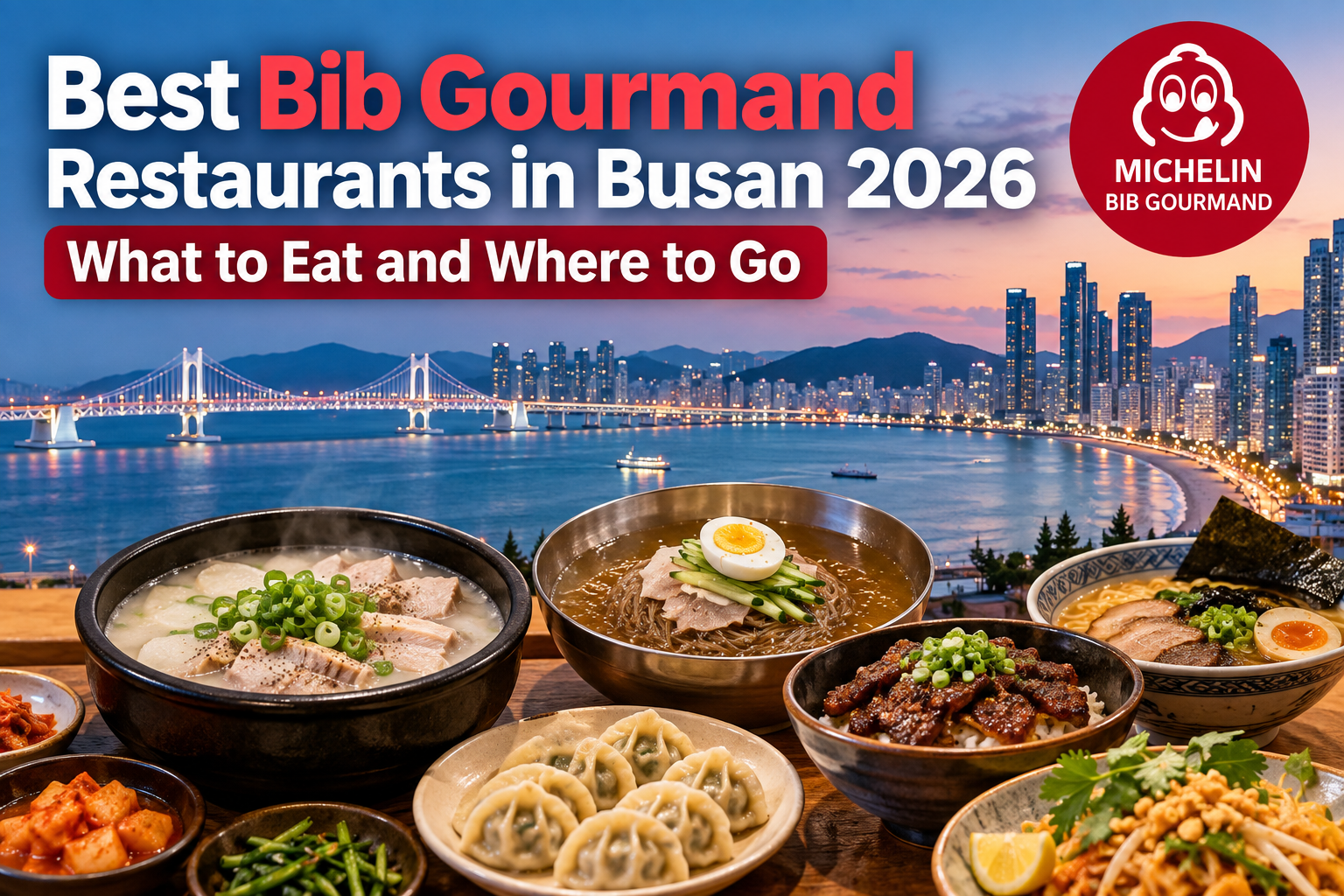
  • Best Bib Gourmand Restaurants in Busan 2026: What to Eat and Where to Go

    Best Bib Gourmand Restaurants in Busan 2026: What to Eat and Where to Go

    Busan has 20 Bib Gourmand restaurants in the 2026 Michelin Guide, but most travelers do not need a list of all 20.

    They need to know which ones actually fit their trip.

    If this is your first visit to Busan, start with the food you want to experience and the neighborhood already on your itinerary. A bowl of dwaeji-gukbap can make more sense than crossing the city for another highly rated restaurant, while travelers staying around Haeundae or Gwangalli have good Michelin-recognized options much closer to them.

    Quick answer: For a distinctly Busan meal, start with one of the Bib Gourmand restaurants specializing in dwaeji-gukbap. If you are staying around Haeundae, Buda Myeonoak or Haemok can be easier to work into your day. Around Gwangalli and Suyeong, Hanwolgwan, Anmok and other nearby selections give you several choices without a long detour. Travelers who want something other than Korean food can also find Taiwanese, Japanese, Thai, Italian and other cuisines in the 2026 selection.

    The goal of this guide is not to rank every Michelin Bib Gourmand restaurant from 1 to 20.

    It is to help you choose the right one for your Busan trip.

    Busan Bib Gourmand 2026: Quick Picks

    If you want…Start with…Why
    A classic Busan experienceDwaeji-gukbapOne of Busan’s signature local foods
    A meal around Gwangalli/SuyeongHanwolgwan or AnmokEasier to combine with the Gwangalli area
    A meal around HaeundaeBuda Myeonoak or HaemokUseful if Haeundae is already on your itinerary
    Something new in the 2026 GuideMoemiljip, Songheonjip or PyeongyangjipAll three are new Busan Bib Gourmand additions for 2026
    NoodlesMoemiljip, Buda Myeonoak or 100.1.PyeongnaengDifferent styles rather than one generic noodle choice
    Something other than Korean foodChoose by cuisine and neighborhoodThe list includes Japanese, Taiwanese, Thai and Italian options
    A vegetarian-friendly searchCheck the vegan/vegetarian selections firstThe Michelin selection includes vegan and vegetarian options
    A solo mealPrioritize simple meal-focused restaurantsOften easier than building your day around a formal dining experience

    The most important thing to notice is that “Bib Gourmand” does not describe one type of restaurant.

    Busan’s 2026 selection ranges from local soup and noodle shops to Japanese, Taiwanese, Thai, Italian and vegan restaurants.

    So choosing by Michelin status alone does not narrow the decision enough.

    What Does Bib Gourmand Mean in Busan?

    Bib Gourmand is Michelin’s recognition for restaurants offering good-quality cooking at good value.

    It is different from a Michelin Star.

    For travelers, that difference is useful.

    A Michelin-starred restaurant may become the centerpiece of an evening. A Bib Gourmand restaurant can often work much more naturally into an ordinary sightseeing day.

    That makes the category particularly useful in Busan, where you may be moving between areas such as Haeundae, Gwangalli, Seomyeon, Nampo and Yeongdo.

    In the 2026 Michelin Guide, Busan has 20 Bib Gourmand restaurants. Nineteen are placed in Michelin’s lower price category, while only one is shown in the next price category.

    This is why Bib Gourmand can be a good place to start if you want a recognized restaurant without turning every meal into a special-occasion expense.

    First Time in Busan? Start With Dwaeji-Gukbap

    If you only have time for one Michelin Bib Gourmand meal and want it to feel specifically connected to Busan, dwaeji-gukbap deserves serious consideration.

    Dwaeji-gukbap is pork soup served with rice and is one of the foods most strongly associated with Busan.

    The 2026 Michelin Bib Gourmand selection includes several restaurants specializing in it.

    That is actually more useful than having one obvious “winner.”

    Your best choice can depend on where you are staying.

    Anmok

    Anmok is in Suyeong-gu, making it a practical option if your day already includes the Gwangalli or Suyeong area.

    Choose it when you want a local Busan meal without adding a cross-city restaurant trip to your schedule.

    Jeongjitgan

    Jeongjitgan specializes in dwaeji-gukbap but is located in Saha-gu.

    That makes it more attractive when your itinerary takes you toward western Busan rather than when you are spending the entire day around Haeundae.

    Hapcheon Gukbapjip

    Another Bib Gourmand option for travelers specifically looking for Busan-style pork soup.

    The important decision here is not which restaurant has the most impressive label.

    It is which one fits the part of Busan you are actually visiting.

    Best Bib Gourmand Choices Around Gwangalli and Suyeong

    Gwangalli is one of the easiest areas for travelers to combine sightseeing with a Bib Gourmand meal.

    You can visit the beach, see Gwangan Bridge and build lunch or dinner into the same part of the day rather than traveling across Busan just for a restaurant.

    Hanwolgwan

    Hanwolgwan specializes in gomtang.

    This is a good option if you want a comforting Korean soup but would prefer something other than dwaeji-gukbap.

    It also works particularly well when Gwangalli is already part of your itinerary.

    Anmok

    Anmok is another strong choice in this part of the city if your priority is a more distinctly Busan meal.

    Choose Anmok over Hanwolgwan if dwaeji-gukbap itself is something you specifically want to try.

    Choose Hanwolgwan if you would rather have gomtang.

    That is a more useful distinction than simply asking which restaurant is “better.”

    100.1.Pyeongnaeng

    If you want noodles instead of soup with rice, this gives you another direction.

    Cold noodles can also be a welcome change if you have already eaten several heavier Korean meals during your trip.

    The larger point is that travelers staying near Gwangalli do not need to cross Busan simply because another Michelin restaurant appears higher on somebody’s ranking.

    You already have meaningful choices nearby.

    Best Bib Gourmand Choices Around Haeundae

    Haeundae is one of the most common bases for first-time Busan visitors, so location matters here.

    Buda Myeonoak

    Buda Myeonoak specializes in naengmyeon.

    It is a useful choice if you want a relatively straightforward meal that can fit between Haeundae sightseeing stops rather than planning an entire evening around dining.

    Haemok

    Haemok offers a different experience and is particularly relevant if you want Japanese cuisine rather than another Korean soup or noodle meal.

    It is also the exception travelers should notice when thinking about Bib Gourmand as uniformly inexpensive: Michelin currently places it in a higher price category than the other 19 Busan Bib Gourmand restaurants.

    So check the current menu before assuming every Bib Gourmand meal will cost roughly the same.

    Should You Stay in Haeundae Just to Eat at a Bib Gourmand?

    No.

    Choose Haeundae because it fits your overall Busan itinerary, not simply because it contains Michelin-listed restaurants.

    But if you are already staying there, using a nearby Bib Gourmand is often smarter than spending a large part of your afternoon traveling across the city for a restaurant with a similar level of recognition.

    Three New Busan Bib Gourmand Restaurants for 2026

    Three Busan restaurants joined the Bib Gourmand selection in 2026:

    Moemiljip, Songheonjip and Pyeongyangjip.

    These are particularly interesting for repeat visitors who have already tried some of Busan’s better-known Michelin selections.

    Moemiljip

    Moemiljip focuses on buckwheat noodles made with 100% Korean buckwheat.

    Its dishes include different preparations such as spicy mixed buckwheat noodles and perilla-oil or broth-based versions.

    Choose it if noodles are the main reason for your meal rather than simply looking for the newest Michelin restaurant.

    Songheonjip

    Songheonjip centers its meal around thick charcoal-grilled tteokgalbi served with rice, side dishes and doenjang-jjigae.

    This is the new 2026 addition I would look at if you want a fuller Korean meal rather than a noodle-focused stop.

    Pyeongyangjip

    Pyeongyangjip specializes in northern Korean-style mandu and also serves dishes such as mung-bean pancakes.

    It gives travelers another useful choice when they want Korean food but have already eaten gukbap, barbecue and noodles elsewhere on the trip.

    The “new for 2026” label is useful, but it should not be the only reason to choose one.

    Pick the food first.

    What If You Do Not Want Korean Food?

    One strength of Busan’s Bib Gourmand selection is its variety.

    The 2026 list is not limited to traditional Korean restaurants.

    Michelin currently categorizes restaurants in the Busan Bib Gourmand selection across cuisines including Japanese, Taiwanese, Thai, Italian, ramen, yakitori and freshwater eel.

    This can be useful on a longer Korea trip.

    After several days of Korean meals, you may simply want something different.

    For example, travelers spending time around Seomyeon can consider Bib Gourmand options in Busanjin-gu rather than automatically heading toward the beach districts for every notable meal.

    This is another reason to choose by neighborhood + cuisine, not by a universal ranking.

    Vegetarian or Vegan Travelers: Check the Restaurant, Not Just the Michelin Label

    Busan’s 2026 Bib Gourmand selection includes vegan and vegetarian-friendly options, but this is one area where travelers should check carefully before going.

    Michelin’s current filters show vegan and vegetarian options within the selection.

    However, “vegetarian options” does not necessarily mean every dish is vegetarian, and Korean broths, sauces and side dishes can contain ingredients that are not obvious from the menu name.

    If this matters to you, verify the current menu before visiting.

    A Michelin designation tells you about the restaurant’s cooking and value.

    It does not replace checking dietary requirements.

    Solo Travelers: Bib Gourmand Can Be Easier Than Fine Dining

    Solo travelers in Korea sometimes worry about restaurants that are designed around shared dishes.

    Bib Gourmand can be useful because several of the Busan selections revolve around individual meals such as soup, noodles or rice dishes.

    Michelin itself currently identifies several Busan Bib Gourmand restaurants as suitable for solo dining.

    Still, do not assume every restaurant operates the same way.

    If you are traveling alone, restaurants centered on gukbap, gomtang, naengmyeon, ramen or similar individual dishes are generally the easiest places to investigate first.

    Should You Travel Across Busan for a Michelin Bib Gourmand Restaurant?

    Usually, no.

    This is probably the most important practical advice in this guide.

    Busan is geographically spread out.

    A restaurant that looks close on a city map can require a substantial subway or bus journey from your sightseeing area.

    If two restaurants both interest you, choose the one that fits your route.

    For example:

    If you are spending the afternoon at Gwangalli, eat around Suyeong or Gwangalli.

    If you are staying around Haeundae, start with the Haeundae selections.

    If you are exploring Seomyeon, look at Busanjin-gu options.

    Only make a dedicated restaurant trip when the specific dish or restaurant itself is something you particularly want to experience.

    Michelin recognition alone is rarely a good reason to lose two hours of a short Busan itinerary.

    Lunch or Dinner: Which Is Better?

    For Bib Gourmand restaurants, lunch can often be easier to fit into a sightseeing itinerary.

    But opening days and service hours vary considerably.

    Do not build your schedule around the assumption that a restaurant serves continuously from lunch through dinner.

    Some restaurants have a break between services, some close on particular weekdays, and popular places may involve a wait.

    Check the restaurant’s current opening hours on the day you plan to visit.

    This is especially important if you are traveling across Busan specifically for that meal.

    Do You Need a Reservation?

    It depends on the restaurant.

    Bib Gourmand covers everything from casual meal-focused establishments to restaurants where planning ahead can be more useful.

    Do not assume that Michelin recognition automatically means formal reservations are required.

    Likewise, do not assume you can walk into every popular restaurant immediately at peak lunch or dinner time.

    For casual restaurants, arriving slightly outside the busiest meal period can sometimes be more useful than trying to build a complicated reservation strategy.

    For restaurants that accept bookings, check the restaurant’s current booking method before your trip.

    How I Would Choose a Busan Bib Gourmand Restaurant

    For a first Busan trip, use this order:

    1. Decide which neighborhood I will already be in.

    Avoid unnecessary cross-city travel.

    2. Decide whether I want a specifically Busan dish.

    If yes, dwaeji-gukbap is an obvious place to start.

    3. Check what I have already eaten on the trip.

    If you have already had several soup and rice meals, noodles, mandu or another cuisine may make the next meal more enjoyable.

    4. Check opening hours and current menu.

    Restaurant details change more quickly than Michelin selections.

    5. Only then compare individual restaurants.

    This reverses the way many “best restaurant” lists work, but it produces a much more practical travel plan.

    Bib Gourmand or Michelin-Starred Restaurant in Busan?

    Choose Bib Gourmand when you want a good meal to fit naturally into your sightseeing day.

    Choose a Michelin-starred restaurant when the dining experience itself is one of the major activities of your trip.

    Neither is automatically better.

    They solve different travel needs.

    A three-day first visit to Busan might easily include both: a casual local Bib Gourmand lunch one day and a planned fine-dining experience on another.

    Final Recommendation

    Busan’s 20 Bib Gourmand restaurants give travelers much more choice than a simple “best restaurants” ranking suggests.

    For a first visit, I would not try to collect Michelin restaurants.

    I would use the guide to improve meals that already fit the trip.

    Start with dwaeji-gukbap if you want a distinctly Busan experience.

    Choose Gwangalli/Suyeong or Haeundae options when those neighborhoods are already part of your sightseeing route.

    Look at Moemiljip, Songheonjip and Pyeongyangjip if you specifically want to explore the new 2026 additions.

    And if you have already eaten plenty of Korean food, use the broader Bib Gourmand selection to try something different rather than forcing another “must-eat” dish into the itinerary.

    The best Bib Gourmand restaurant in Busan is not necessarily the restaurant with the longest queue or the most recommendations.

    It is the one that gives you a meal you actually want without making the rest of your Busan trip worse.
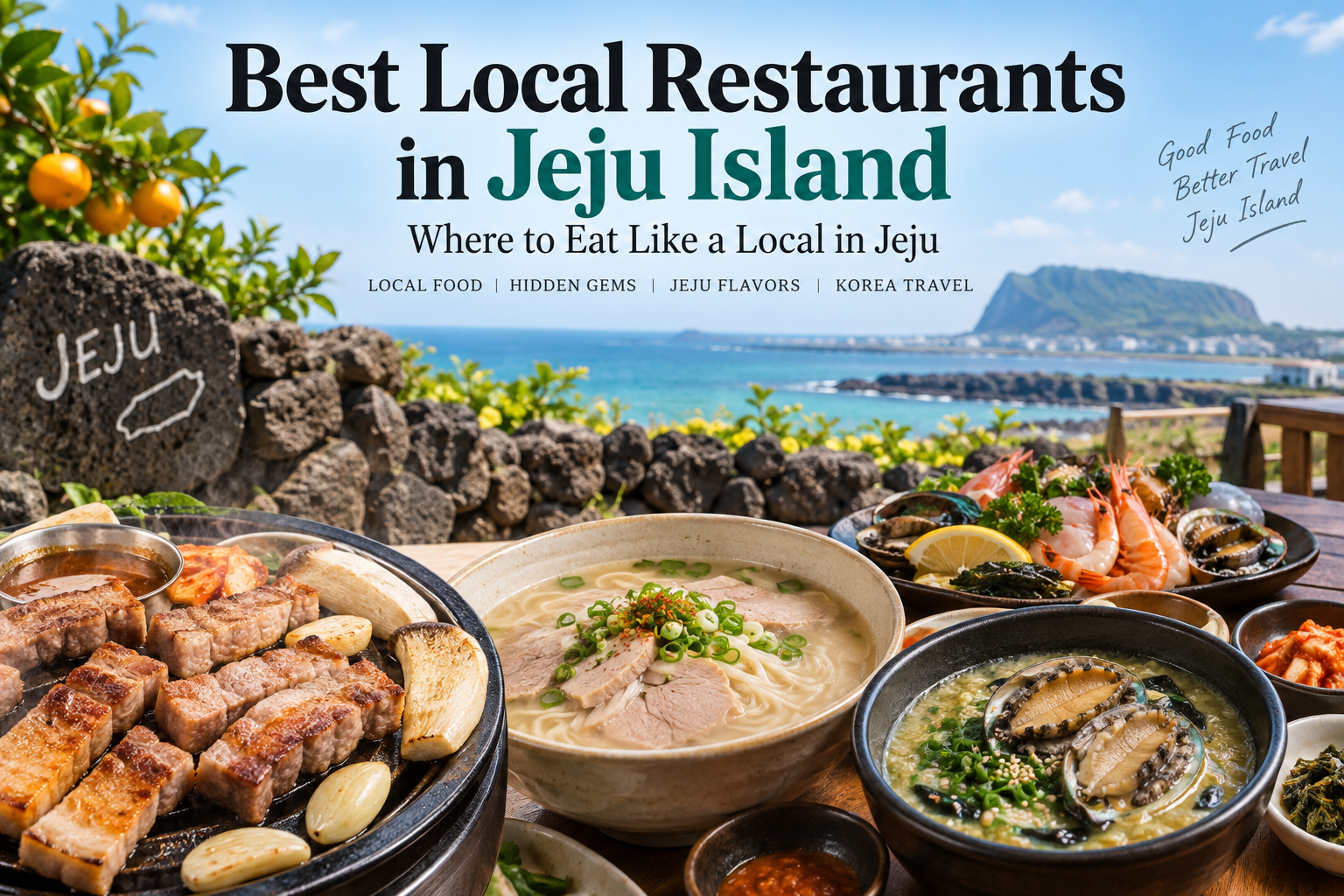
  • Best Local Restaurants in Jeju Island: Where to Eat Like a Local in Jeju

    Best Local Restaurants in Jeju Island: Where to Eat Like a Local in Jeju

    What Should You Eat in Jeju Island?

    Jeju Island has a food culture that feels different from mainland Korea.

    The island’s volcanic landscape, surrounding sea, fishing traditions, and history of raising pigs have shaped a cuisine built around ingredients such as black pork, seafood, seaweed, abalone, and locally prepared noodles.

    For first-time visitors, choosing where to eat can be difficult. Popular tourist areas are filled with restaurants, but some dishes are especially worth seeking out if you want to experience the flavors associated with Jeju.

    Here are some local restaurants and foods to consider during your trip.

    1. Woojin Haejangguk — Try Jeju-Style Momguk

    우진해장국

    4.1•한식당경로

    •064-757-3393

    One of the most distinctive dishes to try in Jeju is momguk, a traditional soup made with pork broth and gulfweed.

    Woojin Haejangguk in Jeju City is widely known for its Jeju-style dishes and is particularly associated with gosari haejangguk, a thick and savory soup made with bracken and meat.

    For international travelers, this is a useful place to experience a flavor that is very different from the Korean barbecue and bibimbap commonly found outside Korea.

    Its Jeju City location also makes it relatively convenient to include near the beginning or end of an island trip.

    What to try: Gosari haejangguk and traditional Jeju-style soup.

    Best for: Travelers interested in traditional local food and a hearty Korean breakfast.

    2. Ollae Guksu — A Classic Bowl of Jeju Gogi-Guksu

    올래국수 본점

    4.1•국수 전문점경로

    •064-742-7355

    Gogi-guksu, or pork noodles, is one of the easiest Jeju specialties for first-time visitors to enjoy.

    Ollae Guksu specializes in this Jeju-style noodle soup.

    The dish combines noodles, generous slices of pork, and a rich pork broth. Unlike many restaurants with long menus, Ollae Guksu has become particularly associated with this single local specialty.

    Jeju’s official tourism information describes its gogi-guksu as using medium-thick noodles, thick pork slices, and a savory bone broth.

    It is simple, filling, and an excellent introduction to Jeju comfort food.

    What to try: Gogi-guksu.

    Best for: First-time visitors, solo travelers, and anyone looking for an affordable local meal.

    3. Guksu Bada — Pork Noodles and More in Seogwipo

    Travelers staying in southern Jeju do not need to return to Jeju City to try local noodles.

    Guksu Bada in Seogwipo is another option for gogi-guksu.

    Its pork broth is simmered for more than 12 hours, while the restaurant makes and ages its own noodles. The menu also includes other dishes associated with Jeju, including dombe-gogi and momguk.

    This makes it particularly useful for travelers who want to sample several Jeju flavors during a Seogwipo itinerary.

    What to try: Gogi-guksu and dombe-gogi.

    Best for: Seogwipo travelers and visitors who want to explore several Jeju specialties.

    4. Sukseongdo — Jeju Black Pork Barbecue

    숙성도 제주본점

    4.8•숯불구이/바베큐전문점경로

    •064-743-8877

    No Jeju food trip feels complete without black pork barbecue.

    Jeju black pork is famous for its rich flavor and pleasantly chewy texture. Traditionally, grilled pork is often eaten with meljeot, a fermented anchovy sauce that adds a salty, savory contrast to the meat.

    Sukseongdo is a popular choice in Jeju City for travelers who want to experience aged pork prepared over charcoal.

    Korean barbecue is also a social meal, so this is especially enjoyable when traveling with a partner, friends, or family.

    What to try: A selection of aged Jeju pork cuts.

    Best for: Korean barbecue lovers and first-time visitors to Jeju.

    5. Ttungttanji Aewol — Black Pork on the Aewol Coast

    If your itinerary takes you toward Aewol, consider combining the coastal drive with a black pork meal.

    Ttungttanji Aewol Black Pork Main Branch has been operated across two generations and specializes in aged Jeju black pork. The meat is grilled for diners by restaurant staff.

    Aewol is already popular for its ocean scenery and cafés, so having a local pork meal here can fit naturally into a day exploring western Jeju.

    What to try: Aged black pork.

    Best for: Aewol road trips, couples, families, and groups.

    6. Sangchunjae — A Korean Meal Featuring Jeju Ingredients

    상춘재

    4.4•한식당웹사이트

    •경로

    •064-725-1557

    Travelers who want something other than barbecue or noodles can consider a more complete Korean-style meal.

    Sangchunjae in Jeju City is known as a Korean restaurant where visitors can experience dishes built around local ingredients.

    This type of meal is particularly useful for travelers who want to see how vegetables, seafood, rice, soups, and side dishes come together at a Korean table.

    Instead of focusing on one famous dish, the experience is about enjoying several flavors together.

    Best for: Couples, families, and travelers interested in Korean home-style dining.

    7. Try Abalone and Jeju Seafood

    양씨네 제주전복칼국수 본점

    4.6•해산물 요리 전문식당웹사이트

    •경로

    •064-721-1588

    Jeju is surrounded by the sea, so seafood deserves an important place in any island food itinerary.

    Abalone is one ingredient closely associated with Jeju dining.

    Travelers can find it prepared in porridge, rice dishes, soups, grilled dishes, and noodle dishes.

    At Yangssine Jeju Abalone Kalguksu in Jeju City, seafood lovers can try an abalone-focused version of Korean knife-cut noodles.

    This can be a good alternative for travelers who want a warm, comforting seafood meal rather than raw fish.

    What to try: Abalone kalguksu.

    Best for: Seafood lovers and travelers looking for a comforting lunch.

    8. Black Pork and Seafood in Seogwipo

    Jeju’s food culture does not require choosing between meat and seafood.

    Some restaurants combine the two.

    Black Pork & Seafood Samhap near Seogwipo’s Olle Market serves combinations of black pork and seafood, including octopus and other seafood ingredients.

    This type of meal can be fun for groups because several Jeju flavors arrive at the table together.

    After eating, visitors can continue exploring Seogwipo and its traditional market area.

    Best for: Groups, adventurous eaters, and travelers exploring central Seogwipo.

    Foods Every First-Time Jeju Visitor Should Know

    Even if you do not visit every restaurant in this guide, there are several Jeju foods worth remembering.

    Heukdwaeji means Jeju black pork. Try it grilled and, if available, dip it into meljeot.

    Gogi-guksu is Jeju-style pork noodle soup.

    Dombe-gogi is boiled pork traditionally served on a wooden cutting board called a dombe in the Jeju dialect.

    Momguk is a traditional pork and gulfweed soup.

    Jeonbok, or abalone, appears in porridge, rice, noodles, and many seafood dishes.

    Jeju is also known for fresh fish and other seafood that reflects its island environment.

    Jeju City or Seogwipo: Which Is Better for Food?

    You can eat well in both.

    Jeju City is especially convenient for travelers arriving through Jeju International Airport and offers everything from traditional soup and pork noodles to black pork barbecue and seafood.

    Seogwipo is an excellent base for combining local restaurants with markets, waterfalls, coastal attractions, and southern Jeju sightseeing.

    Aewol and western Jeju work particularly well for travelers who want to combine restaurants with coastal drives and cafés.

    Rather than driving across the island for one famous restaurant, it is usually better to choose good local food near the area you are already exploring.

    Tips for Eating at Local Restaurants in Jeju

    Restaurant hours and closing days can change, so check current information on the day you visit.

    Some famous restaurants may have long lines during lunch, dinner, weekends, and Korean holiday periods.

    At Korean barbecue restaurants, minimum orders may apply, particularly when ordering meat.

    Smaller local restaurants may also have limited English menus, although translation apps make ordering much easier than it once was.

    And do not be afraid to try something unfamiliar.

    Some of Jeju’s most memorable dishes are very different from the Korean foods international visitors already know.

    Local Restaurant or Michelin Restaurant?

    They offer different experiences.

    A local restaurant may specialize in one dish that residents have eaten for generations, while a Michelin-recognized restaurant may interpret Jeju ingredients through a more refined or contemporary style.

    Neither is necessarily more “authentic” than the other.

    They simply show different sides of Jeju’s evolving food culture.

    In a separate guide, we will explore Michelin-recognized dining and other notable restaurants for travelers looking for a more curated culinary experience.

    Final Thoughts

    Eating in Jeju is one of the best ways to understand the island.

    Black pork reflects Jeju’s agricultural traditions. Seafood connects the table to the surrounding ocean. Gogi-guksu and momguk reveal a simpler, comforting side of local cooking.

    Do not spend your entire trip searching only for the most famous restaurant on social media.

    Instead, try several kinds of Jeju food as you travel around the island.

    A bowl of pork noodles in Jeju City, black pork after an Aewol coastal drive, or a seafood meal in Seogwipo can become as memorable as any major tourist attraction.

    And after exploring Jeju’s local food, there is another side of the island worth discovering: its growing café culture.

    From ocean-view cafés in Aewol to quiet spaces hidden among stone walls and tangerine fields, Jeju has become one of Korea’s most interesting café destinations.


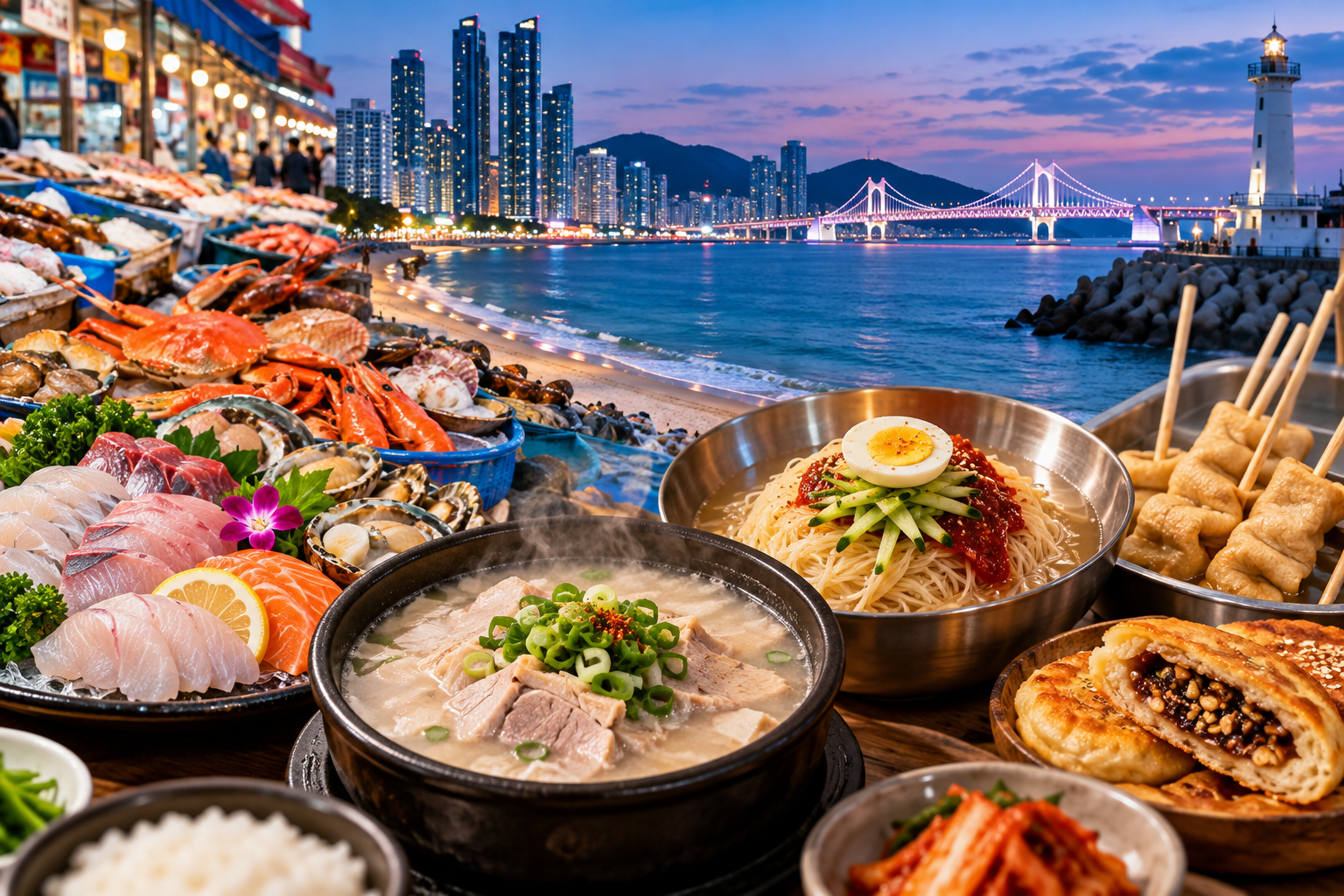
  • Best Restaurants in Busan: Must-Try Korean Food and Local Favorites

    Best Restaurants in Busan: Must-Try Korean Food and Local Favorites

    Busan is one of the best cities in South Korea for travelers who love food.

    As Korea’s largest coastal city, Busan is famous for fresh seafood, but the local food scene goes far beyond fish markets. Pork soup with rice, wheat noodles, Korean-style raw fish, traditional market food, and neighborhood restaurants are all part of the experience.

    For first-time visitors, deciding what and where to eat can be difficult because Busan is a large city and many famous restaurants are spread across different neighborhoods.

    This guide introduces some of the foods and restaurants worth experiencing in Busan, with practical information including addresses, phone numbers, locations, and what to order.

    1. Songjeong Samdae Gukbap – Classic Dwaeji Gukbap in Seomyeon

    One of the first foods visitors should try in Busan is dwaeji gukbap, a comforting bowl of pork broth served with pork and rice.

    Songjeong Samdae Gukbap is located in Seomyeon’s famous Dwaeji Gukbap Alley and has a long history in the neighborhood.

    Address:
    33 Seomyeon-ro 68beon-gil, Busanjin-gu, Busan, South Korea

    Phone:
    +82-51-806-5722

    What to try:
    Dwaeji gukbap, sundae gukbap, suyuk, and chapssal sundae.

    The broth is known for being milky yet relatively clean in flavor, making this a good introduction to Busan-style pork soup.

    Seomyeon is also one of the most convenient dining areas for travelers because it combines restaurants, shopping, cafés, nightlife, and excellent public transportation.

    Best for

    First-time visitors, solo travelers, budget-conscious travelers, and anyone who wants to try one of Busan’s signature dishes.

    2. Eom Yongbaek Dwaejigukbap – A Modern Take on a Busan Classic

    For travelers who want to compare different styles of pork soup, Eom Yongbaek Dwaejigukbap is another interesting choice.

    The restaurant serves both Busan-style and Miryang-style versions of dwaeji gukbap, giving visitors a chance to experience how this familiar Korean dish can vary.

    Address:
    1F, 39 Suyeong-ro 680beon-gil, Suyeong-gu, Busan, South Korea

    Phone:
    +82-51-757-8092

    What to try:
    Busan-style dwaeji gukbap, Miryang-style dwaeji gukbap, and steamed pork.

    The restaurant is also known for its steamed pork served with accompaniments such as tofu, chives, and garlic.

    Best for

    Food-focused travelers and visitors who want to explore different interpretations of Busan’s famous pork soup.

    3. Hapcheon Gukbapjip – Clear-Broth Pork Soup Loved in Busan

    Not every bowl of Busan pork soup looks the same.

    Hapcheon Gukbapjip in Nam-gu is known for a clearer, lighter-looking broth and generous portions of pork.

    Address:
    235 Yongho-ro, Nam-gu, Busan, South Korea

    Phone:
    +82-51-628-4898

    What to try:
    Dwaeji gukbap and steamed pork.

    This is a useful restaurant for travelers who want to go beyond the most tourist-oriented neighborhoods and experience a well-known local version of the dish.

    Hapcheon Gukbapjip is also included in the MICHELIN Guide’s Busan selection, demonstrating how seriously this seemingly simple local dish is taken in the city.

    Best for

    Local-food enthusiasts, repeat visitors, and travelers interested in traditional Busan dishes.

    4. Yeongjin Dwaeji Gukbap – Famous for Suyuk Baekban

    Yeongjin Dwaeji Gukbap is another popular name in Busan’s pork-soup culture.

    Located in Saha-gu, it is particularly well known for suyuk baekban, a set meal featuring steamed pork.

    Address:
    39 Hasinbeonyeong-ro 157beon-gil, Saha-gu, Busan, South Korea

    Phone:
    +82-507-1374-3820

    What to try:
    Suyuk baekban and dwaeji gukbap.

    For visitors who enjoy exploring restaurants outside Busan’s main tourist districts, this can be an interesting addition to a food-focused itinerary.

    Best for

    Travelers who want a more local dining experience and anyone who enjoys boiled or steamed pork dishes.

    5. Jagalchi Market – The Classic Busan Seafood Experience

    No Busan food guide would be complete without seafood.

    Jagalchi Market is one of the city’s best-known food destinations and remains an essential stop for many first-time visitors.

    Rather than thinking of Jagalchi as a single restaurant, think of it as an entire seafood district.

    Visitors can see tanks filled with live seafood, explore the market, and choose from numerous seafood restaurants and vendors in the surrounding area.

    Popular choices may include Korean-style raw fish known as hoe, shellfish, grilled fish, seafood soups, and seasonal catches.

    Best for

    Seafood lovers, first-time visitors, market explorers, and travelers who want one of Busan’s most recognizable food experiences.

    Travel tip

    Prices and available seafood can vary according to season and vendor. Ask about the price before ordering, particularly when choosing seafood sold by weight.

    6. Gwangalli – Seafood With a View

    Gwangalli is another excellent area for food lovers.

    The neighborhood surrounding Gwangalli Beach is filled with seafood restaurants, Korean restaurants, bars, cafés, and modern dining spots.

    What makes the area special is the view.

    In the evening, restaurants around the waterfront can offer beautiful views toward Gwangan Bridge, making dinner part of the sightseeing experience.

    For travelers who want seafood without the traditional market atmosphere of Jagalchi, Gwangalli can be an appealing alternative.

    Best for

    Couples, evening dining, seafood lovers, and travelers who enjoy restaurants with coastal views.

    7. Try Milmyeon – Busan’s Famous Wheat Noodles

    Another food closely associated with Busan is milmyeon.

    The dish features wheat noodles and is commonly served either in a chilled broth or mixed with a spicy sauce.

    It can be especially refreshing during Busan’s hot and humid summer.

    You may see two common versions:

    Mul milmyeon – noodles served in cold broth.

    Bibim milmyeon – noodles mixed with a spicy sauce.

    Rather than visiting Busan and eating only Korean barbecue or seafood, trying milmyeon gives travelers another taste of the city’s distinctive food history.

    Best for

    Summer travelers, noodle lovers, budget travelers, and anyone interested in regional Korean dishes.

    8. Nampo-dong and BIFF Square – Street Food and Casual Eating

    For casual eating, head toward Nampo-dong and BIFF Square.

    This part of Busan is ideal for travelers who prefer tasting several small foods rather than sitting down for one large meal.

    One of the best-known Busan snacks is ssiat hotteok, a sweet Korean pancake filled with seeds.

    You may also encounter tteokbokki, fish cakes, dumplings, fried foods, and other Korean street-food favorites.

    The nearby Gukje Market and Jagalchi area make it easy to combine sightseeing and food exploration.

    Best for

    Street-food lovers, families, budget travelers, and first-time visitors.

    9. Busan Eomuk – More Than Ordinary Fish Cake

    Busan is famous throughout Korea for eomuk, or fish cake.

    Although fish cake can be found everywhere in Korea, Busan has a particularly strong association with it because of the city’s history as a major port.

    Modern Busan fish-cake shops sell much more than the traditional skewers served in broth.

    Travelers may encounter fish cakes filled with cheese, vegetables, seafood, or other ingredients, as well as gift boxes designed for travelers.

    Trying warm eomuk while exploring a market is one of the simplest ways to experience everyday Busan food culture.

    10. Traditional Markets – Where Busan’s Food Culture Comes Alive

    Some of the most memorable food experiences in Busan happen in markets rather than famous restaurants.

    Gukje Market, Bupyeong Kkangtong Market, and the neighborhoods around Jagalchi provide opportunities to try numerous Korean dishes in a relatively small area.

    Bupyeong Kkangtong Market is particularly interesting in the evening, when visitors can explore a lively collection of snacks and street foods.

    Markets are also useful for travelers who are unfamiliar with Korean cuisine because you can see many foods before deciding what to order.

    What Food Is Busan Most Famous For?

    If you have only a short time in the city, start with a few dishes that strongly represent Busan.

    Dwaeji gukbap is one of the most important.

    Then try milmyeon, fresh or grilled seafood, Busan eomuk, and ssiat hotteok.

    Together, these foods provide a much broader introduction to Busan than eating only at internationally familiar restaurants.

    Which Area Is Best for Food in Busan?

    Different neighborhoods offer different experiences.

    Choose Seomyeon for pork soup, casual restaurants, nightlife, and easy transportation.

    Choose Jagalchi and Nampo-dong for seafood, markets, traditional food, and street snacks.

    Choose Gwangalli for seafood, cafés, restaurants, and evening views of Gwangan Bridge.

    Choose Haeundae for the widest combination of tourist-friendly restaurants, cafés, bars, hotels, and beachside dining.

    Exploring more than one neighborhood is the best way to understand Busan’s food culture.

    Tips for Eating at Local Restaurants in Busan

    Many traditional Korean restaurants specialize in only a few dishes. A short menu is therefore not necessarily a disadvantage.

    At popular restaurants, expect queues during lunch and dinner.

    Some smaller restaurants may have limited English information, so having the Korean name of the dish available on your phone can be useful.

    Restaurant hours, prices, menus, and closing days can change, so check current information before making a special trip.

    And when visiting seafood markets, confirm prices before ordering.

    Busan Beyond Local Food

    Busan is no longer only a destination for markets and traditional Korean dishes.

    The city also has a growing contemporary and fine-dining scene. The MICHELIN Guide now publishes a Seoul & Busan edition, with restaurants across Busan ranging from local specialties to contemporary cuisine.

    That side of the city deserves its own guide, so we will explore Busan’s MICHELIN restaurants separately.

    Final Thoughts

    Busan is a city that rewards travelers who arrive hungry.

    A bowl of dwaeji gukbap in a neighborhood restaurant, cold milmyeon on a summer afternoon, seafood near the harbor, and street food in Nampo-dong can reveal as much about the city as its beaches and famous landmarks.

    For first-time visitors, do not worry about finding only the most expensive or fashionable restaurant.

    Start with the foods Busan is known for, explore different neighborhoods, and allow some room in your itinerary for unexpected local discoveries.

    That is often where the best Busan food memories begin.


  • Best Restaurants in Seoul: Must-Try Korean Food and Local Favorites

    Best Restaurants in Seoul: Must-Try Korean Food and Local Favorites

    Food is one of the best reasons to visit Seoul.

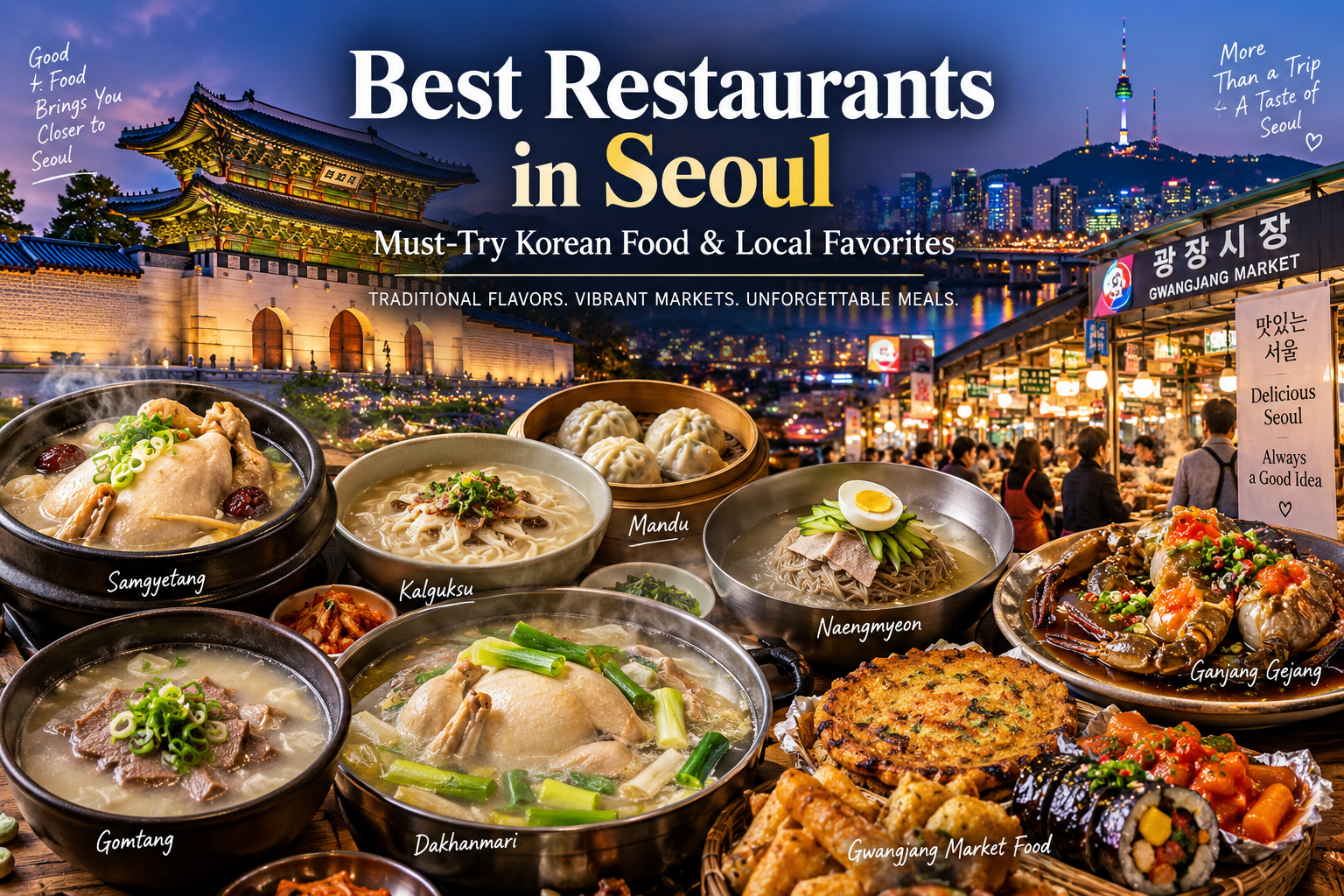
    The city offers everything from decades-old soup restaurants and traditional chicken dishes to handmade noodles, Korean barbecue, marinated crab and busy market food stalls.

    For first-time visitors, however, deciding where to eat can be difficult. Seoul is enormous, and thousands of restaurants compete for attention.

    This guide focuses on places where travelers can experience some of Korea’s most recognizable dishes while exploring different neighborhoods of Seoul.

    Addresses, telephone numbers and practical information are included to make planning easier.

    1. Tosokchon Samgyetang – Traditional Ginseng Chicken Soup Near Gyeongbokgung

    Tosokchon Samgyetang is one of Seoul’s best-known restaurants for samgyetang, a traditional Korean soup made with a whole young chicken filled with ingredients such as glutinous rice, garlic, jujube and ginseng.

    The restaurant has operated near Gyeongbokgung Palace since 1983, and its traditional hanok-style setting adds to the experience. Seoul’s official tourism guide continues to list it as a samgyetang specialty restaurant and notes that multilingual menus are available.

    Signature dish: Samgyetang (Ginseng Chicken Soup)
    Address: 5 Jahamun-ro 5-gil, Jongno-gu, Seoul 03041, South Korea
    Telephone: +82-2-737-7444
    Price level: ₩₩
    Best for: First-time visitors, traditional Korean food and lunch after palace sightseeing.

    Nearby attractions: Gyeongbokgung Palace, Seochon, Gwanghwamun and Tongin Market.

    Why Eat Here?

    Samgyetang is particularly associated with Korea’s summer food culture. Koreans traditionally eat the hot, nourishing soup during the hottest days of summer—a custom connected with the idea of fighting heat with heat.

    Combining Gyeongbokgung Palace, Seochon and a samgyetang lunch makes an excellent half-day Seoul itinerary.

    2. Myeongdong Kyoja – Kalguksu and Mandu in the Heart of Myeongdong

    Myeongdong Kyoja has been serving diners since 1966 and is famous for a remarkably small menu centered on kalguksu, handmade noodle soup, and mandu, Korean dumplings.

    Its location makes it particularly convenient for travelers exploring Myeongdong.

    The kalguksu combines soft noodles with a rich, savory broth, while the dumplings are another long-standing favorite.

    Signature dishes: Kalguksu and Mandu
    Address: 29 Myeongdong 10-gil, Jung-gu, Seoul 04537, South Korea
    Telephone: +82-2-776-5348
    Price level: ₩
    Best for: Budget-friendly Korean food, noodle lovers and Myeongdong visitors.

    Nearby attractions: Myeongdong, Namsan, Namdaemun Market and central Seoul.

    Why Eat Here?

    This is the kind of restaurant that works particularly well for first-time travelers because the menu is easy to understand and the food represents a familiar side of everyday Korean dining.

    Seoul’s official tourism guide currently lists the restaurant as operating daily and identifies kalguksu as its specialty.

    3. Hadongkwan – Historic Seoul-Style Gomtang

    Hadongkwan is one of Seoul’s classic restaurants for gomtang, a clear beef soup served with rice.

    The restaurant dates back to 1939 and has become a long-standing Myeongdong institution. Its menu remains focused on gomtang and suyuk, or boiled beef.

    Unlike heavily seasoned soups, the attraction here is the clean but deep beef flavor.

    Signature dish: Gomtang
    Address: 12 Myeongdong 9-gil, Jung-gu, Seoul 04538, South Korea
    Telephone: +82-2-776-5656
    Price level: ₩
    Best for: Traditional Seoul food, breakfast or an early lunch.

    Nearby attractions: Myeongdong, Euljiro, Cheonggyecheon Stream and Seoul City Hall.

    Travel Tip

    Hadongkwan opens early and traditionally stops serving when the day’s prepared soup is sold out, so visiting earlier in the day is a sensible choice.

    4. Wonhalmae Wonjo Dakhanmari – A Dongdaemun Favorite

    Dakhanmari literally means “a whole chicken.”

    The dish is strongly associated with Dongdaemun, where restaurants serve whole chicken simmered at the table in broth. Diners typically eat the chicken first and then add noodles to the remaining broth.

    Wonhalmae Wonjo Dakhanmari is one of the restaurants associated with the origins of Dongdaemun’s famous Dakhanmari Street. Seoul’s official tourism guide currently lists its whole-chicken stew set for two among its signature offerings.

    Signature dish: Dakhanmari (Whole Chicken Stew)
    Address: 25 Jong-ro 40ga-gil, Jongno-gu, Seoul 03197, South Korea
    Telephone: +82-2-2279-2078
    Price level: ₩₩
    Best for: Couples, families and small groups.

    Nearby attractions: Dongdaemun, Gwangjang Market, DDP and Cheonggyecheon Stream.

    Why Eat Here?

    Dakhanmari is a social meal.

    The pot sits in the middle of the table, making it especially enjoyable when shared with another traveler or a group of friends.

    5. Woo Lae Oak – Pyongyang Naengmyeon Since 1946

    Woo Lae Oak is one of Seoul’s most established names for Pyongyang naengmyeon, cold buckwheat noodles served in a delicate broth.

    The restaurant has operated since 1946. Its broth is made from beef and is known for a restrained flavor that can seem surprisingly subtle to travelers encountering Pyongyang-style noodles for the first time.

    Bulgogi is another popular choice here and can be paired with naengmyeon.

    Signature dishes: Pyongyang Naengmyeon and Bulgogi
    Address: 62-29 Changgyeonggung-ro, Jung-gu, Seoul 04546, South Korea
    Telephone: +82-2-2265-0151
    Price level: ₩–₩₩
    Best for: Korean food enthusiasts and travelers interested in historic restaurants.

    Nearby attractions: Euljiro, Dongdaemun, Gwangjang Market and central Seoul.

    What Should You Expect?

    Pyongyang naengmyeon is not designed to overwhelm you with spice or sweetness.

    Its appeal is subtle. The broth, buckwheat noodles and meat create a restrained combination that becomes more interesting as you continue eating.

    6. Pro Soy Crab – Try Ganjang Gejang in Sinsa

    Pro Soy Crab is one of Seoul’s long-established restaurants specializing in ganjang gejang, raw crab marinated in soy sauce.

    The main restaurant in Sinsa dates back to 1980 and serves several crab and seafood dishes.

    Ganjang gejang has an intense combination of salty, sweet and rich seafood flavors. It is traditionally eaten with rice, which absorbs the seasoned crab sauce.

    Signature dish: Ganjang Gejang (Soy Sauce Marinated Crab)
    Address: 9 Gangnam-daero 97-gil, Seocho-gu, Seoul 06526, South Korea
    Telephone: +82-2-543-4126
    Price level: ₩₩₩
    Best for: Seafood lovers and adventurous first-time visitors.

    Nearby attractions: Sinsa, Garosu-gil, Gangnam and the Hangang River.

    Before Ordering Raw Crab

    Ganjang gejang is raw marinated seafood, so it may not suit every traveler.

    Visitors with shellfish allergies, pregnancy-related dietary restrictions or concerns about raw seafood should choose another dish.

    7. Jin Ok-Hwa Original Chicken Restaurant – Another Dongdaemun Classic

    Jin Ok-Hwa Original Chicken Restaurant is another famous name associated with Dongdaemun’s dakhanmari scene.

    The experience is casual and energetic: chicken cooks in a large pot at the table and diners customize dipping sauces before adding noodles or other ingredients later in the meal.

    Signature dish: Dakhanmari
    Address: 18 Jong-ro 40ga-gil, Jongno-gu, Seoul, South Korea
    Telephone: +82-2-2275-9666
    Price level: ₩–₩₩
    Best for: Groups, casual dining and travelers exploring Dongdaemun.

    Nearby attractions: Dongdaemun Market, Gwangjang Market, DDP and Cheonggyecheon Stream.

    8. Gwangjang Market – For a Korean Street-Food Experience

    Not every memorable Seoul meal needs to happen inside a traditional restaurant.

    Gwangjang Market is one of the best places for travelers to experience several Korean foods in one area.

    Popular foods include bindaetteok (mung bean pancakes), mayak gimbap (small seaweed rice rolls), yukhoe (Korean-style raw beef) and various noodles, dumplings and market snacks.

    Instead of choosing one large meal, walk through the market and try several smaller dishes.

    Area: Jongno-gu, Seoul
    Price level: ₩
    Best for: Street-food lovers, first-time visitors and travelers who enjoy busy traditional markets.

    Nearby attractions: Jongmyo Shrine, Dongdaemun, Cheonggyecheon Stream and Euljiro.

    Market Tip

    Bring an appetite but do not order too much at the first stall.

    One of the pleasures of Gwangjang Market is trying several different foods as you walk.

    What Korean Foods Should First-Time Visitors Try?

    If this is your first trip to Seoul, do not feel that you need to try everything in one day.

    Start with a few representative dishes.

    Try samgyetang for traditional chicken soup, kalguksu for handmade noodles, gomtang for a classic Seoul beef soup, dakhanmari for a shared meal, and Korean barbecue for one of the country’s most social dining experiences.

    Then explore dishes such as naengmyeon, bibimbap, tteokbokki, mandu and ganjang gejang as your trip continues.

    What About Korean BBQ?

    Korean barbecue deserves its own guide.

    Seoul has everything from inexpensive neighborhood pork barbecue restaurants to premium Hanwoo beef establishments.

    Instead of adding one random barbecue restaurant to this list, a dedicated Seoul Korean BBQ guide will allow us to compare neighborhoods, meat types, prices and ordering styles properly.

    For first-time visitors, remember that many barbecue restaurants expect at least two portions of meat to be ordered, although policies vary by restaurant.

    Where Should Food Lovers Stay in Seoul?

    Jongno is an excellent base for traditional Korean food, markets and historic sightseeing.

    Myeongdong and Euljiro combine famous restaurants with convenient transportation and central sightseeing.

    Hongdae and Yeonnam-dong are good choices for younger dining culture, casual restaurants, cafés and nightlife.

    Gangnam, Sinsa and Apgujeong offer everything from Korean barbecue to contemporary restaurants and luxury dining.

    Your hotel location can therefore influence your food experience almost as much as your restaurant choices.

    Traditional Restaurants vs. Michelin Dining

    Seoul’s food culture operates on many levels.

    A bowl of soup from a restaurant that has served generations of Seoul residents can be just as meaningful as a carefully designed tasting menu.

    That is why this guide focuses primarily on traditional and accessible restaurants.

    Seoul also has an increasingly important fine-dining scene, including restaurants recognized by the MICHELIN Guide. We will explore those restaurants separately in our dedicated guide to Michelin dining in Seoul.

    How Much Does Eating in Seoul Cost?

    Seoul can accommodate very different food budgets.

    Market snacks and simple noodle dishes can be relatively inexpensive, while Korean barbecue, premium seafood and high-end dining can cost considerably more.

    Prices also change over time, so travelers should check the restaurant’s current menu rather than relying entirely on older online price lists.

    A useful strategy is to mix inexpensive local meals with one or two special dining experiences.

    Restaurant Etiquette for First-Time Visitors

    At many Korean restaurants, side dishes called banchan are served automatically.

    Water and utensils may be self-service in casual restaurants, while table service is more common at higher-end establishments.

    Some restaurants specialize in only one or two dishes. A small menu is not necessarily a disadvantage—in Korea, it can be a sign that a restaurant has spent decades focusing on one specialty.

    Busy traditional restaurants may also expect customers to eat and leave relatively quickly, particularly during peak lunch periods.

    A Simple Seoul Food Day

    A food-focused day in central Seoul could begin with a traditional beef soup in Myeongdong, continue with market snacks at Gwangjang Market and finish with dakhanmari near Dongdaemun.

    Another day could combine Gyeongbokgung Palace with samgyetang in Seochon before heading to Sinsa or Gangnam for dinner.

    Planning meals around neighborhoods reduces unnecessary travel and gives you more time to experience the city.

    Before You Visit

    Restaurant hours, prices, holidays and menus can change.

    Popular restaurants may also have long lines during lunch, dinner, weekends and holidays.

    Check the latest information before traveling across the city specifically for one restaurant. For particularly popular places, arriving outside peak meal times can make the experience easier.

    Final Thoughts

    The best way to understand Seoul is not only through palaces, museums and neighborhoods.

    It is also through food.

    A bowl of gomtang in a restaurant that has survived for generations, noodles in crowded Myeongdong, chicken bubbling in a Dongdaemun pot or a few dishes shared at a traditional market can reveal a side of Seoul that sightseeing alone cannot provide.

    Do not simply ask, “What is the most famous restaurant in Seoul?”

    Ask instead, “What part of Seoul do I want to taste today?”

    That question can lead to some of the best memories of your trip.


  • Must-Try Korean Snacks and Drinks You Can Find in Korea

    Must-Try Korean Snacks and Drinks You Can Find in Korea

    Korean Snacks and Drinks Are Part of the Travel Experience

    Traveling in South Korea is not only about visiting palaces, temples, mountains, and famous restaurants.

    Sometimes, one of the most memorable parts of a trip can be something as simple as walking into a Korean convenience store and discovering a snack or drink you have never tried before.

    Convenience stores and supermarkets across Korea are filled with colorful drinks, sweet snacks, ice cream, chips, and traditional beverages.

    Many Korean products are now available overseas, but trying them in Korea is still part of the fun.

    Here are some Korean snacks and drinks worth looking for during your trip.

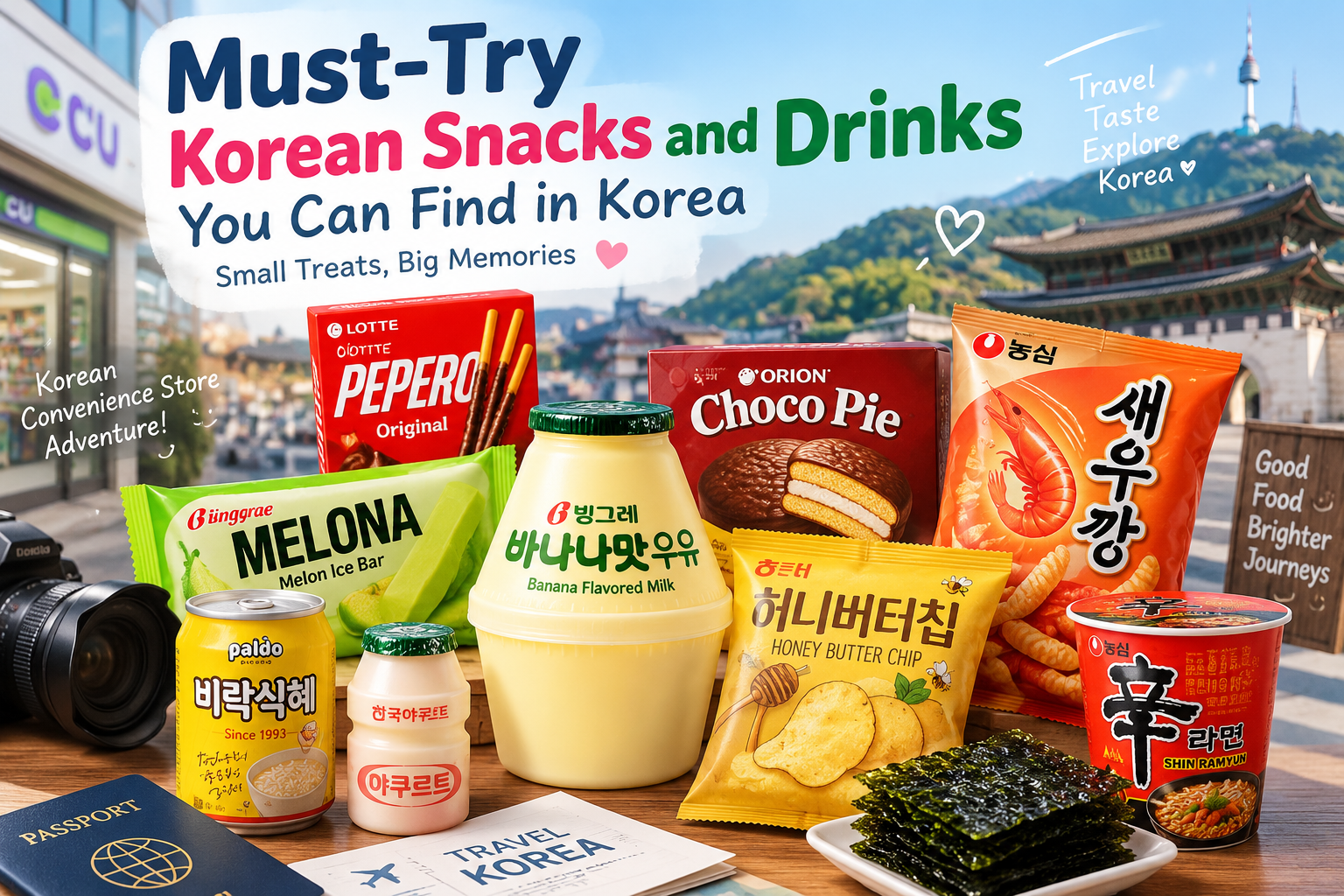
    1. Banana Flavored Milk

    One of the most iconic drinks to try in Korea is Binggrae Banana Flavored Milk.

    First released in 1974, the drink is easily recognized by its small round container inspired by the shape of a traditional Korean moon jar.

    The flavor is sweet, creamy, and gently fruity rather than tasting strongly of fresh banana.

    It has remained a familiar part of Korean convenience-store culture for decades and is easy to find in convenience stores and supermarkets.

    For many international visitors, grabbing a bottle of banana milk from a convenience store has become a small but memorable Korean travel experience.

    Where to find it: Convenience stores and supermarkets
    What it tastes like: Sweet, creamy, and mildly banana-flavored
    Try it if: You enjoy flavored milk or want to try one of Korea’s best-known convenience-store drinks

    2. Melona

    Melona is a popular Korean ice cream bar known for its soft, creamy texture and melon flavor.

    The original melon variety is the classic choice, although other flavors are also available.

    Its refreshing sweetness makes it particularly enjoyable during Korea’s hot and humid summers.

    You can usually find Melona in convenience-store and supermarket freezers.

    Where to find it: Convenience stores and supermarkets
    What it tastes like: Creamy, sweet, and fruity
    Try it if: You want a simple Korean ice cream treat

    3. Pepero

    Pepero is one of Korea’s most recognizable snacks.

    These thin biscuit sticks are coated with chocolate or other flavors and come in many varieties.

    Depending on the store, you may find almond, cookies-and-cream, white chocolate, and other versions alongside the classic chocolate variety.

    Pepero is easy to carry, making it a convenient snack for train rides or sightseeing days.

    It can also be an inexpensive edible souvenir to take home.

    Where to find it: Convenience stores, supermarkets, and souvenir shops
    What it tastes like: Crisp biscuit with a sweet coating
    Try it if: You want an easy snack to share with friends

    4. Choco Pie

    Choco Pie is another classic Korean snack familiar to generations of Koreans.

    It consists of two small cake layers with a soft marshmallow filling, covered in chocolate.

    The combination of cake, chocolate, and marshmallow makes it richer than an ordinary cookie.

    Boxes containing individually wrapped Choco Pies are widely available in supermarkets, which also makes them convenient for sharing.

    Where to find it: Supermarkets and convenience stores
    What it tastes like: Soft, chocolatey, and sweet
    Try it if: You like chocolate-covered cakes

    5. Honey Butter Chips

    Honey Butter Chips became a famous snack trend in Korea thanks to their unusual combination of salty potato chips, honey-like sweetness, and buttery flavor.

    Instead of being purely salty, the chips combine sweet and savory flavors.

    That combination can be surprising at first, but it is exactly what makes the snack interesting.

    Where to find it: Convenience stores and supermarkets
    What it tastes like: Sweet, buttery, salty, and crispy
    Try it if: You enjoy sweet-and-savory snacks

    6. Saewookkang – Korean Shrimp Crackers

    Saewookkang is a long-running Korean savory snack made with shrimp flavor.

    The crackers are light and crunchy with a salty seafood taste.

    They are quite different from Korea’s sweeter snacks and are a good option if chocolate and candy are not your preference.

    Where to find it: Convenience stores and supermarkets
    What it tastes like: Salty, savory, crunchy, and slightly seafood-flavored
    Try it if: You prefer savory snacks

    7. Sikhye

    If you want to try something more traditional, look for sikhye.

    Sikhye is a traditional Korean sweet rice drink made using malt and rice.

    It has a gentle sweetness and may contain small grains of cooked rice at the bottom of the container.

    Traditionally served as a dessert drink, sikhye offers a very different experience from soda or flavored milk.

    Packaged versions are widely available, making it easy for travelers to try.

    Where to find it: Convenience stores, supermarkets, traditional markets, and some Korean restaurants
    What it tastes like: Lightly sweet with a distinctive grain flavor
    Try it if: You want to experience a traditional Korean beverage

    8. Korean Yogurt Drinks

    Small bottles of yogurt drinks are another familiar sight in Korea.

    They are usually sweet, slightly tangy, and easy to drink in just a few sips.

    Korean supermarkets and convenience stores now carry many different yogurt and fermented-milk products, so visitors can choose from both classic and modern varieties.

    Where to find them: Convenience stores and supermarkets
    What they taste like: Sweet, creamy, and slightly tangy
    Try them if: You enjoy yogurt or fermented milk drinks

    9. Korean Seaweed Snacks

    Seaweed is an important part of Korean food culture, but it is not only served with meals.

    Small packages of roasted seaweed can also be eaten as a light snack.

    They are usually thin, crispy, salty, and sometimes seasoned with sesame oil.

    Because the packages are lightweight, seaweed snacks can also be an easy food souvenir.

    Where to find them: Supermarkets, convenience stores, and traditional markets
    What they taste like: Salty, crispy, and savory
    Try them if: You prefer lighter savory snacks

    10. Korean Convenience Store Ramen

    Instant ramen is much more than emergency food in Korea.

    Convenience stores often allow customers to prepare cup noodles using hot water, and some locations provide seating where you can eat immediately.

    There are countless varieties, ranging from mild soups to extremely spicy noodles.

    For travelers, choosing an unfamiliar ramen package and eating it at a Korean convenience store can be an inexpensive and enjoyable experience.

    If you are sensitive to spicy food, check the package carefully before choosing.

    Where to find it: Almost every convenience store and supermarket
    What it tastes like: Depends on the variety, from mild and savory to extremely spicy
    Try it if: You want an inexpensive Korean convenience-store meal

    A Fun Combination: Banana Milk and Coffee

    Banana milk can also be used in a more unusual way.

    Some convenience-store visitors combine banana-flavored milk with an espresso shot over ice to create a simple banana milk latte.

    The result combines the sweetness of banana milk with the bitterness and aroma of coffee.

    It is an easy example of how Korean convenience stores can become part of the travel experience rather than simply places to buy necessities.

    Where Can Travelers Buy Korean Snacks?

    The easiest places to find these foods are convenience stores and supermarkets.

    Convenience stores are particularly useful because they are common throughout Korean cities and often stay open late.

    Larger supermarkets offer a wider selection and can be better if you want to buy several packages to take home.

    Traditional markets are also worth exploring because they offer snacks and drinks alongside freshly prepared Korean food.

    Are Korean Snacks Good Souvenirs?

    Yes, especially packaged products that do not require refrigeration.

    Pepero, Choco Pie, seaweed, crackers, and other individually packaged snacks are easy to share with family, friends, or coworkers.

    However, travelers should check customs and food-import regulations in their destination country before packing food products.

    Fresh, refrigerated, meat-based, and agricultural products may be subject to restrictions.

    Don’t Skip the Korean Convenience Store

    A convenience store may not appear on a traditional sightseeing itinerary, but it can be one of the easiest places to experience everyday Korean food culture.

    Buy a banana-flavored milk, choose an unfamiliar bag of chips, try a Korean ice cream, or prepare a cup of ramen.

    You do not need an expensive restaurant reservation to discover something new.

    Sometimes, a few thousand won and a curious appetite are enough.

    A Small Taste of Everyday Korea

    Korean food is much bigger than barbecue, bibimbap, and kimchi.

    Snacks and drinks reveal another side of the country’s food culture — casual, playful, convenient, and constantly changing.

    From the nostalgic taste of banana-flavored milk to traditional sikhye and convenience-store ramen, these simple foods can become surprisingly memorable parts of a trip.

    So when you travel around Korea, leave a little room in your itinerary — and your stomach — for the convenience store.

    You might discover your favorite Korean snack in the most unexpected place.


  • A First-Time Traveler’s Guide to Korea: What to Know Before You Go

    A First-Time Traveler’s Guide to Korea: What to Know Before You Go

    Planning your first trip to Korea can feel exciting and a little overwhelming.

    There are many things to think about before you leave, including where to stay, how to get around, what to eat, how to pay for things, and what local customs to know.

    The good news is that you do not need to know everything before your trip.

    A little preparation can make your journey much more comfortable and help you spend more time enjoying Korea.

    This guide brings together some of the most useful things first-time travelers should know before visiting Korea.

    1. Decide What Kind of Trip You Want

    Before making detailed plans, think about what you want from your trip.

    Do you want to explore Korean history and traditional culture?

    Would you rather spend your time shopping, enjoying cafes, trying local food, or experiencing nightlife?

    Perhaps you want a mixture of city sightseeing, nature, food, and cultural experiences.

    Knowing your priorities will make it easier to choose where to stay and how to plan your daily activities.

    You do not need to visit every famous attraction.

    A relaxed itinerary can sometimes create better memories than trying to see everything in a short period.

    2. Choose the Right Time to Visit

    Korea has four distinct seasons, and each one offers a different travel experience.

    Spring can be beautiful with flowers and comfortable temperatures.

    Summer is warm and can be a good time for beaches and island trips.

    Autumn offers pleasant weather and colorful scenery.

    Winter is cold but provides opportunities to experience winter landscapes, seasonal food, and indoor cultural activities.

    Think about the activities you enjoy before choosing your travel dates.

    3. Choose Your Accommodation Area Carefully

    Where you stay can have a major effect on your daily travel experience.

    Myeongdong can be convenient for first-time visitors who want shopping and easy access to tourist attractions.

    Hongdae is popular with travelers who enjoy cafes, music, shopping, and nightlife.

    Jongno and Insadong are good choices for travelers interested in history and traditional Korean culture.

    Gangnam offers a modern atmosphere, shopping, restaurants, and business facilities.

    Itaewon is known for its international atmosphere and diverse food options.

    Seoul Station can be particularly useful if you plan to travel to other Korean cities by train.

    Before booking, check the exact location and the distance to public transportation.

    4. Decide What Type of Accommodation You Need

    Your accommodation does not have to be the most expensive option.

    Luxury hotels can offer excellent comfort and service, while mid-range and budget hotels may provide better value for travelers who spend most of their day sightseeing.

    A hanok stay can provide a memorable traditional Korean experience.

    Guesthouses and Airbnb-style accommodations may offer a more local atmosphere or useful facilities for longer stays.

    The important thing is to choose accommodation that matches your travel style, budget, and expectations.

    5. Learn the Basics of Public Transportation

    Korea has a convenient public transportation system, especially in major cities.

    Subways and buses are useful for exploring Seoul, while trains can make it easier to travel between different cities.

    A transportation card such as T-money can be useful if you plan to use buses and subways frequently.

    Before leaving your accommodation, check your route and allow extra time if you need to transfer between subway lines or buses.

    If you are carrying large luggage, a route with fewer transfers may be more comfortable even if it takes slightly longer.

    6. Try Different Korean Foods

    Food is one of the most enjoyable parts of traveling in Korea.

    Popular choices include bibimbap, bulgogi, gimbap, Korean fried chicken, tteokbokki, samgyeopsal, and many different soups and stews.

    Do not feel that you have to eat at expensive restaurants.

    Traditional markets, neighborhood restaurants, cafes, and casual food shops can all provide interesting experiences.

    If you are sensitive to spicy food, ask about the level of spiciness before ordering.

    Trying a small portion of an unfamiliar dish can be an easy way to discover new flavors.

    7. Understand How Payments Work

    The currency used in Korea is the South Korean won, or KRW.

    Credit and debit cards are widely accepted, especially in cities and tourist areas.

    However, carrying some Korean won can still be useful for small businesses, traditional markets, street food, or situations where card payment is unavailable.

    It is also a good idea to have a backup payment method while traveling.

    Before your trip, check whether your bank or card provider charges international transaction or ATM fees.

    8. Learn a Few Local Customs

    You do not need to memorize every Korean custom before your trip.

    A few simple habits can make everyday interactions easier.

    Use polite language when speaking with people, follow local rules at cultural sites, and be considerate on public transportation.

    In some places, such as homes and certain traditional accommodations or restaurants, you may be expected to remove your shoes.

    When taking photographs, be respectful of people’s privacy and follow photography rules at cultural or religious sites.

    A friendly attitude and willingness to learn go a long way.


    9. Prepare for the Weather

    Check the weather forecast before your trip and pack accordingly.

    Korea can have significant seasonal differences, so the clothing you need will depend on when you visit.

    Comfortable walking shoes are especially important because many sightseeing days involve walking between attractions, subway stations, restaurants, and shopping areas.

    An umbrella can also be useful depending on the season.

    10. Stay Connected

    Having reliable internet access can make traveling much easier.

    You may need mobile data for maps, translation apps, transportation information, restaurant searches, and communication.

    Depending on your phone and travel plans, you can consider options such as an international roaming plan, a travel eSIM, or a local SIM.

    Check compatibility and pricing before your trip so you can choose the option that works best for you.

    11. Plan Your Days, But Leave Some Flexibility

    A basic itinerary is helpful, but you do not need to plan every minute.

    Group attractions that are located near each other so you do not spend unnecessary time traveling across the city.

    Leave some free time for unexpected discoveries.

    You may find a small restaurant, traditional market, cafe, park, or neighborhood that was not in your original plan.

    Some of the best travel memories can come from experiences you did not plan in advance.

    12. Be Prepared, But Enjoy the Journey

    A successful trip is not about following a perfect schedule.

    Things can change because of weather, transportation, opening hours, or unexpected circumstances.

    If something does not go according to plan, take a breath and look for another option.

    Korea has many different places to explore, and there is usually more than one way to enjoy a day.

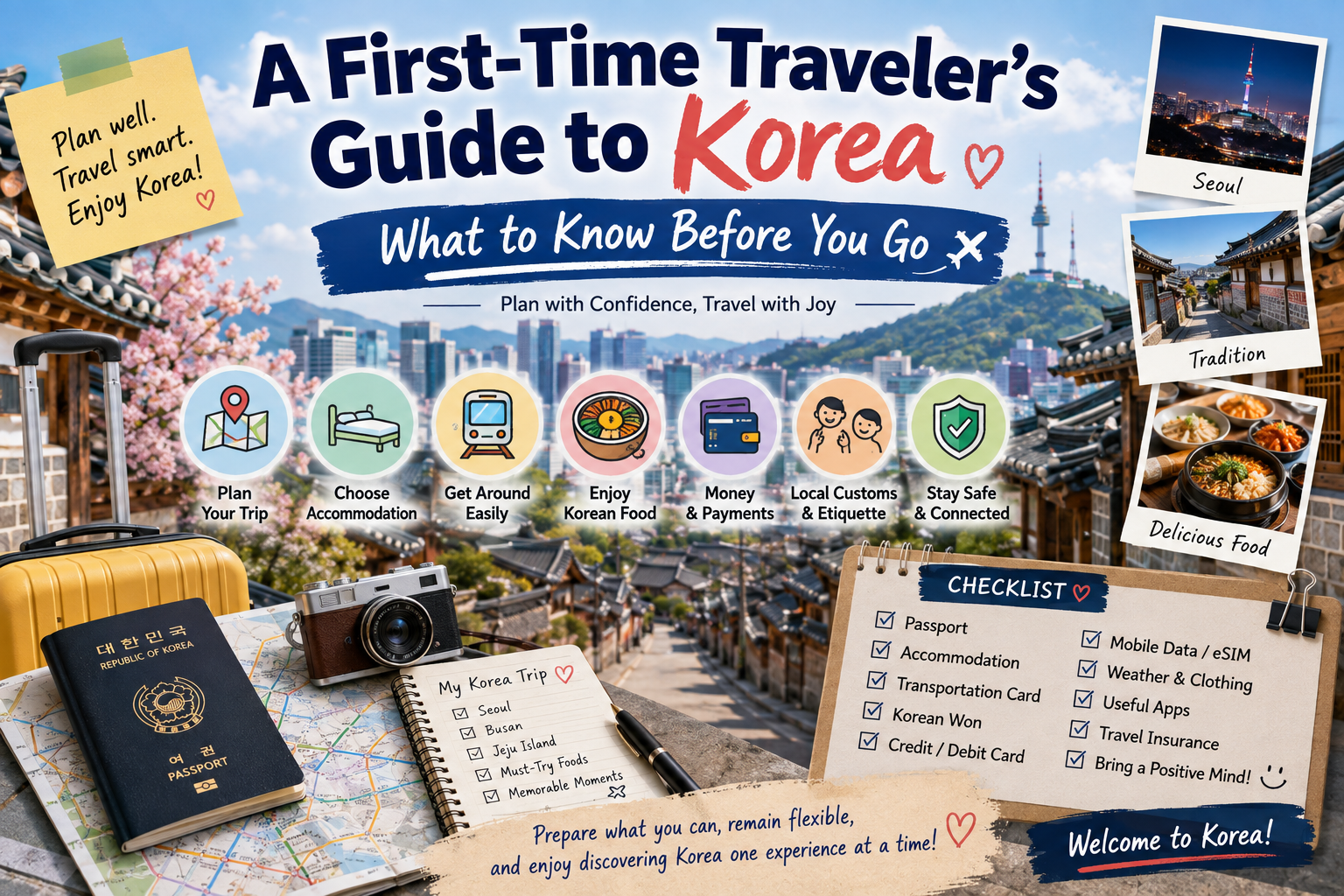
    Final Checklist Before Leaving for Korea

    Before your trip, consider checking these basics:

    • passport and travel documents;
    • accommodation reservations;
    • transportation plans;
    • international payment cards;
    • some Korean won;
    • mobile data or an eSIM;
    • weather and appropriate clothing;
    • useful navigation and translation apps;
    • important addresses saved on your phone;
    • and travel insurance appropriate for your circumstances.

    Final Thoughts

    Your first trip to Korea does not have to be complicated.

    Choose an area that suits your travel plans, find accommodation that fits your needs, learn the basics of public transportation, and prepare a few simple payment and communication options.

    Try Korean food, explore traditional and modern neighborhoods, and take some time to experience everyday life.

    Most importantly, stay curious.

    You do not have to understand everything before you arrive.

    Prepare what you can, remain flexible, and enjoy discovering Korea one experience at a time.

    We hope this guide helps you feel more confident about your first trip to Korea.

    Welcome to Korea, and have a wonderful journey!


  • 10 Korean Foods Every Traveler Should Try

    10 Korean Foods Every Traveler Should Try

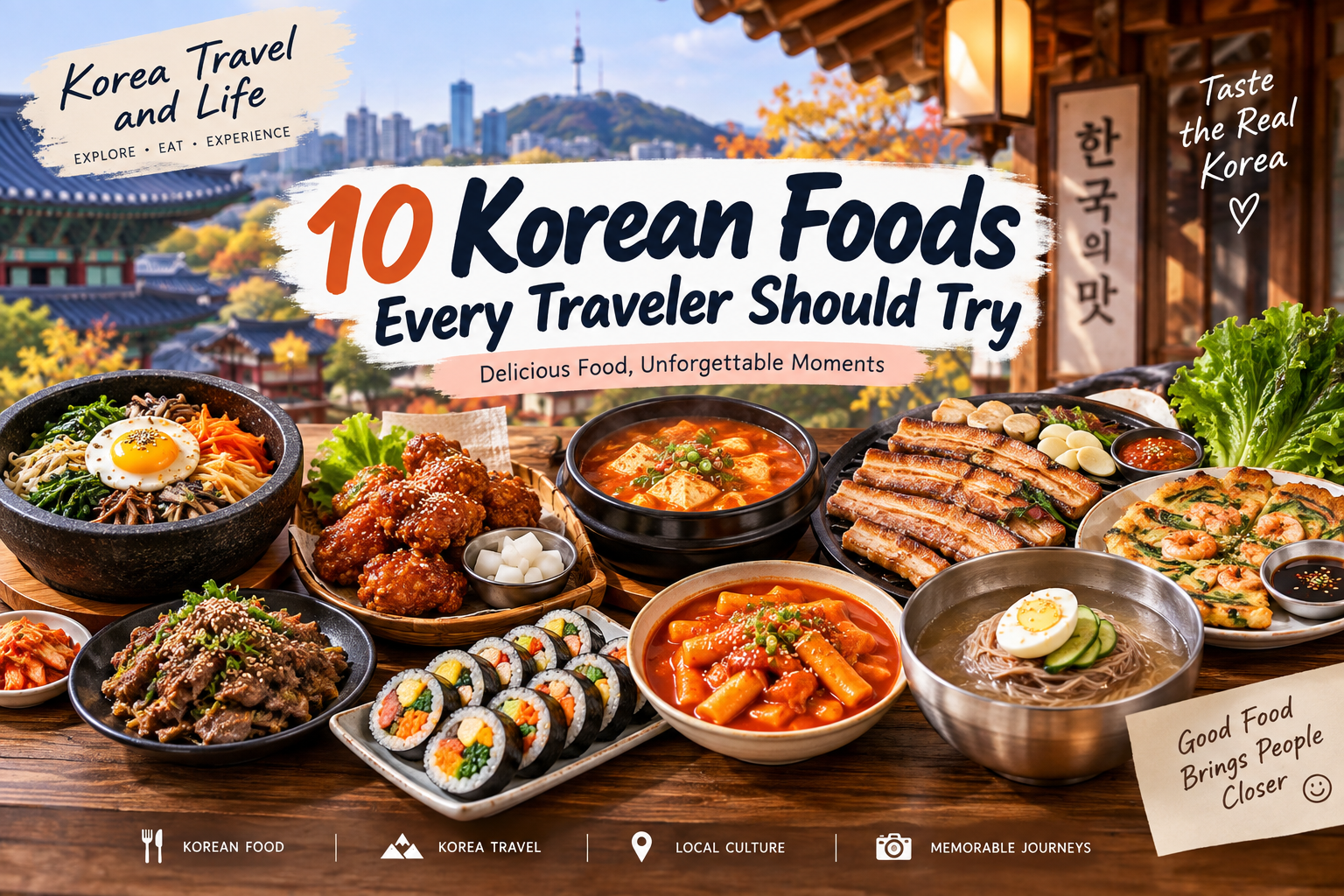
    Planning a trip to Korea? One of the best ways to experience the country is through its food.

    Korean cuisine offers a wide variety of flavors, from savory grilled dishes and comforting soups to spicy street food and simple rice dishes.

    You don’t need to visit expensive restaurants to enjoy Korean food. Traditional markets, neighborhood restaurants, food courts, and casual eateries can all offer memorable meals.

    If you are visiting Korea for the first time, choosing what to eat can feel overwhelming.

    This guide introduces 10 Korean foods that are popular, accessible, and worth trying during your trip.

    1. Bibimbap

    Bibimbap is one of the most well-known Korean dishes.

    It is usually made with rice, vegetables, meat or other toppings, and a Korean chili paste called gochujang.

    The ingredients are arranged on top of the rice and mixed together before eating.

    One of the best things about bibimbap is that the flavors and textures come together in one bowl.

    If you prefer less spicy food, ask for the gochujang on the side so you can control how much you add.

    Travel tip: Bibimbap is a good choice for first-time visitors because it can include a variety of ingredients in one meal.

    2. Korean Fried Chicken

    Korean fried chicken is known for its crispy texture and flavorful sauces.

    Unlike some traditional Korean dishes, Korean fried chicken is a relatively modern food that has become popular both in Korea and around the world.

    You can find many different styles, including original crispy chicken, soy garlic chicken, and spicy versions.

    It is often enjoyed with pickled radish and a cold drink, making it a popular choice for a casual meal or evening snack.

    Travel tip: If you are ordering for the first time, consider trying a half-and-half order so you can enjoy two different flavors.

    3. Bulgogi

    Bulgogi is thinly sliced meat that is marinated before being grilled or cooked.

    The marinade often includes ingredients that create a savory and slightly sweet flavor.

    Bulgogi can be served with rice and side dishes or used as part of another Korean meal.

    Because it is generally milder than some spicy Korean dishes, bulgogi can be a comfortable choice for visitors who are trying Korean food for the first time.

    Travel tip: If you are not used to spicy food, bulgogi is one of the dishes you may want to try first.

    4. Kimchi Stew (Kimchi-jjigae)

    Kimchi-jjigae is a warm and comforting Korean stew made with kimchi and other ingredients such as pork, tofu, onions, and green onions.

    It is often served bubbling hot in a small pot and eaten with rice.

    The flavor can be spicy, sour, and savory, depending on the kimchi and the recipe.

    For visitors who enjoy bold flavors, kimchi-jjigae is a great dish to try.

    Travel tip: If you are sensitive to spicy food, ask about the level of spiciness before ordering.

    5. Samgyeopsal

    Samgyeopsal is grilled pork belly and is one of the most popular Korean barbecue dishes.

    The thick slices of pork are usually grilled at the table and eaten with lettuce, sauces, garlic, and other side dishes.

    Many people enjoy making small wraps with the grilled pork and vegetables.

    Samgyeopsal is especially popular for group meals because everyone can share the food and grill it together.

    Travel tip: Restaurant portions and serving styles can vary, so check whether the menu is priced per person or per serving.

    6. Tteokbokki

    Tteokbokki is a popular Korean street food made with chewy rice cakes cooked in a spicy and slightly sweet sauce.

    It is commonly found at traditional markets, street food stalls, and casual snack shops.

    The classic version can be quite spicy, but some restaurants offer milder versions.

    Tteokbokki is often enjoyed with other street foods such as fish cakes and fried snacks.

    Travel tip: If you are sensitive to spicy food, ask for a mild version or start with a small portion.

    7. Gimbap

    Gimbap is a Korean rice roll made with rice, vegetables, and other ingredients wrapped in dried seaweed.

    Common fillings include egg, vegetables, pickled radish, and meat or fish.

    Gimbap is convenient to eat and can be found at restaurants, markets, convenience stores, and food shops throughout Korea.

    It is a great option when you want a quick and affordable meal while traveling.

    Travel tip: Gimbap is easy to take with you, making it useful for a picnic, day trip, or train journey.

    8. Naengmyeon

    Naengmyeon is a Korean cold noodle dish that is especially popular during the warmer months.

    The noodles are served in a chilled broth or with a spicy sauce, depending on the style.

    The texture of the noodles can be different from pasta or other noodles that international visitors may be familiar with.

    Naengmyeon is refreshing and can be a good choice after eating grilled meat.

    Travel tip: If you prefer a milder flavor, try the broth-based version first.

    9. Haemul Pajeon

    Haemul pajeon is a savory Korean pancake made with green onions and seafood.

    It is often served as a shared dish and can be enjoyed with a dipping sauce.

    The outside can be crispy while the inside remains soft and flavorful.

    It is especially enjoyable on a cool or rainy day.

    Travel tip: Since it is often served as a shared dish, consider ordering it with friends or family.

    10. Korean Street Food

    Korean street food is an easy way to try several different flavors without having a full restaurant meal.

    Popular choices include fish cakes, hotteok, mandu, fried snacks, and other regional specialties.

    Traditional markets and busy food streets are good places to discover local snacks.

    Street food prices and ingredients vary, so check the menu or ask the vendor if you have allergies or dietary restrictions.

    Travel tip: Try small portions of several different foods rather than ordering too much of one item.

    Final Thoughts

    Korean food is an important part of experiencing Korea.

    From bibimbap and bulgogi to gimbap and street food, there are many different flavors and styles to discover.

    You do not have to try everything in one trip.

    Start with foods that look familiar, then gradually try something new.

    Exploring local restaurants, traditional markets, and neighborhood food shops can become one of the most memorable parts of your journey.

    Enjoy your meal and discover Korea one dish at a time!