
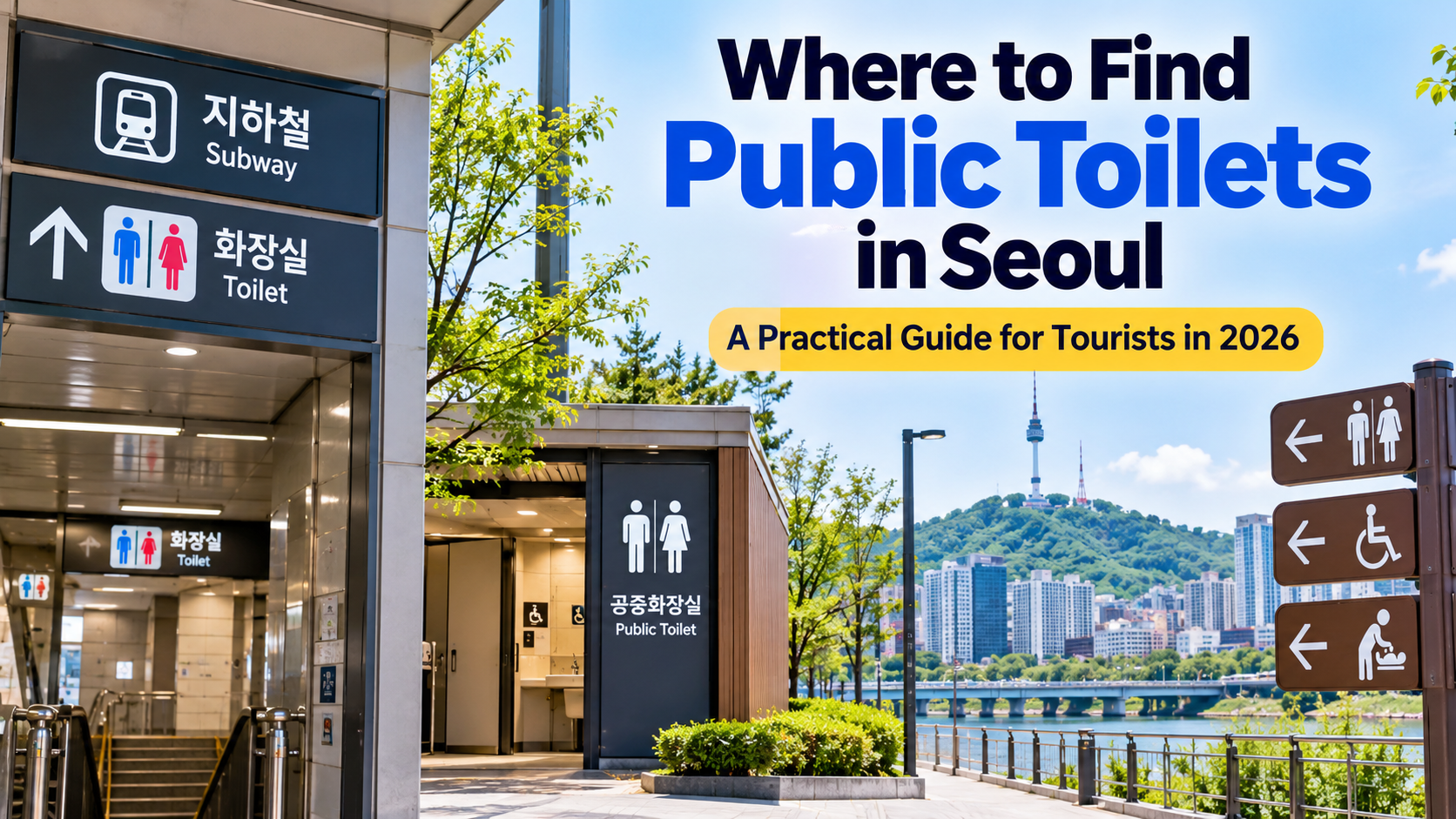
You are exploring Seoul when you suddenly need a restroom. You are nowhere near your hotel, and the nearest café may not have a toilet available to non-customers.
Where should you go?
The good news is that Seoul has public toilets in many subway stations, parks, public buildings, and tourist areas. The challenge is knowing which location to try first—and whether the restroom is actually accessible when you arrive.
The quickest strategy is to look for a subway station, public facility, or officially marked public toilet rather than assuming every café or convenience store has one.
This guide explains where tourists can find toilets in Seoul, how to search for them using Korean map apps, what signs to recognize, and what to do when the nearest option is unavailable.
Where Can You Find a Public Toilet in Seoul?
Not every restroom in Seoul is open to the public, but several types of locations are useful starting points.
| Location | Why it may help | What to check |
|---|---|---|
| Subway stations | Many have restrooms and clear signs | Some toilets are inside fare gates |
| Public parks | Often have designated public facilities | Availability and operating hours vary |
| Museums and cultural facilities | Restrooms are generally available to visitors | Admission or opening hours may apply |
| Public offices and community facilities | Some provide visitor restrooms | Access may be restricted outside business hours |
| Shopping malls and department stores | Usually have well-maintained customer restrooms | Building opening hours |
| Tourist information centers | Staff may direct you to nearby facilities | Not every center has its own toilet |
| Cafés and restaurants | Convenient if you are already a customer | Restrooms may be customer-only or shared |
If you need a toilet urgently, do not spend too long checking random businesses. Search for a clearly marked public facility first.
1. Start With a Subway Station
Seoul’s subway system is often one of the most practical places to look for a restroom.
Many stations have toilets marked with recognizable restroom symbols and Korean or English signage.
However, there is an important detail tourists sometimes overlook.
Is the toilet inside or outside the ticket gates?
Some station restrooms are located in areas accessible without paying a fare. Others may be beyond the ticket gates.
If you are not already taking the subway, entering a paid area just to use the restroom may not be convenient.
Look at the station’s information board or ask a station employee before tapping your transportation card.
You can say:
화장실이 어디에 있어요?
Hwajangsiri eodie isseoyo?
“Where is the restroom?”
If you need to know whether the restroom is outside the gates, ask:
개찰구 밖에 화장실이 있나요?
Gaechalgu bakke hwajangsiri innayo?
“Is there a restroom outside the ticket gates?”
What if the nearest subway station is large?
Major transfer stations may have several levels, exits, and underground corridors.
Following the first restroom sign you see can sometimes involve a longer walk than expected.
Check the station map for the nearest restroom location before changing levels.
If you have luggage, a stroller, or limited mobility, also check whether an elevator provides a suitable route.
2. Search for a Toilet Using Naver Map or KakaoMap
Google Maps can be useful for general navigation in Seoul, but Korean mapping services are also valuable for finding local facilities.
Two options to try are Naver Map and KakaoMap.
The most useful Korean search term is:
공중화장실
Gongjung hwajangsil — public toilet
You can also search:
화장실
Hwajangsil — restroom or toilet
These searches may produce different results depending on the map service and your location.
How to search step by step
- Open Naver Map or KakaoMap.
- Allow the app to use your current location.
- Enter
공중화장실in the search field. - Check the results near your current position.
- Open a result to examine its location and available details.
- Navigate to the entrance, not merely the center of the building.
<underline>Important:</underline> A map listing does not guarantee that a restroom is open, accessible, or available to everyone at that moment.
For an urgent visit, prefer a clearly identified public toilet or a facility whose entrance and opening hours you can confirm.
Useful search terms to copy
| Korean | Meaning |
|---|---|
| 공중화장실 | Public toilet |
| 화장실 | Restroom |
| 무료 화장실 | Free restroom |
| 장애인 화장실 | Accessible restroom |
| 수유실 | Nursing room |
| 기저귀 교환대 | Diaper-changing station |
Searching for an accessible restroom or changing station does not guarantee that the facility meets your specific needs. Confirm the details whenever possible.
3. Public Parks Can Be Useful—But Check the Location
Seoul has many public parks and riverside recreation areas where restrooms may be available.
If you are walking near the Han River, exploring a large urban park, or spending time in a public recreation area, look for designated toilet symbols on local information boards.
In a large park, the nearest toilet may be some distance from your current position.
Do not assume that every park entrance has a restroom.
When walking along the Han River
The Han River parks extend over long distances.
If you are cycling, walking, or having a picnic, check restroom locations before moving far from busy facilities.
Look for public signs, park maps, and official facility information.
If you are traveling with children, it is especially useful to identify a restroom before settling into a picnic area.
4. Shopping Malls and Department Stores Are Useful Backup Options
When a clearly marked public toilet is not nearby, a large shopping mall or department store can be a practical alternative during business hours.
These buildings generally provide restrooms for customers and visitors.
They may also have elevators, family facilities, or accessible restrooms, although the available features vary by building.
Why large buildings can be easier than small cafés
A shopping center typically has directories and restroom signs.
A small café may share a restroom with other tenants, require a key or access code, or reserve it for customers.
If you are in a busy shopping district, identifying a large public-facing building may save time compared with asking at several small businesses.
However, shopping facilities are not necessarily open early in the morning or late at night.
Always consider the time of day.
5. Can You Use a Café or Restaurant Toilet Without Buying Anything?
Do not assume that café and restaurant restrooms are freely available to everyone.
Some establishments allow non-customers to use their facilities, while others restrict access.
In certain buildings, the restroom may be in a shared corridor or on another floor.
You may also encounter a door code provided to customers.
If you are already purchasing food or drinks, asking the staff is usually straightforward.
If you are not a customer, ask politely rather than entering without permission.
화장실 사용해도 될까요?
Hwajangsil sayonghaedo doelkkayo?
“May I use the restroom?”
If the answer is no, thank the staff and look for another facility.
Convenience stores should not be treated as a reliable restroom option. Many do not provide customer toilets.
6. What Do Korean Restroom Signs Look Like?
Most visitors will recognize the standard restroom pictograms used in subway stations, public buildings, and shopping centers.
You may also see Korean signs.
| Korean sign | Meaning |
|---|---|
| 화장실 | Restroom |
| 남자 화장실 | Men’s restroom |
| 여자 화장실 | Women’s restroom |
| 장애인 화장실 | Accessible restroom |
| 공중화장실 | Public toilet |
| 사용 중 | Occupied / In use |
| 고장 | Out of order |
Some facilities use separate signs for accessible toilets or family-related facilities.
If you cannot identify the correct entrance, ask a staff member rather than relying on assumptions about the building layout.
7. Are Public Toilets in Seoul Free?
Many public toilets in Seoul can be used without paying an admission fee.
However, this does not mean every restroom in the city is freely accessible.
A toilet inside a paid attraction may require admission to the facility.
A café restroom may be restricted to customers.
A subway restroom located beyond the fare gates may not be directly accessible to someone outside the paid area.
The most useful distinction is therefore not simply free versus paid.
It is publicly accessible versus restricted access.
When checking a restroom, consider both the cost and the conditions for entering the building or area.
8. What About Toilet Paper, Soap, and Cleanliness?
Restroom conditions vary by location.
Many modern public facilities provide toilet paper, running water, and soap, but supplies can run out.
For longer sightseeing days, carrying a small packet of tissues and hand sanitizer is a sensible precaution.
Where should used toilet paper go?
Follow the instructions posted in the restroom.
In many modern Korean toilets, ordinary toilet paper is intended to be flushed. However, specific facilities may post different instructions because of their plumbing conditions.
Do not flush wet wipes, sanitary products, or other items that are not designed for toilet plumbing.
If a restroom provides disposal instructions, follow them.
What if a toilet is out of order?
Look for signs such as 고장 or 사용 금지.
Do not use a fixture that has been marked unavailable.
If possible, ask staff where the nearest functioning restroom is located.
9. Finding Toilets When Traveling With Children
Traveling with children changes how you should plan restroom stops.
A location that works for one adult may not be convenient for a family with a stroller or a child who needs assistance.
Before entering a large park, market, or sightseeing area, identify at least one likely restroom location.
For families with babies, look separately for changing facilities or nursing rooms.
These are not automatically provided in every public restroom.
Useful Korean phrases
기저귀 교환대가 있나요?
Gijeogwi gyohwandaega innayo?
“Is there a diaper-changing station?”
수유실이 어디에 있나요?
Suyusiri eodie innayo?
“Where is the nursing room?”
Large shopping centers, transport hubs, and major public facilities may be useful places to ask about these services.
10. Finding Accessible Restrooms in Seoul
Travelers with mobility limitations should not rely solely on a standard restroom symbol.
An accessible restroom may be located in a different part of a station or building.
Even when a facility is marked accessible, the approach route, doorway, interior layout, or availability may not meet every person’s needs.
What to check before going
- Is there a step-free route to the restroom?
- Is the facility open at the time of your visit?
- Does the entrance provide enough clearance?
- Is the restroom inside a restricted area?
- Is an elevator required to reach it?
For major transport facilities and attractions, official accessibility information may help with planning.
If the information is incomplete, contact the facility directly when possible.
Useful phrase:
장애인 화장실이 어디에 있나요?
Jangaein hwajangsiri eodie innayo?
“Where is the accessible restroom?”
11. What Should You Do If You Need a Toilet Urgently?
If you are unfamiliar with the neighborhood, use this practical sequence.
Step 1: Look for a visible public facility
Check for a subway entrance, public park information board, museum, visitor center, or large shopping building.
Step 2: Search 공중화장실 on a Korean map app
Use your current location and check the nearest clearly identified result.
Step 3: Confirm access
Look for opening hours, building restrictions, and whether the restroom is inside a ticketed area.
Step 4: Ask someone nearby
If the map result is confusing, ask staff at a station, information center, or business.
가장 가까운 화장실이 어디예요?
Gajang gakkaun hwajangsiri eodiyeyo?
“Where is the nearest restroom?”
Step 5: Have a backup
If your first choice is closed or unavailable, move to the next reliable public-facing facility rather than continuing to search the same building.
This is particularly important late at night, when many shops and public buildings may be closed.
12. Common Tourist Mistakes When Looking for Toilets in Seoul
Assuming every subway toilet is outside the fare gates
Check its location before entering the station.
Assuming a café restroom is public
Ask permission and respect customer-only restrictions.
Relying on an outdated map listing
A listed restroom may be temporarily closed, inside a restricted building, or difficult to access.
Walking into a large park without checking facilities
Restrooms may be farther apart than expected.
Confusing a nursing room with a public toilet
A nursing room or baby-care facility may be separate from the restroom.
Ignoring opening hours
Shopping centers, museums, and some public buildings may be useful during the day but unavailable late at night.
Frequently Asked Questions
Are there public toilets in Seoul?
Yes. Public toilets are available in various subway stations, parks, public facilities, and other locations. Accessibility and opening hours vary.
How do I find the nearest public toilet in Seoul?
Try searching 공중화장실 or 화장실 on Naver Map or KakaoMap. Confirm the location and access conditions before walking there.
Can tourists use subway station toilets in Seoul?
Many subway stations have restrooms, but some are located beyond ticket gates. Check the station map or ask staff if you are not taking the train.
Are public toilets in Seoul free?
Many are free to use. However, some restrooms are inside paid attractions, restricted areas, or customer-only businesses.
Can I use a convenience store toilet in Korea?
Do not rely on convenience stores for restroom access. Many do not offer customer toilets.
Is toilet paper provided in Korean public restrooms?
Many modern facilities provide it, but availability varies. Carrying tissues is a useful precaution.
Are public toilets in Seoul open 24 hours?
Not all of them. Opening hours depend on the facility, building, and location. Check before relying on a restroom late at night.
Final Thoughts: The Fastest Way to Find a Toilet in Seoul
Finding a public toilet in Seoul is usually manageable once you know where to look.
Start with a subway station, clearly marked public restroom, or public-facing facility.
Use 공중화장실 in Naver Map or KakaoMap when you need to search nearby.
Check whether the restroom is accessible without a ticket, purchase, or building access restriction.
And if you are unsure, asking “화장실이 어디에 있어요?” is often the simplest solution.
A little preparation can prevent an inconvenient interruption from becoming a stressful part of your Seoul trip.
Leave a Reply