Author: koreatravellife

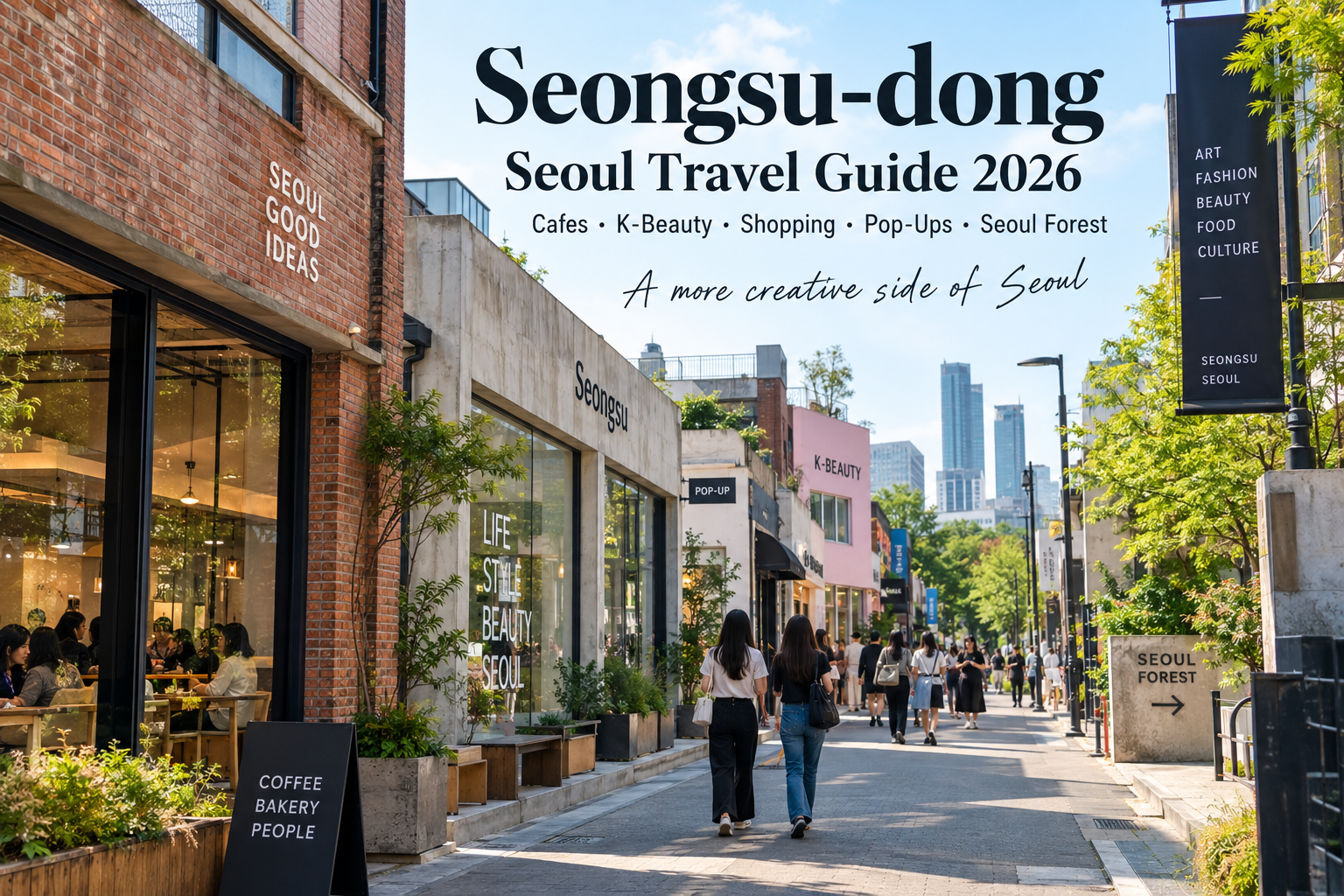
  • Seongsu-dong Seoul Travel Guide 2026: Cafes, K-Beauty, Shopping, Pop-Ups and Seoul Forest

    Seongsu-dong Seoul Travel Guide 2026: Cafes, K-Beauty, Shopping, Pop-Ups and Seoul Forest

    Introduction

    Seoul is famous for palaces, traditional markets, K-pop, and late-night shopping, but one neighborhood has become especially popular with travelers looking for a more contemporary side of the city: Seongsu-dong.

    Once known for warehouses, factories, and handmade shoe workshops, Seongsu has evolved into one of Seoul’s most creative neighborhoods. Old industrial buildings now house specialty coffee shops, fashion boutiques, art spaces, K-beauty stores, restaurants, and constantly changing pop-up shops.

    What makes Seongsu particularly interesting is that it offers more than shopping. You can spend the morning exploring cafes and local streets, discover Korean beauty and fashion brands in the afternoon, and then walk to Seoul Forest for a relaxing break from the city.

    For international visitors—especially travelers returning to Seoul after already seeing major attractions such as Gyeongbokgung Palace, Myeongdong, and N Seoul Tower—Seongsu offers a different way to experience everyday Seoul.

    In this Seongsu-dong Seoul travel guide for 2026, you’ll learn what to see, where to explore, how to get there, when to visit, and how to combine Seongsu’s cafes, K-beauty, shopping, pop-ups, and Seoul Forest into an easy half-day or full-day itinerary.

    Why Is Seongsu-dong So Popular?

    Seongsu-dong is often described as one of Seoul’s most creative neighborhoods because it combines the area’s industrial past with Korea’s fast-moving fashion, beauty, cafe, and pop-up culture.

    Instead of replacing every old building with something new, many businesses have transformed former factories and warehouses into stylish cafes, showrooms, galleries, restaurants, and retail spaces. The contrast between exposed brick buildings and modern Korean brands gives Seongsu a distinctive atmosphere that feels different from more traditional shopping districts.

    Cafes and Industrial Spaces

    Seongsu is especially famous for its cafe culture. Large warehouse-style cafes, small specialty coffee shops, bakeries, and dessert cafes are scattered throughout the neighborhood.

    Rather than visiting Seongsu for one specific attraction, many travelers simply walk through the streets, stop at a cafe that catches their attention, and continue exploring.

    Pop-Up Stores and Korean Brands

    Pop-up stores are another major reason people visit Seongsu. Korean fashion, beauty, food, entertainment, and lifestyle brands frequently use the neighborhood for temporary exhibitions, product launches, and interactive experiences.

    Because pop-ups change regularly, the neighborhood can feel different each time you visit.

    K-Beauty and Shopping

    Seongsu has also developed into an important destination for travelers interested in K-beauty and Korean fashion. Flagship stores and brand experience spaces allow visitors to explore products in a more immersive setting than a conventional shopping mall.

    Seoul Forest

    One of Seongsu’s biggest advantages is its proximity to Seoul Forest, one of the city’s most popular urban green spaces.

    After spending several hours exploring busy shopping streets and cafes, visitors can walk toward the park and enjoy a quieter side of Seoul.

    This combination of cafes, shopping, K-beauty, pop-ups, creative spaces, and nature is what makes Seongsu particularly appealing to travelers who want to experience contemporary Seoul beyond the city’s traditional sightseeing route.

    How to Get to Seongsu-dong

    Seongsu is easy to reach by Seoul’s subway system, but there are two useful stations depending on which part of the neighborhood you want to explore.

    Seongsu Station

    Seongsu Station (Line 2) is usually the most convenient starting point if your main goal is to explore Seongsu’s cafes, shops, pop-up stores, restaurants, and creative spaces.

    After leaving the station, you can explore the neighborhood on foot. Many of Seongsu’s popular streets and businesses are spread across several blocks, so comfortable walking shoes are recommended.

    Seoul Forest Station

    Seoul Forest Station (Suin-Bundang Line) is more convenient if you want to begin your visit near Seoul Forest and then walk toward the main Seongsu shopping and cafe areas.

    This can be a good option for travelers who want to combine nature, shopping, and cafes in one route.

    Which Station Should You Use?

    A simple rule is:

    • Start at Seongsu Station if cafes, shopping, K-beauty, and pop-ups are your priorities.
    • Start at Seoul Forest Station if Seoul Forest is your first destination.

    For a half-day or full-day trip, you do not necessarily need to return to the station where you started. One convenient strategy is to enter the neighborhood through one station, explore Seongsu on foot, and leave through the other.

    Getting There From Popular Areas of Seoul

    From neighborhoods such as Myeongdong, Hongdae, or Gangnam, the subway is generally the easiest option. Depending on where you start, you may need to transfer lines.

    Instead of relying on a fixed travel time, check your route shortly before leaving because transfer combinations and travel times vary by starting location.

    For navigation in Korea, travelers may also find Korean map apps useful when locating individual cafes, stores, and pop-up venues.

    Best Things to Do in Seongsu-dong

    Seongsu is best explored on foot rather than by rushing from one famous attraction to another. Part of the experience is discovering new stores, cafes, and pop-ups as you walk through the neighborhood.

    Here are some of the best ways to experience Seongsu in 2026.

    1. Explore Seongsu’s Cafe Streets

    Cafe hopping is one of the most popular things to do in Seongsu.

    The neighborhood is known for transforming former factories, warehouses, and industrial buildings into distinctive coffee shops and bakeries. Some are large destination cafes, while others are smaller specialty coffee shops hidden along side streets.

    Instead of planning every cafe in advance, consider choosing one or two places that interest you and leaving time to discover others while walking.

    Weekends and afternoons can be particularly busy, so visiting earlier in the day can provide a more relaxed experience.

    2. Discover the Latest Pop-Up Stores

    Seongsu has become one of Seoul’s best-known neighborhoods for pop-up stores and temporary brand experiences.

    Beauty companies, fashion labels, food brands, entertainment companies, and lifestyle brands regularly open short-term spaces where visitors can see new products, take photos, participate in events, or receive samples.

    The important thing to remember is that Seongsu pop-ups change constantly. A store mentioned in an older travel guide may already be closed by the time you arrive.

    For that reason, check current pop-up information shortly before your visit rather than building your itinerary around an old list.

    3. Explore K-Beauty Flagship Stores

    If you are interested in Korean skincare and cosmetics, Seongsu is becoming much more than a cafe neighborhood.

    Beauty brands increasingly use Seongsu for flagship stores and experience-focused spaces where visitors can test products, discover new releases, and experience the brand beyond a traditional cosmetics counter.

    One of the neighborhood’s major beauty destinations is Olive Young N Seongsu, a large beauty-focused space designed around products, trends, and brand experiences.

    Even travelers who already plan to shop for K-beauty in Myeongdong may find Seongsu worthwhile because the experience here is often more focused on discovering brands and trends rather than simply purchasing products.

    4. Shop Korean Fashion and Lifestyle Brands

    Seongsu is one of the best neighborhoods in Seoul for discovering contemporary Korean fashion and lifestyle brands.

    Rather than concentrating everything inside a large department store, Seongsu is filled with flagship stores, showrooms, concept shops, and smaller boutiques spread throughout the neighborhood. This makes shopping feel like part of exploring the area itself.

    You may find Korean clothing, shoes, accessories, fragrances, home goods, stationery, and design products that are less visible in Seoul’s traditional tourist shopping districts.

    New stores also open frequently, so it is worth leaving some flexibility in your itinerary rather than planning every stop in advance.

    5. Take a Break at Seoul Forest

    After exploring Seongsu’s busy streets, Seoul Forest provides a completely different atmosphere.

    The large urban park includes walking paths, lawns, trees, gardens, and spaces where visitors can slow down and take a break from shopping and cafe hopping.

    Spring and autumn are particularly pleasant seasons for walking, but the park can be enjoyed throughout much of the year.

    Combining Seongsu with Seoul Forest also makes the neighborhood suitable for travelers who do not want to spend an entire day shopping.

    A convenient itinerary is to explore Seongsu’s cafes and shops first and then finish the afternoon with a walk through Seoul Forest.

    6. Walk Through Seongsu’s Industrial Streets

    Do not limit your visit to the newest flagship stores.

    Part of Seongsu’s character comes from the contrast between its industrial history and its modern transformation. Older workshops, brick buildings, warehouses, small factories, and narrow streets still exist alongside fashionable cafes and contemporary retail spaces.

    Walking between these different areas helps explain why Seongsu feels different from purpose-built shopping districts.

    For photographers and travelers interested in urban neighborhoods, simply exploring the streets can be one of the most memorable parts of visiting Seongsu.

    Where to Eat and Drink in Seongsu

    Seongsu’s food scene is almost as varied as its shopping. Alongside its famous cafes, the neighborhood has Korean restaurants, bakeries, casual dining spots, dessert shops, and restaurants serving international cuisine.

    Coffee and Desserts

    Cafe hopping is part of the Seongsu experience, but you do not need to visit every famous cafe you see on social media.

    Choose a cafe based on what matters most to you—specialty coffee, baked goods, unusual architecture, outdoor seating, or simply a convenient break during your walk.

    Because popular cafes can become crowded on weekends, having one or two backup options nearby can save time.

    Korean Food

    If you want a proper meal between shopping stops, explore the streets beyond the busiest cafe areas. You can find Korean dishes ranging from casual everyday meals to more contemporary interpretations of Korean cuisine.

    Looking a few streets away from the most crowded shopping areas can also lead to a quieter dining experience.

    Bakeries and Quick Snacks

    Seongsu is also a good neighborhood for travelers who prefer to eat smaller meals throughout the day. Bakeries, dessert shops, and takeaway snacks make it easy to combine eating with sightseeing rather than planning a long restaurant stop.

    Half-Day Seongsu Itinerary

    If you have around four to five hours, try this route:

    Seongsu Station → Cafe → Pop-Up Stores → K-Beauty & Shopping → Lunch or Snack → Seoul Forest

    Start at Seongsu Station and explore the cafe and shopping streets while your energy is high. Check any current pop-ups you want to visit, browse Korean beauty and fashion stores, and then gradually walk toward Seoul Forest.

    Finish with a relaxed walk through the park and leave from Seoul Forest Station.

    Full-Day Seongsu Itinerary

    With a full day, you can explore at a slower pace:

    Morning: Arrive at Seongsu Station and have coffee or brunch.

    Late Morning: Explore industrial streets, boutiques, and Korean fashion stores.

    Afternoon: Visit K-beauty spaces and current pop-ups, followed by lunch and another cafe.

    Late Afternoon: Walk toward Seoul Forest and spend time exploring the park.

    Evening: Return toward Seongsu for dinner or continue to another nearby Seoul neighborhood.

    A full day works particularly well for travelers interested in shopping, photography, cafes, Korean brands, and contemporary Seoul culture.

    Best Time to Visit Seongsu

    Seongsu can be visited throughout the year, but the experience changes depending on the day and time.

    Weekdays vs. Weekends

    If your schedule allows, a weekday visit is usually more comfortable. Popular cafes, flagship stores, and pop-up spaces can become crowded on weekends, particularly in the afternoon.

    For travelers visiting on Saturday or Sunday, arriving earlier in the day can make it easier to explore before the busiest period.

    Spring and Autumn

    Spring and autumn are especially pleasant if you plan to combine Seongsu with Seoul Forest. Mild temperatures make walking between the neighborhood’s shops, cafes, and the park more enjoyable.

    Summer can be hot and humid, while winter temperatures can make long outdoor walks less comfortable. Fortunately, Seongsu has plenty of indoor cafes and shops where you can take breaks.

    Practical Tips for International Travelers

    Check Pop-Ups Shortly Before Your Visit

    Pop-up stores are temporary by nature. Do not rely entirely on a travel article or social media post published months earlier.

    Search for current Seongsu pop-ups shortly before your visit and confirm dates and operating hours.

    Save Places on Your Map

    Seongsu is spread across many streets rather than concentrated inside one shopping complex. Save the places you most want to visit before arriving, but leave room for spontaneous discoveries.

    Wear Comfortable Shoes

    Expect to walk considerably more than you might think. Cafes, shops, pop-ups, and Seoul Forest are spread across the neighborhood, so comfortable shoes will make the day much easier.

    Carry a Payment Backup

    Cards are widely accepted in Seoul, but carrying more than one payment option can be useful when traveling. A small amount of Korean won can also be helpful for occasional situations where cash is more convenient.

    Check Tax Refund Eligibility

    International visitors shopping for Korean beauty, fashion, and other products may encounter stores participating in Korea’s tax-refund system. Eligibility and procedures can vary, so look for tax-refund information at the store and keep your passport available when required.

    Do Not Overplan

    Seongsu changes quickly. New stores appear, pop-ups rotate, and unexpected places are often part of the experience.

    Plan a few priority stops, but leave enough time simply to walk around and see what you find.

    Frequently Asked Questions About Seongsu-dong

    Is Seongsu-dong worth visiting?

    Yes, especially if you are interested in contemporary Seoul culture. Seongsu combines cafes, Korean fashion and beauty brands, pop-up stores, creative spaces, industrial architecture, and Seoul Forest in one walkable area.

    It can be particularly interesting for repeat visitors who have already explored Seoul’s major historical attractions.

    How much time do you need in Seongsu?

    Allow at least four to five hours if you want to visit cafes, browse shops, explore pop-ups, and walk through Seoul Forest without rushing.

    Travelers interested in shopping, photography, K-beauty, and cafe hopping can easily spend most of a day in the neighborhood.

    Is Seongsu better on weekdays or weekends?

    Weekdays are generally more comfortable for travelers who want to avoid the largest crowds. Weekends can be lively, but popular cafes, stores, and pop-ups may have longer waits.

    What is Seongsu famous for?

    Seongsu is best known for its warehouse-style cafes, Korean fashion and lifestyle brands, K-beauty stores, temporary pop-ups, creative spaces, and its proximity to Seoul Forest.

    Is Seongsu good for K-beauty shopping?

    Yes. Seongsu has become an increasingly important destination for Korean beauty brands, flagship stores, and brand experience spaces. It offers a different experience from traditional cosmetics shopping areas such as Myeongdong.

    Should I use Seongsu Station or Seoul Forest Station?

    Use Seongsu Station on Line 2 if you want to begin with cafes, shopping, and pop-ups. Seoul Forest Station on the Suin-Bundang Line is convenient if you want to start near the park.

    A good strategy is to enter through one station and leave through the other.

    Can I visit Seongsu and Seoul Forest on the same day?

    Absolutely. They are close enough to combine naturally, which is one reason Seongsu works so well as a half-day or full-day Seoul itinerary.

    Final Thoughts

    Seongsu represents a side of Seoul that is constantly changing.

    Its appeal does not come from one famous landmark. Instead, it comes from the combination of old industrial streets, creative cafes, Korean fashion and beauty brands, temporary pop-ups, restaurants, and the greenery of Seoul Forest.

    For first-time visitors, Seongsu can add contemporary Korean culture to a traditional Seoul itinerary. For repeat visitors, it offers a reason to explore beyond the city’s most familiar tourist districts.

    Most importantly, do not try to schedule every minute. Choose a few places you genuinely want to visit, check the latest pop-ups before you go, and leave time to explore.

    Seongsu is one of those Seoul neighborhoods where discovering something you did not plan can become the best part of the day.
  • T-Money vs Climate Card in Seoul 2026: Which Transportation Card Is Best for Tourists?

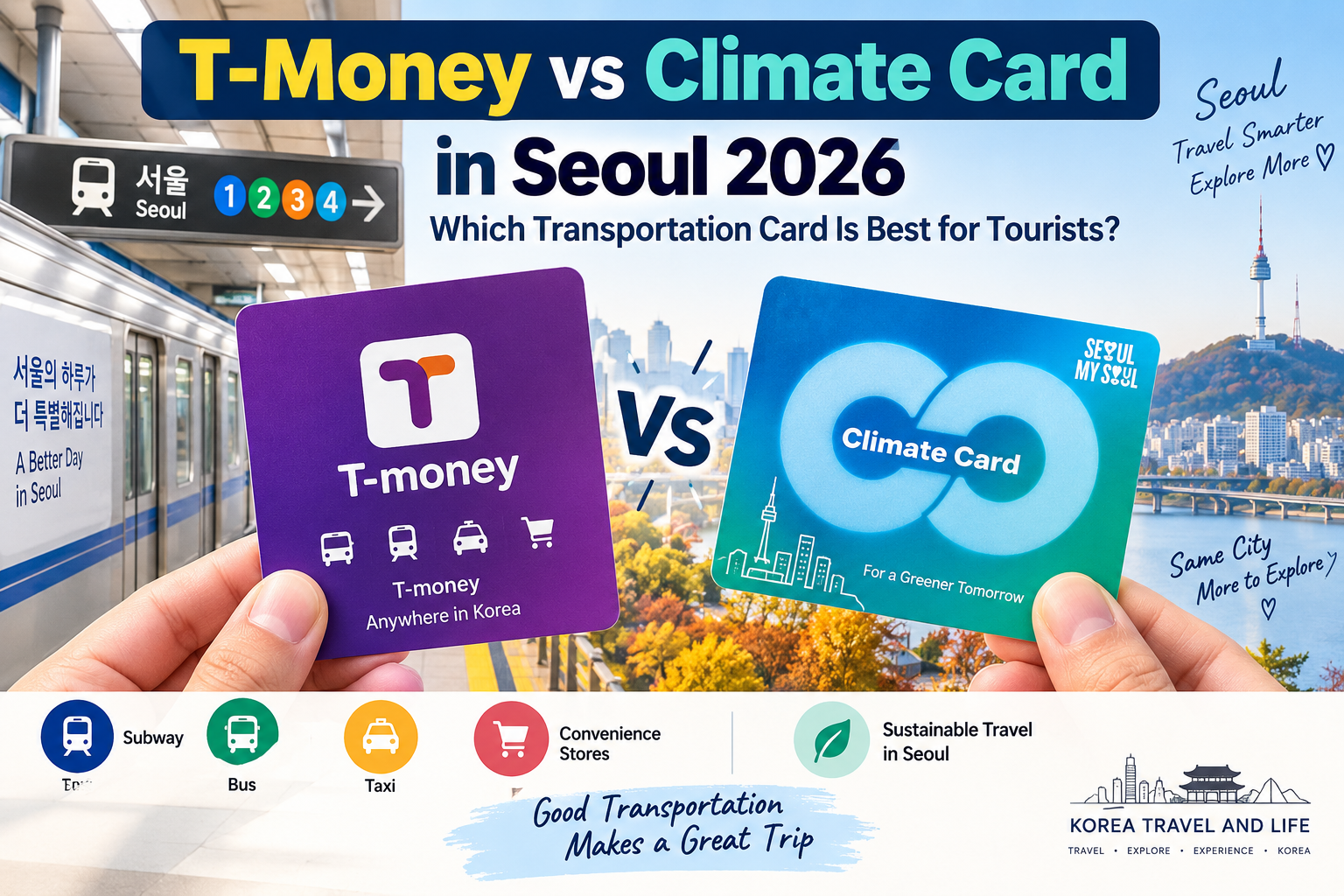
    T-Money vs Climate Card in Seoul 2026: Which Transportation Card Is Best for Tourists?

    Getting around Seoul is easy once you understand the city’s transportation system. But for first-time visitors, choosing the right transportation card can be surprisingly confusing.

    Two of the most useful options are T-Money and the Climate Card.

    Both can make traveling around Seoul much easier, but they work very differently. T-Money is a rechargeable transportation card that can be used across Korea, while the Climate Card offers unlimited rides within its designated Seoul transportation network for a fixed period.

    So which one should you buy?

    This 2026 guide explains the differences between T-Money and the Climate Card, how much they cost, where you can use them, and which option may make more sense for your Korea itinerary.

    Quick Answer: T-Money or Climate Card?

    For most travelers, the choice depends on where you are traveling.

    Choose T-Money if you:

    • Plan to travel outside Seoul
    • Will visit places such as Busan, Gyeongju, Jeju, or other Korean cities
    • Prefer paying for transportation based on actual usage
    • Want one transportation card that works across much of Korea
    • Expect to use taxis or other transportation outside the Climate Card service area

    Choose the Climate Card if you:

    • Will spend most of your trip inside Seoul
    • Expect to use buses and subways frequently
    • Want unlimited eligible public transportation during your pass period
    • Prefer knowing your transportation cost in advance
    • Are staying in Seoul for between one and seven days

    For many first-time visitors traveling around Korea, T-Money offers greater flexibility.

    For travelers spending several busy sightseeing days almost entirely in Seoul, however, a short-term Climate Card can be very convenient.

    What Is a T-Money Card?

    T-Money is one of Korea’s most widely used prepaid transportation cards.

    Instead of buying an individual ticket every time you ride a subway or bus, you load money onto the card and tap it when entering and leaving the transportation system.

    T-Money can be purchased at many convenience stores, including chains such as CU, GS25, and 7-Eleven, as well as at transportation facilities.

    The standard card generally costs around KRW 3,000–5,000, before adding transportation credit.

    One of T-Money’s biggest advantages for international travelers is its wide coverage.

    It can be used on public transportation across many parts of Korea, making it particularly useful for travelers visiting several cities during one trip.

    Where Can You Use T-Money?

    T-Money can be used on many:

    • Subways
    • City buses
    • Express and intercity buses
    • Taxis
    • Other participating transportation services

    It can also be used at some convenience stores, vending machines, and other participating merchants displaying the T-Money logo.

    This makes T-Money particularly useful for itineraries such as:

    Seoul → Busan → Gyeongju → Seoul

    Instead of buying a new local transportation card in every destination, travelers can continue using the same T-Money card for many local transportation needs.

    What Is the Seoul Climate Card?

    The Climate Card was introduced by the Seoul Metropolitan Government as an unlimited public transportation pass.

    For tourists, the most important products are the short-term Climate Card passes.

    As of 2026, short-term passes are available for:

    • 1 day — KRW 5,000
    • 2 days — KRW 8,000
    • 3 days — KRW 10,000
    • 5 days — KRW 15,000
    • 7 days — KRW 20,000

    A physical Climate Card costs an additional KRW 3,000.

    These passes are particularly attractive for travelers who plan to take public transportation repeatedly while sightseeing around Seoul.

    Important Climate Card Change in 2026

    Visitors may see older online guides discussing the Climate Card’s 30-day prepaid pass.

    This information is changing.

    Seoul announced that recharging the existing 30-day prepaid Climate Card ends after August 31, 2026, as the city transitions toward its newer Climate Pass system.

    However, this does not mean tourists can no longer use the Climate Card.

    The short-term tourist passes for 1, 2, 3, 5, and 7 days continue to be available.

    This distinction is important when reading older travel guides about Seoul transportation.

    Can Foreign Tourists Buy the Climate Card With an International Credit Card?

    Yes, and this became significantly easier in 2026.

    Seoul expanded payment support at hundreds of new subway vending machines, allowing travelers to use internationally issued credit and debit cards such as Visa and Mastercard to purchase Climate Cards and recharge short-term passes.

    International card payments are supported at new vending machines installed across Seoul Metro Lines 1–8.

    An average service fee of approximately 3.7% may apply when using an internationally issued card.

    This is an important improvement for international visitors because transportation card purchases in Korea have traditionally relied heavily on Korean won cash or locally issued cards.

    T-Money vs Climate Card: Main Differences

    Here is the simplest way to understand the two cards.

    T-Money

    Payment system: Pay per ride

    Best for: Flexible travel throughout Korea

    Coverage: Widely usable across Korea

    Main advantage: One card can be used for transportation in many Korean cities

    Best traveler: Someone visiting Seoul plus other destinations

    Climate Card

    Payment system: Unlimited eligible transportation during the pass period

    Best for: Frequent transportation within Seoul

    Coverage: Limited primarily to eligible Seoul transportation services

    Main advantage: Unlimited rides without worrying about individual fares

    Best traveler: Someone sightseeing intensively within Seoul

    Is the Climate Card Really Unlimited?

    Within its eligible transportation network, the Climate Card allows unlimited rides during the validity period.

    However, “unlimited” does not mean that every transportation service in Korea is included.

    The Climate Card has a defined service area and exclusions. Travelers planning trips outside Seoul should therefore check whether their destination is covered before relying exclusively on the card.

    This is one of the biggest differences between the Climate Card and T-Money.

    T-Money does not provide unlimited transportation, but its geographical flexibility is much greater.

    Which Card Is Better for a 3-Day Seoul Trip?

    Consider a traveler spending three full days sightseeing around Seoul.

    The itinerary might include:

    Day 1: Gyeongbokgung Palace → Bukchon Hanok Village → Insadong → Myeongdong

    Day 2: Hongdae → Yeonnam-dong → Han River → Gangnam

    Day 3: Seongsu → Seoul Forest → Dongdaemun → Namsan

    This traveler may take multiple subway and bus rides each day.

    A 3-day Climate Card costs KRW 10,000, plus the KRW 3,000 physical card cost if a card needs to be purchased.

    For a transportation-heavy itinerary like this, the Climate Card can be particularly convenient.

    Which Card Is Better for a 7-Day Korea Trip?

    Now consider this itinerary:

    Days 1–3: Seoul
    Days 4–5: Gyeongju
    Days 6–7: Busan

    In this situation, T-Money is generally more practical because the traveler is moving beyond Seoul.

    The Climate Card’s main value comes from frequent eligible transportation within Seoul, whereas T-Money can continue to be useful in other Korean cities.

    Can You Use Both T-Money and the Climate Card?

    Yes.

    In fact, some travelers may find that carrying both is convenient.

    You could use the Climate Card during several intensive sightseeing days in Seoul and keep a T-Money card for transportation outside the Climate Card coverage area or later trips to other Korean cities.

    You do not necessarily have to choose only one card for your entire Korea trip.

    Where Can Tourists Buy T-Money?

    T-Money cards are widely available.

    Travelers can commonly find them at convenience stores such as:

    • CU
    • GS25
    • 7-Eleven
    • Other participating convenience stores

    They are also available at transportation-related sales locations.

    According to VISITKOREA, a standard T-Money card generally costs approximately KRW 3,000–5,000 before adding transportation credit.

    One detail international travelers should know is that ordinary T-Money purchases and top-ups may still require Korean won cash in many situations, so carrying some cash after arriving in Korea remains useful. Korea Tourism Organization’s 2026 transportation guide specifically notes cash-only purchasing/top-up for standard prepaid T-Money.

    Where Can Tourists Buy a Climate Card?

    Physical Climate Cards are available through designated subway vending machines and participating sales locations in Seoul.

    New transportation-card vending machines across Seoul Metro Lines 1–8 have made purchasing the card considerably easier for international visitors.

    Remember that the physical card itself costs KRW 3,000, and the short-term pass is loaded separately.

    Unlike an ordinary T-Money balance, a short-term Climate Card begins according to the rules associated with the pass, so travelers should check the activation timing before loading it.

    What About Airport Transportation?

    This is where travelers should be careful.

    Not every airport transportation option is included with every Seoul transportation pass.

    For example, the AREX Express Train operates differently from ordinary Seoul subway transportation.

    Travelers arriving at Incheon International Airport should therefore check their airport-to-hotel transportation separately instead of assuming that a Climate Card covers every airport option.

    We will cover this in a separate guide comparing AREX Express, AREX All-Stop Train, airport limousine buses, and taxis from Incheon Airport to Seoul.

    What About WOWPASS?

    WOWPASS is another popular option for international visitors.

    Unlike T-Money, which is primarily a transportation card, WOWPASS combines several traveler-focused functions, including prepaid payments, transportation functionality, and currency-related services.

    That makes it a different type of product.

    For travelers wondering whether WOWPASS or T-Money is better, we will compare those options separately because the decision involves more than transportation alone.

    T-Money vs Climate Card: Which Should First-Time Visitors Choose?

    There is no single card that is ideal for every Korea itinerary.

    For a traveler spending almost the entire trip sightseeing around Seoul and taking public transportation many times each day, the Climate Card can be a simple and convenient choice.

    For travelers visiting multiple Korean cities or wanting maximum transportation flexibility, T-Money is usually easier to use throughout the trip.

    And for some travelers, carrying both can make sense.

    The key is to choose based on your itinerary rather than simply buying whichever transportation card you see first.

    Frequently Asked Questions

    Is T-Money only available in Seoul?

    No. One of T-Money’s biggest advantages is that it can be used on public transportation in many areas throughout Korea.

    Can tourists still use the Climate Card in 2026?

    Yes. Although Seoul is changing its longer-term Climate Card system, short-term tourist passes for 1, 2, 3, 5, and 7 days remain available.

    How much is a 3-day Climate Card?

    The 3-day short-term pass costs KRW 10,000. A physical Climate Card costs an additional KRW 3,000 if you do not already have one.

    Can I buy a Climate Card with a foreign credit card?

    Internationally issued credit and debit cards are accepted at supported new transportation-card vending machines for Climate Card purchases and short-term pass recharging.

    Can I use T-Money in Busan?

    Yes. T-Money is widely usable on public transportation beyond Seoul, including major Korean cities.

    Should I buy T-Money at Incheon Airport?

    For many visitors, getting a transportation card soon after arrival is convenient, especially if they plan to use public transportation frequently during their trip.

    Final Thoughts

    Choosing between T-Money and the Climate Card becomes much easier once you know your itinerary.

    If your trip is focused almost entirely on Seoul and you expect to ride buses and subways frequently, a short-term Climate Card can provide simple, predictable transportation costs.

    If your Korea itinerary includes several cities, T-Money offers greater flexibility and can remain useful throughout your trip.

    Before traveling, always check the latest transportation rules because Seoul’s transit card system continues to evolve.

    For most international travelers, the best strategy is simple:

    Choose the Climate Card for intensive Seoul sightseeing. Choose T-Money for flexibility across Korea.


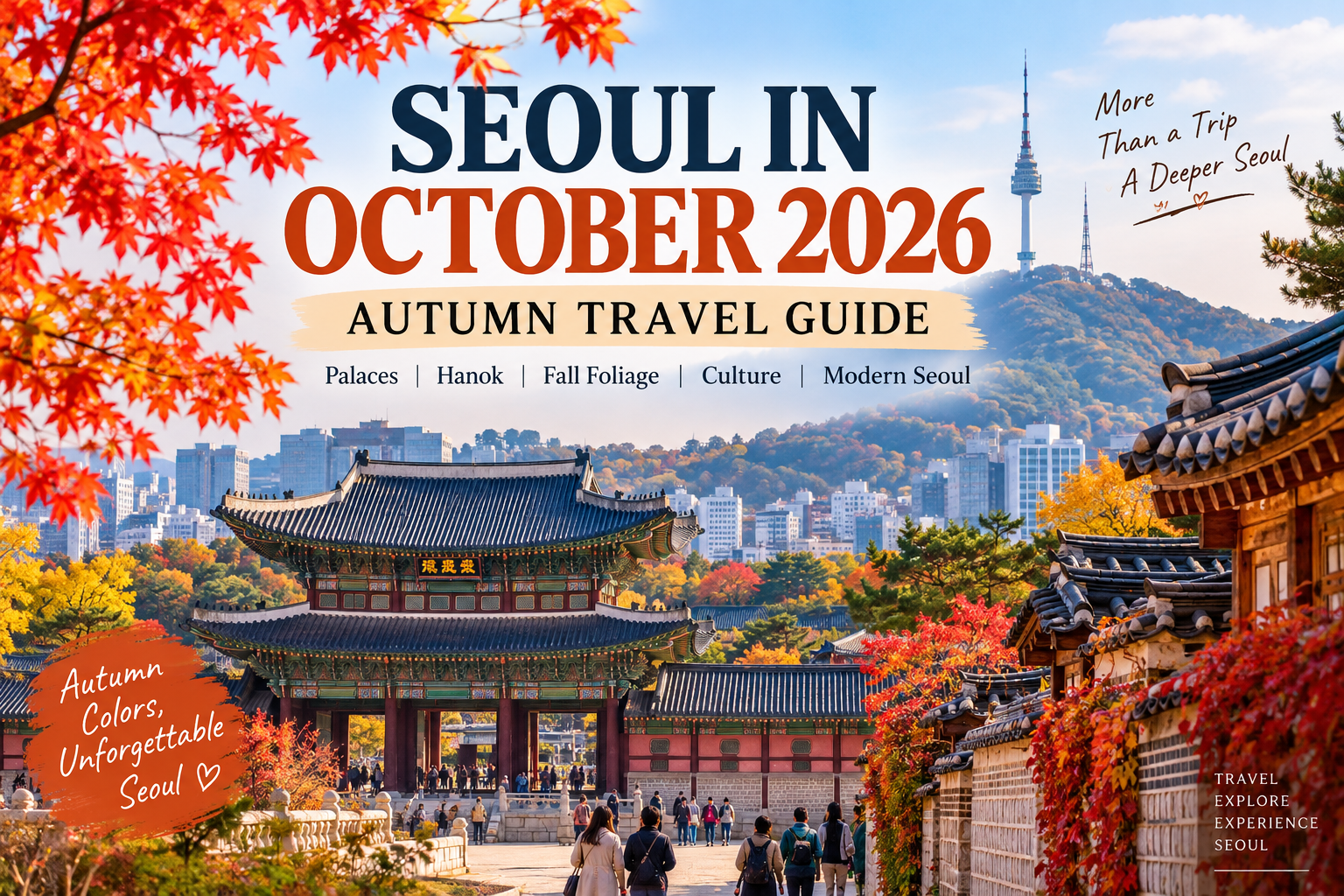
  • Seoul in October 2026: Best Things to Do, Festivals, Hanok Week & Autumn Travel Guide

    Seoul in October 2026: Best Things to Do, Festivals, Hanok Week & Autumn Travel Guide

    Why October Is One of the Best Months to Visit Seoul

    October is one of the most rewarding times of the year to explore Seoul.

    The intense summer heat has eased, autumn colors begin spreading across the city, and Seoul’s parks, palaces, hanok neighborhoods, and mountains become especially attractive for walking and sightseeing.

    In October 2026, travelers can also experience seasonal cultural events, including Seoul Hanok Week, alongside autumn activities across neighborhoods such as Bukchon and Seochon.

    For international visitors, this combination of comfortable weather, traditional culture, seasonal scenery, and outdoor events makes October an excellent month to experience different sides of the Korean capital.

    In this guide, we’ll cover the best things to do in Seoul in October 2026, major autumn events, Hanok Week, fall foliage spots, what to wear, and practical travel tips for planning your trip.

    Seoul Weather in October 2026: What to Expect

    October brings noticeably cooler and drier weather to Seoul, making it comfortable for travelers who plan to spend much of the day outdoors.

    Early October can still feel mild during the daytime, while mornings and evenings become increasingly cool as the month progresses. By late October, visitors should be prepared for much cooler temperatures, especially after sunset.

    What to Wear in Seoul in October

    Layering is the easiest approach.

    Bring long-sleeved shirts, light sweaters, comfortable pants, and a jacket that you can add or remove as temperatures change throughout the day.

    Comfortable walking shoes are especially important because many of Seoul’s best autumn experiences — from palace grounds and hanok neighborhoods to riverside parks and mountain trails — involve plenty of walking.

    If you are visiting toward the end of October, packing a slightly warmer outer layer is also a good idea.

    Seoul Hanok Week 2026: Explore Bukchon and Seochon

    One of the standout cultural events for October visitors is Seoul Hanok Week 2026, taking place from October 2 to October 11.

    The event brings a wide range of cultural programs to Seoul’s famous hanok neighborhoods, particularly Bukchon and Seochon, giving visitors an opportunity to experience traditional Korean architecture alongside exhibitions, walks, workshops, and other cultural activities.

    For international travelers, special programs including guided walking experiences make Hanok Week particularly accessible even if it is your first visit to these neighborhoods.

    Bukchon or Seochon?

    Bukchon Hanok Village is one of Seoul’s best-known areas for traditional Korean houses and historic streets, while Seochon offers a different atmosphere with hanok buildings mixed among small restaurants, cafés, galleries, and local streets.

    Visiting during Hanok Week makes it possible to combine Seoul’s historic architecture with contemporary neighborhood culture in a single autumn itinerary.

    Because some programs require advance reservations and schedules can vary, travelers should check the latest official Seoul Hanok Week information before visiting.

    Best Places to Enjoy Autumn in Seoul

    October is also when Seoul gradually begins to take on its autumn colors.

    Instead of traveling far outside the capital, visitors can find seasonal scenery at palaces, parks, mountains, and riverside areas throughout the city.

    Some popular places to consider include Gyeongbokgung Palace, Changdeokgung Palace, Namsan, Seoul Forest, Olympic Park, and Bukhansan National Park.

    The exact timing of peak foliage varies by location and weather conditions, so travelers visiting specifically for autumn colors should check the latest foliage forecast shortly before their trip.

    If seeing Korea’s fall colors is one of the main reasons for your visit, our separate Korea Fall Foliage 2026 guide covers peak dates and destinations beyond Seoul in more detail.

    Experience Seoul’s Palaces After Dark

    October is also a great time to experience Seoul’s historic palaces in the evening.

    One notable seasonal program is the Changdeokgung Moonlight Tour, which allows visitors to explore parts of the palace after dark while experiencing traditional performances and cultural storytelling in a very different atmosphere from a daytime palace visit.

    For international visitors, selected 2026 sessions are offered in foreign languages, making the experience more accessible to travelers who do not speak Korean.

    Even if you cannot reserve a special nighttime program, Seoul’s royal palaces are worth including in an October itinerary. Cooler weather makes walking through the large palace grounds much more comfortable than during the summer months.

    If a nighttime palace experience is high on your list, check the official reservation schedule before your trip because special programs may have limited capacity.

    Best Things to Do in Seoul in October

    Beyond autumn foliage and traditional culture, October is an excellent month for simply exploring Seoul on foot.

    Spend a morning walking through Gyeongbokgung Palace and Seochon, then continue to cafés, galleries, and local restaurants nearby. Another day can be devoted to Seoul Forest and Seongsu, combining autumn scenery with one of Seoul’s most popular contemporary neighborhoods.

    For panoramic city views, consider Namsan and N Seoul Tower, especially in the late afternoon when you can watch the city transition from daylight to night.

    October is also ideal for spending time along the Han River. Parks such as Yeouido Hangang Park offer open spaces for walking, cycling, picnics, and sunset views without the intense heat of summer.

    The key is not to pack too many neighborhoods into one day. Seoul is a large city, so grouping nearby attractions together will give you more time to enjoy each area instead of spending much of your trip on public transportation.

    Festivals and Events to Check in October 2026

    October is one of Seoul’s busiest months for outdoor events, cultural programs, neighborhood festivals, and seasonal activities.

    In addition to Seoul Hanok Week, travelers may find performances, food events, art programs, and local festivals taking place across different parts of the city.

    However, event dates and reservation requirements can change, so avoid building your entire itinerary around an event without checking its latest schedule.

    Before your trip, check official tourism information for the exact dates, locations, admission rules, and reservation requirements of any festival you want to attend.

    A good strategy is to choose one major seasonal event and combine it with nearby attractions. This keeps your itinerary flexible while still giving you a memorable October experience in Seoul.

    Sample 3-Day Seoul October Itinerary

    If you have three days in Seoul, you can combine traditional culture, autumn scenery, and modern neighborhoods without rushing.

    Day 1: Palaces, Hanok Streets & Seochon

    Start at Gyeongbokgung Palace, then explore Seochon’s streets, cafés, and hanok buildings. If your visit falls during Seoul Hanok Week, check whether any programs fit your schedule.

    Day 2: Seoul Forest, Seongsu & the Han River

    Spend the morning enjoying the seasonal scenery at Seoul Forest, continue to Seongsu for cafés, shops, and restaurants, and finish the day near the Han River.

    Day 3: Namsan & Central Seoul

    Explore central Seoul before heading to Namsan in the afternoon. Stay through sunset for views of the city as the lights begin to appear.

    This itinerary can easily be adjusted depending on foliage conditions, festival schedules, and the neighborhood where you are staying.

    Frequently Asked Questions About Seoul in October

    Is October a good time to visit Seoul?

    Yes. October generally offers cooler weather, outdoor activities, seasonal events, and the beginning of autumn foliage, making it a popular time for sightseeing in Seoul.

    Is Seoul cold in October?

    Early October is usually milder, while mornings and evenings become noticeably cooler later in the month. Layered clothing and a light jacket are useful, with a warmer outer layer recommended toward late October.

    Can I see fall foliage in Seoul in October?

    Yes, although the best timing depends on the location and weather conditions. Colors generally develop as October progresses, with some locations reaching their best displays later in the season.

    What are the best places to visit in Seoul in October?

    Popular choices include Gyeongbokgung Palace, Changdeokgung Palace, Bukchon, Seochon, Namsan, Seoul Forest, Bukhansan National Park, and the Han River parks.

    What special events are happening in Seoul in October 2026?

    One major event is Seoul Hanok Week 2026, scheduled for October 2–11. Seasonal palace programs and various neighborhood cultural events may also be available during the month.

    What should I pack for Seoul in October?

    Pack comfortable walking shoes, long-sleeved tops, sweaters, pants, and a jacket. Layering is particularly useful because daytime and evening temperatures can feel quite different.

    Final Thoughts: Visiting Seoul in October 2026

    October brings together many of the experiences that make Seoul memorable: historic palaces, hanok neighborhoods, changing autumn scenery, outdoor walks, cultural events, and lively modern districts.

    In 2026, events such as Seoul Hanok Week add another reason to explore neighborhoods like Bukchon and Seochon, while parks, mountains, palaces, and the Han River provide plenty of opportunities to enjoy the cooler season outdoors.

    The best approach is to keep your itinerary flexible. Check current foliage conditions and event schedules shortly before your visit, then group nearby attractions together to spend less time traveling across the city.

    Whether you are visiting Seoul for the first time or returning to explore it more deeply, October 2026 offers an excellent combination of Korean culture, seasonal scenery, and comfortable city travel.

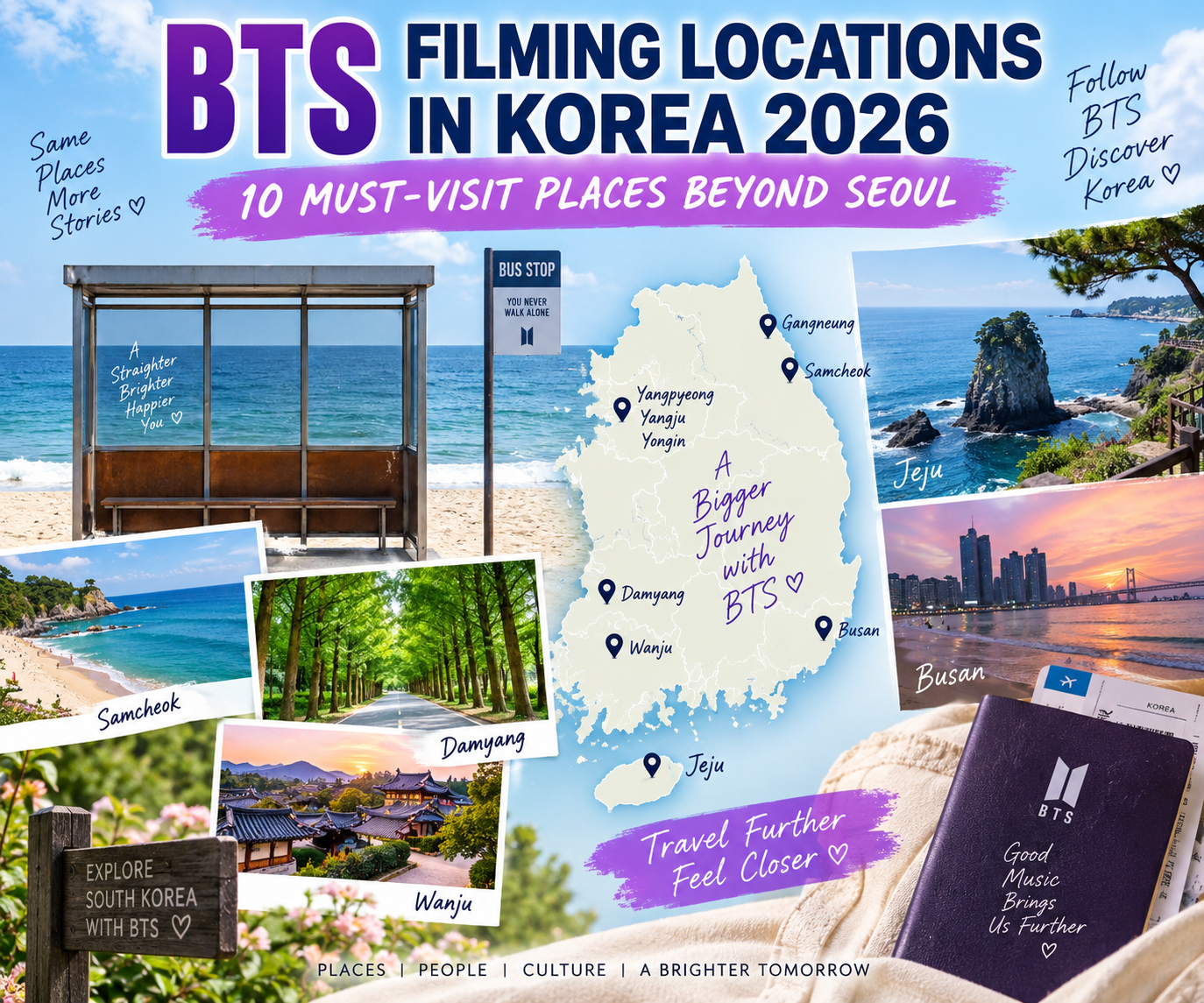
  • BTS Filming Locations in Korea 2026: 10 Must-Visit Places Beyond Seoul for ARMY

    BTS Filming Locations in Korea 2026: 10 Must-Visit Places Beyond Seoul for ARMY

    Introduction

    Seoul may be the starting point for many BTS fans visiting South Korea, but the BTS journey does not end in the capital.

    Across Korea, ARMY can discover beaches, forests, lakes, art spaces, and other locations connected to BTS album photos, music videos, performances, and memorable content. Some have become famous destinations in their own right, attracting fans from around the world.

    One of the best known is the BTS Bus Stop at Jumunjin Beach in Gangneung, recreated at the location associated with BTS’s You Never Walk Alone album imagery. But Gangneung is only one part of a much larger BTS travel map.

    In this guide, we’ll explore 10 BTS-related locations beyond Seoul that ARMY can visit in 2026, along with practical ideas for turning these stops into real Korea travel itineraries.

    If you have already explored BTS places in Seoul, consider this your next journey — following the BTS story beyond the capital and discovering more of South Korea along the way.

    1. BTS Bus Stop at Jumunjin Beach, Gangneung

    The BTS Bus Stop in Jumunjin, Gangneung is one of the most recognizable BTS pilgrimage destinations outside Seoul.

    The original bus stop appeared in imagery associated with BTS’s 2017 album You Never Walk Alone. Although the original structure was created for the photo shoot and later removed, a replica was installed at the location for fans and visitors.

    Standing beside the blue sea with the beach stretching behind it, the bus stop has become a favorite photo spot for ARMY traveling in Korea. Fans often recreate the album-inspired scene while enjoying the quieter coastal atmosphere of Gangneung.

    The location is also an excellent reason to explore more of Korea’s east coast. Jumunjin, Gangneung’s beaches, cafés, seafood restaurants, and other coastal attractions can easily turn a BTS stop into a full-day or overnight trip.

    Travel tip: Gangneung is accessible from Seoul by KTX, making the BTS Bus Stop possible as a day trip. However, staying overnight gives you more time to explore the coast without rushing.

    2. Maengbang Beach, Samcheok — The “Butter” Album Location

    On Korea’s east coast, Maengbang Beach (맹방해변) in Samcheok became internationally known among ARMY after appearing in the concept photography for BTS’s 2021 single album Butter.

    The colorful beach setting — including parasols, beach chairs, and the lifeguard-style backdrop — created some of the most recognizable images from the Butter era. The location later became a destination for fans hoping to recreate those photographs.

    Maengbang Beach also shows why BTS-themed travel can be a great way to explore Korea beyond the major cities. Samcheok offers beautiful coastline, beaches, and scenic attractions that international travelers might otherwise miss.

    For travelers already visiting the BTS Bus Stop in Gangneung, Maengbang Beach can become part of a longer Gangwon east-coast BTS itinerary rather than a separate trip from Seoul.

    Travel tip: Gangneung and Samcheok are in the same general east-coast region, but they are not next to each other. Allow sufficient transportation time if you plan to visit both during the same trip.

    3. Awon Gotaek, Wanju — A Beautiful BTS “Summer Package” Location

    Awon Gotaek (아원고택) in Wanju, Jeollabuk-do, offers a completely different atmosphere from the coastal BTS locations in Gangwon.

    The traditional Korean house and surrounding scenery became familiar to ARMY through BTS’s 2019 Summer Package in Korea. Its combination of hanok architecture, mountains, and peaceful countryside made it one of the most visually memorable locations connected to the group’s travel content.

    For international visitors, Awon Gotaek is especially interesting because the trip offers more than a BTS photo location. It is also an opportunity to experience traditional Korean architecture and the quieter landscape of rural Korea.

    Wanju can be combined with nearby Jeonju, famous for its Hanok Village and Korean food, making this a strong option for travelers who want to turn their BTS pilgrimage into a broader cultural trip.

    Travel tip: Check current visitor access and operating information before making the journey, as Awon Gotaek is not simply an always-open public park.

    4. Seohuri Forest, Yangpyeong — A Peaceful BTS Photo Location

    Seohuri Forest (서후리숲) in Yangpyeong, Gyeonggi-do, is a beautiful woodland destination that became well known among ARMY after BTS visited the area for album photography.

    The forest’s tall trees and quiet walking paths create a very different experience from Seoul’s busy BTS landmarks. Fans can enjoy the natural scenery while exploring a place connected to BTS’s earlier years.

    Yangpyeong is relatively close to Seoul, making Seohuri Forest an attractive option for travelers who want a countryside escape without traveling across the country.

    The area is also known for mountains, rivers, cafés, and scenic drives, so visitors can easily build a relaxing day trip around the BTS-related stop.

    Travel tip: Check Seohuri Forest’s current opening days and admission information before traveling, particularly if visiting during winter or periods of bad weather.

    5. Iryeong Station, Yangju — A “Spring Day” Filming Location

    Iryeong Station (일영역) in Yangju, Gyeonggi-do, is closely associated with BTS’s beloved song “Spring Day.” The station appeared in the music video, making it one of the recognizable BTS filming locations near Seoul.

    The quiet railway setting has a nostalgic atmosphere that matches the emotional tone of the song. For many ARMY, visiting the area offers a chance to connect a familiar music-video scene with a real place in Korea.

    Yangju is outside central Seoul but close enough to consider as part of a day trip. The surrounding area also gives travelers a glimpse of a quieter side of Gyeonggi Province.

    Travel tip: Railway facilities can have access restrictions and operational changes. Check current visitor information before traveling, stay only in permitted areas, and never enter active railway tracks.

    6. Yongin Dae Jang Geum Park — Step Into the World of “Daechwita”

    Yongin Dae Jang Geum Park (용인 대장금파크) in Gyeonggi-do is a large historical drama filming complex, but BTS fans may recognize its scenery from Agust D’s “Daechwita” music video, featuring SUGA.

    Traditional-style streets, palace settings, and historical architecture helped create the dramatic visual world of the music video. For fans of SUGA and BTS, visiting the park offers a chance to experience scenery associated with one of his most memorable solo releases.

    The destination is also worthwhile for travelers interested in Korean historical dramas and traditional architecture, making it more than a single-purpose BTS photo stop.

    Travel tip: Yongin is accessible from Seoul, but the park is outside the city center. Check current opening hours, admission information, and transportation options before leaving Seoul.

    7. Mosan Airfield, Jecheon — A Location from BTS’s Youth Era

    Mosan Airfield (모산비행장) in Jecheon, Chungcheongbuk-do, is associated with imagery from BTS’s celebrated The Most Beautiful Moment in Life (HYYH) era.

    The wide open landscape and runway-like setting created a distinctive backdrop during an important period in BTS’s artistic development. For longtime ARMY, locations connected to the HYYH era can feel particularly meaningful because of the themes of youth, friendship, uncertainty, and growing up that defined this chapter of BTS history.

    Jecheon itself is surrounded by mountains and lakes, making it possible to combine a BTS-related stop with a scenic trip through central Korea.

    Travel tip: Access conditions around airfield areas can change. Check current local information before visiting and remain only in areas legally open to the public.

    8. Metasequoia-Lined Road, Damyang — A Scenic BTS Travel Stop

    Damyang’s Metasequoia-Lined Road (담양 메타세쿼이아길) in Jeollanam-do is known for its long rows of towering trees and picturesque scenery. The Damyang area has also become familiar to BTS fans through content connected to the group.

    For international travelers, Damyang is especially appealing because a BTS-inspired trip can easily become a broader journey through southern Korea. The region is famous for bamboo forests, peaceful walking paths, local food, and beautiful natural scenery.

    A visit here offers a slower travel experience than Seoul or Busan and can be combined with Juknokwon Bamboo Garden and other Damyang attractions.

    Travel tip: Damyang is best treated as part of a regional itinerary rather than a quick trip from Seoul. Consider combining it with Gwangju or other destinations in Jeollanam-do.

    9. Dadaepo Beach, Busan — Follow Jimin’s Footsteps by the Sea

    Dadaepo Beach (다대포해수욕장) in Busan is especially meaningful for fans of Jimin, who was born in Busan. The beach became familiar to ARMY after Jimin shared photographs from the area, turning it into a popular stop for fans following places connected to the BTS members.

    Dadaepo is famous for its wide sandy beach, beautiful sunsets, and relaxed atmosphere. It offers a very different experience from Busan’s busier destinations such as Haeundae and Gwangalli.

    For international ARMY, the stop can be combined with a wider BTS-inspired Busan itinerary, while also exploring one of Korea’s most popular coastal cities.

    Travel tip: Try to visit in the late afternoon. Dadaepo is particularly beautiful around sunset, and you can combine the trip with other western Busan attractions.

    10. Oedolgae Sea Stack, Jeju — A BTS Album Photo Location

    Oedolgae Sea Stack (외돌개) in Seogwipo, Jeju Island, is one of the most scenic BTS-related destinations outside Seoul. The dramatic volcanic rock and surrounding coastline appeared in photography connected to BTS’s The Most Beautiful Moment in Life, Part 2 era.

    For ARMY, the location offers something especially valuable: it combines BTS history with one of Korea’s most popular travel destinations. Instead of visiting only for a photo, travelers can explore the surrounding Jeju coastline and nearby walking trails while enjoying the island’s volcanic landscape.

    Jeju also has several other places connected to BTS members and BTS content, making it possible to build an entire BTS-inspired day into a longer Jeju itinerary.

    Travel tip: Oedolgae is in Seogwipo on the southern side of Jeju Island. Plan it together with other southern Jeju attractions rather than traveling there as a single stop.

    How to Plan Your BTS Trip Beyond Seoul

    These BTS locations are spread across South Korea, so trying to visit them all in one trip would require significant travel time. A better strategy is to group them by region.

    For an east-coast trip, combine Gangneung’s BTS Bus Stop with Samcheok’s Maengbang Beach and spend one or two nights exploring Gangwon-do.

    For locations closer to Seoul, Yangpyeong, Yangju, and Yongin can be planned as separate day trips depending on transportation and opening conditions.

    In the southwest, combine Wanju with Jeonju, while Damyang works well as part of a trip through Gwangju and Jeollanam-do.

    Busan and Jeju deserve longer stays. Rather than visiting only for a BTS-related photo, use these locations as starting points for exploring Korea’s beaches, food, neighborhoods, and natural scenery.

    This approach turns a BTS pilgrimage into something even better: a journey through different regions of South Korea.

    Frequently Asked Questions About BTS Filming Locations in Korea

    What is the most famous BTS location outside Seoul?
    The BTS Bus Stop near Jumunjin in Gangneung is one of the best-known BTS pilgrimage spots in Korea, especially because of its connection to the You Never Walk Alone album imagery.

    Can I visit the BTS Bus Stop from Seoul?
    Yes. Gangneung can be reached from Seoul by KTX, and travelers can continue to the Jumunjin area using local transportation. An overnight stay is worth considering if you want to explore more of Gangneung.

    Where was BTS’s “Butter” concept photography taken?
    Maengbang Beach in Samcheok became famous among ARMY through BTS’s Butter concept photography.

    Are there BTS filming locations near Seoul?
    Yes. Locations in Gyeonggi-do, including Yangpyeong, Yangju, and Yongin, can be incorporated into trips from Seoul, although travel times and public transportation options vary.

    Are there BTS-related places in Jeju?
    Yes. Jeju has locations connected to BTS content, including Oedolgae in Seogwipo, which is associated with BTS album photography.

    Should I rent a car for a BTS pilgrimage outside Seoul?
    It depends on the destination. Major cities such as Gangneung and Busan are accessible by public transportation, but some rural filming locations can be considerably easier to reach by car. International visitors should compare train, bus, taxi, tour, and rental-car options before planning each regional itinerary.

    Final Thoughts

    Following BTS filming locations beyond Seoul is also a wonderful way to discover how diverse South Korea really is.

    From the blue coastline of Gangneung and Samcheok to the forests of Yangpyeong, traditional scenery around Wanju, beaches in Busan, and the volcanic landscape of Jeju, each destination offers something beyond its BTS connection.

    For ARMY, these places can bring familiar albums, videos, and BTS memories into the real world. For travelers, they can also become gateways to Korean food, nature, regional culture, and destinations that many first-time visitors never experience.

    So don’t rush simply to recreate a photograph. Stay a little longer, explore the surrounding area, and let your BTS pilgrimage become part of a bigger journey through Korea.

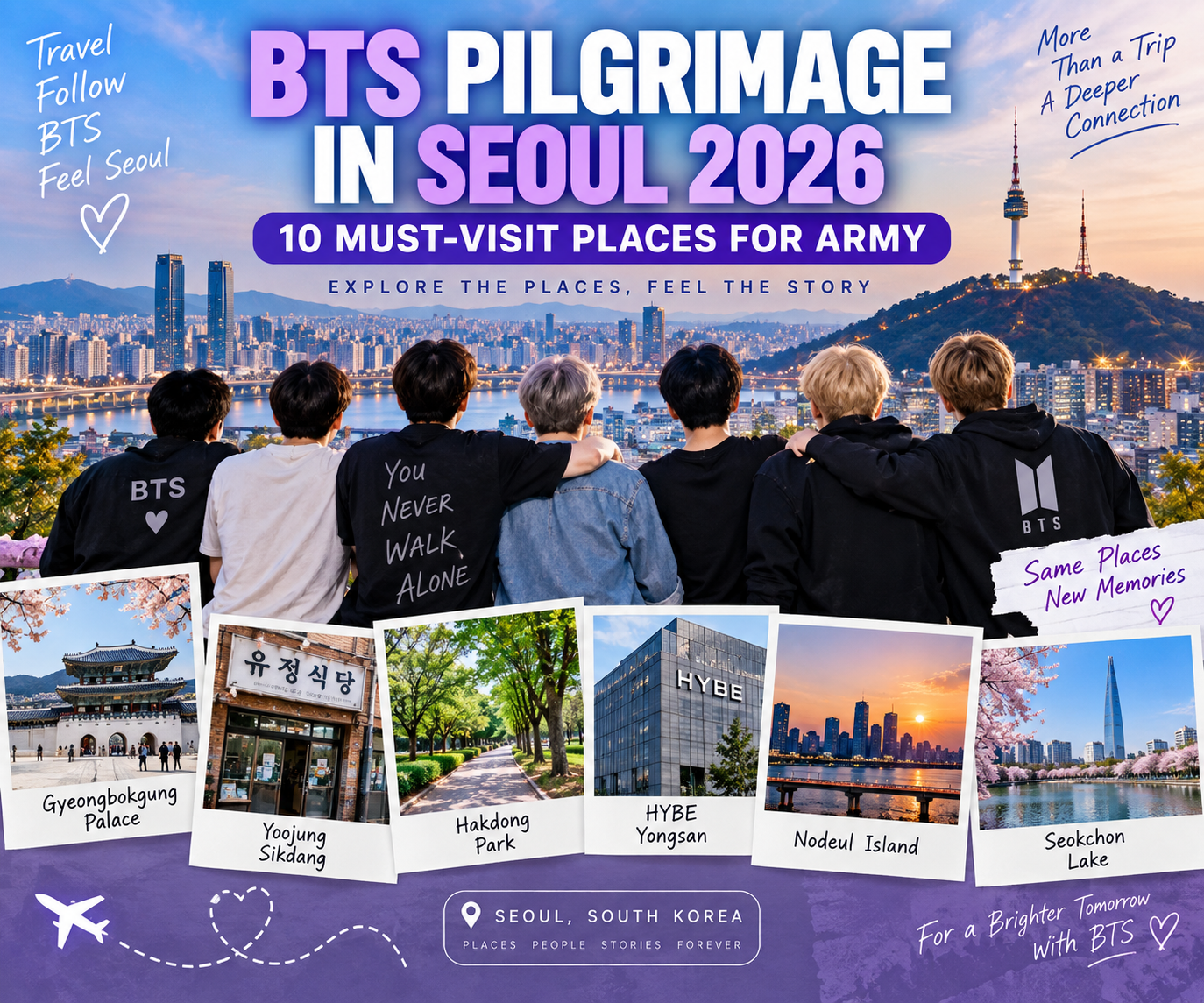
  • BTS Pilgrimage in Seoul 2026: 10 Must-Visit Places Every ARMY Should See

    BTS Pilgrimage in Seoul 2026: 10 Must-Visit Places Every ARMY Should See

    Introduction

    For ARMY visiting South Korea, Seoul is more than palaces, shopping streets, and famous cafés. Hidden throughout the city are places connected to BTS’s journey — from the neighborhood where the members spent their early years to locations that appeared in performances, videos, and memorable moments in BTS history.

    Some of these places are closely associated with BTS before they became global superstars. Others allow fans to experience locations they may recognize from BTS content while also discovering Seoul itself.

    This guide introduces 10 BTS-related places in Seoul that ARMY can add to a Korea itinerary in 2026, with practical travel tips and ideas for combining the stops into an enjoyable day of sightseeing.

    Rather than simply checking places off a list, think of this as a journey through different chapters of the BTS story — while experiencing the neighborhoods, food, culture, and everyday atmosphere of Seoul along the way.

    1. Yoojung Sikdang — A Restaurant from BTS’s Trainee Days

    For many longtime ARMY, Yoojung Sikdang (유정식당) is one of the most meaningful BTS-related stops in Seoul.

    Located in the Nonhyeon area of Gangnam, the restaurant became known among fans because BTS members ate there during their trainee and early debut years, when their practice space was nearby.

    Today, the restaurant attracts BTS fans from around the world. Inside, visitors can find BTS-related decorations and memorabilia while enjoying a Korean meal.

    Rather than visiting only for a photograph, consider eating here and exploring the surrounding neighborhood. It gives fans a glimpse into the part of Seoul connected to BTS long before stadium tours and worldwide fame.

    Travel tip: Combine Yoojung Sikdang with Hakdong Park and the area around BTS’s former BigHit building. These locations are close enough to make them part of the same ARMY walking route.

    2. Hakdong Park — A Place Connected to BTS’s Early Years

    Hakdong Park (학동공원) is another meaningful stop for fans interested in BTS’s pre-debut and early-career years.

    Located near the group’s former practice area in Nonhyeon-dong, the park has become associated with stories and memories from the period when the members were still trainees and young artists working toward their debut.

    Unlike a major tourist attraction, Hakdong Park is an ordinary neighborhood park. That is part of its appeal. Visiting gives ARMY a chance to experience the everyday surroundings connected with BTS’s beginnings rather than only the polished landmarks associated with their later global success.

    Because it is close to Yoojung Sikdang and BTS’s former BigHit neighborhood, the three stops work especially well as one walking itinerary.

    Travel tip: Be considerate of local residents when visiting. Hakdong Park is a public neighborhood space, so keep noise low and avoid blocking paths while taking photos.

    3. BTS’s Former BigHit Building — Where the Early Story Took Shape

    Before HYBE became a major entertainment company with its headquarters in Yongsan, BTS spent an important part of their early career around BigHit Entertainment’s former offices and practice spaces in Gangnam.

    For longtime ARMY, the area is meaningful because it represents the years when BTS was still building its career, practicing, recording, and gradually growing from a newly debuted group into an international phenomenon.

    The building is not an official BTS tourist attraction, and visitors should remember that it is private property. The best way to experience this stop is to view the exterior respectfully and then continue exploring the surrounding neighborhood.

    Together with Yoojung Sikdang and Hakdong Park, this area creates one of the most interesting walking routes for fans who want to understand BTS’s beginnings in Seoul.

    Travel tip: Do not enter private property or disturb people using nearby buildings. A quick exterior visit is enough before continuing your BTS walking tour.

    4. HYBE Headquarters in Yongsan — BTS’s Present-Day Home Base

    BTS’s story eventually moved from the small offices of BigHit Entertainment to HYBE’s headquarters in Yongsan, reflecting just how dramatically the group and its company grew.

    The modern HYBE building is located in Yongsan, one of Seoul’s most accessible central districts. For ARMY, seeing the building from outside can be an interesting contrast to the former BigHit locations in Gangnam — from BTS’s humble beginnings to the global scale of their career today.

    However, visitors should know that HYBE headquarters is an office building, not a general BTS tourist attraction, and access to working areas is restricted. Fans should respect the property and avoid waiting around entrances or interfering with employees.

    Also, the former HYBE INSIGHT museum at the headquarters is no longer operating, so travelers should not plan a visit expecting to enter a BTS museum there.

    Travel tip: Combine an exterior stop at HYBE with other attractions around Yongsan rather than making the building your only destination.

    5. Gyeongbokgung Palace — BTS’s Iconic Seoul Performance Location

    Gyeongbokgung Palace is one of Seoul’s most famous historical attractions, but for ARMY it also holds a special connection to BTS.

    In 2020, BTS filmed performances at Gyeongbokgung for The Tonight Show Starring Jimmy Fallon. The spectacular setting brought together K-pop and traditional Korean architecture, introducing millions of international viewers to one of Korea’s most important royal palaces.

    This makes Gyeongbokgung especially valuable for BTS fans visiting Seoul: it is not only a filming location but also a major cultural attraction worth exploring on its own.

    Allow enough time to walk through the palace grounds rather than visiting only for a BTS-related photo. Nearby attractions such as Bukchon, Insadong, and Gwanghwamun can also be combined into the same day.

    Travel tip: Check the palace’s current opening hours and closing days before visiting, as schedules can vary by season.

    6. Nodeul Island — A Scenic BTS Filming Location on the Han River

    Nodeul Island (노들섬) sits in the middle of the Han River and offers a very different atmosphere from Seoul’s busy shopping and entertainment districts.

    For ARMY, the island is especially recognizable as a filming location connected to BTS’s 2021 Season’s Greetings. Its open spaces and Han River scenery have made it a popular stop for fans who enjoy visiting places seen in BTS content.

    Nodeul Island is also worth visiting even without the BTS connection. Travelers can walk along the river, relax outdoors, take photographs, and enjoy views of Seoul from a quieter setting.

    Travel tip: Visit in the late afternoon and stay toward sunset for beautiful Han River views. It can easily be combined with other Yongsan-area stops on your BTS itinerary.

    7. Seokchon Lake — A BTS-Connected Stop in Jamsil

    Seokchon Lake (석촌호수) in Jamsil is another Seoul destination that has appeared in BTS-related content and is a pleasant place to include in an ARMY itinerary.

    Surrounded by walking paths and city views, the lake is particularly popular during spring cherry blossom season. It also sits beside Lotte World and close to Lotte World Tower, making this stop easy to combine with a full day in Jamsil.

    For international visitors, this is a good example of how a BTS-themed trip can lead to discovering other parts of Seoul. Rather than traveling across the city only to recreate a photo, spend some time walking around the lake, exploring Jamsil, or visiting nearby attractions.

    Travel tip: If you visit during cherry blossom season, expect large crowds. Early morning is usually more comfortable for walking and photography.

    8. Seoul Forest — Walk Through a Place Loved by BTS Fans

    Seoul Forest (서울숲) is one of Seoul’s most relaxing green spaces and has also become a familiar destination for ARMY.

    Over the years, fans have created BTS-related commemorative spaces and adopted trees in and around the park to celebrate members’ birthdays and other special occasions. These fan-supported spots have helped turn parts of Seoul Forest into places where ARMY can experience the fan culture surrounding BTS.

    The park itself is worth exploring beyond its BTS connection. With walking paths, gardens, open lawns, and cafés in the nearby Seongsu neighborhood, it is an easy place to spend several hours.

    Travel tip: Combine Seoul Forest with Seongsu-dong, one of Seoul’s popular café and shopping neighborhoods. This turns a BTS-related stop into a fuller half-day Seoul itinerary.

    9. Yeouido Hangang Park — A Place Connected to BTS and Seoul’s Han River

    Yeouido Hangang Park (여의도한강공원) is one of Seoul’s most popular riverside destinations and has a special connection to BTS history.

    The Yeouido area has hosted major BTS-related events, including celebrations connected to BTS FESTA, when large numbers of ARMY gathered along the Han River to celebrate the group’s anniversary.

    Even when there is no BTS event taking place, the park offers international visitors a classic Seoul experience. You can walk or cycle beside the river, enjoy Korean convenience-store food, have a picnic, and watch the city lights after sunset.

    For ARMY, it is a good place to experience both BTS fan culture and the everyday Han River lifestyle that is such an important part of Seoul.

    Travel tip: Visit in the evening and combine the stop with a Han River picnic. During major events or festivals, check official announcements in advance because access and transportation arrangements may change.

    10. Seoul Olympic Stadium — A Landmark in BTS Concert History

    Seoul Olympic Stadium (서울올림픽주경기장) in Jamsil holds an important place in BTS history as the setting for some of the group’s major concerts in South Korea.

    For ARMY, the stadium represents a very different chapter from the small restaurants, parks, and practice spaces associated with BTS’s early years. Performing at a massive stadium in Seoul became a powerful symbol of how far the group had come.

    The stadium area has undergone major redevelopment, so travelers should check current access and construction conditions before visiting rather than expecting the same appearance seen in older BTS concert footage.

    Even when access to the stadium itself is limited, Jamsil is easy to combine with other attractions, including Seokchon Lake, Lotte World Tower, shopping, restaurants, and cafés.

    Travel tip: Do not make a special trip solely to enter the stadium. Check its current status first and combine the area with your Jamsil itinerary.

    How to Plan Your BTS Pilgrimage in Seoul

    Trying to visit all 10 locations in a single day would mean spending too much time traveling across Seoul. A better option is to group the destinations by neighborhood.

    For fans interested in BTS’s early history, start with Yoojung Sikdang, Hakdong Park, and the former BigHit area in Gangnam. These locations work naturally as one walking route.

    On another part of your trip, explore HYBE’s Yongsan area and Nodeul Island, followed by an evening along the Han River.

    Gyeongbokgung Palace deserves several hours because it is also one of Seoul’s most important historical attractions. Likewise, Seoul Forest and Seongsu work well together for a relaxed half-day of parks, cafés, shopping, and BTS fan culture.

    Finally, Seokchon Lake and the Jamsil area can be combined into another itinerary.

    The best BTS pilgrimage is not about rushing between photo spots. Give yourself time to experience the Seoul neighborhoods that became part of the BTS story.

    Frequently Asked Questions About BTS Places in Seoul

    Where can BTS fans go in Seoul?
    Popular BTS-related stops include Yoojung Sikdang, Hakdong Park, the former BigHit area, HYBE’s Yongsan headquarters area, Gyeongbokgung Palace, Nodeul Island, Seoul Forest, and several Han River locations.

    Can fans enter the HYBE headquarters?
    HYBE headquarters is primarily an office building, not a general BTS tourist attraction. Visitors should not expect access to working areas and should respect the building, employees, and surrounding property.

    Is the old BigHit building open to tourists?
    No. The former BigHit location should be treated as private property. Fans can respectfully see the area from outside without entering or disturbing occupants.

    Can I visit BTS places in Seoul in one day?
    It is possible to see several locations in one day, but the sites are spread across Seoul. For a more enjoyable trip, divide them into neighborhood-based routes over two or more days.

    What is the best area for BTS fans visiting Seoul for the first time?
    Fans especially interested in BTS’s early history may want to start around Nonhyeon-dong with Yoojung Sikdang, Hakdong Park, and the former BigHit area.

    Are there BTS places outside Seoul?
    Yes. BTS-related filming and photo locations can be found in several other parts of South Korea. One of the most famous is the BTS Bus Stop at Jumunjin Beach in Gangneung.

    Final Thoughts

    A BTS pilgrimage in Seoul is more than a tour of places connected to a famous K-pop group. It is also a journey through different parts of the city and different chapters of BTS’s history.

    From the modest streets around Yoojung Sikdang and Hakdong Park to Gyeongbokgung Palace, the Han River, and the neighborhoods associated with BTS today, each stop offers ARMY a different perspective on the group’s journey.

    Most importantly, take time to enjoy Seoul itself. Eat Korean food, explore the neighborhoods, visit cafés, walk along the Han River, and experience the culture surrounding these locations.

    And Seoul is only the beginning. Beyond the capital, destinations such as Gangneung’s famous BTS Bus Stop give ARMY even more reasons to explore South Korea.

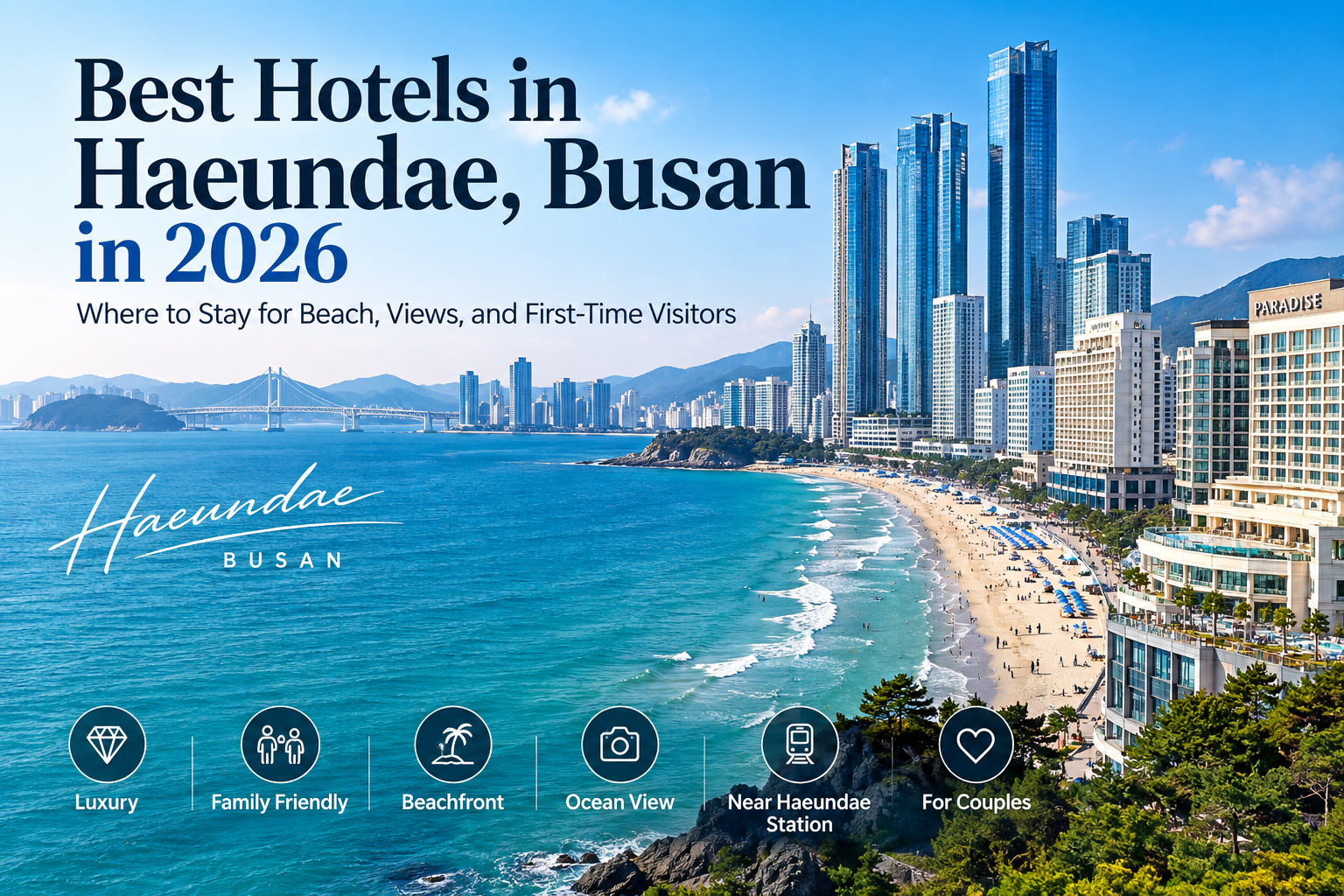
  • Best Hotels in Haeundae, Busan in 2026: Where to Stay for Beach, Views, and First-Time Visitors

    Best Hotels in Haeundae, Busan in 2026: Where to Stay for Beach, Views, and First-Time Visitors

    Best Hotels in Haeundae, Busan in 2026

    If you are planning your first trip to Busan, there is a good chance Haeundae is already on your list.

    Haeundae is one of Busan’s most famous coastal areas, combining a long sandy beach with hotels, restaurants, cafes, nightlife, shopping, and easy access to some of the city’s most popular attractions.

    It also has one of the widest selections of accommodation in Busan.

    You can stay in a luxury oceanfront hotel, a stylish mid-range property, or a practical hotel close to Haeundae Station.

    But which hotel should you choose?

    This guide compares some of the best hotels in Haeundae in 2026 for first-time visitors, couples, families, beach lovers, luxury travelers, and travelers who simply want a convenient location.

    Quick Guide: Best Haeundae Hotels by Traveler Type

    If you want the short answer:

    SIGNIEL Busan — Best for a luxury ocean-view experience

    Paradise Hotel Busan — Best for a classic beachfront resort stay

    Grand Josun Busan — Best for families and modern beachfront luxury

    The Westin Josun Busan — Best for beach access and Dongbaekseom location

    Park Hyatt Busan — Best for luxury, marina atmosphere, and Gwangan Bridge views

    Shilla Stay Haeundae — Best for practical comfort and value near the beach

    L7 Haeundae by Lotte — Best for a modern, lifestyle-focused stay

    There is no single hotel that is best for everyone.

    The right choice depends on whether you value beachfront location, ocean views, transportation, luxury facilities, family convenience, or price.

    Why Stay in Haeundae?

    For first-time visitors, Haeundae is one of the easiest areas in Busan to understand.

    The neighborhood offers much more than the beach itself.

    Around Haeundae you can find:

    • Haeundae Beach
    • Restaurants and cafes
    • Traditional market food
    • Nightlife
    • Shopping
    • Coastal walks
    • Easy subway access
    • Luxury hotels
    • Family-friendly attractions

    It is particularly convenient if your idea of Busan includes waking up near the sea and ending the day with a walk along the coast.

    Haeundae is also a useful base for exploring eastern Busan.

    1. SIGNIEL Busan — Best for Luxury Ocean Views

    For travelers looking for one of the most luxurious stays in Haeundae, SIGNIEL Busan is an obvious hotel to consider.

    Located in the Haeundae area near the beachfront, it is designed for travelers who want the hotel itself to be a major part of the trip.

    This is not simply somewhere to sleep between sightseeing days.

    It is the type of property travelers choose for the overall experience.

    Best For

    • Luxury travelers
    • Couples
    • Honeymoons
    • Special occasions
    • Ocean-view seekers
    • Travelers who enjoy premium hotel facilities

    Why Choose It?

    The biggest reason is the combination of location, elevated sea views, and luxury positioning.

    If you are celebrating an anniversary or simply want to make your Busan accommodation one of the highlights of the trip, this is the kind of property worth comparing.

    What to Check Before Booking

    Ocean-view categories can differ.

    Do not assume every room has exactly the same view.

    Check the specific room description and view category before paying a premium rate.

    2. Paradise Hotel Busan — Best for a Classic Beachfront Resort Experience

    Paradise Hotel Busan is another well-known luxury option directly associated with the Haeundae beachfront experience.

    Its location makes it especially appealing to travelers who want the beach immediately outside their hotel rather than several streets away.

    Best For

    • Beach lovers
    • Couples
    • Families
    • Resort-style travelers
    • First-time Busan visitors
    • Travelers who want to minimize walking to the beach

    Why Stay Here?

    The biggest advantage is simple:

    You are staying right at one of Korea’s most famous beaches.

    This can make a major difference during summer or for travelers planning a relaxed coastal vacation.

    You can spend the morning sightseeing, return to the hotel, and enjoy the Haeundae area without another long journey across Busan.

    Possible Downside

    Prime beachfront luxury comes at a price.

    During popular travel periods, rates can rise substantially.

    Compare room types and cancellation conditions rather than booking the first rate you see.

    3. Grand Josun Busan — Best for Families and Modern Beachfront Luxury

    Grand Josun Busan combines a prime Haeundae location with a contemporary luxury-hotel experience.

    Its beachfront position makes it convenient for travelers who want easy access to the sea while still enjoying the facilities of a full-service hotel.

    Best For

    • Families
    • Couples
    • Luxury travelers
    • Multi-night Haeundae stays
    • Travelers who want the beach nearby

    Why Choose Grand Josun Busan?

    For families, hotel facilities can matter just as much as location.

    Parents traveling with children often value:

    • Convenient dining
    • Swimming facilities
    • Easy beach access
    • Comfortable common areas
    • Minimal transportation after a long sightseeing day

    Grand Josun is particularly worth comparing with Paradise Hotel Busan if you want a higher-end Haeundae stay.

    Grand Josun vs Paradise Hotel Busan

    These hotels appeal to similar travelers, so how do you choose?

    Choose Grand Josun Busan if you prefer a modern luxury atmosphere and family-oriented hotel experience.

    Choose Paradise Hotel Busan if a classic Haeundae resort experience is your priority.

    For either hotel, compare the exact room category, included benefits, breakfast, cancellation policy, and current rate before booking.

    4. The Westin Josun Busan — Best for Haeundae Beach and Dongbaekseom

    The Westin Josun Busan occupies an especially interesting position at the western end of Haeundae Beach near Dongbaekseom.

    This makes it attractive for travelers who want both the beach and scenic coastal walks.

    The hotel also offers views toward Haeundae, Marine City, and the wider coastal skyline depending on the room and location.

    Best For

    • Couples
    • Beach lovers
    • Walking enthusiasts
    • Families
    • Travelers who like scenic locations
    • Repeat Busan visitors

    Why Choose It?

    Location is the strongest reason.

    You can enjoy Haeundae while also being close to the Dongbaekseom walking area.

    That gives the stay a slightly different feeling from being directly in the busiest central streets of Haeundae.

    For travelers who enjoy morning or evening walks, that can be a significant advantage.

    5. Park Hyatt Busan — Best for Marina and Gwangan Bridge Views

    Park Hyatt Busan is located in Marine City rather than directly in the busiest central section of Haeundae Beach.

    That distinction is important.

    Choose this hotel if you are attracted to modern architecture, luxury interiors, marina surroundings, and views toward the ocean and Gwangan Bridge.

    Best For

    • Luxury travelers
    • Couples
    • Design-focused travelers
    • Business travelers
    • Special occasions
    • Travelers who value skyline and bridge views

    Why Choose Park Hyatt Busan?

    The atmosphere is different from a traditional beachfront resort.

    Marine City feels sleek and urban.

    You are surrounded by modern towers and waterfront scenery rather than the busiest beach streets.

    For some travelers, that makes Park Hyatt one of the most appealing luxury choices in Busan.

    Who Should Choose Another Hotel?

    If your number-one priority is walking out of the lobby and immediately reaching the central section of Haeundae Beach, consider a beachfront property instead.

    Location within Haeundae matters.

    Park Hyatt vs SIGNIEL Busan

    Both appeal to luxury travelers, but the experience differs.

    Choose SIGNIEL Busan if you want a high-end stay closely associated with Haeundae’s beach and oceanfront atmosphere.

    Choose Park Hyatt Busan if you prefer Marine City’s sophisticated waterfront setting and views toward Gwangan Bridge.

    This is less about which hotel is “better” and more about which Busan experience you want.

    6. Shilla Stay Haeundae — Best for Comfort and Value

    Not every traveler needs a five-star resort.

    Shilla Stay Haeundae is useful for visitors who want a recognizable hotel experience in a convenient location without necessarily paying luxury-resort prices.

    The hotel is close to Haeundae Beach and approximately an eight-minute walk from Haeundae Station.

    It also offers a rooftop pool and bar with views over the Haeundae area.

    Best For

    • First-time visitors
    • Couples
    • Business travelers
    • Travelers who prioritize location
    • Visitors looking for mid-range comfort
    • Travelers using the subway frequently

    Why Choose It?

    The biggest strength is balance.

    You can stay near the beach while remaining reasonably close to Haeundae Station.

    That matters because Busan is a large city.

    If you plan to spend several days sightseeing beyond Haeundae, convenient subway access can save a surprising amount of time.

    7. L7 Haeundae by Lotte — Best for a Modern Lifestyle Stay

    L7 Haeundae by Lotte is another option for travelers who want a contemporary hotel in the Haeundae area.

    The L7 brand generally targets travelers looking for a more modern, lifestyle-oriented atmosphere rather than a traditional luxury-hotel experience.

    Best For

    • Couples
    • Younger travelers
    • Friends
    • Design-conscious travelers
    • Short city breaks
    • Travelers who want to stay near Haeundae Beach

    Why Consider It?

    For some visitors, a hotel should feel modern and fun without moving into the highest luxury price category.

    That is where lifestyle hotels can be appealing.

    Compare it directly with Shilla Stay when deciding between practical convenience and a more lifestyle-focused hotel experience.

    Luxury vs Mid-Range: How Much Should You Spend?

    The right hotel budget depends heavily on how you plan to use the property.

    If your itinerary is packed from morning until night, paying significantly more for extensive hotel facilities may not provide much value.

    But if your Busan trip is partly a beach vacation, paying more for:

    • Ocean views
    • Swimming pools
    • Resort facilities
    • Larger rooms
    • Beachfront access

    may be worthwhile.

    Think about how many hours you will actually spend at the hotel.

    That is often a better guide than star ratings alone.

    Best Haeundae Hotel for Couples

    For a romantic trip, consider:

    SIGNIEL Busan for a premium ocean-view experience.

    Park Hyatt Busan for luxury and sophisticated waterfront views.

    The Westin Josun Busan for beach access and scenic walks.

    Grand Josun Busan for modern beachfront luxury.

    The right choice depends on whether your ideal trip feels more like a resort vacation, city escape, or special-occasion hotel stay.

    Best Haeundae Hotel for Families

    Families should prioritize more than the room photograph.

    Check:

    • Room size
    • Bed configuration
    • Pool access
    • Breakfast
    • Children’s facilities
    • Beach distance
    • Laundry options
    • Nearby restaurants

    Grand Josun Busan and other full-service beachfront properties are worth comparing when facilities matter.

    But families spending most of the day sightseeing may find a well-located mid-range hotel more practical.

    Best Haeundae Hotel for First-Time Visitors

    For first-time visitors, location is especially important.

    If you want easy access to restaurants, the beach, and Haeundae’s main streets, staying close to the central beach area can simplify the trip.

    If you also plan to use the subway frequently, check walking distance to Haeundae Station before booking.

    A beautiful ocean-view hotel can still be inconvenient if it does not fit your actual itinerary.

    Best Haeundae Hotels for Ocean Views

    Ocean-view travelers have several strong options in the broader Haeundae area.

    Properties worth comparing include:

    • SIGNIEL Busan
    • Paradise Hotel Busan
    • Grand Josun Busan
    • The Westin Josun Busan
    • Park Hyatt Busan

    However, remember:

    Hotel name does not guarantee ocean view.

    Room category matters.

    Always confirm the exact view listed for the room you are booking.

    Should You Stay Directly on Haeundae Beach?

    For many visitors, yes.

    Beachfront accommodation is especially useful if:

    • You are visiting in summer
    • You enjoy morning walks
    • You are traveling with children
    • You want a resort atmosphere
    • You plan to spend significant time around Haeundae

    But beachfront is not automatically necessary.

    A hotel several minutes inland may cost less while still giving you easy access to the beach.

    Haeundae Beach vs Marine City

    This is an important distinction.

    Choose Haeundae Beach If You Want:

    • Immediate beach atmosphere
    • Restaurants
    • Tourist energy
    • Easy access to Haeundae’s central streets
    • A classic first-time Busan experience

    Choose Marine City If You Want:

    • Modern skyline
    • Waterfront towers
    • Luxury atmosphere
    • Marina scenery
    • Gwangan Bridge views

    Park Hyatt is particularly relevant to the second experience.

    How Close Should You Stay to Haeundae Station?

    If you plan to explore Busan extensively, staying near Haeundae Station can be very useful.

    Busan’s attractions are spread across a large area.

    Travel between Haeundae and western parts of the city can take time.

    A hotel within comfortable walking distance of the subway makes sightseeing easier.

    This is particularly important for travelers planning to visit places such as:

    • Seomyeon
    • Nampo-dong
    • Jagalchi
    • Gamcheon Culture Village
    • Other parts of central and western Busan

    How Many Nights Should You Stay in Haeundae?

    For many first-time Busan trips:

    2 nights — enough for a short beach-focused visit

    3 nights — comfortable for Haeundae plus major Busan sightseeing

    4 nights — better for a relaxed trip with beaches, cafes, markets, and coastal attractions

    If you are staying five nights or longer, some travelers may even consider splitting their stay between Haeundae and another part of Busan.

    When Are Haeundae Hotels Most Expensive?

    Rates can change dramatically according to:

    • Season
    • Weekends
    • Festivals
    • Concerts
    • Conferences
    • School holidays
    • Major events
    • Room availability

    Summer is naturally a popular period around Haeundae Beach.

    But major events in Busan can also push accommodation prices higher outside the traditional peak beach season.

    Booking early is particularly useful when your dates coincide with a major event.

    Should You Book a Hotel With Breakfast?

    Not necessarily.

    Haeundae has plenty of cafes and restaurants.

    If your hotel breakfast is expensive and you enjoy exploring local food, a room-only rate may be perfectly reasonable.

    On the other hand, breakfast can be convenient for:

    • Families
    • Early sightseeing days
    • Business travelers
    • Travelers who prefer predictable morning meals

    Compare the room-only price with the breakfast-inclusive rate rather than assuming one option is automatically better.

    What to Check Before Booking a Haeundae Hotel

    Before paying, check these seven things.

    1. Exact Location

    “Haeundae” covers a wider area than many first-time visitors expect.

    Check the property on a map.

    2. Beach Distance

    If the beach is important, check the actual walking route.

    3. Subway Distance

    This matters if you plan to explore the rest of Busan.

    4. Room View

    Ocean view, partial ocean view, city view, and harbor view are not the same.

    5. Room Size

    Compare actual square meters rather than relying on photographs.

    6. Pool Rules

    Some hotels may have operating periods, time slots, additional conditions, or specific access rules.

    Check the hotel’s current policy before booking.

    7. Cancellation Policy

    Compare refundable and non-refundable rates carefully.

    A cheaper non-refundable room may not be worth the savings if your itinerary could change.

    How to Choose the Right Haeundae Hotel

    Use this simple approach.

    Want the biggest luxury experience?
    Compare SIGNIEL Busan and other five-star beachfront properties.

    Want a classic beach resort?
    Consider Paradise Hotel Busan.

    Traveling with family?
    Compare Grand Josun Busan and other full-service beachfront hotels.

    Want scenic walks and a quieter edge of the beach?
    Consider The Westin Josun Busan.

    Want luxury with Marine City and bridge views?
    Consider Park Hyatt Busan.

    Want convenient mid-range comfort?
    Consider Shilla Stay Haeundae.

    Want a modern lifestyle hotel?
    Consider L7 Haeundae.

    Frequently Asked Questions

    Is Haeundae a good place to stay in Busan?

    Yes. Haeundae is especially good for first-time visitors who want beaches, restaurants, hotels, cafes, and coastal attractions nearby.

    What is the best luxury hotel in Haeundae?

    There are several high-end choices, including SIGNIEL Busan, Paradise Hotel Busan, Grand Josun Busan, The Westin Josun Busan, and Park Hyatt Busan in the broader Haeundae area.

    The best choice depends on your preferred location and type of view.

    Is it better to stay in Haeundae or Gwangalli?

    Choose Haeundae for a larger beach resort area and extensive hotel selection.

    Choose Gwangalli if views of Gwangan Bridge and a lively cafe-and-night atmosphere are more important.

    Is Haeundae convenient for sightseeing?

    Yes, but Busan is very large.

    Haeundae is excellent for eastern Busan, while trips to western attractions can take longer.

    Do I need an ocean-view room?

    No.

    If you plan to spend most of your day outside, a city-view room in a better hotel or location may provide better value.

    How early should I book a Haeundae hotel?

    For summer weekends and major Busan events, booking earlier can provide more room choices.

    For other periods, compare flexible rates and monitor availability.

    Final Thoughts

    Haeundae has accommodation for almost every type of traveler.

    Choose SIGNIEL Busan if luxury and ocean views are central to the trip.

    Consider Paradise Hotel Busan for a classic beachfront resort experience.

    Look at Grand Josun Busan for modern beachfront luxury and family travel.

    Choose The Westin Josun Busan if you value Haeundae Beach and Dongbaekseom.

    Consider Park Hyatt Busan for Marine City and Gwangan Bridge views.

    And compare Shilla Stay Haeundae and L7 Haeundae if you want a more practical or contemporary alternative to the top luxury properties.

    Most importantly, do not choose a hotel by star rating alone.

    In Busan, location can change your entire trip.

    Choose the part of Haeundae that matches how you actually want to travel—and then choose the hotel.


  • Where to Stay in Seoul in 2026: Best Areas and Hotels for First-Time Visitors

    Where to Stay in Seoul in 2026: Best Areas and Hotels for First-Time Visitors

    Where to Stay in Seoul in 2026

    Choosing where to stay in Seoul can be surprisingly difficult for a first-time visitor.

    Seoul is enormous, and there is no single neighborhood that is best for everyone.

    One traveler may want to walk to palaces and traditional streets. Another may care more about nightlife and cafes. A family might prioritize convenience, while a first-time visitor arriving from Incheon Airport may simply want an area that makes transportation easy.

    The good news is that Seoul has excellent neighborhoods for almost every type of traveler.

    In this guide, we compare Myeongdong, Hongdae, Gangnam, Insadong/Jongno, and Seoul Station to help you decide where to stay in Seoul in 2026.

    Quick Answer: Where Should You Stay in Seoul?

    If you want the simplest answer:

    Myeongdong — Best overall for first-time visitors
    Hongdae — Best for nightlife, cafes, and younger travelers
    Gangnam — Best for modern Seoul, shopping, and upscale stays
    Insadong/Jongno — Best for history, palaces, and traditional culture
    Seoul Station — Best for transportation and travelers taking trains around Korea

    For many first-time visitors, Myeongdong is the easiest all-around choice because of its central location and convenient access to major attractions.

    But the best area for you depends on how you plan to spend your trip.

    1. Myeongdong — Best Overall for First-Time Visitors

    For a first trip to Seoul, Myeongdong is one of the easiest areas to recommend.

    It is centrally located and puts you close to many of the places travelers want to see during their first few days in the city.

    Myeongdong is particularly convenient for travelers interested in:

    • Shopping
    • Korean beauty products
    • Street food
    • Restaurants
    • Central Seoul sightseeing
    • Easy public transportation

    You can also reach areas such as Namsan, Namdaemun Market, City Hall, and central historic Seoul relatively easily.

    Why Stay in Myeongdong?

    The biggest advantage is convenience.

    When you only have three or four days in Seoul, spending less time moving across the city can make a major difference.

    Myeongdong has a large concentration of hotels across different price ranges, from practical mid-range properties to more upscale options.

    It is also an area accustomed to international travelers.

    That can make a first visit to Korea feel less intimidating.

    Who Should Stay in Myeongdong?

    Myeongdong works especially well for:

    • First-time visitors
    • Short stays
    • Shoppers
    • Couples
    • Families
    • Travelers who want a central base
    • Visitors interested in Korean beauty and food

    Possible Downsides

    Myeongdong is highly commercial and busy.

    If your dream of Seoul involves quiet residential streets and neighborhood cafes, another area may feel more atmospheric.

    But for convenience, it remains difficult to beat.

    2. Hongdae — Best for Nightlife, Cafes, and Young Travelers

    Hongdae offers a completely different Seoul experience.

    Located around Hongik University, the area is known for youthful energy, cafes, restaurants, shopping, nightlife, music, and street culture.

    During the evening, the neighborhood becomes particularly lively.

    For travelers who want to step outside their hotel and immediately feel Seoul’s younger social scene, Hongdae can be an excellent choice.

    Why Stay in Hongdae?

    One major advantage is transportation from Incheon International Airport.

    The AREX airport railroad connects the airport with Hongik University Station, making Hongdae convenient for many international arrivals.

    That can be especially useful if you have heavy luggage.

    The neighborhood itself also offers plenty to do without needing to travel elsewhere every evening.

    Hongdae Is Best For

    • Younger travelers
    • Solo travelers
    • Nightlife
    • Cafes
    • Casual dining
    • Fashion
    • Music and entertainment
    • Travelers arriving through Incheon Airport

    Possible Downsides

    Hongdae can be noisy.

    If your hotel is located near the busiest nightlife streets, weekends can feel especially active.

    Travelers who prioritize quiet evenings should check the hotel’s exact location rather than choosing purely by the word “Hongdae.”

    Myeongdong vs Hongdae: Which Is Better?

    This is one of the most common decisions first-time travelers face.

    Choose Myeongdong if your priority is:

    • Central sightseeing
    • Shopping
    • Convenient access to historic attractions
    • A straightforward first trip

    Choose Hongdae if your priority is:

    • Nightlife
    • Cafes
    • Youth culture
    • Evening entertainment
    • Convenient airport rail access

    For a traditional first-time sightseeing itinerary, Myeongdong generally makes the easier base.

    For travelers who care about nightlife and neighborhood atmosphere, Hongdae may be more enjoyable.

    3. Insadong and Jongno — Best for History and Traditional Seoul

    If you are coming to Korea because you want to experience palaces, hanok streets, temples, traditional food, and Korean history, consider staying around Insadong or Jongno.

    This part of central Seoul puts you close to some of the city’s most important cultural attractions.

    Depending on your exact accommodation, you can have convenient access to places such as:

    • Gyeongbokgung Palace
    • Changdeokgung Palace
    • Bukchon Hanok Village
    • Insadong
    • Jogyesa Temple
    • Gwanghwamun
    • Cheonggyecheon Stream

    This makes the area particularly attractive for cultural travelers.

    Why Stay in Insadong or Jongno?

    The atmosphere is different from Gangnam or Hongdae.

    Instead of skyscrapers and clubs, you are closer to historic neighborhoods, traditional architecture, museums, tea houses, and palaces.

    You can spend a morning visiting a royal palace, walk through traditional streets in the afternoon, and enjoy Korean food in the evening without traveling across the entire city.

    Best For

    • History lovers
    • Cultural travelers
    • Couples
    • Photographers
    • First-time visitors
    • Travelers interested in traditional Korea

    What About Hanok Accommodation?

    Travelers looking for something more memorable can also consider a traditional-style hanok stay.

    A hanok stay provides a very different experience from a conventional hotel and can be particularly appealing for visitors interested in Korean architecture and culture.

    However, traditional accommodation may offer different room layouts and amenities from international-style hotels, so check the property details carefully before booking.

    4. Gangnam — Best for Modern Seoul and Upscale Stays

    Gangnam is internationally famous, but it is important to understand its location before booking.

    Gangnam is south of the Han River, while many of Seoul’s most famous historic attractions are north of the river.

    That does not make Gangnam a bad place to stay.

    It simply makes it best for a different type of trip.

    Why Stay in Gangnam?

    Gangnam is ideal if you want to experience Seoul as a modern global city.

    The broader area offers:

    • Upscale hotels
    • Shopping
    • Restaurants
    • Cafes
    • Business districts
    • Modern architecture
    • Nightlife
    • Beauty and fashion
    • Convenient access to southern Seoul

    Popular destinations such as COEX and the surrounding neighborhoods are also located in this part of the city.

    Gangnam Is Best For

    • Business travelers
    • Repeat visitors
    • Luxury travelers
    • Shopping
    • Modern Seoul
    • Travelers with activities mainly south of the Han River

    Is Gangnam Good for a First Visit?

    It can be.

    But if most of your itinerary includes Gyeongbokgung Palace, Bukchon, Insadong, Myeongdong, and other central or northern attractions, staying in Gangnam means more travel time.

    For many first-time tourists, central Seoul is therefore more practical.

    5. Seoul Station — Best for Transportation

    Seoul Station is not necessarily the most atmospheric neighborhood on this list.

    But it may be the most practical for certain itineraries.

    Seoul Station is one of Korea’s major transportation hubs.

    From here, travelers can connect to:

    • KTX high-speed trains
    • Subway lines
    • Airport transportation
    • Regional rail services
    • Buses and taxis

    This makes it particularly useful for travelers using Seoul as the starting point for a larger Korea trip.

    Who Should Stay Near Seoul Station?

    Consider this area if you plan to visit destinations such as:

    • Busan
    • Gyeongju
    • Daegu
    • Daejeon
    • Other cities accessible by rail

    It can also be convenient for a one-night stay before or after a train journey.

    Possible Downsides

    If your main goal is to experience Seoul’s nightlife or neighborhood atmosphere, Hongdae or another district may feel more exciting.

    Seoul Station is primarily about convenience.

    Best Area in Seoul for Couples

    For couples, the best neighborhood depends on the style of trip.

    Myeongdong works well for couples visiting Seoul for the first time.

    Insadong/Jongno offers a more cultural and atmospheric experience.

    Gangnam can be attractive for couples interested in upscale hotels, dining, and shopping.

    Hongdae suits couples who enjoy nightlife and lively cafes.

    For a romantic first trip combining sightseeing and food, central Seoul is often the easiest choice.

    Best Area in Seoul for Families

    Families often benefit from staying somewhere central with easy transportation.

    Myeongdong can work particularly well because it provides access to:

    • Restaurants
    • Shopping
    • Subway stations
    • Major sightseeing areas

    When booking as a family, pay close attention to room size.

    Hotel rooms in Seoul can be smaller than some international travelers expect.

    Check:

    • Bed configuration
    • Maximum occupancy
    • Room size
    • Breakfast options
    • Laundry facilities
    • Distance from the subway

    These details can matter more than the hotel’s star rating.

    Best Area for Solo Travelers

    Solo travelers have several excellent choices.

    Hongdae is attractive if you want social energy, cafes, and nightlife.

    Myeongdong is convenient if this is your first visit and you want straightforward sightseeing.

    Jongno can be excellent for travelers who enjoy exploring cultural sites on foot.

    Seoul is a large city, so solo travelers should prioritize a location that matches what they plan to do most often.

    Best Area for Nightlife

    Hongdae is one of the most obvious choices for travelers looking for a lively evening atmosphere.

    Gangnam also offers nightlife, but the experience is different.

    Hongdae generally feels younger and more casual.

    Gangnam tends to feel more polished and spread across several entertainment districts.

    If nightlife is a major part of your trip, check how close your hotel is to the specific streets or venues you plan to visit.

    Best Area for Shopping

    For many first-time visitors:

    Myeongdong is excellent for cosmetics, fashion, and tourist-friendly shopping.

    Gangnam offers department stores, luxury shopping, and modern commercial districts.

    Hongdae is popular for youthful fashion, accessories, and trend-driven shops.

    The best choice depends on what you want to buy.

    Best Area for Korean Food

    There is excellent food throughout Seoul.

    You do not need to choose your hotel solely around restaurants.

    However:

    Jongno and Insadong are useful for traditional Korean food and historic dining areas.

    Myeongdong offers enormous variety and easy access for visitors.

    Hongdae has casual restaurants, cafes, and late-night options.

    Because Seoul’s public transportation is excellent, serious food travelers can explore multiple neighborhoods regardless of where they sleep.

    Best Area for Airport Access

    For travelers arriving at Incheon International Airport, Hongdae and Seoul Station can be especially convenient because of the AREX airport railroad.

    Other central areas can also be reached using airport transportation, subway connections, buses, or taxis.

    Do not choose accommodation based only on distance from the airport.

    Consider what happens during the rest of your trip.

    Saving a little time on arrival is less useful if you then spend an extra hour commuting every day.

    How Close Should Your Hotel Be to a Subway Station?

    This is one of the most important booking tips in Seoul.

    Try to stay within approximately 5–10 minutes’ walk of a useful subway station when possible.

    Seoul is extremely walkable in individual neighborhoods, but attractions are spread across a very large metropolitan area.

    A convenient subway station can save considerable time.

    Before booking, check the hotel on a map and identify:

    1. The nearest subway station
    2. The subway line
    3. Walking distance
    4. Whether transfers are required for your main attractions

    A cheaper hotel far from transportation is not always the better deal.

    How Many Nights Should You Stay in Seoul?

    For first-time visitors:

    3 nights — enough for major highlights, but fast-paced

    4–5 nights — comfortable for most first trips

    6–7 nights — better for slower travel, neighborhoods, shopping, cafes, and day trips

    If Seoul is your only destination in Korea, staying longer is easy to justify.

    If you are combining Seoul with Busan, Jeju, or Gyeongju, four or five nights can be a useful starting point.

    Budget Hotels vs Mid-Range vs Luxury Hotels

    Seoul offers accommodation at almost every price level.

    Budget

    Budget travelers can consider:

    • Hostels
    • Guesthouses
    • Small hotels
    • Simple business hotels

    Location should remain a priority.

    Saving money on accommodation is less helpful if transportation becomes inconvenient.

    Mid-Range

    For many international travelers, mid-range hotels offer the best balance.

    You can often find:

    • Private bathrooms
    • Convenient locations
    • Reliable Wi-Fi
    • Front desk service
    • Modern rooms

    This category is especially competitive in Myeongdong and other central areas.

    Luxury

    Seoul has an extensive luxury hotel market.

    High-end properties may offer:

    • Larger rooms
    • City views
    • Fine dining
    • Spas
    • Pools
    • Executive lounges
    • Premium service

    Luxury travelers should decide whether they value the hotel experience itself or primarily want the best sightseeing location.

    What to Check Before Booking a Seoul Hotel

    Before clicking “Book,” check these details carefully.

    1. Exact Location

    Do not rely only on the neighborhood name.

    A property marketed as being in a famous district may actually be a substantial walk from its main attractions.

    2. Subway Distance

    Look at the real walking route to the station.

    3. Room Size

    Check the square meters or square feet.

    Photos can make rooms appear larger than they are.

    4. Bed Type

    A “double room” does not always mean two beds.

    Confirm the exact configuration.

    5. Cancellation Policy

    Travel plans change.

    Compare refundable and non-refundable rates before deciding.

    6. Recent Reviews

    Read recent reviews rather than relying only on the overall score.

    Look especially for comments about:

    • Cleanliness
    • Noise
    • Location
    • Beds
    • Air conditioning
    • Staff
    • Luggage storage

    7. Check-In Time

    This matters particularly if your flight arrives early in the morning or late at night.

    Where Should First-Time Visitors Stay?

    For most first-time visitors who want a straightforward sightseeing trip, Myeongdong or the wider central Seoul area is a strong starting point.

    You will have convenient access to many classic attractions while remaining well connected to the rest of the city.

    Choose Hongdae instead if nightlife and youthful culture matter more.

    Choose Jongno/Insadong if history is your priority.

    Choose Gangnam if your itinerary focuses on modern southern Seoul.

    Choose Seoul Station if transportation around Korea is the deciding factor.

    A Simple Decision Guide

    Still unsure?

    Use this quick decision tree.

    Is this your first trip to Seoul?
    Start with Myeongdong.

    Do you care most about nightlife and cafes?
    Choose Hongdae.

    Do you want palaces and traditional culture?
    Choose Insadong/Jongno.

    Do you prefer modern, upscale Seoul?
    Choose Gangnam.

    Will you take several trains to other Korean cities?
    Consider Seoul Station.

    That simple choice can narrow hundreds of hotels down to a manageable list.

    Frequently Asked Questions

    What is the best area to stay in Seoul for first-time visitors?

    Myeongdong is one of the most convenient choices because of its central location, shopping, restaurants, and access to major sightseeing areas.

    Is Myeongdong or Hongdae better?

    Myeongdong is generally better for traditional first-time sightseeing and shopping. Hongdae is better for nightlife, cafes, and a younger atmosphere.

    Is Gangnam a good place for tourists?

    Yes, particularly for travelers interested in modern Seoul, shopping, business, nightlife, and upscale accommodation. However, it is less convenient for some historic attractions north of the Han River.

    Where should I stay in Seoul for easy airport transportation?

    Hongdae and Seoul Station are convenient choices for many travelers using the AREX airport railroad.

    Where should I stay for traditional Korean culture?

    Insadong and Jongno provide convenient access to royal palaces, traditional streets, temples, and historic central Seoul.

    Should I stay near Seoul Station?

    It is especially useful if you plan to take KTX trains to destinations such as Busan or other Korean cities.

    How far should my Seoul hotel be from the subway?

    For most travelers, staying within a 5–10 minute walk of a useful station is ideal.

    Final Thoughts

    Choosing where to stay in Seoul is less about finding the single “best” hotel and more about choosing the right neighborhood for your trip.

    For many first-time visitors, Myeongdong provides the easiest balance of sightseeing, shopping, food, and transportation.

    Choose Hongdae for nightlife and youthful energy.

    Choose Insadong/Jongno for history and traditional culture.

    Choose Gangnam for modern Seoul and upscale experiences.

    Choose Seoul Station when transportation is your highest priority.

    Once you choose the right area, selecting a hotel becomes much easier.

    And that is the real secret to booking accommodation in Seoul:

    Choose the neighborhood first. Choose the hotel second.


  • Where to Stay in Busan in 2026: Best Areas and Hotels for First-Time Visitors

    Where to Stay in Busan in 2026: Best Areas and Hotels for First-Time Visitors

    Where to Stay in Busan: Choosing the Right Area for Your Trip

    Busan is one of South Korea’s most exciting destinations, combining beaches, seafood, shopping, nightlife, traditional markets, mountain scenery, and modern city life.

    But Busan is also a large and spread-out city.

    That means choosing the right neighborhood can make a major difference to your trip.

    For most first-time visitors, four areas stand out:

    Haeundae, Gwangalli, Seomyeon, and Nampo-dong.

    Each offers a very different Busan experience.

    This guide compares the best areas to stay in Busan in 2026 and explains which neighborhood is best for beaches, sightseeing, nightlife, transportation, couples, families, and first-time visitors.

    Quick Answer: What Is the Best Area to Stay in Busan?

    If you want the simplest answer:

    Haeundae — best for beaches and a classic Busan vacation
    Gwangalli — best for ocean views, cafés, and couples
    Seomyeon — best for transportation, nightlife, and exploring the whole city
    Nampo-dong — best for markets, food, and traditional sightseeing

    For many first-time international visitors, Haeundae or Seomyeon will be the easiest choices.

    However, the best area depends on what you want to do.

    Busan Is Bigger Than Many Travelers Expect

    One of the most common mistakes first-time visitors make is choosing a hotel based only on price.

    A cheaper hotel may look attractive, but if it is far from the places you want to visit, you could spend a large part of your vacation traveling across the city.

    Busan’s attractions are spread across several districts.

    Haeundae Beach and Gwangalli Beach are on the eastern side of the city, while Jagalchi Market and Nampo-dong are farther west.

    Seomyeon sits closer to the center and functions as an important transportation hub.

    Therefore, when comparing Busan hotels, consider location and transportation time alongside the nightly price.

    1. Haeundae — Best for First-Time Beach Travelers

    For many international travelers, Haeundae is the image that comes to mind when they think of Busan.

    The neighborhood is centered around Haeundae Beach, one of Korea’s best-known urban beaches.

    The area has a large concentration of hotels, restaurants, cafés, convenience stores, entertainment, and tourist services.

    Why Stay in Haeundae?

    Haeundae is especially convenient if you want a vacation atmosphere.

    You can wake up near the ocean, walk along the beach, visit nearby attractions, enjoy seafood, and return to your hotel without crossing the entire city.

    The neighborhood is also accustomed to international tourism, making it relatively easy for first-time visitors.

    Haeundae Is Best For

    • First-time Busan visitors
    • Beach lovers
    • Families
    • Couples
    • Luxury hotel travelers
    • Travelers who want a resort-like atmosphere

    Possible Disadvantages

    Haeundae is not equally convenient for every Busan attraction.

    If you plan to spend significant time around Nampo-dong, Jagalchi Market, or western Busan, transportation can take longer.

    Hotels near the beach can also become more expensive during popular travel periods.

    What Kind of Hotels Can You Find?

    Haeundae has one of Busan’s widest selections of accommodation.

    You can find:

    Luxury beachfront hotels with ocean views and extensive facilities.

    Mid-range hotels offering comfortable rooms within walking distance of the beach.

    Budget hotels and guesthouses for travelers who prioritize location over luxury.

    For travelers willing to spend more on accommodation, Haeundae is one of the strongest areas to compare premium hotels.

    2. Gwangalli — Best for Ocean Views and Couples

    Gwangalli offers a different beach experience.

    The main attraction is Gwangalli Beach, with spectacular views of Gwangandaegyo Bridge across the water.

    At night, the illuminated bridge creates one of Busan’s most recognizable cityscapes.

    The beachfront is lined with cafés, restaurants, bars, and places to relax while enjoying the view.

    Why Stay in Gwangalli?

    Choose Gwangalli if atmosphere matters more to you than checking off as many attractions as possible.

    It works especially well for travelers who enjoy slow mornings, cafés, evening walks, restaurants, and ocean views.

    Gwangalli Is Best For

    • Couples
    • Café lovers
    • Travelers who enjoy nightlife
    • Ocean-view hotel seekers
    • Repeat visitors to Busan
    • Travelers looking for a relaxed city-and-beach experience

    Possible Disadvantages

    Gwangalli is not necessarily the most efficient base for travelers who plan to visit attractions across all of Busan.

    Depending on your hotel’s exact location, reaching the subway may also require more walking than in a transportation-focused neighborhood such as Seomyeon.

    What Kind of Hotels Can You Find?

    Accommodation around Gwangalli ranges from stylish ocean-view properties to smaller affordable hotels.

    When comparing rooms, pay attention to whether “ocean view” actually means a clear Gwangandaegyo Bridge view.

    The difference can significantly affect both the experience and the price.

    3. Seomyeon — Best for Transportation and Nightlife

    If your priority is exploring as much of Busan as possible, Seomyeon deserves serious consideration.

    Located closer to the center of the city, Seomyeon is one of Busan’s major commercial and transportation districts.

    Busan Metro Lines 1 and 2 meet here, which makes it particularly useful for travelers moving between different parts of the city.

    Why Stay in Seomyeon?

    The biggest advantage is transportation.

    Instead of choosing between eastern and western Busan, Seomyeon provides a more central base.

    You can travel toward Haeundae and Gwangalli in one direction and toward Nampo-dong and Jagalchi in another.

    The neighborhood also offers restaurants, shopping, cafés, bars, and nightlife.

    Seomyeon Is Best For

    • First-time visitors who want to see many attractions
    • Travelers using public transportation
    • Solo travelers
    • Nightlife seekers
    • Food lovers
    • Travelers who do not need to stay beside the beach

    Possible Disadvantages

    The biggest disadvantage is obvious:

    You are not staying at the beach.

    If your dream Busan trip involves opening your hotel curtains and seeing the ocean every morning, choose Haeundae or Gwangalli instead.

    What Kind of Hotels Can You Find?

    Seomyeon has a broad range of accommodation, including business hotels, international hotel brands, mid-range properties, and budget options.

    For travelers balancing price, convenience, and transportation, Seomyeon can provide excellent value.

    4. Nampo-dong — Best for Markets, Food, and Traditional Busan

    Nampo-dong is an excellent choice for travelers who are more interested in markets, street food, history, and local atmosphere than beaches.

    This part of Busan puts you close to several famous attractions.

    Jagalchi Market, BIFF Square, and Gukje Market are among the best-known destinations in the area.

    Why Stay in Nampo-dong?

    Nampo-dong gives travelers easy access to a different side of Busan.

    Instead of beach resorts and modern waterfront cafés, you are surrounded by markets, shopping streets, food stalls, and older commercial neighborhoods.

    It can also be convenient for travelers interested in attractions in western Busan.

    Nampo-dong Is Best For

    • Food travelers
    • Market lovers
    • Cultural sightseeing
    • Budget-conscious visitors
    • Travelers interested in traditional Busan
    • Visitors prioritizing western Busan attractions

    Possible Disadvantages

    Nampo-dong is farther from Haeundae and Gwangalli.

    If you plan to spend most of your vacation on Busan’s eastern beaches, staying here may create unnecessary transportation time.

    Haeundae vs Gwangalli: Which Beach Area Is Better?

    This is one of the most common decisions travelers face.

    Choose Haeundae if you want:

    • A famous beach
    • More large hotels
    • A classic first-time Busan experience
    • Family-friendly convenience
    • Easy access to a large tourist district

    Choose Gwangalli if you want:

    • Gwangandaegyo Bridge views
    • Romantic evenings
    • Trendy cafés
    • Beachfront restaurants and bars
    • A more atmospheric stay

    For first-time visitors, Haeundae is generally the safer all-around choice.

    For couples and travelers prioritizing evening scenery, Gwangalli can be more memorable.

    Haeundae vs Seomyeon: Beach or Convenience?

    This decision depends almost entirely on your itinerary.

    Choose Haeundae if the beach is a major reason you are visiting Busan.

    Choose Seomyeon if you want to explore many different parts of the city.

    A traveler staying three nights and planning Haeundae, Gwangalli, Jagalchi, Gamcheon, and several other attractions may appreciate Seomyeon’s central transportation connections.

    A traveler who mainly wants a relaxing beach vacation will probably prefer Haeundae.

    Best Area for First-Time Visitors

    There is no single answer for every traveler, but Haeundae and Seomyeon are the strongest starting points.

    Choose Haeundae for the iconic Busan beach experience.

    Choose Seomyeon for efficient sightseeing.

    If you have four or more nights, another strategy is to split your stay.

    For example:

    Spend the first part of your trip in Seomyeon while exploring different parts of Busan.

    Then spend your final nights in Haeundae or Gwangalli for a more relaxing coastal experience.

    This approach can reduce unnecessary transportation while allowing you to experience two very different sides of the city.

    Best Area for Couples

    For couples, Gwangalli is particularly attractive.

    Ocean views, cafés, restaurants, evening walks, and the illuminated bridge create an atmosphere that works well for romantic trips.

    Haeundae is another strong option if you prefer larger hotels and more resort-style facilities.

    Best Area for Families

    For many families, Haeundae is the easiest choice.

    The concentration of hotels, restaurants, convenience stores, beach access, and tourist infrastructure can simplify daily travel.

    Families planning extensive sightseeing across the city may still prefer Seomyeon for transportation convenience.

    Best Area for Solo Travelers

    Seomyeon works particularly well for solo travelers.

    Its central location, public transportation connections, restaurants, shopping, and nightlife make it easier to explore Busan without relying heavily on taxis.

    Budget-conscious solo travelers may also find a wider range of practical accommodation choices.

    Best Area for Food Lovers

    Nampo-dong and Seomyeon are both excellent choices.

    Choose Nampo-dong for traditional markets, seafood, street food, and older Busan neighborhoods.

    Choose Seomyeon for a dense variety of restaurants and nightlife in a more central location.

    Best Area for Luxury Hotels

    Travelers searching for premium accommodation should start with Haeundae.

    The Haeundae area includes some of Busan’s most prominent upscale properties and ocean-view accommodation.

    Luxury travelers should compare more than room price.

    Look at:

    • Ocean or city view
    • Distance from the beach
    • Breakfast
    • Pool and spa facilities
    • Lounge access
    • Transportation
    • Cancellation policies

    A slightly more expensive hotel in the right location can sometimes provide better overall value than a cheaper property requiring frequent long taxi rides.

    Best Area for Budget Travelers

    Budget travelers should compare Seomyeon and Nampo-dong first.

    Both areas can provide convenient access to food and transportation without requiring beachfront hotel prices.

    However, accommodation prices change significantly depending on season, weekends, festivals, and holidays.

    Always compare current rates for your actual travel dates.

    How Much Should You Spend on a Busan Hotel?

    There is no fixed amount because Busan hotel prices vary considerably.

    Factors include:

    • Season
    • Weekday versus weekend
    • Beach proximity
    • Ocean views
    • Hotel category
    • Festivals and major events
    • Korean public holidays

    Instead of choosing a hotel based on a generic average nightly rate, compare hotels for your exact dates.

    This is especially important during summer, autumn festivals, major events, and national holidays.

    What to Check Before Booking a Hotel in Busan

    Before clicking the booking button, check five things carefully.

    1. Distance From the Nearest Subway Station

    A hotel may appear centrally located on a map while still requiring a long walk.

    2. Actual Travel Time to Your Main Attractions

    Use a map to check your planned destinations.

    3. Room Size

    Some affordable city hotels have compact rooms.

    4. View Type

    If you are paying extra for an ocean-view room, verify exactly what the room overlooks.

    5. Cancellation Conditions

    Flexible cancellation can be valuable when travel plans change.

    How Many Nights Should You Stay in Busan?

    For first-time visitors, three to four nights provides a comfortable introduction to the city.

    Two nights can work for a short trip, but you will need to prioritize carefully.

    Four or more nights allow you to combine beaches, markets, cultural attractions, cafés, food, and slower sightseeing.

    Travelers staying longer may benefit from splitting their accommodation between central Busan and the beach area.

    Busan Hotel Strategy for Different Trips

    2-Night Trip

    Stay in Seomyeon if sightseeing efficiency matters most.

    Stay in Haeundae if the beach is your main priority.

    3- to 4-Night Trip

    Choose one base—Haeundae or Seomyeon—and organize your itinerary geographically.

    5 Nights or More

    Consider splitting your stay between:

    Seomyeon + Haeundae

    or

    Nampo-dong + Gwangalli

    This gives you easier access to multiple parts of the city while creating two different travel experiences.

    Frequently Asked Questions

    What is the best area to stay in Busan for first-time visitors?

    Haeundae is excellent for travelers who want the classic beach experience, while Seomyeon is ideal for travelers prioritizing transportation and sightseeing.

    Is it better to stay in Haeundae or Seomyeon?

    Stay in Haeundae for beaches and vacation atmosphere. Stay in Seomyeon for central transportation and easier access to different parts of Busan.

    Is Gwangalli a good place to stay?

    Yes. Gwangalli is especially good for couples, café lovers, nightlife, and travelers who want views of Gwangandaegyo Bridge.

    Is Nampo-dong a good area for tourists?

    Yes. It is particularly convenient for Jagalchi Market, BIFF Square, Gukje Market, food, shopping, and western Busan sightseeing.

    Where should couples stay in Busan?

    Gwangalli is one of the strongest choices because of its beachfront atmosphere and night views.

    Where should families stay in Busan?

    Haeundae is a convenient choice because of its beach, hotels, restaurants, and tourist infrastructure.

    Should I split my hotel stay in Busan?

    For trips of five nights or longer, splitting your stay can be useful because Busan is geographically spread out.

    Final Thoughts

    Choosing where to stay in Busan is not simply about finding the cheapest hotel.

    It is about choosing the part of the city that matches your travel style.

    Choose Haeundae for beaches and a classic Busan vacation.

    Choose Gwangalli for ocean views, cafés, and romantic evenings.

    Choose Seomyeon for transportation, nightlife, and efficient sightseeing.

    Choose Nampo-dong for markets, food, and traditional Busan.

    For most first-time travelers, Haeundae and Seomyeon are the easiest places to begin.

    Choose the right base, and you will spend less time crossing the city—and more time actually enjoying Busan.


  • Korea During Chuseok 2026: What Tourists Need to Know About Travel, Transport, Shops, and Attractions

    Korea During Chuseok 2026: What Tourists Need to Know About Travel, Transport, Shops, and Attractions

    Korea During Chuseok 2026: A Guide for International Travelers

    If you are visiting South Korea in late September 2026, your trip may overlap with Chuseok, one of Korea’s most important traditional holidays.

    For travelers, Chuseok can be a fascinating time to experience Korean culture. Families gather, traditional customs become more visible, and major cities can feel noticeably different from an ordinary week.

    However, Chuseok can also affect transportation, opening hours, restaurant availability, and travel times.

    The key is not to avoid Korea during Chuseok—it is to plan differently.

    This guide explains what international visitors should know about traveling in Korea during Chuseok 2026, including transportation, attractions, restaurants, shopping, and practical travel strategies.

    When Is Chuseok in 2026?

    In 2026, Chuseok falls on Friday, September 25.

    The official Chuseok holiday period runs from September 24 to September 26, creating a major holiday period around the weekend.

    Because millions of Koreans travel to visit family during Chuseok, transportation demand can become extremely high before and after the holiday itself.

    If your Korea trip falls around these dates, transportation planning should be one of your highest priorities.

    What Is Chuseok?

    Chuseok is often described as one of Korea’s most important family holidays.

    Traditionally, families gather to honor ancestors, spend time together, prepare special foods, and visit their hometowns.

    One of the foods most strongly associated with the holiday is songpyeon, a small half-moon-shaped rice cake traditionally prepared for Chuseok.

    For international visitors, the holiday provides an opportunity to see a different side of Korean culture beyond shopping districts, cafés, and famous tourist attractions.

    The Biggest Travel Challenge: Transportation

    Transportation is usually the most important issue for tourists during Chuseok.

    Millions of people travel between Seoul and other regions to visit their hometowns or relatives.

    As a result, trains, express buses, highways, and domestic flights can become extremely busy.

    KTX and Train Tickets

    KTX and other intercity trains are among the most convenient ways to travel around Korea.

    During Chuseok, however, popular routes may sell out quickly.

    Routes between Seoul and cities such as Busan, Daegu, Daejeon, Gyeongju, and other regional destinations can experience especially strong demand.

    If you already have confirmed train tickets, keep them.

    If you do not, avoid assuming that you will simply arrive at Seoul Station and find a convenient seat.

    Express Buses

    Express buses are another option, but heavy highway traffic can significantly increase travel times during peak holiday periods.

    A journey that normally takes a few hours may take considerably longer when roads are congested.

    Build extra time into your itinerary.

    Domestic Flights

    Travelers visiting Jeju should also pay close attention to domestic flight availability.

    Jeju is one of Korea’s most popular domestic travel destinations, and holiday periods can create strong demand for flights and accommodation.

    Book early whenever possible.

    Should Tourists Leave Seoul During Chuseok?

    Not necessarily.

    In fact, staying in Seoul can be a smart strategy during the busiest part of Chuseok.

    Many Seoul residents leave the capital to visit their hometowns, while tourists remain.

    Although individual businesses may close, major tourist districts and attractions can still offer plenty to do.

    Instead of trying to cross the country during the busiest travel period, consider using Chuseok itself to explore Seoul and schedule your intercity travel for a less congested day.

    What Can You Do in Seoul During Chuseok?

    Chuseok can be an excellent time to explore Korea’s traditional culture.

    Visit a Royal Palace

    Places such as Gyeongbokgung Palace offer international travelers an accessible introduction to Korean history and architecture.

    Traditional areas around the palaces also pair well with a Chuseok itinerary.

    Explore Bukchon and Insadong

    Bukchon Hanok Village and Insadong are popular areas for travelers interested in traditional architecture, crafts, tea, and Korean culture.

    Opening hours for individual shops and restaurants may vary during the holiday, so check before visiting a specific business.

    Walk Along Cheonggyecheon

    If you want something simple and flexible, Cheonggyecheon Stream is a pleasant place to walk through central Seoul.

    Outdoor attractions are especially useful during holidays because they are less dependent on individual store opening schedules.

    Explore Seoul’s Parks

    Parks, riverside areas, and walking routes can also be good options when some indoor businesses operate on reduced schedules.

    The Han River parks, for example, provide an easy way to enjoy Seoul without relying on reservations.

    Are Tourist Attractions Closed During Chuseok?

    Some attractions remain open, while others may close or operate with adjusted hours.

    There is no single rule that applies to every museum, palace, attraction, restaurant, or shop.

    Therefore, one of the most important Chuseok travel habits is:

    Check official opening information shortly before visiting.

    Do not rely entirely on an old blog post or a schedule from a previous year.

    Holiday operating hours can change.

    Are Restaurants Open During Chuseok?

    Many restaurants remain open, especially in major tourist areas, shopping districts, hotel zones, and neighborhoods with heavy visitor traffic.

    However, smaller independent restaurants may close for part or all of the holiday.

    This can be particularly noticeable in residential neighborhoods.

    If there is a specific restaurant you absolutely want to visit, check its official website or social media account before traveling across the city.

    Hotels can also be useful during the holiday because hotel restaurants and surrounding tourist infrastructure may offer more predictable options.

    Are Convenience Stores Open?

    Convenience stores are one of the most useful resources for travelers in Korea.

    Many convenience stores continue operating during holidays, although individual locations can vary.

    They are useful for drinks, snacks, simple meals, toiletries, and other basic travel needs.

    Still, travelers should avoid assuming that every individual business will follow its normal schedule.

    What About Shopping Malls and Department Stores?

    This is an area where travelers should plan carefully.

    Large department stores, supermarkets, shopping centers, and individual shops may have special Chuseok schedules.

    Some may close on particular days while others remain open.

    Tourist-heavy shopping districts may still have many businesses operating, but opening hours can vary significantly.

    If shopping is one of the main purposes of your trip, check each major destination shortly before your visit.

    Is Myeongdong Open During Chuseok?

    Myeongdong remains one of Seoul’s most tourist-oriented neighborhoods.

    Because it serves large numbers of international visitors, travelers may find more restaurants, beauty stores, cafés, and retail businesses operating there than in quieter residential neighborhoods.

    However, individual stores can still change their hours.

    Treat Myeongdong as a useful option—not a guarantee that every shop will be open.

    Is Public Transportation in Seoul Available?

    Seoul’s subway and bus systems remain essential transportation options during the holiday period.

    Service schedules and special transportation measures can vary, so travelers should check current information when traveling.

    For most international visitors staying within Seoul, using the subway is generally much easier than attempting long-distance highway travel during peak Chuseok traffic.

    Best Strategy for a First-Time Visitor

    If this is your first trip to Korea and you will be there during Chuseok, consider a simple strategy.

    Before Chuseok: Complete any important intercity travel that requires trains or flights.

    During the busiest holiday period: Stay primarily in Seoul or another city where you already have accommodation.

    After Chuseok: Resume longer regional travel once transportation pressure begins to ease.

    This reduces the risk of spending valuable vacation time in traffic or searching for sold-out transportation.

    Where Should You Stay During Chuseok?

    Location becomes even more important during a major holiday.

    In Seoul, staying near a subway station can make sightseeing much easier.

    Areas such as Myeongdong, Jongno, Hongdae, Seoul Station, and Gangnam offer different advantages depending on your itinerary.

    For travelers interested in historical attractions, Jongno can be particularly convenient.

    For airport access and nightlife, Hongdae may be more suitable.

    Myeongdong is convenient for first-time visitors who want central access to shopping and major attractions.

    Choosing accommodation based on transportation—not just hotel price—can save considerable time during a busy holiday.

    Should You Visit Busan During Chuseok?

    Busan is one of Korea’s most popular destinations, but traveling between Seoul and Busan during peak Chuseok movement requires planning.

    If you already have confirmed transportation and accommodation, Busan can still be a great part of your trip.

    If you have not booked transportation, however, avoid building your entire itinerary around the assumption that convenient last-minute train tickets will be available.

    Another strategy is to visit Busan either before or after the busiest holiday travel days.

    What About Gyeongju?

    Gyeongju is particularly attractive in autumn because its historic sites combine well with cooler weather and seasonal scenery.

    However, Chuseok travel demand can affect regional transportation.

    If Gyeongju is part of your itinerary, confirm your intercity transportation first and then plan local sightseeing.

    Historic destinations such as temples, royal tombs, and traditional areas make Gyeongju one of Korea’s most rewarding cultural destinations.

    What Should You Book in Advance?

    During Chuseok, advance planning becomes much more valuable.

    Prioritize:

    Intercity trains and buses
    Domestic flights
    Hotels and accommodation
    Popular tours or activities
    Restaurants that require reservations

    You do not need to schedule every hour of your trip.

    Instead, secure the things that would be difficult to replace if they sell out.

    Five Mistakes to Avoid During Chuseok

    1. Assuming Everything Is Closed

    Korea does not completely shut down during Chuseok.

    Many attractions and businesses continue operating, particularly in tourist areas.

    2. Assuming Everything Is Open

    The opposite assumption is equally risky.

    Individual restaurants, museums, stores, and attractions may change their schedules.

    3. Planning Last-Minute Intercity Travel

    This is one of the biggest risks.

    Holiday transportation demand can make spontaneous long-distance travel difficult.

    4. Underestimating Highway Traffic

    Even if bus tickets are available, road congestion can dramatically increase travel time.

    5. Building an Inflexible Itinerary

    Flexibility is extremely valuable during a national holiday.

    Prepare one or two alternative attractions or restaurants for each day.

    A Simple Chuseok 2026 Travel Checklist

    Before your trip, confirm:

    • Your hotel reservations
    • Intercity train, bus, or flight tickets
    • Opening hours for must-see attractions
    • Restaurant reservations where necessary
    • Airport transportation plans
    • Alternative activities in case a destination is closed

    Save important reservation information on your phone so it remains accessible even if you have connectivity problems.

    Frequently Asked Questions

    Is Korea worth visiting during Chuseok?

    Yes. Chuseok can provide a unique cultural experience, but travelers need to plan transportation and opening hours more carefully than usual.

    Is Seoul empty during Chuseok?

    Some residents leave Seoul to visit family, which can change the atmosphere of the city. However, major tourist districts remain active and there are still many things for visitors to do.

    Can tourists use KTX during Chuseok?

    Yes, but tickets on popular routes can be difficult to obtain because demand is extremely high.

    Are restaurants closed?

    Some close, while many others remain open. Check individual restaurants rather than assuming.

    Should I travel from Seoul to Busan during Chuseok?

    You can if you have confirmed transportation. If you do not, traveling immediately before or during peak holiday movement may be inconvenient.

    Is Chuseok a good time to experience Korean culture?

    Yes. The holiday offers travelers an opportunity to learn more about Korean family traditions, food, history, and seasonal customs.

    Final Thoughts

    Traveling in Korea during Chuseok 2026 does not have to be difficult.

    The most important rule is simple: secure long-distance transportation early and remain flexible with everything else.

    Rather than trying to travel across the country during the busiest days, international visitors may enjoy spending more time exploring Seoul, traditional neighborhoods, palaces, parks, and cultural attractions.

    With a little advance planning, Chuseok can become one of the most memorable parts of a Korea trip rather than an obstacle.


  • Korea Fall Foliage 2026: Best Places and When to See Autumn Colors

    Korea Fall Foliage 2026: Best Places and When to See Autumn Colors

    Autumn is one of the most beautiful seasons to visit South Korea. As the weather becomes cooler, mountains, royal palaces, parks, and historic temples across the country turn brilliant shades of red, orange, and gold.

    For travelers planning a trip to Korea in October or early November, seeing the fall foliage can easily become one of the highlights of the journey.

    The good news is that you do not have to travel far into the countryside to enjoy Korea’s autumn colors. Beautiful foliage can be found in Seoul, while famous destinations such as Nami Island, Seoraksan National Park, and Gyeongju offer completely different autumn experiences.

    This guide explains the best places to see fall foliage in Korea in 2026, when the colors are likely to appear, and how to plan your autumn trip.

    When Is the Best Time to See Fall Foliage in Korea in 2026?

    Fall foliage in Korea usually begins in the northern and mountainous regions before gradually moving south.

    According to the 2026 fall foliage forecast shared by VISITKOREA, the first autumn colors are expected to appear at Seoraksan around early October. Other mountain areas follow during October, while peak foliage generally arrives from mid-October through early November depending on the region and elevation.

    For most international travelers, late October to early November is one of the safest periods for combining comfortable autumn weather with colorful scenery.

    However, fall colors depend on temperature and weather conditions, so exact peak dates can change from year to year.

    1. Seoraksan National Park

    If you want to experience dramatic Korean autumn scenery, Seoraksan National Park should be near the top of your list.

    Located in Gangwon Province, Seoraksan is famous for rocky mountain peaks, deep valleys, temples, hiking trails, and forests that become covered with vivid autumn colors.

    Because of its northern location and elevation, Seoraksan is normally one of the first major destinations in Korea to show fall foliage.

    October is especially popular, so weekends can become very crowded.

    Travelers who enjoy hiking can explore the park’s trails, while visitors who prefer a more relaxed experience can still enjoy beautiful scenery around the main park areas.

    Best for: Mountain scenery, hiking, photography
    Recommended period: October

    2. Nami Island

    Nami Island is one of the most recognizable autumn destinations near Seoul.

    The island is famous for its tree-lined walking paths, particularly its rows of ginkgo and metasequoia trees. During autumn, the landscape changes into shades of yellow, orange, and red.

    It is also relatively easy to visit as a day trip from Seoul, which makes it popular with international travelers.

    Walking or cycling around the island is a relaxing way to enjoy the season.

    Because Nami Island attracts many visitors during peak foliage season, arriving earlier in the day can make the experience more comfortable.

    Best for: Couples, families, photography, easy day trips
    Recommended period: Mid-October to early November

    3. Gyeongbokgung Palace, Seoul

    You do not need to leave Seoul to enjoy beautiful autumn scenery.

    Gyeongbokgung Palace combines traditional Korean architecture with colorful trees and mountain views, creating one of the most distinctive autumn scenes in the capital.

    The contrast between palace roofs, stone courtyards, ponds, and fall foliage makes this an excellent location for photography.

    Visitors can also rent a hanbok from shops around the palace area and explore nearby attractions such as Bukchon Hanok Village and Insadong on the same day.

    Best for: Korean culture, photography, first-time visitors
    Recommended period: Late October to early November

    4. Changdeokgung Palace and the Secret Garden

    Changdeokgung is another excellent place to experience autumn in Seoul.

    Its famous Secret Garden, known as Huwon, contains wooded paths, traditional pavilions, ponds, and historic buildings surrounded by nature.

    In autumn, the garden becomes especially beautiful as the leaves change color.

    Unlike some modern city parks, Changdeokgung offers an atmosphere where nature and traditional Korean architecture feel closely connected.

    Access conditions and tour arrangements for the Secret Garden can change, so check current visitor information before going.

    Best for: History, quiet walks, traditional scenery
    Recommended period: Late October to early November

    5. Seoul Forest

    For travelers who prefer parks to palaces, Seoul Forest is an easy autumn destination.

    The large urban park offers walking paths, open spaces, trees, and seasonal scenery without requiring a long trip outside the city.

    It can also be combined with Seongsu-dong, one of Seoul’s popular neighborhoods for cafés, shops, and restaurants.

    This makes Seoul Forest particularly useful for travelers who want a relaxed half-day itinerary rather than a full-day excursion.

    Best for: Relaxed walks, cafés, couples, families
    Recommended period: Late October to early November

    6. Olympic Park

    Olympic Park is another convenient place to enjoy autumn colors in Seoul.

    Its spacious grounds, walking paths, grassy areas, and famous Lone Tree provide plenty of opportunities for seasonal photography.

    Because the park is large, it is possible to spend several hours walking without feeling as confined as in some of Seoul’s busiest tourist districts.

    It is a good choice for travelers who want to experience everyday Seoul while enjoying autumn scenery.

    Best for: Walking, photography, relaxed city travel
    Recommended period: Late October to early November

    7. Gyeongju

    Gyeongju offers something very different from Seoul.

    Known for its heritage from the ancient Silla kingdom, the city is filled with royal tombs, temples, historic sites, traditional architecture, and peaceful landscapes.

    During autumn, places such as Bulguksa Temple become surrounded by colorful foliage, creating a beautiful combination of history and nature.

    Visitors can also explore Daereungwon Tomb Complex, Cheomseongdae, Donggung Palace and Wolji Pond, and nearby historic areas.

    Gyeongju is particularly suitable for travelers who want to experience Korean history beyond Seoul.

    Best for: History, temples, culture, photography
    Recommended period: Late October to early November

    8. Naejangsan National Park

    Naejangsan is one of Korea’s classic autumn foliage destinations.

    Located in Jeolla Province, the park is especially famous for its colorful maple trees. During peak season, paths through the park can become surrounded by brilliant red and orange leaves.

    The area around Naejangsa Temple is particularly popular for autumn photography.

    Naejangsan is farther from Seoul than destinations such as Nami Island, but travelers who are willing to make the journey can experience some of Korea’s most famous fall scenery.

    Best for: Maple leaves, nature, photography
    Recommended period: Late October to early November

    9. Jeju Island

    Autumn in Jeju has a different character from Korea’s mountain destinations.

    Instead of visiting only for colorful forests, travelers can combine seasonal scenery with volcanic landscapes, coastal drives, hiking, and fields of silver grass.

    Hallasan National Park is one of the main places to experience autumn nature on the island.

    Because conditions vary significantly by elevation, foliage timing around Hallasan can differ from lower areas of Jeju.

    Best for: Nature, road trips, hiking, longer stays
    Recommended period: October to early November

    A Simple Fall Foliage Itinerary

    If you are visiting Korea for about a week in late October, you could build your trip around both city and nature experiences.

    Spend your first few days exploring Seoul, including Gyeongbokgung Palace, Changdeokgung, and Seoul Forest. Then take a day trip to Nami Island.

    If you have additional time, travel to Seoraksan for mountain scenery or spend one or two nights in Gyeongju for a combination of autumn foliage and Korean history.

    Travelers staying longer can continue south toward Busan or Jeju.

    Tips for Traveling in Korea During Fall Foliage Season

    Autumn is a popular travel season in Korea, especially on weekends. Famous destinations can become crowded when foliage reaches its peak.

    Whenever possible, visit major attractions on weekdays and start early in the morning.

    Bring layers because temperatures can vary considerably between morning and afternoon, particularly in mountainous regions.

    Comfortable walking shoes are also important. Even travelers who are not planning serious hikes may spend much of the day walking through parks, palaces, temples, and historic districts.

    For mountain destinations, always check current weather, trail conditions, transportation information, and park notices before leaving.

    Is Autumn a Good Time to Visit Korea?

    For many travelers, the answer is yes.

    Autumn combines comfortable temperatures, seasonal food, cultural attractions, hiking opportunities, and some of Korea’s most photogenic landscapes.

    October offers excellent mountain scenery, while late October and early November can be particularly attractive for visitors staying in Seoul and traveling through central and southern Korea.

    The biggest challenge is popularity. Hotels, trains, buses, and famous foliage destinations can become busy during peak weekends, so booking important parts of your trip in advance is a good idea.

    Final Thoughts

    Korea’s autumn colors offer much more than a single famous destination.

    You can hike through the mountains of Seoraksan, walk beneath colorful trees on Nami Island, explore royal palaces in Seoul, visit historic temples in Gyeongju, or combine autumn scenery with a trip to Jeju Island.

    If this is your first autumn trip to South Korea, try to combine at least one city destination with one nature destination.

    And remember that foliage dates are forecasts rather than guarantees. Check the latest local conditions shortly before your trip, especially if seeing peak autumn colors is one of your main reasons for visiting Korea.

    With good timing and a flexible itinerary, autumn 2026 could be one of the most beautiful times to experience South Korea.